Surgical site infections after knee and hip replacement have been a key target recommended by the Centers for Disease Control and Prevention for epidemiological surveillance for the past couple decades.Reference Astagneau, Rioux, Golliot and Brücker 1 – Reference Wilson, Gibbons and Reeves 7 Rates of surgical site infections after total joint arthroplasty are estimated at 0.5%–6% in the United StatesReference Bozic, Kurtz and Lau 8 – Reference Lentino 10 and 0.5%–1.0% in Europe.Reference Grammatico-Guillon, Baron and Gettner 5 , Reference Astagneau, L’Hériteau and Daniel 11 – Reference Zimmerli, Trampuz and Ochsner 13 Prosthetic joint infections (PJI) of the hip or knee are devastating with heavy medical consequences of multiple reoperations, prolonged hospital stay, and functional disability,Reference Grammatico-Guillon, Baron and Gettner 5 , Reference Hunt, Ben-Shlomo and Clark 14 , Reference Coello, Gastmeier and Boer 15 which result in increasing financial burden and sometimes litigation, with the emotional component emphasized by the media.Reference Astagneau, Rioux, Golliot and Brücker 1 – Reference Grammatico-Guillon, Baron and Gettner 5
Results of 3 decades of surveillance give evidence about the effectiveness of these systems but highlight failures in terms of postdischarge, long-term follow-up, and completeness of data.Reference Grammatico-Guillon, Rusch and Astagneau 6 This statement brings up the necessity to develop a new approach to complete these existing methods. Use of French medico-administrative databases (Programme de Médicalisation des Systèmes d'Information) could provide a computerized PJI detection, decreasing time for reporting data.Reference Grammatico-Guillon, Baron and Gettner 5 , Reference Inacio, Paxton and Chen 9 , Reference Grammatico-Guillon, Maakaroun Vermesse, Baron, Gettner, Rusch and Bernard 16 – Reference Lipsky, Weigelt, Gupta, Killian and Peng 19
This study assessed the routine use of a hospital discharge algorithm for PJI detection and surveillance. In addition, risk factors associated with increasing PJI morbidity and mortality rates after a first hip or knee arthroplasty could be determined.
METHODS
Study Design
A historic cohort study was performed using 1 French regional hospital discharge database 2008–2012, corresponding to all hospital stays from residents of this region (Région Centre, 2.5 million inhabitants, 38 private and public hospitals). Patients were selected by the presence in the hospital discharge, from January 1, 2008, through December 31, 2011, of a surgical hip or knee arthroplasty procedure according to the French Common Classification of Medical Acts associated with the corresponding specific code for prosthetic material (implant code).Reference Grammatico-Guillon, Baron and Gettner 5 , Reference Grammatico-Guillon, Baron, Gaborit, Rusch and Astagneau 20 This hospital stay database is linked to patient data owing to the encrypted anonymized number. We extracted the 32,678 patients who underwent primary knee or hip arthroplasty during the selection period (Online Appendix). Patients younger than 18 were excluded (8 patients). Follow-up started at the first hospital stay when the procedure was performed (admission day) and continued until the end of 2012. Patients were not recalled for this study but followed up through their consecutive hospital stays and discharges, regardless of the location of admission in France, either inside or outside the region. The minimum target time of follow-up was 12 months (inclusion up to December 2011 and follow-up until December 2012).
Primary Outcome: PJI
PJI screening was based on a hospital discharge algorithm previously validated in an investigation study (more than 1,000 medical charts checked): the positive predictive value was 87% and the negative predictive value was 98%.Reference Grammatico-Guillon, Baron, Gaborit, Rusch and Astagneau 20 The criteria used for identifying and classifying surgical site infections were developed by different experts for PJI: orthopedic surgeons, medical doctors specialized in infectious diseases, and data in the medical information system (Appendix). This definition was based on the diagnosis and procedure codes used in the hospital database summary, their position in the summary, and the presence of specific codes, according to the international admitted clinical definition for deep PJI.Reference Zimmerli, Trampuz and Ochsner 13 , Reference Zimmerli and Ochsner 21
Patient infection rates were calculated from the number of PJI with respect to the total number of patients who underwent hip or knee arthroplasty during the study period. In our analysis of risk factors for infection and mortality, patients were included only once, regardless of the number of arthroplasties undergone. The case fatality rate was calculated using the number of stays with in-hospital death as numerator, and all hip or knee arthroplasty patients as denominator.
Covariables of Interest
Variables evaluated as potential confounders were coded patient variables (comorbidities) and hospital variables (Appendix). Incidence timing and predictive factors of PJI after a primary hip or knee arthroplasty were considered as the statistical unit. Lost to follow-up in this hospital discharge cohort was defined as no further hospital readmission or the moving of the patient toward another region with possible readmission or death.
Statistical Analysis
The main outcome was the PJI incidence describing the occurrence of surgical site infection for different age and sex (incidence density=person-time incidence rate). We used Kaplan Meier estimates to describe PJI occurrence and overall survival. All possible explanatory variables were first tested in a univariate model (Appendix). The criterion for inclusion in the multivariate analysis was P<.2 in the univariate analysis. Joint location, age, and sex were always included. Cox proportional hazards models were used to determine the effects of different confounding factors, as well as time period, on the risk of developing PJI. Hazard ratios (HRs) and 95% CIs were calculated. We checked proportionality of hazards and log-rank test by SAS, version 9.1 (SAS Institute).
RESULTS
Baseline Characteristics
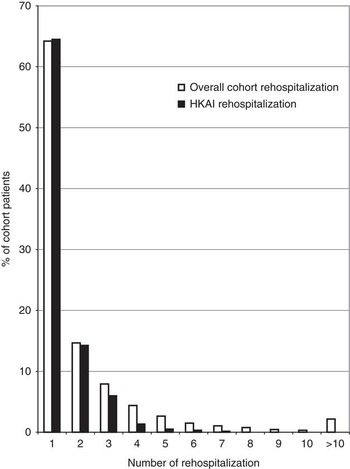
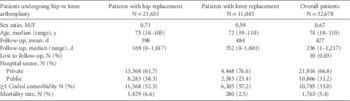
Overall, 32,678 patients underwent hip or knee arthroplasty during the study period (1.8% of the inpatient hospital stays/year). Table 1 presents the baseline characteristics of cohort patients. The sex ratio (male/female) for replacement was 0.67. Two-thirds of replacements were hip arthroplasty (66.2%). The median (range) age at replacement was 74 (18–110) years. Among men, mean age was significantly lower (69.9 y [95% CI, 69.7–70.1 y]) than among women (73.8 y [73.7–74.0 y]). The mean length of follow-up was 427 days (14.2 months); the median (range) was 236 (1–1,217) days. Ten patients were lost to follow-up. Independent of the reason of hospital admission, two-thirds of the cohort patients were readmitted once (64.2%) and 15% were readmitted 2 times, allowing reliable hospital database follow-up of patients (Figure 1). Arthroplasty surgery was mainly undergone in private hospitals (67%). In public settings, arthroplasty mainly took place in tertiary care university hospitals (53%). During follow-up, at least 1 comorbidity was coded in 33% of hospital stays. The most frequently coded comorbidities were diabetes mellitus and cardiologic diseases (Tables 2–4). Crude patient mortality was 5.4% in the whole cohort with cardiovascular diseases and cancer as the main cause of death (17% and 12%, respectively), as in the general population. At baseline, among hip replacements, significant differences existed depending on the indication of arthroplasty.
Frequency of rehospitalization after hip or knee arthroplasty (hip or knee arthroplasty infection [HKAI] hospitalization included), 2008–2012 cohort (N=32,678 patients).

Baseline Characteristics of the Cohort Patients, 2008–2011

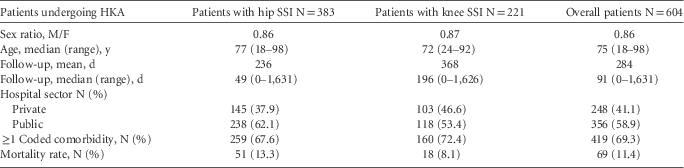
Characteristics of the Patients With Prosthetic Joint Infection, 2008–2012

NOTE. No patients were lost to follow-up. HKA, hip or knee arthroplasty; SSI, surgical site infection.
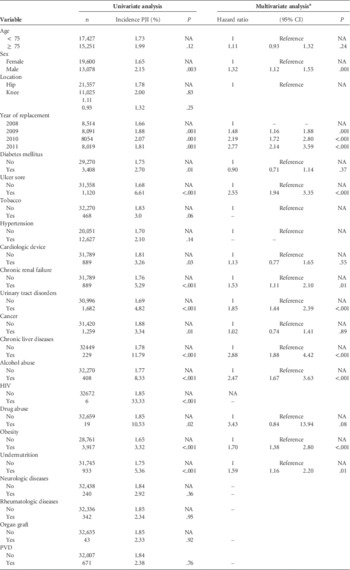
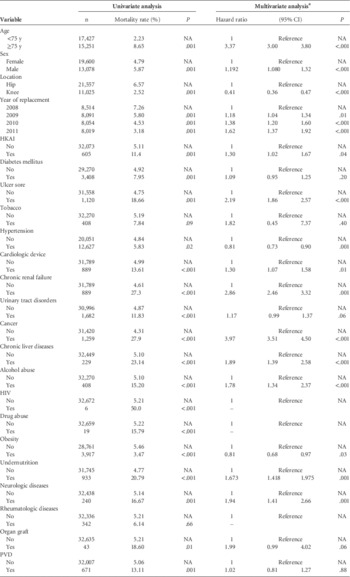
Univariate and Multivariate Cox Proportional Hazards Models of HKAI Occurrence After Hip or Knee Arthroplasty

NOTE. HIV, human immunodeficiency virus; PJI, prosthetic joint infection after hip or knee arthroplasty; PVD, peripheral vascular disorders.
a N=32,582.
Univariate and Multivariate Cox Proportional Hazards Models of Mortality After Hip or Knee Arthroplasty

NOTE. HIV, human immunodeficiency virus; HKAI, hip or knee arthroplasty infection; PVD, peripheral vascular disorders.
a N=32,582.
Among hip replacements, baseline characteristics were different according to the replacement undergone. Total hip arthroplasty was performed on coxarthrosis cases (89%), whereas partial arthroplasty surgery mostly occurred after hip fracture (80%). Coxarthrosis represented 74% of the hip replacement stays, with more male (HR=0.88 vs 0.32 in hip fracture cases), a lower mean age (70.1 y [95% CI, 69.9–70.3 y] vs 82.0 y [81.7–82.9 y] in hip fracture cases), and most surgical management in private sector (72% vs 32% for fracture management). Owing to the patient profile, among hip arthroplasty, mortality increased from 3% in coxarthrosis to 16% after hip fracture management.
Characteristics of Outcome Events
PJI was identified in 604 of the 32,678 patients over the whole study period (Table 2). The sex ratio (male/female) was 0.86. The median (range) age of PJI patients was 75 (18–98) years, significantly lower in men (72.5 [18–98] y) than women (77 [25–98] y).The 1–year incidence of PJI was 1.31% (N=418 patients infected during the year after replacement). Annual PJI incidence increased significantly during the 4-year period from 1.02% to 1.69% for hip-associated infections and from 0.84% to 1.33% for knee-associated infections, with a slightly lower increase for knee. Overall density incidence was 2.3 per 100 person-years (95% CI, 2.0–2.6): 2.2 per 100 person-years (2.0–2.6) in hip replacement and 2.5 per 100 person-years (2.1–2.69) in knee replacement, without significant difference.
Among hip replacements, again patient characteristics were different after fracture or coxarthrosis: 2-fold more PJI after hip fracture management (2.6%) than coxarthrosis (1.3%), and more female (69% vs 42%), higher mean age (80 y vs 69.8 y), and more management in public sector (74% vs 36%), respectively.
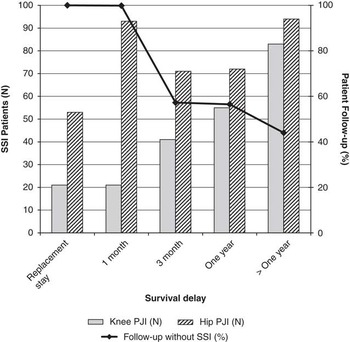
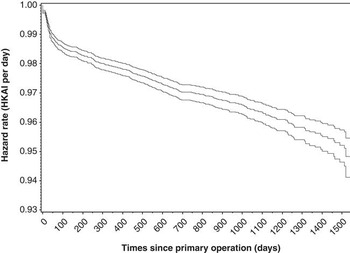
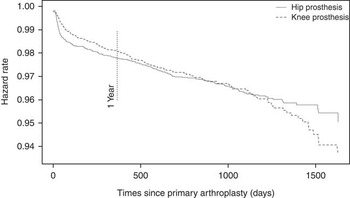
PJI occurred during the first 30 days after the replacement for 183 patients (30.3%), of which 78 (42.6%) were during the replacement hospital stay. A total of 243 patients (40.1%) were infected between 1 month and 1 year; 178 (29.5%) were infected more than 1 year after joint replacement (Figure 2). The mean time between joint replacement and PJI diagnosis was 284 days (95% CI, 281–286 days) and the median (range) time was 91 (0–1,631) days. If PJI occurred out of the arthroplasty stay (525 patients), the median (range) time was 119 (10–1,631) days, with a mean of 312 days (95% CI, 281–345 days) (Figures 3 and 4).
Distribution of surgical site infection (SSI), by location according to the survival delay, in parallel with the cohort follow-up (prosthetic joint infection [PJI] among the arthroplasties, by location). The black curve represents the proportion of patients remaining in the cohort over time.

Risk of hip or knee arthroplasty infection (HKAI) over the period 2008–2012.

Risk of hip or knee arthroplasty infection over the period 2008–2012, according to the prosthesis location.

The mean length of stay for PJI occurring during the replacement stay was 28.2 days (95% CI, 22.9–33.5 days), with a median (range) of 23 (1–149) days, significantly longer than arthroplasty hospital stay without complication (mean, 10.3 days [95% CI, 10.2–10.4 days], median [range], 9 [1–149] days).
The distribution of the hospitalization for PJI management was mostly in the public sector (60%) compared with the arthroplasty stay (67% in private hospitals). Among the public sector, 58% of PJI patients were treated in the regional university hospital. Most PJI were surgical stays (75%), including a surgical procedure during the hospitalization; 7.5% of the PJI hospital stays were classified as complicated. The surgical procedures mainly performed in PJI stays were aspiration or biopsies (20%), partial or complete removal of the artificial joint (24%), and surgical cleaning of the prosthetic joint (34%). The most frequent surgical procedure associations performed were, decreasingly and whatever the location, (1) evacuation of pus and cleaning up the prosthetic joint; (2) complete exchange of joint replacement performed as a single operation, during which the infected prosthesis is removed, the bone is cleaned, and a new prosthesis is implanted; and (3) complete removal of the joint replacement, cleaning of the bone, and sometimes implantation of a temporary cement spacer, before new replacement.
Microbiology
The infectious agent was coded for 502 (61%) of the 828 PJI stays: Staphylococcus sp. were found in 46%, in which a resistance was coded in 26%; there were 21 coded as methicillin-resistant S. aureus. One hundred and twenty patients among the 347 patients who had at least one coded microorganism had a coded resistance, leading to a global resistance at 14%; Candida was coded in 12 hospital discharges (6 patients).
Among the 604 PJI patients, 347 (57%) had at least 1 coded microorganism, with 24% of these coded as drug resistant agents (17 patients with methicillin-resistant S. aureus and 66 with a multiresistant bacteria coded).
PJI Occurrence and Comorbidities
Associations between risk factors and PJI are described in Table 3. In univariate analysis, factors associated with PJI were aged at least 75 years, male sex, having replacement after 2008, and comorbidities such as diabetes, ulcer sore, cardiac device, urologic inflammatory diseases, liver diseases and alcohol abuse, chronic renal failure, undernutrition, and obesity.
In multivariate analysis, factors associated with PJI remained age at least 75 years, male sex, having replacement after 2008, liver diseases and alcohol abuse, ulcer sore, urologic inflammatory diseases, chronic renal failure, undernutrition, and obesity. No significant association was found between PJI and diabetes, location of device, having hypertension or a cardiologic device, or cancer.
Long-Term Mortality
The overall inpatient mortality in arthroplasty patients was 5.4%; the part of inpatient mortality due to infection of the prosthesis was 1.9%. The inpatient case fatality in PJI patients was 11.4% in the overall period of surveillance. Mortality rate was higher in patients with hip replacement or hip surgical site infections. Again, this was mostly due to patients undergoing partial hip replacement after hip fracture.
PJI patients were more likely to die in hospital than those without such infection (HR, 1.30 [95% CI, 1.02–1.67]) (Table 4). Inpatient mortality was associated with older age and cancer, hip replacement, chronic renal failure or ulcer sores, liver diseases or alcohol, having a cardiologic device, undernutrition, a recent year of replacement, and neurologic diseases, whereas hypertension and obesity were protective (Table 4).
DISCUSSION
Principal Findings
For the first time, to our knowledge, incidence density of PJI after hip or knee arthroplasty (2.3% person-year) was estimated from a large and complete database, allowing public policy to consider a routine use for PJI detection and surveillance. This routine use of medico-administrative data has proved its efficacy and complementarity with the existing surveillance system, with fewer healthcare professionals involved and a lower cost than previous studies.
Incidence density estimation was higher than previous estimations (1% to 2% in published studies in France,Reference Astagneau, Rioux, Golliot and Brücker 1 , Reference Grammatico-Guillon, Baron and Gettner 5 , Reference Rioux, Grandbastien and Astagneau 12 the Netherlands, or the United StatesReference Zimmerli, Trampuz and Ochsner 13 , Reference Coello, Gastmeier and Boer 15 , Reference Malinzak, Ritter, Berend, Meding, Olberding and Davis 22 ). This difference could be due to the possible postdischarge surveillance and 1 year minimum follow-up (versus 1 month in the French surveillance network, Infection du site opératoire—Réseau Alerte Investigation Surveillance des Infections).The partition between total and partial prosthesis was not analyzed in this first evaluation of the routine use of this validated hospital discharge surveillance method.Reference Grammatico-Guillon, Baron, Gaborit, Rusch and Astagneau 20 This could explain the distribution of patient characteristics (replacement age, comorbid factors), major risk factors (cancers, chronic diseases), and mortality after hip or knee arthroplasty. Replacement of the joint after hip fracture corresponded to different patients compared with replacement for coxarthrosis purposes.Reference Zhao, Fu and Chen 23 , Reference Lindgren, Wretenberg, Kärrholm, Garellick and Rolfson 24 The incidence increased significantly between the 2008 and the 2011 years of arthroplasty, possibly linked to new hospital financial incentives that have been installed in France to report bone and joint infection coding since 2009 (date of establishment of the French reference centers for the treatment of complicated bone and joint infections).Reference Grammatico-Guillon, Baron and Gettner 5 In this exploratory study, major risk factors of PJI were liver diseases including alcohol abuse, obesity, undernutrition, and chronic renal failure, as already reported, especially after hip fracture replacement.Reference Grammatico-Guillon, Baron and Gettner 5 , Reference Lipsky, Weigelt, Gupta, Killian and Peng 19 , Reference Malinzak, Ritter, Berend, Meding, Olberding and Davis 22 , Reference Kurtz, Lau, Schmier, Ong, Zhao and Parvizi 25 The age at surgery was not associated with a higher risk. Several clinical factors were associated with increased mortality after hip or knee arthroplasty (ulcer sore, undernutrition, chronic renal failure). Being overweight was protective, as in a recent publication from the National Joint registry for England and Wales,Reference Hunt, Ben-Shlomo and Clark 14 whereas several previous articles focused on hip or knee location showed the opposite.Reference Bozic, Kurtz and Lau 8 , Reference Malinzak, Ritter, Berend, Meding, Olberding and Davis 22 , Reference Jämsen, Nevalainen, Eskelinen, Huotari, Kalliovalkama and Moilanen 26 , Reference Núñez, Lozano, Núñez, Sastre, Luis Del Val and Suso 27
The number of hip and knee replacements performed each year steadily rose in France as in other Northern European countries, according to data provided by National Joint Registries. Reference Grammatico-Guillon, Rusch and Astagneau 6 , Reference Hunt, Ben-Shlomo and Clark 14 , Reference Bhumbra 28 , Reference Robertsson, Knutson, Lewold and Lidgren 29 This increased number of primary hip or knee arthroplasties means more complications (infections, revisions),Reference Grammatico-Guillon, Baron and Gettner 5 , Reference Kurtz, Lau, Schmier, Ong, Zhao and Parvizi 25 , Reference Bhumbra 28 , Reference Grammatico-Guillon, Baron, Gaborit, Rosset, Rusch and Bernard 30 especially with the rising burden of an aging population, which is accompanied by increasing risk of developing osteoarthritis. The current question is how to improve the quality of orthopedic care in our aging countries. As argued in a report from the British Orthopaedic AssociationReference Bhumbra 28 and in a recent study led by Ravi et al,Reference Ravi, Jenkinson and Austin 31 clinical workers are best placed to drive the development of best pathways of orthopedic care. An English study recently published that a secular decrease in death caused by hip replacement has occurred owing to specific management acting on comorbitidies.Reference Hunt, Ben-Shlomo and Clark 14 A comorbidity score predicting infection after arthroplasty could be imagined based on hospital discharge cohort studies. By developing a method for classifying comorbid conditions that might alter the risk of infection, a weighted index taking into account the number of comorbidities could be built.Reference Charlson, Pompei, Ales and MacKenzie 32 This composite criterion could be proposed to assess the risk of PJI at replacement, compared with the index of Charlson, predicting patient mortality according to a range of comorbidities. The Charlson score has already been assessed using International Statistical Classification of Disease, Tenth Revision, diagnosis codes in patients undergoing urological surgery in cancer.Reference Charlson, Pompei, Ales and MacKenzie 32 , Reference Nuttall, van der Meulen and Emberton 33 The PJI score could be calculated by the surgeon and/or the anesthetist before planning joint replacement (eg, an increasing score would be linked to the presence of components of interest—ulcer sore, undernutrition, liver diseases). This score could represent an indirect way to estimate the risk of PJI and it could be shared with patients.Reference Conner-Spady, Marshall and Bohm 34 Like the Charlson score, this method of classifying comorbidity could provide a simple, readily applicable, and valid method of estimating PJI risk from chronic diseases found in hospital discharge database studies. Moreover, detection of PJI and highlighting risk factors could allow care adjustment, proposing new strategies for hip or knee replacement in France; this could represent a monitoring model, such as the cumulative monitoring methods that have shown promises in United Kingdom. However, the major question will remain: who determines the threshold of the score beyond which the surgery must not be performed?
This kind of score would help streamline the decision to undergo replacement.Reference Grammatico-Guillon, Baron and Gettner 5 , Reference Wilson, Gibbons and Reeves 7 , Reference Grammatico, Baron and Rusch 17 , Reference Kurtz, Lau, Schmier, Ong, Zhao and Parvizi 25 , Reference Andersen, Madsen, Jørgensen, Mellemkjoer and Olsen 35 – Reference Ruwald, Hansen and Lamberts 37 Moreover, it could help determine new indicators for the management of joint replacement in aging patients with more comorbidities. The same investigation can be performed on other surgeries currently monitored in surveillance systems, such as colorectal or gynecological surgery (eg, building and validating an algorithm with professionals, and applying the case definition in a cohort to estimate the risk linked to predictors in different types of surgery).
Study Limitations
There were some limitations, particularly as concerns the quality of the hospital discharge data coded and thus the reporting of PJI.Reference Tanner, Padley, Kiernan, Leaper, Norrie and Baggott 38 , Reference Mayor 39 The reliability of the coding system used in the hospital discharges remains debatable because data are coded by different healthcare professionals.Reference Grammatico-Guillon, Baron and Gettner 5 , Reference Grammatico, Baron and Rusch 17 , Reference Lipsky, Weigelt, Gupta, Killian and Peng 19 , Reference Cuggia, Bayat and Garcelon 40 But the robustness of the method was previously demonstrated and published. Reference Grammatico-Guillon, Baron, Gaborit, Rusch and Astagneau 20 Also, survival analyses are based on a hospital discharge cohort. A hypothesis had to be made to control this bias owing to the retrospective hospital cohort where patients without hospitalization during the observation period are considered as lost to follow-up or informative censoring; the time-to-event and lost to follow-up definition are based on hospital discharge databases. However, only 10 patients were lost to follow-up directly after the arthroplasty hospital stay. This bias of “lost to follow-up” was then minimized. Concurrent events needing outpatient medical care were not checked, but PJI are usually known as requiring hospital management. Moreover, the absence of systematic coding for several interesting comorbidities (such as tobacco or drug abuse), surgical sequences (prophylaxis type, length of intervention), or ASA score could represent a misinterpretation of the cofactors studied. Diabetes or cancers are exhaustively reported instead, owing to financial valuation. However, the results of this cohort study, compared with the English analysis from their National Joint Registry, are superposable, similar for the confounding factors (liver diseases, cancer, chronic renal failure)Reference Hunt, Ben-Shlomo and Clark 14 and could provide an easy and inexpensive way to survey arthroplasty. Another bias of the study could be represented by the choice to study both hip and knee arthroplasties and not to separate the different types of hip replacement. One next step will be to study singly national total knee and total hip arthroplasty. Differences in morbidity and mortality are significantly associated with comorbidities and they would be emphasized by separating the different profiles of patients according to the indication of joint replacement and its location.
Conclusion
The evolving demographic and environmental contexts, as well as the progression of the medical practice and findings, influence the development and outcome of diseases and consequently their epidemiologic surveillance. Using the medical information systems that cover the entire population health services allows data analysis and production of indicators, then benchmarking.Reference Saint-Laurent, Blais, Jean, Sirois, Rochette and Émond 41 This approach allows the opportunity to understand the burden of comorbidities and other impact factors in the occurrence of diseases.
ACKNOWLEDGMENTS
We thank all the medical doctors and infection control teams around the world that allow surveillance networks to exist. We thank the CRIM (collège régional de l’information médicale), study group of medical doctors specialized in medical information systems in the region Centre, for help and comment on the building of algorithms and for coordinating the relations with the authors. We thank J. Druon, MD, in orthopedics, and G. Gras, MD, in infectious disease, for constructive comments and availability.
Financial support. None reported.
Potential conflicts of interest. All authors report no conflicts of interest relevant to this article.
Disclaimer: This study was approved by the Commission nationale de l'informatique et des libertés, Paris, France, on March 15, 2013 (n° 131024).
SUPPLEMENTARY MATERIAL
To view supplementary material for this article, please visit http://dx.doi.org/10.1017/ice.2015.148