I. INTRODUCTION
Plastics are one of the most commonly used materials and provide great convenience for us in our daily lives. Poly (lactic acid) and poly (lactic-co-glycolic acid) are two common biopolymers and have been widely used as biomaterials in clinical rehabilitative medicine. Since they are expensive, it is desirable to find renewable cheap and environmentally benign materials to use as common plastics.Reference Das, Ray, Bandyopadhyay, Gupta, Sengupta, Sahoo, Mohanty and Misra1
Starch is one of the most promising biopolymers and has attracted worldwide attention because of its abundance, nontoxicity, biodegradability, and low cost.Reference Belhassen, Boufi, Vilaseca, Lo′ pez, Me’ndez, Franco, Pe′ lach and Mutje′2 Starch films, as packing materials, have been prepared from many different starch sources.Reference Sreedhar, Chattopadhyay, Karunakar and Sastry3, Reference Zou, Qu and Zou4 Oxidized starch (OSt) is widely used in industries such as paper, textile, and laundry finishing. It also shows great potential in making films because of its low viscosity, excellent film forming ability, and transparency. But because of its poor mechanical properties and high moisture sensitivity, starch films often fail to meet the demands of many applications. Several methods have been used to overcome these drawbacks, including modification of the starch or blending it with other materials.Reference Avella, Errico, Rimedio and Sadocco5–Reference Follain, Joly and Dole7 Biocompatible synthetic polymers such as poly(vinyl alcohol) (PVA), ethylene vinyl acetate copolymer, poly(e-caprolactone), and Bionolle have been incorporated into starch to improve its properties.Reference Park, Chough, Yun and Yoon8 But to maintain its biodegradability, natural polymers such as chitosan,Reference Wu, Liu, Chen, Chen, Anderson and Chang9 cellulose nanofibers,Reference Wan, Luo, He, Liang, Huang and Li10 alginate,Reference Wang, Hu, Du and Kennedy11 pullulan,Reference Kristo and Biliaderis12 gelatin,Reference Mu, Liu, Cheng, Li, Wu, Zhang and Lin13 or other proteinsReference Gomes, Ribeiro, Malafaya, Reis and Cunha14, Reference Blazek and Copeland15 are more suitable. These can be selected to improve the mechanical and other properties of the starch films. In addition to organic materials, inorganic materials have also been incorporated into starch films. Reis and coworkersReference Leonor, Ito, Onuma, Kanzaki and Reis16 prepared starch thermoplastic/hydroxyapatite composites and studied the possibility of using them as a bone material. Clay is another important inorganic filler, and it is often used to make clay-reinforced synthetic polymers. Starch films with montmorillonite nanoparticles display an improvement in tensile properties as a result of a reinforcement effect.Reference Kampeerapappun, Aht-Ong, Pentrakoon and Srikulkit17–Reference Vertuccio, Gorrasi, Sorrentino and Vittoria19
Halloysite, a type of nanoclay, is a kind of naturally occurring aluminum silicate hollow cylinder with a length of 0.5–1 μm, an outer diameter of about 50 nm, and a lumen of 15 nm.Reference Ismail, Pasbakhsh, Ahmad Fauzi and Abu Bakar20 In the empty space inside the nanotubes, halloysite is able to entrap a range of molecules with specific sizes, and it has been used as a viable nanocage for active molecules. For example, halloysite has been reported as a carrier for the controlled release of anticorrosion coating agents, herbicides, and fungicides.Reference Shchukin, Zheludkevich, Yasakau, Lamaka, Ferreira and Mohwald21–Reference Price, Gaber and Lvov23 Halloysite has also been used as a support to immobilize catalyst molecules such as metallocomplexes.Reference Machado, Castro, Wypych and Nakagaki24 Like montmorillonite nanoparticles, halloysite nanotubes can be incorporated into polymers to modify their properties.Reference Ismail, Pasbakhsh, Ahmad Fauzi and Abu Bakar20 Composites of halloysite/plastic,Reference Marney, Russell, Wu, Nguyen, Cramm, Rigopoulos, Wright and Greaves25 halloysite/rubber,Reference Pasbakhsh, Ismail, Ahmad Fauzi and Abu Baka26 and halloysite/hydrogelReference Zheng and Wang27 have been studied. These composites have the potential to be widely used for drug delivery,Reference Hughes and King28, Reference Vergaro, Abdullayev, Lvov, Zeitoun, Cingolani, Rinaldi and Leporatti29 nanotemplates,Reference Ismail, Pasbakhsh, Ahmad Fauzi and Abu Bakar20 and reinforcing materials.Reference Ning, Yin, Luo, Zhang, Du and Fu30 But the application of halloysite nanotubes to natural polymers has rarely been reported because halloysite nanotubes aggregate easily, which causes poor dispersion of the halloysite nanotubes in hydrophilic polymer matrixes. To solve this problem, in this work different solvent media were used to mill, modify, and disperse the halloysite nanotubes. The modified natural halloysite nanotubes were used as fillers to prepare halloysite/OSt films, and their properties were studied.
II. MATERIALS AND METHODS
A. Materials
The OSt and potato starch (PSt) were from Tianjin TingFung Starch Development Co., Ltd., Tianjin, China; halloysite was supplied by Hunan Xiangtan Kaolin Industry Co. Ltd., Xiangtan, China; and glycerol, sodium bromide, potassium bromide, magnesium chloride, PVA, and polyethylene glycol (PEG 4000) were from Tianjin Chemical Reagent Co., Tianjin, China. With the exception of halloysite, all chemicals were used as received.
B. Treatment of halloysite
Halloysite (15.0 g) and PEG (0.30 g) were added to 150 mL of distilled water or to a distilled water/ethanol mixture with different ratios for ball milling. The halloysite suspension was made by ball milling for 4 h at a speed of 800 rpm, followed by centrifugation to obtain the precipitate. The precipitate was rinsed several times with a water/ethanol mixture (50/50, v/v) to remove the free PEG macromolecules and then dried in a freeze dryer to obtain the modified halloysite powder. The halloysite powder was redispersed in distilled water using ultrasonic treatment for 15 min using a cell grinding apparatus to give an aqueous suspension of halloysite nanotubes.
C. Preparation of halloysite/OSt films
Halloysite/OSt composite films were prepared by a casting method. Starch slurry was first prepared by dispersing 10 g OSt in 100 mL distilled water, using ultrasonic treatment for 15 min using a cell grinding apparatus. The slurry was then gelatinized at 85 °C for about 1 h, and then the desired amounts of glycerol, halloysite suspension, and aqueous PVA solution (if needed) were added. The mixture was stirred to obtain a homogenous paste that was then cast on a stainless steel plate and dried at 30 °C for about 48 h to give halloysite/OSt composite films. Three types of halloysite/OSt films were prepared. The samples loaded with different amounts of halloysite and 20%w glycerol are denoted by OStH; the samples containing different amounts of glycerol with 5%w halloysite are denoted by OStH-G; and the samples with a fixed amount of halloysite (5%w) and glycerol (20%w) and different amounts of PVA are labeled OStH-P.
D. Characterization of the halloysite/OSt films
1. Scanning electron microscopy
The morphology of the natural halloysite nanotubes and their distribution in the halloysite/OSt films were determined by scanning electron microscopy (SEM). The samples were gold coated using a sputter coater (Desk–II; Denton Vacuum, Moorestown, NJ), placed onto the stage in the chamber and observed with a SEM (JEOL-6700F ESEM; JEOL, Tokyo, Japan).
2. X-ray diffraction analysis
The x-ray powder diffraction (XRD) spectra of the halloysite/OSt films were measured using an x-ray diffractometer (X’pert; PANAlytical, Almelo, Netherlands) with a reference of target: Cu-Kα radiation (λ = 1.73Å); voltage, 45 kV; and current, 30 mA. They were measured from 5° to 80° (2θ) with steps of 0.007° and a measuring time of 5 s/step.
3. Transparency of the halloysite/OSt films
After their thicknesses were measured, the halloysite/OSt films were cut into samples (8 × 30 mm2) and placed on one side of a cuvette. Their spectra were measured with a double-beam ultraviolet–visible spectrophotometer. The transmittance was determined from 200 to 800 nm, using the bare cuvette as the reference. The relative transmittance (RT) was calculated according to the following equations. All the data are the mean values of three independent measurements.


where T m is the measured transmittance of the halloysite/OSt films; d r and d m are the relative and actual thicknesses of the films, respectively; and d o is the thickness of one film in a set of films and was used as the control.
4. Mechanical properties of the halloysite/OSt films
For each of the halloysite/OSt films, at least six sample strips with a size of 80 × 12 mm2 were cut from the films. The samples were conditioned at 58% Relative Humidity (RH) (saturated NaBr solution) and 25 °C for 24 h in an incubator, and their thicknesses were measured with a micrometer before the test. The thicknesses were measured at five different positions for each sample, and the average value was used. The tensile strength (TS) and percent elongation at break (E) were measured using a material testing machine (The Testometric Company Ltd., Rochdale Lancashire, United Kingdom) with a 10-kg load cell, using ASTM Standard Method D882–88 (ASTM, 1989a). The initial grip separation was 40 mm, and the cross-head speed was 5 mm/min. The TS was calculated by dividing the maximum force exerted on the film during fracture by the cross-sectional area, and the percent elongation at break is expressed as the percent change of the original length of a specimen between the grips at break.
5. Moisture absorbability of the halloysite/OSt films
Moisture absorbability (M) of the halloysite/OSt films was measured in an environment that contained a saturated salt solution giving a defined relative saturation humidity (MgCl2: RH = 33%; NaBr: RH = 58%; KBr: RH = 81%). The initial weight of the samples with a size of 20 × 20 mm2 was determined after they were dried to a constant weight at 50 °C in a vacuum oven. The weighed samples were placed in incubators with different relative saturation humidities until their weights became constant. Then the samples were removed and weighed. Tests were performed in triplicate, and the average moisture absorbability (M) was calculated as follows:

where M 0 is the initial average weight (g) of the dry sample, and M is the weight of the sample in a certain RH environment.
III. RESULTS AND DISCUSSION
A. SEM and XRD analysis of the halloysite/OSt films
As a kind of clay, halloysite easily aggregates owing to its large specific surface area and the polar functional groups on its surface. This causes halloysite nanotubes to disperse poorly hydrophilic polymer matrixes. In an attempt to solve this problem, water was used as a medium to mill the halloysite powder, but this failed to produce well-dispersed halloysite nanotubes. So water/ethanol mixtures with different ratios were tried as the media and PEG was used as a dispersing agent to treat the halloysite. A water/ethanol ratio of 50/50 was found to be suitable, and the aggregated halloysite powder was separated. Hallyosite treated in this manner could then be easily dispersed in water/ethanol or water.
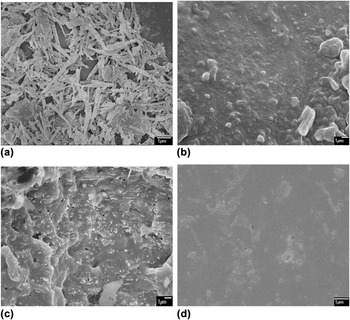
Figure 1(a) shows the SEM photographs of the treated halloysite. It has a tubular structure with lengths of about 1.5 μm and diameters of about 100 nm. The halloysite nanotubes exist as separated monotubes rather than in the aggregated structure of the natural halloysite nanotubes. This indicates that ball milling can separate the aggregated halloysite nanotubes and that PEG helps the separated monotubes to stably disperse in the solvent. The ball-milling treatment smashes some of the halloysite nanotubes, so some short halloysite nanotubes are also observed in the SEM image (about 100 nm in length).
Scanning electron micrograph images of (a) treated halloysite, (b) cross section of oxidized starch/halloysite (OStH) films with polyethylene glycol (PEG) and 3% halloysite, (c) cross section of OStH films with PEG and 7% halloysite, and (d) surface with 7% halloysite.

Figures 1(b)–1(d) show the SEM photographs of the cross section (b, c) and surface (d) of the OStH films with 3%w (b) and 7%w (c, d) halloysite. The halloysite monotubes are evenly distributed in the OSt matrix and are well mixed with the starch in these films, indicating that the modified halloysite monotubes and the starch are compatible. PEG macromolecules contain –OH groups at both ends of the macromolecule, and they can be adsorbed onto the halloysite nanotubes through hydrogen bonds with the –OH groups on the surface of the nanotubes. This makes it easy for the nanotubes to disperse in water. When modified halloysite nanotubes are added into starch paste, the PEG macromolecules can also form hydrogen bonds with the –OH groups on the starch macromolecules. So PEG acts as a bridge to connect the halloysite nanotubes and the starch macromolecules, and this improves the compatibility of the halloysite and the OSt.
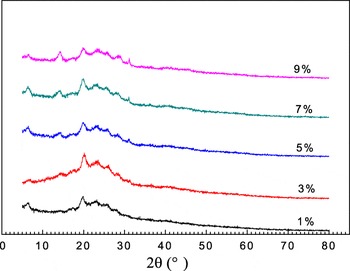
Native starch exists in granules that are composed of crystalline and amorphous phases. However in the OStH films, the x-ray peaks from the OSt should be weaker than in the native starch since the crystalline structure is damaged during oxidization. Furthermore, since the OSt aqueous suspension was gelatinized at high temperatures, the crystalline structure would be further damaged and the x-ray spectra should show decreased crystallinity in the region from 18° to 30°. Halloysite is a crystalline material and has a peak at 14° in its x-ray spectrum. When a small amount of halloysite nanotubes were added into the starch, only the crystalline peaks belonging to starch were found. But as the amount of halloysite nanotubes increased, the halloysite crystalline peak appeared and became more apparent (Fig. 2). Figure 2 also shows that the addition of halloysite nanotubes has no obvious effect on the x-ray spectra of the starch, indicating that the existence of halloysite nanotubes does not influence the crystallization of the starch during the film preparation.
X-ray diffraction of OStH films with different amounts of halloysite (glycerol content: 20%w).

B. Mechanical properties of the halloysite/OSt films
Mechanical properties are one of the most important parameters used to evaluate materials. Natural polymers usually possess rigid or semirigid chains and often show undesired flexibility. So it is hard for starch, including OSt, to form successive soft films if no plasticizer is added. Here, glycerol was chosen as a plasticizer, and its effect on the mechanical properties of halloysite/OSt films was studied.
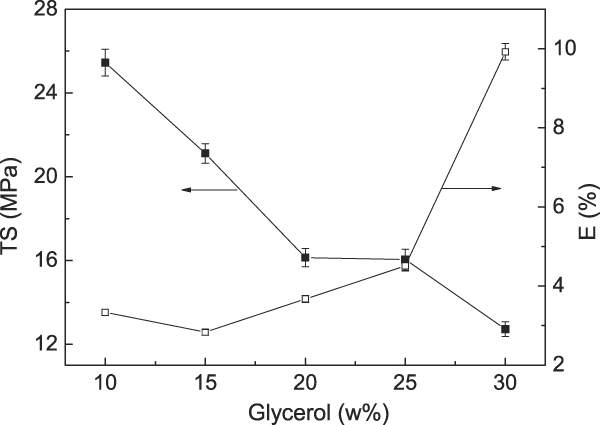
Figure 3 shows the changes in TS and E for OStH-G films with different amounts of glycerol (the amount of halloysite was fixed at 5%). As the glycerol increased from 10 to 30%, the TS of the OStH-G films decreased, while the E increased. During the preparation of the OStH-G films, the granular and crystal structures of the starch were partially destroyed by the high temperature and shear force. This transformed the starch into a mainly amorphous structure, which is favorable for the permeation of the plasticizer, which causes a decrease in the interactions (intra and intermolecular) among the starch macromolecules and in the strong hydrogen bonding between the starch hydroxyl groups and the small glycerol molecules. This promotes the movement and rearrangement of the starch macromolecules under an external force and causes an increase in the flexibility of the OStH-G films. Therefore, the E of the OStH-G films increased, whereas the TS decreased. For application purposes, if the strength of the OStH-G films is more important than the flexibility, then 10% glycerol is sufficient; whereas if both are important, 20–25%w glycerol is better.
Tensile strength (TS) and percent elongation at break (E) of OStH-G films with different amounts of glycerol content (halloysite amount: 5%w).

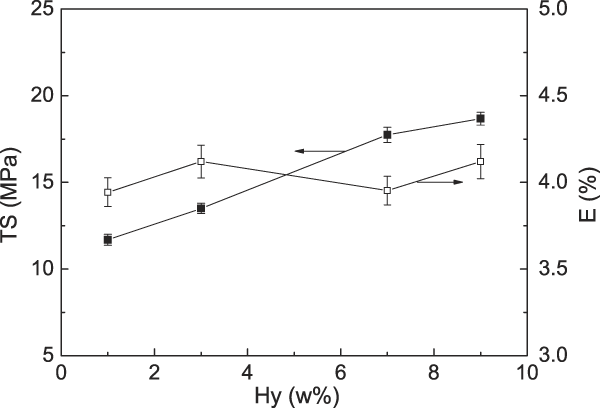
Halloysite nanotubes have a diameter of about 100 nm and look like other synthesized or natural inorganic nanowires or nanotubes. So they can be used as fillers to reinforce composite materials. Figure 4 shows the TS and E of the OStH films with different amounts of halloysite. The TS of the OStH films increased about 50%, whereas the E changed little, which is not commonly observed in polymeric composites reinforced by inorganic fillers. Usually, when the amount of inorganic fillers is increased, the E value decreases and the TS value increases.Reference Chang, Yu and Ma31 In the OStH films, the PEG macromolecules on the halloysite nanotubes can act as bridges to connect the fillers in the matrix. The two phases showed good compatibility. Therefore, halloysite had almost no effect on E when TS increased (with up to 9%w halloysite). In view of the mechanical properties of the OStH film, the optimum amount of halloysite is 5–9%w.
TS and E of OStH films with different amounts of halloysite (glycerol content: 20%w).

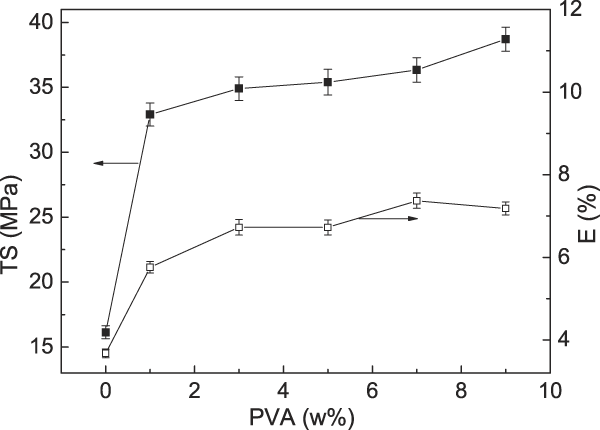
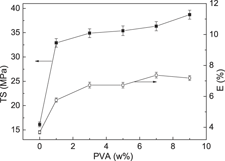
To further increase the mechanical strength of the halloysite/OSt films, PVA was incorporated into the films, and its effect is shown in Fig. 5. PVA is a hydrophilic polymer and contains numerous –OH groups on the macromolecular chains. It possesses high mechanical strength because of the strong interactions among PVA macromolecules through hydrogen bonding. When PVA was added to starch, the –OH groups on the PVA macromolecules formed hydrogen bonds with those on the OSt macromolecules and thus formed a compatible matrix. Since PVA has good mechanical properties, the OStH-P films have a higher TS and E than those of OStH as shown in Fig. 5. The TS increased from 16 to 33 MPa when 1%w PVA was added, an increase of more than 100%. With a further increase in PVA, the TS increased slowly and the E grew gradually. In view of the degradability of the OStH-P films, the amount of PVA should be as small as possible. So 1–3% PVA is recommended for preparation and applications of the OStH-P films.
TS and E of OStH-P films with different amounts of poly(vinyl alcohol) (PVA) (glycerol content: 20%w, halloysite amount: 5%w).

C. Transparency of the starch-based films
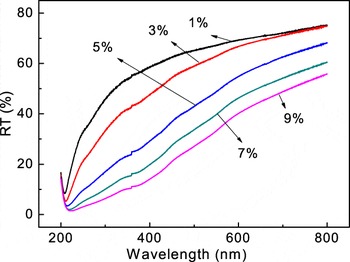
Figure 6 shows the RTs of the OStH films with different amounts of halloysite. The OSt film possesses an excellent RT, and the addition of halloysite obviously decreases the RT of the films. This decrease is more obvious for films with a higher amount of halloysite. In addition, the RTs of OStH-G films with different amounts of glycerol were also measured (not shown). The glycerol caused a slight decrease in the transparency of the OStH-G films.
Relative transmittances (RTs) of OStH composite films with different amounts of halloysite (glycerol content: 20%w).

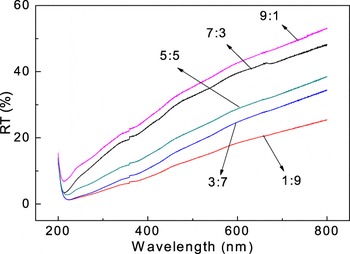
OSt films have super transparency compared with other native starch films, such as potato starch (PSt), banana starch, etc. According to the above discussion, the addition of halloysite decreases the transparency of the OStH films, and the RT decreased to 50% at 600 nm when 5% halloysite was added (Fig. 6). But this value is still higher than that of other starch films. For comparison, Fig. 7 shows the RT of dual starch films made by blending OSt and PSt with different OSt/PSt ratios. The addition of PSt decreased the transparency of the OSt film, and this decrease is much more obvious than that from halloysite. So OStH films are relatively transparent when 1–3%w halloysite is incorporated, and these films can be used when low to medium light transmittance is required in a plastic, such as for shopping bags.
RT of dual starch films with different OSt/potato starch ratios.

D. Moisture absorbability of the halloysite/OSt films
Figure 8 shows the moisture absorption of the OStH composite films with different amounts of halloysite at different RH. Initially, M increased very quickly and was about 20% at 14 h. It then increased gradually and reached an absorption balance at 50 h. A longer time was needed to reach an absorption balance at a lower RH, so 70 h was chosen as the time required to reach the maximum moisture absorption (M max). Since halloysite does not retain moisture well, the addition of it did not help the moisture absorbability of the OStH composite films. The M max decreased slightly as the amount of halloysite increased in the OStH films. All the OStH composite films showed a high M max under high RH.
Moisture absorption ability of the OStH films with different amount of halloysite under different RH (glycerol content: 20%w).

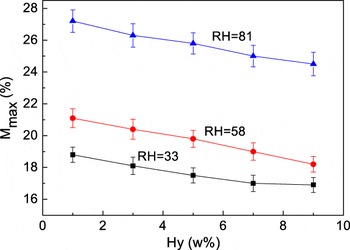
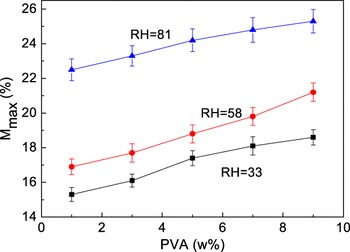
Figure 9 shows the maximum moisture absorption of OStH-P composite films in different RH with different amounts of PVA. At a given RH, PVA did not have an obvious effect on the M max of the OStH-P composite. Like OStH films, the M max of the OStH-P composite films also increased with increasing RH. Thus, the OSt films should be stored in dry and ventilative conditions.
M max of OStH-P composite films with different amounts of PVA (glycerol content: 20%w, halloysite amount: 5%w).

IV. CONCLUSIONS
Halloysite/OSt films were fabricated from OSt using modified natural halloysite nanotubes as fillers. The aggregated halloysite powder was separated into halloysite nanotubes, and the nanotubes were easily dispersed in water/ethanol or water after a ball-milling treatment using a 50/50 water/ethanol mixture as the medium and PEG as the dispersing agent. The treated halloysite nanotubes were well dispersed in the OSt matrix, and the two phases showed good compatibility owing to the action of PEG. The halloysite improved the TS of the OStH films. When a small amount of PVA was incorporated into the film, both the elongation at break and TS of the composite film were improved. The highest TS was almost 2.5 times higher than that of halloysite/OSt films without PVA. Although the transparency of the halloysite/OSt films was not as good as that of OSt films, it was still comparable with other native starches, and even better than some of them, such as PSt. Furthermore, the addition of halloysite slightly improved the stability of the film in a moist atmosphere. Since halloysite/OSt films are low-cost and have high strength, these reinforced OSt films show great potential as green packaging materials.
ACKNOWLEDGMENTS
We thank Dr. Jeanne Wynn for helping to revise the English language. This work was supported by the National Science Foundation of China (21074089, 50873075).