Trochetia (Malvaceae s.l., Dombeyoideae), a genus endemic to the Mascarenes (Indian Ocean), is an emblematic taxon of the flora of this oceanic archipelago. The genus contains six species of shrubs and treelets (Friedmann Reference FRIEDMANN, Bosser, Cadet, Guého and Marais1987), five of which are endemic to Mauritius and one to Réunion (Trochetia granulata Cordem.). All these taxa are under threat of extinction (Le Péchon et al. Reference LE PÉCHON, HUMEAU, GIGORD, PAUSÉ, CARON, BAIDER, GIGORD, GROSSER, HANSEN and SEVATHIAN2011a). Recent phylogenetic investigations placed Trochetia in a clade endemic to Mauritius and Réunion (Le Péchon et al. Reference LE PÉCHON, DUBUISSON, HAEVERMANS, CRUAUD, COULOUX and GIGORD2010, Reference LE PÉCHON, BAIDER, GIGORD, HAEVERMANS and DUBUISSON2011b; Skema Reference SKEMA2012). Inflorescences of Trochetia are composed of either one or three large, bell-shaped flowers, with white or red corolla without perceptible fragrance. The flowers of five species produce a coloured (orange to yellow) and hexose-rich nectar (Hansen et al. Reference HANSEN, OLESEN, MIONE, JOHNSON and MÜLLER2007a). Such uncommon floral features among angiosperms in combination with the flower shape might facilitate vertebrate pollination (Hansen et al. Reference HANSEN, BEER and MÜLLER2006, Reference HANSEN, OLESEN, MIONE, JOHNSON and MÜLLER2007a). Previous investigations suggested that two species of white-eye (Zosterops borbonicus mauritianus (Gmelin 1789) and Z. chloronothos (Viellot 1817)) may be the pollinators of the Mauritian species Trochetia blackburniana Bojer ex Baker (Cheke Reference CHEKE and Diamond1987, Hansen et al. Reference HANSEN, OLESEN and JONES2002). However, Hansen et al. (Reference HANSEN, KIESBÜY, JONES and MÜLLER2007b) recently showed that this Trochetia species appears to be mainly pollinated by the Mauritian endemic day gecko, Phelsuma cepediana (Milbert 1812). While these interactions between vertebrates and T. blackburniana have been investigated, little is known about the pollination ecology of the sister species T. granulata (Boura et al. Reference BOURA, LE PÉCHON and THOMAS2011, Le Péchon et al. Reference LE PÉCHON, DUBUISSON, HAEVERMANS, CRUAUD, COULOUX and GIGORD2010). Trochetia granulata exhibits similar pattern of floral traits: coloured nectar, inflorescence of solitary bell-shaped flower and specific protandrous flowers in which the staminal tube falls off when the flower enters in female phase. However, the Réunion species differs from other Trochetia taxa (except Trochetia triflora DC.) in the colour of the corolla (white for T. granulata vs. red or pinkish for the other Mauritian species). Réunion and Mauritius show similar closely related nectarivorous species of white-eye birds (Warren et al. Reference WARREN, BERMINGHAM, BOWIE, PRYS-JONES and THÉBAUD2006) and day geckos (Rocha et al. Reference ROCHA, RÖSLER, GEHRING, GLAW, POSADA, HARRIS and VENCES2010). In this study, we focused on the pollination ecology of T. granulata and our main objectives were (1) to describe its breeding system, (2) to identify its visitors and (3) to compare the findings with those of other studies of Mauritian species of Trochetia.
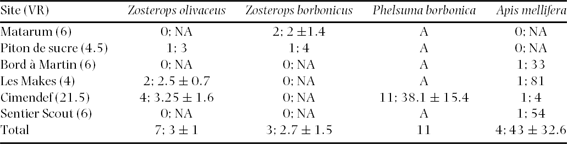
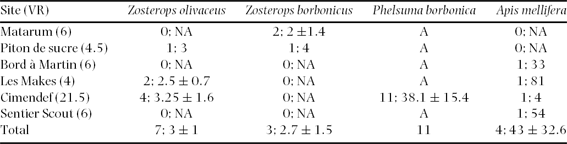
Trochetia granulata grows on open slopes from 1100 up to 1800 m asl and its flowering period stretches from March to August with a peak in May. During this period, we conducted our study on six natural sites (Table 1). In 2010 and 2011, we investigated the breeding system of T. granulata by bagging buds and applying one of three different treatments (1) autofertility (no pollination; N = 55 flowers of 33 individuals), (2) self-pollination (self-compatibility; N = 51 flowers of 28 individuals), (3) cross-pollination (outcrossing; N = 48 flowers of 26 individuals). Fruit sets from different treatments were recorded several weeks later. Comparisons between the three treatments were performed using Fisher test. During the period, we also studied the pollination ecology of T. granulata. We focused on one fully opened flower per day by recording visits using a digital video camera (SONY Handycam HDR-XR200). We also performed opportunistic observations of other flowers on the same tree. These observations were conducted from 9h00 to 16h00 for a total of 12 d across 2010 and 2011: a total of 48 h of videotape recording. We (1) identified each visitor, (2) made a description of its behaviour (i.e. proportion of flowers visited on the same tree and the behavioural strategy for reaching the nectar), (3) noted the duration of the visit within the flower, and (4) tried to determine whether pollen was removed from the anthers.
Details of visitors recorded during the observations of Trochetia granulata at each studied site on Réunion. Sites: coordinates; Matarum: 21°07′11.21″S 55°29′5″E; Piton de sucre: 21°07′52.19″S, 55°26′48.9″E; Bord à Martin: 21°02′46.5″S 55°27′18.31″E; Les Makes: 21°11′09.7″S 55°26′03.26″E; Cimendef: 21°01′34.01″S 55°27′42.36″E; Sentier Scout: 21°02′57.78″S 55°26′41.84″E. VR: Videotape Record duration (h). Data: number of visits; mean ± SD duration of visits (s); NA: not applicable; A: absent from the studied site.
Only 5.4% of the flowers produced a fruit by autofertility but seeds were infertile (T. Le Péchon, unpubl. data), suggesting T. granulata requires a pollen vector to set fruit. Levels of self-compatibility and outcrossing were not significantly different (i.e. fruit set = 60.8% and 64.5% respectively; P = 0.73) and T. granulata is therefore self-compatible.
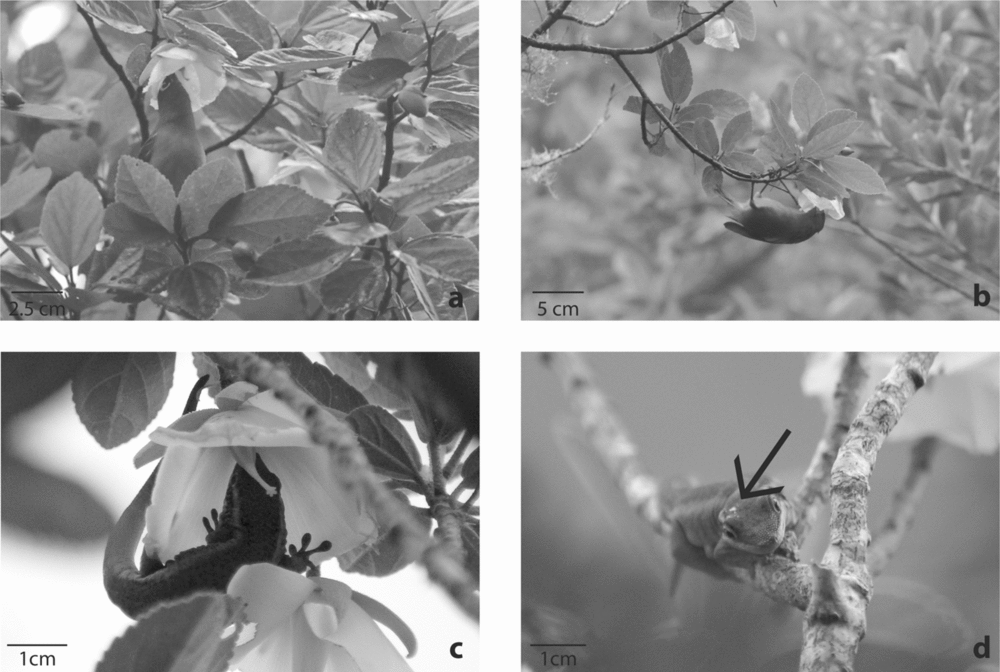
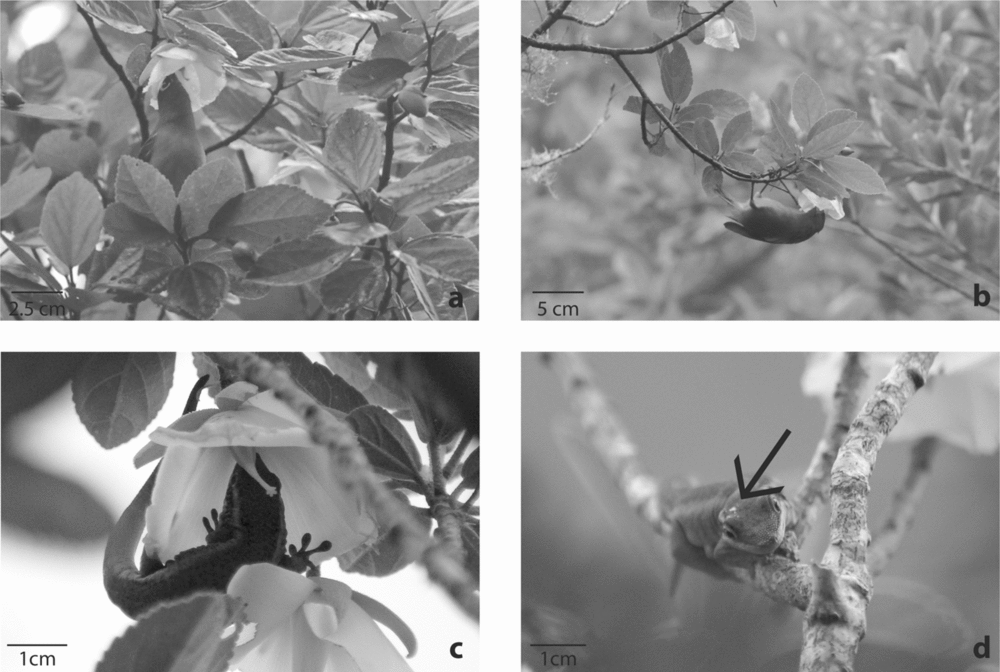
We observed four different visitors: the honeybee Apis mellifera (Linnaeus 1758), two endemic species of white-eye (Zosterops borbonicus borbonicus (Boddaert 1783) and Zosterops olivaceus (Linnaeus 1766)), and the endemic Réunion day gecko, Phelsuma borbonica Mertens 1966 (Figure 1).
Visitors recorded in the flowers of Trochetia granulata. Visitors observed in flowers of Trochetia granulata (a–c). Zosterops olivaceus (a), Z. borbonicus (b), Phelsuma borbonica (c). Presence of pollen deposit (arrow) on the head of the Réunion day gecko (d). Photographs taken by D. Caron (BACOMAR project, UR).
The status of A. mellifera is still controversial but it is considered by many biologists as introduced in the Mascarenes (Hansen et al. Reference HANSEN, OLESEN and JONES2002). Distributed all over Réunion, honeybees visited flowers in four of the sites studied and were foraging for nectar (Table 1). Each visit was long in comparison to the other visitors (mean value = 43 s), the insect having difficulties in getting into flowers (Table 1). We did not notice any pollen removal during the visits of A. mellifera. This insect is too small to touch either the androecium or the gynoecium by entering the flower through the margin of the corolla. The honeybee is unlikely to be an efficient pollen vector of T. granulata.
In two of the sites studied, the flowers were visited by Zosterops borbonicus borbonicus (Table 1, Figure 1a). The duration of each flower visit was brief (mean value = 5 s) and only few flowers on the same tree were visited. This bird seemed to be an opportunistic visitor. Zosterops borbonicus borbonicus has a generalist diet, consuming a range of insects and fruits but also sometimes nectar (Cheke Reference CHEKE and Diamond1987). The Réunion grey white-eye probed the flowers for foraging nectar. The way in which Z. borbonicus borbonicus visited the flowers of T. granulata suggested that this species could directly touch the anthers and could potentially transfer pollen onto its head. However we did not note any pollen deposit or transport during our surveys.
The nectar-specialist Z. olivaceus was frequently recorded visiting flowers in three of our sites (Table 1, Figure 1b). The visits of the Réunion olive white-eye to T. granulata were brief (mean value = 3 s). In contrast with the Réunion grey white-eye, this species often probed all the flowers on a tree in its forage for nectar. Sometimes, Z. olivaceus exhibited a striking behaviour pattern: it hung upside-down from the distal portion of the petals by its claws, to reach the nectar inside the corolla. In this way, Z. olivaceus damaged the distal portion of the petals by leaving small holes and 32% of T. granulata flowers collected in the studied sites showed such marks (T. Le Péchon, N = 117, unpubl. data). This behaviour, the diet preferences and the frequency of visits of Z. olivaceus indicate that this species is probably one of the major pollinators of T. granulata.
We observed P. borbonica visiting flowers in the Cimendef site (Table 1, Figure 1c). This site is home to a thriving population of the endangered Réunion day gecko (Probst Reference PROBST2003), which seemed to be the major visitor of T. granulata (11 visits during 21 h, Table 1). The duration of each flower visit was long in comparison to those of birds (mean value = 38.1 s; Table 1) and geckos visited almost all the flowers of each tree. To enter into flowers, P. borbonica did so either from above, climbing down the peduncle, or by reaching out to grab and enter the flower while still clinging onto the branch (as described by Hansen et al. Reference HANSEN, KIESBÜY, JONES and MÜLLER2007b for P. cepediana on T. blackburniana), or by climbing directly on the petals of the flowers. During one visit, we recorded pollen transfer from the anthers onto the head of the gecko (Figure 1d). These observations may indicate that the gecko is involved in the pollination of T. granulata, as suggested by Deso et al. (Reference DESO, PROBST, SANCHEZ and INEICH2008). Our study is the first well-documented case of potential lizard pollination in Réunion. According to Olesen & Valido (Reference OLESEN and VALIDO2003), mutually beneficial lizard–plant interactions are typical island phenomena. As with endemic birds such as Zosterops, the Réunion day gecko could be a key taxon for the pollination and reproductive success of native plant species (Deso et al. Reference DESO, PROBST, SANCHEZ and INEICH2008).
Many taxa of Malvaceae s.l. possess an incompatibility system (i.e. no fruit production after selfing; Cope Reference COPE1962, Gigord et al. Reference GIGORD, LAVIGNE and SHYKOFF1998, Humeau et al. Reference HUMEAU, PAILLER and THOMPSON1999). By contrast, our experiments indicated that T. granulata, like T. blackburniana, is self-compatible. This uncommon reproductive system within Malvaceae might be linked to the behaviour of their similar visitors and pollinators. For both Trochetia species, olive white-eyes (Z. chloronothos and Z. olivaceus) and day geckos (P. cepediana and P. borbonica) visited many flowers on the same tree for nectar; this might involve high level of autogamous fruit set by autogamy via geitonogamy (Eckert Reference ECKERT2000). In addition to Trochetia, several taxa endemic to the Mascarenes (e.g. Roussea, Nesocodon, Heterochaenia) show similar floral pattern and reproductive system (e.g. coloured nectar, bell-shape inflorescence, self-compatibility and protandrous flowers (Hansen & Müller Reference HANSEN and MÜLLER2009, Hansen et al. Reference HANSEN, OLESEN, MIONE, JOHNSON and MÜLLER2007a, Olesen et al. Reference OLESEN, ALARCÓN, EHLERS, ALDASORO and ROQUET2012). Such floral characters and reproductive features might be linked to the specific interactions with endemic fauna of the Mascarenes. Hansen & Müller (Reference HANSEN and MÜLLER2009) recently showed that Roussea simplex is visited by Z. borbonicus and is mainly pollinated by P. cepediana. Similar interactions are suspected for Heterochaenia and Nesocodon (Olesen et al. Reference OLESEN, ALARCÓN, EHLERS, ALDASORO and ROQUET2012). In Mauritius and Réunion, the lineage including Trochetia, presents a striking diversity in species richness and in floral morphology. This diversity observed in the Dombeyoideae might be the results of an adaptive radiation mediated by pollinator interactions (Le Péchon et al. Reference LE PÉCHON, DUBUISSON, HAEVERMANS, CRUAUD, COULOUX and GIGORD2010, Reference LE PÉCHON, HUMEAU, GIGORD, PAUSÉ, CARON, BAIDER, GIGORD, GROSSER, HANSEN and SEVATHIAN2011a).
SUPPLEMENTARY MATERIAL
For supplementary material for this article, please visit http://dx.doi.org/10.1017/S0266467413000278
ACKNOWLEDGEMENTS
This research is included in the BACOMAR Project (http://mahots.univ-reunion.fr/) supported by the UR, the Région Réunion, the European Community and the Ministère Français de la Recherche. The studies of P. borbonica ecology has been funded by the Direction de l'Environnement de l'Aménagement et du Logement de La Réunion. Funding from the Open Laboratory of Ecological Restoration and Biodiversity Conservation of CIB, CAS, and a CAS Research Fellowship for International Young Researchers provided support to TLP during the writing. The authors thank the National Park of Réunion for collecting permission and general assistance. We are grateful to Dr J. Clémencet, J. Harber, and the anonymous referee for the valuable comments on an earlier version of the manuscripts, to P. Stamenoff and J. Fournel for help in crossing experiments, to the staffs of the NOI and the CBNM for the field assistance. We warmly thank D. Caron for the illustrations and P. Gigord for the management of the project.