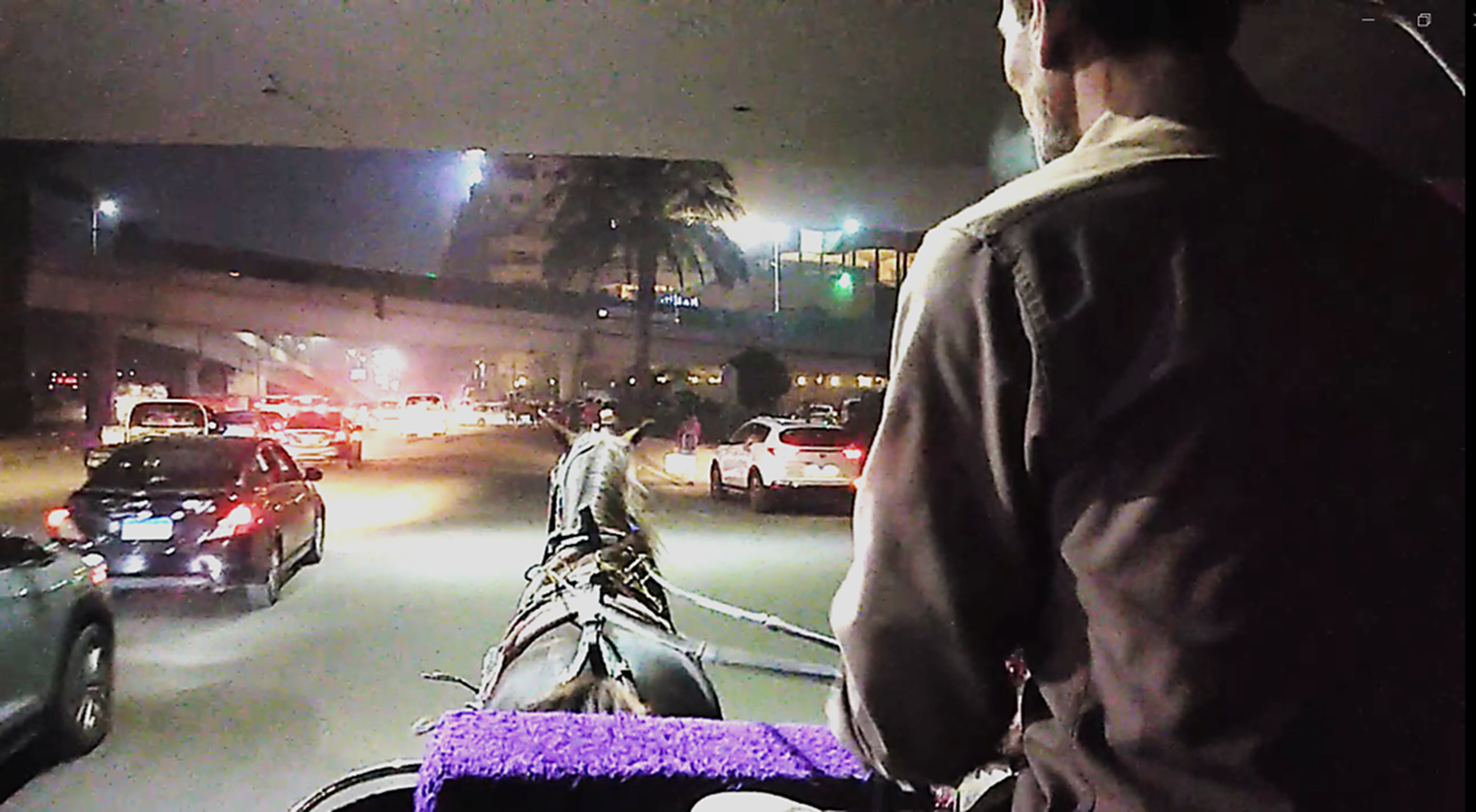
This essay is part of a larger research project on the intersection of music, animals, and social class dynamics in Egypt. It draws on a fieldwork encounter that I had in Cairo in April 2022 with Salih, a horse-carriage driver, and his horse Ziko (Fig. 1). Together, they operate what is known in Egypt as ḥanṭūr (pl. ḥanāṭīr), a lightweight four-wheeled horse-carriage, which, designed with a front seat for the coachman, one or two double passenger seats in the back, and a foldable leather hood, is often rendered as the Egyptian version of the English Victoria or the Italian Botticelle. Indeed, the ḥanṭūr is widely believed to have first been introduced to Alexandria in the mid-19th century by Italian immigrants, who constituted the city’s second largest European population at that time.Footnote 1
Salih and his horse driving a ḥanṭūr in central Cairo. Photograph by the author.

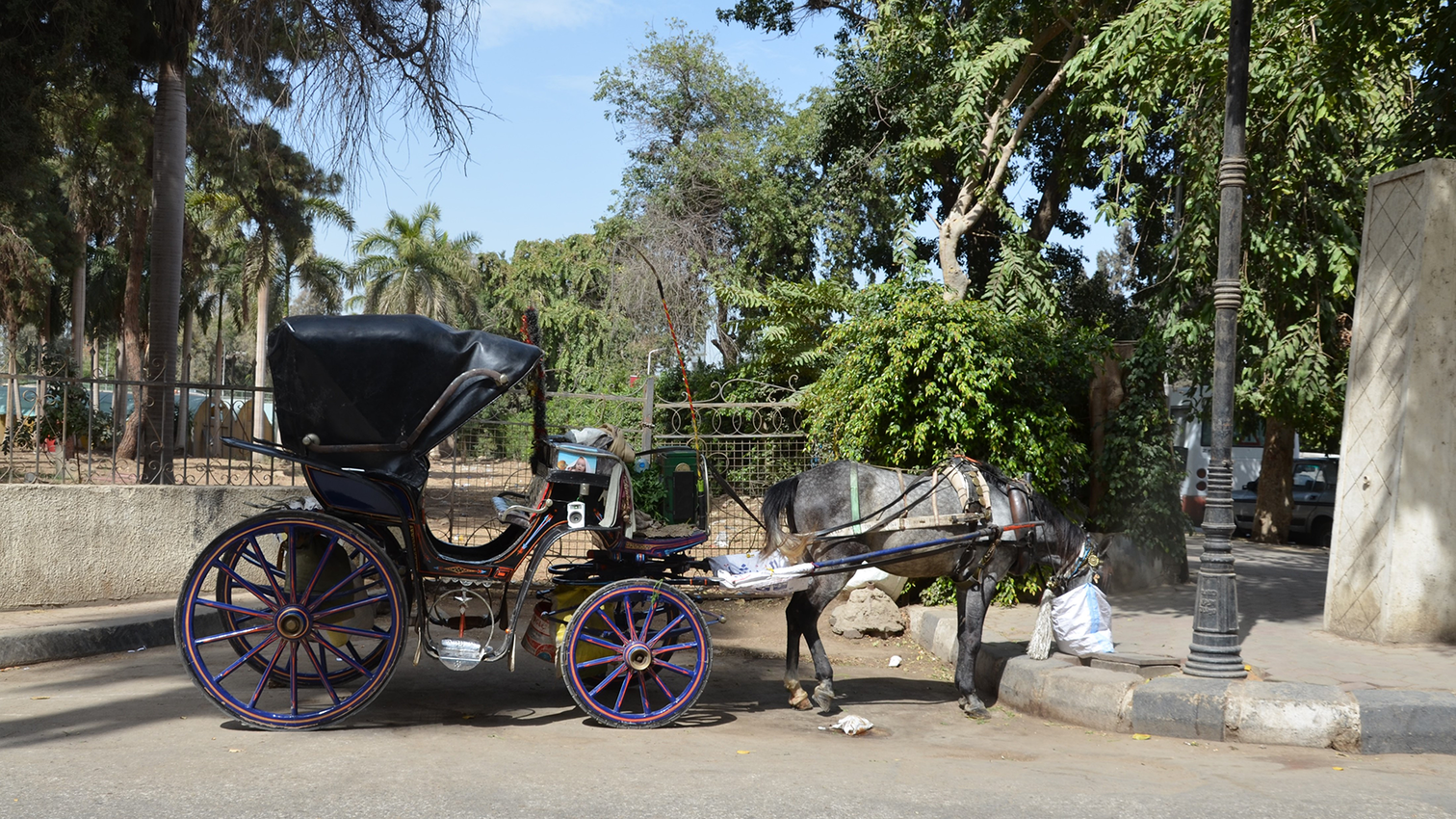
Although in some towns the ḥanṭūr still functions as a form of public transportation, it is primarily used for tourism today. Marketed as the ultimately authentic way to experience Egypt’s historic landmarks, it can be found alongside the ancient temples of Luxor, the pyramids of Giza, the waterfront of Alexandria, and in central Cairo (Fig. 2). Salih, who has worked as a coachman for more than forty years, has his spot on the Corniche, not far from the famous Maspero TV building in downtown Cairo. “There are about one hundred or one hundred twenty of us,” he estimated, as following his standard one-hour-tour route he proceeded through the congested traffic on Tahrir Square and past the Egyptian Museum. All ḥanṭūr drivers had their own designated spot, he explained, alongside the Corniche, beneath the Qasr al-Nil bridge, near the Cairo Opera House, or in front of large hotels like the Marriott. However, most coachmen live in the predominantly working-class districts of al-Sharabiyya, al-Imbaba, or, like Salih himself, in Bulaq.
A ḥanṭūr and a resting horse in Zamalek, Cairo. Photograph by the author.

The ḥanṭūr, like most private horse carriages, was once associated with Egypt’s urban elite, but many view it today as an item of national folklore and a symbol of an authentic and nostalgically remembered past. It comes ornamented with flashy neo-pharaonic motifs, royal emblems, crescents, and colored beads and amulets to protect from the evil eye. It is drawn by (often malnourished) horses with henna-tinted tails or color-tasseled bridles. And it tends to be accompanied by popular songs. Like most coachmen, Salih drives with a sound box that enables him to play a selection of music from a USB, including songs by Umm Kulthum, mahragānāt, a highly popular electronic dance music genre that emerged from Cairo and Alexandria’s informal neighborhoods, or khalīgī pop (many of his customers come from the Gulf states). However, according to Salih, his passengers’ all-time favorite is a song that revolves around the ḥanṭūr, the horse carriage. “Hey dude!” (Yā ʿām), the voices of shaʿbī music superstars Amina and Sa`d al-Sughayyar burst out of his sound box, “You on the carriage, you riding back and forth! Oh, how I want to drive that carriage and ride back and forth (yāma nafsī arkab al-ḥanṭūr wa atḥanṭar)!”
“Arkab al- Hantur”: Leisure Rides
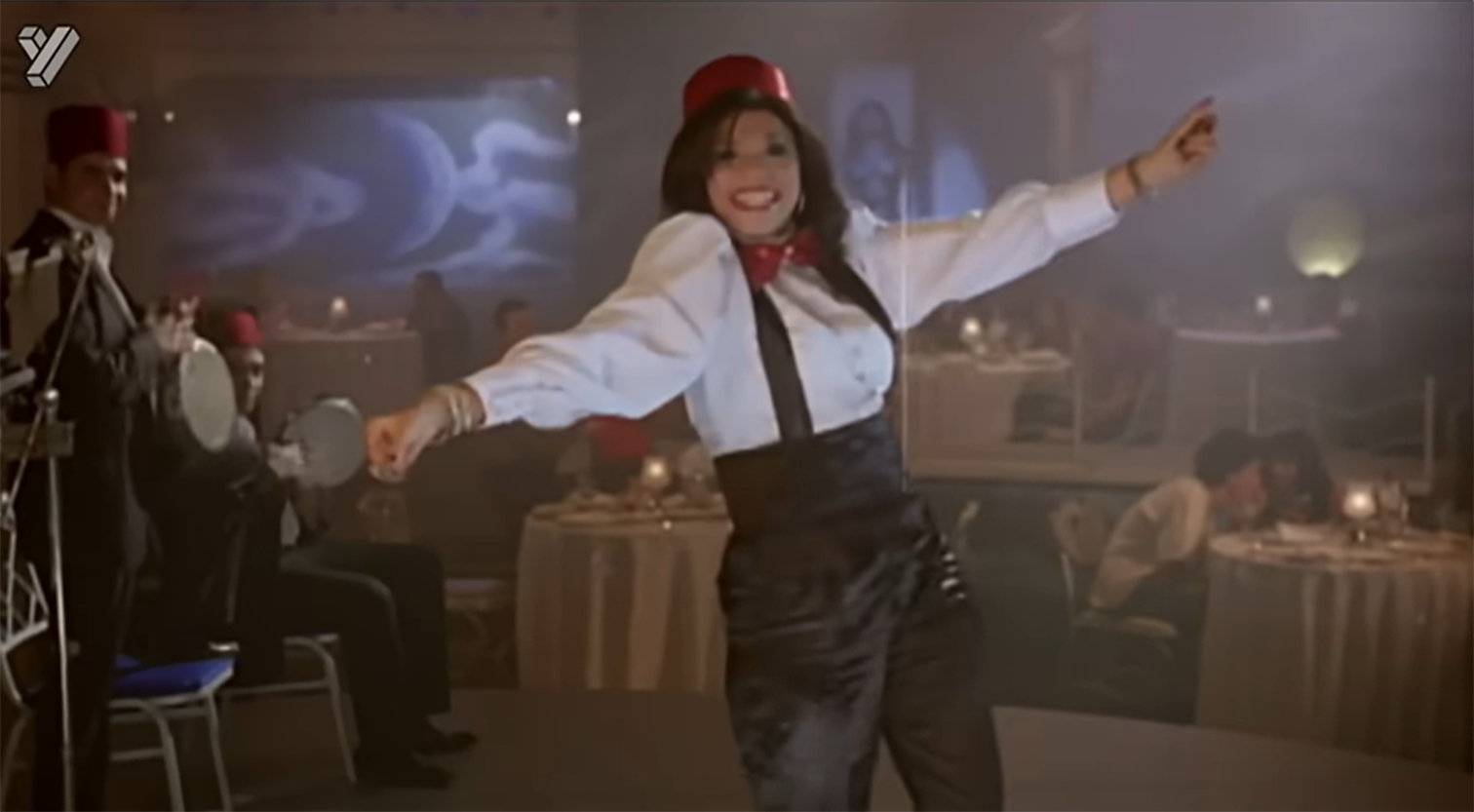
The song “Arkab al-Hantur” (I Ride the Carriage) belongs to the genre of shaʿbī music, a popular music style that emerged from Cairo’s lower-class districts in the late 1960s.Footnote 2 It was originally part of Ashraf Fayeq’s film Qisat al-Hayy Shaʿbi (The Story of the Common Neighborhood, 2006), a production of the famous al-Sobky family of film producers. The scene that features the song is set in a nightclub (Fig. 3). “I sit up front and hold the reins,” sings Amina, while swaying her hips back and forth in a way that suggests an act of interpersonal intimacy, rather than riding a carriage. This impression is reinforced by the singer’s vocalizations: the refrain is a verbification of al-ḥanṭūr that may be translated as “I sway back and forth,” with an interspersed hiis, a vocal signal that is used by a coachman to communicate with his horse, but which the song has stylized into an expression of sexual animation.
A still from Qisat al-Hayy Shaʿbi, showing Amina performing “Arkab al-Hantur.” YouTube video posted by YT movies, https://youtu.be/THjXbZ90mF8?feature=shared (accessed 11 July 2025).

Hearing this song while watching Salih maneuver his tired horse Ziko through Cairo’s downtown traffic made for a peculiar experience. The traffic noise of honking motorcycles, taxis, and passing cars, was interspersed with the sounds of synthesizer, electronic saxophone, and the singers’ satirical narration of a romantic carriage ride. Meanwhile, the sound of Ziko’s hooves clattering on the street pavement began to overlap with the sound of hooves clattering from the sound box—“Arkab al-Hantur”’s opening sequence, a two-beat rhythm that imitates a trotting horse, is, as I later found out, a direct quotation of “Itmakhtari ya Khayl” (Trot, Horse), the iconic song Layla Murad performed on horseback in Ghazal al-Banat (The Flirtation of Girls, 1949). In short, it was as if Salih’s carriage took on a new, second life, turning from a site of everyday labor into an item of musical consumption and leisurely pleasure.
This transformation can be traced in Egyptian popular music. Following studies that have explored the implication of different means of (tourist) transportation, such as Nile cruising boats, taxis, microbuses, and the bicycle, in Egyptian popular dance and music, this essay identifies a series of 20th-century songs that revolve around the horse carriage.Footnote 3 Many of these songs were composed for theatrical plays or films. Although they originate in different historical contexts, they are collectively animated by a dynamic that the historian Ulrich Raulff, in his Farewell to the Horse: The Final Century of Our Relationship has captured as follows: “Just as the old, solid world of horses, carriages and cavalrymen begins to crumble under the pressure of an increasingly mechanized civilization, horses take on a more imaginary and chimeric form.”Footnote 4 Raulff argues that the less important horses and horse carriages become in our everyday lives, the more symbolic power and aesthetic—in our case musical—appeal they gain. This essay assumes that this process has a class dynamic in Egypt, as elsewhere in the world. For the ḥanṭūr to appeal to the consumer tastes of a leisure class, I argue, its cultural and musical memory had to be gradually disassociated from the everyday labor, hardships, and vulnerabilities that it historically meant (and still means) for both horse and coachman.
“Al-ʿArbagi”: A Coachman’s Work
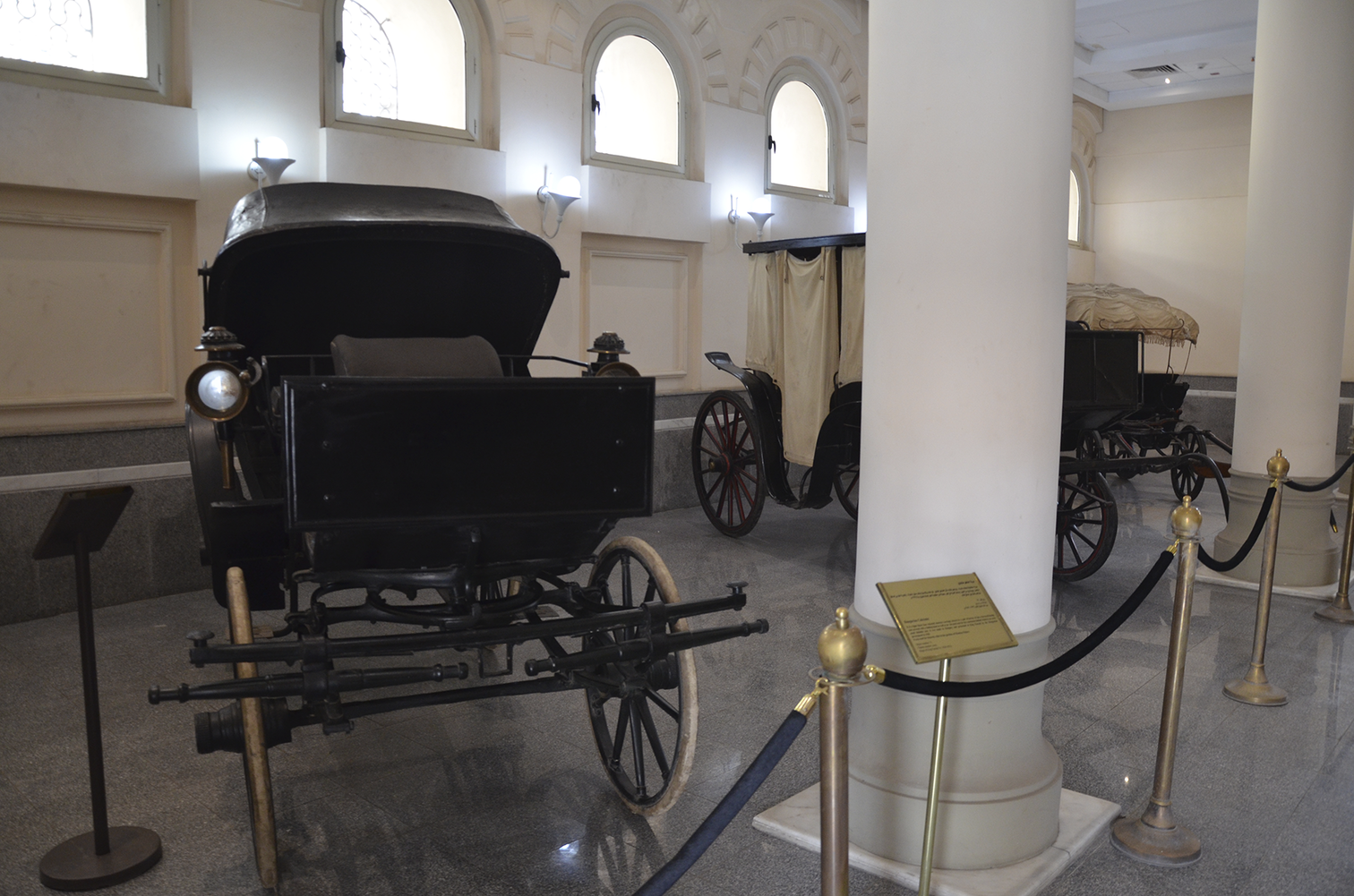
Introduced to Egypt’s urban centers in the mid-19th century, private horse-drawn carriages were, at least at the beginning, predominantly used by wealthy Egyptians and foreigners, including the royal family (Fig. 4). The working classes used carts drawn by donkey and mules, and later mule- or horse-drawn omnibuses.Footnote 5 For the country’s upper and upper-middle classes, private horse carriages functioned as a marker of social status and a way to distinguish themselves from the old and premodern ways of life. As Janet Abu-Lughod wrote in Cairo: 1001 Years of the City Victorious: “One entered the old city by caravan and traversed it on foot or animal-back; one entered the new by railroad and proceeded via horse-drawn Victoria.”Footnote 6
A private horse carriage as used by Egypt’s royal family, on display in Cairo’s Royal Carriages Museum. Photograph by the author.

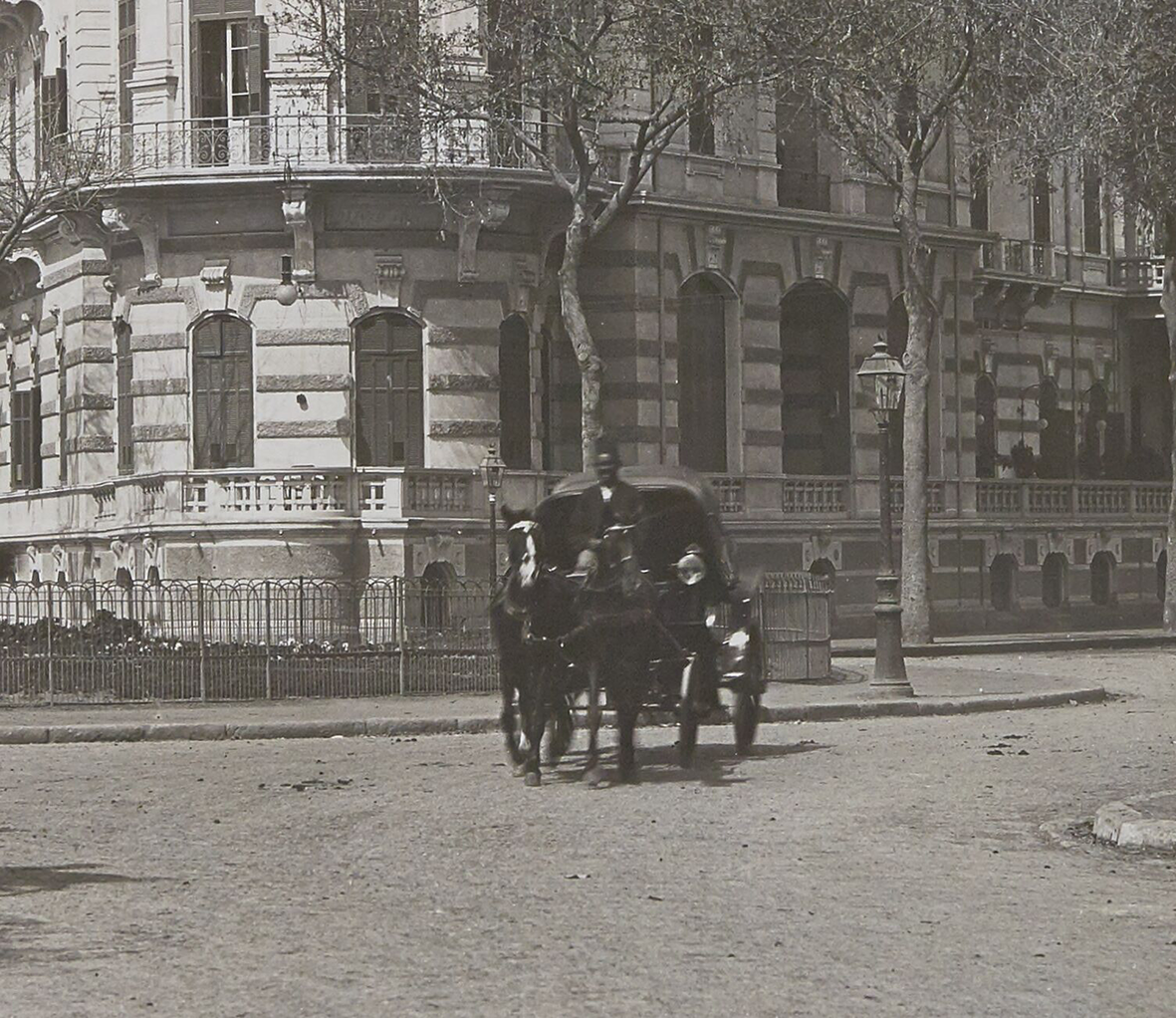
Although in mid-19th-century and early 20th-century Egypt, private horse carriages were part of an urban geography of privilege, the people driving them usually belonged to a much lower class than their passengers (Fig. 5). Their precarious working conditions are addressed in a song that is known as “al-ʿArbagi” (The Coachman). Composed by Sayyid Darwish to lyrics written by Amin Sidqi, “al-ʿArbagi” was part of ‘Ali al-Kassar’s play Wa Lissa (More to Come) which premiered in Cairo in February 1919.Footnote 7 The song is one of a series of Sayyid Darwish compositions that revolve around specific working-class professions, including “al-Garsunat” (The Waiters, 1919), “al-Shayalin” (The Carriers, 1919) and “al-Saqayyin” (The Water Carriers, 1918).Footnote 8
A coachman driving his carriage in front of Cairo’s Savoy Hotel, 1898. Source: Richard Mosseri, Photographies sur les transformations urbaines du Caire entre 1849 et 1946, Bibliothèque nationale de France, https://gallica.bnf.fr/ark:/12148/btv1b10546945n/f66.item.

“Al-ʿArbagi” registers the hardship that Egypt’s early 20th-century coachmen were exposed to: the long working hours, being confined to sit for more than ten hours in a row, the constant maltreatment by the police authorities (the shāwīshiyya), the rude passengers who behaved like they sat on a sofa, and the rising costs of living, which made it impossible to feed a family, or a horse. “How do we live, people, where is the justice, brothers?” the song laments. “Me and that brave one (al-gadʿa, the horse) are crucified … our class has nothing (ṭabaqātna aḥna dūn).”Footnote 9
The lyrics of “al-ʿArbagi” resonated in a time in which Egypt’s coachmen had already organized a series of local protests and petitions. They were addressing their precarious working conditions and their maltreatment by the authorities, which included arbitrary fines, the random withdrawal of their licenses, and the neutralization of their horses.Footnote 10 On March 17, 1919, amid the nationwide revolt against British rule and around three weeks after Wa Lissa had first been performed on the theater stage, they, alongside the majority of Cairo and Alexandria’s transportation sector, went on strike again.
But the working conditions of Egypt’s coachmen only worsened in the following decades, when horse-dawn carriages became increasingly replaced by trams, buses and, most importantly, cars. In 1916, Cairo’s streets supported over fifteen hundred horse-drawn carriages, but by the 1950s that number had reduced to less than four hundred.Footnote 11
Egypt’s infrastructural transformations and the increasing competition that its coachmen faced from new forms of transportation were addressed in popular song. Already “al-ʿArbagi” held the “tramway people” responsible for the coachmen’s suffering. Twenty-five years later, the film Taxi Hantur (1945) featured an iconic dispute between a taxi driver and a coachman (the latter played by the singer Muhammad ʿAbd al-Mutalib), with each singing about the merits of their vehicle. As late as 1984, popular singer Su`ad Mansur offered comfort to those still preferring the ḥanṭūr over a Peugeot. Despite some claiming that the carriage’s days were over, she sings, “your time has not yet passed, you still have loved ones (zamanak lissa mā fāt,lik ḥabāyib).”
Such popular songs not only narrated the replacement of the horse carriage by modern forms of transportation; they also registered the new cultural and nostalgically inflected meanings that it gained in the course of its decline as a means of everyday transport. Indeed, Mansur’s association of the ḥanṭūr with love points to a cultural symbolism that had already begun to be popularized in mid-century Egypt.
“Al-Nuzha”: Private Romance
Sayyid Darwish’s early 20th-century composition highlighted the everyday struggles of a working-class profession. In mid-century Egypt, by contrast, the horse carriage begins to appeal to Egypt’s emergent consumer classes as a symbol of romantic love and leisure. A well-known case in point is the song “al-Nuzha” (The Leisure Stroll), which Egyptian radio broadcast in the mid-1940s as part of a radio format known as al-suwar al-mūsīqiyya (musical images). As the title suggests, this format mobilized music to evoke all kinds of different scenes of Egyptian cultural and social life. “Al-Nuzha” meant to communicate to listeners the image of a couple (represented by the voices of Shafya Ahmad and Karim Mahmud) and their coachman (sung by Sayyid Mustafa) enjoying a leisurely carriage ride. Although previously the coachman and his passengers had been divided by different class-belongings, here they sing, in harmony, about a happy life. The coachman: “The couple, the horse and the carriage, their melodies are all tenderness (al-gawz, al-khayl wa-l-ʿarabiyya, anghāmhum kullha ḥaniyya).” And the woman passenger: “I like the coachman, how beautiful his singing is… . He is joyful with his horse and his life in the world is happy (al-usṭa ʿāgibnī yā māḥla ghunāh … farḥān bi-l-khayl yillī muhāwidahu wa ḥayātu fī al-dunyā haniyya).”
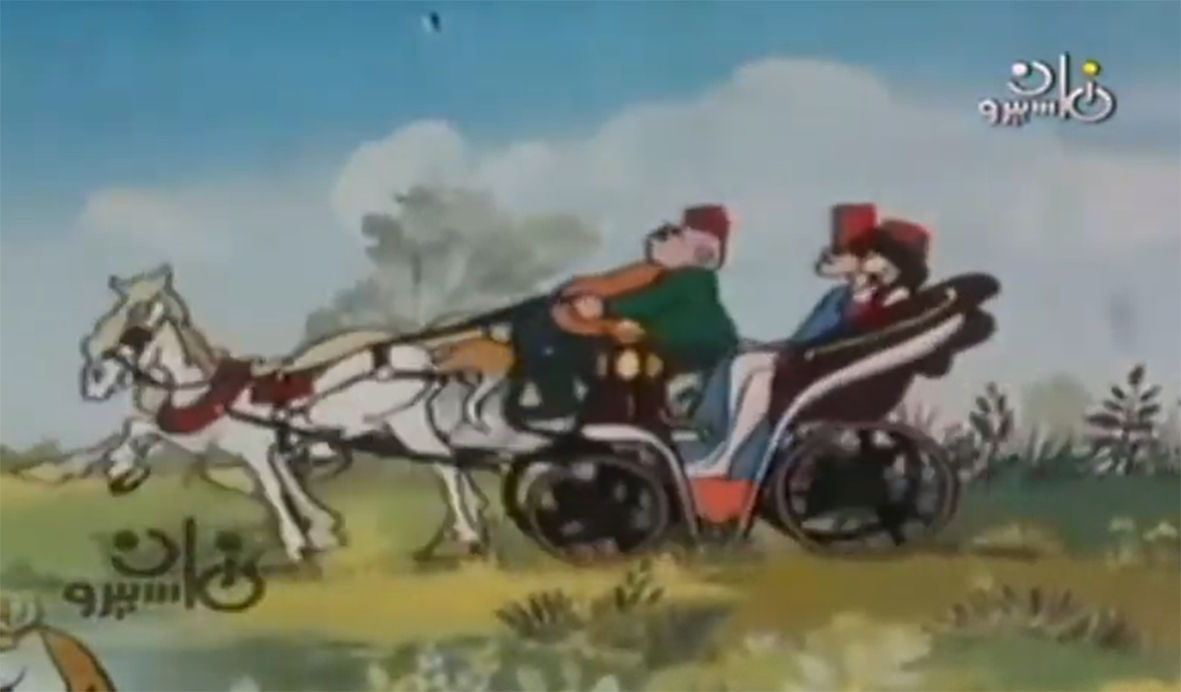
“Al-Nuzha” not only presents an artfully arranged “musical image” of a pleasant carriage ride (Fig. 6), it also puts into relief how the refashioning of the horse carriage from a means of everyday transport into an item of leisure and consumer culture relied on a process of sanitization. To start, its lyrics are devoid of the class struggles and grievances that dominated Sayyid Darwish’s “al-ʿArbagi.” Rather, the coachman is represented as content with his life (“his life in the world is happy”), his voice is no longer a tool of critique, but there to curate the leisurely experience of the passenger couple (“how beautiful his singing is!”).
A still from an animated TV version of “al-Nuzha,” directed by Ahmad Saʿd. YouTube video posted by RurQan, https://youtu.be/6e5j2n4rl9c?feature=shared (accessed 11 July 2025).

The song also effectively dissociates the carriage ride from all the other noises that passengers would have been exposed to in mid-century Cairo. What is missing are the creaking sounds of wooden wheels, the vocal signals of the coachman, his whistling, his tongue and cheek clicking, the crack of his whip, and the jingling bells attached to the horse gear. In short, all the noises that, as so vividly documented in Ziad Fahmy’s Street Sounds, would give sound to a horse carriage’s presence on the road.Footnote 12 Rather, the carriage ride’s sonic representation is realized primarily via the smooth, four-beat reproduction of hooves clattering on pavement.Footnote 13
The image that listeners were meant to have in mind, then, was that of a private leisure ride. Private not only because it took passengers away from urban traffic and to the park, the waterfront, or the Nile Corniche, but also in the sense of offering a way to be secluded from the public gaze. The foldable leather hood of the ḥanṭūr not only protected from bad weather and the sun, but also, at least in theory, offered its passengers the privilege of being partly shielded from the outside world, the perfect conditions for a romantic experience. It is, after all, not only the coachman and his horse whom “al-Nuzha” associates with love and tenderness; it is, above all, the passenger couple.
“Ihna Wahdina”: Cross-Class Love and the Simple Life
In mid-century Egypt, the image of the horse-drawn carriage as a site of private, romantic love had already entered Egypt’s cultural imagery via some cinematic productions of that time. One example is Ahmad Badrakhan’s Aida (1942), which stars Umm Kulthum as a poor village girl who aspires to be an opera singer and falls in love with Sami, the son of a wealthy landowner (played by singer Ibrahim Hamuda). The film revolves around the many obstacles they face until they can finally get married. At the end, when difficulties are resolved, Sami’s coachman leaves the couple to ride off into the Egyptian countryside. With Umm Kulthum eventually taking over the reins, they sing “Ihna Wahdina” (We are Alone), a duet composed by Muhammad al-Qasabgi with lyrics by Ahmad Rami. This is an excerpt:
They separated two lovers, how cruel their hearts! They think the laws of love follow their laws—the poor guy for the poor girl, the girl for the rich. They are wrong, wealth resides in a delighted heart.
Faraqu bayn al-aḥiba yā qasāwat qalbuhum! Yaḥsibu sharʿa al-maḥaba yimshī zayy sharʿahum—al-faqīr li-hu al-faqīra wa-l-ghaniyya li-l-ghanī. Ghalṭanīn da al-ʿizz kulhu yiskun al-qalb al-hanī.
The above lyrics vividly illustrate what would, in the decades that followed, become one of the central tropes of Egyptian cinema under Nasserist rule: modern, individual-choice, and cross-class love.Footnote 14 But in mid-century Egypt, the refashioning of the horse carriage as a symbol of romantic, cross-class love and leisure was intimately entangled with another cultural symbolism, and that was its nostalgic association with a simpler and more authentic life.Footnote 15
A scene from Henri Barakat’s comedy Law Kunt Ghani (If I Were Rich, 1942), released in the same year as Aida, is revealing. The story revolves around a poor barber’s aspirations for upward mobility, and the harm that his obsession with money and social status inflicts on his family. When he eventually gains enough wealth, he decides to move from working-class Bulaq to upscale Zamalek. He insists on driving there in a Mercedes, the ultimate “symbol of decadence” in modern Egyptian cinema.Footnote 16 His wife, who will eventually convince him to return to their poor and simple but ultimately happier life in Bulaq, insists on following him in a horse carriage.
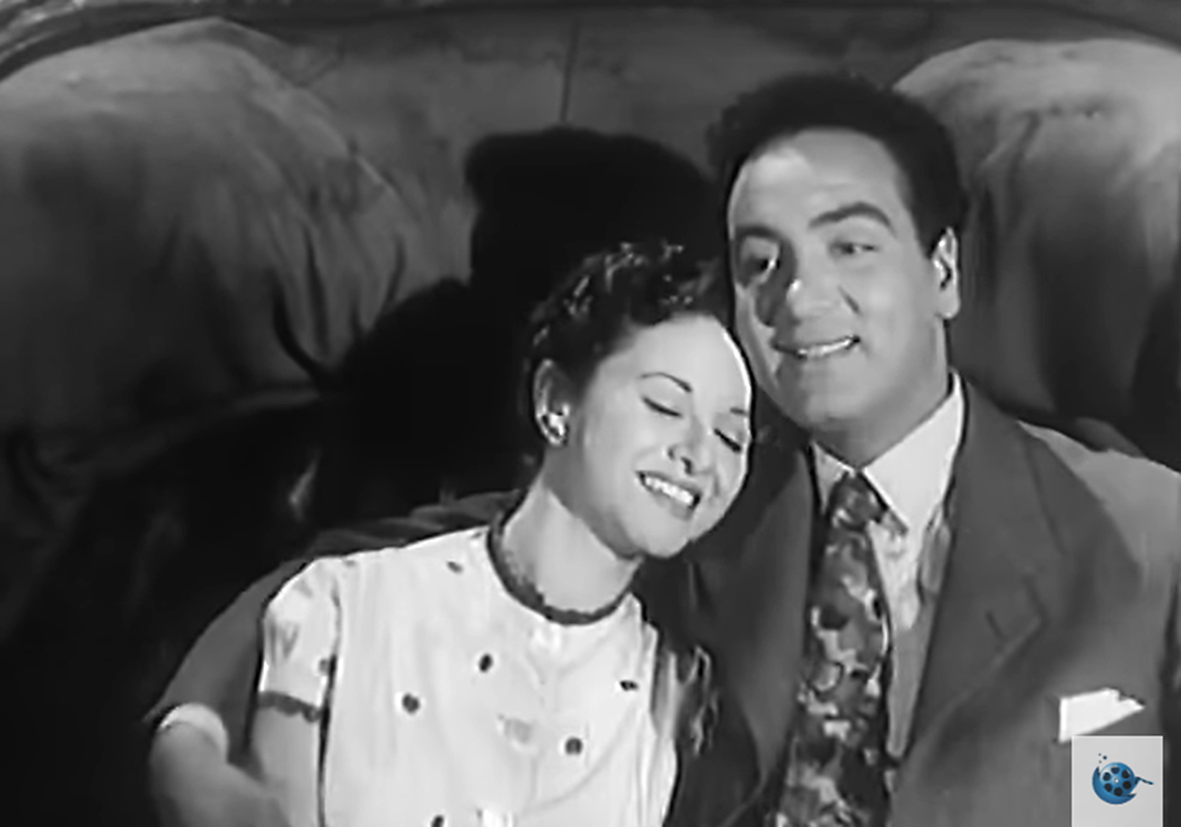
What follows are a series of films that continue this double theme of cross-class love/cultural authenticity in different, musical variations. In Barakat’s Da’iman Maʿak (Forever with You, 1954), it is in a modest room right above a horse and carriage stable where upper-class Tafida (played by Fatin Hamama) and her common lover Hamada, a train conductor (played by the singer Muhammad Fawzi) imagine their happy future together. Later, when they are engaged, they, too, will embark on a ḥanṭūr ride, with Fawzi singing the memorable song “Tir Bina ya Qalbi” (Fly with Us, My Heart; Fig. 7). In the 1967 classic Gharam fi-l-Karnak (Love in Karnak, directed by ʿAli Rida), the singer Muhammad al-Iyaby and members of the Mahmud Rida dance troupe stylize the ḥanṭūr as Luxor’s quintessential tourist attraction by performing the iconic hit “Our Luxor is a tourist land (Uqsur baladna balad sawwah)” while riding and dancing beside a procession of ḥanāṭīr. Footnote 17 In Hussein Kamal’s 1976 musical comedy Mulid Ya Dunya (Crazy World), the brilliant ʿAbd al-Munʿim al-Madbuli stars as a drunk, heartbroken coachman who, hugging his carriage and cracking his whip, laments the decline of his profession in a now dehumanized and mechanized world: “Lovers used to send us to the moon,” he sings, “but we became antiques … the world is a factory, it chops up humans.”Footnote 18
A still from Da’iman Maʿk depicting singer Muhammad Fawzi and actress Fatin Hamama in a ḥanṭūr. YouTube video posted by Midnight Entertainment, accessed 11 July 2025, https://youtu.be/hTlPCbTk1CA?feature=shared.

The songs discussed in this essay give insights into the ḥanṭūr’s shifting cultural symbolisms and historic class belongings. Some render it as a site of precarious labor, some represent it as a sanitized symbol of leisure and romantic, cross-class love, and yet others memorialize it as marker of a simpler past and a source of cultural authenticity. As different as these associations may be, I suggest that they are all implicated in the transformation of the carriage from a means of everyday (elite) transport into an item of leisurely consumption. Meanwhile, the contemporary conditions of Egypt’s ḥanṭūr drivers still resonate with the 1919 lyrics of “al-ʿArbagi”: authorities regularly refuse to renew their licenses; they face a steadily growing competition from more popular forms of tourist transportation such as Nile party boats and coastal resorts’ electronic tourist trains, tuftufs; and periodic drops in tourist numbers have left many, including Salih, struggling to feed their families and horses.