During the past few years, the term translational research has been used to describe the trend in funding priorities at the NIH. Although the term is frequently used in journals and medical schools to describe the roles of disciplines in facilitating the “translation” of laboratory science into better medical practice, few scientists understand the unique features of a translational model and the implications of this emerging research agenda for their ability to “translate” findings from specific scientific domains into clinical practice. The definition of translational research, as stated in several NIH documents, is vague. However, despite the ambiguity of meaning, several disciplines rapidly adopted and supported the construct without understanding how their techniques and paradigms fit within the “translational chain” moving laboratory findings to clinical practice (e.g., see Hall, 2001). In the absence of a dialog elaborating and defining the important scientific links along this translational chain, many scientists involved in biomedical research have conceptualized translational research as a replacement construct for clinical research in which there is a tacit acknowledgement of a multidisciplinary contribution. Translational research poses a particular challenge for the biobehavioral sciences, because they are not clearly positioned in the translational chain. The consequences of not being positioned in the translational chain potentially will result in lost opportunities to impact on clinical outcomes and for future funding. Developmental psychopathology, being defined by the interaction between psychological and developmental processes, is vulnerable without a well-defined model of translational research that emphasizes the role of biobehavioral sciences.
Translational research as a construct rapidly became relevant to the science community when it was described as a funding target in the NIH Roadmap. Soon after Elias A. Zerhouni became Director of the NIH, he convened several working groups to develop initiatives aimed at accelerating medical research. The product of these meetings was a document entitled the NIH Roadmap (Zerhouni, 2003). The Roadmap identifies three areas: new pathways to discovery, research teams of the future, and reengineering the clinical research enterprise. Embedded within the section on “reengineering the clinical enterprise” is a discussion of translational research. Broadly stated, “translational research is the process of applying ideas, insights, and discoveries generated through basic scientific inquiry to the treatment or prevention of human disease” (Zerhouni, 2003, NINDS PAR-02-139). Some of the commonly used definitions also include the bidirectionality of informants. Thus, emphasizing the flow of information from clinical settings into the laboratory as well as from the laboratory to the clinic.
The Roadmap is having an immediate impact on major medical research environments where the NIH National Center for Research Resources (NCRR) funded General Clinical Research Centers (GCRC) are being transitioned into Institutional Clinical and Translational Science Awards (CTSA). Currently, there is a national network of 78 GCRCs that provide a research environment for investigators to conduct in-patient and outpatient studies of both children and adults. The CTSA is “a new program designed to transform clinical and translational research, so that new treatments can be developed more efficiently and delivered more quickly to patients” (http://www.ncrr.nih.gov/clinicaldiscipline.asp). The CTSA program is proposed by NIH to “create a definable academic home for the discipline of clinical and translational science,” although this discipline is yet to be defined. An article in the Winter 2006 issue of the NCCR Reporter (Contie, 2006) describes several explicit features of the CTSA (http://www.ncrr.nih.gov/newspub/publica.asp) including the requirement of a team approach representing several participating disciplines, without identifying the disciplines and how translation should move across disciplines. The article also defines two domains of translational research: (a) research on the translation of discoveries made in the laboratory to human clinical trials and (b) research on improving the acceptance in the medical community of best treatment practices.
A recent Medline search of the NIH Roadmap identified several articles in a variety of medical and biomedical journals prompting diverse disciplines to become actively involved in Roadmap initiatives. A primary aspect of the Roadmap is to encourage “novel partnerships, such as those between the public and private sectors … to accelerate movement of scientific discoveries from bench to bedside” (Zerhouni, 2003, p. 64). Although emphasis in the scientific community has been on the translation of science to practice, others have interpreted aspects of the Roadmap as contributing to the process of commercialization of the university. These criticisms are based on an agenda of positioning companies, which develop pharmaceuticals and use the human genome to refine pharmaceutical development, to exploit publicly funded university research resources (e.g., Geiger, 2004).
Is There a Need for Translational Research?
The need is obvious when considering the gap between basic research and the implementation of these findings in both medical education and in the treatment of human disease. However, although this is an admirable objective, the arbitrary definition of translational research incorporated in the NIH Roadmap poses the possibility of minimizing or excluding the role of biobehavioral science in the “translation” from treatment to outcome. This potential omission becomes more obvious, if we interpret the translational research agenda as a model accelerating the movement of new drugs to practice. In an insightful editorial, Hall (2001), wrote that the gap between basic research and clinical practice was due, in part, to a weakening in the translational research chain through the decline in research and training in integrative [whole organism] physiology and clinical [human or medical] physiology. An appreciation of a translational model, which explicitly describes the “translational research chain” and the defining disciplines that compose the chain, is missing from the Roadmap. If this issue is not addressed, then several disciplines along a chain from gene to treatment will be omitted and “translational” research will emerge as a rapid movement from the interface of drug and gene research to clinical trials and from clinical trials to clinical practice. Without positioning behavior and biobehavioral sciences within the chain of translation, translational research will quickly be absorbed and driven by a corporate and patent agenda aimed at moving from genome and drug to clinical trials. Under these constraints, developmental psychopathology would be represented in translational research as studies that focus on Gene × Drug interactions as a function of age and evaluate outcome with easily administered questionnaires.
Will biobehavioral sciences be represented in the new translational research centers funded by NIH (i.e., CTSA)? The role of biobehavioral sciences is likely to be minimized. This may occur even in translational research directed toward improved outcomes of psychiatric disorders and behavioral problems. The concept of a translational chain moving from genes to nervous system to physiology to behavior to clinical condition, although intuitive, is not a feature of most models of translational research. A best-case scenario for the biobehavioral sciences is a subservient role in which the biobehavioral sciences provide outcome variables for the products developed by pharmaceutical and genomic corporations. The biobehavioral sciences are not alone in this exclusion. Hall's (2001) editorial alerts us to a chilling fact that physiology, the science upon which medicine is based, is being displaced on the translational chain by chemistry and molecular genetics. This view of translational research breaks the naturally occurring intervening transitions from the pharmaceutical treatment to the dynamic and integrative features of physiology and neurophysiology to the study of human behavioral and psychological processes.
Unfortunately, these natural transitions were vulnerable long before NIH stimulated an interest in translational research. For almost a century, there has been an active movement in the study and treatment of mental processes to remove biological process from the chain of intellectual inquiry. If there is a future for biobehavioral science in translational research, it will be necessary to reassert the importance of the nervous system and behavior as integral components of the translational chain. Thus, it is necessary to initiate a “behavioral neurobiology revolution” to foster the translation of neurobiological principles to understand, to assess, and to treat important clinical problems related to behavioral and mental disorders.
This paper proposes a model for translational research that focuses on social behavior and emotional regulation and positions biobehavioral processes as intervening processes on the translational research chain. The model has four primary features. First, the model defines the features of a translational chain and limits translational research to strategies that require an articulated translational chain evaluating intervening processes between putative causes and treatment outcomes. Thus, in contrast to the NIH CTSA announcement, clinical research that primarily evaluates the relative effectiveness of treatments on outcomes, service research that evaluates strategies to increase compliance and access to treatments, and epidemiological research are NOT translational. Second, the model focuses on social behavior, because features of social behavior, including state and emotion regulation, are not only primary features of several psychiatric disorders and behavioral problems, but also contribute to the clinical course of several disorders due to genetic, nervous system, and physiological factors. Third, by emphasizing the dependence of both behavior and physiology on the nervous system and the interdependence between behavior and physiology, the model focuses on behavioral neurobiology. Fourth, the model takes a developmental biobehavoral perspective. By appreciating the influence of developmental processes in both biological and behavioral systems, the model provides the opportunity to study the dynamic effects and interactions that occur among context, behavior, and nervous system. Thus, diverse processes that define the emergent subdiscipline of developmental psychopathology, including those involved in modulating gene expression, in identifying neurophysiological substrates fostering behavioral regulation, and in context triggering disruptive behavioral strategies can be studied within the same model.
How Biobehavioral Sciences Lost Its Position on the Translation Chain: The Consequence of Studying Mental Processes and Illness Independently of the Biological Sciences
The rapid advances in physics and chemistry during the 19th century and early part of the 20th century created a stage for a strong reductionistic approach to the biological sciences. A climate of reductionism fostered the development of technologies that were applied to physiology and to the study of the nervous system. For more than 150 years scientists struggled to identify specific neurobiological characteristics of psychological processes and mental diseases. Although the basic sciences fostered the development of technologies to measure neurobiological systems, these same scientific advances created a climate in which the importance of synthesis and integration dependent on crossing discipline boundaries was minimized. For several decades, “legitimate” research could only investigate psychological process within paradigms designed to produce reliable observable behaviors or reliable verbal responses. These developments fostered the description of general rules of behavior such as the laws of learning, which became the foundation of experimental psychology and later served as the basis for interventions associated with behavior modification. However, this focus on reliable behavioral observations resulted in theories and models that neglected the important biological contributions to behavior and mental processes, especially in understanding deviations from the norm and mental disorders.
Psychiatry and disease models of mental illness have a different history. Top-down models have thrived in an environment that “allowed” the study of mental events to occur independent of biological systems. Although Freud initially based his work on biology, Freudian psychoanalysis rapidly became a discipline that was presented as independent of other scientific disciplines. This “separation” dominated psychiatry for decades and continued until biological psychiatry emerged with an emphasis on pharmacological manipulations. The development of target drugs for mental health disorders promoted deterministic models of mental illness based on hypothetical neurochemical imbalances. The neurochemical models focus on the brain, as if it functioned independently from peripheral physiology, and omit an understanding of the influence of drugs on behavioral state via the autonomic nervous system and the important afferent influences of the autonomic nervous system on brain function. The product of this tradition is a commonly practiced psychopharmacology within biological psychiatry (a domain of psychiatry that minimizes the importance of the dynamic features of the nervous system including the influence of developmental and epigenetic processes) in which clinical symptoms are monitored (i.e., usually via self-report) and drugs are titrated. No intervening physiological or neurophysiological assessment is commonly used with the exception of occasionally assessing blood for toxic levels. No psychological process is evaluated with the exception of self-report questionnaires and diagnostic checklists. A rare exception is the attempt to introduce into the clinic measures of reaction time and attention to evaluate function in children diagnosed with attention-deficit disorder.
Whereas psychoanalysis dominated psychiatry, behaviorism dominated experimental psychology. As behaviorism prospered, the scientific investigation of mental states was discouraged. By the 1950s, academic scientists challenged the prevailing behaviorist model of human function that dismissed the need to examine mental processes and minimized an interest in underlying neurobiological systems. Several disciplines, including psychology, linguistics, computer science, anthropology, neuroscience, and philosophy, contributed to this “cognitive revolution.” During the last 25 years, cognitive neuroscience has merged the research constructs of cognitive science with the emergent technologies of neuroscience focusing on measures of brain function via imaging and high density EEG recordings. Scientists, who have integrated research constructs associated with emotion and the tools of neuroscience, have mirrored cognitive neuroscience with another emergent discipline, affective neuroscience. These new emergent disciplines are at the forefront of research on both mental function and the atypical processes assumed to mediate mental disorders. New subdisciplines such as cognitive medicine have emerged that attempt to bridge mental illness with a biological substrate via imaging technologies and neuropsychological evaluations. Unfortunately, these “merged” interdisciplinary sciences and their clinical analogs have relied on “correlational” strategies to link psychological constructs to neurophysiological processes. This strategy has inherent limitations, because the organizing principles for the two domains may differ. For example, the technologies of imaging require relatively slow snapshots of brain activation that are significantly slower than the processes they are attempting to monitor. In addition, the stimuli used to elicit affective processes are generally static, while the nervous system evolved to assess dynamic changes in environment. The correlational approach, by minimizing the integrative and dynamic nature of brain structure and function, has assumed that brain structures activated during cognitive and affective challenges are the structures of origin and organization for these processes. Moreover, this strategy, by relying on correlations between brain morphology and not nervous system process, also minimizes the role of development as a biological process that influences brain circuits and psychological experience. In place of development as biological process, development is often treated as an “age” variable indexing accumulated experiences.
By studying psychological processes and mental illness, as if they were independent of the biological sciences, organizing principles based on psychoanalysis, cognition, and affect were used as explanatory processes independent of a neural substrate. The separation between the nervous system and the descriptions of mental illness and psychological processes produced new disciplines that accepted the constructs of mental disease and conducted research correlating diagnosis with neurobiological processes. Instead of conceptualizing mental illness as an endpoint along a chain of intervening biobehavioral processes that connect gene or brain morphology to maladaptive behavior, the research sought direct causal linkages between gene or brain morphology and diagnosis.
Mental diseases were organized along dimensions of cognition and affect. These diseases were being treated as if they were orthogonal in the function and initially independent of biological processes. The introduction of treatments, including pharmaceuticals targeted at specific neurotransmitters and electroconvulsive shock therapy, linked the brain to the disorders. However, the important influences of afferent inputs from the periphery on the brain were neglected. Thus, two important biological processes were stripped from the study of mental disease. First, the potential influence of visceral state on both affective and cognitive processes was not incorporated in the model of disease or in the treatment strategies. Specifically, the resulting strategy promoted a view of the nervous system as a cortex that processes information and disease reflected a dysfunction in this process. In contrast, a biobehavioral strategy would have emphasized the importance of peripheral afferent information monitoring visceral state and regulating states of alertness and accessibility to areas of the cortex. Second, development as a biological process was minimized in the study of mental illness. Research often focuses on age groups without an appreciation for the biological processes associated with development and does not maximize this understanding to improve intervention.
Asserting the Role of Biobehavioral Sciences in the Translational Chain
Deconstruction and integration: Insights from the NIH
Disorders such as schizophrenia and autism have been assumed to have strong genetic influences, because the risk is high in families in which there is a confirmed diagnosis. For example, if both parents are affected with schizophrenia, the offspring will have a 40% risk of developing schizophrenia. In addition, if one monozygotic twin is diagnosed with schizophrenia, there is a 50% risk that the other twin will develop the disease. If the twins are dizygotic, there is only a 10% probability that the second twin will develop the disorder. However, despite the strong evidence of a genetic factor, specific genetic markers and the neurobiological expression of putative genetic mechanisms have eluded researchers. After decades of limited successes, recent strategies are changing towards the untangling of genetic and neurobiological mediators of psychiatric disorders. An article in Science (Holden, 2003) emphasizes this poignant point and provides the following statement from the former director of the National Institute of Mental Health (NIMH), Stephen Hyman: “Instead of comparing people with schizophrenia to those without, scientists are ‘deconstructing’ the disease … attempting to unravel it by looking at its characteristic features in both the sick and the well.” This focus will direct future research toward an understanding of the biobehavioral processes underlying mental disease.
Limitations of prevalent research strategies: Limitations of a single variable model and the need to change
The application of neuroscience methods to identify intervening biobehavioral processes in the study of human social behavior and emotion regulation has been limited to methods that are easily applied (e.g., measures of heart rate or cortisol). Although there has been rapid growth in knowledge and resources (e.g., increased number of investigators, students, publications, and funds) in this area, the research has been limited, primarily, to the testing of “single” system models and hypotheses. Most studies in biological psychiatry, psychobiology, psychophysiology, or affective and behavioral neuroscience investigate one specific neural response system, such as the autonomic nervous system, the prefrontal cortex, the amygdala, the hypothalamic–pituitary–adrenal axis, or specific hormones such as cortisol, oxytocin, or vasopressin as the mediators of social behavior and emotion regulation. Single variable research often results in straightforward hypotheses that are unambiguously confirmed or rejected. This level of specialization accelerates knowledge associated with specific systems, but does not foster integrative models, generalizable theories, or applications. Because these systems are not neurophysiologically, neuroanatomically, or neurochemically independent, the research generates overlapping information and theoretical models. Thus, independent laboratories of neuroscientists, who study emotion and stress or the neural mechanisms of psychiatric disorders, may focus on different variables and be uninformed about the findings related to systems that they do not study. For example, some laboratories may search for genetic polymorphisms, anomalies in brain function with imaging technologies, or neural regulators of visceral state as modulators of social behavior and emotion regulation. Paradoxically, most of these systems are interrelated in terms of both structure (i.e., neuroanatomy) and function (i.e., neurophysiology). No independent laboratory has the resources to respond adequately to the challenge of integrating neurophysiological measures, methods, and theories. Similarly, no independent laboratory has the resources to build the translational chain necessary to promote effective translation from the laboratory to the clinic.
There are sound explanations, not only why integrated multimethod/multimeasure research studying the biobehavioral processes underlying psychiatric disorders should be done now, but also why this integrative process has, hitherto, been rare or nonexistent.
- Neuroscience theories, as they relate to normal and atypical behavior, have been too limited to stimulate integrative research.
- Theories explaining behavioral and psychiatric disorders are restrictive. Although these disorders have been assumed to be manifestations of the nervous system, in general, there are no known biological markers that can be used as reliable diagnostic tools. Often, hypotheses are based on relative efficacy of pharmacological treatments, rather than upon known patterns of brain dysfunction associated with the disorder (e.g., schizophrenia).
- Current research paradigms tend to employ correlational research strategies making it difficult to distinguish whether any physiological variable is a “cause” or an “effect” of the clinical disorder.
- Quantitative tools are not easily available to integrate information from several variables with different response time courses. In addition, multivariate analyses with widely different variable scaling capacities do not exist. Most modeling approaches generate descriptive explanations that do not contribute to an understanding of neurobiological mechanisms.
- It is difficult to accumulate in one laboratory the expertise necessary to collect, analyze, and interpret data from several variable systems.
- The cost for personnel and for obtaining and maintaining the equipment necessary to collect and process data from multiple systems may be prohibitive for one laboratory.
- Paradigms and analyses that would allow simultaneous measurement of several of the variables with different time courses have not been developed.
- Neuroscientists are seldom knowledgeable of the difficulties associated with testing clinical populations (e.g., availability and sensitivity to the testing environment).
- The incorporation of a developmental perspective amplifies difficulties by requiring multiple testing sessions, increasing the demand on resources, creating difficulties in recruitment and retention, and requiring the development of new quantitative models to deal with individual developmental trajectories.
A new model
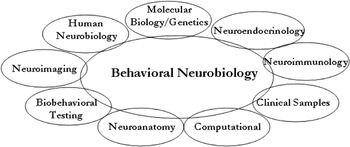
A model for translational research can be conceptualized consistent with the “deconstruction of disease” strategy suggested by Stephen Hyman, the former director of NIMH. In structuring this new model for translational research relating social behavioral and emotional regulation to psychiatric disorders, several disciplines need to be represented. As illustrated in Figure 1, a translational research environment that focuses on biobehavioral processes could be organized by ordering several “technique-defined” neuroscience laboratories along a “conceptual” perimeter with a central region that overlaps with all the technique laboratories labeled “behavioral neurobiology.” Each technique-defined neuroscience could contribute to an understanding of the mechanisms underlying functional deficits observed in behavior. Thus, the features of this translational research center would enable the deconstruction of individual and atypical differences in social behavior and emotion regulation that form a core set of deficits in several psychiatric disorders into neural and molecular processes. Several neuroscience disciplines would be represented, including molecular neurobiology, genetics, neuroendocrinology, neuroimmunology, and neuroanatomy. Unique to the conceptual design is the expanded biobehavioral translational chain that integrates the more traditional “wet lab” disciplines of molecular genetics and electrophysiology with laboratories for neuroimaging, human neurobiology, computational neuroscience, animal models, and the biobehavioral testing of clinical populations. Human neurobiology laboratories would enable the monitoring of human physiology and behavior, including measures of cognitive performance as well as brain, facial, autonomic, neuroendocrine, and neuroimmune activity. The biobehavioral laboratories would provide detailed measurements of animal and human behavior and how these variables would be related to neurophysiological parameters. In addition, the availability and access to clinical populations will foster the development of clinical researchers.

The contributing disciplines to the Center for Advanced Research in Behavioral Neurobiology.
The collaborative model includes principles of proximity and parity and dispels the archaic “hierarchy of science” model that obstructs communication among neuroscientists, behavioral scientists, and clinicians. By having several disciplines within close proximity focusing on a common research question, the environment would be educational for the scientists. Through formal and informal dialogue, new paradigms and models will emerge. The proposed model provides a platform for translational science and moves beyond the single variable model to develop a more integrated neurophysiological model of the contribution of social behavior and emotion regulation to mental health by encouraging the formation of collaborative multimethod/multimeasure research teams consistent with the directives of the NIH Roadmap. Thus, the proposed research environment would have four primary objectives:
- To develop a collaborative research program that allows for a multimethod strategy to integrate several of the variables that have been studied independently as mediators of social behavior and emotion regulation.
- To provide a collaborative test-bed laboratory in a clinical setting to foster translational research and training.
- To provide an integrative multimethod research environment that fills the gap between “bench to bed” in the study and treatment of mental disorders related to social behavior and emotion regulation.
- To emphasize development as a biological process in the translational research model.
Defining the translational chain
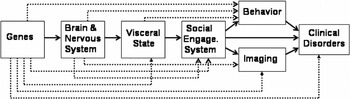
By positioning biobehavioral sciences within the translational chain, there would be an opportunity to investigate features of mental illness with several domains of neurobiological and biobehavioral variables that are theoretically related to social behavior and emotion regulation. Figure 2 provides an example of a translational research program that incorpo- rates a hierarchical model of neurobiological substrates, contributing to clinical disorders that includes features of atypical face to face social communication and emotion regulation. In this example, the biobehavioral sciences are conceptualized as intervening between genes and clinical disorder. The sciences are hierarchically organized and discovery is assumed to move from left to right. The bold lines represent direct testable hypotheses and the dotted lines represent indirect neurobiological influences. In developing the model, testing direct hypotheses could be used to develop more complex multivariate computational models of mental illness and risk.

The translational research chain: direct and indirect hypotheses. Genes, genetic polymorphisms (i.e., genes) related to the central and peripheral components of the nervous system; Brain & Nervous System, methylation, neuropeptides, neuroanatomy, electrophysiology; Visceral State, measures of autonomic, neuroendocrine, and neuroimmune regulation; Social Engage. System, measures of the neural regulation of the striated muscles of the face and head; Behavior, observable features of social behavior, facial expression, state regulation, and subjective reports by participants, parents, teachers, and clinicians; Imaging, functional magnetic resonance imaging and high-density EEG; and Clinical Disorders, test populations including individuals with autism, anxiety disorders, language delays, depression, attention-deficit disorder, and other mental disorders that express atypical social behavior and emotion regulation.
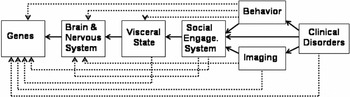
As illustrated in the flow diagram in Figure 2, genetic polymorphisms contribute to nervous system development, the nervous system regulates visceral state, visceral state regulation contributes to the expression of social engagement behaviors, and social engagement behavior and state regulation contribute to both the regulation of brain systems measured with imaging and to behavior assessed via subjective and observational techniques. According to this hierarchical model, the relationship with mental disorders will be strongest with neurobiological features that are most closely linked to the observable behaviors associated with the diagnosis. Thus, observable and self-report behaviors, as well as features of the social engagement system, which regulates eye gaze and facial expressivity, will have direct links with clinical disorders. The proposed model provides an opportunity to integrate information from various levels of inquiry. Figure 3 illustrates that insights and observations from research on each level informs the research program. Frequently, researchers applying fundamental neuroscience technologies to investigate psychiatric disorders lack first-hand knowledge of the disorder. Similarly, researchers developing animal models of mental disorders often do not have an opportunity to observe individuals with the diagnoses that they are modeling. By placing the basic scientists in proximity with the clinical research, researchers will observe and discuss with their colleagues the clinical disorder being studied. By providing the platform for researchers to dialogue across various disciplines, information will flow not only between the investigators, but also between investigators and clinicians. Consequently, the quality of the research will be enhanced. Moreover, the dialog will ensure that the research will maintain its relevance and mission related to a better understanding of mental disorders. Consistent with this model, the variables representing multiple levels of analysis (e.g., Caccioppo, Berntson, Sheridan, & McClintock, 2000; Cicchetti & Blender, 2004; Cicchetti & Dawson, 2002) and cumulative risk factors (e.g., Sameroff, Peek, & Eccles, 2004) that are emphasized in developmental psychopathology become hierarchically organized.

The translational research chain: informants. Genes, genetic polymorphisms (i.e., genes) related to the central and peripheral components of the nervous system; Brain & Nervous System, methylation, neuropeptides, neuroanatomy, and electrophysiology; Visceral State, measures of autonomic, neuroendocrine, and neuroimmune regulation; Social Engage. System, measures of the neural regulation of the striated muscles of the face and head; Behavior, observable features of social behavior, facial expression, state regulation, and subjective reports by participants, parents, teachers, and clinicians; Imaging, functional magnetic resonance imaging and high-density EEG; and Clinical Disorders, test populations including individuals with autism, anxiety disorders, language delays, depression, attention-deficit disorder, and other mental disorders that express atypical social behavior and emotion regulation.
Research perspective
In general, within clinical research and practice, social engagement behaviors and emotion regulation are measured via questionnaires. The proposed approach adds to these traditional tools, measures of the neural mechanisms (e.g., neural regulation of autonomic state and the striated muscles of the face and head) mediating social engagement behavior and emotion regulation and further extends an understanding of mechanism by investigating other neurobiological systems (e.g., brain imaging, immune function, genetic polymorphisms involved in visceral regulation, neuropeptides, endocrine function) involved in the regulation of physiological states.
Within this model, experiments can be designed to evaluate psychiatric disorders in which individuals have deficits in social engagement behaviors and emotion regulation. For example, hypotheses can test whether individuals with behavioral and psychological deficits have a specific neurophysiological profile characterized by the following:
- poor vagal regulation to the heart;
- low facial muscle tone and/or dysregulation of facial motor tone (i.e., resulting in limited facial expression);
- atypical patterns of activity of neurotransmitters, neuropeptides, adrenal hormones, and immune responses to stressors;
- genetic polymorphisms related to compromised visceral regulation;
- a tendency to look away from the eyes when engaging another; and
- a lack of cortical activation in areas that are involved in or project to the upper motor neurons regulating the striated muscles of the face and head (i.e., the social engagement system).
Although research has demonstrated that several of these features are characteristic of individuals with either social behavior problems or difficulties in affect regulation, no research program has integrated these variables into a testable model leading to a clinical disorder. Thus, a well-conceived translational research center would provide a platform to study the dynamic interaction of several neurobiological variables along a developmental continuum, to develop a collaborative integrative model, and to describe the neurobiological substrate of individuals with difficulties in social engagement and emotion regulation. By investigating variables along the translational chain, specific products could be developed that would enhance diagnosis and refine treatment. For example, biobehavioral and neurophysiological assessment procedures might supplement or replace the current observational and self-report diagnostic tools. In addition, treatments might be improved by understanding the biobehavioral features of individuals that improve or do not improve with interventions.
Research example
Consistent with the NIH Roadmap initiative, the proposed research center creates an interdisciplinary team that will study features of clinical disorders defined by observable behavior with neurobiological variables that are theoretically related to individual differences in social communication and emotion regulation. For example, applying this translational model, the compromised social behavior that characterizes autism would be studied by investigating the following:
- features of the social engagement system, a neurobehavioral system that regulates the striated muscles of the face and head (i.e., special visceral efferent pathways) and visceral state (i.e., cardiac vagal tone) to facilitate face to face communication;
- neuroendocrine (i.e., salivary cortisol) influences on visceral state that foster fight/flight behaviors and potentially disrupt social engagement behaviors and emotion regulation;
- oxytocin and vasopressin, neuropeptides associated with bonding and nurturance; and
- genetic polymorphisms related to the regulation of visceral state.
As illustrated in the flow diagram of testable hypotheses, genetic polymorphisms contribute to visceral state regulation (e.g., neuropeptide, neuroendocrine, neuroimmune, and autonomic regulation), visceral state regulation contributes to the expression of social engagement behaviors via the muscles of the face and head, and social engagement abilities (including the ability to regulate visceral state) contributes to normal social behavior and emotion regulation. The new model would also provide the opportunity to build and test new interventions that could be targeted to subsets of individuals based on their biobehavioral profile. For example, our current research with autistic children indicates that hearing sensitivities may be a defining feature of the subset of autistic individuals who respond beneficially to an intervention designed to stimulate the neural regulation of the social engagement system (e.g., Porges, 2003).
From Concept to Reality
The proposed model for translational research is more than a concept. Through funding from the Division of Research Infrastructure at NCRR (NIH) with cost sharing from the University of Illinois at Chicago, the Center for Advanced Research in Behavioral Neurobiology (CARBN) is being built to implement the model of translational research described in this paper. CARBN will occupy approximately 30,000 ft2 of remodeled space and will contain the specialty laboratories described above. The center incorporates both a “deconstructing” strategy and an “integrative” translational model to unravel the underlying behavioral, cognitive, developmental, neurobiological, and genetic processes of mental health and psychiatric disorders, specific to social behavior and emotion regulation. In addition, CARBN will investigate the neural mechanisms through which there are health benefits from positive social experiences and emotional states. CARBN is interested in both the neural mechanisms of social behavior and emotion regulation and the neural mechanisms through which positive social interactions and positive emotions benefit mental and physical health. To reach these objectives, CARBN will support collaborative research that is conceptually integrative, interdisciplinary, and interactive with basic and clinical researchers. Thus, CARBN provides a translational research model that emphasizes the importance of asserting the intervening biobehavioral processes between genes and clinical disorder on the translational research chain. This model provides the justification for integrating several “single variable” models of social behavior and emotion regulation in neuroscience and applying this integrated model in a clinical research environment.