Introduction
In the United States, seasonal influenza (SI) is responsible for over 36,000 deaths and 134,000 hospitalizations.Reference Moser, Mabire, Hugli, Dorribo, Zanetti, Lazor-Blanchet and Carron 1 Influenza is a major concern for Emergency Medical Services (EMS).Reference Thompson, Shay and Weintraub 2 Since infected persons can spread the virus before signs of illness develop, exposure of EMS workers (EMS-Ws) can contribute to the spread of influenza into the community, resulting in increased morbidity and mortality, particularly among vulnerable patients.Reference Thompson, Shay and Weintraub 2 , Reference Rueckmann, Shah and Humiston 3 Nevertheless, most EMS-Ws underestimate this risk or are not aware of the recommendations for prevention.Reference Thompson, Shay and Weintraub 2 , Reference Poland, Tosh and Jacobson 4 Furthermore, compliance of EMS-Ws with infection control recommendations is frequently suboptimal, particularly when it comes to the use of personal protective equipment (PPE), like surgical masks.Reference Hubble, Zontek and Richards 5 - Reference Goodman and Cone 8
Influenza vaccination is both a personal and an altruist intervention, limiting the spread of the disease and reducing morbidity and mortality in health care workers (HCWs) and in the community.Reference Eustis, Wright, Wrenn, Fowlie and Slovis 9 - Reference Nichol, Margolis, Wuorenma and Von Sternberg 12 Influenza vaccination prevents between 70% and 90% of influenza casesReference Nichol, Lind and Margolis 13 and is considered cost-effective.Reference Bridges, Thompson and Meltzer 14 , Reference Saxén and Virtanen 15 Therefore, vaccination has long been recommended for all HCWs – including EMS-Ws involved in prehospital direct patient careReference Chan 16 – and has become mandatory in some settings. 17 , Reference Caplan 18 Nevertheless, vaccination rates among HCWs in acute care services remain low: between 30% to 65% among emergency department HCWsReference Thompson, Shay and Weintraub 2 , Reference Ottenberg, Wu, Poland, Jacobson, Koenig and Tilburt 19 and usually between 20% and 50% for prehospital EMS-Ws.Reference Thompson, Shay and Weintraub 2 , Reference Poland, Tosh and Jacobson 4 Vaccination is also recommended for Swiss EMS-Ws.Reference King, Woolhandler and Brown 20 Since 2009, the vaccination strategy was associated with a dedicated new mandatory mask wearing policy requiring that unvaccinated EMS-Ws wear a surgical mask during patient care duties.Reference Masserey 21
In April 2009, swine influenza H1N1 was identified in North America. On April 29, the World Health Organization (WHO; Geneva, Switzerland) raised its pandemic alert level to Phase 5 (imminent pandemic)Reference Boubaker and Masserey 22 and the pandemic state was finally declared on June 11, 2009. In three months, more than 94,000 cases were confirmed worldwide. 23 The H1N1 pandemic influenza (PI) was responsible for serious complications and increased mortality, particularly among children and healthy young adults. 24
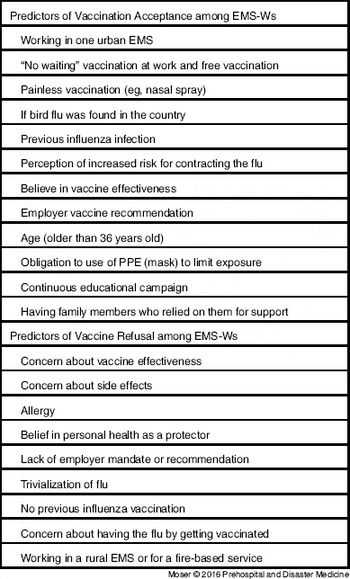
Only a few studies about vaccination rates have focused on EMS-Ws and most of these studies were prior to the H1N1 pandemic.Reference Thompson, Shay and Weintraub 2 , Reference Poland, Tosh and Jacobson 4 Differences in vaccination rates for SI vs PI have been described in some studies,Reference Poland, Tosh and Jacobson 4 , Reference Ottenberg, Wu, Poland, Jacobson, Koenig and Tilburt 19 , 25 but variations and determinants of vaccination for either of these types of influenza aren’t well-known in the prehospital EMS setting (Table 1). The main objective of this study was to observe if EMS-W vaccination rates had been influenced by the H1N1 pandemic and if vaccination rates were different for PI and SI. A second aim also was to identify potential specific factors promoting or limiting PI and SI vaccination rates.
Identified Vaccination Determinants of EMS-WsReference Thompson, Shay and Weintraub 2 , Reference Poland, Tosh and Jacobson 4 , Reference Bish, Yardley, Nicoll and Michie 29 , Reference Barnett, Levine and Thompson 30

Abbreviations: EMS, Emergency Medical Services; EMS-W, EMS workers.
Methods
Setting
This questionnaire-based survey was conducted from December 1, 2010 through January 21, 2011 in the two prehospital EMS sites serving the city of Lausanne, located in the French-speaking part of Switzerland, with a population of 130,000. The clinical guidelines, rules of operations, and safety regulations are enacted by the State authorities and are the same for the two EMS sites. For the purpose of analysis, the data of the two EMS were pooled.
According to the international guidelines, during the period under analysis, the local recommendations concerning influenza for EMS-Ws was to get vaccinatedReference King, Woolhandler and Brown 20 and to wear a surgical mask as PPE during the two weeks after vaccination or, if vaccination was declined by the HCW, to wear a mask at all times when tending to patients.Reference Masserey 21
Study Design
A standardized, multiple-choice, anonymous questionnaire (Appendix 1; available online only) was developed to collect demographic data, self-declared vaccination status against the 2009-2010 SI and/or the 2009 PI, and to evaluate the factors associated with vaccination against the 2009-2010 SI and/or the 2009 PI. The questions were based on a previous standardized questionnaire addressing the intra-hospital determinants of vaccination, 25 and on a review of the literature for specific questions related to EMS and EMS-Ws. Motives for accepting or refusing vaccination were assessed by a Likert scale, with results expressed as a mean on a 10-point scale. Questions assessing motivations were analyzed according to self-reported vaccinations status. All paramedics of the two EMS were asked to complete the survey, regardless of their level of certification or level of employment (part-time vs full-time). Study participation was voluntary, and all participants signed an informed consent. The Lausanne University Ethics Committee (Lausanne, Switzerland) and the officials from both EMS sites approved the protocol.
Statistics
The motives for acceptance or refusal of vaccination were dichotomized for the purpose of analysis (claimed motives on one side, unclaimed motives and neutral opinion pooled on the other side). Continuous data are expressed as mean and standard deviation (SD), whereas categorical data are presented as numbers and percentages. Differences between vaccination groups in normally distributed data and independent continuous variable were assessed using Student’s t-test or using one-way analysis of variance (ANOVA). In skewed data, the Mann-Whitney test was used, and for dependent continuous variables, the Wilcoxon rank sum test was used. Differences in proportion for categorical variables were analyzed using Fischer’s exact test. Differences for all analyses were considered statistically significant at two-tailed P<.05. Analysis was undertaken using Stata 13.1 (StataCorp; College Station, Texas USA).
Results
Population Description and Vaccination Rates
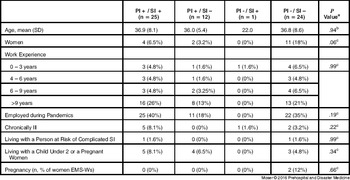
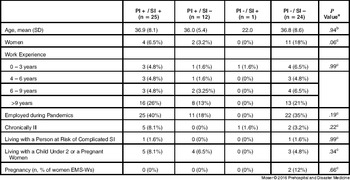
Sixty-five EMS-Ws were included in the study, with a 95% response rate (62/65). The population (Table 2) was composed of a majority of men (72%), with more than six years of work experience in 74%. Only 6.5% were not employed during the 2009 PI season. A minority of the EMS-Ws (13%) declared suffering from a chronic illness. While only two EMS-Ws (3.2%) declared living with a person at risk for an influenza complication, 19% (n=12) lived with a child under two years of age or with a pregnant woman at the time of the PI season. Two female EMS-Ws were pregnant during the PI season.
Characteristics of the Responders
Abbreviations: EMS-W, Emergency Medical Services worker; PI, pandemic influenza; SI, seasonal influenza.
a Group PI-/SI+ was excluded from analysis.
b ANOVA oneway with Bonferroni test.
c Fisher’s exact test.
Forty percent of the EMS-Ws declared to be vaccinated simultaneously for SI and PI (PI+/SI+), 19% for PI only (PI+/SI-), and 1.6% for SI only (PI-/SI+). Thirty-nine percent (n=24) of the EMS-Ws were not vaccinated at all (PI-/SI-). Compared with men, women’s vaccination rates were lower for both PI and SI, but these results were not statistically significant (PI+/SI+: 24% vs 47%; PI+/SI-: 12% vs 22%; PI-/SI-: 65% vs 29% in female and male EMS-Ws, respectively). The two pregnant women were not immunized for PI or SI. Amongst chronically ill EMS-Ws (n=8), five were PI+/SI+ (63%) and two were PI-/SI- (25%). Only one of the two EMS-Ws who declared living with a person at risk of influenza complications was PI+/SI+.
Past and Future Vaccination Status
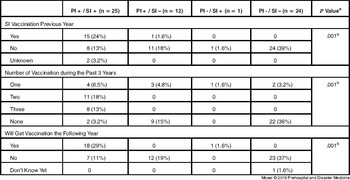
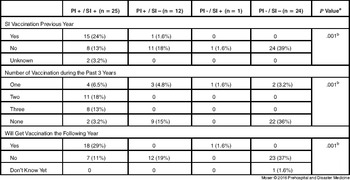
In terms of vaccination habits (Table 3), 92% of the PI+/SI+ EMS-Ws had received at least one SI vaccination during the previous three years, whereas only 8.3% of the PI-/SI- group got one (P=.001). Seventy-five percent of PI+/SI- EMS-Ws didn’t get any SI immunization during the previous three years.
Vaccinations Habits
Abbreviations: PI, pandemic influenza; SI, seasonal influenza.
a Group PI-/SI+ was excluded from analysis.
b Fisher’s exact test.
Compared with the preceding year, the SI vaccination rate increased globally from 26% to 42% during the H1N1 pandemic year (+62%). Specifically, in the PI+/SI+ group, the vaccination rate against SI increased by 40% in comparison with the preceding year.
Questioned about future vaccination, 30% of the PI+/SI+ EMS-Ws declared that they would not get vaccination during the following year. In the PI-/SI- and PI+/SI- EMS-W groups, no one was willing to be vaccinated in the future.
Positive Determinants of Vaccination Status
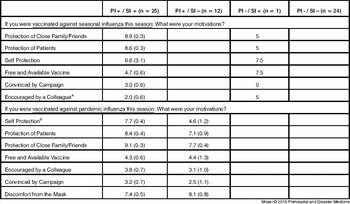
For PI+/SI+ EMS-Ws, “protection of close family or friends” and “protection of patients” were the two main reasons for getting vaccinated against SI (Table 4), with mean values of 8.9 on the Likert scale (protection of close family or friends) and of 8.6 (protection of patients), respectively. For them, “protection of close family or friends” and “protection of patients” were also the two main motivations for vaccination against PI, with mean values of 9.1 on the Likert scale (protection of close family or friends) and of 8.4 (protection of patients), respectively.
Positive Determinants for SI and PI Vaccination
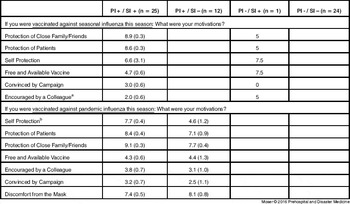
Data are expressed as mean of all opinion on the Likert scale and standard deviation (SD). P<.01 for peer example (« Encouraged by a Colleague ») as motivation to get vaccination PI vaccination in the PI+/SI+ group. P<.01 for self protection motivation concerning the PI vaccination between both groups.
Abbreviations: PI, pandemic influenza; SI, seasonal influenza.
a t test q11 vs q17, for PI+/SI+.
b t test q17 PI+/SI+ vs q17 PI+/SI-.
A significant difference on the Likert scale (P<.01) was found for “self-protection against PI” as a motivation factor for the PI+/SI+ group (7.7; SD=0.4) vs PI+/SI- group (4.6; SD=1.2).
For the EMS-Ws only vaccinated against PI (PI+/SI-), the discomfort from the mandatory surgical mask wearing policy was the most important motivation (mean Likert scale: 8.1; SD=0.8). For the EMS-Ws with complete immunization (PI+/SI+), this discomfort appeared less important but was present (7.4; SD=0.5).
Peer model (“encouraged by a colleague”) had limited impact and was rated higher for PI vaccination (3.8; SD=0.7) than for SI vaccination (2.0; SD=0.6; P<.01).
The other potential positive determinants of vaccination (easy access, free vaccination, and information campaigns) were not considered relevant by EMS-Ws and were not statistically different between PI+ and SI+ groups.
Negative Determinants of Vaccination Status
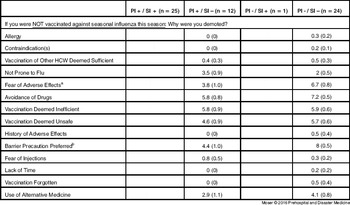
In the PI-/SI- group, the “preference for barrier precaution” was the main justification to reject SI vaccination (8.0; SD=0.5 on the Likert scale) or PI vaccination (7.8; SD=0.6; Table 5). This negative determinant was less important for PI+/SI- EMS-Ws (P<.01). For the PI-/SI- EMS-Ws, the two other main negative determinants against SI were “avoidance of medication” (7.2; SD=0.5) and “fear of adverse effects” (6.7; SD=0.8). The main negative determinants for the pandemic influenza vaccination were “avoidance of drugs” (6.8; SD=0.6), “fear of adverse effects” (6.0; SD=0.8), and “vaccination deemed unsafe” (6.0; SD=0.7). The “fear of adverse effects” was significantly less prominent for PI+/SI- EMS-Ws (3.8; SD=1.0) than for PI-/SI- EMS-Ws (6.7; SD=0.8; P<.05).
Negative Determinants of SI and PI Vaccination
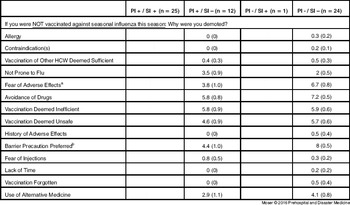
Data are expressed as mean of all opinion on the Likert scale and standard deviation (SD). P<.05 for fear of adverse effects between both groups and P<.01 concerning barrier precaution (use of PPE) to avoid vaccination between both groups.
Abbreviations: HCW, health care worker; PI, pandemic influenza; PPE, personal protection equipment; SI, seasonal influenza.
a P<.05.
b P<.01.
Finally, concerns about effectiveness (“vaccination deemed ineffective”) and safety (“vaccination deemed unsafe”) of vaccines were two other negative determinants, especially for PI-/SI- EMS-Ws (Table 5). The other negative determinants of vaccination were not considered relevant by EMS-Ws and were not statistically different between PI and SI vaccinations.
Additional Comments
Analysis of comments showed similar positive determinants (self protection, n=2; and protection of close family, n=2) and some additional positive arguments (peer pressure, n=4; and free-of-charge vaccination, n=1). Comments related to negative determinants included mistrust against the pharmaceutical industry (n=4), fear of adverse effects (n=3), and vaccination deemed unsafe or unnecessary (n=3).
Attitude Towards the Scenario of a Hospitalized Relative
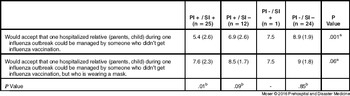
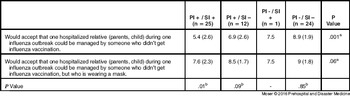
The PI-/SI- EMS-Ws largely agreed with the assertion that they would accept that a family member could be managed by an HCW who didn’t get influenza vaccination (8.9; SD=1.9; Table 6). The acceptance rate towards this assertion was lower for PI+/SI- EMS-Ws (6.9; SD=2.6) and for the PI+/SI+ EMS-Ws (5.4; SD=2.6; P=.01).
Attitude toward Immunization und Mask in the Scenario of a Hospitalized Relative
Abbreviations: PI, pandemic influenza; SI, seasonal influenza.
a ANOVA oneway test.
b t test.
For PI-/SI- EMS-Ws, the result remained unchanged if the HCW wore a surgical mask (9.0; SD=1.8). In opposite, the acceptance rate improved for the PI+/SI+ EMS-Ws if a facemask was worn (7.6; SD=2.3; P=.01).
Fairness of a Mandatory Surgical Mask Wearing Policy
When asked about the fairness of the new surgical mask wearing policy for unvaccinated EMS-Ws, the PI+/SI- EMS-Ws scored only 3.5 (SD=3.4) points on the Likert scale, significantly less than the PI-/SI- EMS-Ws (6.4; SD=3.2; P=.02) or the PI+/SI+ EMS-Ws (7.0; SD=3.4; P=.01). All EMS-W groups agreed on the fact that the surgical mask was hard to wear on duty, without any statistical difference between vaccination statuses.
Discussion
Rates of Vaccination and Differences between PI and SI Vaccination
This study shows that a minority of EMS-Ws were vaccinated against SI (42%). The vaccination rate was higher for PI (60%). The rates of vaccination for PI and SI were lower in women EMS-Ws, but these differences were not statistically significant. A simultaneous vaccination against both types of influenza was observed in only 40% of the cases. Interestingly, 39% of the EMS-Ws declared not to be vaccinated against either.
The global vaccination rate against SI is low in this study, but remains within the range of the results observed in previous publications about EMS-Ws.Reference Thompson, Shay and Weintraub 2 , Reference Poland, Tosh and Jacobson 4 Compared with the vaccination rates observed in the HCWs of the Lausanne University Hospital (Lausanne, Switzerland), or in other emergency services,Reference Thompson, Shay and Weintraub 2 , 25 , Reference Hugli, Dorribo, Lazor-Blanchet and Zanetti 26 the vaccination rates of these EMS-Ws were lower for both PI and SI.
In this study, EMS-Ws were mainly young, healthy men and only a minority of them reported living with a person at risk of complicated influenza. Nevertheless, one in five declared living with a child less than two years of age or with a pregnant woman. These results therefore suggest an incomplete knowledge and a potential misunderstanding, combined with a trivialization about the risk, of influenza. These results are a source of concern as they pertain to HCWs involved in acute care of vulnerable, elderly, or pediatric patients.
Interestingly, compared with the previous year, the occurrence of the PI was associated with a 1.6-fold increase in the SI vaccination rate. This effect was observed predominantly in the PI+/SI+ group, showing a 40% increase of the vaccination rate against SI in comparison with the previous year. This “pandemic effect” has been described previously in the literatureReference Dorribo, Hugli, Lazor-Blanchet and Zanetti 27 , Reference Prematunge, Corace, McCarthy, Nair, Pugsley and Garber 28 and may be related to the fear of adverse events – directly in line with the mediatization of the PI – or with the facilitated access to free SI vaccination and to both SI and PI vaccinations. At the same time, a “pandemic peer pressure” was also identified as a significant positive determinant for PI vaccination.
Positive and Negative Determinants of Vaccination
The analysis of the positive determinants of vaccination revealed that altruism remained the main motivation to get SI or PI vaccination, a result that was consistent with results of the literature.Reference Thompson, Shay and Weintraub 2 , Reference Poland, Tosh and Jacobson 4 , Reference Bish, Yardley, Nicoll and Michie 29 , Reference Barnett, Levine and Thompson 30 “Self-protection against PI” was rated lower in the PI+/SI- group than in the PI+/SI+ group. Again, these results raise the question of the trivialization of the influenza infection, particularly for PI, in the PI+/SI- EMS-Ws. This difference may also be explained by the surgical mask wearing policy. Getting the vaccination to avoid the surgical mask may therefore appear as an indirect positive determinant of vaccination in the PI+/SI- subgroup. Others positive determinants, including an information campaign or a history of a previous influenza infection, weren’t relevant for these EMS-Ws.
Even if the surgical mask policy played a positive role towards vaccination, it was also the main negative determinant of vaccination in this study, particularly for PI-/SI-EMS-Ws. In this context, the surgical mask policy may impact the vaccination strategy adversely, providing an alternative to the vaccination. The other main negative determinants of vaccination included avoidance of medication, fear of adverse effects, and concerns about safety and effectiveness of the vaccination. These elements corroborate previous studies about HCWs,Reference Thompson, Shay and Weintraub 2 , Reference Barnett, Levine and Thompson 30 - Reference Salgado, Giannetta, Hayden and Farr 32 revealing serious doubts regarding adverse effects and distrust towards the pharmaceutical industry. These reservations may have been enhanced by the presence of adjuvants in one of the PI vaccines. They illustrate a profound fear and anxiety to serve as “guinea pig” for a “new” vaccine, which only benefited from a short period of development.Reference Heimberger, Chang, Shaikh, Crotty, Morse and Birkhead 33 , Reference Smith, Burkle, Holman, Dunlop and Archer 34
EMS-W Vaccination Profiles
More than 90% of the PI+/SI+ EMS-Ws received at least one SI vaccination during the previous three years, whereas only 8.3% of the PI-/SI- group did. For the following influenza epidemics, 30% of the PI+/SI+ EMS-Ws declared that they would not get vaccinated, whereas in the EMS-Ws in the PI-/SI- group or in the PI+/SI-, no one was willing to be immunized. These results therefore confirm that the previous vaccination status is a significant determinant of future vaccination acceptance or refusal.
Analysis of behaviors toward vaccination reveals three distinct groups previously described in the literature.Reference Thompson, Shay and Weintraub 2 , Reference Poland, Tosh and Jacobson 4 , Reference Hubble, Zontek and Richards 5 The first is globally favorable to the vaccination strategy (were vaccinated, are vaccinated during the period of observation, and according to official recommendations, will be vaccinated). In this study, they represent a disappointingly small group (40%) of the EMS-Ws. The second one is exactly at the opposite. This group more frequently involved women and shared a profound suspicion of the pharmaceutical industry. These EMS-Ws particularly are reluctant toward vaccinations, more prone to trivialization, and less easily reached by the recommendations and education policies about influenza vaccination. Coercion remains an option, but as demonstrated by the mask policy, may produce unpredictable results. The last one is composed of EMS-Ws who traditionally reject SI vaccination, but accept to be vaccinated against PI, and for convenience, against both PI and SI. This group is more heterogeneous and may be called the “pandemic effect group” (the majority of them didn’t get a vaccination during the previous years but at this point did due to the pandemic context). This group of people may also explain the significant increase in the global rate of SI vaccination, in comparison with the previous year. Unfortunately, most of the EMS-Ws of this group are not disposed to get vaccinated during the next flu season. This fact should be put into perspective with the limited number of PI cases and disproportionate media coverage. This group is more volatile and might be influenced more easily. The public health care challenge within this group is therefore to educate and to motivate them to get vaccinated in the next years, even without the pandemic context.
New Surgical Mask Wearing Policy
The new surgical mask wearing policy was a double-edged sword. On one side, it was a significantly positive determinant of PI vaccination, but on the other side, offered an alternative to the vaccination for EMS-Ws tending to reject the influenza vaccination. Even if this policy had a positive impact on the vaccination rate, it isn’t considered fair by a majority of these EMS-Ws. Furthermore, the question of compliance with such a policy constitutes another challenge, as it’s well known that EMS-Ws are not compliant with infection control recommendations in general.Reference Hubble, Zontek and Richards 5 , Reference Emanuelsson, Karlsson, Castrèn and Lindström 7 , Reference Goodman and Cone 8 This risk is strengthening by the fact that a large majority of these EMS-Ws expressed doubts about the acceptability of a surgical mask in the field.
Limitations
This study has some limitations. The small sample size and monocentric design reduce the external validity of the results; however, these findings are supported by studies in other settings.Reference Thompson, Shay and Weintraub 2 , Reference Poland, Tosh and Jacobson 4 , Reference Hubble, Zontek and Richards 5 , Reference Dorribo, Hugli, Lazor-Blanchet and Zanetti 27 - Reference Smith, Burkle, Holman, Dunlop and Archer 34 In the self-administered questionnaire, vaccination rates were self-reported and not verified by vaccination logs. Face-to-face interviews, on the other hand, could have led to a social desirability bias.
Conclusion
The EMS-W immunization rates observed in this study are not sufficient to prevent the spread of influenza to uninfected transported patients and can contribute to nosocomial influenza transmission. This issue needs to be addressed, as it implies a high-risk situation for the operation of the prehospital emergency medical system in this region, especially in case of a new pandemic. Therefore, one of the public health challenges for the coming years is to increase the proportion of EMS-Ws getting influenza vaccinations every year. One part of the solution is to develop specific educational campaign targeting EMS-Ws. A surgical mask wearing policy should be presented as a solution of last resort for EMS-Ws who have contra-indications to vaccination, versus an acceptable alternative.
Acknowledgement
The authors wish to acknowledge Dr. Geneviève Bois, MD, University of Montréal (Montréal, Québec, Canada), for her corrections of the script.
Supplementary Material
To view supplementary material for this article, please visit http://dx.doi.org/ 10.1017/S1049023X16000121