The occurrence of postoperative infections has declined due to implementation of a variety of evidence-based practices and guidelines, but surgical site infections (SSIs) and bloodstream infections (BSIs) remain serious complications and sources for other postoperative infections after orthopedic surgeries,Reference Weiner, Webb and Limbago1–Reference Fowler, Justice and Moore4 particularly those related to internal fixation hardware and joint prostheses.Reference Segreti, Parvizi, Berbari, Ricks and Berrios-Torres5–Reference Kurtz, Lau, Watson, Schmier and Parvizi14 Although other organisms can be responsible,Reference Weiner, Webb and Limbago1–Reference Segreti, Parvizi, Berbari, Ricks and Berrios-Torres5 staphylococci are the most commonly isolated microorganisms,Reference Winkler15 and two-thirds of implant-related orthopedic infections due to S. aureus (methicillin-susceptible and -resistant) and coagulase-negative staphylococci (S. epidermis).Reference Ribeiro, Monteiro and Ferraz6
Most of the available data about SSIs and BSIs following orthopedic surgeries and responsible organisms are specific to inpatient surgeries, primarily from single academic institutions.Reference Anderson, Arduino and Reed16 Less is known about SSIs and BSIs after outpatient surgeries, even though more of these procedures have been performed in this setting in recent years. Additionally, overall postoperative infection incidence data, including respiratory infection and UTI data, are limited. Information on the burden of postoperative infections due to S. aureus would help inform novel prevention efforts, such as vaccination prior to planned procedures. This descriptive study builds on a previous study that utilized this administrative hospital database to estimate the incidence of S. aureus infections after a wide range of surgeries.Reference Dreyfus, Yu, Begier, Gayle and Olsen17 In contrast to the previous publication, we present these findings in the context of orthopedic procedures, and we examine the etiology of infection outside S. aureus. We determined (1) the incidence and timing of S. aureus infections after inpatient and outpatient-based orthopedic surgeries performed during elective admissions or visits; (2) the proportions of SSIs, BSIs, and other types of S. aureus infections; and (3) the etiology of SSIs and BSIs outside S. aureus occurring in the postoperative period in these settings.
Methods
This observational retrospective study used data from the Premier Healthcare Database (PHD), a large, geographically diverse, hospital-based, service-level, all-payer administrative US database containing discharge information from inpatient and hospital-based outpatient visits.18 All data were deidentified. Our procedures complied with the Health Insurance Portability and Accountability Act, and the study was considered exempt from institutional review board oversight.
The study included adults aged ≥18 years who underwent inpatient or hospital-based outpatient orthopedic surgeries during an elective admission (as defined on the UB04 hospital claims form) between July 1, 2010, and June 30, 2015, in one of the hospitals continuously reporting microbiology laboratory culture data to the PHD (Supplementary Fig. A, Attrition Diagram, online). Exclusions included admission type other than elective, discharges with surgeries performed >2 days after admission, transfers from acute care, emergency department charges, or S. aureus infections present on admission.
Surgery and infection definitions
The 17 orthopedic surgeries in this study (Supplementary Fig. B online) were defined based on International Classification of Disease, Ninth Revision, Clinical Modification (ICD-9-CM) procedure and current procedural terminology (CPT) codes using the National Healthcare Safety Network (NHSN) categories and other relevant surgeries identified by a coauthor (M.A.O.). All analyses were conducted at the discharge level, with 1 index surgery performed on day 1 or day 2 per visit assigned to the denominator. If multiple orthopedic surgeries were performed, the surgery with the highest priority risk for infection (Supplementary Fig. B online) was chosen as the index surgery. Identification of BSIs and SSIs was based on evidence of venipuncture and wound culture, respectively, along with ICD-9-CM/ICD-10-CM diagnosis codes (Supplementary Fig. B online).
We categorized S. aureus infections into mutually exclusive groups based on the following hierarchy: BSI > SSI > all other types (respiratory infection, UTI, uncertain invasive infection, and/or all other uncertain sites). Causative microorganisms for BSI and SSI were identified to determine the proportion of these infections caused by S. aureus. If multiple organisms were present, the patient was counted in each microorganism group. If a patient had multiple cultures of the same microorganism within 180 days of the procedure, the microorganism was counted only once. Incident S. aureus infections were summarized overall, by infection category for each surgery, and by inpatient and outpatient procedures. The incidence of S. aureus per 100 surgical discharges was calculated during hospitalization for inpatients, and at 30, 90, and 180 days. Details about the database, microbiology data collection, identification and incidence of S. aureus infections for the inpatient and outpatient settings at 30, 90, and 180 days have been published in detail elsewhere.Reference Dreyfus, Yu, Begier, Gayle and Olsen17
Statistical analyses
Continuous variables expressed as mean and standard deviation or median and interquartile range (IQR) were compared using t tests or Wilcoxon rank-sum tests. Categorical variables summarized as counts and percentages were compared with χ2 tests. All analyses were performed using SAS version 9.4 software (SAS Institute, Cary, NC), and statistical significance was defined as P < .05.
Results
Patient and hospital characteristics
Overall, 651,279 orthopedic surgical discharges met our inclusion criteria; 359,268 (55.2%) in the inpatient setting and 292,011 (44.8%) in the hospital-based outpatient setting (Table 1). Within 180 days after surgery, there were 4,046 (1.13%) culture-confirmed S. aureus infections after inpatient surgeries and 2,299 (0.78%) culture-confirmed S. aureus infections after outpatient surgeries. Regardless of setting, patients with versus without S. aureus infections were less often female, had higher comorbidity scores, were more often discharged to another acute facility, had government health insurance, and were treated at larger hospitals (ie, >300 beds), rural-serving hospitals, and Southern-region hospitals (all P < .001). Inpatients with versus without infections were more often African American, and outpatients with infections were less often treated in teaching hospitals (both P < .001).
Patient and Hospital Characteristics for Inpatients and Outpatients Without and With Staphylococcus aureus Infections Within 180 Days After Orthopedic Surgery

a All differences between those with/without S. aureus infections were statistically significant at P < .001, except for teaching hospital for inpatients (P = .5354).
Infection outcomes
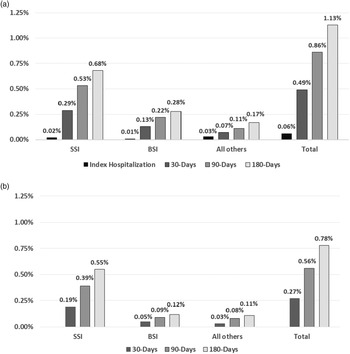
SSIs comprised 2430 (60%) of 4046 S. aureus infections after inpatient surgeries, and 1610 (70%) of 2299 S. aureus infections after outpatient surgeries. BSIs comprised 1,016 (25%) of 4,046 orthopedic postoperative infections after inpatient surgery and 335 (15%) of 2,299 after outpatient surgery. All other types of infections comprised 600 (15%) of 4,046 orthopedic postoperative infections after inpatient surgery and 354 (15%) of 2,299 after outpatient surgery. Also 1,858 (46%) of 4,046 of all S. aureus infections after inpatient surgery were due to MRSA and 1,018 (44%) of 2,299 after outpatient surgery were due to MRSA. Most S. aureus infections were identified between 31 and 180 days after surgery in both operative settings (Fig. 1, a and b). By 180 days, the total incidence of S. aureus infections was almost 1.5-fold higher after inpatient orthopedic surgeries than after outpatient orthopedic surgeries.
Staphylococcus aureus cumulative incidence by infection type and timing after inpatient (a) and outpatient (b) orthopedic elective surgery. Bar graphs of S. aureus surgical site, bloodstream, and other infection types (respiratory, urinary tract infection (UTI), uncertain invasive, and/or all other uncertain sites), and total infections represent the temporal cumulative postoperative incidence through 180 days after (a) inpatient and (b) hospital-based outpatient orthopedic surgical discharges.

The overall median days to positive culture collection for S. aureus infections was longer for outpatient versus inpatient orthopedic surgeries: 51 (interquartile range [IQR], 23–103) versus 36 (IQR, 19–85) (P < .0001). The largest difference in median days to positive culture collection was for SSIs: 54 (IQR, 23–104) versus 35 (IQR, 20–81) (P < .0001). The median days to positive culture collection for BSIs were 52 (IQR, 23–103) for outpatient surgeries and 36 (IQR, 20–86) for inpatient surgeries (P = .009). For all other infections, the median days to infection were 60 after outpatient surgeries (IQR, 29–106) and 49 days (IQR, 17–107) (P = .0025) after inpatient surgeries.
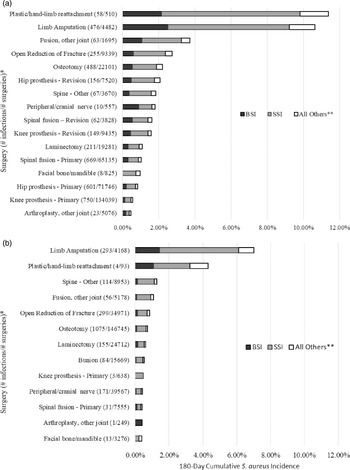
Figures 2a and 2b show the 180-day incidence of S. aureus BSIs, SSIs, and other infections for the 17 included orthopedic surgeries. Hand-limb reattachments and amputations had the highest S. aureus infection incidence overall among inpatient surgeries (11.38% and 10.62%, respectively) and outpatient surgeries (4.30% and 7.03%, respectively), as described previously.Reference Dreyfus, Yu, Begier, Gayle and Olsen17 In the inpatient setting, primary knee prostheses had both the highest volume of surgeries and number of S. aureus infections, followed by primary hip prostheses in terms of surgical volume and by primary spinal fusions for number of S. aureus infections. In the outpatient setting, osteotomies had both the highest volume of surgeries and S. aureus infections, as described previously.Reference Dreyfus, Yu, Begier, Gayle and Olsen17 The next-highest surgical volume was peripheral or cranial nerve surgery, but open reduction of fractures had the next-highest number of S. aureus infections. SSIs made up the majority of S. aureus infections across surgery types, although these proportions varied across orthopedic surgeries.Reference Dreyfus, Yu, Begier, Gayle and Olsen17
Staphylococcus aureus infection incidence up to 180 days after selected (a) inpatient and (b) outpatient orthopedic surgeries. Stacked bar graphs of S. aureus surgical site, bloodstream, and other infection types (respiratory, urinary tract infection (UTI), uncertain invasive, and/or all other uncertain sites) at 180 days after (a) inpatient and (b) hospital-based outpatient orthopedic surgical discharges with the highest infection incidence identified from the microbiology reporting hospitals between July 1, 2010, and June 30, 2015.

Other microorganisms
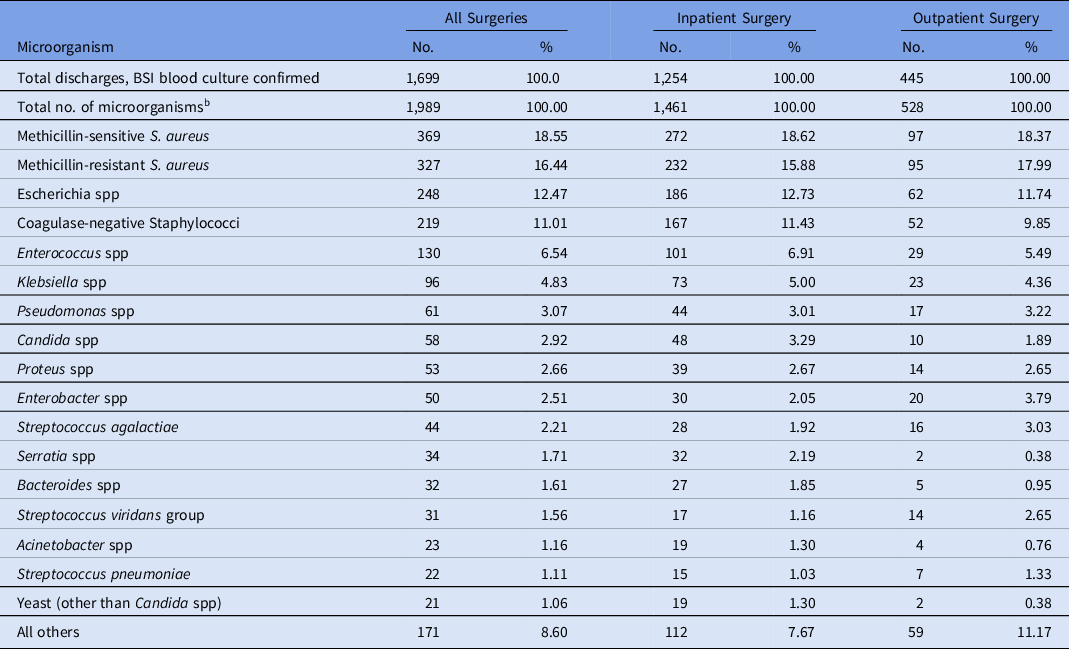
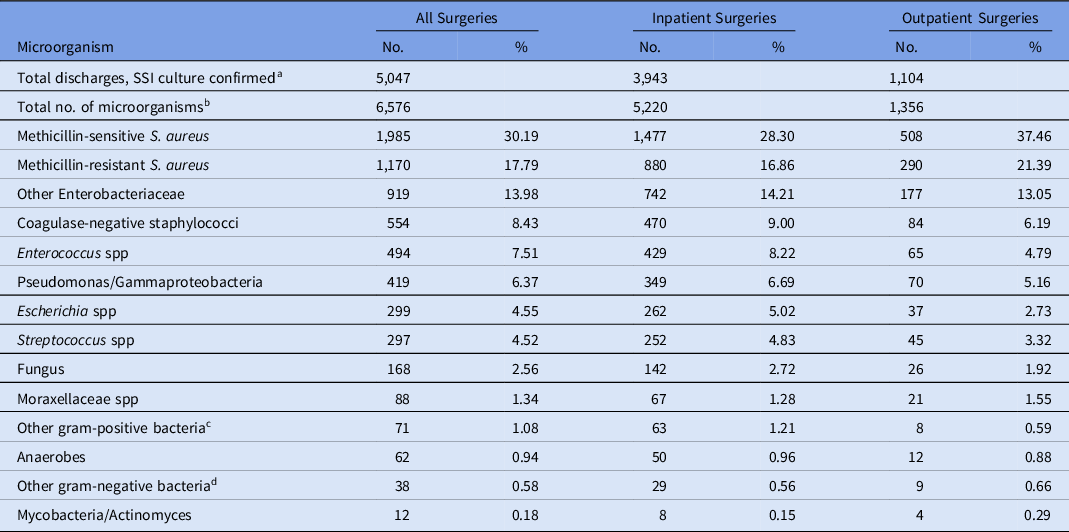
Table 2 shows the microorganism distribution among culture-confirmed BSIs identified within 180 days after surgery. S. aureus was the most commonly identified microorganism, comprising 35% of BSIs (19% MSSA and 16% MRSA), followed by Escherichia spp (12%), and coagulase-negative staphylococci (11%). The distribution of SSI microorganisms is displayed in Table 3. S. aureus comprised the largest proportion of culture-positive SSIs (48%; 30% MSSA and 18% MRSA), followed by other Enterobacteriaceae (14%), and coagulase-negative Staphylococcus (8%). These rankings were consistent across inpatient and outpatient surgeries, but a higher proportion of isolates were S. aureus after outpatient surgeries (58%; 37% MSSA and 21% MRSA) compared with inpatient surgeries (45%; 28% MSSA and 17% MRSA).
Distribution of Microorganisms Associated with Culture-Positive Bloodstream Infection Within 180 Days of Inpatient and Outpatient Orthopedic Surgeriesa

a Listing of microorganisms with frequency >1%.
b Some patients had >1 microorganism type. Among all surgical discharges with positive blood cultures 236 (14%) had >1 microorganism, and 85 (5%) had S. aureus plus at least 1 other microorganism (inpatient surgeries: 170 (14%) had >1 microorganism, and 61 (5%) had S. aureus plus at least 1 other microorganism; outpatient surgeries: 66 (15%) had >1 microorganism, and 24 (5%) had S. aureus plus at least 1 other microorganism).
Distribution of Microorganisms Associated With Culture-Positive Surgical Site Infections (SSIs)a Within 180 Days of Orthopedic Surgeries

a Positive wound culture among patients with at least 1 ICD-9 or ICD-10 code listed in Supplementary Fig. C (online).
b Some patients had >1 microorganism type. Among all discharges with positive cultures, 1,125 (22%) had >1 microorganism, and 667 (13%) had S. aureus plus at least 1 other microorganism: inpatient surgeries, 945 (24%) had >1 microorganism and 550 (14%) had S. aureus plus at least 1 other microorganism. Among outpatient surgeries, 180 (16%) had >1 microorganism, and 117 (11%) had S. aureus plus at least 1 other microorganism.
c Includes other staphylococci (n=70), Rothia (n=1).
d Includes Haemophilus spp (n=15), Pasteurella spp (n=7), Eikenella spp (n=5), Alcaligenes spp (n=5), Sphingomonas spp (n=4), Bordetella spp (n=1), and Veillonella spp (n=1).
Discussion
We examined orthopedic procedures occurring during elective admissions, and hospital visits had a higher incidence of S. aureus infections after inpatient surgeries versus hospital-based outpatient orthopedic surgeries. More than half of these infections were identified postoperatively between 31 and 180 days, and many of these infections occurred in a variety of orthopedic surgeries not subject to national surveillance, such as osteotomy and limb reattachment.20 These findings demonstrate the need for longer-term infection surveillance after orthopedic surgery. SSIs and BSIs were the most common type of S. aureus infection, and MRSA comprised nearly half of S. aureus infections in both surgical settings. These findings are similar to our previous findings for other surgical procedures using the same database.Reference Dreyfus, Yu, Begier, Gayle and Olsen17 Although this study was not designed to examine risk factors per se, patients with postoperative infections had higher comorbidity scores at the index surgical visit, and some underlying comorbidities (eg, diabetes) may place patients at higher risk for both the surgeries as well as subsequent infections.
Few multicenter studies report overall S. aureus incidence results specific to orthopedic surgeries. In a study of 9 community and 2 tertiary-care hospitals from 2 southern US states, Anderson et alReference Anderson, Arduino and Reed16 assessed invasive S. aureus infections in 57,748 orthopedic patients undergoing prosthetic implant (ie, knee, hip, or other), open reduction of fracture, amputation, or other musculoskeletal surgeries between 2003 and 2006. SSIs were identified from validated surveillance databases and BSIs from hospital microbiology databases. The overall S. aureus infection incidence was 0.37%, with incidences of 0.27% for SSI, 0.13% for BSI, and 0.03% for both. MRSA was responsible for 54% of all invasive S. aureus infections, including 65% of the BSI. These rates of infection may be lower for several reasons: (1) only deep and organ-space SSIs and BSIs were included rather than all S. aureus infections as was done in our study and (2) the SSI analysis utilized only NHSN SSI surveillance data, which may have involved some level of under-ascertainment.
Prosthetic joints account for much of the orthopedic surgical literature on invasive S. aureus SSIs and BSIs. Arduino et alReference Arduino, Kaye and Reed21 assessed 13,719 patients who underwent hip or knee arthroplasty from the multicenter study by Anderson et al.Reference Anderson, Arduino and Reed16 The incidences of invasive S. aureus infection were 0.57% after knee arthroplasty and 0.83% after hip arthroplasty (which are very similar to our findings of 0.53% and 0.84%, respectively), and MRSA was responsible for 45% of the knee and 61% of hip infections.
The earlier median time to onset of infections after inpatient versus outpatient procedures in the present study most likely reflects ongoing risk of infection in the hospital setting, or possibly earlier detection. Anderson et alReference Anderson, Arduino and Reed16 reported a median onset of invasive S. aureus infection of 24 days for all orthopedic surgeries and 29 days for invasive S. aureus infections involving prosthetic implants. A study of >11,000 orthopedic surgeries from 2002 to 2007 at a single US ambulatory surgical center found an overall 30-day SSI rate of 0.33%,Reference Edmonston and Foulkes22 but causative microorganisms and time to infection were not reported. Nonetheless, this is one of few studies specific to outpatient orthopedic procedures.
Although MSSA and MRSA combined accounted for 35%–49% of the cultured BSIs and SSIs overall in the present study, coagulase-negative staphylococci accounted for 11% of BSIs and 9% of SSIs. Similarly, in a report of hospital-associated infections reported to the NHSN, 44% of SSIs after orthopedic surgeries were associated with S. aureus and 13% were associated with coagulase-negative staphylococci.Reference Weiner, Webb and Limbago1 The 2011 NHSN surveillance report stated that S. aureus accounted for 37%–47% of SSIs after hip and knee arthroplasties, whereas coagulase negative staphylococci were responsible for 11%–17% of SSIs.Reference Segreti, Parvizi, Berbari, Ricks and Berrios-Torres5 A Finnish study from a tertiary-care hospital reported S. aureus as the predominant causal microorganism (73%) of postsurgical secondary BSIs in orthopedic patients.Reference Skogberg, Kontula, Jarvinen and Lyytikainen3
The current study was limited by the ability to identify orthopedic surgeries using ICD-9/ICD-10 and/or CPT codes. The specific type of S. aureus infection may have been misclassified if hospital charges or culture results were incomplete or were insufficiently detailed to determine the source of infection. Ascertaining postsurgical infections relied on patients returning to the same hospital for follow-up care; thus underestimation of incidence and infections that occurred >180 days after surgery may have occurred. Furthermore, a positive bacterial culture was needed to identify the pathogen; if a postoperative infection had a negative culture or was not cultured, it was not captured here. ICD-9-CM/ICD-10-CM codes were used to identify SSIs for the analysis of all microorganisms. Although we may have underestimated total SSIs, our microorganism distribution was similar to that reported by the NHSN.Reference Weiner, Webb and Limbago1 Despite our use of older data from 2010 and 2015, these results remain relevant because little has changed in terms of infection control practices in the interim suggesting the need for additional preventive measures. Finally, the PHD is a convenience sample of hospitals, and results may not be generalizable across all US hospitals and patient populations. Nonetheless, administrative databases facilitate evidence-based and population-based analyses.
The main strength of our study was the use of infection data based on microbiology results in a large cohort of patients from a diverse group of US hospitals. Use of laboratory results allowed classification of culture-confirmed postsurgical infections by microorganism. The PHD provided insights into the characteristics of the surgeries and S. aureus infections for patients with all types of primary payers in both inpatient and hospital-based outpatient settings. Finally, inclusion of 17 orthopedic surgical categories makes this one of the most comprehensive studies of postsurgical S. aureus infections after orthopedic surgeries.
In conclusion, the use of a large national hospital database has highlighted the burden of postoperative S. aureus infections following a variety of orthopedic surgeries performed in the inpatient and hospital-based outpatient settings. Staphylococcus aureus remains a major cause of post-surgical infections, even in clean nontraumatic orthopedic surgeries. The changes in delivery of health care with more surgeries performed in the outpatient setting highlights the need to develop standardized methods for surveillance of postsurgical infections after outpatient orthopedic surgeries. Our findings indicate that other actionable strategies to decrease infection rates are warranted, such as decolonizing individuals at higher risk of infection prior to surgery. Development of a vaccine to administer before planned procedures has great potential to protect against not only multiple types of S. aureus infections but also for prolonged time after surgery.
Acknowledgments
We thank Alvaro Quintana for contributing to the study design and guidance on interpretation of the results and Carol Cohen, an employee of Premier, Inc, for medical writing and editing contributions. We thank Ning Rosenthal for providing consultation on identification of infections in the Premier Healthcare Database. Jessica Chung, Jake Gundrum, John House, and Roberta James from Premier provided programing and statistical support for this project.
Financial support
The study was performed by Premier Applied Sciences, Premier, Inc, Charlotte, NC, with funding from Pfizer.
Conflict of interest
J.D. was an employee and shareholder of Premier, Inc, at the time of this work, and is currently employed by Avalere. J.G. is currently an employee and shareholder of Premier, Inc. H.Y. and E.B. are employees and shareholders of Pfizer. M.A.O. is a paid consultant by Pfizer, working for the Washington University at St Louis.
Supplementary material
To view supplementary material for this article, please visit https://doi.org/10.1017/ice.2021.65