Implications
Dietary fiber is the main constituent of rabbit feed, usually ranges from 150 to 500 g/kg, but the price of traditional fiber like alfalfa, mugwort and rice hull are rising sharply. Therefore, alternatives are required to produce balanced pelleted feeds using local raw materials, available at a lower price. This study aimed to assay that if oat hulls (OH) can satisfactorily replace traditional fiber source in diets for growing-fattening rabbits.
Introduction
The rabbit is a small-sized mono-gastric herbivorous animal and fiber is one of the main constituents of diets for intensively reared rabbits (de Blas et al., Reference de Blas and Mateos1999).The type and inclusion level of fiber sources determine the quality of rabbit diets (de Blas et al., Reference de Blas and Mateos1999). Rice hulls and mugwort (RHM) is the fiber source common utilized in diet formulation for the fattening rabbit, but the price of mugwort is rising sharply. Therefore, alternatives are required to produce balanced pelleted feeds using local raw materials, available at a lower price.
Oats (Avena sativa L.) are a major cereal worldwide and the sixth cereal grain after maize, rice, wheat, barley and sorghum (Food and Agriculture Organization, 2011). Oat cultivation yields two main by-products: oat straw, the vegetative residue after grain harvest, and OH. OH is considered as a source of fiber for ruminants and rabbits and is often compared with a low-quality roughage in terms of nutritive value (Fraser et al., Reference Fraser and McCartney2004). As a source of fiber, OH is a classic compound feed ingredient in commercial rabbit feeding, Maríaet et al. (2007) tested the effect of OH on digestion, intestinal microbiota and performance in 25-day-old weaned rabbits. Martínez et al. (Reference Martínez, Martínez, Ródenas, Moya, Cervera, Pascual and Blas2013) observed the effect of OH on ileal apparent digestibility and cecal environment in 17 to 35-day-old rabbits. David and John (1978) observed the effect of OH on New Zealand White rabbits between 5 and 8 weeks old, but the information related to the effect of the OH on fattening rabbits is scarce and insufficient to formulate practical recommendations. Thus, OH use as rabbit feed ingredients merits further investigation.
The objective of this study was to evaluate the use of OH to substitute traditional fiber in the diets of fattening rabbits by examining its effect on the growth performance, coefficient of total tract apparent digestibility (CTTAD) of nutrients, gastrointestinal tract development, cecum fermentation and carcass traits.
Material and methods
The study was approved by the Animal Welfare and Healthy Breed committee of Shandong province (Shandong, China) and performed in accordance with the ‘Guidelines for Experimental Animals’ of the Ministry of Science and Technology (Beijing, China).
Animal and diet
A total of 160 30-day-old weaned Hyla commercial meat rabbits (male–female ratio of 1 : 1) with average BWs (550±50 g) were used in this study. All rabbits were randomly divided into four groups (n=40, equal numbers of males and females per group) and fed with different experimental diets. Rabbits were individually housed in self-made metabolism cages (60×40×40 cm). The rabbits were provided with free access to water. During the trials, rabbits were housed in a closed and ventilated building in which the temperature was maintained at 17°C to 25°C and the relative humidity ranged from 50% to 60%. A cycle of 12 h of light: dark was used throughout this trial.
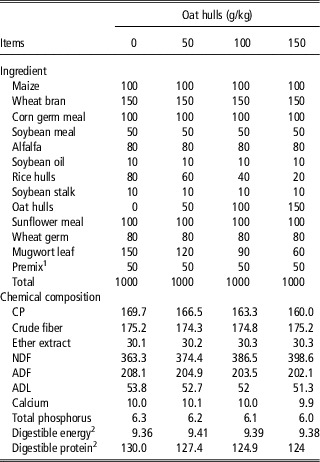
The diets (see Table 1) were formulated according to the values for growers from National Research Council (Reference Nicodemus, Carabaño, García, Méndez and de Blas1989) and de Blas and Mateos (Reference de Blas, García and Carabaño1998) and were pelleted by the use of pressure. The diameter of each pellet was 4 mm. The OH supplementation levels of the four experimental diets were 0, 50, 100 and 150 g/kg diet (as-fed basis), respectively.
Ingredients and chemical composition of the experimental diet (g/kg, as-fed basis)

1 The premix provided the following per kg of diet: Lys 1.5 g; Met 1.5 mg; Cu 50 mg; Fe 100 mg; Zn 50 mg; Mn 30 mg; Mg 150 mg; I 0.1 mg; Se 0.1 mg; vitamin A 12 000 IU; vitamin D 800 IU; vitamin E 50 g.
2 Calculated from digestibility coefficients obtained in the digestibility trial.
Experimental procedures
The feed was offered ad libitum and refilled at 0830 and 1730 h daily, residual feed was collected from the cages simultaneously. The total experiment consisted of a 5-day adjustment period followed by a 45-day experimental period including a 7-day (day 74 to day 80) collection of feces.
In addition, 40 additional rabbits at day 74 to day 80 of age were used in a digestibility trial to determine the CTTAD of CP, gross energy (GE), dry matter, ether extract (EE), NDF, ADF and ADL of the diets, following the European reference method (Perez et al., Reference Perez, Lebas, Gidenne, Maertens, Xiccato, Parigi-Bini, Dalle Zotte, Cossu, Carazzolo, Villamide, Carabaño, Fraga, Ramos, Cervera, Blas, Fernández, Falcao e Cunha and Bengala Freire1995). Feces and residual feed were collected from the metabolism cages. The CTTAD of CP, GE, EE, NDF and ADF, ADL of the diets, following the European reference method (Perez et al., Reference Perez, Lebas, Gidenne, Maertens, Xiccato, Parigi-Bini, Dalle Zotte, Cossu, Carazzolo, Villamide, Carabaño, Fraga, Ramos, Cervera, Blas, Fernández, Falcao e Cunha and Bengala Freire1995). Individual weight (with restriction of food and water) was measured at the beginning and end of the trial and the average daily gain (ADG) was calculated. The average daily feed intake (ADFI) was calculated according to total of food intake divided by total experimental days. The feed conversion ratio (FCR) was then calculated. The ADG, ADI and FCR calculations did not include the 5-day adjustment period.
At the end of the trial, eight rabbits per group were selected for the further examination based on the following criteria: equal ratio of males : females and the average BW of the eight rabbits was equal to the average BW of entire treatment group. Selected animals were electrically stunned (70 V, pulsed direct current, 50 Hz for 5 s) and killed by cervical dislocation at 1700 h. BW and carcass weight were measured. The hot carcass weight (weight of the carcass 15 to 30 min after slaughter) and dressing out percentage were calculated.
Meanwhile, the whole longissimus lumborum (LL, between the first and seventh lumber vertebra) was removed from the right side of each carcass. The LL was then divided into three sub-samples. One sub-sample was utilized for pH measurements at 45 min and 24 h. The second sub-sample was utilized for the measure of the muscle color (L*, a* and b*) and third sub-sample was utilized for the measure of cooking loss and shear force. The pH was measured on the LL with a Crison MicropH 2001(Crison Instruments, Barcelona, Spain) provided with a combined electrode and an automatic temperature compensator. The pH was measured by inserting the probe into the muscle and the values were obtained considering the average of three readings per meat sample. Meat color was measured at room temperature (20°C) using a portable Minolta CR-331 CMinolta Colorimeter (Min-olta Camera, Osaka, Japan) with D65 illuminant and 2° standard observer. The color values were obtained considering the average of three readings per meat sample. As for the cooking loss, each sample of the LL was weighed, placed in a vacuum sealed polyethylene bag, totally immersed in a constant temperature water bath and cooked at 80°C for 1 h to calculate the cooking losses. After cooking, the samples were cooled under running water for 30 min. The samples were then removed from the bags, blotted and weighed. The cooking losses were expressed as a percentage of the initial weight. The LL, cooked as described above, were cut into rectangular cross-section strips (1 cm thick×1 cm wide×3 cm along the fiber) and were sheared perpendicular to the muscle fiber direction using an Instron 5543 equipped with a Warner–Bratzler shear device (Instron Corporation, MA, USA) and cross-head speed set at 100 mm/min. The maximum force measured to shear the strips was expressed as Newtons.
After slaughter, the cecum was removed and weighed both with and without its contents. The following was calculated: cecum ratio (g/g)=cecum weight (g)/BW (g) and the cecum content ratio (g/g)=cecum content weight (g)/BW (g).
Chemical analyses
The protein content was obtained by the measuring nitrogen content of feeds and feces by the methods outlined by Kjeldahl (Association of Official Analytical Chemist (AOAC), 1995), and AOAC (1995) for crude fiber. Analysis of fiber components was performed according to Goering and Van Soest (Reference Goering and Van Soest1970) and more recent modifications to the NDF procedure (Van Soest et al., Reference Van Soest, Robertson and Lewis1991). EE was measured in a Soxhlet extractor. The energy levels of the feed and feces were measured in a bomb calorimeter.
The pH value of cecal content was determined from each rabbit 45 min postmortem with a pH meter equipped with a pH probe (Crison MicropH 2001). The samples of cecal contents were then centrifuged at 25 000g at 0°C for 10 min. The NH3-N concentration and volatile fatty acid (VFA) of the supernatant were measured. NH3-N concentration was measured by the technique of Weatherburn (Reference Weatherburn1967) and determined via spectrophotometer. The VFAs were measured by gas chromatography, with a gas column: free fatty acids and phenols 10% H3PO4, 1% acid-washed chromosorb W, 100 to 120 mesh. The carrier gas was N2 with a flow rate of 40 ml/min; H2 and air flows to the detector were set at a rate of 60 ml/min. Injector and detector temperatures were maintained at 250°C. The oven temperature was set to150°C.
Statistical analysis
The experiment was conducted using a completely randomized design with four treatments, 40 replicates/treatment and one rabbit per replicate. All data are expressed as means and analyzed using linear models ANOVA (GLM) procedure (SAS, 9.3; SAS Institute Inc., Cary, NC, USA). For growth performance analysis, n=40/treatment, for CTTAD, gastrointestinal tract development, cecum fermentation and carcass traits and meat qualities analysis, n=8/treatment. Differences among treatments were examined by Duncan’s multiple range test and were considered to be significant at P<0.05.
Results
The effect of dietary oat hulls levels on growth performance
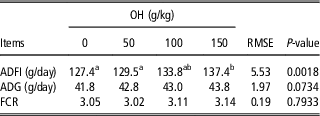
The growth performances of the experimental rabbits reared under different OH levels are presented in Table 2. Throughout the experiment, the health status of rabbits was good, as only one rabbit died in group feed 0 g/kg OH and only two in the 150 g/kg OH group had transitory diarrhea. These three rabbits were excluded from the evaluation. ADFI increased significantly as OH levels increased, a higher feed intake was observed in rabbits fed the 150 g/kg OH diet compared with diets with lower OH concentrations (P<0.05). However, no significant difference was observed for FCR and ADG (P>0.05).
The effect of oat hulls (OH) concentration on the growth performance of experimental rabbits

RMSE=root mean square error; ADFI=average daily feed intake; ADG=average daily gain; FCR=feed conversion ratio.
a,bWithin a row, means without a common superscript letter differ (P<0.05).
The effect of dietary oat hulls levels on gastrointestinal tract development
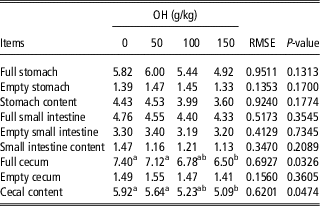
Table 3 shows the effect of different OH dietary treatments on the relative weight of digestive organs and their contents. There are no variations in the relative weight of stomach, intestine and their contents. However, the relative weight of full cecum and cecal contents decreased with the increase in OH levels (P<0.05).
The effect of oat hulls (OH) concentration on the gastrointestinal tract development of experimental rabbits (% BW)

RMSE=root mean square error.
a,bWithin a row, means without a common superscript letter differ (P<0.05).
The effect of dietary oat hulls levels on coefficient of total tract apparent digestibility of nutrients
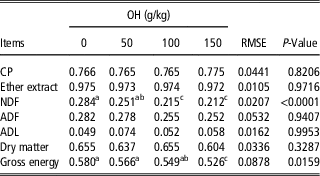
From the data of Table 4, we can conclude that the increase in OH had a significant effect on the CTTAD of ADF and GE, both ADF and GE were decreased in the group feed 150 g/kg OH (P<0.05), but the CTTAD of CP, EE, ADF, ADL, dry matter and GE were not affected (P>0.05).
The effect of oat hulls (OH) concentration on the coefficient of total tract apparent digestibility of experimental rabbits

RMSE=root mean square error.
a,b,cWithin a row, means without a common superscript letter differ (P<0.05).
The effect of dietary oat hulls levels on cecum fermentation
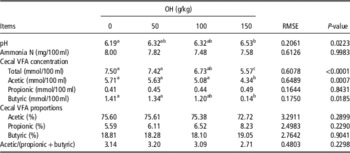
The values of cecal pH, ammonia N and VFA concentrations and proportions are presented in Table 5. Cecal pH was significantly influenced by diet (P<0.05), but ammonia N in the cecal content was not (P>0.05). Although, acetic acid was the predominant VFA (72.72% to 75.61% of the total) followed by butyric and propionic acids, it was not affected by diet (P>0.05). The absolute concentrations of VFAs (namely acetic and butyric acids) and total VFA concentrations were affected by treatments (P<0.05). High OH diet significantly decreased the concentration of total VFAs, acetic acid and butyric acid (P<0.05). No significant differences in propionic diets were observed (P>0.05). Proportions of acetic, propionic and butyric acids were not affected by treatments (P>0.05). Moreover, treatments had no significant effect on the ratios of acetic acid/(propionic+butyric acids).
The effect of oat hulls (OH) concentration on the cecum fermentation of experimental rabbits

RMSE=root mean square error; VFA=volatile fatty acid.
a,bWithin a row, means without a common superscript letter differ (P<0.05).
The effect of dietary oat hulls levels on carcass traits and meat qualities
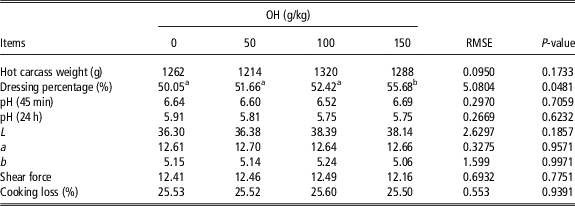
The carcass traits and meat quality data are given in Table 6. There were no differences among the groups in hot carcass weight (P>0.05). However, dressing out percentage increased with increasing in OH levels (P<0.05). Further, the pH (45 min), pH (24 h), shear force, cooking loss and physical traits (lightness, redness, yellowness) of LL muscles were not affected by the inclusion of OH in the diet (P>0.05).
The effect of oat hulls (OH) concentration on the carcass traits and meat quality of experimental rabbits

RMSE=root mean square error; L=lightness; a=redness; b=yellowness.
a,bWithin a row, means without a common superscript letter differ (P<0.05).
Discussion
The effect of dietary oat hulls levels on growth performance
Dietary fiber has been known to affect rabbit growth performance but the effects are largely dependent on the source of fiber due to its highly variable lignification and cell wall complexity and different hemicelluloses constituents (Gidenne et al., Reference Gidenne1992; Carabaño et al., Reference Carabaño, García and de Blas2001; García et al., Reference García, Gidenne, Falcão-e-Cunha and de Blas2002b). Moreover, insoluble fiber and the less lignified fiber fractions can act as substrate for microorganisms and stimulate cecal fermentation and microbial nitrogen recycling (Gidenne et al., Reference Gidenne, Carabaño, García and De Blas2004; Gómez-Conde et al., Reference Gómez-Conde, de Rozas, Badiola, Pérez-Alba, de Blas and Carabaño2009); thus they can affect and regulate the digestive health and growth performance of rabbits (Gidenne et al., Reference Gidenne, Garcia, Lebas and Licois2010a and 2010Reference Gidenne, Jehl, Lapanouse and Segurab). In the present study, we observed a higher feed intake in rabbits fed the 150 g/kg OH diet compared with diets with lower OH concentrations, probably associated with the lower digestible energy of the OH diet (Partridge et al., Reference Partridge, Garthwaite and Findlay1989; Nicodemus et al., 1999). FCR and ADG were similar to that described by María et al. (2007), using diets containing 79 g/kg OH in rabbits. According to García et al. (Reference García, Gidenne, Falcão-e-Cunha and de Blas2002b) dietary inclusion of fibrous feedstuffs at levels of 100 to 150 g/kg has little effect on rabbit performance, when the rabbit is able to regulate its digestible energy intake and thus to adjust its growth.
The effect of dietary oat hulls levels on gastrointestinal tract development
The level and type of dietary fiber can play the most important role in controlling gastrointestinal tract development and digestive content (Margüenda et al., Reference Margüenda, Nicodemus, Vadillo, Sevilla, García-Rebollar, Villarroel, Romero and Carabaño2012). In the present study, no differences were observed in gastrointestinal tract development among different treatments. The relative weights of each gastrointestinal tract were similar to those previously reported in healthy rabbits (Tao and Li, Reference Tao and Li2006; Chao et al., Reference Chao and Li2008). However, the relative weight of the full cecum decreased and the ceacal content was lower in rabbits fed the 150 g/kg OH diet compared with diets with lower OH concentrations, probably because of the lower level of neutral detergent soluble fiber in OH. María et al. (2007) found that weight of cecal contents decreased linearly between rabbits fed beet pulp/apple pulp and OH diets, due to neutral detergent soluble fiber reduction. Furthermore, in diets with the same level of dietary fiber, the type of fiber alters the time of fermentation in the cecum. Rice hulls is considered a kind of small particle size (<0.315 mm) source of fiber, which might causes accumulation of digesta in the cecum (Fraga et al., Reference Fraga, Pérez de Ayala, Carabaño and De Blas1991; Gidenne et al., 1992). However, no similar effect was observed in OH. These effects might account for the increase observed in feed intake. It would be partly related to the decrease of dietary digestible energy content when OH increased, and the negative effect of an accumulation of digesta in the cecum on feed intake (García et al., Reference García, Nicodemus, Carabaño and de Blas2002a) obtained previously when the effects of 54 diets were reviewed.
The effect of dietary oat hulls levels on coefficient of total tract apparent digestibility of nutrients
In our study, the CTTAD of NDF and GE decreased with the inclusion of OH. Similar results have been reported previously, using diets with 79 g/kg OH in rabbits (María et al., 2007).The CTTAD of NDF was lower in rabbits fed the 100 g/kg and 150 g/kg OH diet, probably associated with the higher lignin and lower pectin content of this diet (Gidenne and Perez, 1994; de Blas et al., Reference de Blas and Mateos1999; Nicodemus et al., 1999). Besides, the higher feed intake and lower ceacal content weight in rabbits fed the 150 g/kg OH diet in this experiment assure a short cecal fermentation time and obviously a high degree of lignification of NDF, which also would account for the relatively low efficiency of NDF digestion of OH. This is in agreement with previous studies (DePeters et al., 1997; Hall et al., 1998; Escalona et al., 1999) with ruminants, which have shown that the extent of NDF degradation is very high after 72 h of fermentation (94%),but also that the degradation rate of its potentially degradable NDF fraction (99.9%) is relatively low(0.038/h). Moreover, the CTTAD of GE was lower in rabbits fed the 150 g/kg OH diet than in rabbits fed the other diets, probably because of the lower neutral detergent soluble fiber content of this diet. María et al. (2007) observed a linear increase of energy digestibility with neutral detergent soluble fiber level. This result is in accordance with the lower CTTAD of NDF.
The effect of dietary oat hulls levels on cecum fermentation
In the present trial, the concentration of ammonia N in the cecal content was not affected by diet. This might be due to the nearly same level of CP in these diets. Castellini et al. (Reference Castellini, Cardinali, Rebollar, Dal Bosco, Jimeno and Cossu2007) observed that a reduction of CP in the rabbit diet reduces the ammonia concentration in the cecum.
The concentrations of total VFA observed in our study ranged from 5.57 to 7.50 mmol/100 ml. In general, these values are consistent with those obtained by García et al. (Reference García, Nicodemus, Carabaño and de Blas2002a) and Pinheiro et al. (Reference Pinheiro, Guede, Outor-Monteir and Mourao2009). Of note, in the present work, the production of total VFAs, acetic and butyric decreased with increase of OH concentration. These results were in agreement with Gidenne et al. (2000) who observed a linear decrease in cecal VFA level with increasing dietary fiber supply. Furthermore, at the same concentration of dietary fiber, the dietary inclusion of soluble and fermentable fiber decreases the pH and increases the total cecal concentration of VFA and the total mean retention time (García et al., Reference García, Galvez and de Blas1993; Carabaño et al., 1997). We thus hypothesize that OH has a lower level of soluble and/or fermentable fiber than RHM.
VFA provide an important source of energy for the rabbit (Bellier and Gidenne, Reference Bellier and Gidenne1996). Moreover, VFA, mainly butyrate, having anti-inflammatory action (Chiang et al., Reference Chiang, Sheih, Wang and Liao2000; Qiao et al., Reference Qiao, Duffy, Griffiths, Dryja, Leavens, Rossman, Rich, Riepenhoff-Talty and Locniskar2002). Thus, negative effect may be observed with the increasing of OH, though not founded in the present study.
The effect of dietary oat hulls levels on carcass traits and meat qualities
Some fiber sources, such as sugar beet pulp (García et al., Reference García, Galvez and de Blas1993; Cobos et al., 1995; Margüenda et al., Reference Margüenda, Nicodemus, Vadillo, Sevilla, García-Rebollar, Villarroel, Romero and Carabaño2012), olive pomaces (Dal Bosco et al., Reference Dal, Mourvaki, Cardinali, Servili, Sebastiani, Ruggeri, Mattioli, Taticchi, Esposto and Castellini2012), were tested at different levels of inclusion. All these studies found that the lower levels (5% to 15%) of supplementation showed little or no effects on carcass traits, dressing percentage, meat chemical composition or physical characteristics such as tenderness, drip loss and color. These results are congruous with those obtained by our research. Increasing dietary concentration of OH did not affect hot carcass weight and dressing percentage and the pH (45 min, 24 h), lightness, redness, yellowness, 24-h drip loss of LL muscles. However, in this study, the dressing percentage affected by the inclusion of OH. We found that dressing out percentage increased with higher (150 g/kg) inclusion of OH. This effect is in accordance with the decrease of relative weight of the full cecum decreased and the ceacal content. A similar result that accumulation of digesta in the cecum lead to a reduction of dressing out percentage was observed by Carabaño et al. (1997)
Conclusions
In conclusion, the use of 150 g/kg OH in substitution for RHM could reduce the CTTAD of GE and NDF and impaired fermentation of the cecum content: the pH values increased and the VFA values decreased. OH could thus be considered as a fiber source which has a lower level of soluble and/or fermentable fiber for the fattening rabbit. Moreover, OH has a lower digestible energy which lead to a higher feed intake. However, OH can be included in rabbit diets at levels up to 100 g/kg almost without adverse effects on the growth performance, CTTAD of nutrients, gastrointestinal tract development, cecum fermentation and carcass traits.
Acknowledgment
This study was supported by the Special Fund for Agro-scientific Research in the Public Interest (2000903006) and by the earmarked fund for Modern Agro-industry Technology Research System (CARS-44-B-1).