Introduction
Recurrent infection and persistent discharge are the main indications for surgical excision of a preauricular sinus.Reference Richardson, Rosenfeld, Bluestone and Rosenfeld1 It has been advised that a part of the helical cartilage at the base of the preauricular sinus should be excised to ensure complete removal of the sinus, and to reduce what may otherwise be a large amount of dead space.Reference Yeo, Jun, Park, Lee, Song and Chang2, Reference Lam, Soo, Wormald and Van Hasselt3 Compressive dressing with gauze and bandages is frequently used after preauricular sinus excision to reduce the risk of post-operative haematoma formation and recurrence.Reference Yeo, Jun, Park, Lee, Song and Chang2 However, dressing with a head bandage may result in reduced hearing, an unpleasant appearance, pain, disturbance of daily life, localised alopecia and a foul odour due to old blood in the bandages, and many of these problems may be exacerbated by hot weather.Reference Castelli, Di Lisi, Marcato, Tavormina, Cappellaro and Sartoris4
We therefore designed a method of compressive dressing using suture transfixion of silicone sheets, in order to reduce the need for head bandage compressive dressing.
Materials and methods
Patients
This retrospective study included all patients who had undergone preauricular sinus excision via a standard approach and had received compressive dressing post-operatively, in a tertiary referral centre between January 2003 and May 2008, and who had been followed up for at least six months.
Indications for surgery included persistent discharge, recurrent infection or both. Patients with acute exacerbation of infection first received conservative treatment for two weeks, including systemic antibiotics and dressing with or without drainage of the abscess, followed by excision of the preauricular sinus.
We excluded from the study patients with variants of preauricular sinus, those treated with a non-standard approach (i.e. retroauricular or supra-auricular), and those with small sinus tracts that did not reach the helical cartilage and which received a simple coverage dressing after surgery.
All patients provided written, informed consent, and the study was approved by our institutional review board.
The medical records of the included patients were further reviewed, and relevant pre- and post-operative demographic and clinical data were collected. Recurrence was defined as post-operative local inflammation, a subcutaneous mass or a discharging sinus after initial healing. Excision of bilateral preauricular sinuses was counted as two operations. Post-operative outcomes were evaluated, including: recurrence, haematoma, wound infection, headache, skin problems resulting from dressing (i.e. facial flushing, skin erosion or focal alopecia), and nausea and/or vomiting.
Surgical techniques
Patients under 10 years of age and those afraid of the procedure received general anaesthesia (including orotracheal intubation).
The operative field was infiltrated with 2 per cent Xylocaine–adrenaline 1:100 000 around and beneath the fistula. Methylene blue was injected until reflux through the orifice was verified. After making an elliptical skin incision around the fistular opening, the sinus tract along with surrounding soft tissues was carefully dissected and completely removed. A small portion of the cartilage penetrated by or adherent to the sinus tract was also excised.
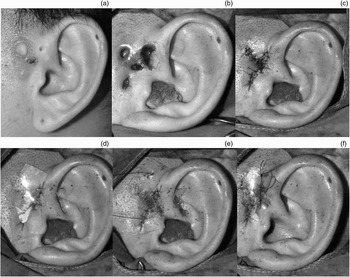
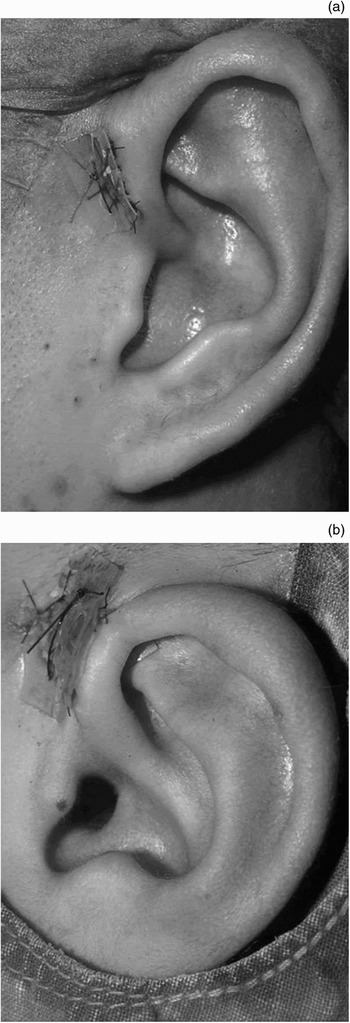
After excision of the preauricular sinus, the temporalis fascia and helical cartilage were identified and a simple skin closure performed. Medical grade silicone sheeting 0.5 mm thick (BioPlexus, Ventura, California, USA) was cut into two or three rectangular sections of increasing size. Where three sections were used, the smallest (about 1.0 × 0.5 cm) was placed onto the posterior surface of the ascending helix, the medium-sized section (2.0 × 1.0 cm) was placed on the upper anterior surface of the former sinus tract, and the largest section (2.5×1.5 cm) was placed on the lower anterior surface of the tract (Figure 1a to 1d). The area was sutured with 3/0 nylon (Woorhi Medical, Seoul, South Korea) in an anterior to posterior direction, sequentially transfixing the lower part of the largest silicone sheet, the helix and the lower part of the smallest silicone sheet. The area was then sutured in the opposite direction, transfixing the upper part of the smallest silicone sheet, the helix and the upper part of the medium-sized silicone sheet (Figure 1e). The suture was tied at the front of the anterior sheets (Figure 1f). If the dead space left following preauricular sinus excision was not large, only one large (Figure 2a) or two small (Figure 2b) silicone sections were used in the anterior position.
Clinical photographs of the left ear of a 22-year-old man with a history of multiple incision and drainage procedures. (a) Pre-operative view showing a lesion of the preauricular sinus and an abscess. (b) Appearance following excision of the preauricular sinus, drainage of the abscess and curettage of the involved tissues. (c) Appearance following primary repair of the skin with nylon sutures. (d) A silicone sheet was cut into three rectangular sections; the smallest was positioned on the posterior surface of the ascending helix, and the medium and largest sections were positioned at the anterior surface of the former sinus tract. (e) The silicone sheets were sutured into place. (d) The sutures were tied at the front of the wound.

Cases involving a smaller amount of dead space, showing the use of (a) one and (b) two small sections of silicone sheeting, sutured in place in front of the ascending helix after excision of the preauricular sinus.

The area was covered with lightly applied gauze, and the patient was discharged on the afternoon of the same day.
The silicone sheets were removed on the third post-operative day, and the skin stitches were removed on the fifth to seventh post-operative day, in the out-patient department.
Results
During the study period, 37 patients of mean age 18.34 years (range one to 72 years) were identified; 50 ears (20 right and 30 left) were involved. The recurrence rate was 4 per cent (two of 50 ears). Post-operative haematoma developed in one ear (2 per cent) on post-operative day 7 to 14. Wound infection was not observed. No patients complained of skin erosion at the dressing site, headache, facial flushing, alopecia areata, or nausea and/or vomiting.
Discussion
Factors known to reduce recurrence after primary excision of preauricular sinus include: meticulous dissection of the tract by an experienced head and neck surgeon; general anaesthesia; a supra-auricular approach with clearance down to the temporalis fascia; avoidance of sinus rupture; and closure of wound dead space with a drain or compression bandage.Reference Richardson, Rosenfeld, Bluestone and Rosenfeld1, Reference Tan, Constantinides and Mitchell5 If there is minimal dead space after preauricular sinus excision, a simple dressing covering the wound may be sufficient. However, in most preauricular sinus cases the tract runs medially, penetrating or attaching to the helical cartilage; furthermore, the connective tissues around the tract are known to contain hair follicles, sebaceous and sweat glands, and inflammatory tissue.Reference Yeo, Jun, Park, Lee, Song and Chang2 This appendage of preauricular sinus tissue should be surgically removed, resulting in a dead space large enough to require a compression dressing. Our study excluded all patients with a small sinus tract not related to the helical cartilage.
The purpose of any dressing is to provide optimum conditions for wound healing. An ideal external ear dressing would: (1) adhere tightly to the skin but not the wound; (2) be comfortable enough to be worn for one week; (3) be thin enough for the patient to comfortably rest their head on it; (4) be sufficiently aesthetic to be worn in public; (5) apply enough pressure to minimise blood and serum collection; (6) protect the wound from soiling; and (7) be malleable enough to conform to all the contours of the external ear.Reference Godley6
Head bandaging has become a routine part of post-operative otological practice since temporalis fascia harvesting has become widespread.Reference Hill, Allan, Malhan and Williams7 A standard otological head bandage is rarely tight enough to prevent haematoma formation; these bandages frequently lose their efficacy after the first hour, and higher bandage pressures are associated with headaches.Reference Hill, Allan, Malhan and Williams7 Head bandages also cause other problems. Slippage of the bandage is common, leading to unscheduled hospital visits for reapplication.Reference Powell8 Very tight head bandaging after ear surgery can cause skin or cartilage necrosis at various sites, possibly resulting in alopecia.Reference Powell8 Dressing materials may also carry intrinsic risks, including allergic and irritant reactions to adhesive bandages.Reference Widman, Oostman and Storrs9
Silicone sheets are now commonly used as external ear dressings.Reference Godley6, Reference Rieger, Haug and Pierer10 We have designed a new type of compressive dressing involving suture transfixion of silicone sheets. This dressing is simple to apply, and is tolerated better than compressive head bandaging over a prolonged period of time. The post-operative outcomes of our patients receiving silicone sheet compressive dressings were similar to previous reports, and the side effects of head bandaging were avoided.Reference Yeo, Jun, Park, Lee, Song and Chang2, Reference Lam, Soo, Wormald and Van Hasselt3, Reference Tan, Constantinides and Mitchell5
Our method may however compress only a limited area. For example, in patients undergoing preauricular sinus excision using a retroauricular or supra-auricular approach, or in those with variants of preauricular sinus, the dead space may be so large that only compressive head bandaging will suffice.
Conclusion
We have designed a new compressive dressing, involving suture transfixion of silicone sheets, to be used after standard preauricular sinus excision. This method had the same post-operative results as compressive head bandaging, but eliminated the latter's adverse effects.
Acknowledgement
This work was supported by the 2006 Inje University research grant.