




No CrossRef data available.
Family processes that shape the impact of interparental conflict on adolescents
Published online by Cambridge University Press: 01 September 2004
Abstract
This study draws on the family systems concepts of triangulation and wholism to investigate how interparental conflict may affect adolescents' psychological adjustment. An ethnically and socioeconomically diverse sample (N = 388) of 14- to 18-year-olds completed measures of interparental conflict, family relationships, internalizing problems, and externalizing problems. We found that triangulation into parental disagreements mediated the association between parental conflict and both internalizing and externalizing problems. Adolescents exposed to more frequent, intense, and poorly resolved conflict were more likely to feel triangulated, but this association was moderated by the nature of the alliances they had with their parents. Specifically, at low levels of interparental conflict, adolescents who had substantially stronger alliances with one parent than the other reported greater triangulation than those with more balanced alliances. At high levels of conflict, these groups reported similar degrees of triangulation. We also found that supportive parent–child relationships reduced adolescents' appraisals of threat and self-blame for interparental conflict, while more empathic relationships with siblings increased these appraisals. Finally, close relationships with fathers acted as a protective factor that reduced symptoms of maladjustment.
Information
- Type
- Research Article
- Information
- Copyright
- © 2004 Cambridge University Press
Systemic family theorists have long argued that child development can only be understood by considering children within the context of their family (e.g., Minuchin, 1974). With its emphasis on circular causality and interdependence among family members, systems theory introduced a new ontology, language, and level of analysis that had an immediate and dramatic impact on clinical work with children and families. However, its effect on empirical research has been much more limited and gradual (see Cox & Paley, 1997). Most studies investigating family factors related to child psychopathology have focused on one type of relationship (e.g., parenting) to the exclusion of others, and few have explicitly investigated systemic constructs. Research on the link between interparental conflict and child adjustment is no exception: Only a handful of empirical studies have examined interparental conflict in relation to other family interactions or directly assessed systemic processes (e.g., Christensen & Margolin, 1988; Davies, Harold, Goeke–Morey, & Cummings, 2002; Kerig, 1995; Lindahl & Malik, 1999). This research is promising but limited, and consequently, the extent to which family systems theory can contribute to our understanding of the sequelae of children's exposure to conflict remains largely unexplored.
The purpose of the present study was to consider how principles drawn from family systems theory can illuminate the mechanisms by which exposure to interparental conflict increases children's risk for developing psychopathology. We examined these principles through the lens of developmental psychopathology, seeking to identify family processes that function as mediating, protective, or vulnerability factors in the context of interparental conflict (Margolin, Olive, & Medina, 2001). First, we investigated the role of triangulation as a mediator of the association between conflict and child maladjustment, and considered how the nature of children's relationships with each parent may increase the likelihood of being drawn into parental disagreements. Second, we examined whether parent–child and sibling relationships act as protective or vulnerability factors by assessing their associations with children's appraisals of conflict and behavior problems.
Interparental Conflict and Family Systems Theory
The term “family systems theory” encompasses a number of models that share a core set of principles regarding family interaction (see Cox & Paley, 1997; Minuchin, 1985). First, the family is conceptualized as an organized whole that is not reducible to its component parts (“wholism”). These parts, or subsystems (e.g., parent–child relationships, marital relationships), are interrelated and cannot be fully understood in isolation from the rest of the system. Second, causal effects are assumed to be circular rather than linear; that is, each part of the family system both affects and is affected by other parts. Third, subsystems are hierarchically arranged and demarcated by boundaries that define how the members of a subsystem relate to other subsystems. Fourth, the family is self-regulating, using feedback mechanisms to maintain stable functioning, and self-organizing, able to change to adapt to new demands from within or outside of the family (see Cox & Paley, 1997). These principles have a number of important implications for understanding how interparental conflict affects children.
Boundaries
The concept of boundaries suggests a potential mechanism by which interparental conflict may lead to child maladjustment. Several family theorists have argued that children may be inappropriately triangulated into the marital subsystem when discord arises in the marriage (e.g., Emery, 1982; Margolin et al., 2001; Minuchin, 1974; Westerman, 1987). The term “triangulation” has been used in somewhat different ways by different authors, but generally reflects an interaction pattern in which children become involved in their parents' conflict or feel pressure to side with one parent against the other (see Buchanan & Waizenhofer, 2001). Triangulation is proposed to increase children's risk for adjustment problems for several reasons (e.g., Emery, 1982; Buchanan & Waizenhofer, 2001). Children can become the target of anger or aggression from their parents, or, if a child is drawn into a crossgenerational coalition with one parent against the other, tension and conflict may increase with the excluded parent. Children who are caught in the middle of parental disagreements also may feel anxious, sad, or helpless if they believe they have to take sides in the dispute. Finally, children may be reinforced for acting out or exhibiting difficulties during parental disagreements if the behavior stops interparental conflict from being expressed overtly. Triangulation also has adverse effects for marital and family functioning because it prevents couples from working out their difficulties constructively and disrupts the power hierarchy in the family by drawing the child into the parental subsystem.
The link between marital discord and triangulation was documented in a longitudinal study that assessed married couples prior to and 5 years following the birth of their first child (Lindahl, Clements, & Markman, 1997). Lindahl and colleagues (1997) found that couples experiencing higher levels of conflict were more likely to form crossgenerational coalitions and to draw their child into discussions of marital problems (also see Christensen & Margolin, 1988). Kerig (1995) also reported an association between interparental discord and triangulation. Using a self-report measure of triangulation that focused on the presence of a crossgenerational coalition in the family, she found that couples from triangulated families had the lowest marital adjustment ratings and that children from these families perceived their parents' fights as more intense, frequent, and unresolved. Parent–child relationships also differed across the family types; children in triangulated families reported both experiencing and expressing higher levels of negative affect than children from cohesive families.
Triangulation has also been linked to child maladjustment. Kerig (1995) found that children in triangulated and detouring (i.e., parents have a close relationship, but exclude child) families had higher levels of adjustment problems than those in cohesive families. Davis and colleagues (Davis, Hops, Alpert, & Sheeber, 1998) used observational measures to study children's responses to interparental conflict. They reported that both boys and girls who appeared to ally with their fathers following a hostile interparental interaction by becoming verbally aggressive toward their mothers exhibited higher levels of aggression 1 year later. Finally, Buchanan and colleagues (Buchanan, Maccoby, & Dornbusch, 1991; Buchanan & Waizenhofer, 2001) studied triangulation in both divorced and intact families. In divorced families, loyalty conflicts, or feeling caught in the middle of parental tensions, mediated the association between parental conflict and children's internalizing and externalizing problems. In contrast, in intact families, adolescents' tendency to align with their mother during conflicts mediated links between conflict and depressive symptoms, but loyalty conflicts did not.
Wholism
The systemic principle of wholism suggests that discord in the marriage affects other family relationships, and vice versa. Empirical research supports this proposition, showing that marital conflict generally is associated with poorer quality parenting, including greater parent–child conflict and less warmth or support (for reviews see Grych, 2002; Erel & Burman, 1995). Marital discord also has been linked to poorer sibling relationships, although there is much less data on this topic (see Dunn & Davies, 2001). The concept of wholism further suggests that the impact of interparental conflict on children may depend on the nature of other relationships within the family, and has implications for identifying protective and vulnerability factors that can explain why exposure to parental disagreements may lead to different developmental outcomes. Specific processes by which family relationships could influence the impact of interparental conflict on children have been described by two conceptual models developed to understand the effects of conflict on children.
First, the cognitive–contextual framework (Grych & Fincham, 1990) holds that parental disagreements taking place in an otherwise warm and supportive family will be perceived differently than the same interactions occurring in families marked by hostile or distant relationships. Children who have close relationships with their parents are predicted to appraise conflict as less threatening to their well-being and to the harmony and stability of their family. Grych (1998) tested this idea in a study in which children reported their perceptions of and emotional reactions to standardized, audiotaped interparental conflicts. Children reporting greater acceptance and warmth from their fathers perceived the conflicts as less threatening and were less likely to blame the fathers on the tape for the conflict. In addition, children reporting greater conflict with their fathers reported greater threat and lower levels of coping efficacy in response to the conflict vignettes than did children with less conflictual relationships.
Second, Davies and Cummings (1994) also highlighted the potential for supportive parent–child relationships to reduce the threat posed by conflict, but focused specifically on threats to children's emotional security. They argued that strong parent–child relationships enhance children's security and so can serve as a buffer against the adverse effects of parental discord. In one of the few studies to examine associations between interparental conflict and child adjustment in the context of broader family processes, Davies and colleagues (2002) found that the association between emotional insecurity (assessed as a composite of ratings of children's emotional, behavioral, and cognitive responses to conflict) and adjustment problems was weaker for children from highly cohesive families and stronger for families exhibiting problems in parenting.
In summary, the limited research applying family systems theory to the study of interparental conflict and child adjustment has provided initial empirical support for the value of this perspective. Further exploring systemic principles and integrating them with conceptual models of the effects of parental conflict on child functioning holds considerable promise for understanding the processes that explain the development of psychopathology in children from discordant homes. Although the occurrence of triangulation and the potentially protective function of parental support typically have been considered independently, they reflect different aspects of family relationships. The protective role of relationships derives from parents' responsivity and warmth and the extent to which children feel their parents support and care about them (a dyadic process). In contrast, triangulation reflects the nature of the boundaries of the interparental and parent–child relationships (a triadic process). Whereas a strong parent–child alliance generally would be expected have a protective effect, parent–child alliances formed as a reaction to discord in the marital relationship may not be protective if they lead to crossgenerational coalitions that exclude the other parent. Crossgenerational coalitions can cause tension in the child's relationship with the other parent or lead to loyalty conflicts for the child and make triangulation more likely. The meaning and impact of one family relationship influences and is influenced by other relationships, and to fully understand risk and protection in the family context, it is important to consider the nature of boundaries as well as the degree of warmth and support in relationships.
The Present Study
The present study had two primary goals. The first was to investigate the boundaries of parent–child and marital subsystems, and, specifically, to test whether triangulation in parental discord mediates the association between children's exposure to interparental conflict and their maladjustment. Then, we sought to identify family factors that predicted when children are most likely to be triangulated into parental conflict. We hypothesized that triangulation would be most likely to occur in families in which adolescents had a considerably stronger alliance with one parent than the other. Children who have unbalanced or discrepant alliances might be drawn to support the parent that they feel closer to, or may be pulled into a disagreement as an ally by that parent. In contrast, children who feel equally close to both parents may be less likely to feel pressured to “take sides” when their parents have a disagreement.
The second goal of the study reflects the systemic principle of wholism: we examined whether other family relationships functioned as protective factors for children exposed to interparental conflict. We did this in two ways. First, we investigated whether parent–child and sibling relationships are associated with how children appraise interparental conflict. The cognitive–contextual framework posits that children's perceptions and interpretations of parental disagreements mediate the impact of conflict on them, and empirical research has shown that children who experience greater threat or self-blame for parental conflict are at greater risk for developing internalizing and externalizing problems (e.g., Dadds, Atkinson, Turner, Blums, & Lendich, 1999; Grych, Fincham, Jouriles, & McDonald, 2000; Grych, Harold, & Miles, 2003; Kerig, 1998a). However, we know relatively little about why some children make particular kinds of appraisals. The nature of the conflict that children witness is one factor that shapes their perceptions and interpretations, but individual differences in appraisals consistently are found even when children view standardized conflictual interactions (Grych, 1998; Grych & Fincham, 1993). To understand the role that appraisals play in shaping the impact of conflict on children, it is important to learn why some children are more threatened by conflict than others or are more likely to blame themselves for parental disagreements. We predicted that adolescents reporting closer, more supportive family relationships would perceive interparental conflict as less threatening and report lower levels of self-blame.
The second way that we examined how the larger context of the family may further understanding of the relation between interparental conflict and child maladjustment was by testing whether supportive parent–child and sibling relationships acted as protective factors that reduced the effects of conflict on adolescent functioning. Protective factors can operate in different ways (Luthar, Cicchetti, & Becker, 2000; Rutter, 1988). A close alliance with a parent or sibling may have a “main effect”, exerting a positive influence on all adolescents regardless of the level of interparental discord they witness. Alternatively, alliances may have a moderating or buffering effect in which they reduce the impact of conflict for adolescents experiencing high levels of parental discord but do not benefit adolescents from low conflict homes. In keeping with Luthar and colleagues' (2000) call for precision in the terminology used to describe such effects, we examine whether closeness to mothers, fathers, and siblings provided a protective effect, promoting healthy functioning in all children regardless of the level of conflict in the family, or protective-stabilizing effect, helping to maintain healthy functioning in adolescents from high conflict homes but having a negligible effect on children in low conflict homes.
Finally, we examined whether family relationships had similar associations with interparental conflict for boys and girls. Gender differences in socialization and goals become more salient in adolescence (see Davies & Lindsay, 2001), and it is possible that girls' increasing focus on relationships may make them more attuned to the quality of their parents' marriage and more vulnerable to being drawn into parental disagreements. However, we did not make specific predictions regarding gender differences in the role of family relationships as potential protective factors.
We chose to test these hypotheses in a sample of adolescents because they may be more likely to be triangulated into parental conflicts than younger children. Adolescents are more sophisticated than young children, and thus may be more sensitive to subtle relationship problems, and may be more likely to be perceived as potential allies by their parents. Empirical support for this idea is provided by Davies, Myers, and Cummings (1996), who reported that 14-year-olds were more likely than 8-year-olds to report that they would offer suggestions and take one parents' side if their parents had a conflict that they had trouble resolving. Further, parent–child relationships often experience more strain and conflict in adolescence, and may be more vulnerable to disruption when marital discord is high (Collins & Laursen, 1992). At the same time, given that rates of many forms of child psychopathology increase during adolescence, strong parent–child relationships may be especially important protective factors.
Method
Participants
Participants were recruited from a large, ethnically diverse public high school in a medium-sized Midwestern city. Letters explaining the study and consent forms were sent home to parents of students who were currently taking social studies classes. Those who obtained parents' informed consent were invited to complete a packet of questionnaires at school. The final sample consisted of 338 9th- through 12th-grade students (203 females) ranging in age from 14 to 19 years (M = 16.29, SD = 1.17). Approximately 75% of eligible students participated. The ethnic makeup of the sample is 56.5% Caucasian, 19.2% Latino/Hispanic, 12.7% African American, 4% Asian/Pacific Islander, 2.1% Native American, 2.1% Biracial, and 3% other. We did not obtain any information from the students that would allow us to assess their socioeconomic status; however, approximately half of the students in the school are eligible for free lunches.
Procedures
Data collection took place during the regular school day in social studies classrooms during a 90-min class period. Two researchers and the teacher were present in each class. Those who had not obtained parental consent were excused and given an alternate activity to complete in a different location. After obtaining participants' informed consent, questionnaires were distributed with the instructions to complete them quietly without conversing with their peers. If the participants had any questions or concerns, a researcher addressed them individually.
Measures
Interparental conflict
Participants' reports of their parents' conflicts were assessed using the Conflict Properties subscale of the Children's Perception of Interparental Conflict Questionnaire (CPIC; Grych, Seid, & Fincham, 1992). The Conflict Properties scale includes 19 items tapping the frequency, intensity, and resolution of interparental conflict. Sample statements include, “I often see or hear my parents arguing” and “My parents get really mad when they argue” to which children respond on a 3-point scale (true, sort of true, or false). This measure correlates significantly with parental reports of interparental conflict and has demonstrated satisfactory levels of internal consistency and test–retest reliability (see Grych et al., 1992). The reliability of the Conflict Properties subscale in the present sample (α = .94) was consistent with values reported by Grych and colleagues (1992) for children and by Bickham and Fiese (1997) for adolescents.
Appraisals of interparental conflict
The Threat and Self-Blame subscales from the CPIC (Grych et al., 1992) were used to assess adolescents' appraisals of interparental conflict. The 12-item Threat scale assesses the level of threat felt by respondents when interparental conflict occurs and their perceived ability to cope with the conflict. Sample items include “When my parents argue, I'm afraid something bad will happen,” and “When my parents argue I'm afraid one of them will get hurt.” The 9-item Self-Blame scale taps the extent to which parental disagreements concern child-related issues as well as the respondents' tendency to blame themselves for these disagreements. Sample items include “It is usually my fault when my parents argue” and “My parents blame me when they have arguments.” The validity of these scales as measures of children's subjective evaluations of conflict was supported by significant correlations with children's appraisals of specific episodes of conflict (see Grych et al., 1992). The alpha coefficients for these scales in the present sample were .79 for Threat and .85 for Self-Blame.
Triangulation
Triangulation between the parents and the adolescent was assessed using the Triangulation subscale of the CPIC (Grych et al., 1992). This eight-item subscale assesses the extent to which children feel involved in or caught in the middle of their parent's conflict. Sample items include, “When my parents argue I end up getting involved somehow,” and “I feel caught in the middle when my parents argue.” Scores on this scale have been found to correlate significantly with children's involvement in interparental conflict during triadic family interactions (Lindahl, 1998). Reliability of the Triangulation subscale in this sample was .72.
Parent–child relationship
The Inventory of Parent and Peer Attachment (IPPA; Armsden & Greenberg, 1987) contains two 28-item scales to assess the quality of relationships with mothers and fathers. Participants respond to questions such as, “My mother respects my feelings,” and “My father accepts me as I am” on a 5-point Likert scale ranging from almost never or never true to almost always or always true. We used two of the subscales, Trust and Communication, in the present study. Due to the high correlation between these scales (r = .83 and .82 for mothers and fathers, respectively) the two scales were combined to form a “Closeness” scale for the analyses that we used as an indicator of the strength of the parent–child alliance. In this sample, the Closeness scale demonstrated adequate reliability (α = .95 for both mother and father scales).
Differential closeness to parents
To assess whether adolescents have relatively stronger alliances with one parent than the other, their scores on the Parental Closeness scale were combined by computing the absolute value of the difference between mother and father closeness scores. Higher values on this index reflect a greater discrepancy between adolescents' alliance with their mother and father, whereas lower scores reflect more similar closeness scores or more balanced alliances.
Sibling relationships
The Brother–Sister Questionnaire (Graham–Berman & Cutler, 1994) is a 35-item measure designed to assess the participants' relationship with their sibling(s). We used the Empathy and Similarity subscales in the present analyses because they reflect positive, supportive aspects of sibling relationships. These scales include items such as, “We usually get along very well,” and “She or he cares a lot about what I think.” The Empathy and Similarity scales were strongly correlated (r = .55) and so were combined to form a single Closeness scale (α = .93).
Adolescent adjustment
The Anxious/Depressed and Aggressive Behavior subscales from the Youth Self-Report (Achenbach, 1991) were used to assess adolescents' internalizing and externalizing problems, respectively. Each item is answered on a 3-point Likert-type scale ranging from never or almost never to often. The Anxious/Depressed scale was used as a measure of internalizing symptoms and includes questions such as, “I cry a lot,” and “I feel that no one loves me.” The Aggressive Behavior scale was used as a measure of externalizing symptoms and includes items such as, “I physically attack people,” and “I argue with others.” The internal consistency of the current sample was adequate, with α = .92 for internalizing and α = .87 for externalizing symptoms.
Results
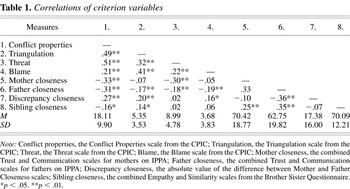
Family systems theory holds that family subsystems or relationships are interdependent. Accordingly, Table 1 shows that adolescents' reports of interparental conflict were moderately correlated with the quality of their relationships with their parents and siblings. Adolescents reporting more frequent, intense, and poorly resolved conflict also report less closeness in their relationships with their mothers (r = −.33), fathers (r = −.31), and siblings (r = −.16). Similarly, adolescent's relationships with their siblings were correlated with mother (r = .25) and father (r = .35) relationships.
Correlations of criterion variables

Triangulation
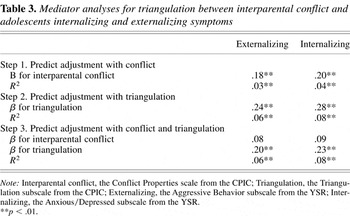
The first major goal of the study was to investigate whether adolescents' experience of triangulation in parental discord mediated the association between conflict and maladjustment, and, if so, to attempt to identify family factors that predicted higher levels of triangulation. Mediators are factors or processes proposed to explain how one variable affects another. According to conventions outlined by Baron and Kenny (1986), for triangulation to act as a mediator it must be significantly associated with interparental conflict and with the adjustment measures. Further, when triangulation is entered into a regression equation testing the association between conflict and adjustment, it must continue to predict adjustment while the relation between conflict and adjustment decreases significantly or becomes nonsignificant (see Baron & Kenny, 1986; Holmbeck, 1997).
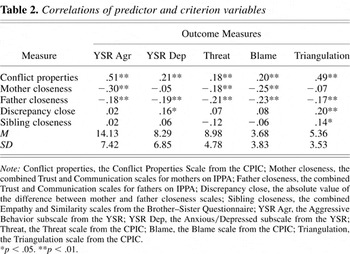
Table 2 shows that interparental conflict, triangulation, internalizing problems and externalizing problems all were intercorrelated. Therefore, we conducted a hierarchical regression analysis in which interparental conflict was initially entered as a predictor of externalizing problems and triangulation was added in a second step. As Table 3 shows, this analysis showed that interparental conflict initially predicted externalizing (β = .18, p < .01, R2 = .03), but this association became nonsignificant once triangulation was entered into the equation (β = .08, p = .24). However, triangulation remained a significant predictor of externalizing problems (β = .20, p < .01), and thus acted as a mediator of the link between conflict and externalizing problems.
Correlations of predictor and criterion variables

Mediator analyses for triangulation between interparental conflict and adolescents internalizing and externalizing symptoms

Next, we conducted a similar analysis on adolescents' reports of depression and anxiety (see Table 3). When entered first in the regression equation, the Conflict Properties subscale from the CPIC significantly predicted internalizing symptoms (β = .20, p < .001). When the Triangulation scale was added in the second step, the beta weight for the Conflict Properties scale was reduced to .09 (ns) and no longer predicted internalizing symptoms, while Triangulation exhibited a significant unique association with internalizing symptoms (β = .23, p < .001). Although only longitudinal or experimental research can test the causal and temporal relations implied in a mediational model, these data are consistent with the hypothesis that triangulation is a mediator of the association between interparental conflict and both internalizing and externalizing problems in adolescence.
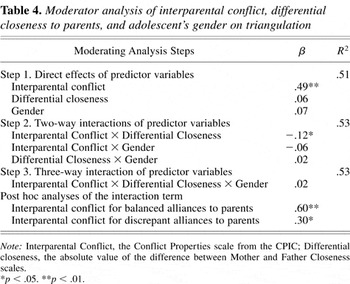
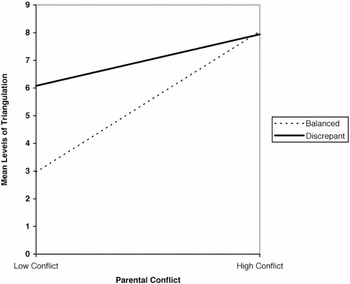
We then turned to examine whether the tendency for adolescents to become triangulated into parental disagreements can be predicted by the quality of their relationships with their parents. Specifically, we hypothesized that those children who had substantially closer alliances with one parent than the other would be particularly likely to be drawn into interparental conflicts. To test this hypothesis, we conducted a hierarchical regression equation in which conflict, differential closeness with parents, and gender were entered in the first step, and the two-way interactions between these variables in a second step. The three-way interaction involving all the constructs was added in a third step. This analysis showed that only exposure to interparental conflict predicted greater triangulation in the first step of the regression. However, there also was a significant interaction between Conflict Properties and Differential Closeness. This interaction was decomposed by conducting separate regression analyses examining the association between exposure to conflict and triangulation for children reporting more discrepant alliances with their parents (defined as 0.5 SD above the mean) and those reporting more balanced alliances (0.5 SD below the mean; see Aiken & West, 1991). As shown in Table 4, both groups exhibited a significant association between interparental conflict and triangulation, but that this association was much stronger for adolescents with more balanced alliances (β = .60) than those with discrepant alliances (β = .30; see Table 4).
Moderator analysis of interparental conflict, differential closeness to parents, and adolescent's gender on triangulation

To better understand this interaction, we plotted the triangulation scores of the discrepant and balanced groups at low and high levels of conflict. Figure 1 presents this plot, which shows that at low levels of interparental conflict, children with unbalanced alliances report experiencing much more triangulation than those with balanced alliances. However, at high levels of interparental conflict, the balanced and discrepant groups report equally high levels of triangulation. Thus, greater conflict between parents generally led adolescents to feel more triangulated, but those with unbalanced alliances felt more triangulated even when conflict was infrequent.

The interaction of interparental conflict and differential parental closeness on adolescents' reports of triangulation.
Conflict in the context of other family relationships
The second goal of the study was to investigate whether supportive parent–child and sibling relationships act as protective factors. To test the hypotheses that parent–child and sibling relationships would predict adolescents' (a) appraisals of interparental conflict and (b) psychological adjustment, we conducted hierarchical regression analyses in which the Conflict Properties subscale of the CPIC, the measures of closeness in parent–child and sibling relationships, and gender were entered together in the first step. This step assessed the “main effect” of each aspect of family functioning separately as well as the ability of all of these relationships taken together to predict adolescents' subjective evaluations of parental disagreements or adjustment. Then, the interaction of conflict with each type of family relationship (computed after centering the variables) was added in a second step to assess whether these relationships had moderating or buffering effects on the outcome measures (see Baron & Kenny, 1986; Holmbeck, 1997).
Conflict appraisals
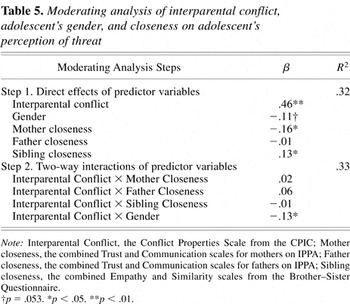
The first set of analyses tested whether closeness and support in mother–child, father–child, and sibling relationships are related to adolescents' appraisals of threat and self-blame. In the first step of the equation predicting threat (see Table 5), we found that interparental conflict, gender, and the measures of relationship closeness together accounted for a significant proportion of variance (32%). Further, conflict, maternal closeness, and sibling closeness each accounted for unique variance in perceived threat, with gender approaching significance. Adolescents who reported closer alliances with their mothers were less threatened by interparental conflict, but those reporting greater closeness to siblings were more threatened by parental disagreements. Girls reported greater threat than did boys. None of the interactions between the Conflict Properties subscale and the measures of family relationships were significant. However, exposure to conflict did interact with gender. We explored the nature of this interaction by testing the simple slopes of the association between conflict and perceived threat for boys and girls separately (see Aiken & West, 1991). The results of these analyses showed that both boys and girls reported higher levels of threat as their exposure to interparental conflict increased, but that this association was much stronger for girls (β = .60, p < .001) than for boys (β = .33, p < .001).
Moderating analysis of interparental conflict, adolescent's gender, and closeness on adolescent's perception of threat

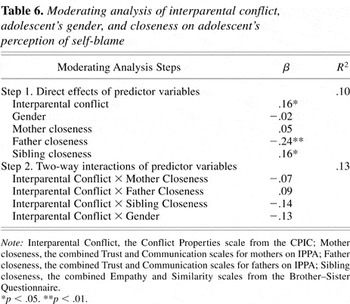
The regression predicting adolescents' self-blame for interparental conflict also accounted for significant variance in this type of appraisal, although the amount of variance accounted for was less than perceptions of threat (10%). In this analysis (see Table 6), exposure to conflict, adolescents' closeness to their fathers, and relationship with their siblings each accounted for unique variance. Adolescents were more likely to blame themselves for interparental conflict if they were exposed to higher levels of conflict, if they had weaker alliances with their fathers, and closer relationships with their siblings. None of the interactions between conflict and the family factors were significant.
Moderating analysis of interparental conflict, adolescent's gender, and closeness on adolescent's perception of self-blame

Psychological adjustment
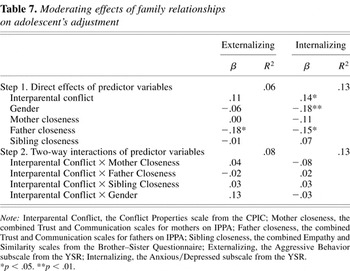
The second set of analyses examined whether family relationships served as protective factors that reduced the adverse effects of interparental conflict on adolescents' adjustment (see Table 7). Turning first to adolescents' reports of depressive and anxious symptoms, the variables in the regression equation accounted for significant variance (13%) as a group, and exposure to conflict, closeness to fathers, and gender were significant unique predictors of internalizing symptoms. Specifically, youths reporting more interparental conflict and poorer relationships with their fathers reported higher levels of depression and anxiety, and girls reported higher levels than boys. Again, interparental conflict did not interact with any of the family variables.
Moderating effects of family relationships on adolescent's adjustment

Finally, the equation predicting aggressive behavior accounted for a smaller yet still significant proportion of variance (6%). The only unique predictor in this analysis was closeness to fathers: adolescents reporting weaker alliances with their fathers exhibited higher levels of aggressive and disruptive behavior. None of the interaction terms were significant.
Discussion
Although family systems concepts were introduced over 30 years ago and had a major impact on clinical interventions with children (see Nichols & Schwartz, 2001), this theory largely has been overlooked when studying the mechanisms by which marital discord affects children's development. This is unfortunate considering that the few studies inspired by this perspective have produced promising results (e.g., Buchanan & Waizenhofer, 2001; Davies et al., 2002; Kerig, 1995). The findings of the present study build on this research by showing how two systemic concepts, triangulation and wholism, may illuminate the processes that increase or decrease the effects of interparental conflict on adjustment problems in adolescence.
Triangulation occurs when children are drawn into or feel caught in the middle of parental disagreements, and represents a violation of the boundary between the marital and child subsystems (see Buchanan & Waizenhofer, 2001; Margolin et al., 2001). From a systems perspective, triangulation is often an attempt to avoid overt expression of marital conflict by focusing attention on the child or an effort by one parent to enlist the support of the child in the conflict, and is viewed as maladaptive for both the child and the family as a whole. Accordingly, we found that adolescents were more likely to feel triangulated into parental conflicts as the level of conflict increased in the marriage; moreover, triangulation mediated the association of interparental conflict with both internalizing and externalizing problems, supporting the hypothesis that triangulation is a process by which interparental conflict leads to child maladjustment.
Buchanan et al. (1991) found that experiencing loyalty conflicts mediated the link between parental discord and adolescents' maladjustment in divorced families, and our findings indicate that triangulation affects adolescents in intact families in similar ways. Only one other study has tested this hypothesis in youths from intact families: Buchanan and Waizenhofer (2001) reported that aligning with mothers during parental conflict, but not loyalty conflicts, acted as a mediator of the association between conflict and maladjustment. These findings raise the possibility that triangulation may be experienced differently in divorced and intact families. Divided loyalties are likely to be more common in children from divorced families because these children are often placed in a position where they feel that closeness to one parent is viewed as betrayal by the other. In intact families, a perceived need to choose between one's parents may be less common than a subjective sense that one (or both) is trying to enlist the child's support or that the child may be drawn into the conflict against his or her will. Triangulation is not always initiated by parents, however. Some children may willingly intervene in a parental disagreement in an effort to reduce the distress they experience when they witness an argument.
Being caught in the middle of parental conflicts or feeling compelled to side with one parent against another is likely to be stressful for most adolescents, and may produce tension, anxiety, resentment, or guilt. If triangulation becomes a consistent pattern that occurs when parents have a disagreement, these feelings may develop into more persistent symptoms of internalizing and externalizing disorders. Triangulation also may result in adolescents becoming the target of parental hostility or aggression, which in turn is associated with a range of adjustment problems. Boundary violations may be especially problematic for adolescents because one of the normative developmental tasks for this age group is individuation, and involvement in marital disputes and crossgenerational coalitions may interfere with adolescents' efforts to establish greater autonomy from their parents.
We also investigated aspects of family functioning that predicted when adolescents would be triangulated into parental conflict. Drawing from family systems theory, we predicted that adolescents who had a much stronger alliance with one parent than the other would be more likely to feel drawn into parental disagreements. We found that adolescents who had relatively similar or balanced alliances with their parents reported little triangulation when interparental conflict was low, but experienced increasing levels of triangulation as parental conflict increased. For those with discrepant or unbalanced alliances, the association between interparental conflict and triangulation also was significant and positive, but not as strong. Like the balanced alliance group, these adolescents also reported high levels of triangulation when interparental conflict was frequent; in contrast to the balanced group, however, those involved in crossgenerational coalitions experienced relatively high levels of triangulation even at low levels of conflict.
Thus, as interparental conflict increases in frequency and intensity, most adolescents may feel caught in the middle or be motivated to intervene. However, involvement in a crossgenerational coalition establishes the conditions for triangulation to occur even when conflict is infrequent. For example, an adolescent who is closer to his mother may take her side or defend her when a disagreement occurs between his parents. Alternatively, triangulation may affect parent–child relationships; children who become triangulated into parental conflicts subsequently may develop closer alliances with one parent than the other. For instance, an adolescent who takes her father's side in a parental dispute may incur resentment from her mother, and as a result the adolescent may become more closely allied with her father and more distant from her mother. In keeping with a systemic view of causality, it is most likely that the relation between triangulation and crossgenerational coalitions is circular or transactional; that is, unbalanced alliances may make triangulation more likely when conflict occurs, and being drawn into parental conflicts, in turn, may further unbalance existing alliances.
The second major focus of the study concerned the role of other family relationships in shaping the impact of parental disagreements on adolescents' conflict appraisals and on their adjustment more broadly. The principle of wholism suggests that family interactions are interrelated, and that the impact of a given relationship is best understood in the larger context of the family. As documented in prior research (see Erel & Burman, 1995; Grych, 2002), families in which there were higher levels of interparental conflict also were characterized by poorer parent–child and sibling relationships. Further, closeness in these relationships was associated with adolescents' appraisals of threat or self-blame, factors that have been identified as processes by which exposure to parental disagreements can lead to adjustment problems (e.g., Dadds et al., 1999; Grych et al., 2000, 2003; Kerig, 1998). In addition, there was a significant interaction between gender and exposure to conflict in predicting threat appraisals: girls showed a stronger linkage between their threat appraisals and the level of conflict they witnessed than did boys. Although both genders reported increasing levels of threat as conflict in the marital subsystem increased, girls appeared to be more sensitive to the occurrence of parental conflict. This may reflect the intensification of girls' focus on relationships in adolescence (Davies & Lindsay, 2001): Girls may be both more attuned to the state of their parents marriage and more concerned by the implications of conflict for the health and stability of the relationship.
Adolescents with stronger parent–child alliances reported being less threatened by conflict and less likely to blame themselves when conflict occurred. When mother– and father–child relationships were entered together into regression equations predicting these appraisals, only maternal relationships accounted for significant unique variance in threat and only paternal relationship accounted for unique variance in self-blame. The link between parent–child relationships and perceived threat supports the proposal made by both the cognitive–contextual framework (Grych & Fincham, 1990) and emotional security hypothesis (Davies & Cummings, 1994) that supportive parent–child relationships can reduce the impact of interparental conflict. If parental conflict is distressing because it poses a threat to the well-being of adolescents or their family, a close parent–child relationship can reinforce children's beliefs that they are cared for and that family relationships are not jeopardized by disagreements. Similarly, feeling secure and supported in their relationships with their parents may allow adolescents to separate themselves from marital disagreements and avoid taking responsibility for causing or resolving them. Perhaps parents who are sensitive and responsive to their children avoid implicating them in marital issues and reinforce the idea that parental disagreements are not their fault. We know very little about how parents communicate with their children about conflicts that they observe, and investigating this issue might shed light on the process by which children understand the causes and consequences of interpersonal discord.
The negative association between sibling closeness and perceived threat was unexpected. The influence of sibling relationships on adolescents' responses to interparental conflict has been rarely studied; consequently, it is difficult to offer more than tentative hypotheses about their role, but we offer a couple of possibilities. First, the sibling measure assessed the degree of empathy and similarity respondents experienced with their siblings, and it is possible that adolescents who are particularly empathic and sensitive to others may find conflict between their parents to be more upsetting. Adolescents who develop highly empathic relationships with their siblings may also become overly connected to parental disagreements and feel responsible for causing or for resolving them. In the language of family systems theory, their boundaries with others in the family may be too permeable. Second, the causal relation between these constructs may flow in the other direction, or, more likely, be reciprocal. That is, youths who feel highly threatened by conflict may be more likely to seek support from their siblings, and so the quality of the sibling relationship may be shaped by the conflict that occurs in the family. It should also be noted that the correlations between sibling closeness and both appraisals were very small, and so raise questions about the stability of these findings. Replication is needed before drawing any firm conclusions about links between sibling relationships and adolescents' appraisals of interparental conflict.
Our final goal was to examine whether family relationships acted as protective factors in relation to adolescent adjustment. The data supported the conceptualization of close parent–child relationships as exerting a “main effect” on adolescent adjustment rather than a buffering or moderating effect (see Luthar et al., 2000; Rutter, 1988). That is, supportive parent–child relationships had a beneficial effect for all youths regardless of the level of interparental conflict they witnessed. Specifically, adolescents having closer alliances with their fathers and mothers reported lower levels of aggression, but only paternal relationships accounted for unique variance. Father–child closeness also was associated with lower levels of internalizing problems. These data are consistent with the large literature documenting the positive effects of strong parent–child relationships on adolescent functioning. Much of this research has focused exclusively on mothers, but our findings suggest that father–child relationships may play an even more salient role than maternal relationships in shaping adolescent adjustment.
An important next step for this research will be to further integrate dyadic aspects of relationships with triadic (or larger) aspects. A strong alliance with one parent may be a protective factor when it occurs in a generally supportive family with clear generational boundaries, but a vulnerability factor when it occurs in the context of a crossgenerational coalition. Because our measure of discrepant alliances was a linear combination of the scales used to measure parent–child closeness, these constructs could not be tested independently in this study. Observational and parent-report data will be needed in addition to child reports to better distinguish alliances, crossgenerational coalitions, and triangulation. Similarly, it will be important to more fully integrate systemic thinking with existing conceptual models of the links between conflict and adjustment. In the present study, adolescents who reported more triangulation also perceived parental disagreements to be more threatening and had a greater tendency to feel responsible for causing or resolving the disagreements (see Table 1). Investigating how children's appraisals shape and are shaped by other family interactions will further understanding of how intrapersonal processes such as emotional and cognitive responses to conflict are related to interpersonal dynamics in the family.
Limitations
Although this study provides promising data on the role of systemic processes in shaping the impact of parental discord on adolescents, it does have a number of limitations. First, all of the constructs were measured via self-report, which could artificially inflate the associations among the variables. This concern is allayed to some extent by a recent study showing that relations between interparental conflict, appraisals, and child adjustment were similar for parent and child ratings of conflict (Grych et al., 2003), but including other family members as reporters would provide a broader perspective on the links between family processes and child adjustment. Observational methods are particularly important for assessing interaction patterns such as triangulation. In addition, although adolescents' subjective perceptions of interparental conflict and family relationships are important from a theoretical perspective, linking these perceptions to observed behavior in the family is critical. Second, as noted above, triangulation can be defined in different ways, and consequently, the results of this study pertain only to youths' experience of being caught in the middle of parental disagreements and may not apply equally well to other conceptualizations of triangulation (e.g., scapegoating, detouring). It will be important to examine whether subjective feelings of triangulation relate to naturally occurring triadic family interactions. Finally, these are cross-sectional data and thus do not provide insights into the direction of effects among the constructs. Given the transactional nature of the processes described by systems theory, longitudinal research will be needed to examine the interplay of family interactions and relationships over time.
In summary, this study supports the value of family systems principles for guiding research on the effects of interparental conflict on children. It indicates that triangulation may be one process by which exposure to parental disagreements increases children's risk for developing maladjustment, and offers insights into ways that parent–child relationships may increase or decrease the impact of conflict on children and adolescents. Not all children exposed to high levels of interparental conflict exhibit adjustment problems, and one factor promoting resiliency may be the presence of strong, balanced alliances between children and their parents. Although interparental conflict tends to undermine the quality of parent–child relationships, parents who can remain supportive and responsive to their children despite conflict in their relationship may be able to reduce the adverse effects associated with marital discord.
References
REFERENCES
Achenbach, T. M.
(1991).
Manual for the Youth Self-Report and 1991 profile.
Burlington, VT:
University of Vermont, Department of Psychiatry.
Aiken, L. S., &
West, S. G.
(1991).
Multiple regression: Testing and interpreting interactions.
Newbury Park, CA:
Sage.
Armsden, G. C., &
Greenberg, M. T.
(1987).
The Inventory of Parent and Peer Attachment: Individual differences
and their relationship to psychological well-being in adolescence.
Journal of Youth and Adolescence
16,
427–454.CrossRefGoogle Scholar
Baron, R. M., &
Kenny, D. A.
(1986).
The moderator–mediator variable distinction in social
psychological research: Conceptual, strategic, and statistical
considerations.
Journal of Personality and Social Psychology
51,
1173–1182.CrossRefGoogle Scholar
Bickham, N. L., &
Fiese, B. H.
(1997).
Extension of the Children's Perception of Interparental
Conflict Scale for use with late adolescents.
Journal of Family Psychology
11,
246–250.CrossRefGoogle Scholar
Buchanan, C. M.,
Maccoby, E. E., &
Dornbusch, S. M.
(1991).
Caught between parents: Adolescents' experience in divorced
homes.
Child Development
62,
1008–1029.CrossRefGoogle Scholar
Buchanan, C. M., &
Waizenhofer, R.
(2001).
The impact of interparental conflict on adolescent children:
Considerations of family systems and family structure. In
A. Booth,
A. C. Crouter, &
M. Clements (Eds.),
Couples in conflict (pp.
149–160).
Mahwah, NJ:
Erlbaum.
Christensen, A., &
Margolin, G.
(1988).
Conflict and alliance in distressed and nondistressed families.
In
R. A. Hinde &
J. Stevenson–Hinde (Eds.),
Relationships within families (pp.
263–282).
Oxford:
Clarendon Press.
Cox, M. J., &
Paley, B.
(1997).
Families as systems.
Annual Review of Psychology
48,
243–267.CrossRefGoogle Scholar
Dadds, M. R.,
Atkinson, E.,
Turner, C.,
Blums, G. J.,
Lendich, B.
(1999).
Family conflict and child adjustment: Evidence for a
cognitive–contextual model of intergenerational
transmission.
Journal of Family Psychology
13,
194–208.CrossRefGoogle Scholar
Davies, P. T., &
Cummings, E. M.
(1994).
Marital conflict and child adjustment: An emotional security
hypothesis.
Psychological Bulletin
116,
387–411.CrossRefGoogle Scholar
Davies, P. T.,
Harold, G. T.,
Goeke–Morey, M., &
Cummings, E. M.
(2002).
Child Emotional Security and Interparental Conflict.
Monographs of the Society for Research in Child Development
67(3, Serial No. 270).Google Scholar
Davies, P. T., &
Lindsay, L. L.
(2001).
Does gender moderate the effects of marital conflict on children?
In
J. Grych &
F. Fincham (Eds.),
Interparental conflict and child development: Theory, Research, and
application (pp.
129–156).
New York:
Cambridge University Press.
Davies, P. T.,
Myers, R. L., &
Cummings, E. M.
(1996).
Responses of children and adolescents to marital conflict scenarios
as a function of the emotionality of conflict endings.
Merrill–Palmer Quarterly
42,
1–21.Google Scholar
Davis, B. T.,
Hops, H.,
Alpert, A., &
Sheeber, L.
(1998).
Child responses to parental conflict and their effect on
adjustment: A study of triadic relations. Journal of
Family Psychology
12,
163–177.CrossRefGoogle Scholar
Dunn, J., &
Davies, L.
(2001).
Sibling relationships and interparental conflict. In
J. Grych &
F. Fincham (Eds.),
Interparental conflict and child development: Theory, Research,
and application (pp.
273–290).
New York:
Cambridge University Press.
Emery, R. E.
(1982).
Interparental conflict and the children of discord and divorce.
Psychological Bulletin
92,
310–330.CrossRefGoogle Scholar
Erel, O., &
Burman, B.
(1995).
Interrelatedness of marital relations and parent–child
relations: A meta-analytic review.
Psychological Bulletin
118,
108–132.CrossRefGoogle Scholar
Graham–Berman, S., &
Cutler, S. E.
(1994).
The Brother–Sister Questionnaire: Psychometric assessment and
discrimination of well-functioning from dysfunctional
relationships.
Journal of Family Psychology
8,
224–238.CrossRefGoogle Scholar
Grych, J. H.
(1998).
Children's appraisals of interparental conflict: Situational
and contextual influences.
Journal of Family Psychology
12,
1–17.CrossRefGoogle Scholar
Grych, J. H.
(2002).
Marital relationships and parenting. In
M. Bornstein (Ed.),
Handbook of parenting
(2nd ed., pp.
203–226).
Mahwah, NJ:
Erlbaum.
Grych, J. H., &
Fincham, F. D.
(1990).
Marital conflict and children's adjustment: A
cognitive–contextual framework.
Psychological Bulletin
108,
267–290.CrossRefGoogle Scholar
Grych, J. H., &
Fincham, F. D.
(1993).
Children's appraisals of marital conflict: Initial
investigations of the cognitive–contextual framework.
Child Development
64,
215–230.CrossRefGoogle Scholar
Grych, J. H.,
Fincham, F. D.,
Jouriles, E. N., &
McDonald, R.
(2000).
Interparental conflict and child development: Testing the
mediational role of appraisals in the cognitive–contextual
framework.
Child Development
71,
1648–1661.CrossRefGoogle Scholar
Grych, J. H.,
Harold, G. T., &
Miles, C. J.
(2003).
A prospective investigation of appraisals as mediators of the link
between interparental conflict and child adjustment.
Child Development
74,
1176–1193.CrossRefGoogle Scholar
Grych, J. H.,
Seid, M., &
Fincham, F. D.
(1992).
Assessing marital conflict from the child's perspective.
Child Development
63,
558–572.CrossRefGoogle Scholar
Holmbeck, G. N.
(1997).
Toward terminological, conceptual, and statistical clarity in the
study of mediators and moderators: Examples from the
child—Clinical and pediatric psychology literatures.
Journal of Consulting and Clinical Psychology
65,
599–610.CrossRefGoogle Scholar
Kerig, P. K.
(1995).
Triangles in the family circle: Effects of family structure on
marriage, parenting, and child adjustment.
Journal of Family Psychology
9,
69–78.CrossRefGoogle Scholar
Kerig, P. K.
(1998).
Gender and appraisals as mediators of adjustment in children
exposed to interparental violence.
Journal of Family Violence
15,
345–363.CrossRefGoogle Scholar
Lindahl, K., &
Malik, N. M.
(1999).
Marital conflict, family processes, and boys' externalizing
behavior in Hispanic American and European American families.
Journal of Clinical Child Psychology
28,
12–24.CrossRefGoogle Scholar
Lindahl, K. M.
(1998, November).
Triadic family observational coding: The use of a global coding
system with a multi-ethnic sample.
Paper presented at the 1998 Annual Convention of the Association
for Advancement of Behavior Therapy, Washington, DC.
Lindahl, K. M.,
Clements, M., &
Markman, H.
(1997).
Predicting marital and parent functioning in dyads and triads: A
longitudinal investigation of marital processes.
Journal of Family Psychology
11,
139–151.CrossRefGoogle Scholar
Luthar, S. S.,
Cicchetti, D., &
Becker, B.
(2000).
The construct of resilience: A critical evaluation and guidelines
for future work.
Child Development
71,
543–562.CrossRefGoogle Scholar
Margolin, G.,
Olive, P. H., &
Medina, A. M.
(2001).
Conceptual issues in understanding the relation between
interparental conflict and child adjustment: Integrating developmental
psychopathology and risk/resilience perspectives. In
J. Grych &
F. Fincham (Eds.),
Interparental conflict and child development: Theory, research, and
application (pp.
129–156).
New York:
Cambridge University Press.
Minuchin, P.
(1985).
Families and individual development: Provocations from the field of
family therapy.
Child Development
56,
289–302.CrossRefGoogle Scholar
Minuchin, S.,
(1974).
Families and family therapy.
Cambridge, MA:
Harvard University Press.
Rutter, M.
(1988).
Functions and consequences of relationships: Some
psychopathological considerations. In
R. A. Hinde &
J. Stevenson–Hinde (Eds.),
Relationships within families: Mutual influences (pp.
332–353).
Oxford:
Clarendon Press.
Westerman, M. A.
(1987).
“Triangulation,” marital discord and child behaviour
problems.
Journal of Social and Personal Relationships
4,
87–106.CrossRefGoogle Scholar
Correlations of criterion variables
Correlations of predictor and criterion variables
Mediator analyses for triangulation between interparental conflict and adolescents internalizing and externalizing symptoms
Moderator analysis of interparental conflict, differential closeness to parents, and adolescent's gender on triangulation
The interaction of interparental conflict and differential parental closeness on adolescents' reports of triangulation.
Moderating analysis of interparental conflict, adolescent's gender, and closeness on adolescent's perception of threat
Moderating analysis of interparental conflict, adolescent's gender, and closeness on adolescent's perception of self-blame
Moderating effects of family relationships on adolescent's adjustment
 You have
Access
- 134
- Cited by