One of the reasons for recommending surgical or transcatheter closure of secundum atrial septal defects is to prevent atrial arrhythmias. Atrial arrhythmias are responsible for significant morbidity and mortality. Two simple electrocardiographic markers, P-wave maximal duration and P-wave dispersion, have been used to evaluate the intra-atrial and inter-atrial conduction times and the inhomogeneous propagation of sinus impulses, which are well-known electrophysiological characteristics of the atrium prone to fibrillation.Reference Dilaveris, Gialafos and Sideris1, Reference Aytemir, Ozer and Atalar2 In atrial septal defects, the right atrial pressure increases, and the right atrium stretches and becomes more enlarged.Reference Morton, Sanders and Vohra3 Thus, the depolarisation of the right atrium is prolonged and this causes an increase in P dispersion.Reference Guray, Guray and Yilmaz4 In children with secundum atrial septal defect, P maximum and P dispersion analysed and compared between transcatheter and post-operative closure of the defects. We studied the dynamicity of P duration and dispersion changes; therefore, measurements were made before the procedure and 1 week after the procedure.
Materials and methods
Patient population
Sixty-eight children having transcatheter or surgical atrial septal defect closure at Gaziantep University, Gaziantep, Turkey, were evaluated for enrolment in the study. The study protocol was approved by the medical ethics committee of the university. Written informed consent was obtained from all patients. All the patients had normal sinus rhythm. Patients with other congenital cardiac defects associated with atrial septal defect were also excluded. A 12-lead electrocardiography with a paper speed of 50 millimetres per second and 1 millivolt per centimetre standardisation was obtained the day before and 1 week after the procedure. P-wave duration was measured by using an electronic digital compass with a sensitivity of 0.001 millimetre in all 12 leads by one observer in order to exclude inter-observer variability. At each derivation, the distance between the points of the earliest and latest P-wave activity was recorded as P-wave duration. At each electrocardiography, the longest P-wave measurement was noted as P maximum and the shortest measurements as P minimum. P dispersion was defined as the difference between the P maximum and P minimum. Acceptable electrocardiography was defined by the ability to measure P-wave duration in at least 8 of the 12 electrocardiographic leads that were recorded simultaneously.
In the transcatheter group, we used Amplatzer septal occluder (AGA Medical Corporation, Golden Valley, Minnesota, United States of America). These Amplatzer devices have a nitinol-braided skeleton with a thrombogenic effect provided by polyester dacron fibres made up of double discs with self-expanding and self-centring features and a connecting waist joining these double discs. Surgical closure was by direct suturing or by patch. The surgical group operated before starting transcatheter therapy in our institute or their defects were not suitable for transcatheter closure (very large defect, deficient rims, etc.). Pulmonary-to-systemic flow ratio was calculated from cardiac catheterisation by the Fick method from the transcatheter group. But in the surgical group, the shunt ratio was generally calculated by echocardiographic measurements.
Statistical analysis
Data were expressed as median, means plus or minus the standard deviations. Student’s t-test and χ 2 tests were used for the differences in numerical data between the groups; p-value of less than 0.05 was considered to be statistically significant. For the comparison of the values at baseline and after the procedure, paired t-tests were used. The SPSS 10.0 statistical software package (SPSS Inc., Chicago, Illinois, United States of America) was used for all calculations.
Results
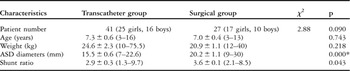
A total of 68 children (42 girls, 26 boys; the mean age was 7.2 plus or minus 3.3 years, with a range from 3 to 16 years; the mean weight was 23.1 plus or minus 12.1 kilograms, with a range from 10 to 75.5 kilograms; the mean secundum atrial septal defects diameter was 17.3 plus or minus 5.4 millimetres, with a range from 7 to 30 millimetres) were evaluated in this study. None of the children had documented arrhythmias during the post-operative follow-up, or any other clinically significant adverse events regardless of therapy. The transcatheter closure group was of 41 patients. The surgical group was of 27 patients. Clinical and echocardiographic characteristics of the groups are shown in Table 1.
Clinical characteristics of the patients.

ASD = atrial septal defect
*p less than 0.05, statistically significant
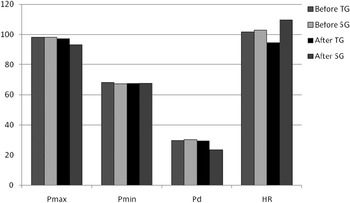
There were no significant differences between the groups with regard to patient numbers, age and weight (p greater than 0.05). But the diameter of the secundum atrial septal defects and systemic/pulmonic flow ratio were significantly different. P maximum, P minimum and P dispersion were found to be similar in patients with pre- and post-procedure (98.0 plus or minus 19.3 versus 95.1 plus or minus 23.0 milliseconds; 68.0 plus or minus 20.8 versus 67.6 plus or minus 24.3 milliseconds; and 29.9 plus or minus 11.0 versus 27.1 plus or minus 12.1 milliseconds, respectively). There was no significant difference in P-wave measurements in all the patients throughout the follow-up as compared both before and after the procedure (p values 0.415, 0.926 and 0.149, respectively; Fig 1).
P-wave measurements in the groups (TG = transcatheter group; SG = surgical group; Pmax = P maximum; Pmin = P minimum; Pd = P dispersion; HR = heart rate).

There was also a similarity in the P maximum, P minimum and P dispersion between the transcatheter and surgical closure groups before the procedure. After the procedure, P maximum and P minimum were not significantly different between the groups (p greater than 0.05). But P dispersion was significantly different between the transcatheter and surgical patients in the post-procedure period (29.5 plus or minus 11.6 versus 23.5 plus or minus 12 milliseconds; p-value is equal to 0.043; Table 2). P dispersion value was more decreased in the post-surgical group.
P-wave measurements in between groups.

*p less than 0.05, statistically significantly
In the surgical group, the diameter and the shunt ratio of the secundum atrial septal defects were greater than the transcatheter group, with a p-value less than 0.05. But both P maximum and P dispersion were similar in both groups (Table 2). In order to investigate the effect of surgical repair on P dispersion, the before and post-operative electrocardiographic values of the children were compared (Table 3). Data indicate that P dispersion significantly decreased within 1 week after surgery when compared with baseline values – p-value is equal to 0.03. After transcatheter closure with Amplatzer septal occluder, both P maximum and P dispersion were not significantly different compared with before closure values – p-value is greater than 0.05.
P-wave measurements between groups.

*p less than 0.05, statistically significantly
Discussion
Atrial fibrillation is a common arrhythmia found in conjunction with atrial septal defects in adults and is a significant cause of morbidity.Reference Guray, Guray and Yilmaz4, Reference Berger, Vogel and Kramer5 Oliver et alReference Oliver, Gallego, Gonzalez, Benito, Mesa and Sobrino6 demonstrated that advanced age is the most important condition related to the presence of atrial fibrillation in patients with atrial septal defect both before and after surgical closure. P-wave dispersion is greatest on days 2 and 3 after open-heart surgery, finding that it coincides with the time of greatest risk for atrial fibrillation.Reference Tsikouris, Kluger, Song and White7 Therefore, we calculated P dispersion at 1 week after any procedure.
We have demonstrated that in children with secundum atrial septal defects and normal sinus rhythm, P maximum and P dispersion are insignificantly changed compared with transcatheter closure with Amplatzer septal occluder and surgical closure. P dispersion is decreased significantly after surgery among children with atrial septal defect. We think that earlier closure of the defect might result in more homogeneous and organised conduction of the atrial impulse.
Ho et alReference Ho, Chia, Yip and Chan8 demonstrated that P dispersion was higher in children with atrial septal defect. Guray et alReference Guray, Guray, Mecit, Yilmaz, Sasmaz and Korkmaz9 also demonstrated a reduction in P dispersion after surgical atrial septal defect closure in adult patients. In addition, like us, Yavuz et alReference Yavuz, Nisli, Oner, Aydogan, Omeroglu and Ertugrul10 found a significant decrease in P maximum and P dispersion after surgical repair in children. In the transcatheter group, P dispersion was not changed, but may be it was related to the mass effect and metal configuration of the device.
Increased P dispersion is correlated with the size of defect and the degree of right atrial dilation in children with secundum atrial septal defects. P-wave dispersion could be used for the prediction of idiopathic paroxysmal atrial fibrillation. In normal healthy children, normal P dispersion was described as 27.0 plus or minus 5.4 milliseconds.Reference Dilaveris, Gialafos and Sideris1, Reference Aytemir, Ozer and Atalar2, Reference Kose, Kilic, Iyisoy, Kursaklioglu and Lenk11 Dilaveris et alReference Dilaveris, Gialafos and Sideris1 used 40 milliseconds; Aytemir et alReference Aytemir, Ozer and Atalar2 used 36 milliseconds as a cut-off value for P dispersion for the risk of atrial fibrillation. We found that P dispersion in 16 patients was greater than 36 milliseconds before the procedure and greater than 36 milliseconds after the procedure in 15 patients. Patient numbers with their P dispersion values in the clinical important range are not increased. We did not find a difference in P maximum and P dispersion values compared with transcatheter and surgical closure groups. Although the surgery group had a lower level of P dispersion values, closure of transcatheter atrial septal defects in childhood can reverse electrical and mechanical changes in the atrial myocardium and cause a subsequent reduction in P maximum and P dispersion times.
In conclusion, P-wave dispersion is a simple and useful parameter for the prediction of atrial arrhythmias. After surgical closure of the atrial septal defect, significant decrease in P-dispersion indices may be related to a lower risk of atrial fibrillation. There is no difference in P dispersion for transcatheter closure with Amplatzer septal occluder.