Introduction
Oswaldocruzia Travassos, 1917 (Nematoda: Molineidae) comprises about 90 nominal species of parasites from amphibians and reptiles distributed worldwide (Guerrero Reference Guerrero2013; Svitin Reference Svitin2017; Willkens et al. Reference Willkens, Furtado, Santos and Melo2021). Currently, 43 species have been reported in the Neotropical region (Willkens et al. Reference Willkens, Furtado, Santos and Melo2021), in which 11 are widely distributed in Brazil, infecting several species of amphibians and lizards (see Lent and Freitas Reference Lent and Freitas1935; Freitas and Lent Reference Freitas and Lent1938; Ben Slimane and Durette-Desset Reference Ben Slimane and Durette-Desset1995; Bursey and Goldberg Reference Bursey and Goldberg2004, Reference Bursey and Goldberg2011; Durette-Desset et al. Reference Durette-Desset, Anjos and Vrcibradic2006; Ávila and Silva Reference Ávila and Silva2010; Campião et al. Reference Campião, Morais, Dias, Aguiar, Toledo, Tavares and Silva2014; Larrat et al. Reference Larrat, Melo, Gomes, Wilkens and Santos2018; Benício et al. Reference Benício, Santos, Freire, Ávila, Silva and Fonseca2022; Lacerda et al. Reference Lacerda, Santana, Araujo Filho and Ribeiro2023). Although species of Oswaldocruzia from Brazil frequently appear in studies of species inventory or parasite ecology, most taxonomic studies regarding morphological descriptions have been published before the last 20 years (Bursey and Goldberg Reference Bursey and Goldberg2004; Durette-Desset et al. Reference Durette-Desset, Anjos and Vrcibradic2006; Santos et al. Reference Santos, Giese, Maldonado Junior and Lanfredi2008; Larrat et al. Reference Larrat, Melo, Gomes, Wilkens and Santos2018). Recent evaluations on these nematodes that include morphological and genetic characterisation are still scarce, especially in Brazil (see Simões et al. Reference Simões, Fraga-Neto, Vilar, Maldonado Júnior and Vilela2019).
Based on the currently limited knowledge of Oswaldocruzia species in Brazil, the present study proposes a new species of this genus, parasitizing Leptodactylus macrosternum (L. macrosternum) Miranda-Ribeiro, 1926 (Anura: Leptodactylidae), from Caatinga morphoclimatic domain, in the State of Pernambuco, using morphological and genetic characterisation.
Material and methods
Collection and necropsy of hosts
A total of 67 specimens of L. macrosternum were collected in a conventional agricultural area (9°20’4.68”S, 40°35’11.25”W), in the municipality of Petrolina, sub-middle region of São Francisco River, State of Pernambuco, Brazil. Collections were carried out in May 2018, February, September, and October 2019, and September 2021. The sampling area is in the Northeastern semi-arid part of Brazil. It has typical Caatinga vegetation (sensu stricto), with a climate characterised by high temperatures and irregular and scarce periods of rain (Prado Reference Prado, Leal, Tabareli and Silva2003). Amphibians were collected manually by active search and sent alive to the Laboratório de Morfofisiologia, Centro de Conservação e Manejo de Fauna da Caatinga (CEMAFAUNA-CAATINGA), Universidade Federal do Vale do São Francisco (UNIVASF), municipality of Petrolina, State of Pernambuco. These anurans were identified according to Magalhães et al. (Reference Magalhães, Lyra, Carvalho, Baldo, Brusquetti, Burella, Colli, Gehara, Giaretta, Haddad, Langone, López, Napoli, Santana, Sá and Garda2020) and representative specimens (symbiotypes) deposited in the Coleção Herpetológica do Museu de Fauna da Caatinga, UNIVASF, Brazil (MFCH – 5346, 5347, 5349, 5350, 5352, 5354–5357, 5363, 5365, 5381, 5382, 5388, 5402–5404, 5406, 5408, 5411, 5418, 5420, 5423, 5424, 5431, 5432, 5434, 5442).
Hosts were euthanised with an overdose of lidocaine hydrochloride applied topically to their dorsal region, according to the recommendations of the Conselho Nacional de Controle de Experimentação Animal (2018) and necropsied under a stereomicroscope.
Collection, processing and morphological identification of nematodes
A total of 124 nematodes were collected alive. They were placed in Petri dishes containing 0.85% saline and fixed in hot 4% formaldehyde solution, remaining for 15 days at room temperature, and posteriorly transferred to 70° GL ethanol for morphological studies. For molecular studies, some males from each infrapopulation were fixed and preserved in 100% ethanol.
Nematodes were cleared in Amann’s Lactophenol for morphological identification, mounted on temporary slides in the same medium, and observed using light microscopy. Drawings were made using a drawing tube attached to a Motic light microscope (Motic, Jiangsu, China). Measurements of parasites are given in micrometres, unless otherwise indicated, and are presented as ranges followed by mean inside parentheses.
Morphological terminology, identification, and description of nematodes follow Ben Slimane et al. (Reference Ben Slimane, Chabaud and Durette-Desset1996) and Bursey and Goldberg (Reference Bursey and Goldberg2011). The study of the synlophe was according to Durette-Desset (Reference Durette-Desset1985). Prevalence, mean intensity, and mean abundance of parasites were calculated according to Bush et al. (Reference Bush, Lafferty, Lotz and Shostak1997).
Molecular characterisation and phylogenetic analyses
For molecular characterisation, a small tissue sample was excised from the mid body part of a male specimen and subjected to DNA isolation, using DNeasy Blood & Tissue Kit (QIAGEN, Hilden, Germany), following manufacturer’s instructions. The anterior and posterior parts of the body were processed for morphological identification as previously described. A region of the nuclear 18S rDNA was amplified by polymerase chain reaction (PCR) assay, using the primers Nema18SF (5’-CGCGAATRGCTCATTACAACAGC-3’) and Nema18SR (5’-GGGCGGTATCTGATCGCC-3’) (Floyd et al. Reference Floyd, Rogers, Lambshead and Smith2005). The domains D2–D3 of the 28S rDNA and cox1 of the mtDNA were also aimed for amplification, using the genetic markers proposed by De Ley et al. (Reference De Ley, De Ley, Morris, Abebe, Mundo-Ocampo, Yoder, Heras, Waumann, Rocha-Olivares, Burr, Baldwin and Thomas2005) and Folmer et al. (Reference Folmer, Black, Hoeh, Lutz and Vrijenhoek1994), respectively, but proper amplicons could not be obtained. PCR reactions were carried out in a final volume of 25 μl consisting of 2.5 μl of 10X PCR buffer minus MgCl2, 1.25 μl of MgCl2 (50 mM), 0.5 μl of dNTP’s (10 mM), 0.5 μl of each oligonucleotide primer (10 μM), 0.2 μl of Recombinant Taq DNA polymerase (5 U/μl) (Invitrogen), 1.25 μl of BSA (10 μg/μl), 16.3 μl of H2O, and 2.0 μl of genomic DNA (about 40 ng). PCR cycling conditions were as follows: denaturation at 94°C for 5 min, followed by 36 cycles of 94°C for 30 s, annealing at 52.7°C for 30 s, and extension at 72°C for 1 min, followed by a post-amplification extension at 72°C for 5 min. Presence of amplicons were verified using agarose gel electrophoresis, positive products were subjected to enzymatic treatment with ExoSAP-IT (Applied Biosystems, Massachusetts, EUA) and sent for sequencing, with the same PCR primers, in ACTGene Molecular Analyses (Rio Grande do Sul, Brazil).
Contiguous sequences were assembled in Geneious Prime (by Dotmatics, Auckland, New Zealand), and the consensus extracted and subjected to BLAST search, in the NCBI database, for confirmation of the genetic proximity between the present sequence and those of Oswaldocruzia/Molineidae. This sequence was deposited in the GenBank database (see taxonomic summary).
In order to verify the phylogenetic position of the new species, 18S sequences overlapping the same region obtained in the present study, from all representatives of Molineidae, were taken from the GenBank database. Sequences MG586086 and MG586088, both identified as Oswaldocruzia filiformis (Goeze, 1782) parasitizing the smooth newt Lissotriton vulgaris (Linnaeus, 1758) (Caudata: Salamandridae) in Germany, had only a very small fragment of the 5’ end of the 18S and, consequently, could not be included in the analysis. Since the phylogeny of this family is still unresolved, showing conflicting results (see De Bellocq et al. Reference De Bellocq, Ferté, Depaquit, Justine, Tillier and Durette-Desset2001; Simões et al. Reference Simões, Fraga-Neto, Vilar, Maldonado Júnior and Vilela2019), sequences from representatives of Ancylostomatidae, Angiostrongylidae, Chabertiidae, Diaphanocephalidae, Dictyocaulidae, Strongylidae, Syngamidae, and Trichostrongylidae were also used. Heterorhabditis bacteriophora Poinar, 1976 (Nematoda: Heterorhabditidae) was used as the outgroup, based on a previous broad phylogenetic approach including bursate nematodes (Chilton et al. Reference Chilton, Huby-Chilton, Gasser and Beveridge2006). Detailed information on these sequences is presented in Table 1.
Taxa whose 18S rDNA genetic sequences were retrieved from GenBank associated with their accession number (GenBank ID), geographic origin, host, and reference

* Superscript numbers make correspondence with taxa in Figure 3.
Sequences were aligned using the multiple algorithm tool T-Coffee (Notredame et al. Reference Notredame, Higgins and Heringa2000) and then subjected to Bayesian inference in the software BEAST 2.5 (Bouckaert et al. Reference Bouckaert, Vaughan, Barido-Sottani, Duchêne, Fourment, Gavryushkina, Heled, Jones, Kühnert, De Maio, Matschiner, Mendes, Müller, Ogilvie, Du Plessis, Popinga, Rambaut, Rasmussen, Siveroni, Suchard, Wu, Xie, Zhang, Stadler and Drummond2019) for phylogenetic reconstruction. The best-fit nucleotide substitution model was chosen based on bModelTest (Bouckaert and Drummond Reference Bouckaert and Drummond2017). The molecular clock model was relaxed (log normal), defined using the nested sampling method (Russel et al. Reference Russel, Brewer, Klaere and Bouckaert2019) and the Yule tree prior, selected according to the posterior densities and the effective sample sizes (ESSs), verified in Tracer (Rambaut et al. Reference Rambaudt, Drummond, Xie, Baele and Suchard2018). The posterior estimates of parameter densities and the ESSs for each parameter of the model, as well as the posterior probability for nodal supports in the majority rule consensus phylogenetic tree, were determined after running the Markov chain Monte Carlo (MCMC), always four chains in two runs, each run with 10 × 106 generations, saving the last 10,001 trees and 25% burn-in. The quality of the analysis (parameter densities, ESSs, and burn-in) and the chain convergence were examined in Tracer (Rambaut et al. Reference Rambaudt, Drummond, Xie, Baele and Suchard2018).
Holotypes, allotypes, paratypes, and hologenophore were deposited in the Coleção Helmintológica do Instituto Oswaldo Cruz (CHIOC), Instituto Oswaldo Cruz (IOC), Fundação Oswaldo Cruz (FIOCRUZ).
Results
Morphological description
Os waldocruzia franciscoensis n. sp.
General: Oswaldocruzia franciscoensis n. sp. has small and slender nematodes, and a cuticle with longitudinal ridges along the body. Sexual dimorphism is evident, and females are twice as large as males. Anterior region with cephalic cuticular inflation is divided into two parts, transversally striated, and ending anteriorly to the nerve ring (Figures 1A, 2A). Cervical alae begins slightly anterior to the nerve ring, ending somewhat at the level of the oesophagus intestinal junction (Figures 1A, 2A). Synlophe is composed of uninterrupted longitudinal cuticular crests, without reinforcement (Figures 1B, 1C, 2E, 2F). Mouth is surrounded by three simple, inconspicuous lips: a dorsal lip with two sessile papillae and ventrolateral lips with one sessile papilla and lateral amphid, each (Figure 2D). Oesophageal tooth is absent. Corona radiata is also absent. Oesophagus claviform has a nerve ring just anterior to its midlength. Excretory pore is at the final third oesophagus, anterior to deirids (Figures 1A, 2A).
Oswaldocruzia franciscoensis n. sp. male. Line drawing. A – The anterior region showing the ventral view. B – The transversal section at the level of the oesophagus region, between the nerve ring and the excretory pore. C – The transversal section at the level of the mid-body. D – The posterior region, caudal bursa, showing the right lateral view. E – The left spicule showing the ventral view. F – The caudal bursa showing the ventral view. G – The distal end of the left spicule blade showing the ventral view. H – The caudal bursa showing the ventral view. (Abbreviations: b – spicule blade; d – dorsal side; f – spicule fork; l – left side; r – right side; s – spicule shoe; v – ventral side).

Male (based on holotype and seven paratypes): Total body length is 4.8–6.85 (5.63) mm, and the body width at the oesophagus intestinal junction is 97–132 (114) mm. Cuticular inflation is 51–84 (67.6) long and 32–42 (38.1) wide. Oesophagus 359–427 (396.5) long. Nerve ring and excretory pore 123–181 (159) and 264–371 (326.3), respectively, from the anterior end. Excretory pore-oesophagus ratio 0.80. Deirids between the excretory pore and the oesophagus intestinal junction (Figure 1A) 280–381 (343) from the anterior end. Synlophe (based on three specimens): dorsal crests starting posteriorly to cephalic inflation, ventral crests starting at level of oesophagus intestinal junction. Dorsal and ventral crests ending close to anterior region of bursa. Number of crests between nerve ring and excretory pore: Ten to eleven dorsal crests, cervical alae, ventral crests absent (Fig. 1B). Thirty two to thirty three crests at mid-body (16-17 dorsal, 16 ventral) (Fig. 1C). Copulatory bursa trilobed, rays are arranged in type 2-1-2 pattern (Figure 1H). Rays 2 and 3 parallel, with a common origin, reaching edge of bursa (Figure 1D, 1F, 1H). Rays 4, 5, and 6 with a common origin (Figure 1D, 1H); ray 4 is not parallel, not reaching the margin of bursa separated from rays 5 and 6; rays 5 and 6 turning caudal, parallel, reaching margin of bursa (Figure 1H). Ray 8, with an independent origin, turns caudal, not reaching margin of bursa (Figure 1F, 1H) (caudal bursa type I). Dorsal ray conical distally divided into rays 9 and 10, reaching the dorsal edge of the bursa; ray 9 lateral and subterminal, ray 10 terminal subdivided into two bilobed branches at each side (Figure 1F, 1H). Genital cone with medial ray 0 on the anterior margin and ray 7 posterior to ray 0 located lateroventrally (Figure 1F). Gubernaculum absent. Spicules equal 149–168 (157.4) long, divided proximally into three main parts: shoe, blade, and fork (Figure 1E). Fork bifurcated at approximately 28% of the spicule; right and left branches not subdivided (Figure 1E). Spicular blade divided into two unequal branches, longer branch bifurcating in distal portion and second branch with three distal processes, each with distal bifurcations (Figure 1G).
Female (based on alloptype and eight paratypes): Total body length is 6.83–11.96 (9.52) mm, and the body width at the oesophagus intestinal junction is 112–172 (137.9). Cuticular inflation is 63–83 (72.9) long and 36–48 (42) wide. Oesophagus is 407–484 (452.9) long. Nerve ring and excretory pore 157–199 (173.3) and 253–392 (332.9), respectively, from the anterior end. Deirids between excretory pore and oesophagus intestinal junction are 274–418 (397). Synlophe (based on three specimens): dorsal crests beginning posteriorly to cephalic inflation, ventral crests beginning at level of oesophagus intestinal junction. Dorsal and ventral crests ending slightly anterior to tail end. Number of crests between nerve ring and excretore pore: Eighteen dorsal crests, cervical alae, ventral crests absent. (Fig 2E). Fifty six to fifty seven crests at mid-body (30-31 dorsal, 26 ventral) (Fig. 2F). Vulvar opening at 4.36–7.76 (6.16) mm from the anterior end, vulval lips not prominent as a transverse slit (Figure 2E). Didelphic and amphidelphic uterus (Figure 2B). Vagina short at 87–103 (93.7) long, vestibule is 106–114 (109) long (Figure 2B). Sphincters both 103–112 (108), infundibula both 27–39 (29) long (Figure 2B). Eggs in morula (Figure 2B) 62–111 (78.4) × 38–69 (45.1). Tail conical 123–165 (147.6) long, flexible filament is 11–13 (120) long (Figure 2C).
Oswaldocruzia franciscoensis n. sp. female. Line drawing. A – The anterior region showing the lateral view. B – The cephalic end showing the apical view. C – The transversal section at the level of the oesophagus region, between the nerve ring and excretory pore. D – The transversal section at the level of the mid-body. E – The female reproductive system region showing the lateral view. F – The posterior region showing the lateral view. (Abbreviations: d – dorsal side; l – left side; r – right side; v – ventral side)

Taxonomic summary
Type host: Leptodactylus macrosternum Miranda-Ribeiro (Anura, Leptodactylidae) (Miranda’s White-lipped Frog, ‘Caçote’)
Type locality: conventional agriculture area (9°20’4.68”S, 40°35’11.25”W), municipality of Petrolina, State of Pernambuco, Brazil
Site of infection: stomach and small intestine
Prevalence: 35.8% (24 infected hosts out of 64 studied)
Mean intensity: 5.9±1.9 parasites per infected host (1–40 specimens)
Mean abundance: 2.1±0.8 parasites per analysed host
GenBank accession: 18S rDNA partial sequence (OR614372)
ZooBank registration: will be provided after the acceptance of the manuscript.
Type specimens: holotype male: CHIOC 39646a; allotype female: CHIOC CHIOC 39646b. Paratypes: CHIOC 39646c (four males and four females). Hologenophore: CHIOC 39646d (anterior and posterior regions of one adult male).
Etymology: The species was named in allusion to the São Francisco River, the primary source of perennial water in the Brazilian Caatinga semi-arid region.
Molecular characterisation
A partial sequence of the 18S rDNA was obtained for O. franciscoensis n. sp. (528 bp). This sequence was most closely related to those of the congeners Oswaldocruzia sp. (LC624873, LC624874, JX877669), showing 99.24–99.43% of genetic identity, and secondly most closely related to species of Nematodirus Ransom, 1907 (AJ920360, JX305977, U01230; genetic identity 96.59–96.78%), a genus also belonging to Molineidae.
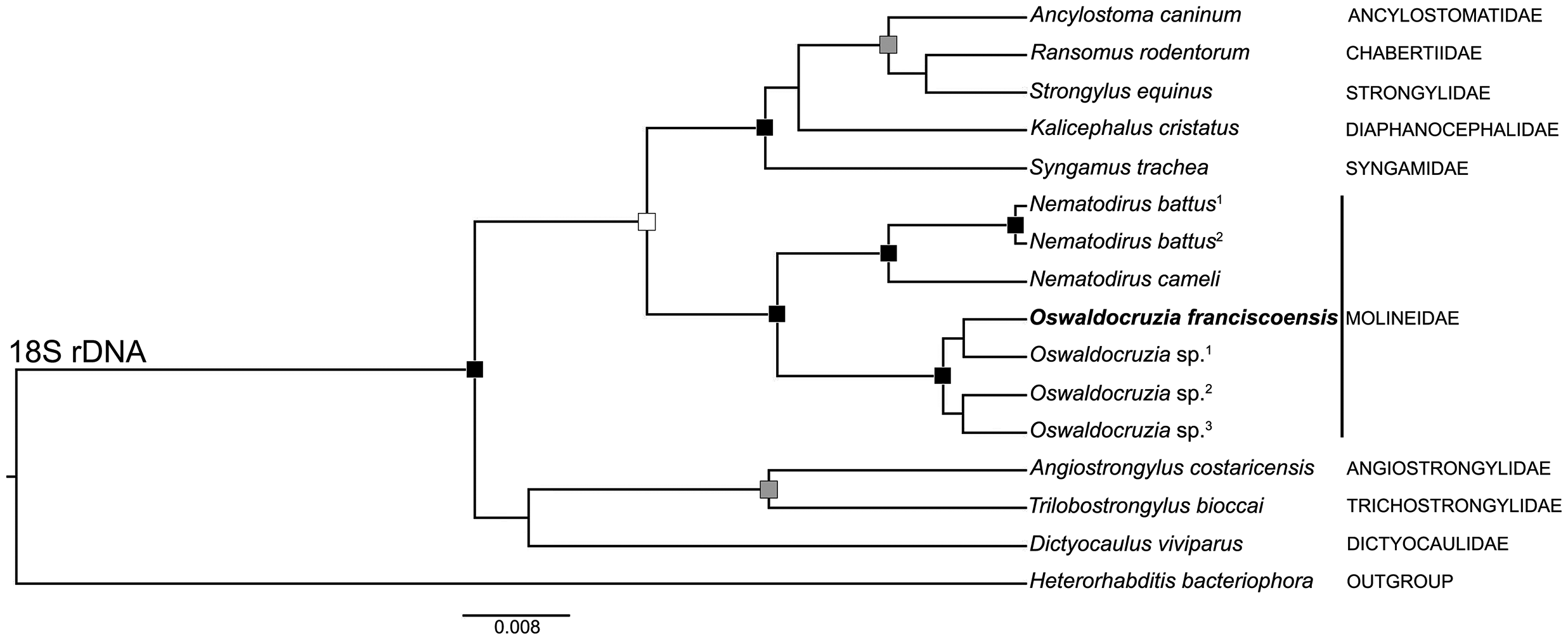
In the phylogenetic reconstruction, the new species formed a fully supported monophyletic assemblage with representatives of Oswaldocruzia (Figure 3). A fully supported monophyletic lineage was formed by the species of Nematodirus, which clustered as a sister group to that of Oswaldocruzia, forming an also fully supported monophyletic assemblage and representing the family Molineidae (Figure 3). Representatives of Ancylostomatidae, Chabertiidae, Diaphanocephalidae, Strongylidae, and Syngamidae clustered together with full support, in which this assemblage was sister to representatives of Molineidae, with high support (Figure 3).
The phylogenetic reconstruction was based on Bayesian inference, from 18S rDNA sequences of representatives from different families of ‘bursate nematodes’. The nodal supports were estimated by Bayesian posterior probability (BPP). The dark squares indicate full support (BPP = 1), the grey squares indicate high support (0.96 < BPP < 1), and the white squares indicate moderate support (0.93 < BPP < 0.96). The families of each taxon are indicated in capital letters. The sequence generated in the present study is in bold. Superscript numbers correspond with the information in Table 1.

Discussion
The new species was assigned to the genus Oswaldocruzia because the males have rays of caudal bursa with a 2-1-2 pattern, a gubernaculum is absent, and the spicules are divided into three parts (shoe, blade, and fork); moreover, females are amphidelphic, have post-equatorial vulva, and a tail ending in a small flexible filament (Ben Slimane et al. Reference Ben Slimane, Chabaud and Durette-Desset1996). In addition, both males and females have cephalic vesicles divided into two portions and covered by longitudinal cuticular crests (synlophe) without chitinous support (Ben Slimane et al. Reference Ben Slimane, Chabaud and Durette-Desset1996).
The main morphological features used for differentiating species of Oswaldocruzia are the morphology of the caudal bursa and of the spicules in males, the number and arrangement of synlophe crests, as well as the presence or absence of cervical alae in both males and females (see Ben Slimane et al. Reference Ben Slimane, Chabaud and Durette-Desset1996; Bursey and Goldberg Reference Bursey and Goldberg2011; Larrat et al. Reference Larrat, Melo, Gomes, Wilkens and Santos2018). However, the number and distribution of synlophe crests were not considered in the present differential diagnosis since some authors indicate that such features show intraspecific variations (see Santos et al. Reference Santos, Giese, Maldonado Junior and Lanfredi2008; Svitin Reference Svitin2017; Kirillova et al. Reference Kirillova, Kirillov and Chikhlyaev2021; Wilkens et al. Reference Willkens, Furtado, Santos and Melo2021), which was confirmed after comparing the species as indicated in Table 2. Some authors also use the zoogeographic distribution as a differential character for species of Oswaldocruzia (see Ben Slimane et al. Reference Ben Slimane, Chabaud and Durette-Desset1996; Bursey and Goldberg Reference Bursey and Goldberg2011; Larrat et al. Reference Larrat, Melo, Gomes, Wilkens and Santos2018).
Morphometrics and main morphological characters of Neotropical species of Oswaldocruzia Travassos with caudal bursa type I

* Authors do not provide data on the length of tail filament.
Currently, 43 species of Oswaldocruzia have been reported in the Neotropical region (see Bursey & Goldberg Reference Bursey and Goldberg2011; Guerrero, Reference Guerrero2013; Ruiz-Torres et al. Reference Ruiz-Torres, Garía-Prieto, Osorio-Sarabia and Violante-González2013; Larrat et al. Reference Larrat, Melo, Gomes, Wilkens and Santos2018), in which eight have type I caudal bursa similar to the new species. Of these, O. bonsi Ben Slimane & Durette-Desset, Reference Ben Slimane and Durette-Dessett1993, O. brasiliensis Lent & Freitas, Reference Lent and Freitas1935, and O. neghmei Puga, Reference Puga1981 differ from the new species because they lack cervical alae, which are present in this latter (see Table 2 for details). The remaining five congeners have cervical alae and will be differentiated from O. franciscoensis n. sp. as follows.
Oswaldocruzia franciscoensis n. sp. differs from O. cartagoensis Bursey & Goldberg, Reference Bursey and Goldberg2011, O. lamotheargumedoi Ruiz-Torres, García-Pietro, Osorio-Sarabia & Violante-Gonzáles, Reference Ruiz-Torres, Garía-Prieto, Osorio-Sarabia and Violante-González2013, O. lopesi Freitas & Lent, Reference Freitas and Lent1938, O. urubambaensis Guerrero, Reference Guerrero2013, and O. vitti Bursey & Goldberg, 2004 mainly based on the morphology of a spicular blade (see Table 2). The new species has a spicular blade divided into two unequal branches, in which the distal end of the longer branch is bifurcated, and the smaller branch has three distal processes, each distally bifurcated (Figure 1E, 1G), contrasting with O. cartagoensis that has a spicular blade formed by only one branch, distally divided into eight long narrow pointed processes. Oswaldocruzia lamotheargumedoi also has one spicular blade formed by only one branch, which is distally divided into 12 unequal processes. Oswaldocruzia lopesi has a spicular blade with one branch ending in three or four single distal parts. Oswaldocruzia urubambaensis has a spicular blade with six to nine unequal branches, ending in single distal parts. Oswaldocruzia vitti has a spicular blade with three equal branches, each with bifurcated distal ends. Therefore, all the previously mentioned species clearly differ from O. franciscoensis n. sp.
The present results of genetic characterisation confirmed the allocation of O. franciscoensis n. sp. in the genus Oswaldocruzia, in which the new species formed a fully supported assemblage with its congeners. Currently, the availability of 18S sequences from representatives of Oswaldocruzia is very limited in the GenBank database. These have been originated from hosts of North America and Japan (see Table 1). Therefore, the present 18S sequence of O. franciscoensis n. sp. is the first generated for a species of Oswaldocruzia in the Neotropical region and may serve for further approaches to the phylogenetic relationships of these nematodes.
Still, on the monophyletic lineage formed by species of Oswaldocruzia, it was possible to observe that the representatives from the Americas, including the new species, clustered together, and the same was observed among representatives from Japan. Although these assemblages were weakly supported, the results may be indicative of a biogeographic influence in the genetic relatedness (and probably speciation) of these parasites.
Regarding other genetic markers available for molineid nematodes (including Oswaldocruzia spp.) in GenBank, nuclear 28S rDNA and ITS1-5.8S-ITS2 and mitochondrial cox1 regions are more numerous. Furthermore, phylogenetic approaches to representatives of Molineidae are limited since they include few species or are focused only on certain genera (De Bellocq et al. Reference De Bellocq, Ferté, Depaquit, Justine, Tillier and Durette-Desset2001; Chilton et al. Reference Chilton, Huby-Chilton, Gasser and Beveridge2006; Kirillova et al. Reference Kirillova, Kirillov, Shchenkov and Chikhlyaev2023). In relation to Oswaldocruzia, the situation may be considered more critical because only five out of 90 species have been genetically characterised, namely, O. belenensis Santos, Giese, Maldonado & Lanfredi, Reference Santos, Giese, Maldonado Junior and Lanfredi2008, O. chabaudi Ben Slimane & Durette-Desset, Reference Ben Slimane, Chabaud and Durette-Desset1996, O. chambrieri Ben Slimane & Durette-Desset, Reference Ben Slimane and Durette-Dessett1993, and O. filiformis and O. ukrainae Ivanitzky, 1940, in addition to several sequences labelled as Oswaldocruzia sp., in which makers for cox1 are by far the most common (see Willkens et al. Reference Willkens, Maldonado, Santos, Maschio and Melo2016; Kirillova et al. Reference Kirillova, Kirillov, Shchenkov and Chikhlyaev2020, Reference Kirillova, Kirillov, Shchenkov and Chikhlyaev2023). Therefore, the currently limited genetic evidence does not allow further conclusions about the phylogeny of Oswaldocruzia.
Simões et al. (Reference Simões, Fraga-Neto, Vilar, Maldonado Júnior and Vilela2019) suggested the possibility of Molineidae to be artificial, based on phylogenetic reconstructions using 28S and cox1 sequences. The authors supported their argument based on the fact that this family of nematodes includes rather complex organisms, with different biological and life history traits, parasitizing hosts from different classes of vertebrates (Simões et al. Reference Simões, Fraga-Neto, Vilar, Maldonado Júnior and Vilela2019). Nevertheless, the phylogenetic resolution of lower nodes and also of higher taxa (i.e. families) in the results shown by Simões et al. (Reference Simões, Fraga-Neto, Vilar, Maldonado Júnior and Vilela2019) was generally low. The lower degree of conservation observed in some regions of the 28S among the ‘bursate nematodes’ (see Pereira et al. Reference Pereira, Ferreira, Tomas, Elisei, Paiva and Tavares2019), as well as of mitochondrial genes in comparison with those nuclear, may be overshadowing the real phylogenetic patterns of Molineidae. In this sense, the present 18S-based phylogeny showed good support for lower nodes, indicating that this genetic marker may represent an adequate additional tool for further phylogenetic investigations about Molineidae and other closely related taxa.
Acknowledgements
Fabiano M. Vieira was supported by a Research Fellowship from Fundação de Amparo à Ciência e Tecnologia do Estado de Pernambuco (FACEPE), Brazil (Process: BFP-0206-2.13/20). Felipe Bisaggio Pereira was supported by Fundação de Amparo à Pesquisa do Estado de Minas Gerais, Brazil (FAPEMIG; Process: APQ-01179-21).
Competing interest
None.
Ethical standard
This study was conducted under the authorizations of the Sistema de Autorização e Informação em Biodiversidade (SISBIO) of the Instituto Chico Mendes de Conservação da Biodiversidade (ICMBio no. 62680-1 and ICMBio no. 78052-1), licenses of the Comitê de Ética no Uso de Animais (CEUA) of the UNIVASF (UNIVASF no. 0001/221018 and UNIVASF no. 0002/230621), and National System for the Management of Genetic Heritage and Associated Traditional Knowledge, Brazil (SISGEN #A9E80D6).