INTRODUCTION
We describe the species Sphyrna lewini (Griffith & Smith, 1834), which was collected from the western region of the Bay of Bengal during recent surveys. The report of S. lewini is the recurrence after 35 years from the Indian coast which indicates a marked extension of the distribution from its type locality (Talwar, Reference Talwar1974). The scalloped hammerhead is viviparous, semi-pelagic, living in both coastal and offshore waters in tropical and sub-tropical regions. The frequency of auction of S. lewini and Sphyrna zygaena fins in Hong Kong fish markets remains high, comprising nearly 5% of the total fin market (Clarke et al., Reference Clarke, Magnussen, Abercrombie, McAllister and Shivji2006a) and thus landings of S. lewini have decreased in recent years (Martínez-Ortíz et al., Reference Martínez-Ortíz, Galván-Magaña, Carrera-Fernández, Mendoza-Intriago, Estupiñán-Montaño, Cedeño-Figueroa, Martínez-Ortíz and Galván-Magaña2007). It is cosmopolitan in distribution and listed as ‘endangered’ in the IUCN Red List of Endangered Species (NOAA NEFSC, Petition to List the Scalloped Hammerhead 24 Shark under the Endangered Species Act Exhibit 9 at 1).
MATERIALS AND METHODS
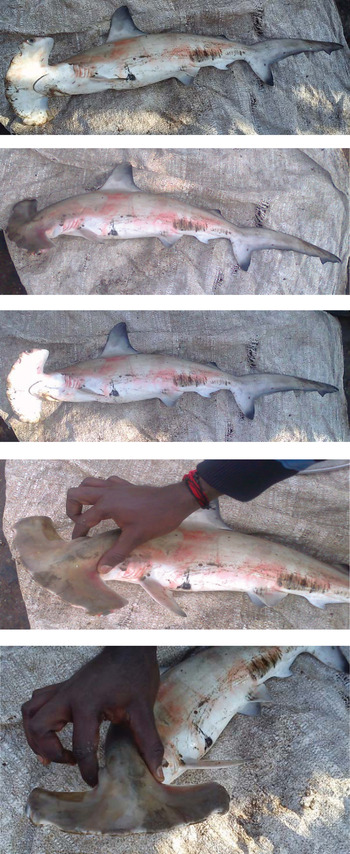
During a routine survey, on 24 January 2012, a single specimen of shark was collected by using long line from Nagapattinam coastal waters, south-east coast of India. It was then identified as scalloped hammerhead shark S. lewini using FAO sheets (FAO, 2000) (Figure 1). It had total length of 75 cm and standard length of 67 cm.

KEY TO SPECIES
Body shape similar to whale shark but the head is flattened and expanded laterally like a hammer with eyes on the ends and, eyes and nostrils close together. Spiracles and interdorsal ridge were absent; first dorsal fin was situated very high and patented; second dorsal and anal fins small and far behind; caudal fin was asymmetrical with well defined sub-terminal notch and small lobe; pre-caudal pits were present. Front margin of head with a distinct median indentation; anal fin base longer than second dorsal fin base. Body elongated and laterally compressed; lateral extensions of head narrow and blade like; anterior margin of head broadly convex, with a distinct median indentation and another prominent notch laterally near end. Body was brownish-grey, shading to white ventrally; ventral side of pectoral fin tips was black. Occasionally found over reefs in search of food and adults are considered to be dangerous to divers. Fins are commercially important (Rao, Reference Rao2003).
Sphyrna lewini (Griffith & Smith, 1834).

Description and behaviour
Scalloped hammerhead shark S. lewini are large hammerhead sharks with moderately large first dorsal fins and small second dorsal and pelvic fins. They can be distinguished by the broadly-arched front margin of their head that has a prominent median notch. The side ‘wings' of their heads are narrow with their rear margins swept backward. Scalloped hammerheads are uniformly grey, greyish brown, or olive on their dorsal surfaces, fading to white on their ventral surfaces and their pectoral fins are tipped with grey or black ventrally. Males mature at 1.5–1.75 m and reach an average length of 3 m while females mature at about 2 m. Maximum length of this species is known to be 3.7 m, and it is thought that a few individuals may reach a length of over 4 m (Smith, Reference Smith1997; Compagno, Reference Compagno, Carpenter and Niem1998).
Distribution
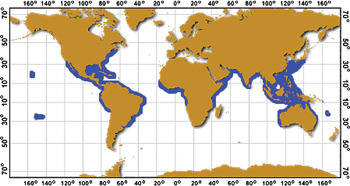
Scalloped hammerheads S. lewini, are coastal–pelagic, semi-oceanic sharks occurring over continental and insular (island) shelves and adjacent deep waters, often approaching close inshore and entering enclosed bays and estuaries. Huge schools of small migrating individuals move poleward in summer in certain areas. Adults are solitary, in pairs, or schools and young are often found in large schools (Figure 2).
Distribution map for Sphyrna lewini.

Of the hammerhead sharks, the smooth hammerhead is the species most tolerant of temperate water, and occurs more often worldwide than any other species. In the Atlantic, it occurs from Nova Scotia to the Virgin Islands and from Brazil to southern Argentina in the west, and from the British Isles to Côte d'Ivoire, including the Mediterranean Sea, in the east. In the Indian Ocean, it is found off South Africa, India, and Sri Lanka. In the western Pacific, it occurs from the Gulf of Tonkin to southern Japan and Siberia, as well as off Australia and New Zealand. In the central and eastern Pacific, it occurs off the Hawaiian Islands, California, Panama, the Galapagos Islands, Ecuador, and Chile. This species is usually considered to be amphitemperate (absent in the tropics) in distribution, though there are rare reports from tropical waters such as in the Gulf of Mannar off India, and off southern Mozambique. Compared to the scalloped and great hammerheads, the smooth hammerhead stays closer to the surface, in water less than 20 m (66 ft) deep. However, it has been recorded to a depth of 200 m (660 ft).
Feeding behaviour
Scalloped hammerhead sharks feed mainly on teleost (bony) fishes (sardines, herring, anchovies, conger eels, silversides, halfbeaks, mullet, barracuda, spanish mackerel, jacks, grunts, parrotfishes and goatfish) and cephalopods (squid, octopus and cuttlefishes), lobsters, shrimps, crabs, as well as smaller elasmobranchs such as blacktip reef sharks, angelsharks and stingrays (Clarke, Reference Clarke1971). In the Indo-West Pacific, the stomach content analysis of these sharks revealed the presence of sea snakes. Stingray spines, up to 50 or more, are often found in the mouth and digestive systems of hammerhead sharks (Compagno, Reference Compagno1984).
Reproduction
As with all hammerheads, the scalloped hammerhead is viviparous and nourishment is provided by a yolksac placenta. During the summer months, following a 9–10 month gestation period, scalloped hammerheads move inshore to shallow waters to give birth. Large litters are born, ranging from 12–38 pups. Pups measure approximately 15–18 inches (38–45 cm) in length at birth. Kaneohe Bay, Oahu, Hawaii (US) is a nursery ground for scalloped hammerhead sharks where much research has been conducted looking at the biological and ecological aspects of these sharks.
Conservation status and comments
Scalloped hammerhead sharks are considered potentially dangerous to people but usually non-aggressive and shy when approached by divers. Under baited conditions scalloped hammerheads may make close approaches to divers but quickly lose interest and depart when they determine that the divers are not the source of the food odours. Their flesh is sold as fresh, dried–salted, smoked and frozen and they are also sought for their fins. Their oil is used for vitamins and carcasses for fishmeal. Lack of data on population trends makes it difficult to assess whether the high level of catches of this species at all life stages is having an effect on stocks, but some declines are reported.
Remarks
Hammerheads are generally suffering high by-catch mortality (IUCN, 2008). Previous reports revealed that hammerheads are the second most abundant species in the international fin trade (Clarke et al., Reference Clarke, McAllister, Milner-Gulland, Kirkwood, Michielsens, Agnew, Pikitch, Nakano and Shivji2006b). The hammerhead sharks constitute an important component in the drift gill-net catches of the Orissa coast (east coast of India). Talwar (Reference Talwar1974) reported that two species were recognized in the commercial catches, viz., Sphyrna blochii and Sphyrna lewini and in the present study the latter species is a second report from the east coast of India. Subsequently, a mature female smooth hammerhead shark, Sphyrna zygaena (Linnaeus, 1758) was collected on 6 October 1975 by hook and line off Porto Novo (south-east coast of India) at a depth of 80–90 m (Devadoss & Natarajan, Reference Devadoss and Natarajan1977). After more than three decades, Sphyrna lewini has reappeared on the Indian coast demonstrating its continued existence in Indian waters.
ACKNOWLEDGEMENTS
We thank the authorities of Annamalai University for providing the necessary facilities and the first author thanks the INCOIS-SATCORE Project, Ministry of Earth Sciences (Government of India) for financial support. We also thank the anymous referees for the valuable comments, which greatly improved our manuscript.