




No CrossRef data available.
Extended psychosis phenotype – yes: single continuum – unlikely
A commentary on ‘Why we need more debate on whether psychotic symptoms lie on a continuum with normality’ by David (2010)
Published online by Cambridge University Press: 18 March 2010
Abstract
An abstract is not available for this content. As you have access to this content, full HTML content is provided on this page. A PDF of this content is also available in through the ‘Save PDF’ action button.
Keywords
Information
- Type
- Commentary
- Information
- Copyright
- Copyright © Cambridge University Press 2010
References
Bak, M, Myin-Germeys, I, Hanssen, M, Bijl, R, Vollebergh, W, Delespaul, P, van Os, J (2003). When does experience of psychosis result in need for care? A prospective general population study. Schizophrenia Bulletin 29, 349–358.CrossRefGoogle Scholar
David, AS (2010). Why we need more debate on whether psychotic symptoms lie on a continuum with normality. Psychological Medicine. Published online: 11 February 2010. doi: 10.1017/S0033291710000188.CrossRefGoogle ScholarPubMed
Dominguez, M, Can Saka, M, Lieb, R, Wittchen, H-U, Van Os, J (in press). Onset of clinical psychosis: do negative/disorganized symptoms increase risk for positive symptoms and for impairment? A 10-year study. American Journal of Psychiatry.Google Scholar
Dominguez, MD, Wichers, M, Lieb, R, Wittchen, HU, van Os, J (2009). Evidence that onset of clinical psychosis is an outcome of progressively more persistent subclinical psychotic experiences: an 8-year cohort study. Schizophrenia Bulletin. Published online: 21 May 2009. doi: 10.1093/schbul/sbp022.Google ScholarPubMed
Hanssen, M, Bak, M, Bijl, R, Vollebergh, W, van Os, J (2005). The incidence and outcome of subclinical psychotic experiences in the general population. British Journal of Clinical Psychology 44, 181–191.CrossRefGoogle ScholarPubMed
Howes, OD, Kapur, S (2009). The dopamine hypothesis of schizophrenia: version III – the final common pathway. Schizophrenia Bulletin 35, 549–562.CrossRefGoogle ScholarPubMed
Kaymaz, N, van Os, J (2009 a). Heritability of structural brain traits: an endophenotype approach to deconstruct schizophrenia. International Review of Neurobiology 89, 85–130.CrossRefGoogle ScholarPubMed
Kaymaz, N, van Os, J (2009 b). Murray et al. (2004) revisited: is bipolar disorder identical to schizophrenia without developmental impairment? Acta Psychiatrica Scandinavica 120, 249–252.CrossRefGoogle Scholar
Linscott, RJ, Van Os, J (2010). Systematic reviews of categorical versus continuum models in psychosis: evidence for discontinuous subpopulations underlying a psychometric continuum. Implications for DSM-V, DSM-VI, and DSM-VII. Annual Review of Clinical Psychology 6. Published online: 4 January 2010. doi: 10.1146/annurev.clinpsy.032408.153506.CrossRefGoogle ScholarPubMed
Murray, RM, Sham, P, Van Os, J, Zanelli, J, Cannon, M, McDonald, C (2004). A developmental model for similarities and dissimilarities between schizophrenia and bipolar disorder. Schizophrenia Research 71, 405–416.CrossRefGoogle ScholarPubMed
Picchioni, MM, Walshe, M, Toulopoulou, T, McDonald, C, Taylor, M, Waters-Metenier, S, Bramon, E, Regojo, A, Murray, RM, Rijsdijk, F (2009). Genetic modelling of childhood social development and personality in twins and siblings with schizophrenia. Psychological Medicine. Published online: 29 October 2009. doi: 10.1017/S0033291709991425.Google ScholarPubMed
Poulton, R, Caspi, A, Moffitt, TE, Cannon, M, Murray, R, Harrington, H (2000). Children's self-reported psychotic symptoms and adult schizophreniform disorder: a 15-year longitudinal study. Archives of General Psychiatry 57, 1053–1058.CrossRefGoogle ScholarPubMed
Stip, E, Letourneau, G (2009). Psychotic symptoms as a continuum between normality and pathology. Canadian Journal of Psychiatry Revue Canadienne de Psychiatrie 54, 140–151.CrossRefGoogle ScholarPubMed
Van Os, J, Linscott, RJ, Myin-Germeys, I, Delespaul, P, Krabbendam, L (2009). A systematic review and meta-analysis of the psychosis continuum: evidence for a psychosis proneness–persistence–impairment model of psychotic disorder. Psychological Medicine 39, 179–195.CrossRefGoogle ScholarPubMed
van Rossum, I, Dominguez, M, Lieb, R, Wittchen, H-U, van Os, J (2009). Affective dysregulation and reality distortion: a 10-year prospective study of their association and clinical relevance. Schizophrenia Bulletin. Published online: 30 September 2009. doi: 10.1093/schbul/sbp101.Google ScholarPubMed
Welham, J, Scott, J, Williams, G, Najman, J, Bor, W, O'Callaghan, M, McGrath, J (2008). Emotional and behavioural antecedents of young adults who screen positive for non-affective psychosis: a 21-year birth cohort study. Psychological Medicine 39, 625–634.CrossRefGoogle ScholarPubMed
Werbeloff, N, Drukker, M, Dohrenwend, BP, Levav, I, Yoffe, R, Van Os, J, Davidson, M, Weiser, M (2009). Self-reported psychotic symptoms in the community are associated with increased risk of later hospitalization for non-affective psychotic disorders (conference abstract). Schizophrenia Bulletin 35, 74.Google Scholar
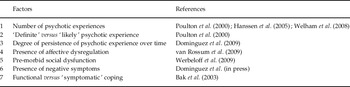
Table 1. Factors influencing transition to clinical disorder in representative general population studies of extended psychosis phenotype
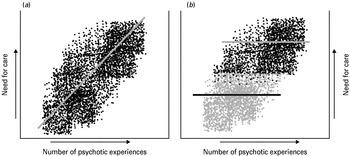
Fig. 1. Simulation of psychosis continuum model (a) versus latent categorical structure model of psychosis (b). On the left side (a) is depicted the apparent psychosis continuum, greater load of subclinical psychotic experiences predicting greater probability of clinical outcome. On the right side (b) is depicted a latent categorical structure representing two different groups: one with psychotic experiences in the context of cognitive and motivational impairments, associated with high probability of need for care (•) and one group with psychotic experiences of a different origin, associated with low likelihood of need for care ().
 You have
Access
- 71
- Cited by
The accepted dogma is that psychotic disorders come as diagnosable ‘things’, categories, the carriers of which form a diagnostic boundary, below which reside the healthy non-carriers who do not display the mental phenomena observed in patients. This model has come under some pressure, as population research has shown high rates of psychotic experiences in people who are not readily diagnosable according to International Classification of Diseases (ICD) criteria, Diagnostic and Statistical Manual of Mental Disorders (DSM) criteria and Research Diagnostic Criteria (RDC) – suggesting an extended psychosis phenotype. Research on psychotic experiences in the general population is in its early stages. A recent meta-analysis showed that half of the heterogeneity in rates of subclinical psychotic experiences across studies is due to study cohort and design factors (Linscott & Van Os, Reference Linscott and Van Os2010). Furthermore, systematic review of the literature shows that there is evidence not only for a psychometric ‘continuum’ (in the sense of an extended psychosis phenotype blending gradually into clinical syndromes) (Van Os et al. Reference Van Os and Kapur2009), but also for an underlying latent categorical structure of the population (in the sense that regardless of the presence of a psychometric continuum, the population may still be composed of two different types of people) (Linscott & Van Os, Reference Linscott and Van Os2010).
Therefore, more, and more detailed and fine-grained work is necessary. Nevertheless, research on psychotic experiences suggesting an extended psychosis phenotype already is producing certain ‘side effects’, essentially to do with perceived blurring or undermining of diagnostic boundaries, expressed from a statistical (type I and type II continuum), philosophical (continuity in risk or essence) or moral (madness is rare or common) perspective (David, Reference David2010). However, the notion that high rates of psychotic experiences undermine diagnostic categories only has relevance if (ICD, DSM, RDC) diagnoses like ‘schizophrenia’ represent valid nosological entities, i.e. ‘exist’. As the evidence for the hypothesis of valid nosological entities is weak, it may be necessary to formulate an alternative, but scientifically productive, approach. In this context, it may be helpful to not use the word ‘continuum’, as it carries the implication of a specific theory, but instead refer to the more agnostic psychosis ‘extended phenotype’ (coined by Howes & Kapur, Reference Howes and Kapur2009).
Extended psychosis phenotype and need for care
Psychotic disorders, spread over a myriad of diagnostic categories in the different classification systems, in reality represent highly variable syndromal clusters of continuous psychotic and affective symptom dimensions, in combination with variable degrees of motivational and neurocognitive impairments (van Os & Kapur, Reference Van Os and Kapur2009). Until recently, research on syndromal clustering of these psychosis dimensions was carried out almost exclusively in the population of people attending mental health services. The implicit assumption was that symptoms observed in patients with psychotic disorder naturally did not exist outside the mental health service. However, now that general population research is showing that similar clusters of psychotic, affective, motivational and neurocognitive phenomena are also expressed as extended phenotypes in the general population (Stip & Letourneau, Reference Stip and Letourneau2009), a conceptual switch is required: it may not be productive to consider populations inside and outside mental health services qualitatively different at the level of symptoms per se, but at the level of whether or not need for care has developed. One person with hallucinatory experiences may experience distress to such a degree that he will visit his GP; another may not. The first person may become a patient with a diagnosis of schizophrenia; the second may never receive a diagnosis.
Need for care and the psychopathological, neurodevelopmental and psychological context of psychotic experiences
To date, very little research has been carried out in trying to determine which persons, given a certain level of expression of the extended psychosis phenotype, will develop need for care and help-seeking behaviour. Several longitudinal studies in representative non-help-seeking general population samples, following individuals with subclinical psychotic experiences over time to determine the likelihood of transition to a clinical outcome, have produced a number of variables predicting transition (Table 1). These suggest that not only the ‘load’ of psychotic experiences is important, and what type of coping the person develops, but also the degree of persistence over time. Another important observation is that admixture with affective dysregulation, negative symptoms and pre-morbid social dysfunction also increases the likelihood of transition to a clinical psychotic outcome. In other words, not just the presence of psychotic experiences per se, but the psychopathological, developmental and psychological context determines the outcome.
Factors influencing transition to clinical disorder in representative general population studies of extended psychosis phenotype
A model for future research
It is generally accepted that the risk for psychotic disorder treated in mental health services is much more prevalent than the rate of psychotic disorder itself; more people have risk than there are people with the disease. Research has demonstrated that (genetic and non-genetic) risk for psychotic disorder is not behaviourally silent: it is expressed in the area of cognition, subtle psychotic experiences and sensitivity to stress (reviewed by van Os & Kapur, Reference Van Os and Kapur2009). Therefore, the fact that psychotic experiences are encountered in non-diagnosed individuals in the general population is not surprising: psychotic experiences probably represent the behavioural expression of distributed risk for psychotic disorder. There is also evidence, however, that the causes of positive psychotic symptoms may only partly overlap with the causes of developmental and cognitive impairment seen in psychotic disorder (Murray et al. Reference Murray, Sham, Van Os, Zanelli, Cannon and McDonald2004; Kaymaz & van Os, Reference Kaymaz and van Os2009b). Therefore, the hypothesis of a single psychosis continuum lacks explanatory power, and also is not in agreement with the observation that motivational and developmental impairments, possibly of genetic origin (Kaymaz & van Os, Reference Kaymaz and van Os2009a; Picchioni et al. Reference Picchioni, Walshe, Toulopoulou, McDonald, Taylor, Waters-Metenier, Bramon, Regojo, Murray and Rijsdijk2009), moderate the probability of clinical outcome in those with subclinical psychotic experiences. Instead, we suggest that the model depicted in Fig. 1 (simulated data) may apply. On the one hand, there is an observed apparent continuum (Fig. 1 a), indicating that the greater the load of subclinical psychotic experiences, the greater the probability of clinical outcome. This concept is heuristically useful, as it allows for examination, for example, of how coping and the degree of distress associated with psychotic experiences may affect development of need for care. On the other hand, the apparent continuum model may be ‘confounded’, at least to a degree, as underneath the continuum, a latent categorical structure may exist, representing two different groups: one with psychotic experiences in the context of cognitive and motivational impairments, associated with high probability of need for care (Fig. 1 b; black dots) and one group with psychotic experiences of a different origin, associated with lower likelihood of need for care (Fig. 1 b; grey dots). Future research will examine to what degree the continuum model, the latent categorical structure model, or both (a distinct possibility), apply.
Simulation of psychosis continuum model (a) versus latent categorical structure model of psychosis (b). On the left side (a) is depicted the apparent psychosis continuum, greater load of subclinical psychotic experiences predicting greater probability of clinical outcome. On the right side (b) is depicted a latent categorical structure representing two different groups: one with psychotic experiences in the context of cognitive and motivational impairments, associated with high probability of need for care (•) and one group with psychotic experiences of a different origin, associated with low likelihood of need for care ( ).
Acknowledgements
N.K. was supported by The Netherlands Organization for Scientific Research (NWO), project no. 017.002.048.
Declaration of Interest
None.