Health technology assessment (HTA) is a policy tool that helps decision makers understand the potential impacts of implementing a healthcare technology through a comprehensive evaluation of its clinical, economic, social, ethical, and legal implications (Reference Velasco Garrido, Gerhardus, Rottingen and Busse1). By doing so, HTAs reduce decision uncertainties and help facilitate the decision-making process. Because novel technologies may create some ethical and moral issues, HTAs can be less useful for decision making if they fail to systematically and objectively consider the ethical issues that might lead to different decisions, or if they do not represent moral values that may have an impact on dissemination and implementation of new health technologies (Reference Burls, Caron and Cleret de Langavant2). In a survey of HTA decision makers in thirteen European countries, fifteen of the eighteen respondents (83 percent) perceived ethical issues as being moderately to highly influential on their decisions about health technologies (3).
Despite the increasing emphasis on the importance of ethical assessment as a part of the HTA process, priority setting and policy making for new heath technologies in most jurisdictions rely mainly on the assessment of clinical- and cost-effectiveness of health technologies. Ethical considerations around the technology are usually absent or poorly addressed in the majority of HTA reports. A systematic review conducted by the Institute of Health Economics (Canada) to describe the criteria used by major publicly funded HTA agencies to set priorities for HTA revealed that less than 20 percent of the agencies considered ethical implications of health technologies in priority setting (Reference Scott and Harstall4). There have also been several studies in the literature which show that only a small proportion of HTA products address equity considerations (Reference Lavis, Wilson and Grimshaw5–Reference Mathes, Jacobs, Morfeld and Pieper7) or wider ethical and social issues as a part of the assessment process (Reference Tarride, McCarron and Lim8–Reference Cicchetti, Marchetti, Dibidino and Corio13).
In response to the recognition of a need for a structured methodology for ethical analysis in HTA by producers and users of HTA products (Reference Hofmann14–Reference Saarni, Hofmann and Lampe16), several frameworks, models, and evaluation tools have been proposed by several authors (Reference Assasi, Schwartz and Tarride17). However, their use has been constrained most likely due to practical issues. The results of a survey of the International Network of Agencies for Health Technology Assessment (INAHTA) member agencies in 2003 indicated that the majority of the respondent organizations did not have an internal system for handling ethical issues as a part of HTA (18). Other reasons have also been stated in the literature for a lack of consideration of ethical issues in HTA practice including: diversity of the available methodologies and lack of consensus on a practical method for considering ethical issues in HTA (Reference Saarni, Hofmann and Lampe16;Reference Arellano, Willett and Borry19), limited information of the appropriate scope and level of details of an ethical analysis in HTA (Reference Duthie and Bond15;Reference Saarni, Hofmann and Lampe16), HTA professionals’ attitudes toward the inclusion of ethical considerations in HTA (Reference Arellano, Willett and Borry19), and uncertainties around the role of ethics expertise in such analyses (Reference Duthie and Bond15). However, to the best of our knowledge, no studies have been published which have formally evaluated the factors that might influence the intention of HTA procedures to perform an ethical analysis.
A need for identifying barriers and enablers to the use of existing guidelines and tools for ethical evaluation in HTA has been highlighted by experts in the field of ethics and HTA (Reference Stoklosa and Bond20). Understanding the ways in which ethical evaluation is performed by HTA producers and identifying related barriers and facilitators can be regarded as important steps toward selecting or tailoring a practical framework to promote ethical analysis in HTA, and thereby to enhance the value of HTA as a policy-making research tool. This study will address this need by identifying key barriers that inhibit, as well as facilitators that improve, successful incorporation of ethical consideration in HTA.
METHODS
Two complementary approaches were undertaken: (a) a systematic review of the literature to identify the range of themes on barriers and facilitators to the incorporation of ethical issues in HTA; and (b) an international survey to explore the degree to which and how HTA agencies include ethical considerations in their HTA products, and to identify key enablers and challenges around their adoption of ethical analysis methods.
Systematic Review of Literature
Structured literature searches were conducted across the following databases to identify English-language articles that reported or provided insights on barriers and/or facilitators of ethical evaluation in HTA: Ovid's Medline (In-Process & Other Non-Indexed Citations) and EMBASE; PubMed (for non-Medline records only); and Wiley's Cochrane Library, including: Cochrane Database of Systematic Reviews, Database of Abstracts of Reviews of Effects, Cochrane Methodology Register, and HTA Database. Separate searches were also conducted in Bioethics Literature Database (BELIT) and the European Database on Literature of Ethics in Biotechnology (ENDEBIT) through Ethicsweb database search interface. The searches used a combination of the National Library of Medicine's Medical Subject Heading (MeSH) terms and keywords for the concepts of “health technology assessment,” ethics, barriers (or synonyms), and enablers (or synonyms). No restriction on year of publication was applied. Adaptations were made in the search strategy to comply with the requirements of each database. The searches were initially undertaken between February and April 2013, and subsequently updated in April 2014. Additional literature was sought from Web sites of international HTA organizations, the reference lists of the included studies, and the commentaries or discussion papers suggested by experts in the field. The details of the search strategy are provided in the Supplementary Material 1.
Decisions on the relevance of the identified citations were made independently by two reviewers. Studies were included if they were quantitative or qualitative studies, published in English, that investigated or discussed the factors affecting the integration of ethical considerations in HTA. A thematic analysis of data was undertaken, through which the articles were read repeatedly; then similar concepts on barriers to or facilitators of ethical evaluation were abstracted and grouped together to determine common themes present in the included studies. Data abstraction was performed by one reviewer and checked by a second. Any discrepancies were resolved by discussion.
Survey of HTA Agencies
A Survey, consisting of eighteen predominantly multiple-choice questions, was designed specifically for this study using preliminary results of the systematic literature review and in consultation with experts in the fields of HTA and ethics. The survey was in English and included general information about the respondent and the HTA agency, questions related to the current situation of handling ethical issues in HTA reports produced by the agency, and questions regarding factors influencing incorporation of ethical issues in HTA. The survey asked respondents to answer the questions from their organization's point of view. A five-point Likert scale was used in two questions as a rating tool. The rest of the questions asked respondents to pick the best answer or answers from among the provided options. An “other” option was included for respondents’ additional free-text information. Two questions asked for electronic links or references to any existing written instructions or guidelines being used by the HTA organization. The questionnaire was pretested with five potential respondents to ensure face validity and technical functioning. Feedback from the pretest respondents were used to modify the final version of the survey. Ethics approval for the survey was acquired from McMaster University's Research Ethics Board. The survey questionnaire is available in the Supplementary Material 2.
A link to the survey was sent, through an e-mail invitation, to all of the HTA agencies affiliated with the International Network of Agencies for Health Technology Assessment (INAHTA). At the time of the study (April 2013), this network consisted of fifty-six HTA-producer agencies from thirty-one countries in North and Latin America, Europe, Africa, Asia, Australia, and New Zealand. Heads of the HTA agencies or their designated representatives were identified by accessing the Web sites of all of the fifty-six INAHTA member agencies. The recipients were asked to complete the survey questionnaire by following the provided link to the survey (through the Survey Monkey Internet Web service) (21), or to forward the email to the most appropriate person in the agency to respond. Two reminder emails were sent to maximize the response rate.
A descriptive analysis of the survey data was conducted to describe the characteristics of the participating HTA agencies, their experiences with addressing ethics in HTA, and their perceived barriers and facilitators.
RESULTS
Systematic Review
Included Studies
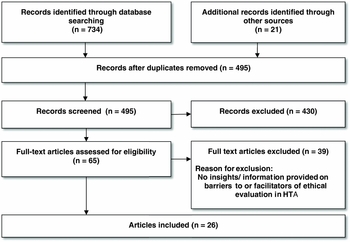
The search resulted in 495 citations, 65 of which were selected for full text review. Ultimately, a total of twenty-six articles met the inclusion criteria and were used in this review. Details of the study selection process are outlined in Figure 1.
Study selection flow chart.

Of the included studies, only one was explicit in its focus on the assessment of barriers and facilitators to the incorporation of ethical aspects in the assessment of healthcare interventions (Reference McCormick, Boyce, Ladd and Cho22). The remaining studies discussed barriers and facilitators qualitatively through critical discussions (Reference Hofmann23–Reference Giacomini, Winsor and Abelson34), philosophical analysis of ethical methodologies or case studies (Reference Duthie and Bond15;Reference Saarni, Hofmann and Lampe16;Reference Grunwald35–Reference Van Der Wilt, Reuzel and Banta38), content analysis of HTA reports (Reference DeJean, Giacomini, Schwartz and Miller9;Reference Lehoux and Williams-Jones39), and collecting expert opinion by means of surveys, focus group discussion, or expert workshop discussions (Reference McCormick, Boyce, Ladd and Cho22;Reference Potter, Avard and Entwistle40–Reference Gagnon, Desmartis and Gagnon43). The barriers and facilitators identified in our review are described below.
Barriers and Facilitators
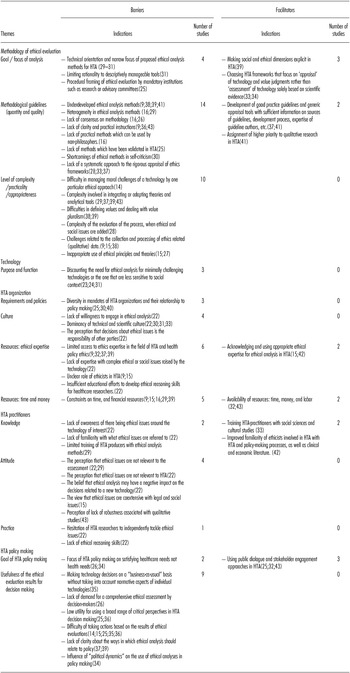
Table 1 summarizes a range of barriers and facilitators to ethical considerations in HTA which were cited by the included studies. It can be seen from the table that the barriers were more frequently cited than the facilitators. Of the twenty-six included studies, twenty-three identified barriers (Reference DeJean, Giacomini, Schwartz and Miller9;Reference Hofmann14–Reference Saarni, Hofmann and Lampe16;Reference McCormick, Boyce, Ladd and Cho22–Reference Hofmann33;Reference Braunack-Mayer36–Reference Nielsen, Funch and Kristensen41;Reference Gagnon, Desmartis and Gagnon43) and ten identified facilitators (Reference Duthie and Bond15;Reference Reuzel, Oortwijn and Decker25;Reference Facey, Boivin and Gracia32–Reference Giacomini, Winsor and Abelson34;Reference Giacomini, Kenny and DeJean37;Reference Lehoux and Williams-Jones39;Reference Nielsen, Funch and Kristensen41–Reference Gagnon, Desmartis and Gagnon43) of ethical analysis in HTA. Through a thematic analysis, we categorized factors specified as barriers or facilitators into five themes pertaining to: methodology of ethical evaluation, technological context, HTA organization, HTA-practitioners, and HTA policy making. Within each theme, the identified factors were further organized into specific sub-themes. For example, those relating to the methodology of ethical evaluation were classified as: focus of analysis, methodological guidelines, appropriateness of analysis to the context, level of complexity, and validity of method; or individual barriers and facilitators associated with HTA practitioners were classified as their knowledge, attitude, or practice.
Key Barriers and Facilitators Identified by the Studies Included in the Systematic Review

The most often cited barriers were scarcity, heterogeneity and complexity of ethical analysis methods; challenges in translating ethical analysis results into knowledge that is useful for decision makers; lack of organizational support in terms of required expertise, time and financial resources. Other barriers included the diversity in requirements and policies of HTA agencies, technical focus of commonly used ethical evaluation methods, lack of rigorous methods for validation of ethical frameworks for HTA, negative attitudes of HTA-practitioners toward inclusion of ethical considerations in the assessment process, and poor knowledge and limited training of HTA-practitioners with ethical analysis methods.
The most commonly cited facilitators included usage of value-based appraisal methods in HTA rather than science-based assessments, using stakeholder dialogue, including policy makers and general public, as a source of data for ethical analysis, development of generic ethical appraisal tools and practice guidelines, using appropriate ethical expertise, and training HTA practitioners with social and ethical analysis methods.
Survey of HTA Agencies
Directors or representatives of thirty-one of fifty-six HTA agencies responded to the survey invitation; however, two of those were unable to participate, due to their busy schedules, and three failed to complete the online questionnaire, leaving a sample of participants from twenty-six HTA agencies (a response rate of 46.5 percent). The majority of responding agencies were from Europe, including two agencies each from Germany, Spain Italy, the Netherlands, and the United Kingdom; and one agency each from Austria, Sweden, Norway, Poland, Finland, Scotland, Belgium, and Lithuania. Other participating agencies were located in Canada (three agencies), South Africa, Australia, Brazil, Malaysia, and Taiwan (one agency each). Four of the HTA agencies were academic research institutions, five were departments of government ministries (mainly ministries of health), and fifteen were governmental or quasi-governmental agencies. Quasi-governmental agencies are privately managed organizations that are supported by governmental funding. A lower proportion of the survey participants were from hospital HTA units (one agency) or independent HTA agencies (one agency). The participants consisted of heads of HTA agencies or units (42.3 percent), program managers (11.5 percent), and HTA researchers (46.2 percent).
Medical devices and procedures were the most common technologies covered by the HTA agencies (100 percent and 92 percent, respectively), followed by public health interventions (69 percent), pharmaceuticals (58 percent) and health system interventions (58 percent). More than 80 percent of the agencies produced full HTA reports and rapid assessments. The median number of published assessments for each of these agencies in 1 year was reported to be five (interquartile range [IQR], 1 to 10) for HTA reports and five (IQR 1 to 20) for rapid assessments. Approximately 50 percent of the agencies performed systematic reviews, with a median of one (IQR, 0 to 4) per year. More details about the characteristics of the respondent agencies are provided in the Supplementary Material 3.
The following presents the reported practice of addressing ethical aspects amongst the surveyed HTA agencies; as well as perceived barriers and facilitators of representatives of such agencies regarding incorporation of ethics in HTA.
Assessment of Ethical Issues in HTA
Based on the survey findings, a median of 10 percent (IQR, 5 percent to 50 percent) of the HTA products produced by the agencies included an assessment of ethical aspects, regardless of what their definition of ethics might be, and a median of 5 percent (IQR, 0 percent to 40 percent) considered only equity aspects. Two of the European HTA agencies (the German Agency for Health Technology Assessment (DAHTA), and the Swedish Council on Health Technology Assessment [SBU]) reported that 100 percent of their HTA reports included an assessment of ethical issues. However, no consistent patterns were found to indicate that inclusion of ethical issues in HTA varied across different types of agencies or various geographic regions. Respondents from 10 HTA agencies (39 percent) reported that their organization gave a high or very high priority to the consideration of ethical issues, while thirteen agencies (50 percent) assigned a low (five agencies) or medium (eight agencies) level of priority to the ethical aspects of health technologies. In the remaining three agencies (11 percent), no priority was assumed for ethical aspects.
In response to the question that asked respondents to indicate who in their organization was responsible for the incorporation of ethical issues, 8 percent believed that this question was not applicable to the types of reports made by their agencies, 77 percent mentioned that a team of HTA professionals, not including an ethicist, was responsible to address ethical considerations, if needed. In 15 percent of the agencies, ethical evaluations were typically performed by individual ethicists or multi-disciplinary teams including ethicists. All but one of these agencies reported that they depended on externally recruited ethical expertise.
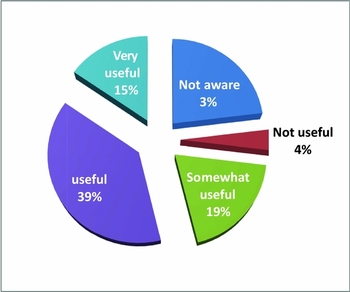
Seven of the twenty-six respondents (27 percent) indicated that written instructions on how to address ethical issues around health technologies were used in their organizations; of those, three reported to have internal checklists, two used the European Network for Health Technology Assessment (EUnetHTA)'s HTA Core Model (44), and two used various published frameworks or tools including Hofmann's thirty-three morally relevant questions (Reference Hofmann14) and the HTA Core Model (44). Eight agencies (30 percent) stated that their agency had a guidance document in preparation that would serve this purpose. The remaining agencies did not have any instructions for addressing ethical considerations. Figure 2 shows how the respondents rated the usefulness of existing ethical frameworks or guidelines. It is notable that more than 20 percent of the survey participants were not aware of any published guidance documents that could be useful for ethical evaluation in HTA.
Survey participants’ perception of usefulness of existing ethical guidance documents (n = 26).

Perceived Barriers and Facilitators to Incorporation of Ethics in HTA among the Surveyed Agencies
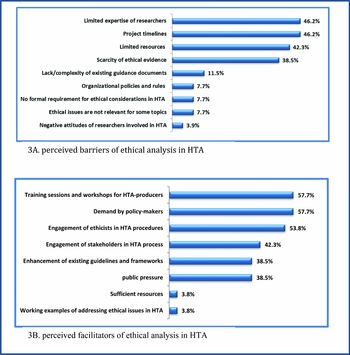
When asked what barriers might discourage HTA professionals from addressing ethical issues in their assessments, the most frequently reported barriers were: limited ethical knowledge and expertise of HTA producers, lack of sufficient time and resources, scantness of useful evidence concerning ethical aspects of health technologies, problems in identifying and using the existing ethical guidelines, and conflicting policies and rules. The respondents also identified several other obstacles that were not listed in the questionnaire, such as lack of organizational requirements and negative attitudes of HTA professionals toward assessment of ethical aspects (Figure 3A).
Survey participants’ perceived barriers to and facilitators of the incorporation of ethical considerations in HTA (n = 26). (A) Perceived barriers of ethical analysis in HTA. (B) Perceived facilitators of ethical analysis in HTA.

We also asked representatives of the HTA agencies about what would help or encourage them to apply ethical evaluation methods in their assessments. More than 50 percent of the respondents perceived educational sessions, demand by policy makers, and involvement of ethicists in the HTA process as the key facilitators. Stakeholder engagement, improvement of existing guidance documents, and public pressure were reported to be other important drivers of ethical analysis in HTA. The participants also identified additional motivators in the free text section, such as practical examples to aid ethical assessment and availability of sufficient resources (Figure 3B).
DISCUSSION
In this study, we aimed to understand the factors that may influence the incorporation of ethics in HTA by drawing on existing literature and through the survey of national and international HTA agencies. Overall, there was a close agreement between the survey and the review findings and the results seemed to reinforce each other. However, discussions in the literature mostly focused on the adequacy and quality of methodological documents, while the survey participants more frequently perceived lack of resourcing and lack of required knowledge and skills as important obstacles to evaluation of ethical issues.
Based on the results of our survey, close to 90 percent of the HTA agencies assigned some level of priority to the inclusion of ethical considerations in HTA; although, a relatively small proportion of them incorporated relevant ethical analysis methods in their assessments. While it was clear that the HTA agencies struggled with providing adequate ethical analysis due to several potential barriers, which will be discussed below, we are optimistic and encouraged by their expressed level of intention for considering ethical issues in HTA.
Our study identified the diversity and complexity of ethics methods and the lack of practical guidelines as important challenges in pursuing ethical analysis. Conducting an ethical analysis is quite complex in nature, requires advanced skills, and can be difficult to perform within the frameworks of the majority of existing HTA agencies (44). Adding to this complexity is the fact that several frameworks using varied analytic methods have been proposed for this purpose (Reference Assasi, Schwartz and Tarride17). In other words, no “one-size-fits-all” method exists for ethical analysis. Of interest, our survey revealed that approximately one in four respondents were unaware of existing ethics guidelines in HTA. Lack of awareness can be considered a technical barrier to using the guidelines. In addition, a negative attitude toward the usefulness of the existing guidance documents, which was present in a small number of the survey participants, can act as a cognitive barrier. These would suggest an essential role for effective methods for identifying knowledge gaps as well as for training programs that are specifically designed for HTA teams to help them evaluate normative considerations around healthcare technologies.
Lack of familiarity with the complex philosophical theories and ethical reasoning methods was frequently cited as a barrier which may restrict HTA-practitioners’ ability or affect their willingness to be involved in ethical analyses. HTA professionals can only take ethical considerations into account in their products if they can reflect on them. In an international survey on the attitudes of HTA professionals toward ethical analysis in HTA, the majority of respondents agreed that incorporation of ethical issues was important, and that ethical recommendations should be included in HTA reports in a normative (45 percent) or descriptive (38 percent) manner. Despite this positive attitude, the respondents of this survey believed that ethical analysis should be performed by an ethicist (68 percent) or an external consultant (78 percent) (Reference Arellano, Willett and Borry19). We suggest that future research should focus on factors that influence HTA-practitioners’ ability and desire to undertake ethical evaluations, and address how and to what extent ethical evaluations can be undertaken by nonethicist HTA professionals.
Organizational factors such as lack of required knowledge and skills, short project time frames, and insufficient financial resources were commonly highlighted in the literature as well as by the survey respondents as important barriers to implementing ethics in HTA. Addressing ethical issues can also be affected by the HTA organizations’ culture and the practical frameworks within which they operate. HTA agencies that set a low priority on ethical evaluation are less likely to be willing to provide initiatives to address ethical issues. In addition, a favorable organizational environment is required for conducting ethical evaluations. The dominance of scientific and technical culture (leadership and expertise) in some HTA agencies may lead to the perception that ethical analyses do not fit or are not feasible in HTA practice (Reference Hofmann45). While we believe no conflict exists between technical and ethical concerns, we acknowledge that HTA producers with clinical or economic research backgrounds tend to subscribe to a distinction between empirically “verifiable” facts and “unverifiable” normative aspects or value judgments; and because ethics is often understood to be exclusively a normative domain, they might be reluctant to incorporate ethical aspects of healthcare technologies into their assessments.
The results of our study suggest that training and capacity-building in ethical methods is crucial in implementing ethics into HTA. We believe that there is an unmet need not only to develop internal capacity in HTA organizations, but also to identify suitable mechanisms to exchange ethics-specific knowledge and experience among different organizations. Availability of appropriate ethical expertise was found to be another critical success factor. The review results suggest that experts who contribute to ethical analysis in HTA require not only a thorough knowledge in ethical principles and reasoning, but also enough background information about the technological context and HTA process (Reference Duthie and Bond15;Reference Grunwald35;Reference Bond, Oremus, Duthie and Griener42).
The agencies surveyed also perceived good practice guideline development as an important facilitator that could enhance the use of ethical evaluation methods in HTA. Although efforts have been directed toward development of practical methods to help support HTA professionals in performing ethical analysis (Reference Assasi, Schwartz and Tarride17;Reference Stoklosa and Bond20;Reference Hofmann, Droste and Oortwijn46), a lack of awareness and familiarity with the guidelines and an uncertainty about their usefulness seem to exist among HTA producers. In our survey, more than a quarter of the responding agencies were not aware of any guidance documents for addressing ethical issues or found the existing ethical guidelines and frameworks not useful. Lack of awareness and lack of familiarity can be improved through professional and continuing education; however, more research is needed to investigate the reasons that might explain the lack of perceived usefulness of ethics guidelines among HTA professionals.
Enhancing ethical understanding through stakeholder engagement was another facilitator that was identified in both the survey and literature review components of our study. The topic of stakeholder engagement in HTA has received great attention in recent years (Reference Facey, Boivin and Gracia32;Reference Gagnon, Desmartis and Gagnon43;Reference Bombard, Abelson, Simeonov and Gauvin47;Reference Abelson, Giacomini, Lehoux and Gauvin48). The identification and inclusion of stakeholders can be an important step in anticipating, and addressing ethical issues in HTA. However, to make high quality decisions that reflect values and preferences of a broad range of stakeholders, there needs to be some mechanisms developed to sufficiently inform stakeholders about the technology and its potential positive and negative impacts.
While the key barriers to and facilitators of ethical evaluation identified in this study may provide directions for future research and development, we recognize that our study has some limitations. First, there is a risk of bias in our systematic review due to the fact that only English-language studies were included. Second, the survey may potentially be subject to selection bias due to nonresponse. Although the response rate for our survey (46.5 percent) is noticeably lower than the 92 percent response rate achieved by the INAHTA Secretariat's survey on ethical issues in 2003 (18), it exceeds those of similar surveys which targeted major international HTA agencies (Reference Watt, Cameron and Sturm11;Reference Arellano, Willett and Borry19;Reference Leggett, Mackean and Noseworthy49;Reference Whitty50). The study by Baruch and Holtom shows that response rates from representatives of organizations are, on average, lower than those from individuals (37.2 percent versus 52.7 percent) (Reference Baruch and Holtom51). This study also suggests that response enhancing techniques, such as reminders, can be less effective in increasing response rates at the organizational level where managers and executive employees are being surveyed. Third, while it was beyond the scope of the present study to explore the true definition and principles of ethical evaluations performed by the surveyed HTA agencies, it appears likely that the expressed barriers and facilitators might have been affected by the respondents’ perceptions of ethical concepts (e.g., equity, respect, rights, or duties) and the ways in which they would choose to address them. The survey responses might also have been affected by respondents’ personal interests, their role in the organization, their educational background, or their tendency to provide favorable responses. Therefore, there is a possibility that information bias could have been introduced into our study. It may be useful to perform supplementary qualitative research to gain more information on the actual practices of different agencies regarding ethical evaluation of healthcare technologies and barriers and facilitators that they encounter in their routine practice.
Finally, our survey was an exploratory effort to provide a descriptive analysis of expressed attitudes, practices, and experiences of HTA producers regarding evaluation of ethical issues. However, the questions remain as to how ethical analyses are integrated in the HTA agency's routine practice and whether such analyses are able to incorporate an important impact on policy decisions.
CONCLUSION
The current study highlights potential facilitators that could enhance the use of ethical evaluation methods, and specific barriers that need to be overcome to increase the success of ethical evaluations in HTA. Based on our results, specific consideration should be given to: simplification of ethics methodology in HTA through adaptation of procedural guidelines or tools that are routinely used in other domains of the HTA process; capacity-building through development of educational materials, and providing case studies to acquaint HTA professionals with the process of ethical analysis, as well as strengthening skills and motivations of HTA producers in the field of ethics; development of good practice guidelines for ethical evaluation of healthcare technologies; and usage of deliberative approaches in HTA.
Challenges that stem from organizational factors, especially insufficient resources, also seem to be of importance. Suitable mechanisms should be sought at organizational levels to overcome these challenges for the purpose of effectively incorporating ethical aspects into HTA.
It is debatable that a certain level of standardization may be desirable to improve the rigor of ethical evaluations in HTA and to assist reviewers and end-users of HTA products in assessing the quality and reliability of the ethical evaluation process.
SUPPLEMENTARY MATERIAL
Supplementary Material 1–3 http://dx.doi.org/10.1017/S026646231500032X
CONFLICTS OF INTEREST
The authors have no conflict of interest to declare.