Introduction
As early as the late nineteenth century, it was observed that the menstrual cycle and pregnancy have an effect upon nasal vascularity and mucus secretion.Reference Bresgen1–Reference MacKenzie3 The mechanism by which female hormones affect nasal physiology is poorly understood. Recent studies have assessed the effect of menstruation and pregnancy upon nasal physiology.Reference Philpott, Conboy, Al-Azzawi and Murty4, Reference Philpott, El-Alami and Murty5 During pregnancy, oestrogen and progesterone levels rise considerably, and as many as 40 per cent of women have been reported to suffer from symptomatic rhinitis of pregnancy.Reference Bende and Gredmark6 Whilst various studies have suggested that the female menstrual cycle and pregnancy have an effect upon nasal physiology, the oral contraceptive pill has not been shown to influence nasal physiology in the same way.Reference Wolstenholme, Philpott, Oloto and Murty7
This study aimed to assess the effects upon nasal physiology of female hormone replacement therapy (HRT) in post-menopausal women. This topic has not been previously studied.
Subjects and methods
Local ethical committee approval was granted prior to commencing the study.
This study was performed in tandem with another study which specifically assessed different nasal preparations of HRT, within our gynaecology department. Therefore, the numbers recruited were dependent on recruitment to the latter study. Patients were seen when they attended for appointments at the menopause clinic. Twenty-six post-menopausal women were recruited; of these, 20 completed the study. Women were excluded if they had any contraindications for HRT, were taking steroids or had any active nasal pathology (e.g. sinusitis). Patients' ages ranged from 36 to 70 years (mean age 57.0 years years). Patients' smoking habits and past medical histories were recorded. The study examined a range of variables to assess the effects of HRT upon nasal physiology, as follows.
Anterior rhinoscopy
Patients were examined using a light source and Thudicum speculum. The examination was scored by giving one point for an enlarged turbinate (this included both inferior and middle turbinates), one point for mild mucosal congestion and two points for heavy mucosal congestion. A maximum total of six points was therefore possible for each subject at each reading.
Peak nasal inspiratory flow rate
This was measured using a Youlten flow meter (Clement Clarke International, Harlow, UK). Subjects were given three opportunities to record their best peak nasal inspiratory flow rate (in ml/min), the lesser two values being discarded. This has been previously shown to be an accurate, objective measurement of nasal patency.Reference Fairley, Durham and Ell8
Acoustic rhinometry
This was performed using an A1 Executive acoustic rhinometer (GM Instruments, Kilwinning, UK). The probe was placed at the end of each nostril. The software was then activated to produce a sound wave from the probe tip, the echo of which was recorded by a microphone within the probe, in order to produce a reading displayed on the computer screen and a volume measurement for the nasal cavity. The two volume readings were then combined to give a total nasal cavity volume (in ml).Reference Jackson, Butler, Millet, Hoppin and Dawson9, Reference Hilberg, Jackson, Swift and Pedersen10
Anterior rhinomanometry
An NR6 rhinomanometer (GM Instruments) was used to obtain these results, in conjunction with a static FP2 calibration unit. The pressure probe was taped to the end of one nostril whilst flow through the other nostril was measured using a mask connected to a flow meter. The patient was then asked to breathe in and out of their nose, keeping their mouth closed. This was then reversed for the other nostril, and a measurement of nasal resistance in expiration and inspiration was recorded (in Pa/cm3).Reference Mackay11
Saccharin test for nasal mucociliary clearance
This was measured by recording the timed interval (in minutes) between placement of a saccharin tablet at the front of the left inferior turbinate and the perception of taste in the oropharynx.Reference Eccles, Jones, Phillips and Hilgers12
Rhinitis quality of life questionnaire
Each patient completed an interviewer-led, validated questionnaire, as developed by Professor Juniper at McMaster University Medical School, Canada.Reference Juniper, Guyatt, Andersson and Ferrie13 The total score was recorded for each patient.
These measurements of nasal physiology were recorded prior to commencing HRT, and then again between 77 and 195 days (mean 101.9 days) following commencement. Women were given one of four combinations of HRT: 350 µg 17β-oestradiol + 50 µg norethisterone transnasally (two sprays per day); 350 µg 17β-oestradiol + 175 µg norethisterone transnasally (two sprays per day); 350 µg 17β-oestradiol + 550 µg norethisterone transnasally (two sprays per day); or 2 mg 17β-oestradiol + 1 mg 19-nortestosterone orally (one capsule per day).
The data collected were analysed using paired t-tests, utilising the Statistical Package for the Social Sciences for Windows version 14.0 software (SPSS Inc, Chicago, Illinois, USA).
Results
Twenty-six post-menopausal women were recruited prior to commencing HRT. Of these, 20 were suitable to complete the study. Patients' ages ranged from 36 to 70 years (mean age 57.0 years). Of the 20 patients who completed the study, 15 were non-smokers and five were smokers, one had had previous nasal surgery, two had a past history of sinusitis, and eight had a history of atopy (i.e. eczema and/or asthma and/or hayfever).
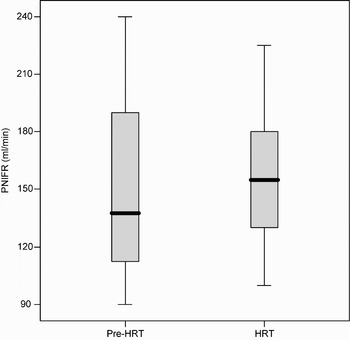
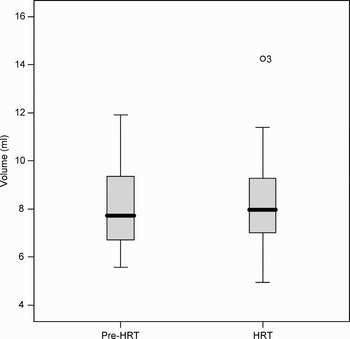
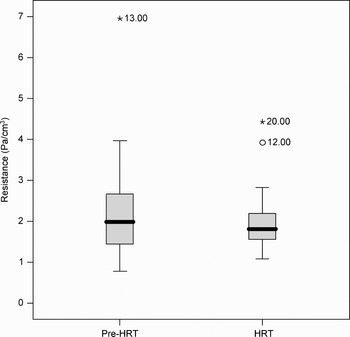
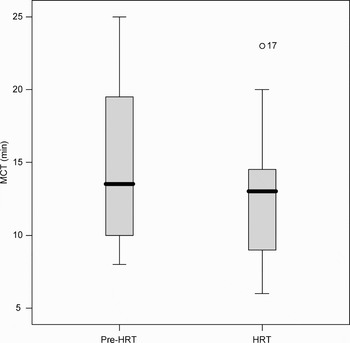
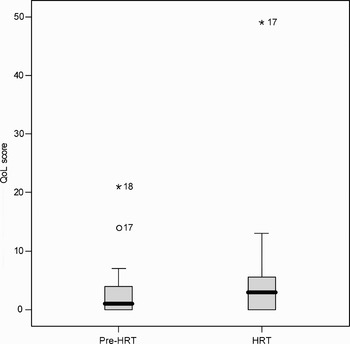
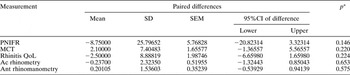
On examination, two out of the 20 had a deviated nasal septum, five were noted to have enlargement of one or two turbinates, two had atrophic nasal mucosa, and one had inflamed mucosa. There were no statistical differences in patient's peak nasal inspiratory nasal flow rates (see Figure 1), acoustic rhinometry results (see Figure 2), anterior rhinomanometry results (see Figure 3), mucociliary clearance times (see Figure 4) and rhinitis quality of life questionnaire scores (see Figure 5), comparing pre- and post-HRT patients, using the paired t-test (p > 0.05 for all) (Table 1).
Boxplot comparing peak nasal inspiratory flow rate (PNIFR) before (pre-HRT) and during hormone replacement therapy (HRT). Bold line indicates median; whiskers indicate interquartile ranges.

Boxplot comparing acoustic rhinometry results before (pre-HRT) and during hormone replacement therapy (HRT). Bold line indicates median; whiskers indicate interquartile ranges; o indicates outlier.

Boxplot comparing anterior rhinomanometry results before (pre-HRT) and during hormone replacement therapy (HRT). Bold line indicates median; whiskers indicate interquartile ranges; o indicates outlier; * indicates extreme outlier; numbers indicate subject numbers.

Boxplot comparing mucociliary clearance time (MCT) before (pre-HRT) and during hormone replacement therapy (HRT). Bold line indicates median; whiskers indicate interquartile ranges; o indicates outlier.

Boxplot comparing rhinitis quality of life questionnaire (QoL) scores before (pre-HRT) and during hormone replacement therapy (HRT). Bold line indicates median; whiskers indicate interquartile ranges; o indicates outlier; * indicates extreme outlier.

T-Test results, before and after HRT

* Two-tailed. SD = standard deviation; SEM = standard error of the mean; CI = confidence intervals; PNIFR = peak nasal inspiratory flow rate; MCT = mucociliary clearance time; QoL = quality of life questionnaire; Ac = acoustic; Ant = anterior
Discussion
The influence of endogenous hormones upon nasal physiology, within the menstrual cycle and during pregnancy, has been shown by previous studies.Reference Philpott, Conboy, Al-Azzawi and Murty4, Reference Philpott, El-Alami and Murty5 However, when these hormones are applied in a non-physiological and endogenous manner, this effect is not seen.Reference Wolstenholme, Philpott, Oloto and Murty7 A previous trial assessing the effect of the early oral contraceptive pill suggested that there was a demonstrable effect.Reference Toppozada, Toppozada, El-Ghazzawi and Elwany14 However, more recent work in our centre could find no difference in nasal physiology following commencement of the combined oral contraceptive pill.Reference Philpott, El-Alami and Murty5 This result may reflect the fact that the modern combined oral contraceptive pill contains lower levels of oestrogen (30 µg as opposed to 50 µg). The present study findings confirm the fact that female HRT has no clear effect upon nasal physiology. Therefore, this refutes the implication that HRT could potentially cause rhinitic symptoms.
However, the cyclic influence of endogenous hormones was once again demonstrated. This was consistent with previous data from our centreReference Philpott, El-Alami and Murty5, Reference Wolstenholme, Philpott, Oloto and Murty7 which suggest that nasal patency is reduced mid-cycle.Reference Hilberg, Jackson, Swift and Pedersen10 The combined oral contraceptive pill seems to reduce the appearance of nasal congestion (as viewed via anterior rhinoscopy) and the rhinitis quality of life questionnaire score at day 14 of the cycle; however, these differences were not statistically significant (p = 0.054 and p = 0.5, respectively).
• The mechanism by which female hormones affect nasal physiology is poorly understood
• This study aimed to assess the effects of female hormone replacement therapy (HRT) upon nasal physiology, in post-menopausal women
• Twenty post-menopausal women underwent assessment of the nasal airway before and after commencement of HRT
• Female HRT has no discernable effect upon nasal physiology, and should not be considered a cause of rhinitic symptoms
In the past, topical application of oestrogen preparations was used in the treatment of atrophic rhinitis, with some effect.Reference Ruskin15 Oestrogen receptors have also been demonstrated within the nasal mucosa,Reference Molteni, Warpeha, Brizio-Molteni and Fors16 although the significance of these receptors is unclear as the mechanism of interaction is yet to be understood.Reference Philpott, Robinson and Murty17
Conclusion
Hormone replacement therapy preparations of ovarian hormones do not appear to have any significant effect on nasal physiology. Further research is needed into the mechanisms underlying the relevant changes, particularly at the receptor level; the findings may further our understanding of the aetiology of rhinitis. Ultimately, it may be possible to utilise this knowledge to develop a pharmacological means of manipulating nasal physiology, which could be used in the treatment of certain types of rhinitis.