Introduction
Temperature can significantly affect the growth and development of wheat (Xiao et al., Reference Xiao, Zhang, Li, Wang, Yao, Zhao and Bai2010). The global climate is currently warming (Ainsworth and Ort, Reference Ainsworth and Ort2010; Xiao et al., Reference Xiao, Tao, Liu, Shi, Wang, Liu, Zhang and Zhu2013), and the accumulated temperature before wintering (the average daily temperature is below zero for 5 days and the winter wheat stops growing) in wheat significantly increases (Yin et al., Reference Yin, Dai and He2018), leading to lodging, pest and other hazards to the wheat (Berry et al., Reference Berry, Sterling, Spink, Baker, Sylvester-Bradley, Mooney, Tams and Ennos2004; Foulkes et al., Reference Foulkes, Slafer, Davies, Berry, Sylvester-Bradley, Martre, Calderini, Griffiths and Reynolds2011), and finally, significantly decreasing grain yield (Knapp and Knapp, Reference Knapp and Knapp1978). Therefore, later sowing of wheat is a feasible planting strategy. Furthermore, in the region of wheat-corn rotation, in general, only late-maturing summer corn varieties could maintain high yield (Niu, Reference Niu2011), which means that the sowing date of winter wheat will be delayed.
Sowing date is an important factor of agronomic management measures, which can affect the grain yield and quality of cereal crops (McLeod et al., Reference McLeod, Campbell, Dyck and Vera1992). Although previous research suggested that a later sowing date would lead to a lower accumulated temperature before winter and less effective tillerings, and ultimately decrease grain yield (Anderson and Smith, Reference Anderson and Smith1990; Bassu et al., Reference Bassu, Asseng, Motzo and Giunta2009), with global warming (Lobell et al., Reference Lobell, Schlenker and Costa-Roberts2011), the accumulated temperature before wintering significantly increased (Wang et al., Reference Wang, Wang, Yang, Zhang and Yin2012; Yin et al., Reference Yin, Dai and He2018). This provides a possible means for delaying the sowing of winter wheat, but it is uncertain how this delay in sowing could affect wheat yield. Studies have shown that this kind of delay may increase, maintain or decrease the grain yield of winter wheat (Weiss et al., Reference Weiss, Hays and Won2003; Sun et al., Reference Sun, Zhang, Chen, Pei and Liu2007; Jalota et al., Reference Jalota, Kaur, Kaur and Vashisht2013; Ding et al., Reference Ding, Feng, Zhao, He, Zou and Jin2016; Rasmussen and Thorup-Kristensen, Reference Rasmussen and Thorup-Kristensen2016). This suggests that not all wheat varieties can maintain their yield by delaying the sowing date and ultimately adapt to global warming.
The grain of winter wheat is mainly comprised of carbohydrate, which is transferred from non-grain aboveground organs (Wang et al., Reference Wang, Offler and Patrick1995), and approximate 70% of the grain yield was from dry matter produced by photosynthesis post-anthesis (Roberto et al., Reference Roberto, Andrea, Pierre, Marco and Pierre2010). Therefore, the photosynthesis of non-grain organs, especially leaves, is important for grain, and higher photosynthesis is often accompanied by higher yield (Zelitch, Reference Zelitch1982). Research showed that the chlorophyll fluorescence was often used for detecting plant photosynthesis (Baker and Rosenqvist, Reference Baker and Rosenqvist2004), and the change in chlorophyll fluorescence from the photosynthetic organism is an adaptation to photosynthetic activity (McAlister and Myers, Reference McAlister and Myers1940; Kautsky and Zedlitz, Reference Kautsky and Zedlitz1941). The chlorophyll fluorescence could also detect the electron transfer rate of PSII (Genty et al., Reference Genty, Briantais and Baker1989), which is related to the assimilation of carbon dioxide (Genty et al., Reference Genty, Briantais and Baker1989, Reference Genty, Harbinson and Baker1990; Harbinson et al., Reference Harbinson, Genty and Baker1990; Krall and Edwards, Reference Krall and Edwards1990, Reference Krall and Edwards1991; Cornic and Ghashghaie, Reference Cornic and Ghashghaie1991; Krall et al., Reference Krall, Edwards and Ku1991; Siebke et al., Reference Siebke, von Caemmerer, Badger and Furbank1997). In addition, previous studies have shown that leaf nitrogen content was positively correlated with photosynthesis (Warren, Reference Warren2004; Bown et al., Reference Bown, Watt, Mason, Clinton and Whitehead2009; Li et al., Reference Li, Gao, Xu, Shen and Guo2009; Yamori et al., Reference Yamori, Nagai and Makino2011), and an optimal N distribution in the plant canopy could improve photosynthesis without additional N input (Gastal and Lemaire, Reference Gastal and Lemaire2002).
In a leaf canopy, the highest leaf N content per unit leaf area is found at the top of the canopy and decreases with depth. Such a gradient of specific leaf N (SLN) contributes to efficient N utilization at the whole-plant level and was historically considered a key plant adaptation in response to local light conditions to maximize canopy photosynthesis (Berthloot et al., Reference Berthloot, Martre and Andrieu2008; Moreau et al., Reference Moreau, Allard, Gaju, Le Gouis, Foulkes and Martre2012; Hikosaka, Reference Hikosaka2014; Hikosaka et al., Reference Hikosaka, Anten, Borjigidai, Kamiyama, Sakai, Hasegawa, Oikawa, Iio, Watanabe, Koike, Nishina and Ito2016). In addition, the Rubisco content of leaves can significantly affect photosynthesis (Farquhar et al., Reference Farquhar, von Caemmerer and Berry1980; Sage, Reference Sage1990; Manter and Kerrigan, Reference Manter and Kerrigan2004). This is mainly because Rubisco is the key enzyme of the Calvin cycle, and about 27% of leaf nitrogen is distributed in Rubisco, which means that Rubisco is the most abundant enzyme in plants (Evans, Reference Evans1989; Makino et al., Reference Makino, Shimada, Takumi, Kaneko, Matsuoka, Shimamoto, Nakano, Miyao-Tokutomi, Mae and Yamamoto1997). Moreover, some studies have shown that Rubisco content is significantly positively correlated with leaf nitrogen content (Makino et al., Reference Makino, Shimada, Takumi, Kaneko, Matsuoka, Shimamoto, Nakano, Miyao-Tokutomi, Mae and Yamamoto1997, Reference Makino, Nakano, Mae, Shimada and Yamamoto2000; Ghannoum et al., Reference Ghannoum, Evans, Chow, Andrews, Conroy and von Caemmerer2005).
Previous research has indirectly suggested that delayed sowing of winter wheat could significantly affect grain yield (Weiss et al., Reference Weiss, Hays and Won2003; Sun et al., Reference Sun, Zhang, Chen, Pei and Liu2007; Jalota et al., Reference Jalota, Kaur, Kaur and Vashisht2013; Ding et al., Reference Ding, Feng, Zhao, He, Zou and Jin2016; Rasmussen and Thorup-Kristensen, Reference Rasmussen and Thorup-Kristensen2016). However, relatively few studies have investigated the types of winter wheat that could maintain grain yield with a later sowing date and the underlying mechanisms. Increased knowledge regarding winter wheat cultivars that can maintain grain yield with later sowing dates will improve the efficiency of crop rotation management and select a suitable winter wheat cultivar for late sowing. Thus, the present study was conducted to study the following objectives: (1) to test whether different varieties can maintain the grain yield as sowing date is delayed; (2) to identify the reasons for maintaining or reducing the grain yield through evaluating net photosynthetic rate (P n), chlorophyll fluorescence, aboveground N (AGN) uptake, spatial and temporal distribution of N, Rubisco content and dry matter dynamics.
Materials and methods
Plant material and growing conditions
Six widely planted winter wheat cultivars (three low-tillering cultivars: Tainong 18, Linmai 4 and Shannong 23, which mainly depends on main stem to ear; three high-tillering cultivars: Jimai 22, Taishan 28 and Shannong 22, which mainly depends on tiller stem to ear) were grown on four sowing dates (October 1, 8, 15 and 22) in the field at the experimental Station of Shandong Agricultural University (35°96′N, 117°06′E), Daiyue District, Taian, Shandong, China in 2016–2017 growing season, which was used to test whether six varieties could maintain grain yield, and to screen out a variety that could maintain the grain yield and a variety that could not maintain the grain yield. Two representative winter wheat cultivars, Tainong 18 (named TN18 below, which could maintain the grain yield) and Jimai 22 (named JM22 below, which could not maintain the grain yield), were grown on the same four sowing dates during the 2017–2018 and 2018–2019 growing seasons, which was used to detect the reasons for maintaining the grain yield and not maintaining the grain yield. The preceding crop was summer corn. The soil was sandy loam with a pH of 7.9. The content of organic matter (Walkley and Black method), total N (semi-micro Kjeldahl method; 8200 Auto Distillation Unit; Kjeltec, Hillerød, Denmark), available phosphorus (P; Olsen method) and available potassium (K; Dirks-Sheffer method) were 11.9, 1.0, 25.3 and 46.2 mg/kg in the soil before sowing in 2017 and 12.2, 1.0, 25.1 and 46.1 mg/kg in the soil before sowing in 2018, respectively. The fresh samples analysed for soil Nmin (mineralized N in soil, including NO3-N and NH4-N) were taken from 0–20, 20–40, 40–60, 60–80 and 80–100 cm underground, respectively, by soil drill before fertilization and measured using a continuous flow analyser (AA3, Seal Analytical, Germany). The soil Nmins at 0–100 cm was 165 and 158 kg/ha before sowing in 2017 and 2018, respectively. The rainfall during the growing seasons of 2017–2018 and 2018–2019 was 275.2 and 301.3 mm, respectively (Fig. 1).
The average air temperature and precipitation over the two growing seasons. Top panel shows the data from the 2017–2018 growing season while the bottom panel shows the data from the 2018–2019 growing season. The data were collected by the agricultural meteorological station approximately 500 m from the experiment field.

Seeds were sown at a density of 405 plants/m2 for low-tillering cultivars and 180 plants/m2 for high-tillering cultivars in 2016, 2017 and 2018 on October 1 (early sowing), 8 (normal sowing), 15 (late sowing) and 22 (latest sowing) using a 12-row planter with 0.25 m row spacing. The accumulated temperature (sum of daily average air temperature) prior to wintering of the early, normal and late sowing treatments was 814.7, 689.9, 576.8 and 464.7°C d in 2017 and 828.5, 674.2, 539.1 and 456.2°C d in 2018. The wheat plants obtained an average of 120.4°C d more accumulated temperature prior to wintering over the two growing seasons than the average of the past 20 growing seasons. The plots were arranged in a completely random design with three replicates. The size of each subplot was 20.0 × 3.0 m. Basal fertilization of each subplot, which was applied before sowing, included N as urea, P as calcium superphosphate and K as potassium chloride at the rates of 120 kg/ha N, 80 kg/ha P2O5 and 120 kg/ha K2O, respectively. An additional 120 kg/ha N as urea was applied at the beginning of jointing (March 27 for early sowing treatment; April 1 for normal sowing treatment; April 5 for late sowing treatment; April 8 for latest sowing treatment). Irrigations were carried out three times, including before wintering (December 1 for all sowing treatments), at jointing (March 27 for early sowing treatment; April 1 for normal sowing treatment; April 5 for late sowing treatment; April 8 for latest sowing treatment) and anthesis (April 26 for early sowing treatment; April 30 for normal sowing treatment; May 3 for late sowing treatment; May 6 for latest sowing treatment), with approximately 60 mm at each time. Pests and diseases were controlled chemically. No significant incidences of pests, diseases or weeds occurred in any of the subplots.
Crop measurements
Tillers of two cultivars were counted at anthesis and maturity in a quadrat of 150 cm × 12 rows (3 m) in each plot with five repeats. Sampling of the dry matter from two cultivars (TN18 and JM22) was carried out at anthesis and at maturity in a quadrat of 80 cm × 12 rows at ground level. The samples were dried at 70°C until a constant weight and weighed. Besides, 50 single shoots were sampled to subsequently calculate N accumulation rates in different organs. Plant samples were separated into the leaves, sheath, stem and ear. All separated samples were dried as described above and weighed. Then, the ears were divided into grains and glumes and ear rachis (weighted by the difference between dry ear dry matter and grain dry matter). The oven-dried samples were milled and N concentration was analysed (Kjeldahl method; Kjeltec 8200 Auto Distillation Unit, Foss Tecator, Hilleroed, Denmark). N accumulation was calculated by multiplying N concentration (%) by dry weight. Aboveground N uptake (AGN) was calculated as the sum of the N uptake of the measured organs at each growing stage. This process was repeated three times.
At anthesis, 0.5 m2 samples of two cultivars were taken from each subplot. The canopy was cut from the top of the ears of the fertile culms to the ground level into four layers at the flag, penultimate, antepenultimate and fourth leaves. The planar green area was measured (in cm−2) using a green area meter (Li–Cor 3100; Li–Cor Inc., Lincoln, NE, USA). The dry mass of all tissues was determined after oven drying at 75°C to constant mass. The samples were ground, and their N concentration was determined by the Kjeldahl method using a Kjeltec 8200 analyser (Foss Tecator). The N mass was the product of N concentration multiplied by dry mass. The SLN (g N/m2 green area) was calculated by dividing N mass by green surface area.
Thirty years in each plot were taken to count the grain number per spike. In addition, plants were harvested from a 2.0 m × 6-row (1.5 m) quadrat in each plot as described by Dai et al. (Reference Dai, Zhou, Jia, Xiao, Kong and He2013). The grain was air-dried, weighed and adjusted to standard 12% moisture content (88% dry matter, kg/ha). This was considered grain dry matter yield.
Dry matter contribution ratio
The dry matter contribution of pre-anthesis (DMCpre) was the dry matter difference between vegetative organs at anthesis (DMa) and maturity (DMm) per plant, as follows:

The dry matter contribution of post-anthesis (DMCpost) was the difference between grain dry matter (DMg) and DMCpre, as follows:

The dry matter contribution ratio at pre-anthesis (DMCRpre) was the ratio of dry matter difference between DMa and DMm to DMg per plant, as follows:

The dry matter contribution ratio of post-anthesis (DMCRpost) was the difference between one and DMCRpre.

Rubisco content
The Rubisco content of the flag leaves of two cultivars at anthesis was determined, according to Makino et al. (Reference Makino, Mae and Chira1985, Reference Makino, Mae and Chira1986). Briefly, leaves were sampled and immersed in liquid N and then stored at −70°C. A 0.5 g aliquot of leaves was ground with a buffer solution containing 50 mmol/l TRIS–HCl (pH 8.0), 5 mmol/l β-mercaptoethanol and glycerol 12.5% (v/v), and the extracts were centrifuged for 15 min at 1500 g at 2°C. The supernatant solution was mixed with a dissolving solution containing 2% (w/v) SDS, 4% (v/v) β-mercaptoethanol and 10% (v/v) glycerol, and the mixture was boiled in water for 5 min for the protein electrophoresis assay. An electrophoretic buffer system was used with an SDS-PAGE of a discontinuous buffer system with a 12.5% (w/v) separating gel and a 4% (w/v) concentrated gel. Afterwards, gels were washed with deionized water several times and then dyed in 0.25% Coomassie Blue staining solution for 12 h and decolourized until the background was colourless. Large subunits and relevant small subunits were transferred into a 10 ml cuvette with 2 ml of formamide and washed in a 50°C water bath at room temperature for 8 h. The washed solutions were measured at 595 nm using background glue as a blank and bovine serum albumin as a standard protein.
Photosynthetic active radiation vertical distribution
The vertical distribution of photosynthetic active radiations (PAR, μmol/m2/s) of the two cultivars was determined at anthesis before plant sampling using a 90 cm-long linear receptor (LP-80 AccuPAR; Decagon Devices; METER, USA) equipped with an external photosynthetic photon flux density sensor. The receptor was inserted in the canopy at 45° from the rows, and measurements were taken every 5–10 cm from the top of the canopy to the ground level. Vertical profiles of PAR were determined in triplicate for each subplot. All measurements were taken between 9:00 and 11:00.
Gas-exchange and fluorescence measurements
At anthesis, 30 culms of the two cultivars with the same flowering date were tagged. The leaf P n of six tagged plants per plot was determined at anthesis. The average of the P n values of the six plants in each plot was taken as a replicate. P n was measured from 9:00 to 11:00 using a portable photosynthesis system (Li6400; LI-COR, Lincoln, NE, USA) at a light intensity of 1200 μmol/m2/s. Leaf temperature during measurements was maintained at 27.0 ± 0.1°C. The ambient CO2 concentration in the leaf chamber (Ca–c) was adjusted as atmospheric CO2 concentration (Ca) (410 ± 1.5 μmol CO2/mol), and the relative humidity was maintained at 60%. Data were recorded after equilibration to a steady state (~10 min) (Li et al., Reference Li, Gao, Xu, Shen and Guo2009).
Simultaneous measurement of steady-state fluorescence (F s), dark-adapted minimum fluorescence (F o), dark-adapted maximum fluorescence (F m) and light-adapted maximum fluorescence (F′m) was conducted using a portable fluorescent instrument (FMS-2, Hansatech, UK). Data were recorded after equilibration to a steady state. The maximum capture efficiency of excitation energy by open photosystem PSII reaction centres (F v/F m) and actual capture efficiency of excitation energy by open photosystem PSII reaction centres (F′v/F′m) were estimated according to Qiu et al. (Reference Qiu, Lu and Lu2003).
Total electron transport rate (ETR) was calculated as follow:

where α leaf is leaf absorbance, and β is the distribution of electrons between PSI and PSII. α leaf is dependent on chlorophyll content, and a curvilinear relationship between leaf absorption and chlorophyll content was observed by Evans (Reference Evans1996), Evans and Poorter (Reference Evans and Poorter2001). However, curvature was extremely low when chlorophyll content was >0.4 mmol/m2. According to Evans and Poorter (Reference Evans and Poorter2001), the α leaf calculation demonstrates that α leaf is close to 0.85 (Asner et al., Reference Asner, Wessman and Archer1998; Manter and Kerrigan, Reference Manter and Kerrigan2004). In this study, α leaf was also assumed to be 0.85, and β was assumed to be 0.5 (Ehleringer and Pearcy, Reference Ehleringer and Pearcy1983; Alvertssom, Reference Alvertssom2001).
Statistical analysis
Results were analysed using DPS v. 7.05 software (Hangzhou RuiFeng Information Technology Co. Ltd., Hangzhou, China). Multiple comparisons were performed after a preliminary F-test. Means were tested based on the least significant difference at P < 0.05.
Results
Grain yield formation
In 2016–2017, as the sowing date was pushed back from 1 October to 22 October, the grain yield and thousand grains weight of low-tillering cultivars (TN18, Linmai 4 and Shannong 23) had no significance, spike number decreased significantly (P < 0.05), and grain number per spike increased significantly (P < 0.05, Table 1). However, the grain yield of high-tillering cultivars (Jimai 22, Taishan 28 and Shannong 22) decreased as the sowing date was delayed from 1 October to 22 October; spike number also decreased significantly (P < 0.05), and grain number per spike and thousand grain weight were unchanged (Table 1).
The grain yield and its components of six winter wheat cultivars in 2016–2017

Values followed by the same letter within a column and the same cultivar in the same year are not significantly different at P < 0.05 as determined by the LSD test.
Significant cultivars × sowing date interactions (P < 0.05) were observed for grain yield and grain number per spike in both years (Table 2). In 2017–2018, moving the sowing date from 1 October to 22 October resulted in no significant change in the grain yield for TN18 and it was much higher than that in JM22, which decreased significantly (P < 0.05). The grain number per spike in TN18 increased significantly (P < 0.05), much higher than that in JM22, which was unchanged. The trends were consistent in 2018–2019.
The grain yield and yield components of TN18 and JM22 with different sowing dates in 2017–2018 and 2018–2019

Values followed by the same letter within a column in the same year are not significantly different at P < 0.05 as determined by the LSD test.
The spike number and thousand grains weight were all affected significantly (P < 0.05) by the cultivars × sowing date interactions in both years (Table 2). In 2017–2018, as the sowing date was delayed from 1 October to 22 October, the spike number in TN18 decreased significantly (P < 0.05), which was consistent with that in JM22. The thousand grains weight in TN18 was unchanged, much lower than that in JM22, which was unchanged. The trends were consistent in 2018–2019.
Fluorescence parameters
The fluorescence parameters such as F v/F m, F′v/F′m, ETR and NPQ were all affected significantly (P < 0.05) by the cultivars × sowing date interactions at anthesis in both years (Table 3). In 2017–2018, as the sowing date moved from 1 October to 22 October, the F v/F m in TN18 was unchanged, much higher than that in JM22, which was unchanged. The F′v/F′m in TN18 increased significantly (P < 0.05), much higher than that in JM22, which decreased significantly (P < 0.05). The ETR in TN18 increased significantly (P < 0.05), much higher than that in JM22, which decreased significantly (P < 0.05). The NPQ in TN18 increased significantly (P < 0.05), much higher than that in JM22, which decreased significantly (P < 0.05). The trends were consistent in 2018–2019.
The fluorescence parameters of TN18 and JM22 with different sowing dates in 2017–2018 and 2018–2019

Values followed by the same letter within a column in the same year are not significantly different at P < 0.05 as determined by the LSD test.
Aboveground nitrogen and specific leaf nitrogen at anthesis
Significant cultivars × sowing date interactions (P < 0.05) were observed for AGN per unit land area and per single stem in both years (Table 4). In 2017–2018, with the change of sowing date from 1 October to 22 October, the AGN per unit land area in TN18 decreased significantly (P < 0.05), much higher than that in JM22, which decreased significantly (P < 0.05). The AGN per single stem in TN18 was unchanged in both years, much higher than that in JM22, which decreased significantly (P < 0.05). The trends were consistent in 2018–2019.
The AGN per unit land area and per single stem, SLN of four leaf layers of TN18 and JM22 with different sowing dates in 2017–2018 and 2018–2019

Values followed by the same letter within a column in the same year are not significantly different at P < 0.05 as determined by the LSD test.
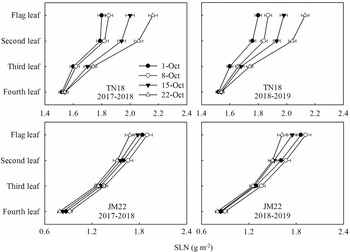
The SLNs of four leaf layers were all affected significantly (P < 0.05) by the cultivars × sowing date interactions at anthesis in both years (Table 4). In 2017–2018, as the sowing date delayed from 1 October to 22 October, the SLN gradient became steeper in TN18 (Fig. 2), the SLN of flag leaf in TN18 increased significantly (P < 0.05), much higher than that in JM22, which decreased significantly (P < 0.05). The SLN of second leaf in TN18 increased significantly (P < 0.05), much higher than that in JM22, which decreased significantly (P < 0.05). The SLN of third leaf in TN18 increased significantly (P < 0.05), much higher than that in JM22, which decreased significantly (P < 0.05). The SLN of fourth leaf in TN18 was unchanged in both years, much higher than that in JM22, which decreased significantly (P < 0.05). The trends were consistent in 2018–2019.
The specific green leaf area nitrogen (SLN) of different layers of TN18 and JM22 cultivars at anthesis during the two growing seasons. Horizontal bars indicate standard error.

Accumulated N amounts and ratios at each growth stage
Significant (P < 0.05) cultivars × sowing date interactions were observed for accumulated N amounts and ratios at each reproductive stage in both years (Table 5). In 2017–2018, with the change of sowing date from 1 October to 22 October, the accumulated N amounts from seedling emergence to jointing in TN18 decreased significantly (P < 0.05), much higher than that in JM22, which decreased significantly (P < 0.05). The accumulated N amounts from jointing to anthesis in TN18 increased significantly (P < 0.05), much higher than that in JM22, which decreased significantly (P < 0.05). The accumulated N amounts from anthesis to maturity in TN18 decreased significantly (P < 0.05), much higher than that in JM22, which decreased significantly (P < 0.05). The trends were consistent in 2018–2019.
The accumulated nitrogen and the ratio of accumulated nitrogen to total accumulated nitrogen at different growth stages of TN18 and JM22 in 2017–2018 and 2018–2019

Values followed by the same letter within a column in the same year are not significantly different at P < 0.05 as determined by the LSD test.
In addition, the ratio of accumulated N from seedling emergence to jointing to total accumulated N in TN18 decreased significantly (P < 0.05), much higher than that in JM22, which decreased significantly (P < 0.05). The ratio of accumulated N from jointing to anthesis to total accumulated N in TN18 increased significantly (P < 0.05), much higher than that in JM22, which increased significantly (P < 0.05). The ratio of accumulated N from anthesis to maturity to total accumulated N in TN18 was unchanged, much higher than that in JM22, which was unchanged (Table 5). The trends were consistent in 2018–2019.
Rubisco content and P n
The Rubisco content and P n of flag leaf at anthesis were all affected significantly (P < 0.05) by the cultivars × sowing date interactions at anthesis in both years (Table 6). Changing the sowing date in 2017–2018 from 1 October to 22 October led to significantly (P < 0.05) increased Rubisco content in TN18, much higher than that in JM22, which decreased significantly (P < 0.05). The P n at anthesis in TN18 increased significantly (P < 0.05), much higher than that in JM22, which decreased significantly (P < 0.05). The trends were consistent in 2018–2019.
The Rubisco content and P n of flag leaf at anthesis, dry matter per single stem and per unit land area at anthesis and maturity of TN18 and JM22 in 2017–2018 and 2018–2019

Values followed by the same letter within a column in the same year are not significantly different at P < 0.05 as determined by the LSD test.
Dry matter
Interaction effects between cultivars and sowing date on dry matter per single stem at anthesis in both years (Table 6). However, significant (P < 0.05) cultivars × sowing date interactions were observed for dry matter per single stem at maturity in both years (Table 6). In 2017–2018, as the sowing date was pushed back from 1 October to 22 October, the dry matter per single stem at maturity in TN18 increased significantly (P < 0.05), much higher than that in JM22, which was unchanged. The trends were consistent in 2018–2019.
The dry matters per unit land area at anthesis and maturity were all affected significantly (P < 0.05) by the cultivars × sowing date interactions at anthesis in both years (Table 6). In 2017–2018, as the sowing date delayed from 1 October to 22 October, the dry matter per unit land area at anthesis in TN18 decreased significantly (P < 0.05). The dry matter per unit land area at maturity in JM22 decreased significantly (P < 0.05). The trends were consistent in 2018–2019.
Significant (P < 0.05) cultivars × sowing date interactions were observed for dry matter contribution content and the ratio of pre-anthesis and post-anthesis to grain yield in both years (Table 5). The dry matter contribution content of pre-anthesis to grain yield in TN18 decreased significantly (P < 0.05) with the sowing date of 22 October compared with 1 October, and was much higher than that in JM22, which was unchanged. The dry matter contribution content of post-anthesis to grain yield in TN18 increased significantly (P < 0.05), much higher than that in JM22, which was unchanged. The dry matter contribution ratio of pre-anthesis to grain yield in TN18 decreased significantly (P < 0.05), much higher than that in JM22, which decreased significantly (P < 0.05). The dry matter contribution ratio of post-anthesis to grain yield in TN18 increased significantly (P < 0.05), much higher than that in JM22, which was unchanged. The trends were consistent in 2018–2019 (Table 7).
The dry matter contribution content and ratio of pre-anthesis and post-anthesis to grain yield of TN18 and JM22 in 2017–2018 and 2018–2019

Values followed by the same letter within a column in the same year are not significantly different at P < 0.05 as determined by the LSD test.
Correlations
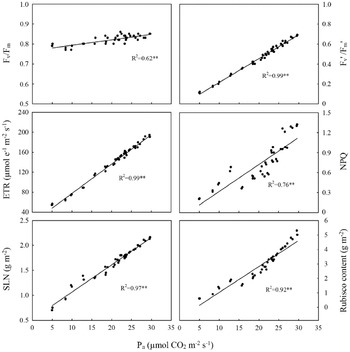
The key characteristics were tested to determine their relationships using correlation analysis (Fig. 3). The P n was positively correlated with F v/F m, F′v/F′m, ETR, NPQ, SLN and Rubisco content.
Relationship of net photosynthetic rate (P n) to the open photosystem PSII reaction centres (F v/F m), actual capture efficiency of excitation energy by open photosystem PSII reaction centres (F′v/F′m), the total electron transport rate (ETR), non-photochemical quenching (NPQ), specific green flag leaf area nitrogen (SLN) and Rubisco content per unit area of flag leaves for different sowing dates in both winter wheat cultivars over two seasons. * and ** are significantly correlated at P < 0.05 and P < 0.01, respectively.

Discussion
Global warming has significantly affected the growth, development and yield of winter wheat (Berry et al., Reference Berry, Sterling, Spink, Baker, Sylvester-Bradley, Mooney, Tams and Ennos2004; Foulkes et al., Reference Foulkes, Slafer, Davies, Berry, Sylvester-Bradley, Martre, Calderini, Griffiths and Reynolds2011). In addition, rotation of summer corn and winter wheat is the main planting system in a few regions of the world, and the late maturing variety of summer corn is the main variety that can produce a higher grain yield (Niu, Reference Niu2011). Therefore, a later sowing date for winter wheat will be imperative under such conditions. However, the key to achieving this goal lies in selecting suitable winter wheat varieties that can maintain or increase grain yield under later sowing dates. In our study, as the sowing date was pushed back, the low-tillering winter wheat cultivars could maintain grain yield, much higher than that in the high-tillering winter wheat cultivars, which significantly decreased grain yield. In addition, a trade-off between spike number per unit area and grain number per spike guaranteed a stable yield in the low-tillering winter wheat cultivars, whereas decreased spike number per unit area and grain number per spike reduced the grain yield in the high-tillering winter wheat cultivars.
Our previous research demonstrated that delayed sowing could significantly decrease the spike number per unit area, mainly owing to the lower accumulated temperature before wintering (Yin et al., Reference Yin, Dai and He2018). This is consistent with the results of our present study. Furthermore, previous research had shown that the grain yield of wheat was mainly determined by the photosynthesis of photosynthetic organ (Wang et al., Reference Wang, Offler and Patrick1995; Roberto et al., Reference Roberto, Andrea, Pierre, Marco and Pierre2010). Although the time from flowering to maturity is shortened at late and latest sowing dates, the higher P n could more quickly fill grain (Fang et al., Reference Fang, Li, Nie, Wang, Huang, Zhang, Zhang, She, Liu, Ruan, Yuan and Yi2018), maintain grain weight and increase grain number per spike. Increased grain number per spike could offset the decrease in the spike number per unit area, and ultimately maintained grain yield in the low-tillering winter wheat cultivars. In contrast, as the sowing date delayed, the lower P n of the late and latest sowing dates in high-tillering winter wheat cultivar decreased significantly, which was lower than that in low-tillering winter wheat cultivar. The lower P n led to a decreasing grain filling rate and grain number per spike, and with a lower spike number per unit area, finally decreased grain yield in high-tillering winter wheat cultivars. As the reason for P n improving in low-tillering winter wheat cultivars and decreasing in high-tillering winter wheat cultivars was concerned, several physiological traits should be taken into account, such as chlorophyll fluorescence parameters, N accumulation dynamics, the level and vertical canopy distribution for SLN at anthesis and Rubisco content.
The chlorophyll fluorescence has often been used to non-invasively detect the photosynthetic properties of plants for years (Baker and Rosenqvist, Reference Baker and Rosenqvist2004). The change in chlorophyll fluorescence from the photosynthetic organism is an adaptation to photosynthetic activity (McAlister and Myers, Reference McAlister and Myers1940; Kautsky and Zedlitz, Reference Kautsky and Zedlitz1941). Furthermore, the chlorophyll fluorescence could detect the ETR of PSII (Genty et al., Reference Genty, Briantais and Baker1989), which is related to the assimilation of carbon dioxide (Genty et al., Reference Genty, Briantais and Baker1989, Reference Genty, Harbinson and Baker1990; Harbinson et al., Reference Harbinson, Genty and Baker1990; Krall and Edwards, Reference Krall and Edwards1990, Reference Krall and Edwards1991; Cornic and Ghashghaie, Reference Cornic and Ghashghaie1991; Krall et al., Reference Krall, Edwards and Ku1991; Siebke et al., Reference Siebke, von Caemmerer, Badger and Furbank1997). In our study, P n was positively correlated with F v/F m, F′v/F′m, ETR, and NPQ. Therefore, the higher F v/F m, F′v/F′m and ETR at the late and latest sowing dates suggested that the P n was higher in low-tillering winter wheat cultivars, whereas the higher NPQ also suggested that later sowing resulted in more waste. In contrast, the lower F′v/F′m and ETR at the late and latest sowing dates suggested that the P n was lower in high-tillering winter wheat cultivars, whereas the lower NPQ also suggested that later sowing resulted in less waste.
N fertilizer is a main influencing factor during wheat crop production. It has been suggested that the timing of the plant N demand is associated with the pattern of canopy architecture and carbon gain development in the wheat canopy (Pan et al., Reference Pan, Yu, Tian, Wang, Liu and Wang1998). High crop demands occur at the start of stem elongation all the way through flag leaf emergence. N uptake at the stem elongation stage initially increases leaf chlorophyll, soluble protein contents and carbon exchange rate in flag leaves compared with N dressing at the double ridge stage (Scalet et al., Reference Scalet, Miceli, Martin and Zerbi1991). Flag leaves are dominant photosynthetic organs responsible for grain filling at post-anthesis. In general, the longer a flag leaf remains on the plant, the greater the contribution offered to cereal grain yield (Olszewski et al., Reference Olszewski, Pszczółkowska, Kulik, Fordoński, Płodzień, Okorski and Wasielewska2008). According to the effects of N fertilisation and watering on organ development in the spring, enhanced N uptake during the jointing to anthesis growth stages may be associated with increased N content in flag leaves leading to improved photosynthetic activity during the grain filling stage (Tian et al., Reference Tian, Li, Liang, Guo, Cai, Jiang, Cao and Dai2016). Additionally, a strong positive correlation has been widely reported between photosynthetic capacity and N content per unit leaf area (Evans, Reference Evans1989). In the present study, the AGN per unit area and SLN in low-tillering winter wheat cultivar were significantly higher than that in high-tillering winter wheat cultivar. Though the AGN per unit area significantly decreased, the AGN per single plant was unchanged in the low-tillering winter wheat cultivars. Furthermore, we observed that the SLN was positively correlated with P n, suggesting that higher SLN promoted the photosynthetic activity of flag leaves during the grain-filling stage under the delayed sowing treatments. In contrast, the AGN per plant significantly decreased, suggesting that lower SLN limited the photosynthetic activity of flag leaves were obtained in the high-tillering winter wheat cultivars.
Efficient photosynthesis is an important factor influencing crop productivity in later plant growth stages. An optimal N distribution in the plant canopy improves photosynthesis without additional N input (Gastal and Lemaire, Reference Gastal and Lemaire2002). Nevertheless, the SLN gradients in actual canopies are less steep than the optimal gradients (Buckley et al., Reference Buckley, Cescatti and Farquhar2013). In situations like normal sowing, where SLN gradients were suboptimal, steeper SLN gradients under delayed sowing may contribute to enhanced photosynthesis with limited N in the plant canopy in the low-tillering winter wheat cultivars, whereas the steeper SLN gradients with higher photosynthesis were observed under normal sowing, and the SLN gradients at the late and latest sowing dates were less steep than that at the normal sowing date in high-tillering winter wheat cultivars. In addition, the higher SLN of flag leaves every growing stage after anthesis at the late and latest sowing dates ensured higher photosynthesis in the low-tillering winter wheat cultivars, whereas the lower SLN led to lower photosynthesis in the high-tillering winter wheat cultivars.
Rubisco is the key enzyme in the Calvin cycle and the most abundant enzyme in plants (Evans, Reference Evans1989; Makino et al., Reference Makino, Shimada, Takumi, Kaneko, Matsuoka, Shimamoto, Nakano, Miyao-Tokutomi, Mae and Yamamoto1997). Furthermore, previous research has shown that the SLN of leaves was positively correlated to Rubisco content (Makino et al., Reference Makino, Shimada, Takumi, Kaneko, Matsuoka, Shimamoto, Nakano, Miyao-Tokutomi, Mae and Yamamoto1997, Reference Makino, Nakano, Mae, Shimada and Yamamoto2000; Ghannoum et al., Reference Ghannoum, Evans, Chow, Andrews, Conroy and von Caemmerer2005). Therefore, more Rubisco is usually accompanied by higher SLN, which will lead to higher P n (Warren, Reference Warren2004; Bown et al., Reference Bown, Watt, Mason, Clinton and Whitehead2009; Li et al., Reference Li, Gao, Xu, Shen and Guo2009; Yamori et al., Reference Yamori, Nagai and Makino2011). In our study, as the sowing date delayed, the Rubisco content in the low-tillering winter wheat cultivar was higher than that in the high-tillering winter wheat cultivar. Furthermore, the Rubisco content was positively correlated with P n, suggesting that more Rubisco at the late and latest sowing dates promoted higher P n in the low-tillering winter wheat cultivars, whereas less Rubisco reduced P n in the high-tillering winter wheat cultivars.
Higher P n could produce more dry matter which would guarantee a higher grain yield (Roberto et al., Reference Roberto, Andrea, Pierre, Marco and Pierre2010; Xiong et al., Reference Xiong, Ding, Wei, Ding and Wang2013). Although there was less dry matter per unit area at anthesis under the later sowing than the normal sowing treatment, higher P n of leaves after anthesis contributed to the increase in dry matter per plant which led to a rapid dry matter accumulation rate, and ultimately produced consistent dry matter per unit area at maturity, ensuring a comparable yield in the low-tillering winter wheat cultivars. In addition, approximately 70% of grain yield was from dry matter produced by photosynthesis at post-anthesis (Roberto et al., Reference Roberto, Andrea, Pierre, Marco and Pierre2010). In our study, owing to the lower dry matter accumulation of pre-anthesis vegetative organs at the late and latest sowing, dry matter contribution and the ratio of pre-anthesis vegetative organs to grain significantly decreased for the low-tillering winter wheat cultivars. However, higher P n after anthesis at the late and latest sowing significantly improved dry matter contribution and the ratio of post-anthesis vegetative organs to grain, so as to be beneficial to maintaining a higher yield. In contrast, the lower P n after anthesis led to a decrease in dry matter per plant, which resulted in a slower dry matter accumulation rate, and finally produced less dry matter per unit area at maturity that also resulted in a lower yield in the high-tillering winter wheat cultivars.
Conclusions
In conclusion, as the sowing date delayed from October 1 to October 22, the grain yield in the low-tillering winter wheat cultivars was maintained consistently, much higher than that in the high-tillering winter wheat cultivars, which decreased significantly. The main reason for this was that the more accumulated N from jointing to anthesis under late and latest sowing resulted in a higher grain number per spike, compared with that under normal sowing, in the low-tillering winter wheat cultivars. Meanwhile, the higher net photosynthetic rate within a shorter time after anthesis, through optimizing the spatiotemporal distribution of N in the canopy and increasing Rubisco content per unit area of flag leaves, improved dry matter accumulation rate and contribution ratio of post-anthesis vegetative organs to grain, and thus, ensured that more grains researched a consistent grain weight. In contrast, compared with that under normal sowing, the spike number of high-tillering winter wheat cultivars under late and latest sowing was less, the less accumulated N from jointing to anthesis resulted in a lower grain number per spike, and the lower net photosynthetic rate through reduced AGN uptake per single plant, unoptimizable spatiotemporal distribution of N in the canopy and decreased Rubisco content per unit area of flag leaves. This reduced the dry matter accumulation rate, and consequently, only satisfied less grains to achieve a consistent grain weight. Thus, low-tillering winter wheat cultivars are more adaptable to late sowing.
Acknowledgements
We thank Professor Mingrong He and Xinglong Dai (Shandong Agricultural University) for their help in the field and laboratory. The authors declare no conflicts of interest.
Financial support
This work was supported by the National Key Research and Development Program of China (2016YFD0300107), the National Natural Science Foundation of China (31871578) and Scientific Research and Development of Yangtze University (802100270402).
Conflict of interest
None.
Ethical standards
Not applicable.