Background
Patients admitted to geriatric psychiatry hospital wards have a high risk of falling (Carle and Kohn, Reference Carle and Kohn2001). Predisposing factors for an increased number of falls and related fall injuries include the patient's general physical condition, like gait disorders, impairment of balance, and mobility, as well as geriatric comorbidities (sarcopenia, frailty, poor bone health, and dementia) (Oliver et al., Reference Oliver, Daly, Martin and McMurdo2004; Scanlan et al., Reference Scanlan, Wheatley and McIntosh2012; Stubbs et al., Reference Stubbs, Brefka, Dallmeier, Stubbs, Vancampfort and Denkinger2016). Furthermore, the acute deterioration of the psychiatric condition in old age; confusional states with agitated behavior as well as exacerbated anxiety symptoms (Eriksson et al., Reference Eriksson, Strandberg, Gustafson and Lundin-Olsson2009; Oliver et al., Reference Oliver, Daly, Martin and McMurdo2004), the use of neuroleptic and sedative medication further increases the individual's risk of falling and consequently risk of severe fall-related injuries (Carle and Kohn, Reference Carle and Kohn2001; Oliver et al., Reference Oliver, Daly, Martin and McMurdo2004; de Hert et al., Reference Hert, Detraux and Stubbs2016)
There is an abundance of literature on fall rates and fall-related injuries in geriatric hospital settings (e.g. see World Health Organization (WHO), 2007; Chari et al., Reference Chari, McRae, Varghese, Ferrar and Haines2013). However, studies of falls in an acute geriatric psychiatry hospital setting primarily focus on fall rates and not on injuries. The reported fall rates are quite heterogeneous ranging from 3.2 in Australia (Scanlan et al., Reference Scanlan, Wheatley and McIntosh2012), 7.6 in Germany (Scheffel and Pantelatos, Reference Scheffel and Pantelatos1997), 9.5 (Poster et al., Reference Poster, Pelletier and Kay1991) and 11.3 (Carle and Kohn, Reference Carle and Kohn2001) in the USA, and 17.1 in Sweden (Nyberg et al., Reference Nyberg, Gustafson, Janson, Sandman and Eriksson1997) per 1,000 hospital bed days. Only one study reports fall-related injuries in geriatric psychiatry hospital care. Scheffel and Pantelatos (Reference Scheffel and Pantelatos1997) report of 3.4% of the falls led to severe injuries like fractures, requiring further hospitalization or surgical interventions.
Given the heterogeneity in reported fall rates and the little information about fall injuries, there is a need to further investigate fall-related sequels in the acute geriatric psychiatry hospital setting. Therefore, the primary objectives of this retrospective study were to determine the fall rate in this sample and to analyze fall-related injuries in a geriatric psychiatry hospital.
Methods
This is a retrospective analysis of one year fall protocols from a department of geriatric psychiatry with four hospital wards.
Setting and patients
This investigation was conducted in the Department of Geriatric Psychiatry of the LVR-Hospital Cologne. The inpatient sector of the department includes four specialized wards, each with twenty beds. Of these four wards, two are closed acute dementia care wards. Other patients admitted to these closed wards suffer from delirium due to somatic complications (surgery, pneumonia, lower urinary tract infections). The two other open wards are mostly for patients suffering from depression, affective and personality disorders, schizophrenia, and dependency problems. Psychiatric patients over the age of 65 are admitted. Most dementia patients are admitted to hospital as they suffer from an exacerbation of neuropsychiatric signs and symptoms (i.e. agitation, apathy, aggressiveness). In this hospital, physical restraints are not used to prevent falls.
Data collection
Every patient experiencing a fall in the department of geriatric psychiatry undergoes a detailed fall analysis, including a structured nursing protocol of factors associated with the fall. All documented falls of 2013 were analyzed. In our hospital, fall protocols are used to standardize the reporting of falls. Each fall requires an examination of the patient to exclude fall-associated injuries. In case of suspected fall-related injuries, further examinations (e.g. surgical or radiological) are arranged. Within the nursing fall protocol, a fall is defined as “inadvertently coming to rest on the ground, floor or other lower level, excluding an intentional change in position to rest in furniture, wall or other objects” (WHO, 2007). The following data are recorded in the hospital's fall protocol: patient identification number, ward number, age, sex, date and approximate time of fall, last contact with the patient, and an incident report. Based on the incident report in the fall protocols and the electronic patient data, predisposing factors for falls like the patients’ diagnosis as well as the patients’ medical sequels of the falls were analyzed. Cognitive performance was assessed with the Mini-Mental Status Examination (Folstein et al., Reference Folstein, Folstein and McHugh1975), the Clock Drawing Test (Shulman et al., Reference Shulman, Pushkar Gold, Cohen and Zucchero1993), and the DemTect (Kalbe et al., Reference Kalbe2004). Patients were diagnosed conform ICD-10, all diagnoses were included in the retrospective analysis.
Data analysis
The fall rate has been calculated as the number of falls per 1,000 hospital days (Carle and Kohn, Reference Carle and Kohn2001; Scanlan et al., Reference Scanlan, Wheatley and McIntosh2012). All falls were divided by the cumulative number of bed days for all patients in 2013. The objective medical sequels were classified according to the categories of Scheffel and Pantelatos (Reference Scheffel and Pantelatos1997): no injuries, mild injuries (contusions, hematomas, and abrasions), moderate injuries (lacerations and dislocations), and severe injuries (fractures and cerebral hemorrhages).
Differences between the group characteristics of single- and multiple fallers were analyzed via the χ 2 test for categorical variables, Mann–Whitney U test for ordinal characteristics, and unpaired t-test for continuous variables. The level of significance was set at p≤0.05. These analyses were conducted in MS EXCEL (Excel 2007, Microsoft, Inc., Redmond, WA) and SPSS (Released 2015, IBM SPSS Statistics for Windows, version 23.0. Armonk, NY: IBM Corp.).
Results
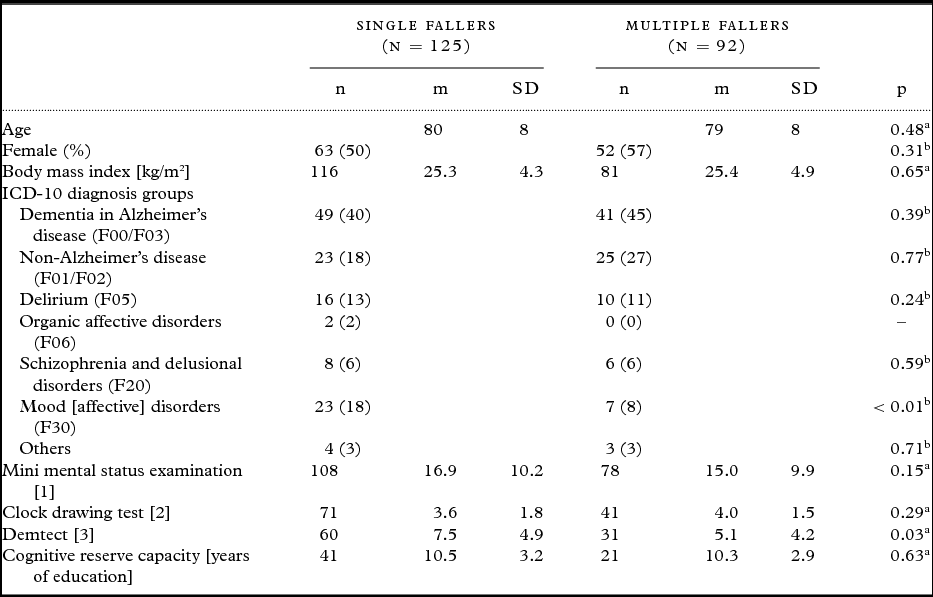
In total, 853 patients were admitted to the four wards. The summarized length of stay was 28,760 bed days with an average length of stay of 33.7 days per patient. During the one-year study period, 510 falls were registered. Out of the 853 patients, 217 (25%) fell during their hospital stay, with 125 (58%) falling once, and 92 (42%) falling multiple times, ranging from 2 to 14 falls. Taking the corresponding bed days of the year 2013 into account, 17.7 falls per 1,000 hospital days have occurred. The patient characteristics are shown in Table 1.
Characteristics of the fallers (n = 217)

a Mann–Whitney U test.
b χ 2 test.
Scaling and References for cognitive assessments: [1] 0–30 points, 30 points indicate no cognitive impairment; Reference: Folstein, Folstein and McHugh (Reference Folstein, Folstein and McHugh1975); [2] 1–6 points, 1 point indicates a perfect clock and no visuospatial impairment; Reference: Shulman et al. (Reference Shulman, Pushkar Gold, Cohen and Zucchero1993); [3] 0–18 points, 18 indicates no cognitive impairment; Reference: Kalbe et al. (Reference Kalbe2004).
The analysis of the group characteristics revealed that patients who fell once were more frequently diagnosed with mood disorders and showed better results in the Demtect assessment. Out of the 510 falls, 269 (53%) were recorded in females and 241 (47%) in males. Overall, 138 of the falling patients were suffering from dementia (64%). Out of 92 patients who fell multiple times, significantly more patients (p<0.001) were suffering from dementia (n=66, 72%). Within the total number of falls, Alzheimer's disease was more prevalent (n=223, 44%) than non-Alzheimer dementias (n=143, 28%, vascular, mixed-type dementia, Lewy-body dementia, frontotemporal dementia).
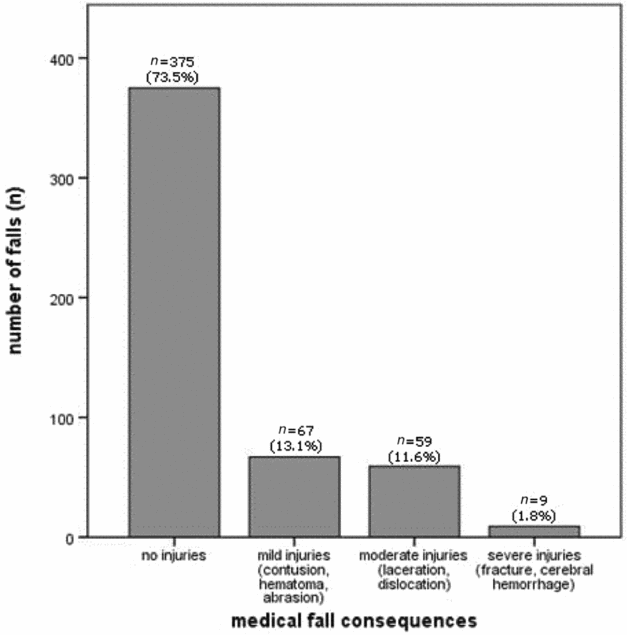
The incidence and distribution of fall-related injuries is illustrated in Figure 1.
Medical fall consequences (n=510 falls).

Further statistical analysis revealed no correlation between the medical fall consequences and the patients‘ cognitive impairment (Mini-Mental Status Examination: r=0.02, p=0.66; Clock Drawing Test: r=−0.11, p=0.08; Demtect: r=−0.02, p=0.78; cognitive reserve capacity: r=−0.15, p=0.07) as well as the application of psychotropic medication (antidepressive: r=−0.1, p=0.80; neuroleptics: r=0.2, p=0.67; benzodiazepines: r=−0.03, p=0.52; sleep medication: r=−0.05, p=0.24).
Discussion
The primary objectives of this report were to determine a fall rate and to analyze fall-related injuries in a geriatric psychiatry hospital. We found a rate of 17.7 falls per 1,000 hospital days. To the best of our knowledge, this is the highest fall rate reported in the geriatric psychiatry setting to date. Although we found a high fall rate in our hospital setting, there were very few severe sequels due to falling (n=9; 1.8%). Most falls did not lead to injuries (n=375, 73%). This low level of moderate and severe injuries is comparable to the investigation of Scheffel and Pantelatos (Reference Scheffel and Pantelatos1997), indicating no injuries in 65–71%, moderate injuries in 10%, and severe injuries in 5% of the recorded falls. Within our study sample, we found a markedly lower rate of severe consequences related to falling, i.e. fractures (n=5; 1.0%), and cerebral hemorrhages (n=4; 0.8%). Interestingly, falls in patients suffering from Alzheimer's disease more often led to mild or severe injuries compared to patients suffering from non-Alzheimer dementias in our sample.
Some factors limit the interpretation and generalization of our results. Data of this retrospective analysis were derived from routine care records in an acute hospital setting, and these did not contain all relevant information. For example, there was no information on history of falls, and psychotropic medication, and neuropsychiatric symptoms were not rated in a standardized way. Furthermore, routine care may not report and document all falls, hence this retrospective study design may underestimate the number of falls and resulting injuries.
Compared to the study by Scheffel and Pantelatos (Reference Scheffel and Pantelatos1997), our analysis reveals a 2.3-fold higher fall rate, but a markedly lower rate of severe medical fall consequences. Contrary to our data, the data of Scheffel and Pantelatos (Reference Scheffel and Pantelatos1997) reflects the use of physical restraints (i.e. five-point fixation, bed barrier) to prevent falls. According to Healey et al. (Reference Healey, Oliver, Milne and Connelly2008), use of bedrails influences fall rates and fall-related injuries. Hence, the approach of not using physical restraints to prevent falls may be linked to the observed higher fall rate, as seen in our sample. Falls can result in severe consequences in the elderly; in our retrospective analysis, only a few falls led to severe injuries. In our setting, we observed 17.7 falls per 1,000 hospital days, with less than one in 50 falls leading to severe injuries. Along with this very high number of falls, the clinical interest should be to implement an individually tailored fall prevention concept in order to reduce the high incidence of falls in our department. This should include a broad and structured fall risk assessment and multi-dimensional and multi-professional fall prevention interventions (WHO, 2007). Further research in the field of falls in geriatric psychiatry care, the effect of not using physical restraints to prevent falls needs to be critically questioned and re-evaluated.
Conclusion
The results of this study indicate a very high fall rate in these patients, but only a small number of falls was associated with severe medical consequences.
Conflict of interest
None.
Description of authors’ roles
Oepen: study concept, data acquisition, statistical analysis, interpretation of data, draft and revision of the manuscript. Fleiner: study concept, data acquisition, statistical analysis, interpretation of data, draft and revision of the manuscript. Oliva y Hausmann: study concept, further data analysis, interpretation of data, draft and revision of the manuscript. Zank: interpretation of data, draft and revision of the manuscript. Zijlstra: study concept, interpretation of data, draft and revision of the manuscript. Haeussermann: study concept, data acquisition, clinical interpretation of data, draft and revision of the manuscript.
Acknowledgments
The authors thank Dr. Nicola Herbig for her support in the data acquisition.