The majority of the sweetpotato acreage (>90%) in North Carolina is planted with ‘Covington’ (NCDACS 2015), a cultivar released by North Carolina State University in 2008 (Yencho et al. Reference Yencho, Pecota, Schultheis, VanEsbroeck, Holmes, Little, Thornton and Truong2008). The wide adoption of Covington sweetpotato is attributed to its disease resistance and high yield (uniformity and high percentage of no. 1 grade) compared to ‘Beauregard’, which had previously dominated acreage in North Carolina (Yencho et al. Reference Yencho, Pecota, Schultheis, VanEsbroeck, Holmes, Little, Thornton and Truong2008). A disorder known as internal necrosis (IN) was first reported in Covington storage roots in 2006 by a North Carolina grower (Jiang et al. Reference Jiang, Perkings-Veazie, Blankenship, Boyette, Pesic-VanEsbroeck, Jennings and Schulthies2015). Covington is not the only susceptible variety, but because it is the primary cultivar grown in North Carolina it is the most concerning (Clark and Silva et al. Reference Clark, Silva, Arancibia, Main, Schultheis, Esbroeck, Jiang and Smith2013).
The symptoms of IN are expressed as dark discolored regions within the sweetpotato storage root. The symptoms begin inside the storage root at the proximal end (end that was attached to the stem), and may progress through approximately half of the root length. No external expression of symptoms occur on the surface of the storage root, which precludes early detection of affected roots (Clark and Ferrin et al. Reference Clark, Ferrin, Smith and Holmes2013; Jiang et al. Reference Jiang, Perkings-Veazie, Blankenship, Boyette, Pesic-VanEsbroeck, Jennings and Schulthies2015). Since the first report of IN, a number of reports and investigations have addressed the problem, but the cause of IN has not been identified. The symptoms of IN are not genetically inherited (Schultheis and Thornton Reference Schultheis and Thornton2007), and no microorganisms are consistently isolated from infected roots, suggesting that it might be a stress-induced physiological disorder (Schultheis et al. Reference Schultheis, Pesic-VanEsbroeck, Jennings, Dittmar and Thornton2009). Previous research has investigated several pre- and postharvest factors that may affect or initiate IN, but no direct causal relationship has been confirmed between these factors and IN. Flooding in the field shortly before harvest had no effect on the incidence and severity of IN of sweetpotato roots (Dittmar et al. Reference Dittmar, Jennings, Monks and Schultheis2010). Jiang et al. (Reference Jiang, Perkings-Veazie, Blankenship, Boyette, Pesic-VanEsbroeck, Jennings and Schulthies2015) reported no relation between IN and registered insecticides in sweetpotato production systems. In addition, no relationship between IN incidence and postcuring storage temperature or relative humidity conditions in commercial storage rooms has been found (Jiang et al. Reference Jiang, Perkings-Veazie, Blankenship, Boyette, Pesic-VanEsbroeck, Jennings and Schulthies2015).
Ethephon is registered and used to enhance defoliation of cotton (Gossypium hirsutum L.) and tobacco (Nicotiana tabacum L.) prior to harvest. Although not registered for application on sweetpotato, it has been evaluated by the sweetpotato industry to use as a harvest aid to reduce storage root damage by tightening the epidermis (Main et al. Reference Main, Shankle and Garrett2009; Wang et al. Reference Wang, Arancibia, Main, Shankle and LaBonte2013). Ethephon caused an increased incidence of IN in sweetpotato storage roots (Clark and Silva et al. Reference Clark, Silva, Arancibia, Main, Schultheis, Esbroeck, Jiang and Smith2013; Dittmar et al. Reference Dittmar, Jennings, Monks and Schultheis2010; Jiang Reference Jiang2013). At 60 d after harvest, an increased incidence of IN of up to 74% in Covington storage roots was observed with ethephon at 1.1 kg ha−1 when applied 14 d prior to harvest. Dittmar et al. (Reference Dittmar, Jennings, Monks and Schultheis2010) reported cultivar difference of IN development in sweetpotato roots after ethephon application, with greater incidence and severity in ‘Carolina Ruby’ and Covington compared with Beauregard. ‘NC 05-198’ is a potential new sweetpotato cultivar developed by the North Carolina State University sweetpotato breeding program for the commercial sweetpotato production industry (C.G. Yencho, personal communication). Incidence of IN is lower in NC05-198 (≤10%) as compared to Covington (≤63%) when treated with ethephon (Clark and Silva et al. Reference Clark, Silva, Arancibia, Main, Schultheis, Esbroeck, Jiang and Smith2013), therefore NC05-198 was included in this research to further evaluate susceptibility of this variety.
Previous research has shown that herbicides can injure sweetpotato storage roots. Glyphosate injury was observed as external cracks to sweetpotato storage roots (Meyers et al. Reference Meyers, Jennings and Monks2016). Postplanting application of halosulfuron can result in injury manifested as a blackened area with blistering on the storage root surface and small red-brown spots within the root (Dittmar et al. Reference Dittmar, Monks, Jennings and Schultheis2012). Late applications of chlorimuron resulted in storage root malformation in ‘Southern Delite’ sweetpotato (Whitwell et al. Reference Whitwell, Melton and Decoteau1989). S-metolachlor caused sweetpotato storage roots to be shorter and rounder than roots from the nontreated control (Meyers et al. Reference Meyers, Jennings and Monks2012; Porter Reference Porter1995). Therefore, we hypothesize that the occurrence of IN may be linked to herbicides used in sweetpotato production systems. The objective of this research was to determine the impact of herbicides on the development of IN when applied during slip (vegetative cuttings planted in sweetpotato fields) production or in the production field. This research includes current and potentially registered herbicides in North Carolina sweetpotato production.
Materials and Methods
Slip Propagation Study
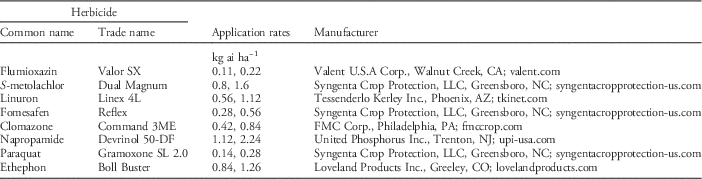
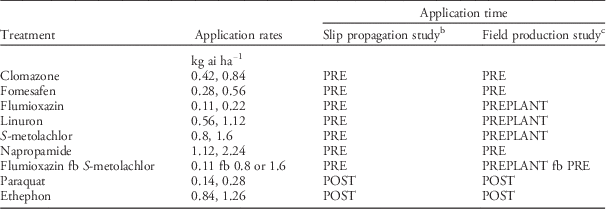
Slip propagation beds were prepared at the Horticultural Crops Research Station (35.028977°N, 78.275692°W) in Clinton, North Carolina, on April 8, 2014 and 2015. Soil was a Norfolk loamy sand (fine-loamy, kaolinitic, thermic typic Kandiudults) with pH 6.1 and 0.8% organic matter. Covington storage roots were placed in transplant propagation beds and covered with soil to a depth of 2.54 cm. Propagation beds were then covered with clear polyethylene mulch, which remained until plants emerged (Loebenstein and Thottappilly Reference Loebenstein and Thottappilly2009). Plot size was 1.5 m wide by 3 m long. Treatments included PRE and POST herbicide application (Tables 1 and 2) and a nontreated control. The selected herbicide rates represented the minimum and maximum recommended or potential registration rates in sweetpotato. The study was arranged in a randomized complete block design with three and four replications in 2014 and 2015, respectively. The PRE herbicides were applied after covering storage roots with soil, but before the polyethylene mulch was installed. Paraquat treatments were applied 2 and 4 wk prior to cutting slips in 2014 and 2015, respectively, while ethephon treatments were applied 10 d prior to cutting slips in both years. Herbicides were applied using a CO2-pressurized backpack sprayer equipped with three XR11002VS nozzles (TeeJet Technologies, Wheaton, IL) spaced 50 cm apart and calibrated to deliver 187 L ha−1 of spray solution.
Herbicides applied in the slip propagation and field production study in 2014 and 2015.

Herbicide treatments in the slip propagation and field production study in 2014 and 2015.Footnote a

a Abbreviations: fb, followed by; POST, postemergence; PRE, preemergence; PREPLANT, 1 d before planting.
b Herbicides were applied PRE (after covering storage roots with soil but prior to polyethylene mulch installation) and POST (2 to 4 wk prior to cutting slips).
c Herbicides were applied PREPLANT (1 d prior to sweetpotato transplanting), PRE (4 d after transplanting), and POST (2 wk prior to harvest).
For production of storage roots, slips were cut from the propagation beds 2 to 3 cm above the soil surface and averaged 20 to 25 cm in length from the soil surface to the growing point. These slips were transplanted on June 11, 2014, and June 22, 2015, in a separate field on the Horticultural Crops Research Station and Cunningham Research Station (35.303992°N, 77.572694°W) in Kinston, North Carolina. Soil was a Faceville fine sandy loam (fine, kaolinitic, thermic typic Kandiudults) with pH 5.3 and 0.8% organic matter in 2014 and a Norfolk loamy sand (fine-loamy, kaolinitic, thermic Typic Kandiuldults) with pH 5.8 and 1.3% organic matter in 2015. Plot size was two rows that were each 1.1 m wide by 6 m long in 2014 and 1.1 m wide by 7.6 m in 2015. The first row of the plot was a border row planted with nontreated slips, and the second row was planted with treated slips from propagation beds. Treatment randomization was identical to that in the propagation beds.
Field Production Study
Studies were conducted at the Horticultural Crops Research Station in Clinton, North Carolina, in 2014, and at the Cunningham Research Station in Kinston, North Carolina in 2015. Soil type was a Norfolk loamy sand (fine-loamy, kaolinitic, thermic Typic Kandiuldults) with pH 5.5 and 1% organic matter and with pH 5.6 and 1.3% organic matter in 2014 and 2015, respectively. In 2015, NC 05-198, an advanced sweetpotato variety in the breeding program at North Carolina State University, was included in the study. Covington and both Covington and NC 05-198 sweetpotato slips were cut from a field propagation bed that had not been treated with herbicide, and were transplanted on June 12, 2014, and June 23, 2015, respectively.
Treatments were arranged in a randomized complete block design with four replications. Plot size was two rows that were each 1.1 m wide by 6 m long in 2014 and three rows that were each 1.1 m wide by 7.6 m in 2015. The first row of each plot was nontreated and served as a border row. The second and third rows were treated and planted with Covington and NC 05-198, respectively. Herbicide treatments included preplant (1 d prior to sweetpotato transplanting), PRE [4 d after transplanting (DAP)], and POST (2 wk prior to harvest) applications (Table 2). A nontreated control was included for comparison. Herbicides were applied using a CO2-pressurized backpack sprayer equipped with two XR11002VS nozzles (TeeJet Technologies, Wheaton, IL) spaced 50 cm apart and calibrated to deliver 187 L ha−1 of spray solution.
In both studies, all plots and border rows were maintained weed-free by cultivation until sweetpotato canopy closure and were hand weeded as needed all season. Sethoxydim POST at 0.34 kg ai ha−1 plus 1% (v/v) crop oil was applied as needed to control goosegrass [Eleusine indica (L.) Gaertn.] and large crabgrass [Digitaria sanguinalis (L.) Scop.]. Standard sweetpotato production practices were implemented throughout the growing season (Kemble Reference Kemble2015).
From both studies, sweetpotato storage roots were harvested 110±5 DAP using a tractor-mounted chain digger and then hand-graded into jumbo (>8.9 cm diam), no. 1 (>4.4 cm but <8.9 cm diam), and canner (>2.5 cm but <4.4 cm diam) grades (USDA 2005) and weighed. Total marketable yield was calculated as the sum of jumbo, no. 1, and canner grades. Forty no. 1 storage roots from each plot were cured at 29 C and 95% relative humidity for 7 d, then stored at 14 C and 85% relative humidity, the recommended storage conditions (Edmunds et al. Reference Edumunds, Boyette, Clark, Ferrin, Smith and Holmes2003; Wilson et al. Reference Wilson, Averre and Covington1976).
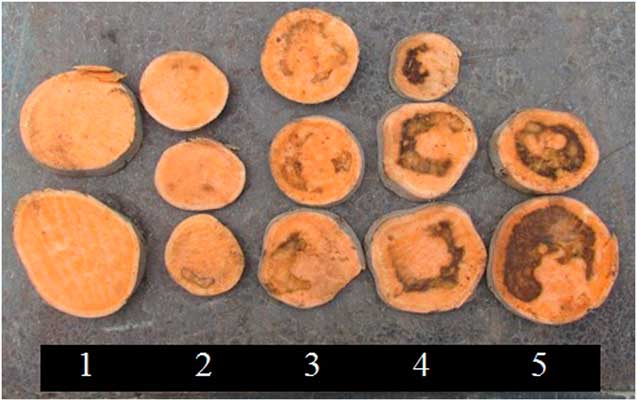
IN in no. 1 roots was determined by cutting roots into approximately 3 mm slices beginning on the proximal end. The slice with the most IN symptomology from each no. 1 root was visually rated for severity on a scale from 1, meaning no IN present, to 5, meaning very severe IN (Figure 1). Assessment for IN was conducted 70 DAP in the field, at harvest, and 30 and 60 d after curing. At 70 DAP two plants from each plot were hand dug and no. 1 roots were evaluated for IN. The purpose of this assessment was to determine if IN symptoms appeared during the growing season. On the same day of sweetpotato harvest, one-third of the no. 1 roots from each plot were evaluated for IN and two- thirds of the roots (approximately forty no. 1 roots from each plot) were kept for IN assessments at 30 and 60 d after curing. Percent incidence at each assessment timing was calculated as follows:
 \eqalignno{ &$$\,\%\,\,{\rm incidence}\,{\equals}\,\left( {{\rm Number}\,{\rm of}\,{\rm roots}\,{\rm with}\,{\rm IN}\,{\rm symptoms}\,/\,}\right \cr \quad\quad\quad\quad\quad\,\,\,\,{\rm Total}\,{\rm roots}\,{\rm evaluated} \right){\times}100.}$$
Scale used to rate internal necrosis in sweetpotato storage roots. Severity was rated on a scale of 1, meaning no internal necrosis present, to 5, meaning very severe internal necrosis.

Data analysis was conducted with a generalized linear mixed model in PROC GLIMMIX in SAS (version 9.3, SAS Institute, Inc., Cary, NC). Year, herbicide, time of assessment, and their interaction were considered fixed effects, while replication within location was considered a random effect. Time of assessment was considered a repeated measure, and an autoregressive correlation structure between observations taken on the same plot over time, by specifying TYPE=ar (1) in RANDOM statement. In both studies, the IN symptoms in sweetpotato roots at 70 DAP and the day of harvest assessment timing were reported as 0 and ≤1%, respectively (data not shown). Therefore, IN data from both of these timings was not included in the incidence and severity analysis. Means were separated using Tukey’s honest significant difference (HSD) test at the 0.05 significance level.
Results and Discussion
Slip Propagation Study
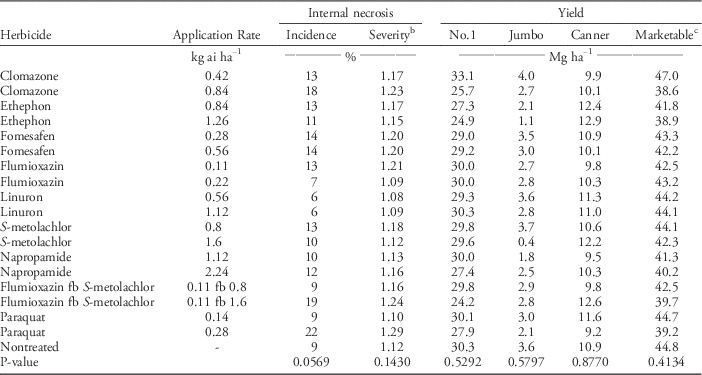
The interaction between year, herbicide, and time of assessment for IN incidence (P=0.2974) and severity (P=0.7033) and year by herbicide for yield (P=0.1265 to 0.9361) were not significant; therefore, data were combined over years. The main effect of herbicide and interaction effects between herbicide and time of assessment were not significant for IN incidence (P=0.0569 and 0.3852, respectively) and severity (P=0.1430 and 0.7240, respectively) (Table 3). Lack of a significant main effect of herbicide indicated that herbicide application at the time of slip propagation had no apparent effect on IN development in sweetpotato storage roots (Table 3). However, the effect of time of assessment was significant for both IN incidence (P=0.0007) and severity (P=0.0009). The incidence and severity of IN increased from 9% to 14% and from 1.12 to 1.19, respectively, as time of assessment increased from 30 to 60 d after curing.
Effect of herbicides on Covington sweetpotato internal necrosis and yield in slip propagation study in 2014 and 2015.Footnote a

a Data pooled over year. All means within a column are not different according to Tukey’s HSD (α=0.05).
b Severity was rated on a scale of 1, meaning no internal necrosis present, to 5, meaning very severe internal necrosis.
c Marketable is the aggregate of jumbo, no. 1, and canner grades of sweetpotato roots.
The nontreated control yielded 30.3, 3.6, 10.9, and 44.8 Mg ha−1 of no. 1, jumbo, canner, and marketable roots, respectively (Table 3). Yield of all grades of sweetpotato roots was not significantly different for herbicide treatment when compared to the nontreated control (Table 3).
Field Production Study
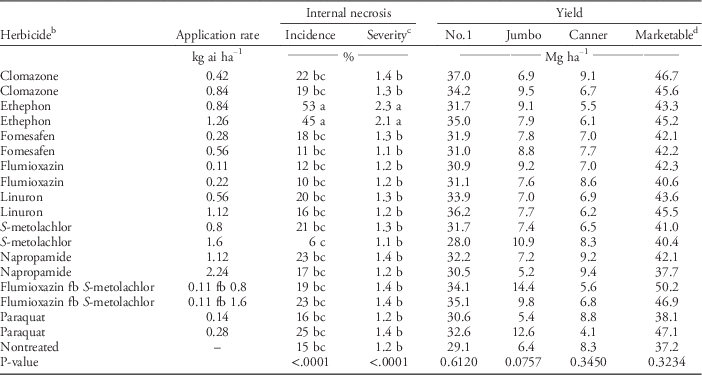
The interaction between year, herbicide, and time of assessment for IN incidence (P=0.6711) and severity (P=0.3345) and year by herbicide for yield (P=0.3075 to 0.9143) were not significant; therefore, data were combined over years. The interaction between herbicide and time of assessment were not significant for IN incidence (P=0.4717) and severity (P=0.5682). However, the effect of herbicide and time of assessment was significant for both IN incidence (P<0.0001) and severity (P<0.0001). The incidence and severity of IN was increased from 16% to 25% and 1.3 to 1.43, respectively, as time of assessment increased from 30 to 60 d after curing. The only treatment that had an increased IN incidence or severity compared to the nontreated control was ethephon (Table 4). The ethephon treatments had 45% to 53% and 2.1 to 2.3 IN incidence and severity, respectively (Table 4). For NC 05-198, IN was observed in <1% roots at all assessment timings (data not shown). Previous research indicated that cultivars differ in IN incidence and severity (Clark and Silva et al. Reference Clark, Silva, Arancibia, Main, Schultheis, Esbroeck, Jiang and Smith2013; Dittmar et al. Reference Dittmar, Jennings, Monks and Schultheis2010). Clark and Silva et al. (Reference Clark, Silva, Arancibia, Main, Schultheis, Esbroeck, Jiang and Smith2013) reported lower IN incidence in NC 05-198 as compared to Covington. Dittmar et al. (Reference Dittmar, Jennings, Monks and Schultheis2010) reported IN incidence up to 74% in Covington compared to 12% in Beauregard after ethephon application.
Effect of herbicides on Covington sweetpotato internal necrosis and yield in field production study in 2014 and 2015.Footnote a

a Data pooled over year. Means within a column followed by the same letter are not different according to Tukey’s HSD (α=0.05).
b Abbreviation: fb, followed by.
c Severity was rated on a scale of 1, meaning no internal necrosis present, to 5, meaning very severe internal necrosis.
d Marketable is the aggregate of jumbo, no. 1, and canner grades of sweetpotato roots.
Yield of all grades of Covington sweetpotato following herbicide treatment was not statistically different when compared to nontreated control (Table 4). Similar to Covington, yield of all grades of NC 05-198 across herbicide treatments was not statistically different from that of the nontreated control. NC 05-198 yield ranged from 34.0 to 43.3, 9.1 to 19.9, 2.8 to 5.7, and 49.9 to 61.4 Mg ha−1 of no. 1, jumbo, canner, and marketable storage roots, respectively (data not shown).
Increased incidence of IN in the ethephon treatments in Covington compared to the that in the nontreated control is consistent with prior research with this variety (Dittmar et al. Reference Dittmar, Jennings, Monks and Schultheis2010; Jiang et al. 2013). Dittmar et al. (Reference Dittmar, Jennings, Monks and Schultheis2010) found a significant increase in incidence of IN when ethephon was applied at higher rates. They also reported 27% of IN incidence in Covington storage roots without ethephon application; but ethephon increased incidence up to 74%. Because ethephon is a compound that releases ethylene gas, a prior research hypothesis was that ethylene could accelerate the development of IN in sweetpotato. However, the presence of IN in storage roots from the nontreated control indicated that there may be multiple or a combination of pre- or postcuring factors play a role to the occurrence of IN.
The present study results confirm the lack of relationship between herbicides evaluated and IN in sweetpotato storage roots. This study reaffirms the importance of variety selection to avoid problems such as IN and assessment of different varieties for their potential differing responses to various herbicides.
Acknowledgements
The authors would like to thank the North Carolina Sweet Potato Commission, North Carolina Agricultural Research Service, North Carolina Cooperative Extension Service, and Golden LEAF Foundation for providing funding for this research. Many thanks are extended to Dr. Cavell Brownie for providing assistance with the statistical analysis, and to the graduate students and undergraduate summer workers in the fruit and vegetable weed science group for putting in countless hours of hard work conducting this research. In addition, the authors would like to thank the staff at the Horticultural Crops Research Station in Clinton, North Carolina and the Raymond P. Cunningham Research Station in Kinston, North Carolina for providing space, cultural management, and labor.