Implications
The results from this study support genetic selection for several pig meat quality traits. The choice of rapid methods makes it possible to test a large number of animals and accurately estimate genetic parameters at an acceptable cost. This is likely to reduce the cost of existing performance testing programmes. This work also shows that it is possible to establish simple routines, and to use preparation methods and instruments that are safe, user- and environmentally friendly, and that do not require chemical solvents.
Introduction
For decades, pig-breeding programmes have focused mainly on the reduction of production costs of pig meat. Selection has been aimed at increased litter size and lean meat percentage in addition to weight gain and improved feed conversion. Currently, to meet consumer expectations, breeding goals are changing their focus towards meat quality traits because of the high economic value of these traits.
The Norwegian Pig Breeders Association (Norsvin, Norway) operates the national recording scheme and breeding programmes. The Norwegian Landrace is bred as a dam line, and its breeding goal in 2008 consisted of production efficiency, carcass quality, meat quality, litter size, reproduction, maternal efficiency, health and defects. The Norwegian Duroc is bred as a sire line, and its breeding goal (2008) consisted of production efficiency, carcass quality, meat quality, health and defects. Selection for meat quality is based on pH and intramuscular fat (IMF). The two breeds differ with regard to meat quality, and complement each other in crossbreeding programmes for slaughter pig production, which in Norway is based on Landrace×Yorkshire dams crossed to Landrace×Duroc sires. Hence, the end product contains 50% Landrace, 25% Duroc and 25% Yorkshire genes.
Drip loss, pH and IMF content have been reported to be favourably and significantly correlated with traits such as sensory tenderness, flavour and firmness scores (Huff-Lonergan et al., Reference Huff-Lonergan, Baas, Malek, Dekkers, Prusa and Rothschild2002). In addition, IMF content and pH have been found to be positively correlated, while colour lightness and moisture content were negatively correlated with flavour appreciation, tenderness and acceptability (Cameron, Reference Cameron1990). Consumer preference for meat seems to be strongly affected by changes in colour, appearance and texture (Risvik, Reference Risvik1994).
This study was designed to estimate genetic parameters for known meat quality traits measured by novel, low labour-intensive equipment that automates parts of the recording process. The costs of measuring meat quality traits are generally very high. Methods for measuring traits such as drip loss and texture are time consuming, and methods for chemical determination of components like fat, moisture and protein are expensive and time consuming and require the use of chemical solvents. It was important to find methods that are inexpensive, rapid, environmentally friendly, safe and user-friendly. Since the number of animals that had to be tested was large, relatively high equipment prices were nonetheless acceptable.
Material and methods
Animals
In the nucleus populations of the two breeds, approximately 50 Landrace and 50 Duroc average information (AI) elite boars are mated annually to 2200 Landrace and 700 Duroc sows, respectively. The proportion of first parity litters is 55% for Landrace and 60% for Duroc. Boars are used in AI for a period of 12 weeks. The average generation interval is 1.2 years in both populations.
The elite boars from the two breeds are selected based on BLUP breeding value estimates, including individual performance and performance of relatives; 3500 boars are tested annually for growth rate, feed intake, backfat thickness and exterior score. All boars used for breeding are tested to be negative for the halothane allele.
Annually, 2800 female and castrate littermates of the above boars are performance tested and slaughtered for carcass evaluation. This takes place in two testing stations (one in central and one in south-eastern Norway), each of which is connected to a different commercial abattoir. Both stations test both breeds with no environmental differences before or after slaughtering. Pigs are kept in mixed-sex single-breed groups of 12 pigs per pen, and fed ad libitum on conventional concentrates containing 14.5% to 15.8% protein and 9.33 MJ net energy/kg. Major feedstuff compounds are barley (48%), oats (22%), peas (5%), soy meal extract (16%) and rendering (animal) fat (2.4%). Data for the present experiment were collected over a period of 3 years on these sib-test animals. In this data set, full-sib group size was two (25% females and 75% castrates); average half-sib group size was 28. The average start and end weights were 30 and 113 kg live weight. Slaughter was performed in weekly batches; pigs were stunned in an atmosphere with 90% CO2. The carcasses were ex-sanguinated, scalded and split within 30 min post mortem. After 45 min the carcasses were carried through a cooling tunnel with a temperature of −22°C and an air velocity of 8 to 10 m/s. After 5 min in a temperate area with 15°C, the carcasses were chilled at 1°C to 3°C for 20 h until a core temperature of 7°C in the ham was reached. The carcasses were transported from the abattoirs to a partial dissection line at Animalia, the Norwegian Meat and Poultry Research Centre.
Meat quality methods
Comprehensive meat quality evaluations at the partial dissection line were performed on approximately 60 pigs/week from 2005 to 2008, totally 6088 animals. Meat quality measurements were carried out on samples from the glycolytic loin muscle LD on the day of carcass dissection, 2 to 9 days post mortem. In addition, ultimate pH was measured in the glycolytic ham muscle m. gluteus medius (GM) and the oxidative ham muscle m. gluteus profundus (GP) on an extended data set. This data set consisted of animals tested in the same sib test from 1998 to 2005. The glycolytic LD and GM muscles were chosen because of the high commercial value of the loin and ham primary cuts. The oxidative GP muscle was chosen because of the importance of pH in this muscle for smoked-cured ham production. The quality traits were measured as follows:
(a) pH: Ultimate pH of the LD at the level of the last rib curvature, and ultimate pH of the GM and GP, were measured 2 to 9 days post mortem, using an insertion pH electrode (WTW 82362, pH 330i, Welheim, Germany). The pH electrode was calibrated daily to pH 4.01 and 7.00 Hamilton Duracal pH buffers (Hamilton Bonaduz AG, Switzerland) at 5.0°C. Some outliers with pH values of more than four standard deviations below or above the mean pH were excluded from the data files.
(b) Colour: The meat colour of bloomed (1 h at 2°C) pork chops was measured using a Minolta Chroma Meter CR-400 (measurement area 8 mm), with a D65 illuminant calibrated against a white tile. The tristimulus parameters L*, a* and b* values (also referred to as the CIELAB color space), representing lightness (L* = 0 is completely black, and L* = 100 is completely white), redness (positive a* values mean red colours and negative a* values mean green colours) and yellowness (positive b* values mean yellow colours and negative b* values mean blue colours), respectively, were measured in duplicate on three fixed sites of each chop surface of the loin, in the dorsal ventral direction. The position was 2 cm anterior to 3 cm posterior to the last rib curvature. The average of six measurements on each chop was used. The Minolta instrument was connected to a computer, and a barcode scanner gave quick and accurate identification. Operator identification and recording time were also automatically stored.
(c) IMF, moisture and protein: The FOSS FoodScan Tm near-infrared spectrophotometer (FOSS, Denmark) with an artificial neural network calibration model was used for the determination of fat, moisture and protein in the same loin chops as used for meat colour measurements. The instrument used was the near infrared spectroscopy (NIR) transmission, with a moving grating monochromator, scanning the region from 850 to 1050 nm. Loin chops were trimmed for fat and homogenised by grinding for 30 s using a mixer (Robot Coupe r5a+, W 1100, Robot Coupe, USA, Inc.). Approximately 180 g, ground samples were placed in a 140 mm round sample dish, and the dish was placed in the FoodScan equipment, taking 16 scans of each of the sample tested. Operator identification was entered, the barcode number for the animal was scanned and the meat product profile within the software was selected. The NIR scanning process took about 1 min. The calibration used in this study gave the results in percentage of (g/100 g) fat, moisture and protein. The FoodScan instrument was calibrated against chemical analyses for these ingredients. The standard error of prediction (SEP) for our NIR analysis predicting IMF was 0.17 for Landrace and 0.23 for Duroc. The correlations between chemically analysed IMF and NIR analysed IMF were 0.87 for Landrace and 0.95 for Duroc.
(d) Drip loss: The EZ-DripLoss method, developed at the Danish Meat Research Institute (Rasmussen and Andersson, Reference Rasmussen and Andersson1996), was carried out with two samples of approximately 10 g from a slice posterior to the chops used for colour measurements, 3 to 5 cm posterior to the last rib curvature. A circular knife with a 2.5 cm diameter and the special containers ensured equal treatment for all samples. The samples were always taken from the dorsal part and from the ventral part of the slice. The samples were placed in pre-weighed drip loss containers (C. Christensen ApS, Denmark), and stored in a refrigerator at 5°C. Twenty-four hours after sampling, each container was weighed, including meat and drip loss and once again for drip loss. All drip loss measurements were expressed as a percentage of the initial sample weight (Rasmussen and Andersson, Reference Rasmussen and Andersson1996). The method was automated by using a digital scale (Mettler-Toledo AS, Norway, model XS603SDR) and a barcode scanner connected to a computer. In addition to identification and sample weights, the records also included the time of recording, which makes the routine more flexible for variation around the 24-h period for dripping. This time effect was expected to be a covariate in the models for drip loss. The EZ-DripLoss method gives relatively high drip loss levels because of the high ratio between sample area and volume. The temperature in the refrigerator was also relatively high to ensure larger variation for this trait.
Statistical analyses
Initial computations were performed using SAS Proc GLM (SAS Inst., Inc., Cary, NC, USA) to evaluate non-genetic factors, that is, fixed effects to be included in the model. Various sub-models of the full model, which included the fixed effects of sex, herd, abattoir × slaughter day, calibration, storage day, slaughter weight and dripping time, were tested. The herd was defined as the animals’ herd of origin until transfer to the test station. Because of the fixed connection between test station and abattoir, there was no need for the effect of station in the models. The effect of calibration was only relevant for the colour measurements. The storage time before carcass dissection ranged from 2 to 9 days. This was due to the large number of pigs tested every week, in combination with the time needed for the partial dissection and meat quality measurements (a team of five people spent approximately 4 days of work on a batch of 60 half carcasses). Slaughter weight was included in all models for the multi-trait analysis, independent of the significance level. Average carcass weights were 83 (Landrace) and 81 kg (Duroc), with standard deviations of 5.5 kg. Dripping time was only relevant for the trait drip loss; average dripping time was 24 h to 20 min with a standard deviation of 1 h to 50 min. Records with times >48 h were excluded from the analyses.
Estimation of (co)variance components was performed using multi-trait animal models, analysed with restricted maximum likelihood (REML) methodology. The DMU 6.7 software package (Madsen and Jensen, Reference Madsen and Jensen2008) and the AI algorithm were used in the estimation. Asymptotic standard errors of (co)variance components were computed from the inverse average information matrix. For Landrace, the multi-trait model with 10 traits reached convergence without any problems. However, due to computational constraints, six multi-trait animal models with four to six traits each were used to cover all trait combinations for Duroc. The final multi-trait (co)variance matrices for the additive genetic and residual effects were constructed from these six multi-trait analyses by an expectation maximisation algorithm producing positive definite matrices (Mäntysaari, Reference Mäntysaari1999). The following general mixed model (the full model) was applied in the multi-trait analysis within each breed:

where Yijklmn is the observed trait i on pig n, of sex j, from herd k, slaughtered at day l and measured within calibration m; μI is the overall mean of trait i; Sexij is the fixed effect of sex j (1, 2), within trait i; Herdik is the fixed effect of herd k (1 to 45 for Landrace and 1 to 10 for Duroc) within trait i; Abattoir × slaughter dayil is the fixed effect of abattoir-day l (1 to 247 for Landrace and 1 to 213 for Duroc), within trait i; Calibrationim is the fixed effect of the calibration m (1 to 301 for Landrace and 1 to 246 for Duroc), within trait i; Storagen is the storage time before dissection of carcass in days (ranging 2 to 9) of pig n; βi 1 is the fixed first-order regression coefficient of storage time for trait i; βi 2 is the fixed second-order regression coefficient of storage time for trait i; βi 3 is the fixed third-order regression coefficient of storage time for trait i; Weightn is the slaughter weight of pig n; γI is the fixed first-order regression coefficient of slaughter weight for trait i; Dripping timen is the dripping time of pig n; δi is the fixed first-order regression coefficient of dripping time for trait i; ain is the random additive genetic effect of pig n for trait i; ein is the random residual effect of pig n for trait i.
The additive genetic effects were assumed to be ∼N(0, G⊗A) and the residual effect was assumed N(0, R⊗I), where A is the additive relationship matrix, G is the additive genetic (co)variance matrix, I is an identity matrix of dimension equal to number of animals with data and R is the residual (co)variance matrix.
In addition, the same model, with the additional fixed effect of breed, was applied to the combined Landrace and Duroc data sets. SAS Proc GLM was used to estimate the least square means for breed effects.
Pedigree files
The pedigree file contained all tested animals and their ancestors traced back seven generations. The final pedigree files for Landrace and Duroc included 29 979 and 12 468 individuals (17 013 and 7469 individuals with data), respectively. The average coefficient of inbreeding was 0.06 for Landrace and 0.07 for Duroc.
Results
Breed differences
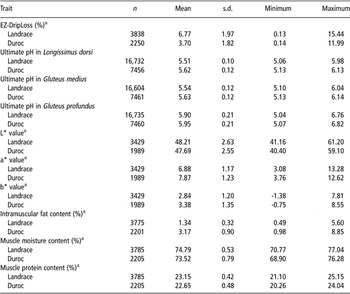
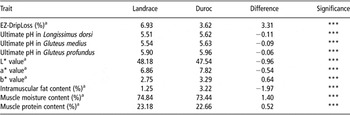
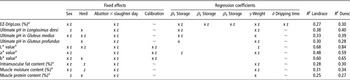
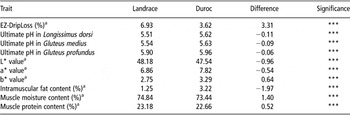
The basic statistics of the traits studied are presented in Table 1; least square means for the breeds are presented in Table 2. The models with their fixed effects are presented in Table 3. Landrace and Duroc were significantly different (P < 0.0001) for all meat quality traits. Landrace had considerably more drip loss than Duroc. For all three muscles included in this study, Landrace had lower pH than Duroc. Meat from Duroc appeared darker (lower L* values) with higher colour intensity (higher a* and b* values), compared to Landrace. Duroc had more IMF, and thus less moisture and protein, than Landrace.
Numbers of animals per trait, mean, s.d. of means, minimum and maximum for Landrace and Duroc

aMeasurement done in L. dorsi.
Least square means for effect of breed, Landrace and Duroc. Sub-models as described in Table 3
aMeasurement done in L. dorsi.
***P < 0.001.
Fixed effects, significance and R 2 of the models for each trait in Landrace and Duroc

aMeasurement done in L. dorsi.
x = significant effect (P < 0.05) for Landrace.
z = significant effect (P < 0.05) for Duroc.
∼ = not tested.
Empty cells = non-significant (P > 0.05).
Fixed effects
The fixed effects included in the models (sex, herd, abattoir × slaughter day, calibration, storage day, slaughter weight and dripping time) had various influences on the traits in this study, independent of breed (Table 3). The effect of abattoir × slaughter day (which includes the effects of test station) was significant for all meat quality traits.
Sex effects
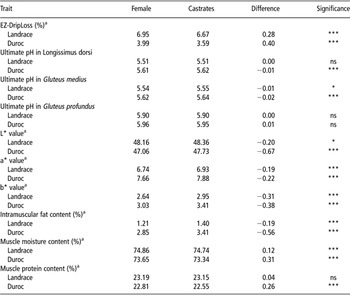
Least square means for the effect of sex on the traits in both breeds are presented in Table 4. For each trait, the contrast between sexes had the same sign for both breeds. However, the contrasts between sexes were more pronounced for Duroc than for Landrace. In general, females had more drip loss and tended to have lower pH than castrates. There was no difference between the sexes for pH in LD for Landrace, and for pH in GP for either of the breeds. The drip loss difference between the sexes may be related to the different levels of IMF and moisture content in the LD muscle, with females showing more moisture and less fat. Castrates showed higher L*, a* and b* values. These differences between sexes are interesting from a biological point of view, but they are small and both sexes can be treated equally during meat processing.
Least square means for effect of sex in Landrace and Duroc. Sub-models as described in Table 3

aMeasurement done in L. dorsi.
* = P < 0.05, *** = P < 0.01, ns = non-significant (P > 0.05).
Storage effects
Storage (the number of days of storage from slaughter to dissection) significantly increased pH in both breeds (Table 3). From day 2 to day 9, pH increased from 5.47 to 5.56 in Landrace and from 5.60 to 5.70 in Duroc. The increase in pH influenced muscle water holding capacity (WHC), and there was thus relatively less drip from the carcasses with longer storage time. Two to 9 days of storage from slaughter to dissection increased WHC by 2.0% in Landrace and 1.5% in Duroc (data not shown in tables).
Heritability estimates for meat quality
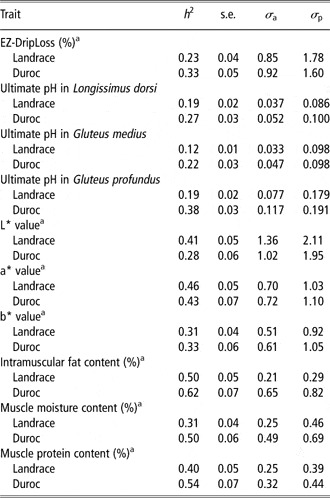
The meat quality evaluation methods used in this study produced moderate-to-high heritability estimates (Table 5). These tended to be higher in Duroc than in Landrace, except for L* and a* values measured on chops from the LD muscle. Correspondingly, Duroc also showed higher genetic variance for most traits (Table 5). The standard errors for the heritability estimates were relatively low due to the large volume of data in this study.
Heritabilities (h 2) with s.e., genetic and phenotypic s.d. (σ a, σ p) in Landrace and Duroc

Relationships among meat quality traits
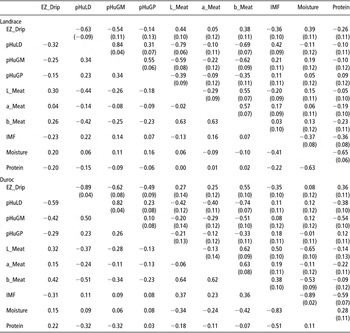
Genetic and phenotypic correlations between meat quality traits are shown in Table 6. Drip loss had negative genetic and phenotypic correlations with pH in LD, GM and GP. Genetic and phenotypic correlations among pH measured in the different muscles were all positive, with a wide range (from 0.10 to 0.84). The correlations for pH in the GM ham muscle were stronger towards the LD loin muscle (measured at a 30 cm distance) than towards the GP ham muscle (measured at a 5 cm distance), possibly due to the glycolytic nature of GM and LD and the oxidative nature of GP, with a higher pH level. In Landrace, the genetic correlation between pH in GM and GP was much higher than in Duroc.
Phenotypic correlations (below diagonal) and genetic correlations (above diagonal; s.e. between brackets) for meat quality traits in Landrace and Duroc

EZ_Drip = drip loss in L. dorsi, method EZ-DripLoss; pHuLD = ultimate pH in L. dorsi; pHuGM = ultimate pH in Gluteus medius; pHuGP = ultimate pH in Gluteus profundus; L_Meat = Minolta L* value in L. dorsi; a_Meat = Minolta a* value in L. dorsi; b_Meat = Minolta b* value in L. dorsi; IMF = intramuscular fat content (mg/g) in L. dorsi; moisture = muscle moisture content (mg/g) in L. dorsi; protein = muscle protein content (mg/g) in L. dorsi.
For meat colour in LD, both Landrace and Duroc had medium-to-high positive genetic and phenotypic correlations between L* and b* values, and between a* and b* values. At the same time there were small negative genetic correlations between L* and a* values, and the phenotypic correlations between L* and a* values were almost zero for the two breeds.
The spectroscopic analyses for percentages of fat, moisture and protein in LD showed negative genetic and phenotypic correlations between IMF and moisture, especially for Duroc. The phenotypic relationship between moisture and protein was different for the two breeds, with Landrace having strong negative genetic and phenotypic correlations, while the same correlations were slightly positive for Duroc. The two breeds were rather different with regard to the composition of fat, moisture and protein, with Duroc showing a much larger variation for these traits (both phenotypic and genetic) than Landrace (Tables 1 and 5).
Genetic and phenotypic correlations of pH measured in LD with the L* and b* values were moderate to high for both breeds, indicating that muscles with low pH also were paler and yellower. The correlation of pH with the a* value was small for Landrace and moderate for Duroc. The genetic and phenotypic correlations between the L* value and IMF were negative for Landrace and positive for Duroc. Genetic and phenotypic correlations between pH and IMF in LD were small-to-moderately positive for both breeds.
Discussion
Breed differences
The Norwegian Landrace and Duroc breeds were quite different with regard to meat quality traits. This may be explained by both the origin of the breeds and the selection they have been exposed to. During the past few decades, the Norwegian Landrace has mainly been selected for growth efficiency and sow fertility as a dam line, whereas the Norwegian Duroc has been selected for growth efficiency and meat quality as a sire line.
The small amount of IMF in Landrace has become a breed characteristic due to many generations of selection for lean meat. Still, small variation and a low level of IMF in Landrace give similar CV for both breeds and thus a scaling effect. Further, the low level of IMF in Landrace reduces the variation of moisture and protein in the muscle and results in more homogeneous meat. Duroc had a very good WHC with small drip loss. One of the advantages of the EZ-DripLoss method is increased variation and a high level of drip (Otto et al., Reference Otto, Roehe, Looft, Thoelking and Kalm2004), which increases measurement accuracy and produces a more symmetric frequency distribution of drip loss. In spite of a large difference in WHC between Landrace and Duroc in this study, the variation in drip loss was almost the same in the two breeds, leading to a larger CV for Duroc than for Landrace.
In our study, Duroc LD muscle was darker, had a more intense, red colour and contained more fat and less moisture than the Landrace muscle. This was also found by Cameron et al. (Reference Cameron, Warriss, Porter and Enser1990) studying the LD muscle in Duroc and British Landrace pigs. Young et al. (Reference Young, Bertram, Rosenvold, Lindahl and Oksbjerg2005) observed higher WHC and ultimate pH, lower colour determinants; a*, b* and L* values in LD muscle from Duroc, compared with Landrace, and Duroc had juicier meat than Landrace. This is in agreement with our observations of drip loss, pH and L* value, but opposite to our observations of a* and b* values. Berg et al. (Reference Berg, McFadin, Maddock, Goodwin, Baas and Keisler2003) studied several breeds and found higher WHC, IMF content and ultimate pH, and lower L* value in LD muscle for Duroc, compared to American Landrace. This is in agreement with our results.
Other fixed effects
The day of slaughter was an important fixed effect in the models for drip loss, the L* value and pH. These traits are affected by variation over time from last feeding to slaughter, and by animal treatment before slaughter, both influencing the glycogen content in the muscle. In addition, carcass handling and temperature management influence the temperature–pH interaction post mortem.
Sex effects
The larger difference in meat quality traits between the two sexes in Duroc, compared to Landrace, is supported by Jelenikova et al. (Reference Jelenikova, Pipek and Miyahara2008). They estimated the differences between Landrace and Duroc (among other breeds) and between females and castrates, for traits related to tenderness and IMF, and also observed a better eating quality (tenderness and juiciness) for females than for castrates. Contrary to most studies, they found that females had higher IMF content than castrates. In our study, castrates had higher IMF content than females; this was supported by Larzul et al. (Reference Larzul, Lefaucheur, Ecolan, Gogue, Talmant, Sellier, Leroy and Monin1997) and Bahelka et al. (Reference Bahelka, Hanusova, Peskovicova and Demo2007), who found significantly higher lean meat percentage and lower levels of IMF in females than in castrates. Latorre et al. (Reference Latorre, Lazaro, Gracia, Nieto and Mateos2003) found significantly higher IMF content, and less moisture and protein in castrates than in females. This was in agreement with our results.
Castrates had lighter meat with higher colour intensity than females. This finding was supported by Lloveras et al. (Reference Lloveras, Goenaga, Irurueta, Carduza, Grigioni, Garcia and Amendola2008), who reported higher L*, b* (significant) and a* (not significant) values in castrates than in females.
In our study, females had significantly higher drip loss than castrates. This was also found in some commercial crossbreeds with a significant effect of lower pH and a tendency to higher drip loss in females (Lloveras et al., Reference Lloveras, Goenaga, Irurueta, Carduza, Grigioni, Garcia and Amendola2008). It is generally accepted that the eating quality of pig meat (measured as tenderness, juiciness and flavour) is similar for castrates and females (Cisneros et al., Reference Cisneros, Ellis, Mckeith, Mccaw and Fernando1996; Ellis et al., Reference Ellis, Webb, Avery and Brown1996; Leach et al., Reference Leach, Ellis, Sutton, Mckeith and Wilson1996).
Storage effects
All muscles, independent of species, show an initial post-mortem reduction in pH from 7 to around 5.5 due to anaerobic metabolism producing lactate in the first hours after killing. The increase in pH that occurred from days 2 to 9 in our study influenced the muscle WHC, and we observed less drip loss from carcasses having a longer storage time. No significant effect of storage time was observed on muscle moisture content (Table 3), so that the effect of evaporation or drip from the LD muscle was most likely limited. The increase in pH was probably an effect of denaturation and enzymatic hydrolysis of the muscle proteins, giving an increased concentration of nitrogen compounds, which had a buffering effect on the pH. The effect of drip loss after storage was studied by van Moeseke and de Smet (Reference van Moeseke and de Smet1999), who found a reduction of drip loss after storage. However, these authors did not measure weight and moisture content of individual muscles, only weight loss from half carcasses and without considering pH. They concluded that the reduction of drip loss measured 5 days post mortem was an effect of carcass drip, whereas in our understanding reduction of drip loss was shown to be an effect of pH. In our study, there was also a reduction of carcass weight after storage, but the LD was not affected, probably because this muscle was left intact when splitting the carcasses.
Heritabilities
For the meat quality traits examined in this study, the estimated heritabilities are moderate to high, and with relatively small standard errors (Table 5). Our results are in agreement with heritability estimates for drip loss published by Hovenier et al. (Reference Hovenier, Kanis, Vanasseldonk and Westerink1992), who used a filter paper method, and also with those of de Vries et al. (Reference de Vries, van der Wal, Long, Eikelenboom and Merks1994) and Hermesch et al. (Reference Hermesch, Luxford and Graser2000a), who both used a bag method. Lower heritability estimates were found by Suzuki et al. (Reference Suzuki, Irie, Kadowaki, Shibata, Kumagai and Nishida2005), who used loin chops hanging from a wire in specimen cases, and by van Wijk et al. (Reference van Wijk, Arts, Matthews, Webster, Ducro and Knol2005), who used a method similar to the EZ-DripLoss method. All methods for the determination of drip loss are relatively sensitive to variations in operator and procedure. The amount of drip loss is affected by the direction of muscle fibres, contact between muscle and bag/case, handling of the meat and temperature variation. In our study, pincers were used to minimise meat handling. The special containers ensured equal direction of the muscle fibres and contact between muscle and container wall for all samples. A refrigerator, rather than a refrigeration room, was chosen to ensure a stable temperature. The connection of a digital scale to a computer reduced the risk of data errors via miskeying. These factors potentially increased the accuracy of the method, and thus contributed to the high heritability estimate for drip loss in our study.
For pH measurements in different muscles, the estimated heritabilities ranged from low to moderately high. Heritability estimates for ultimate pH in LD in the literature were also low (Hermesch et al., Reference Hermesch, Luxford and Graser2000a; Kadarmideen et al., Reference Kadarmideen, Schworer, Ilahi, Malek and Hofer2004; van Wijk et al., Reference van Wijk, Arts, Matthews, Webster, Ducro and Knol2005). These literature estimates were for Landrace and Large White and compare, as expected, better than our estimates for Landrace than for Duroc.
pH IS, in most cases, was used as an indirect selection trait for drip loss. The results from this study showed that direct selection for drip loss could be more efficient than indirect selection for pH. The genetic correlation between drip loss and pH limits the effect of indirect selection, and especially for Landrace this correlation was far <1. In this study, the estimated heritabilities for drip loss were higher than for pH (both measurements were taken at last rib in the LD), thus indicating a better accuracy for drip loss than for pH. Drip loss is relatively costly to measure. The bag method described by Honikel (Reference Honikel1987) is an accepted method for measuring drip loss, but it is time consuming and requires much care. According to Rasmussen and Andersson (Reference Rasmussen and Andersson1996) who developed the EZ-DripLoss method, it is easier to use in an abattoir setting in a reproducible way. This was supported by Otto et al. (Reference Otto, Roehe, Looft, Thoelking and Kalm2004), who confirmed that the method has high sensitivity and estimated a correlation of 0.86 between the two drip loss methods.
The estimated heritabilities for meat L* value in LD were moderately high for Landrace and somewhat lower for Duroc. The Duroc estimate was similar to the highest values reported in earlier studies (Hermesch et al., Reference Hermesch, Luxford and Graser2000a; Suzuki et al., Reference Suzuki, Irie, Kadowaki, Shibata, Kumagai and Nishida2005; van Wijk et al., Reference van Wijk, Arts, Matthews, Webster, Ducro and Knol2005), while the Landrace estimate was much higher. Common to the study reporting the highest heritability (Hermesch et al., Reference Hermesch, Luxford and Graser2000a) and our study was a fixed effect for all the animals tested at the same time, which had a large effect on the heritability estimate in our study (in spite of good routines for calibration). The estimated heritabilities for the a* and b* values in LD were moderately high, between the estimates of Sonesson et al. (Reference Sonesson, de Greef and Meuwissen1998) and van Wijk et al. (Reference van Wijk, Arts, Matthews, Webster, Ducro and Knol2005).
The heritabilities estimated for IMF were in good agreement with previously reported estimates published by Hovenier et al. (Reference Hovenier, Kanis, Vanasseldonk and Westerink1992), de Vries et al. (Reference de Vries, van der Wal, Long, Eikelenboom and Merks1994) and Suzuki et al. (Reference Suzuki, Irie, Kadowaki, Shibata, Kumagai and Nishida2005), who used chemical analyses, and Hermesch et al. (Reference Hermesch, Luxford and Graser2000a) and Kadarmideen et al. (Reference Kadarmideen, Schworer, Ilahi, Malek and Hofer2004), who used NIR for the IMF measurements, as in this study. In addition, heritabilities estimated for marbling were lower in two studies using marbling as a method for measuring IMF (Sonesson et al., Reference Sonesson, de Greef and Meuwissen1998; van Wijk et al., Reference van Wijk, Arts, Matthews, Webster, Ducro and Knol2005). In a preliminary analysis in this study, IMF predicted by NIR was found to have higher heritability estimates, compared with IMF predicted by chemical analysis. In a small data set of 365 Duroc pigs, the heritability for IMF from chemical analysis was estimated at 0.40 ± 0.11. For the same animals, and the same model, the heritability for IMF predicted by NIR was 0.61 ± 0.11. One advantage of NIR is that a larger volume of meat can be tested. With NIR, 180 g of meat were tested in 16 replications. For chemical analysis, only 5 g of meat were tested, and the sampling error could therefore be rather high. However, the SEP for our NIR analysis was not much higher than the SEPs for chemical analysis. The heritability estimates for IMF measured as a marbling score in the literature were lower than those based on chemical analysis or NIR, which might be due to reduced precision.
The estimated heritabilities for muscle moisture and protein content were moderately high, and higher than the heritabilities of moisture content reported by Cameron (Reference Cameron1990) and Lo et al. (Reference Lo, Mclaren, Mckeith, Fernando and Novakofski1992). No heritability estimates were found in the literature for muscle protein content. The different magnitude for heritabilities estimated for IMF, moisture and protein content for the two breeds in our study can partly be explained by a greater variation for these traits in Duroc than in Landrace (Table 1). Larger variation resulted in less effect of the SEP, and better estimates.
Genetic correlations among meat quality traits
The large difference between the breeds in the magnitude of the genetic correlation between pH in GM and GP may be due to a different composition of muscles fibres in Landrace and Duroc. If Landrace pigs have higher amounts of glycolytic muscle fibres in the oxidative GP muscle than Duroc, the genetic correlation to the glycolytic GM muscle would be higher in Landrace than in Duroc.
Negative genetic correlations between drip loss and pH were in agreement with drip loss measured with a filter paper method by Hovenier et al. (1992), a bag method by Sonesson et al. (Reference Sonesson, de Greef and Meuwissen1998) and a method similar to EZ-DripLoss method by van Wijk et al. (Reference van Wijk, Arts, Matthews, Webster, Ducro and Knol2005). The iso-electric point of meat occurs at a pH of about 5.4 to 5.6. After normal rigor mortis, meat has a pH of about 5.5, and thus the lowest WHC possible. In this study, pH in LD averaged 5.51 and 5.62 for Landrace and Duroc, respectively. Landrace was thus at a point where a pH change in both directions would lead to increased WHC, while in Duroc a lower pH is expected to decrease WHC and higher pH is expected to increase it. This may explain the higher correlation between pH and drip loss in Duroc than in Landrace. However, no significant effect of any pigs having low drip loss in combination with low pH was observed in these data. This was not expected, in view of the theory of pH and iso-electric point.
The genetic correlations among L*, a* and b* values in our study were similar for the two breeds, and had the same sign as correlations presented by van Wijk et al. (Reference van Wijk, Arts, Matthews, Webster, Ducro and Knol2005). The low negative correlations between L* and a* values showed that darker meat tended to be redder. The high genetic correlations between L* and b* values indicate that lighter meat was also yellower. For the meat industry, pale pig meat is not desirable, and there has been considerable focus on a reduction of PSE-meat incidence. Improving the quality of pork redness, which also affects the appearance of the meat, is a new challenge (Risvik, Reference Risvik1994). In this regard, the a* value is correlated to the content of pigment and myoglobin in the muscle. Pigments contain iron, and thus make meat nutritionally important to humans. Lindahl et al. (Reference Lindahl, Lundstrom and Tornberg2001) found that 90% of the variation in the a* value of LD and M. biceps femoris was explained by the content of pigment and the size of the fractions of myoglobin oxidised from blooming.
Reduction of IMF in pork leads to increased water content in the meat. The results from this study also indicate that pork with higher water content and a lower level of IMF tended to have more drip loss. A negative genetic correlation between IMF and water content in the meat was also reported by Cameron (Reference Cameron1990). The relationships between water content in the meat and drip loss were not found in the literature, but genetic correlations between IMF and drip loss were reported by Hovenier et al. (Reference Hovenier, Kanis, Vanasseldonk and Westerink1992), de Vries et al. (Reference de Vries, van der Wal, Long, Eikelenboom and Merks1994) and van Wijk et al. (Reference van Wijk, Arts, Matthews, Webster, Ducro and Knol2005). In our study, this genetic correlation between IMF and drip loss was a little stronger.
In Landrace, there was a negative genetic correlation between L* value and IMF, whereas this correlation was positive in Duroc. A negative genetic correlation between lightness and IMF was reported by Hovenier et al. (Reference Hovenier, Kanis, Vanasseldonk and Westerink1992), and positive genetic correlations were reported by Hermesch et al. (Reference Hermesch, Luxford and Graser2000b) and Suzuki et al. (Reference Suzuki, Irie, Kadowaki, Shibata, Kumagai and Nishida2005). Suzuki et al. (Reference Suzuki, Irie, Kadowaki, Shibata, Kumagai and Nishida2005) studied a Duroc population with a high level of IMF (4.25%), and found that meat with higher IMF was lighter in colour. Muscles with high levels of IMF are usually more oxidative than muscles with low levels, since oxidative muscles use more fat in metabolism (Essén-Gustavsson and Fjelkner-Modig, Reference Essén-Gustavsson and Fjelkner-Modig1985). Essén-Gustavsson et al. (Reference Essén-Gustavsson, Karlsson, Lundstrom and Enfalt1994) showed that lipids are stored mainly in type I fibres and in some type IIA fibres. Oxidative muscle has more mitochondria and a higher myoglobin content, and a higher pH post mortem. All these factors give oxidative muscles a darker colour than glycolytic muscles. The positive genetic correlation between L* value and IMF for Duroc in this study most likely comes from visible fat cells detected when colour was measured, and not from the meat colour. There was almost no marbling in Landrace, and darker meat (lower L* value) also had more IMF in this breed.
Both breeds showed low-to-moderately positive genetic correlations between pH and IMF in LD. Correlations of the same magnitude were estimated by Cameron (Reference Cameron1990) and Sonesson et al. (Reference Sonesson, de Greef and Meuwissen1998). An explanation for this positive relationship may be that oxidative muscles with more IMF have higher pH post mortem because their metabolism is more based on fat and less on glycogen, as fat metabolism does not produce lactic acid post mortem.
In most meat quality studies, only a small part of the muscle can be used for analysis due to high measurement costs. Many studies took their measurements in the LD at the position of the last rib, but this position seems to be linked to better meat quality and is not necessarily representative of the quality at other positions of that same muscle. Lundstrom and Malmfors (Reference Lundstrom and Malmfors1985) studied the whole LD muscle and found the most stable and best meat quality with minimum drip loss near the last rib, and higher light scattering in the anterior and posterior parts of LD. In our study, a difference from the dorsal to the ventral part was observed. The ventral part of the muscle had a lighter colour, higher L* value, and a larger drip loss, compared to the dorsal part. This contrast was visible even to the human eye under normal indoor lighting. The difference in L* value was about 2.5 units, and the difference in drip loss was approximately 0.7%. The effect was similar for Landrace and Duroc (data not shown in tables). This physiological relationship has been found earlier, both in pigs (Christensen, Reference Christensen2003; Otto et al., Reference Otto, Roehe, Looft, Thoelking and Kalm2004) and in cattle (Hoset, Reference Hoset2008).
Conclusions
These results show that it is possible to obtain high heritabilities for meat quality traits measured by rapid, low labour-intensive methods. All the methods are safe, user-friendly and robust with regard to operator effects. It is equally important that the methods are environmentally friendly and do not require chemical solvents.
Our results enabled Norsvin to include new meat quality traits in their breeding goal and to reduce the costs of measuring meat quality traits. Among the meat quality traits studied, IMF and drip loss might be the most important traits for selection. The methods chosen for these traits were suitable for rapid measurement, which make it possible to test large numbers of animals each year. The estimated heritability for IMF analysed with NIR was higher than the heritability for chemically analysed IMF. In addition, NIR analysis gave estimates for water and protein content in meat, which can be important for future work. For drip loss, the EZ-DripLoss method gave heritabilities of moderate magnitude, and correlations to pH suggest that selection for drip loss may add valuable information to the breeding programme. The L* value was highly related to pH and drip loss; however, the L* value was affected by the content of IMF, thus making this trait unsuitable for selection programmes. The a* value was less correlated with other traits, and added new and valuable information. As the a* value had a high heritability and additive variance, and only a few unfavourable correlations to other traits, a large response is expected from breeding for this trait.
Meat quality traits are important for the pig meat industry. It is still desirable to increase carcass leanness, but a sustainable breeding programme should also more rapidly improve meat quality traits for breeders, for the industry and for consumers.
Acknowledgements
The project was funded by the Foundation for Research Levy on Agricultural Products, the Research Council of Norway and Norsvin (Norwegian Pig Breeders Association). Animalia (the Norwegian Meat and Poultry Research Centre) and its pilot-scale abattoir are gratefully acknowledged for their goodwill and help with introduction of novel meat quality equipment and recordings. Thanks also to Dr Terje Frøystein, Animalia for valuable suggestions in meat science and Dr Birgit Zumbach, Norsvin for help with the manuscript.