Summations
-
∙ The present study suggests that gambling disorder sufferers with depression benefit from CBT treatment, however, screening for depression may not be a fully accurate assessment of comorbid depressive symptoms.
-
∙ Evidence suggests that gambling disorder sufferers with depression do not differ in gambling related severity level from gambling disorder sufferers without comorbidity.
-
∙ Gambling disorder sufferers with depression improve to the same symptom level as gambling disorder sufferers without depression after treatment, which supports the notion of an integrated treatment approach of gambling disorder and depression.
Limitations
-
∙ The study only included treatment completers in order to have both pre- and post-measures of depressive symptoms and gambling symptoms.
-
∙ Data used in the study indicate a full range of MDI severity of depression, i.e., mild, moderate and severe, the outpatient setting was only geared toward mild to moderate forms of depression.
-
∙ Clinicians in the study monitored the patient’s medication status and were not able to include systematic records of, or control for, medications in the research.
Introduction
Comorbidity is common in gambling disorder (Reference Chamberlain, Derbyshire, Leppink and Grant1,Reference Dannon, Lowengrub, Aizer and Kotler2) ranging from ~30% to 70%. Affective disorders such as depression (Reference Becona, Del Carmen Lorenzo and Fuentes3,Reference Grant and Kim4) and alcohol and substance use disorders (Reference Smart and Ferris5,Reference Crockford and el-Guebaly6) are the most frequent forms of comorbidity.
Gambling disorder patients in treatment generally show significant reductions in depressive symptoms (Reference Linardatou, Parios, Varvogli, Chrousos and Darviri7,Reference Moghaddam, Campos, Myo, Reid and Fong8). A meta-analysis by Linnet (Reference Linnet9) identified three randomised-controlled trials (RCT) of psychological treatment of gambling disorder, which both looked at gambling symptoms and symptoms of depression. The three studies investigated the treatment effect of cognitive behavioural therapy (CBT), compared with a waitlist control (Reference Marceaux and Melville10–Reference Grant, Donahue, Odlaug, Kim, Miller and Petry12). A data analysis of 121 patients in the three RCT studies, showed that the standardised mean difference (SMD) of gambling symptoms between the treatment and control condition was 1.34 [95% CI (2.73; 0.04)], Z=1.90, p=0.06. These results suggest that CBT had small beneficial effects on gambling symptoms compared with a control condition. The SMD of depressive symptoms was 0.61 [95% CI (1.07; 0.15)], Z=2.59, p=0.0009, which suggests that CBT had moderate beneficial effects on depressive symptoms compared with a control condition. Together, the results suggest that CBT treatment of gambling disorder is beneficial on both gambling symptoms and depressive symptoms.
Gambling disorder treatment is also associated with reduction of gambling symptoms and depressive symptoms in telebased psychotherapy. Carlbring and Smit (Reference Carlbring and Smit13) investigated the treatment effect of telebased CBT of gambling disorder treatment, compared with a waitlist control. A data analysis of 32 patients showed that the SMD of gambling symptoms between the treatment and control condition was 3.87 [95% CI (5.24; 2.50)], Z=5.54, p<0.00001. These results suggest that CBT had moderate beneficial effects on gambling symptoms compared with a control condition. The SMD of depressive symptoms was 2.13 [95% CI (3.62; 0.64)], Z=2.80, p=0.005, which suggests that CBT had small beneficial effects on depressive symptoms compared with a control condition. While the evidence from telebased CBT treatment of gambling disorder is uncertain, due to the limited numbers of studies, the results are consistent with the findings of CBT treatment of gambling disorder.
However, it is currently unknown whether or not reduction of depressive symptoms is also related to gambling disorder patients with a diagnosis of depression, which may pose several challenges. First, we do not know if screening for depression is an accurate measure of comorbid depression. Clinical assessment of comorbidity is needed, in addition to screening for comorbidity in order to answer this question. Second, we do not know if reductions in depressive symptoms occurs similarly among patients with comorbid depression, and those without depression. For instance, we do not know if reductions in depressive symptoms occur mostly among patients who do not suffer from depression. This information is important in order to provide optimal treatment gambling disorder patients with comorbidity.
The purpose of the present study was to investigate the treatment effect of gambling symptoms and depressive symptoms in gambling disorder patients with a comorbid diagnosis of depression compared with gambling disorder patients without comorbidity. We hypothesised that gambling disorder sufferers with comorbid depression would show significantly larger reductions in depressive symptoms after treatment compared with gambling disorder sufferers without comorbidity. Furthermore, we hypothesised that gambling disorder sufferers with comorbid depression would no longer meet criteria for depression after treatment, that is, they would be in remission.
Methods and materials
Patients
The cohort consisted of 61 patients suffering from gambling disorder, who received treatment at the Research Clinic on Gambling Disorders and Mindwork Psychological Center. Patients were selected from the Database for Online Clinical Studies, which is a quality assessment database developed by the Research Clinic on gambling disorders under Aarhus University Hospital and the Central Denmark Region. All patients gave informed consent to the use of their data for research purposes.
Patients were assessed using the Structured Clinical Interview for the DSM-IV (SCID-I), the South Oaks Gambling Screen (SOGS) and the Major Depression inventory (MDI). Patients were included if they were between 18 and 75 years of age, had a diagnosis of gambling disorder, and completed the SCID-I and pre- and post-measures of the SOGS and MDI. Patients were excluded if they did not have sufficient reading, writing and oral language proficiency, or suffered from severe comorbidity such as psychotic disorders, current substance abuse or dependence, or post-traumatic stress disorder. Patients with comorbid depression and other types of comorbidity (e.g. anxiety disorder) were included. However, patients were excluded if they suffered from current comorbidity other than depression. Finally, patients without current comorbidity, who had past comorbidity, were excluded.
A total of 136 patients met inclusion and exclusion criteria, and 61 (45%) of those completed pre- and post-test measures of the SOGS and the MDI. A total of 22 (56%) gambling disorder sufferers with comorbidity and 53 (55%) gambling disorder sufferers without comorbidity did not complete pre- and post-test measures, while 17 (44%) gambling disorder sufferers with comorbidity and 44 (45%) gambling disorder sufferers without comorbidity completed pre- and post-test measures. These attrition rates are comparable with other studies of gambling disorder (Reference Ladouceur, Lachance and Fournier14–Reference Sylvain, Ladouceur and Boisvert16) (Ladouceur et al., 2001). An intent-to-treatment analysis would reduce the effect sizes of the study, and the selection of participants therefore reduces the generalisability of the study to treatment completing gambling disorder sufferers.
Measures
The Structured Clinical Interview for DSM-IV (SCID-I)
SCID-I (Reference First, Spitzer, Gibbon and Williams17) is a clinical interview assessing for axis I psychopathology, and also included a special module assessing pathological gambling (Reference Grant, Steinberg, Kim, Rounsaville and Potenza18). Patients were assessed on affective disorders, psychotic disorders, substance use disorders, anxiety disorders, somatoform disorders, eating disorders and gambling disorder.
SOGS
SOGS (Reference Lesieur and Blume19,Reference Lesieur and Blume20) is a widely used 20-item self-report rating scale that assesses lifetime and past year gambling-related difficulties. A score of five or more suggests a diagnosis of pathological gambling. In the present study, we used a twelve month pre test and a three month post test version to accommodate the period of treatment. The SOGS shows good reliability and validity with the diagnosis of pathological gambling (Reference Stinchfield21).
MDI
MDI (Reference Bech, Rasmussen, Olsen, Noerholm and Abildgaard22) is a 10-item self-report rating scale that assesses present symptoms of depression. A score between 20 and 24 indicates mild depression, while a score between 25 and 29 indicates moderate depression, and a score of 30 or above indicates severe depression; a score below 20 indicates no depression. The MDI shows good reliability and validity with the Hamilton Depression Scale (Reference Olsen, Jensen, Noerholm, Martiny and Bech23).
Craving, control, treatment sessions and absence
These scales are part of the CBT protocol use in the present study (Reference Ladouceur, Lachance and Fournier14,Reference Ladouceur, Sylvain, Boutin, Lachance, Doucet and Leblond24,Reference Ladouceur, Sylvain, Boutin, Lachance, Doucet, Leblond and Jacques25). Patients rated their current level of gambling craving and gambling control on a rating scale from 0 to 100, where 0 indicated the lowest level and 100 indicated the highest level. We note that the psychometric properties of these scales have not been validated. In the cohort (n=67) one person had a missing score on craving and two persons had missing scores on control. The total number of treatment sessions and absence (cancellations and no-shows) were recorded.
Treatment
Treatment programme
Patients completed an evidence-based treatment programme, which integrated clinical assessment of comorbidity and CBT. The CBT method is based on Robert Ladouceur’s treatment model (Reference Ladouceur, Sylvain, Boutin, Lachance, Doucet, Leblond and Jacques25–Reference Ladouceur and Lachance27), while the clinical assessment served as a basis for the integrated treatment approach for comorbidity. The therapists were all clinical psychologists who were trained in using the SCID-I, SOGS and MDI, and trained in using the CBT treatment manual.
Statistics
We use χ2 test to determine gender differences between patients with comorbidity and patients without comorbidity. Second, we used binomial regression analysis to determine the classification accuracy between diagnostic assessment of gambling symptoms and depression with SOGS and MDI screening measures. Third, we used one-way analysis of variance (ANOVA) to determine group differences on age, treatment sessions, SOGS, MDI, craving and control, as well as pre- and post-measures of SOGS, MDI, craving and control. Finally, we used two-way ANOVA to determine the effect of SOGS, MDI, craving and control, where group (comorbidity vs. no comorbidity) was the dependent variable, and time (pre vs. post) and measures (SOGS, MDI, craving and control) were the independent measures.
Results
Demographic variables
A χ2 analysis revealed no gender differences between gambling disorder sufferers with depression and those without, χ2=0.43, ns. There were eight women out of 61 gambling disorder sufferers (three with depression). Furthermore one-way ANOVA showed no age differences between gambling disorder sufferers with depression and those without, F(1,60)=2.87, ns. On average gambling disorder sufferers with depression were 35.6 years old at the time of treatment (SD=9.4), while gambling disorder sufferers without depression were 31.5 years old (SD=8.1).
Treatment sessions and compliance
A one-way ANOVA showed no significant differences between gambling disorder sufferers with depression and those without with regard to number of treatment sessions, F(1,60)=1.94, ns, and number of absent sessions, F(1,60)=0.28, ns. On average gambling disorder sufferers with depression completed 8.6 sessions (SD=4.05), while gambling disorder sufferers without depression completed 7.3 sessions (SD=3.07). Gambling disorder sufferers with depression were absent (i.e., cancellations or no-shows) an average of 1.6 sessions (SD=1.91) over the course of treatment, while gambling disorder sufferers without depression were absent an average of 1.3 sessions (SD=1.73).
Treatment outcomes
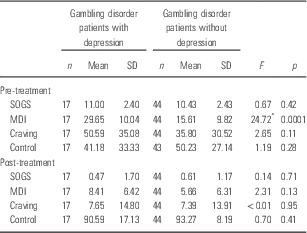
One-way ANOVAs showed highly significant differences on depressive symptoms (MDI) before treatment between gambling disorder sufferers with depression and those without, F(1,60)=4.97, p<0.000001. There were no significant difference before treatment on SOGS, craving or gambling control. Furthermore, there were no significant difference between the two groups after treatment on MDI, SOGS, craving and gambling control (see Table 1).
Patients with comorbid depression and patients without comorbidity

MDI, Major Depression Inventory; SOGS, South Oaks Gambling Screen.
*p<0.0001.
Two-way ANOVAs showed highly significant treatment outcomes associated with reductions in SOGS, F(1,60)=84.79, p<0.0001, MDI, F(1,60)=38.13, p<0.0001, and craving, F(1,60)=29.59, p<0.0001, and highly significant increases in gambling control, 47.65, p<0.0001. These findings suggest that both gambling disorder sufferers with depression and those without depression significantly reduced their symptoms after treatment.
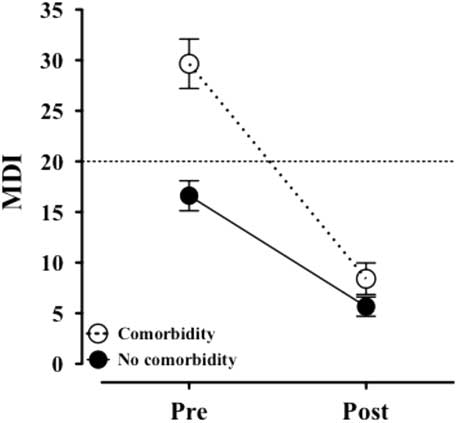
Furthermore, there was a highly significant outcome associated with comorbidity in MDI, F(1,60)=9.17, p<0.0001, where gambling disorder sufferers with depression showed significantly larger reductions in depressive symptoms than did gambling disorder sufferers without depression. Finally, there was a significant interaction effect between treatment outcome and comorbidity, F(1,60)=3.90, p<0.005, suggesting that both treatment and comorbidity contributed to reductions in depressive symptoms. A power analysis showed that the observed power of the interaction between depressive symptoms and comorbidity was 0.96. The treatment outcomes of the MDI are illustrated in Fig. 1.
Gambling disorder patients with comorbidity (empty circles) show indication of depression (above the dotted vertical line), and have significantly higher MDI scores at intake (Pre) than gambling disorder patients without comorbidity (filled circles). Neither group show indication of depression after treatment (Post). Circles and error bars represent means and standard error of mean, respectively.

There were no significant outcomes of comorbidity associated with SOGS, cravings or gambling control, suggesting that gambling disorder sufferers with depression did not differ from gambling disorder sufferers without depression on these outcome measures.
Remission
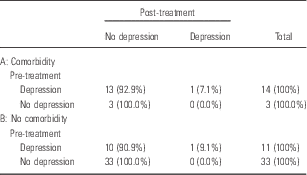
Table 2 shows remissions rates of depression between pre-treatment and post-treatment measures of MDI. Table 2A shows that among the 14 gambling disorder sufferers with depression that MDI accurately classified before treatment, 13 were in remission after treatment, and only one individual still showed indication of depression. Among the three gambling disorder sufferers with depression that MDI misclassified before treatment, none showed an indication of depression after treatment.
Remission Major Depression Inventory

Table 2B shows that among the 33 gambling disorder sufferers without depression that MDI accurately classified before treatment, none showed an indication of depression after treatment. Among the 11 gambling disorder sufferers without depression that MDI misclassified before treatment only one individual was still misclassified after treatment.
Discussion
In this study we found that gambling disorder sufferers with comorbid depression had significantly more symptoms of depression than gambling disorder sufferers with comorbidity, and that they had significantly larger reductions in depressive symptoms following treatment, resulting in similar rates of remission between the two groups. The results suggest that gambling disorder sufferers with depression benefit from CBT treatment. However, screening for depression may not be a fully accurate assessment of comorbid depression, and clinical assessment is therefore recommended.
The classification accuracy between SOGS and the clinical assessment was 98.4%, which is very high compared with validation studies of SOGS and DSM-IV criteria (Reference Stinchfield, McCready and Turner28). There may be several reasons for this. First, the clinical assessments were carried out by skilled clinicians who thoroughly interviewed patients in a face-to-face setting, compared with a telephone survey (Reference Stinchfield, McCready and Turner28). Second, the present population represents treatment seeking gambling disorder suffers, and it is possible that people who are treatment seekers are more aware of their symptom and better able to recognise their symptoms than gambling disorder sufferers who are not treatment seeker. Together, treatment seeking gambling disorder sufferers may represent a more clearly defined population than the entire population of treatment seeking and non-treatment seeking gambling disorder sufferer.
The classification accuracy between MDI and the clinical assessment was 77.0%, which is moderate. A rule of thumb is that classification accuracy of 0.8 (80%) is acceptable. Most of the misclassifications were associated with false positive, that is, MDI indicating a depressive disorder, without the disorder being present. But some of the misclassification (17.6%) was due to false negatives, that is, MDI failing to depression in gambling disorder sufferers. Such individuals may have an increased risk of attrition or treatment failure if their depression is not properly detected or treated. For this reason it may be important not to rely on screening measures of comorbidity, but ensure proper assessment of patients by trained clinicians.
Both treatment and comorbidity were associated with reduction of depressive symptoms in gambling disorder sufferers. There may be several reasons for this. First, gambling disorder sufferers with depression had significantly higher MDI scores than gambling disorder sufferers without depression. As gambling disorder sufferers with depression had a starting point with higher MDI scores, it could be argued that they had the possibility of larger improvements. However, we did not detect a floor effect in our data (i.e., patients indicating the lowest score after treatment). Furthermore, if it were the case that patients did not improve, we would have expected to see significant differences in depression after treatment, which was not the case. Instead, our data suggest that gambling disorder sufferers with depression improved to the same symptom level as gambling disorder sufferers without depression, which supports the notion of an integrated treatment approach of gambling disorder and depression.
The two-way ANOVAs suggested that significant outcomes of comorbid were only associate symptom level on the MDI, and not on the SOGS, craving or gambling control. This may suggest that gambling disorder sufferers with depression do not differ in gambling-related severity level from gambling disorder sufferers without comorbidity. This could support the notion of an integrated treatment approach, as the severity level of gambling symptoms does not appear to be exacerbated or excessively complicated in gambling disorder sufferers with depression. However, it may require clinicians to have the necessary skill set to both detect and treat depression and gambling disorder.
The present study is limited in several ways. First, it only included treatment completers in order to have both pre- and post-measures of depressive symptoms and gambling symptoms. The present study design was not geared towards an intent-to-treatment analysis, nor was it geared towards a randomised-controlled study design. Therefore, it is possible that these data present the best-case scenarios of treating gambling disorder sufferers with comorbid depression. Second, although our data indicate a full range of MDI severity of depression, that is, mild, moderate and severe, the outpatient setting is only geared towards mild to moderate forms of depression. Therefore, it is unlikely that gambling disorder patients with severe depression would have been included in the study, which represents a limitation of the study. Gambling disorder patients with severe depression would, in all likelihood, have been referred to other psychiatric treatment. Third, we were not able to control for medication in this study. Although patients’ medication status was monitored by clinicians, we were not able to include systematic records of medications in the present study.
To our knowledge this is the first study, which compares clinical assessment of comorbid depression in gambling disorder with screening of gambling symptoms and symptoms of depression. Studying comorbidity in gambling disorder is important, as 30–70% of gambling disorder patients suffer from comorbidity, and models are needed, which can address integrated treatment of gambling disorder and comorbidity. Our findings suggest that integrated treatment of gambling disorder and comorbidity by trained clinicians has a beneficial effect among treatment completers. However, in order to sufficiently treat comorbidity, it must be accurately detected. While screening of gambling symptoms appear to be sufficiently accurate for detecting gambling disorder, screening of depression may not be a fully accurate assessment of comorbid depression. Therefore, it is recommended to use standardised clinical assessment of comorbidity in gambling disorder treatment.
Acknowledgements
The research was supported by funding from the Ministry of Health grant number 1001326, 121023, 1301936, 1401063 and 1601074; by the Danish Agency for Science, Technology and Innovation grant number 10-088273 and 12-130953; by a research grant from bwin.party services; and by a research designated donation from Better Collective A/S.