

The “historiographic turn” in theatre and performance studies has produced many important edited collections over the past decade. Though varying in content and organizing principle, these volumes have collectively sought to bridge historic divisions between the two disciplines by foregrounding scholarship that embraces both. For example, two 2010 publications, Theater Historiography: Critical Interventions, edited by Henry Bial and Scott Magelssen, and Representing the Past: Essays in Performance Historiography, edited by Charlotte M. Canning and Thomas Postlewait, showcased the influence of critical theory and performance studies perspectives on the methods, theories, and practices of writing history. In the intervening years, Rosemarie K. Bank and Michal Kobialka’s 2015 Theatre/Performance Historiography focused on the ethics of historical analysis united by an emphasis on time, space, and matter; while collections such as Heather Davis-Fisch’s 2017 Canadian Performance Histories and Historiographies examined historiographic developments within national frameworks.
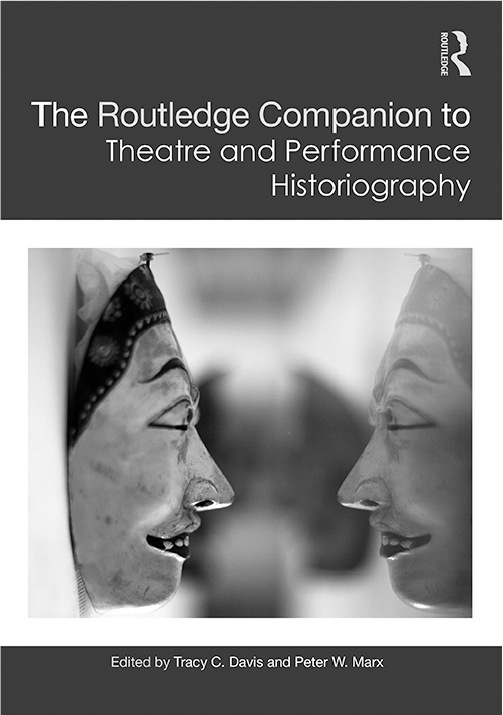
The Routledge Companion to Theatre and Performance Historiography pushes boldly past theatre vs. performance studies debates by declaring instead that “theatre history is performance history” (5). Edited by Tracy C. Davis and Peter W. Marx, with additional support from collaborating editors Leo Cabranes-Grant, Pavel Drábek, Robert Henke, Odai Johnson, Heike Roms, Liz Son, and Margaret Werry, this dynamic collection of 23 chapters proposes “to offer a compelling alternative” (3) to inscribing the “separateness” of theatre studies and performance studies. Determined to “change the perspective and capacity of the [handbook] genre” (xix), the editors proposed an “unconventional editorial process” with an initial gathering of the editorial team to establish key principles, followed by three “chamber conferences” held between 2017 and 2018 (xix), during which contributing authors shared their works in progress. These sessions affirmed the editors’ decision to eschew a singular disciplinary focus and instead embrace a “polyphonic approach,” bringing theatre and performance history into conversation with cognate disciplines and fields, ranging from classics and political theory to digital humanities and Indigenous studies. Indeed, one of this volume’s greatest contributions is the cultural, historical, and geographic diversity of the subject matter covered and the breadth of critical viewpoints presented across five sections: “Theatre History Is Performance History,” “Materiality and the Sensorium,” “Locating,” “Historicising,” and “Scaling.”
Each chapter is built around a case study or series of case studies that allow the author to take up a significant historiographic challenge or introduce a new theoretical or methodological approach. Topics range from 17th-century doll houses (Natasha Korda), 18th-century paintings in colonial Mexico (Leo Cabranes-Grant), 20th-century German radio dramas (Michael Bachmann), commemorative performance in present-day South Korea (Elizabeth W. Son), and Andean patron-saint fiestas (Enzo E. Vasquez Toral) to Indigenous critiques of performance studies (Stephanie Nohelani Teves, Margaret Werry), video recordings of Beijing opera (Siyuan Liu), critical reflections on theatre’s role in the modernization of Tunisia (Vicki Ann Cremona and Mahmoud Mejri), new models for identifying “the early modern performative culture of racialisation” (230) (Noémie Ndiaye), and analysis of translation as a “neglected but omnipresent challenge” for theatre and performance historians (Jean Graham-Jones). It is a testament to the breadth and depth of this impressive collection that I cannot reference all of the chapters here.
Davis and Marx set the stage with an ambitious introduction, wherein they propose that “theatre/performance history” (5) might usefully be understood within the broader historiographic framework of “Critical Media History.” Such a framework, they argue, “arises from the recognition of complex interrelations and interdependencies” (3) between theatre and performance but cannot be defined by either. Rather, in its emphasis on “processes of formatting or trans-formatting the experience of performance and forms of media” (3), critical media history enables a rigorous examination of theatre and performance within and among wider media ecologies, thereby expanding “the scope (and claims) of theatre/performance history” (5) and directing closer attention to the interplay between theatre and performance. I am intrigued by the promise of critical media history but uncertain about how or whether it departs from existing work within media studies or the history of media more broadly. The editors acknowledge the complicated, thorny histories of theatre studies and performance studies but do not afford the same consideration to media studies and communication studies, nor do they consider the messiness of the term “media” itself as it is used by scholars in film and cinema studies, cultural studies, television and new media studies, and related disciplines. If theatre and performance historians are to embrace critical media history, they must take these other histories and historiographies into account lest they find themselves in yet another terminological quagmire. More to the point, how is critical media history to be applied to theatre and performance studies scholarship? Given the editors’ opening, I expected the volume’s contributors to take up this question explicitly. Yet the phrase “critical media history” does not appear outside the introduction, nor is the idea of a critical media history reflected in the five section titles. In fact, the term “media” appears in only a handful of chapters. This apparent disconnect between the editors and the contributors does not diminish the exciting potential of situating theatre and performance historiography within a broader critical media history framework, but it does point to a missed opportunity for developing a more consistent through line across the five sections.
These critiques aside, the volume showcases some truly exemplary scholarship that points the way forward for 21st century theatre and performance historians, especially those invested in addressing the legacies of heteropatriarchal settler colonialism and the enduring crush of white supremacy. This collection is also a valuable historical document in itself — a record of our field before the COVID-19 pandemic ravaged so many lives. What will future collections record? Where will theatre and performance historiography go next?


