Introduction
An unprecedented number of public health events (PHEs), such as tornados, epidemic outbreaks, and acts of terrorism, are occurring around the world. Over the past 30 years, there has been a fourfold increase in the number of reported PHEs.Reference Guha-Sapir, Hargitt and Hoyois 1 , Reference Gutierrez 2 After analyzing data from the American Red Cross (Washington, DC USA), the United Nations, and Louvain University in Belgium, the British charity Oxfam (Oxford, United Kingdom) observed the planet is experiencing approximately 500 natural disasters annually, compared with 120 reported each year in the early 1980s.Reference Gutierrez 2
Evidence indicates that global climate change appears to contribute to the increase in the number and severity of natural disasters.Reference Miller 3 Additionally, changing political climates, along with shifts in populations, are expected to increase the number of people who are vulnerable to PHEs.Reference Guha-Sapir, Hargitt and Hoyois 1
Following the terrorist attacks on September 11, 2001, the United States government invested considerably in programs to expand and improve key PHE response systems. Despite improvements in public health systems and preparedness, challenges remain, including improvements in the capacity and capability of the health care system to absorb a large-scale surge of persons injured or in poor health resulting from a PHE. 4 Given the current fiscal pressures and staffing issues, finding and coordinating the health care resources needed to provide appropriate physical, psychological, and ethical care during a PHE is difficult.
Health care personnel (HCP) are an important link in the emergency response chain and are on the front line when a PHE occurs. Yet, researchers worldwide have reported that just 25%-80% of HCP intend to respond during a PHE; some HCP even consider job exit or early retirement rather than responding to a PHE.Reference Chaffee 5 - Reference Wong, Koh and Cheong 9 Of those who reported a willingness to respond, 15%-20% indicated they were not willing to work any additional shifts.Reference Gershon, Magda and Qureshi 6 , Reference Qureshi, Gershon and Sherman 10
Sufficient staffing of health care facilities during PHEs is necessary to support the health care needs of the community. Staffing challenges are just one of the burdens encountered by health care systems, as PHEs have the potential to transform a resource-rich health care environment to one of austerity, fraught with practical and ethical dilemmas beyond just integrating principles of public health and safety with triage, patient surge, and the allocation of scarce resources.
An understanding of the contributing factors associated with the willingness of HCP to work during a PHE could be used to inform emergency response planners, staffing coordinators, health educators, and hospital administrators about the factors associated with the intentions of HCP to respond to PHEs.
Methods
Definition of Terms
Health Care Personnel refers to all paid and unpaid persons (eg, physicians, nurses, pharmacists, dentists, veterinarians, and support staff) working in settings where health care is provided (eg, hospitals, skilled nursing facilities, physicians’ offices, outpatient clinics, homes, and schools) who have the potential for exposure to injured or ill persons during a PHE. 11
A Public Health Event is an uncommon event having the potential to overwhelm community health infrastructure. A PHE includes, however is not limited to, occurrences of severe weather, natural disaster, epidemics or pandemics, and/or terrorist activities that affect the health of a community. 12 , 13 If assistance from other outside agencies is necessary to support the community, a public health emergency is declared.
Search Strategy
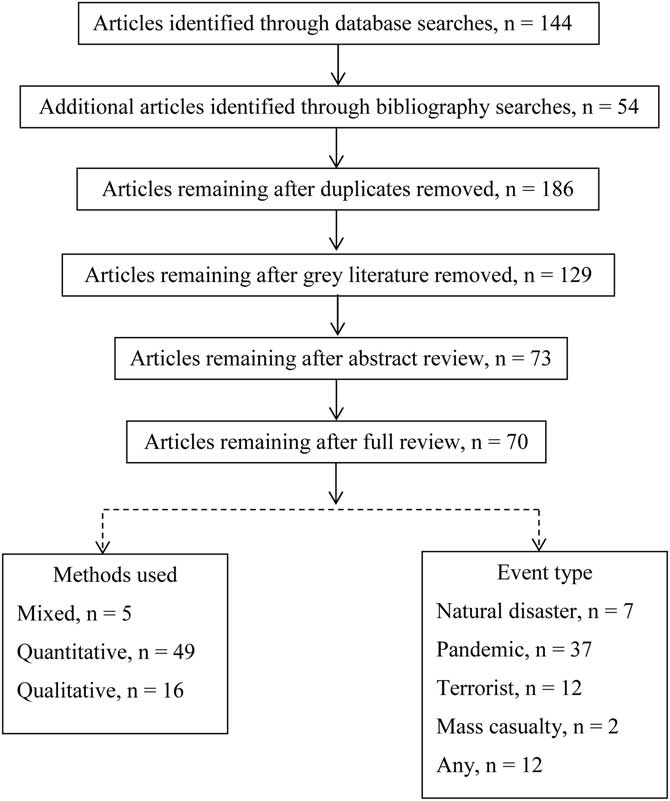
A literature search was conducted in the Cumulative Index to Nursing and Allied Health Literature (CINAHL, EBSCO Information Services, Ipswich, Massachusetts USA), PubMED/MEDLINE (National Center for Biotechnology Information, Bethesda, Maryland USA), PsychINFO (American Psychological Association, Washington, DC USA), and Social Sciences Citation Index (SSCI, Thomson Reuters, New York, New York USA) for the search terms: health care worker/provider/professional AND disaster/emergency/pandemic response AND will*/intent*/obligation. The search was limited to articles published in English from January 1, 1975 through June 30, 2011. References of each article selected for inclusion were reviewed for additional publications. Gray literature (eg, dissertations and theses), commentaries, letters, opinions, and abstracts presented at meetings were not included in this review (Figure 1).
Article Extraction Process

Results
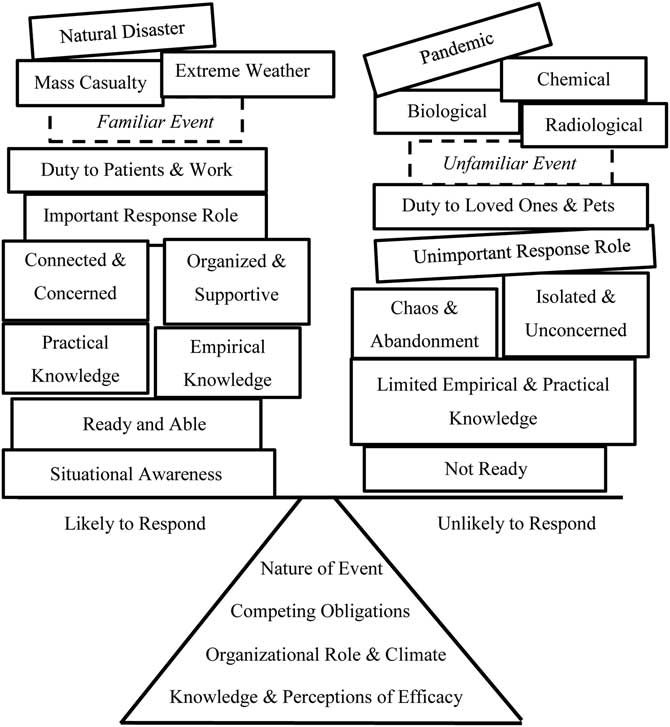
A total of 70 studies met all inclusion criteria. Investigators used mixed methods in five studies, quantitative methods in 49 studies, and qualitative methods in 16 studies. The seminal study by Shapira et alReference Shapira, Marganitt, Roziner, Shochet, Bar and Shemer 7 did not seem to generate much interest until 2002 when the numbers of patient care concerns increased because of HCP reluctance to work during PHEs.Reference French, Sole and Byers 14 , Reference Lanzilotti, Galanis, Leoni and Craig 15 Current evidence suggests that four primary factors either facilitate or hinder HCP's intention to respond to a PHE: (1) the nature of the PHE; (2) competing obligations; (3) organizational role and climate; and (4) the relationships between knowledge and perceptions of efficacy (Figure 2).
Balancing the Factors That Either Facilitate or Hinder the Intention to Respond

Nature of the PHE
PHEs are events that can occur quickly, such as a tornado, or linger, such as the H1N1 pandemic. Some PHEs are common, such as severe weather events. Others, such as terrorist attacks involving biological agents, are infrequent. The nature of a PHE appears to influence HCP's responses. In general, human-made events and pandemic outbreaks seem to be the most unfamiliar and fear inducing, thus creating the perceptions of being large in scale, long in duration, and complex in terms or the range of hazards.Reference Smith, Morgans, Qureshi, Burkle and Archer 16 , Reference Smith, Burkle and Archer 17
Several groups of researchers noted that just 45%-58% of participating HCP indicated a willingness to respond during a human-made event, such as a terrorist attack.Reference Lanzilotti, Galanis, Leoni and Craig 15 , Reference Cone and Cummings 18 - Reference Masterson, Steffen, Brin, Kordick and Christos 20 In similar investigations, merely 25%-82% of the participants indicated they were willing to work during a pandemic.Reference Gershon, Magda and Qureshi 6 , Reference Qureshi, Gershon and Sherman 10 , Reference Dimaggio, Markenson, T Loo and Redlener 19 - Reference Daugherty, Perl, Rubinson, Bilderback and Rand 27 However, for a mass-casualty incident, 83%-90% of study participants implied they were willing to respond to such events as an airplane crash or tornado.Reference Qureshi, Gershon and Sherman 10 , Reference Lanzilotti, Galanis, Leoni and Craig 15 , Reference Cone and Cummings 18 , Reference Masterson, Steffen, Brin, Kordick and Christos 20
The perception of vulnerability also seemed to be an important factor in PHE response. As perceived risks increased, the intention to respond decreased.Reference Smith, Burkle and Archer 17 , Reference Dimaggio, Markenson, T Loo and Redlener 19 , Reference Alexander and Wynia 21 - Reference Basta, Edwards and Schulte 23 , Reference Barnett, Thompson and Storey 28 - Reference Tam, Lee and Lee 31 When the severe acute respiratory syndrome (SARS) and H1N1 pandemics occurred in Asia, four different groups of researchers described that HCP believed their stress was due to three perceptions: (1) lack of control over becoming infected; (2) inexperience with treatments; and (3) colleagues who, through contact with patients, developed and succumbed to the infection.Reference Wong, Wong, Kung, Cheung, Gao and Griffiths 26 , Reference Chong, Wang and Hsieh 32 - Reference Tzeng and Yin 34
Competing Obligations
Researchers suggest beliefs regarding personal and professional obligations are in conflict during a PHE and seemed to influence HCP's willingness to work during a PHE. The tension between personal and professional commitments and loyalties among emergency responders emerged as a hierarchy of concerns. Emergency personnel often described difficulty in finding a balance between their need to be safe and their duty to care, owing to conflicting thoughts about job responsibilities and possible injury or death.Reference Smith, Morgans, Qureshi, Burkle and Archer 16 , Reference Bensimon, Tracy, Bernstein, Shaul and Upshur 35 - Reference Smith 38
Concern for the wellbeing of family and loved ones, including pets, topped the list of limiting factors several groups of researchers reported to influence HCP's intentions not to respond to terrorist events involving biological, chemical or nuclear substances.Footnote * However, a belief that caring for patients is a moral imperative emerged as the most persuasive factor among physicians and emergency department employees when asked why they intended to respond during a PHE. This imperative was expressed as a sense of duty to the patient, altruism, and the perception they were able to provide tangible help:Reference Giarratano, Orlando and Savage 50 - Reference Qureshi, Gershon and Conde 52 “Despite the fear of becoming contagious, we were truly willing to help the patients with SARS because we were the only persons on whom they could call for help. We could not give up on them.”Reference Chiang, Chen and Sue 53 (p 22)
Balancing personal and professional obligation is dynamic and dependent on the perceived risks associated with the PHE. Following the 2001 terrorist attacks in New York City (New York, USA), a paramedic reflected, “Would I respond again, you bet, it's my job. If it was some sort of bioterrorist event, or nuclear thing for example, yeah I would have to think twice about going, my wife wouldn't want me to, that's for sure.”Reference Smith 38 (pp 7,8)
These conflicting beliefs are evident worldwide. In the United Kingdom, a group of researchers reported that 73% of HCP surveyed agreed, “All [health care workers] have a duty to work, even if there are high risks involved.” However, 74% of the same group of participants also agreed, “my main responsibility is to myself and my family.”Reference Damery, Draper and Wilson 40 (p 16) Similarly in Japan, this conflict seemed to increase hesitation of HCP to respond. Over half of the HCP participating in a study expressed strong fears of being infected or infecting family members, yet they believed they had no choice except to work due to obligation.Reference Imai, Matsuishi and Ito 44 As recorded during a telephone interview, a Canadian physician reflected on his experience following the SARS pandemic:
SARS has made everybody think about would I participate in a high-risk procedure with a SARS patient? And I think most of us have come to the conclusion that yes we would as long as we were well informed about what the risk was and as long as we were provided with the appropriate protection. … But I'm sure everybody has thought about where the line is now that they would draw.Reference Straus, Wilson and Rambaldini 54 (p 2)
In a study of 644 German HCP, 28% concurred that it was professionally acceptable to abandon the workplace during a pandemic in order to protect themselves and their families.Reference Ehrenstein, Hanses and Salzberger 55 When Shabanowitz and Reardon replicated this study in the United States, they reported that 40% of those responding to the survey agreed that it was ethical to abandon the workplace during a pandemic.Reference Shabanowitz and Reardon 56
Organizational Role and Climate
Confidence in the employer's capacity to respond appropriately to employee concerns regarding safety significantly increased employee willingness to respond:Footnote † “If the workforce is not informed of the realistic risk and associated plans to be enacted to minimize exposure, they may not report to work.”Reference Irvin, Cindrich, Patterson and Slouthall 24 (p 333) Additionally, HCP with a specific role in an organization's emergency response plans were reported to be three to five times more willing to respond than those who did not have a PHE response role.Reference Balicer, Thompson and Hsu 22 , Reference Barnett, Thompson and Storey 28 , Reference Chokshi, Behar, Nager, Dorey and Upperman 59 - Reference Gullion 62 However if HCP perceived a lack of support from their organization, or did not fill an important role in the response plans, their intention to respond to the PHE waned.Reference Balicer, Thompson and Hsu 22 , Reference O'Boyle, Robertson and Secor-Turner 30 , Reference Tolomiczenko, Kahan and Ricci 63
Knowledge and Perceptions of Efficacy
Even though several authors called for more education as a means of enhancing HCP's response to PHEs, education alone did not seem to bolster the willingness of HCP to respond to a PHE.Reference Basta, Edwards and Schulte 23 , Reference Grimes and Mendias 43 , Reference Tippett, Watt and Raven 49 , Reference Katz, Nekorchuk, Holck, Hendrickson, Imrie and Effler 64 , Reference Katz, Nekorchuk, Holck, Hendrickson, Imrie and Effler 65 Public health event-specific education did decrease concerns about working with infected patients and was correlated with the intention to respond; other factors, such as years of practice, level of education, knowledge of individual response roles, previous experience, hospital support, and a sense of self-efficacy, appeared to also significantly contribute to the willingness of HCP to respond to PHEs.Footnote ‡ Indeed, a variety of factors seemed to affect the perceptions of response efficacy: HCP who were most knowledgeable and able (eg, knowledgeable about the disease, able to recognize symptoms, and treat appropriately) were twice as likely to respond to a PHE than those who lacked the knowledge and resources needed to care for the patient.Reference Lanzilotti, Galanis, Leoni and Craig 15
Discussion
No investigators reported 100% of participants interviewed intended to respond to a PHE. Although the studies included in this review revealed different aspects of the complexities of HCP intentions to respond to a variety of PHEs, the state of the science is still emerging. In 2006, Balicer et alReference Balicer, Omer, Barnett and Everly 76 described several peripheral factors that modified the perceptions of response efficacy during a pandemic: knowledge, role importance, and trust in the organization to provide support:
In order to reduce the perceived risk associated with the worker's role in an influenza pandemic, each worker must have better understanding of the scenario and importance of his or her personal role within these settings, confidence that the agency will provide adequate protective equipment for its employees, psychological support and timely information, and a belief of being well-trained to cope with emergency responsibilities including the ability to communicate risk to others.Reference Balicer, Omer, Barnett and Everly 76 (p 7)
Although Gershon et alReference Gershon, Qureshi and Stone 77 reported that as few as 11% of home health workers intended to continue to provide care to a client in quarantine, there have not been any accounts of large-scale patient abandonment during a PHE. However, as worldwide climate changes and socio-political tensions impact the nature of PHEs, balancing obligations between professional expectations, employment, and loved ones could become more complex. Additional exploration of the ethical and legal implications of not responding to a PHE, or refusing to care for PHE victims, and how this influences HCP decision making will add to this body of knowledge, especially as new technologies emerge (eg, telehealth) that have the potential to limit direct patient contact.
Four groups of investigatorsReference Davidson, Sekayan, Agan, Good, Shaw and Smilde 36 , Reference Chiang, Chen and Sue 53 , Reference Griffiths, Emrys, Finney Lamb, Eagar and Smith 61 , Reference Yang, Xiao, Cheng, Zhu and Arbon 78 explored physical and emotional consequences associated with PHE work. This topic could benefit from additional investigation into the long-range effects of PHE response on HCP wellness, burnout, and intent to respond to a future PHE.
Limitations
Even though an extensive search of the literature was conducted, it is possible a study was missed. The 70 studies selected for review did not appear to have such substantive flaws that one should mistrust the findings, although a number of authors did not describe all of the desirable study characteristics. Additionally, the reported findings might not reflect actual performance during a PHE due to the inherent biases common to any voluntary self-report or survey-based study. Self-reported behavior may not account for the wide range of external factors that could modify actual behavior and any estimate of actual behavior may be overestimated.
Conclusion
The science concerning the phenomenon of HCP intention to respond to a PHE is emerging and two themes that echoed throughout the literature could provide opportunities to influence PHE response intention: knowledge and organizational climate.
The first theme is that educational offerings that increase both empirical and practical knowledge, as well as balance moral and professional responsibilities with practical patient management during PHEs, will better prepare HCP for the uncertainties of PHEs. By providing HCP the opportunity to practice these skills during simulated exercises, perceptions of risk could be altered, thus increasing HCPs’ comfort and efficacy with communicating with peers and implementing appropriate response activities.
Obligations appear to change over time as shifts occur in life status, and may not be modifiable. However, the second theme found in this literature review is that people's likelihood of working during an event was influenced by their perceptions of both the organization's capabilities to support them and the importance of their roles as PHE responders. In addition, organizations who offered pet and childcare or flexible assignments and treatment options seemed to facilitate employee response.Reference Gershon, Magda and Qureshi 6 , Reference Cone and Cummings 18 , Reference Garrett, Park and Redlener 42 , Reference Syrett, Benitez, Livingston and Davis 74
Despite efforts to increase readiness and intention to respond, the PHE that occurs may not be the type HCP are ready, willing, and able to respond to and effectively care for patients.