INTRODUCTION
Coronaviruses did not attract clinical or scientific attention until an outbreak of a related virus, severe acute respiratory syndrome (SARS), in 2003 (Cheng et al., Reference Cheng, Lau, Woo and Yuen2007). Worldwide attention increased following another outbreak of a SARS pandemic with cases of Middle East respiratory syndrome (MERS) in 2012 (Wu, Peng, Huang, et al., Reference Wu, Peng, Huang, Ding, Wang, Niu and Jiang2020). Presently, the world is facing a protracted global pandemic of a newer entity called novel coronavirus 2019 (COVID-19). The causative virus of COVID-19 is termed as severe acute respiratory syndrome coronavirus 2 (SARS-CoV-2). SARS-CoV-2 is an RNA virus believed to be zoonotic in origin (Li, Pei, Chen, et al., Reference Li, Pei, Chen, Song, Zhang, Yang and Shaman2020), and whole-genome sequencing has shown that it shares many features with coronaviruses found in bats, other animals may have been involved in the direct transmission to humans (e.g., bat, civet, pangolin; Fu et al., Reference Fu, Wang, Yuan, Chen, Ao, Fitzpatrick and Zou2020; Paraskevis et al., Reference Paraskevis, Kostaki, Magiorkinis, Panayiotakopoulos, Sourvinos and Tsiodras2020). SARS-CoV-2 is thought to spread primarily through respiratory droplets and close contact; however, these transmission modes do not explain all cases (Cai et al., Reference Cai, Sun, Huang, Gamber, Wu and He2020). Given the rate of transmission and extended asymptomatic incubation period, this makes it more serious than earlier coronavirus iterations. Estimating undocumented infection rates and contagiousness is critical for determining the overall prevalence, as high rates of undocumented infection are thought to have facilitated the rapid dissemination of SARS-CoV-2 and – if this virus follows the patterns of past coronaviruses – it will become the fifth endemic coronavirus within the human population (Li, Pei, Chen, et al., Reference Li, Pei, Chen, Song, Zhang, Yang and Shaman2020).
The clinical spectrum of COVID-19 varies from asymptomatic to mildly symptomatic forms to clinical conditions characterized by respiratory failure and death. Initially, COVID-19 symptoms were thought to include high temperature, malaise, dry cough, dyspnea, and pneumonia (Huang et al., Reference Huang, Wang, Li, Ren, Zhao, Hu and Cao2020), and these have been revised to include fatigue, muscle or body aches, headache, new loss of taste or smell, sore throat, congestion or runny nose, nausea, vomiting, and diarrhea. It is understood patients with underlying medical conditions such as cancer, chronic kidney disease, chronic obstructive pulmonary disease, heart conditions (i.e., coronary artery disease or cardiomyopathies), immunocompromised state from organ transplant, obesity, sickle cell disease, smoking, and diabetes mellitus are at increased risk of severe illness; although there is limited data, potential risk factors could also include asthma, cerebrovascular disease, cystic fibrosis, hypertension, liver disease, pregnancy, pulmonary fibrosis, and thalassemia (CDC, 2020). Even more, emerging research is demonstrating the neuroinvasive potential of COVID-19, which can elicit a host of secondary, neurological disorders and syndromes.
Several routes used by neurotropic coronaviruses to reach the central nervous system (CNS) have been described including penetrance via blood circulation and neuronal pathways (for review, see Wu, Peng, Huang, et al., Reference Wu, Peng, Huang, Ding, Wang, Niu and Jiang2020; Wu, Xu, Chen, et al., Reference Wu, Xu, Chen, Duan, Hashimoto, Yang and Yang2020). The intranasal route via the olfactory nerves is hypothesized as one of the main direct neuronal pathways for SARS-CoV-2 (Baig et al., Reference Baig, Khaleeq, Ali and Syeda2020). The anatomical organization of olfactory nerves and the olfactory bulb in the nasal cavity and forebrain effectively makes it a channel between the nasal epithelium and the CNS. It is also suggested that via the olfactory bulb, SARS-CoV-2 may extend to deeper parts of the brain including the thalamus and brainstem, causing damage in respiratory and cardiorespiratory centers (Gandhi et al., Reference Gandhi, Srivastava, Ray and Tripathi2020; Li, Bai, & Hashikawa, Reference Li, Bai and Hashikawa2020). SARS-CoV-2 may also traffic through the blood–brain barrier (BBB) via blood circulation. BBB impairment route of entry may be facilitated by the cytokine storm that is typical of more progressed cases (Wu, Chen, Cai, et al., Reference Wu, Chen, Cai, Zhou, Xu, Huang and Zhang2020; Wu, Peng, Huang, et al., Reference Wu, Peng, Huang, Ding, Wang, Niu and Jiang2020). The RAAS is a cascade of vasoactive peptides that regulate key physiologic processes. Like other coronaviruses (SARS-Cov, NL63), SARS-CoV-2 interacts with the RAAS via the angiotensin-converting enzyme-2 receptor (ACE-2; Verdecchia et al., Reference Verdecchia, Cavallini, Spanevello and Angeli2020). This in turn helps to mediate RAAS activity, whose receptor may act as a point of viral entry. Importantly, these receptors are widely represented in many organs including the heart, blood vessels, endothelia, lungs, kidneys, intestines, and brain (Hoffmann et al., Reference Hoffmann, Kleine-Weber, Schroeder, Kruger, Herrler, Erichson and Pöhlmann2020; Magrone et al., Reference Magrone, Magrone and Jirillo2020). Finally, research shows that the configuration of SARS-CoV-2 spike glycoprotein (by which SARS-CoV-2 binds to the cell membrane) possesses a higher affinity for ACE-2 compared to other coronaviruses. However, there are also individual genetic polymorphisms of ACE-2 that may play a role in facilitating SARS-CoV-2 cell penetrations. Nevertheless, because of this, SARS-CoV-2 may have a greater neuroinvasive potential than earlier coronaviruses (Natoli et al., Reference Natoli, Oliveira, Calabresi, Maia and Pisani2020).
Emerging case studies and narrative reviews have clearly established neurotropic concerns of COVID-19 (e.g., Coen et al., Reference Coen, Jeanson, Almeida, Hubers, Stierlin, Najjar and Serratrice2020; Robinson & Busl, Reference Robinson and Busl2020; Wu, Peng, Huang, et al., Reference Wu, Peng, Huang, Ding, Wang, Niu and Jiang2020; Wu, Xu, Chen, et al., Reference Wu, Xu, Chen, Duan, Hashimoto, Yang and Yang2020), highlighting the growing importance of neuropsychologists. Yet, there have been few studies, if any, that have published formal neuropsychological test data (Riordan, Stika, Goldberg, & Drzewiecki, Reference Riordan, Stika, Goldberg and Drzewiecki2020). In the absence of pertinent empirical studies, the following narrative review attempts to provide useful information to practicing neuropsychologists, by highlighting associated neurological disorders, comorbid conditions that may affect long-term cognitive functioning, and issues related to COVID-19 severity and epidemiology (i.e., age, race). We finish this critical review with a research agenda for the field, at large.
METHODS
This review did not require direct intervention or interaction with human subjects, nor was personal, private information identifiable, and was therefore exempt from institutional review (Department of Health and Human Services, 2018). In the absence of studies with formal neuropsychological testing of COVID-19 (Riordan et al., Reference Riordan, Stika, Goldberg and Drzewiecki2020), a systematic review was not feasible. After considering the available literature, areas thought to be most pertinent to clinical and research neuropsychologists were reviewed. These areas included: (1) acutely associated neurologic entities; (2) latent viral effects; (3) neuroimaging and neuropathological evidence of CNS damage/dysfunction; (4) special considerations for assessment; and (5) proposed future research agenda.
The online databases, PubMed, PubMed Central, Google Scholar, and bioRxiv, were searched for pertinent literature by using the search terms, coronavirus, COVID, COVID-19, and SARS-CoV-2 along with implications related to the search terms brain, neurological, neuropsychiatric, psychiatric,mental health, neurocognitive, and cognitive spanning all available years up to 2020 (see Table 1 for search terms and strategy and for each review section). To be included as part of the critical review, articles must (1) have been published (or translated) to English and (2) have been published in a refereed scientific journal (i.e., no preprints, poster abstracts). There were no formal exclusionary criteria. Given the amount of subject matter reviewed as well as the inclusion of material not specific to COVID-19, a formal assessment of publication bias was not conducted.
Narrative review search strategies

The asterisk (*) at the end of the truncated search term allows for the simultaneous search of multiple iterations of the word. For example, neuropsych* searches for “neuropsychology” and “neuropsychological”.
RESULTS
Acutely Associated Neurological Entities
COVID-19 does not yet have an established neurocognitive or behavioral profile, nor has it been established how prevalent these symptoms may be in patients or how long they may last in survivors of the disease. However, there are multiple known complications that may be expected to have significant and lasting neurocognitive and/or behavioral impact, including delirium or alteration of consciousness, respiratory failure, stroke, seizure, encephalopathy, and encephalitis and meningoencephalitis (Mao, Jin, Wang, et al., Reference Mao, Jin, Wang, Hu, Chen, He and Hu2020). As COVID-19 becomes increasingly common in patients requiring both acute care and continuing care, there will be a vital role for neuropsychologists in consulting with other medical providers, to define any associated neurocognitive and psychiatric symptoms, and establish potential treatment targets for interventions such as cognitive rehabilitation.
Delirium
Delirium and altered mental status are being recognized as an important factor for the management of patients with COVID-19, in particular, older adults and/or more progressed COVID-19 cases. Two case reports describe frail older adults who presented to the hospital after falls at home, exhibiting confusion and disorientation but not the typical infectious symptoms that would trigger COVID-19 testing (Alkeridy et al., Reference Alkeridy, Almaglouth, Alrashed, Alayed, Binkhamis, Alsharidi and Liu-Ambrose2020; Norman, Stall, & Sinha, Reference Norman, Stall and Sinha2020). Both of these individuals later developed the more typical presentation of the disease. Fortunately, both were identified as having COVID-19 early on in their hospital stays and were managed with appropriate treatment and precautions. A third case report involved a 94-year-old patient with confusion and cardiac signs, who was not identified as having COVID-19 until postmortem examination (Tay & Harwood, Reference Tay and Harwood2020). This case gave rise to a cluster of infections within the hospital where the patient was treated, demonstrating potentially devastating consequences of failing to test and isolate individuals with atypical COVID-19 presenting with altered mental status. A recent retrospective study compared 106 patients with and without COVID-19 who were all admitted to an intensive care unit (ICU) for primary neurological disease. In this study, altered mental status was found to be significantly more common in the group of patients with COVID-19 than those without, despite all patients being admitted in the context of significant neurological symptoms (Benussi et al., Reference Benussi, Pilotto, Premi, Libri, Giunta, Agosti and Bonacina2020).
Kotfis et al. (Reference Kotfis, Roberson, Wilson, Dabrowski, Pun and Ely2020) discuss the significant deliriogenic factors involved in the pandemic, including characteristics of the disease itself (e.g., CNS invasion, inflammatory responses, metabolic dysfunction in the context of organ failure), treatments for the disease (e.g., prolonged mechanical ventilation, use of sedation, loss of typical routines), and age (Kotfis et al., Reference Kotfis, Roberson, Wilson, Dabrowski, Pun and Ely2020). Although an early study from Wuhan estimated the incidence of delirium in COVID-19 to be 7.5% (Mao, Jin, Wang, et al., Reference Mao, Jin, Wang, Hu, Chen, He and Hu2020), this is likely to be a significant underestimation due to the lack of common standardized assessment and prioritization of other medical management such as respiratory support (Kotfis et al., Reference Kotfis, Roberson, Wilson, Dabrowski, Pun and Ely2020; O’Hanlon & Inouye, Reference O’Hanlon and Inouye2020). Indeed, a study of 64 consecutively hospitalized patients with more progressed COVID-19 in France found delirium, as diagnosed by the Confusion Assessment Measure for the ICU, to be present in 65% of the sample. Regarding the management of delirium in patients with COVID-19, the literature suggests that standardized assessment is critical. Additionally, standard approaches to minimizing delirium such as avoiding sedating medications when medically possible, optimizing bowel and bladder management, and frequent reorientation should not be neglected during the pandemic crisis and stretched healthcare systems (Helms et al., Reference Helms, Kremer, Merdji, Clere-Jehl, Collange, Coulay and Meziani2020).
Cerebrovascular Dysfunction
Cerebrovascular dysfunction is an increasingly recognized complication of COVID-19 (Mao, Jin, Wang, et al., Reference Mao, Jin, Wang, Hu, Chen, He and Hu2020; Sharifi-Razavi et al., Reference Sharifi-Razavi, Karimi and Rouhani2020). This may be due to the related depletion of ACE-2, as the virus binds with this enzyme to enter cells. Depletion of ACE-2, in turn, may cause dysregulation of the RAAS, leading to endothelial dysfunction and coagulopathy (Hess, Eldahshan, & Rutkowski, Reference Hess, Eldahshan and Rutkowski2020). Additionally, the acute inflammatory response associated with infection may promote stroke risk by destabilizing plaques in patients with preexisting vascular disease and/or triggering cardiac arrhythmia (Ellul et al., Reference Ellul, Benjamin, Singh, Lant, Michael, Easton and Solomon2020).
Although only studied in a small case series, stroke has been documented in patients with COVID-19 present on nasal swab but not in the cerebrospinal fluid (CSF), further supporting a more systemic mechanism, such as ACE-2 depletion, rather than direct invasion by the virus (Al Saiegh et al., Reference Al Saiegh, Ghosh, Leibold, Avery, Schmidt, Theofanis and Wang2020). Prevalence of stroke has been estimated at about 6% to as high as 23% depending on the study (Ahmad & Rathore, Reference Ahmad and Rathore2020; Carod-Artal, Reference Carod-Artal2020; Helms et al., Reference Helms, Kremer, Merdji, Clere-Jehl, Collange, Coulay and Meziani2020; Mao, Jin, Wang, et al., Reference Mao, Jin, Wang, Hu, Chen, He and Hu2020). Ischemic stroke events are the most common type, but cerebral hemorrhage has also been documented (Benussi et al., Reference Benussi, Pilotto, Premi, Libri, Giunta, Agosti and Bonacina2020; Lahiri & Ardila, Reference Lahiri and Ardila2020; Morassi et al., Reference Morassi, Bagatto, Cobelli, D’Agostini, Gigli, Bnà and Vogrig2020; Salahuddin et al., Reference Salahuddin, Castonguay, Zaidi, Burgess, Jadhav and Jumaa2020). Several studies have found that COVID-19-related stroke tends to be associated with more progressed disease overall, including multiple organ failure and severe pneumonia (Benussi et al., Reference Benussi, Pilotto, Premi, Libri, Giunta, Agosti and Bonacina2020; Carod-Artal, Reference Carod-Artal2020; Morassi et al., Reference Morassi, Bagatto, Cobelli, D’Agostini, Gigli, Bnà and Vogrig2020). Potential risk factors thus far identified include atrial fibrillation, coronary artery disease, or preexisting cerebrovascular disease (Tiwari et al., Reference Tiwari, Berekashvili, Vulkanov, Agarwal, Khaneja, Turkel-Parella and Dmytriw2020).
Seizures
Seizures have been observed in association with other types of coronavirus (Mao, Jin, Wang, et al., Reference Mao, Jin, Wang, Hu, Chen, He and Hu2020; Moriguchi et al., Reference Moriguchi, Harii, Goto, Harada, Sugawara, Takamino and Shimada2020). The prevalence of seizures in COVID-19 is not as well established as some of the other neurological manifestations such as stroke or delirium. While one retrospective study looking at medical records from patients in China did not find significant evidence of new-onset symptomatic seizures in COVID-19 patients (Lu et al., Reference Lu, Xiong, Liu, Liu, Yang, Li and Zhou2020), this analysis was limited by the lack of objective diagnostics such as electroencephalography (EEG). In fact, in a different case series that conducted EEG in critically ill patients with COVID-19 and suspected encephalopathy or seizures, sporadic epileptiform discharges were present in over 40% of the sample (Galanopoulou et al., Reference Galanopoulou, Ferastraoaru, Correa, Cherian, Duberstein, Gursky and Khodakivska2020). Seizures may occur in the context of stroke, metabolic derangement, or maybe a sign of direct viral invasion into the CNS (Galanopoulou et al., Reference Galanopoulou, Ferastraoaru, Correa, Cherian, Duberstein, Gursky and Khodakivska2020; Hess et al., Reference Hess, Eldahshan and Rutkowski2020; Lahiri & Ardila, Reference Lahiri and Ardila2020). Management with anti-seizure medications may be complicated by organ dysfunction. Finally, it is not known whether abnormal brain activity may be a lasting consequence of infection.
Encephalopathy, Encephalitis, and Meningoencephalitis
Encephalitis (i.e., an infection of the brain) and meningitis (i.e., infection of the meninges) typically result from viral, fungal, parasitic, or bacterial causes (Bryan, Reference Bryan2013). Symptoms of these conditions can include headaches, sudden fever, vomiting, photophobia, a stiff neck and back, drowsiness, unsteady gait, irritability, and nausea. Patients can also experience a loss of consciousness, seizures, muscle weakness, or sudden, severe dementia. Evidence that COVID-19 infection can result in an encephalopathic state comes from a handful of single patient case reports (Filatov, Sharma, Hindi, & Espinosa, Reference Filatov, Sharma, Hindi and Espinosa2020; Poyiadji, Shahin, Noujaim, Stone, & Patel, Reference Poyiadji, Shahin, Noujaim, Stone, Patel and Griffith2020), and from larger case series data that is being amassed over time (Helms et al., Reference Helms, Kremer, Merdji, Clere-Jehl, Collange, Coulay and Meziani2020).
There is evidence that the encephalopathic state can result from either direct penetrance of the BBB resulting in brain infection or from an indirect route. For example, Poyiadji et al. (Reference Poyiadji, Shahin, Noujaim, Stone, Patel and Griffith2020) published a case of acute necrotizing encephalitis in a woman in her 50s who had initially experienced several days of persistent cough, fever, and muscle aches. This patient abruptly experienced a state of confusion, lethargy, and disorientation, and had abnormal brain MRI findings (see Neuroimaging and Neuropathology section below). The patient was started on intravenous immunoglobulin, but steroids were avoided due to her respiratory issues. In contrast, a 74-year-old man with a history of multiple medical comorbidities presenting to an emergency room with respiratory symptoms eventually progressed to an encephalopathic state, which turned out not to suggest brain infection (Filatov et al., Reference Filatov, Sharma, Hindi and Espinosa2020). Medical evaluation of this patient included a normal lumbar puncture and a head CT with no acute findings. These findings suggest that there was no penetrance of the BBB and no encephalitis in this individual despite his confused mental status. He was described as nonverbal, with no ability to follow verbal commands or instructions, with the preserved movement of his extremities and reaction to noxious stimuli. An abnormal EEG demonstrated the presence of both epileptiform and nonepileptiform abnormalities, and he was started on anti-seizure medications prophylactically.
Overall, it appears that encephalopathy can occur in the context of COVID-19 infection and can result from direct brain infection or other less direct neuropathological causes. Overall, a comprehensive neurological evaluation, which could include neuroimaging, lumbar puncture, and EEG, is warranted when patients infected with COVID-19 present with altered mental status. Much information is needed with regards to the incidence and prevalence of encephalopathy and its underlying causes in the context of COVID-19 infection. The possibility that patients with baseline neurological comorbidities and advanced age may be more vulnerable to encephalopathy has also been suggested (Filatov et al., Reference Filatov, Sharma, Hindi and Espinosa2020), and highlights the need for comprehensive epidemiological surveys of the infected population.
Latent Viral Effects
While the previous studies concentrated on the acute phase of COVID-19, it is possible that there may be a persistence of the neurological and psychiatric consequences. Once the CNS is reached, coronaviruses may conceal themselves from immune recognition, prohibiting complete clearance of the virus after the acute phase has abated. Although not considered actively infectious, a number of patients possess still-detectable levels of the virus following resolution of the acute phase. A recent long-term study of SARS patients showed detectable antibody levels up to 17 years postinfection (Anderson, Tan, Chia, et al., Reference Anderson, Tan, Chia, Young, Linster, Low and Lye2020).
An existing body of literature already highlights the latent potential of other respiratory viruses such as influenza A (i.e., encephalitis, Reye’s syndrome, Guillain–Barré), but also common viruses such as measles (i.e., acute disseminated encephalomyelitis), enterovirus (i.e., flaccid paralysis, meningitis, encephalitis), and HIV (Desforges et al., Reference Desforges, Le Coupanec, Dubeau, Bourgouin, Lajoie, Dube and Talbot2020). Longer term studies have associated herpes and influenza with a range of degenerative conditions such as Alzheimer’s disease (AD), Multiple Sclerosis (MS), and Parkinson’s disease (PD) (Cairns et al., Reference Cairns, Rouleau, Parker, Walsh, Gehrke and Kaplan2020; Desforges et al., Reference Desforges, Le Coupanec, Dubeau, Bourgouin, Lajoie, Dube and Talbot2020). However, we are certainly too early in the pandemic to assess or predict the long-term potential for degenerative disease and latent-driven brain damage, though there are already case reports documenting postinfectious complications such as multisystem inflammatory syndrome (Morris et al., Reference Morris, Schwartz, Patel, Abbo, Beauchamps, Balan and Godfred-Cato2020), encephalitis (Wu, Peng, Huang, et al., Reference Wu, Peng, Huang, Ding, Wang, Niu and Jiang2020; Wu, Xu, Chen, et al., Reference Wu, Xu, Chen, Duan, Hashimoto, Yang and Yang2020), and Guillain–Barré (see Coen et al., Reference Coen, Jeanson, Almeida, Hubers, Stierlin, Najjar and Serratrice2020; Su et al., Reference Su, Palka, Rao, Chen, Brackney and Cambi2020; Toscano et al., Reference Toscano, Palmerini, Ravaglia and Cavallini2020). The implications can be severe in some cases, leading to cognitive impairment, dysautonomia, paraplegia, tetraplegia, or even quadriplegia (Su et al., Reference Su, Palka, Rao, Chen, Brackney and Cambi2020). Neuropsychiatric sequelae can further complicate the postinfection clinical picture; in a recent study from China, 96.2% of patients reported post-traumatic symptoms (Bo et al., Reference Bo, Li, Yang, Wang, Zhang, Cheung and Xiang2020). These neurologic and neuropsychiatric manifestations are generally consistent with observations from other coronaviruses (e.g., SARS, MERS) and severe respiratory viruses (e.g., influenza, Enterovirus D68, D71) (see Robinson & Busl, Reference Robinson and Busl2020 for a review).
While we are also too early in the pandemic to assess for the potential long-term neuropsychological consequences of COVID-19, studies around the world are ongoing. Additionally, it is challenging to draw firm conclusions based upon related respiratory viruses (e.g., SARS, MERS), as there also is a dearth of literature here, despite a recognition of neurologic manifestations that dates back to the Spanish Flu (Turner, Reference Turner1919). More generally, a 1980 study linked coronavirus with MS following the discovery of coronavirus in CNS tissue during the autopsy of two patients with known MS (Burks et al., Reference Burks, DeVald, Jankovsky and Gerdes1980). However, the literature has stopped short of addressing the long-term cognitive impacts of coronaviruses and other related respiratory viruses. Nevertheless, there are studies examining the long-term cognitive and psychological complications of conditions associated with COVID-19 and other viruses.
Acute Respiratory Distress Syndrome
Acute respiratory distress syndrome (ARDS) is characterized by an acute onset of hypoxemia with diffuse pulmonary infiltrates that appear on radiographs (Wheeler & Bernard, Reference Wheeler and Bernard2007). The pathophysiology of ARDS is related to increased capillary permeability, resulting in increased fluid retention, which causes alveolar damage and decreased oxygen exchange and uptake (Pierrakos et al., Reference Pierrakos, Karanikolas, Scolletta, Karamouzos and Velissaris2012). In the acute phase of ARDS, a metabolic cascade of cytokines causes inflammation, thereby increasing oxidative distress and protease activity (Wheeler & Bernard, Reference Wheeler and Bernard2007). Mortality rates for patients with ARDS are generally high (44.3%, (Phua et al., Reference Phua, Badia, Adhikari, Friedrich, Fowler, Singh and Gattas2009) and reported rates of ARDS in COVID-19 patients range from 15.6 to 31% (Huang et al., Reference Huang, Wang, Li, Ren, Zhao, Hu and Cao2020; Chen et al., Reference Chen, Zhou, Dong, Qu, Gong, Han and Yu2020; Guan et al., Reference Guan, Zheng-Yi, Hu, Liang, Ou, Jian-Xing and Zhou2020; Zhou et al., Reference Zhou, Yu, Du, Fan, Liu, Liu and Guan2020).
Studies of long-term cognitive functioning post-ARDS do reflect cognitive impairments (most commonly memory and executive functioning) as well as psychiatric symptoms up to 1-year post-ICU (e.g., Brown et al., Reference Brown, Wilson, Presson, Dinglas, Greene and Hopkins2017, Hopkins, Gale, & Weaver, Reference Hopkins, Gale and Weaver2006; Hopkins et al., Reference Hopkins, Weaver, Collingridge, Parkinson, Chan and Orme2005; Jackson et al., Reference Jackson, Hopkins, Miller, Gordon, Wheeler and Ely2009; Mikkelsen et al., Reference Mikkelsen, Christie, Lanken, Biester, Thompson, Bellamy and Angus2012). In a recent systematic review, a subset of studies suggested the prevalence of cognitive difficulties was higher in patients with ARDS at least up to 6 months after hospital or ICU discharge as compared to a mixed ICU population (Honarmand et al., Reference Honarmand, Lalli, Priestap, Chen, McIntyre, Owen and Slessarev2020). ARDS often leads to hypoxemia which itself can also result in cognitive deficits (ARDS Definition Task Force, Reference Ranieri, Rubenfeld, Thompson, Ferguson, Caldwell and Slutsky2012; Armengol, Reference Armengol1998; Parkin, Miller, & Vincent, Reference Parkin, Miller and Vincent1987). Brain regions with high oxygen utilization, such as the hippocampus, are particularly susceptible to anoxic injury (Morrell et al., Reference Morrell, McRobbie, Quest, Cummin, Ghiassi and Corfield2003; Gozal, Row, Schurr, & Gozal, Reference Gozal, Row, Schurr and Gozal2001). However, due to a limited number of studies and variable methodology and test battery selection, it is difficult to discern if there is a clear neurobehavioral pattern of deficits prototypical in ARDS survivors.
Sepsis
Severe sepsis is one of the leading causes of indirect development of ARDS (Wheeler & Bernard, Reference Wheeler and Bernard2007). Most patients with severe cases of COVID-19 have sepsis, which places patients at higher risk of mortality (Murthy et al., Reference Murthy, Gomersall and Fowler2020; Zhou et al., Reference Zhou, Yu, Du, Fan, Liu, Liu and Guan2020). Sepsis is a whole body, system-wide inflammatory response in an effort to rid the body of a pathogen (Widmann & Heneka, Reference Widmann and Heneka2014). Up to 70% of patients develop sepsis-associated encephalopathy (Gofton & Young, Reference Gofton and Young2012; Lamar et al., Reference Lamar, Hurley and Taber2011), which causes changes to the blood-brain barrier and brain dysfunction that can last well past initial recovery (Chugh et al., Reference Chugh, Nilsson, Afjei, Bakochi and Ekdahl2013). Mild-to-moderate cognitive deficits can persist for years after recovery from septic shock (Semmler et al., Reference Semmler, Widmann, Okulla, Urbach, Kaiser, Widman and Heneka2013; Iwashyna et al., Reference Iwashyna, Ely, Smith and Langa2010; Lazosky et al., Reference Lazosky, Young, Zirul and Phillips2010); however, clinical presentation tends to be heterogenous with affecting many areas of cognitive functioning, especially memory. Interestingly, while sepsis can lead to cerebral hypoperfusion and hypoxia, the extent of blood and oxygen disruption does not appear to be sufficient to account for cognitive decline and neuronal death; rather, this is hypothesized to be a result of the rapid production of cytokines and chemokines (Widmann & Heneka, Reference Widmann and Heneka2014).
Hypoxia
Unlike sepsis, ARDS leads to hypoxemia, which itself can result in neurocognitive deficits. The severity of ARDS is defined by the level of hypoxemia, which is measured by the ratio of arterial oxygen tension to the fraction of inspired oxygen (ARDS Definition Task Force, Reference Ranieri, Rubenfeld, Thompson, Ferguson, Caldwell and Slutsky2012). Brain regions with high oxygen utilization, such as the hippocampus, are particularly susceptible to anoxic injury (Morrell et al., Reference Morrell, McRobbie, Quest, Cummin, Ghiassi and Corfield2003; Gozal et al., Reference Gozal, Row, Schurr and Gozal2001). Severe anoxia can result in profound, long-term impairments in nearly all areas of cognitive functioning except automatized tasks (Armengol, Reference Armengol1998). Even less severe but chronic hypoxemia (e.g., sleep apnea, climbing at high altitudes) can result in attentional and behavioral changes (Armengol, Reference Armengol1998; Parkin et al., Reference Parkin, Miller and Vincent1987). Given the inherent hypoxemia, coupled with metabolic changes, it is not surprising that survivors of ARDS experience prolonged cognitive impairments.
Neuroimaging and Neuropathological Evidence of CNS Damage/Dysfunction
Neuroradiological evidence on the effect of COVID-19 on the CNS has emerged from case reports or small case series of patients who developed acute encephalopathies or cerebrovascular complications, including stroke. The prevailing view is one of an exaggerated immunologic response, or cytokine storm syndrome, which disrupts the BBB and leads to an inflammatory response in the brain and eventually cell death (Mehta et al., Reference Mehta, McAuley, Brown, Sanchez, Tattersall and Manson2020). A recent case report of a woman who developed COVID-19-associated acute necrotizing hemorrhagic encephalopathy (ANE) supports this hypothesis, evidenced by symmetric, rim enhancing lesions in the thalamus, medial temporal lobes, and subinsular regions (see Figure 1). Bilateral thalamic involvement is the most characteristic imaging feature of viral-associated ANE, however, lesions have also been identified in the brain stem, cerebral white matter, and cerebellum (Poyiadji et al., Reference Poyiadji, Shahin, Noujaim, Stone, Patel and Griffith2020). These lesions are described as hypoattenuating on CT images and hyperintense on fluid-attenuated inversion recovery (FLAIR) images with evidence of internal hemorrhage. Further evidence that COVID-19 may cause an inflammatory response in the brain comes from a case study of a 24-year-old man who developed meningitis. Imaging features included restricted diffusion along the wall of the inferior horn of the lateral ventricle and hyperintensities within the right mesial temporal lobe and hippocampus on FLAIR with slight hippocampal atrophy, suggestive of encephalitis (Moriguchi et al., Reference Moriguchi, Harii, Goto, Harada, Sugawara, Takamino and Shimada2020).
Re-printed with permission from Poyiadji et al. (Reference Poyiadji, Shahin, Noujaim, Stone, Patel and Griffith2020) in Radiology Images A, B, E, and F point to bilateral medial temporal and thalamic hyperintensities on T-2 weighted fluid-attenuated inversion recovery MRI scans. Images C and G point to evidence of hemorrhage on susceptibility-weighted images. Images D and H show rim enhancement on contrast material-enhanced images.

Although COVID-19 may lead to neuroinflammation in some patients, imaging characteristics in emerging studies appear quite heterogeneous and suggest other CNS effects related to ARDS/hypoxia (Solomon et al., Reference Solomon, Normandin, Bhattacharyya, Mukerji, Keller, Ali and Sabeti2020), microvascular dysfunction/bleeds (Bryce et al., Reference Bryce, Grimes, Pujadas, Ahuja, Beasley, Albrecht and Chen2020; Jaunmuktane et al., Reference Jaunmuktane, Mahadeva, Green, Sekhawat, Barrett, Childs and Brandner2020), or perivascular lymphocytic infiltration (von Weyhern, Kaufmann, Neff, & Kremer, Reference von Weyhern, Kaufmann, Neff and Kremer2020).
In a group of 64 patients who presented to the hospital with ARDS, 13 patients received MRI due to the presence of unexplained encephalopathic features (Helms et al., Reference Helms, Kremer, Merdji, Clere-Jehl, Collange, Coulay and Meziani2020). Out of the 13 patients, 8/13 showed leptomeningeal enhancement, 11/11 showed bilateral frontotemporal hypoperfusion, and 3/11 demonstrated evidence of ischemic stroke on diffusion imaging. Of the eight patients who received EEG, one patient showed diffuse bifrontal slowing, while the other seven patients showed nonspecific electrographic features.
Both neocortical and subcortical microvascular dysfunction/bleeds are noted as another neuropathological consequence of COVID-19. In a study of 221 consecutive patients, 13 patients developed acute cerebrovascular disease including evidence of ischemic stroke (11/13), cerebral venous sinus thrombosis (1/13), and cerebral hemorrhage (1/13) on neuroimaging (Li, Pei, Chen, et al., Reference Li, Pei, Chen, Song, Zhang, Yang and Shaman2020). These patients were older on average, and had a history of cerebrovascular risk factors. In line with the cytokine storm hypothesis described in an earlier section, these patients also demonstrated increased inflammatory response and D-dimer levels, suggesting the presence of a hypercoagulable state. During a 50-day period in another center, 1.4% of 1683 COVID-19-related patients developed cerebrovascular disease (Hernández-Fernández et al., Reference Hernández-Fernández, Valencia, Barbella-Aponte, Collado-Jimenez, Ayo-Martin, Barrena and Segura2020). Through a combination of neuroimaging and histopathology, 17 patients were classified as cerebral ischemia (73.9%, including 2 arterial dissections), 5 as intracerebral hemorrhage (21.7%), and 1 leukoencephalopathy of posterior reversible encephalopathy type. Again consistent with the cytokine storm theory, data reflected pathologic changes to microvasculature caused primarily by endothelial damage/dysfunction.
Special Considerations for Clinical and Research-Based Assessment
Mental health sequelae and neuropsychiatric complications
Life-threatening natural disasters or traumatic situations may cause various psychological response patterns. Presently, the pandemic poses a particular threat to mental health, perhaps even greater than previous pandemics, due to the global range, speed and ease of infection, the scale of possible stressors, and significant changes in the lives of individuals and entire societies. Stressors to mental health can be caused by the experience of a direct threat to one’s own life, the lives of loved ones, being a witness of death and threat, awareness of the lack of fully effective drugs, the need to change behavior, as well as constant information about death and danger (Anderson, Heesterbeek, Klinkenberg et al., Reference Anderson, Heesterbeek, Klinkenberg and Hollingsworth2020; Qiu et al., Reference Qiu, Shen, Zhao, Wang, Xie and Xu2020).
Similar to other widespread outbreaks of infectious disease, COVID-19 has produced challenges and stressors that could trigger common psychiatric disorders, including anxiety, depression, and post-traumatic stress disorder (PTSD) (Bao, Sun, Meng, Shi, & Lu, Reference Bao, Sun, Meng, Shi and Lu2020). To contain and control the spread of COVID-19, it was deemed necessary to institute global quarantine measures. Although quarantine is for the greater public good, it may potentially create heavy psychological, emotional, and financial problems (Hawryluck et al., Reference Hawryluck, Gold, Robinson, Pogorski, Galea and Styra2004). However, even those not in quarantine, such as healthcare workers, face emotional challenges (Bao et al., Reference Bao, Sun, Meng, Shi and Lu2020).
Akin to COVID-19, the SARS outbreak also led to quarantines. Hawryyluck et al. (Reference Hawryluck, Gold, Robinson, Pogorski, Galea and Styra2004) found that a substantial proportion of quarantined individuals during the SARS outbreak were distressed, as evidenced by PTSD and depressive symptomatology. Similarly, other studies found a range of psychiatric morbidities that include persistent depression, anxiety, panic attacks, psychomotor excitement, psychotic symptoms, delirium, and suicidality (Maunder et al., Reference Maunder, Hunter, Vincent, Bennett, Peladeau, Leszcz and Mazzulli2003; Xiang et al., Reference Xiang, Zhao, Liu, Li, Zhao, Cheung and Ng2020). Those affected by COVID-19 are not solely in quarantine, as many individuals – deemed essential – continue to work and are likely exposed to a different set of challenges and stressors. The healthcare workers in Chinese hospitals and community settings who actively treated COVID-19 patients during the early months of the pandemic felt scared or experienced bereavement as they themselves were exposed to trauma and were at risk of infection (Bao et al., Reference Bao, Sun, Meng, Shi and Lu2020). For a majority of healthcare professionals, it appears that there is limited training in providing mental health care and receiving mental health support (Joob & Wiwanitkit, Reference Joob and Wiwanitkit2020; Lima et al., Reference Lima, Carvalho, Lima, Nunes, Saraiva, de Souza and Neto2020; Xiang et al., Reference Xiang, Zhao, Liu, Li, Zhao, Cheung and Ng2020; Xiao et al., Reference Xiao, Zhang, Kong, Li and Yang2020). It is unknown how long COVID-19 will linger and continue to affect our lives; however, it is known to impact the quality of life. Zhang and Ma (Reference Zhang and Ma2020) conducted a study less than 1 week after the lockdown in Wuhan and other cities in the Hubei Province, and found that even within a short time frame participants indicated COVID-19 had a mild stressful impact on their quality of life.
A systematic assessment of 2,734 psychiatric patients (i.e., previous diagnosis of major depressive disorder, generalized anxiety disorder, or PTSD) across the United States, Poland, Canada, Spain, and Pakistan showed at least 50% of patients reported worsening of psychiatric symptomatology due to the pandemic (Gobbi et al., Reference Gobbi, Płomecka, Ashraf, Radziński, Neckels, Lazzeri and Jawaid2020). In addition, the authors identified risk factors for worsening symptoms to include female sex, minimal social interaction, dissatisfaction with government, and perceived lack of control. This sense of loss of control and perceived stress may be only a few of the hidden sorrows of the COVID-19 pandemic as the crisis is evident in the lives of affected families, healthcare systems, and the world economy (Helmich & Bloem, Reference Helmich and Bloem2020). Stress-related psychiatric symptoms commonly occur in neurologic populations, and a recent article on PD suggested the increased stress levels during the COVID-19 pandemic may have both short-term and long-term adverse consequences (Helmich & Bloem, Reference Helmich and Bloem2020). It is to be expected that this observation can be applied across neurological populations.
Racial and ethnic health disparities
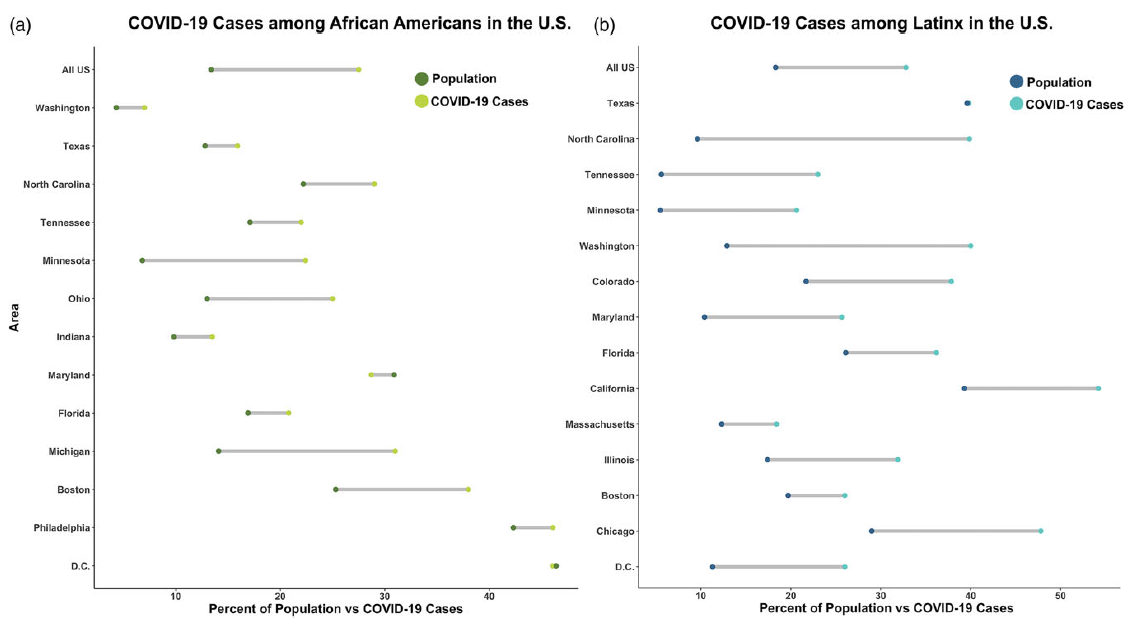
Globally, there has been a disproportionate impact on ethnic minority groups. There are data to support this from the United Kingdom (Iacobucci, Reference Iacobucci2020; Rimmer, Reference Rimmer2020), Brazil (Baqui, Bica, Marra, Ercole, & van Der Schaar, Reference Baqui, Bica, Marra, Ercole and van Der Schaar2020), and across Black, Latinx, and indigenous Native American populations in the USA) (see Figure 2; e.g., Poston, Reference Poston2020; Van Dorn, Cooney, & Sabin, Reference Van Dorn, Cooney and Sabin2020; Yancy, Reference Yancy2020).
Disparities in COVID-19 cases among African Americans and Latinx in the U.S. (a) Percentage of confirmed COVID-19 cases among African Americans versus percentage of their population per state or city. (b) Percentage of confirmed COVID-19 cases among Latinx versus percentage of their population per state or city. Population data (darker blue and green) were collected from the United States Census Bureau and confirmed COVID-19 case data (lighter blue and green) were collected from respective government departments of health websites on June 4, 2020.

There are likely multiple causes for these disparities. First, there are already disproportionately higher rates of chronic medical conditions in Black, Latinx, and other ethnic minority communities (e.g., diabetes mellitus, cardiovascular disease, asthma, and hypertension), and these have been associated with worse COVID-19 outcomes including higher rates of mortality (CDC, 2020). Ethnic minorities may also have underlying differences in the expression of ACE-2, the host receptor for SARS-CoV-2 (Zhao et al., Reference Zhao, Zhao, Wang, Zhou, Ma and Zuo2020). Importantly, these comorbidities are the result of existing health disparities among these groups that have yet to be properly addressed. Second, factors such as low socioeconomic status and poor access to health care may lead to lower rates of COVID-19 testing and less access to treatment. In addition, higher poverty rates during a pandemic of this proportion means an overall lack of resources within these communities, including a lack of basic necessities such as food and medications. Third, ethnic minority community employment characteristics may increase exposure risk: they are more likely to be predominantly composed of service industry work (e.g., transportation, food, and retail service) and, perhaps as a result, less able to work from home (Gould & Shierholz, Reference Gould and Shierholz2020). In the USA, for instance, only 19% of Black employees can work from home, compared to 30% of their White counterparts (US Bureau of Labor Statistics, 2020). Furthermore, ethnic minority communities are more likely to live in densely populated neighborhoods, limiting the ability of social distancing which may lead to increased exposure to the virus.
The vulnerability of older adults
It is clear worldwide that older adults represent the most vulnerable population to succumb to COVID-19 in terms of both mortality and neurological complications (Cesari & Montero-Odasso, Reference Cesari and Montero-Odasso2020; Stokes et al., Reference Stokes, Zambrano, Anderson, Marder, Raz, El Burai Felix and Fullerton2020). In the USA, greater than 40% of deaths thus far are among the 0.6% of the population that lives in long-term care facilities (Behrens & Naylor, Reference Behrens and Naylor2020; Lau-Ng et al., Reference Lau-Ng, Caruso and Perls2020; Stokes et al., Reference Stokes, Zambrano, Anderson, Marder, Raz, El Burai Felix and Fullerton2020). This statistic is sobering, as such a minority of citizens are experiencing the brunt of the fatality burden associated with this disease. Similar numbers are seen in other countries, with one study indicating that 30–60% of deaths in Europe are among the elderly (ECDC Public Health Emergency Team, Reference Danis, Fonteneau, Georges, Daniau, Bernard-Stoecklin and Schneider2020). Case fatality rates dramatically rise by age across all nations (COVID-19 National Incident Room Surveillance Team, 2020). A study conducted by Italian researchers indicated that the fatality rate was 0.8% of patients in the 50–59 years age range, 2.7% in those 60–69 years of age, and 21.1% in individuals over 90 years (Cesari & Montero-Odasso, Reference Cesari and Montero-Odasso2020).
Older adults tend to have higher levels of comorbid disease (Salive, Reference Salive2013), which has repeatedly shown up as a significant risk factor for the poor outcome with COVID-19 (Toraih et al., Reference Toraih, Elshazli, Hussein, Elgaml, Amin, El-Mowafy and Fawzy2020), and in general, show less resilience to disease as their bodies are becoming more infirm secondary to normal aging. Moreover, in the nursing and retirement home settings, such individuals are living in close quarters and often being cared for by staff members who are younger and continuing to interact with broader social communities (i.e., potentially unintentionally introducing infection from the broader environment) (Burki, Reference Burki2020). This is particularly problematic with COVID-19, a highly contagious disease that can remain asymptomatic for a somewhat prolonged time period, increasing the potential risk of spread (Raoult et al., Reference Raoult, Zumla, Locatelli, Ippolito and Kroemer2020). These vulnerabilities are only compounded when the aforementioned factor of race is combined with age (Suleyman et al., Reference Suleyman, Fadel, Malette, Hammond, Abdulla, Entz and Brar2020).
Toward a research agenda
To date, the COVID-19 pandemic has spurred more questions than answers. The neuroinvasive potential of the novel coronavirus likely places patients with COVID-19 at greater risk of neuropsychological sequelae, both from direct (e.g., stroke) and indirect (e.g., sepsis, ARDS) insults. However, it is unclear if COVID-19 increases the risk of neurodegenerative disorders. Furthermore, like other respiratory viruses, the long-term cognitive and functional consequences of COVID-19 infection are not understood, making the role of neuropsychologists in COVID-19 research paramount.
Collaborative research efforts to understand some of these important questions are underway. One such effort is the US National Institutes of Health’s COVID-19 open dataset (https://www.semanticscholar.org/cord19). Another effort is the formation of a COVID-19 Neuro Research Coalition (Winkler et al., Reference Winkler, Knaus, Schmutzhard, Leonardi, Padovani, Abd-Allah and Solomon2020; https://braininfectionsglobal.tghn.org/covid-neurology-resource). More pertinent to neuropsychology is the formation of a COVID-19 Special Interest Group (SIG) within the International Neuropsychological Society (https://www.the-ins.org/sigs/); currently, which is working collaboratively on the development of harmonized research recommendations and clinical implications for the neurocognitive, psycho-social health, olfaction, and taste assessment of patients with COVID-19. In a two-pronged approach, current efforts at the University of Florida are underway to develop normative data for teleneuropsychological evaluations and to invite patients identified in the OneFlorida Research Consortium (a data repository of electronic medical records, covering approximately 75% of the State of Florida; Fleurence et al., Reference Fleurence, Curtis, Califf, Platt, Selby and Brown2014; Shenkman et al., Reference Shenkman, Hurt, Hogan, Carrasquillo, Smith, Brickman and Nelson2018) for longitudinal assessments of cognitive functioning via telehealth.
As we are in the midst of a historic pandemic that is likely to evolve rapidly and hopefully show considerable resolution in a relatively brief span of time (e.g., relative magnitude of 1 to a few years), anything we can do to systematically study the outbreak, its consequences, and the societal, political, and medical response to its occurrence can be of great benefit. This includes wide-ranging research endeavors, including explorations of epidemiological, psychological/psychiatric, neurological/physiological/medical, and social/cultural foci. Finding ways to efficiently gather data in our clinical settings should be a priority. This should include conducting a careful review of medical records to answer basic epidemiological questions, to determine incidence/prevalence rates, and to examine the effects of factors such as age, sex/gender, race/culture, socioeconomic status, and the contribution of medical comorbidities to the outcome. The addition of even brief screening self-report inventories could quickly add to our knowledge of contributory factors as well as to explore the psychological response to the pandemic and the experience of social distancing and quarantine.
We should also explore options for identifying and assessing patients testing positive for COVID-19 who present with neurological and psychiatric complications. We must be able to identify them as they come through our medical systems and community settings, and enact protocols to gather data with regard to cognitive and emotional outcome, associated neuroimaging and electrophysiological alterations, and functional recovery. Ideally, this would include a two-pronged approach that: (1) allows for gathering standard clinical data; and (2) developing focused protocols to answer targeted questions of interest. As an example of the latter approach, one could systematically plan for the screening of COVID-19-positive patients when they enter the ICU setting (e.g., monitoring the level of awareness/responsivity; administering mental status screening when appropriate) and then follow them over time at various time points of recovery with formal neuropsychological testing and psychiatric/emotional inventories and functional rating scales. It would also be valuable to study healthcare providers and their responses to providing treatment in high stress, demanding climate.
The above suggestions reflect a generic approach to gathering data systematically, and could be applied to any study of function in relation to neurological disease. It is possible that COVID-19, to the extent that it is determined to affect CNS function, may simply cause or exacerbate standard neurological and psychiatric disorders. If this is the case, then novel findings may be less compelling apart from simply knowing how often these disorders result from this virus. This alone would be useful for societal planning, for example, with regards to the risk-benefit of reopening an economy versus maintaining a longer period of quarantine. However, by tracking the presence of COVID-19 infection among our patients, we will be better prepared to recognize if any long-term sequelae should occur (i.e., does this virus have the capacity to increase rates of neurological disorder and disease?). For any neuropsychology group able to implement tracking of rates of infection among their patients, such data could be beneficial, and this could be easily augmented with some simple questionnaires regarding COVID-19-related psychopathology (e.g., measuring heightened anxiety or depression symptomatology associated with increased fearfulness/worry).
Prospective research could also be designed to answer targeted questions. This could include a comparison of neuropsychological functioning in COVID-19-positive patients who vary on symptom presentation (e.g., comparison of cases of COVID-19 and asymptomatic patients) or a comparison of patients with various neurological disorders with or without COVID-19. The latter would allow us to determine if the addition of this virus in the setting of a neurological disorder leads to worsening cognitive function. The addition of neuroimaging could allow for an examination of connectivity metrics and inflammatory markers in conjunction with neuropsychological testing, which could potentially increase understanding of any deficits that may occur. As our understanding of COVID-19 grows, it too will likely join the ranks of viruses recognized as potential causative/contributory agents to the emergence of neurologic diseases across the lifespan. For now, neuropsychology has an important role to play in the global inquiry into the COVID-19 pandemic – including deepening our understanding of its potential neurocognitive and mental health sequelae as well as the coping and adjustment of both individual and society.
CONCLUSION
Though primarily considered a respiratory virus, COVID-19 is now recognized as having neurotropic potential, either through direct neural invasion (e.g., ANE) or secondary effects (e.g., hypoxia, cerebrovascular disease). In the acute stages of COVID-19, some neurological conditions are frequent and well recognized (e.g., delirium, altered mental status; Alkeridy et al., Reference Alkeridy, Almaglouth, Alrashed, Alayed, Binkhamis, Alsharidi and Liu-Ambrose2020; Norman et al., Reference Norman, Stall and Sinha2020); whereas, other conditions are less common (e.g., seizures; Lu et al., Reference Lu, Xiong, Liu, Liu, Yang, Li and Zhou2020). Further evidence of the neurotropic potential of COVID-19 comes from neuroimaging studies, which show a heterogeneous pattern of abnormalities, including microvascular bleeds, perivascular lymphocytic infiltration, and focal lesions (Bryce et al., Reference Bryce, Grimes, Pujadas, Ahuja, Beasley, Albrecht and Chen2020; Poyiadji et al., Reference Poyiadji, Shahin, Noujaim, Stone, Patel and Griffith2020; von Weyhern et al., Reference von Weyhern, Kaufmann, Neff and Kremer2020). Problematically, most of these data come from case studies or case series, as large empirical and epidemiological studies are not yet available.
As it is still too early in the pandemic, the long-term neurocognitive effects of COVID-19 infection are still unknown, but conditions commonly associated with other respiratory viruses (e.g., ARDS, hypoxia) are known to have long-term cognitive sequelae (e.g., Brown et al., Reference Brown, Wilson, Presson, Dinglas, Greene and Hopkins2017). In addition to neurocognitive sequelae, COVID-19 is currently and will likely result in an emergence and exacerbation of psychiatric symptoms. Given the training in the assessment of cognitive and emotional functioning, neuropsychologists are well equipped to meaningfully assist in the clinical assessment of the complex and heterogeneous presentation of COVID-19 symptomology and associated cognitive and psychiatric sequela (Bao et al., Reference Bao, Sun, Meng, Shi and Lu2020; Hawryluck et al., Reference Hawryluck, Gold, Robinson, Pogorski, Galea and Styra2004). Acutely, neuropsychologists can be useful in assessing for cognitive impairment and associated neurologic conditions (e.g., delirium). Post-acutely, neuropsychologists will also be important in assessing the long-term cognitive complications of COVID-19 and assessing cognitive recovery of more severe cases with known cognitive impairments. Likely, neuropsychologists will play a pivotal role in disentangling true cognitive impairment secondary to COVID-infection from newly developed or exacerbated psychiatric conditions, much like the assessment of mild traumatic brain injuries.
Neuropsychologists will also play a pivotal role in emerging research, especially as researchers seek to determine if COVID-19 infection can lead to neurodegeneration, an acceleration of the aging process (much like HIV), or an exacerbation of physiological and psychological complications. As the field plays a pivotal role in emerging research, it is also critical for neuropsychologists to make a concerted effort to recruit a representative sample with racial and ethnic minorities. Given how racial/ethnic minorities have been disproportionately affected by the pandemic (Baqui et al., Reference Baqui, Bica, Marra, Ercole and van Der Schaar2020; Iacobucci, Reference Iacobucci2020; Poston, Reference Poston2020; Rimmer, Reference Rimmer2020; Van Dorn et al., Reference Van Dorn, Cooney and Sabin2020; Yancy, Reference Yancy2020), the inclusion of these individuals will be important in the fight to reduce healthcare disparities.
ACKNOWLEDGEMENTS
There are no funding sources to report for this study.
CONFLICTS OF INTEREST
Cady Block, PhD, Lucette Cysique, PhD, Kara Eversole, BS, Michelle Haddad, PhD, Kelsey C. Hewitt, PsyD, and Emilia Lojek, PhD have no conflicts of interest to report. The remaining authors report potential conflicts of interest: Dawn Bowers PhD (NIH 2T32-NS082168, R01-AG064587, & R21-AG057200; Parkinson Foundation IMP-1938); Daniel L. Drane, PhD (NIH/NINDS R01 NS088748, NIH/NIMH R01 MH118514; Medtronic, Inc. – Core Lab Director for Neuroimaging and Neuropsychology of FDA trial of laser ablation); David E. Marra, PhD (UL1TR001427); Carrie McDonald, PhD (NIH/NINDS R01 NS065838, R21 NS107739); and Anny Reyes MS (NIH F31 NS111883-01).