





No CrossRef data available.
Article contents
The influence of classroom input and community exposure on the learning of variable grammar
Published online by Cambridge University Press: 11 March 2016
Extract
As pointed out by Carroll (Carroll), our team has investigated the influence of input on the spoken French competence of older Ontario bilinguals. Our research has examined the learning of invariant and variable aspects of French grammar. We focus here on the learning of variation, since it is an under-researched topic not covered by Carroll. Our research examines adolescent speakers of Ontario French from French-medium schools (e.g., Mougeon & Beniak, 1991), same-age immersion students (e.g., Mougeon, Nadasdi & Rehner, 2010) and advanced learners from a bilingual university (e.g., Mougeon & Rehner, 2015). Two key dimensions of input are teacher classroom speech and frequency of use of French in the community for the Franco-Ontarian students and amount of extra-curricular interactions with Francophones for the FSL students. Having collected corpora from these student groups, we compared the output of learners with primarily classroom-based input with that of learners with broader ranging (extra-) curricular input. The availability of teacher in-class recordings for these learner groups has been crucial in identifying additional factors influencing these students’ output.
Information
- Type
- Peer Commentaries
- Information
- Copyright
- Copyright © Cambridge University Press 2016
References
Carroll, S.E.
Exposure and input in bilingual development. Bilingualism: Language and Cognition. doi:10.1017/S1366728915000863.Google Scholar
Mougeon, F., & Rehner, K. (2010). Identity and nativelikeness in bilingual FSL learners. In Regan, V. and Ni Chasaide, C. (eds.), Language Practices and Identity Construction by Multilingual Speakers of French L2: The Acquisition of Sociostylistic Variation, pp. 11–28. Bern: Peter Lang.Google Scholar
Mougeon, F., & Rehner, K. (2015). Engagement portraits and (socio)linguistic performance: A transversal and longitudinal study of advanced L2 learners. Studies in Second Language Acquisition, 37, 425–456.Google Scholar
Mougeon, R., & Beniak, É. (1991). Linguistic consequences of language contact and restriction: The case of French in Ontario, Canada. Oxford University Press.CrossRefGoogle Scholar
Mougeon, R., Nadasdi, T., & Rehner, K. (2009). Évolution de l'usage des conjonctions et locutions de conséquence par les adolescents franco-ontariens de Hawkesbury et de Pembroke (1978-2005). In Martineau, F., Mougeon, R., Nadasdi, T., and Tremblay, M. (eds.), Le français d'ici: études linguistiques et sociolinguistiques sur la variation du français au Québec et en Ontario, pp. 128–145. Toronto: GREF.Google Scholar
Mougeon, R., Nadasdi, T., & Rehner, K. (2010). The sociolinguistic competence of immersion students. Bristol, U.K.: Multilingual Matters.Google Scholar
Mougeon, R., & Rehner, K. (2015). The neglected topic of variation in teacher classroom speech: Investigating je vais/je vas/m'as in Ontario French-medium high schools. In Cacoullos, R.T., Dion, N., and Lapierre, A. (Eds.), Linguistic Variation: Confronting Fact and Theory, pp. 165–177. New York: Routledge.Google Scholar
Yang, J., & Rehner, K. (2015). Learner beliefs about sociolinguistic competence: A qualitative case study of four university second language learners. Language Learning in Higher Education, 5
(1), 157–180.Google Scholar
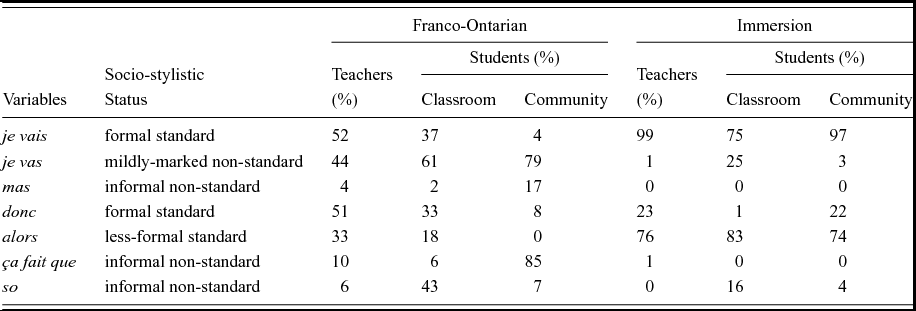
Table 1. Frequency (%) of variant use by Franco-Ontarian and immersion teachers, classroom-based learners, and learners with community exposure
 You have
Access
- 7
- Cited by
As pointed out by Carroll (Carroll), our team has investigated the influence of input on the spoken French competence of older Ontario bilinguals. Our research has examined the learning of invariant and variable aspects of French grammar. We focus here on the learning of variation, since it is an under-researched topic not covered by Carroll. Our research examines adolescent speakers of Ontario French from French-medium schools (e.g., Mougeon & Beniak, Reference Mougeon and Beniak1991), same-age immersion students (e.g., Mougeon, Nadasdi & Rehner, Reference Mougeon, Nadasdi and Rehner2010) and advanced learners from a bilingual university (e.g., Mougeon & Rehner, Reference Mougeon, Rehner, Cacoullos, Dion and Lapierre2015). Two key dimensions of input are teacher classroom speech and frequency of use of French in the community for the Franco-Ontarian students and amount of extra-curricular interactions with Francophones for the FSL students. Having collected corpora from these student groups, we compared the output of learners with primarily classroom-based input with that of learners with broader ranging (extra-) curricular input. The availability of teacher in-class recordings for these learner groups has been crucial in identifying additional factors influencing these students’ output.
To illustrate this, we discuss two morphosyntactic variables from the Franco-Ontarian (FO) and French immersion (FI) datasets: je vais/je vas/mas to express a habitual or future action in the first person singular (Mougeon & Rehner, Reference Mougeon, Rehner, Cacoullos, Dion and Lapierre2015) and donc/alors/ça fait que/so to express a consequence between sentences (Mougeon, Nadasdi & Rehner, Reference Mougeon, Nadasdi, Rehner, Martineau, Mougeon, Nadasdi and Tremblay2009). Table 1 captures variant frequency for FO and FI teachers and compares it with two groups of FO and FI students (‘classroom’ and ‘community’ learners). The classroom FO learners reside in a minority Francophone community and the community FO students in a strong majority one. The classroom FI learners have less than one day of extra-curricular French exposure, while the community FI learners have at least one week (and many over three weeks).
Frequency (%) of variant use by Franco-Ontarian and immersion teachers, classroom-based learners, and learners with community exposure
As Table 1 shows, the teachers use standard variants more frequently than non-standard ones, as one might expect. However, the FO teachers’ use of non-standard variants is by no means negligible, while it is close to nil for the FI teachers, reflecting the FO teachers’ status as native speakers of the local variety and their position as teachers in Francophone schools. The output of the classroom-based learners is more aligned with the teachers’ than is their groupmates’ who have access to the community norms. However, the classroom-based FO students are not as strongly influenced by the classroom input as are their FI counterparts, reflecting that they are not entirely cut-off from the local variety. Concerning the learners with community-based exposure, for the FO students such exposure counterbalances the standardizing influence of the classroom input to the extent that in these students’ output non-standard variants greatly outnumber standard ones. For the FI students, even their modest exposure to the target community has brought their mastery of these morphosyntactic variables to levels comparable to the teachers. These patterns reflecting the variants’ frequency in the learners’ (extra-) curricular input must be further scrutinized, however, by considering the variants’ (inter-) systemic properties. For instance, it is remarkable that the classroom-based FO learners use non-standard so close to half of the time but non-standard mas only minimally, while the FO teachers use both equally infrequently. The differential learning of mas and so by these students reflects mas’ morphological and syntactic irregularity and so’s status as an integrated borrowing from English, the other language of these English-dominant bilinguals. Unlike the teachers, the classroom-based FO students prefer non-standard je vas over standard je vais, reflecting that je vas is well represented in teacher discourse and is easier to learn because of its morphological regularity. The classroom-based FI learners use so and je vas, while the FI teachers (essentially) do not, suggesting that the learners are producing them spontaneously because they have not yet fully mastered the standard counterparts featured in their classroom input. This tendency diminishes for those FI learners with community exposure.
To conclude, analyses of this type offer valuable insight into the complex ways that classroom input, community exposure, and (inter-) systemic factors interact in their impact on the learning of variable grammar. Such insight adds to the already-rich interplay of factors pointed out by Carroll, and attested by Mougeon and Rehner (Reference Mougeon, Rehner, Regan and Ni Chasaide2010) and by Yang and Rehner (Reference Yang and Rehner2015), and will hopefully serve to encourage further research.