1. Introduction: who decides the party leader
Who decides the party leader has recently been a frequently discussed topic in parliamentary democracies (LeDuc, Reference LeDuc2001; Kenig, Reference Kenig2008; Cross and Blais, Reference Cross and Blais2012b; Cross and Katz, Reference Cross and Katz2013; Pilet and Cross, Reference Pilet and Cross2014). In those countries where the president of the majority party automatically becomes the prime minister, this question causes more concerns and sometimes even jeopardizes the legitimacy of a national leader. Thus, to strengthen parliamentary democracy, it usually begins with implementing and improving intra-party democracy.
When measuring intra-party democracy, scholars often look into two dimensions (Scarrow, Reference Scarrow2005; von dem Berge et al., Reference Von dem Berge, Poguntke, Obert and Tipei2013). One is the extent to which individual party members are enabled to express opinions or participate in intra-party decision-making, referred to as inclusiveness. The other is centralization, which describes the extent to which decisions are made by a single group or decision body. Furthermore, ‘inclusiveness’ is a vital factor because what constitutes a ‘democratizing’ change in any specific case depends on where the party is initially located along the ‘inclusiveness’ spectrum (Scarrow, Reference Scarrow2005).
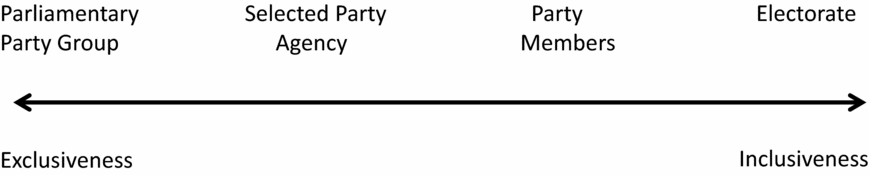
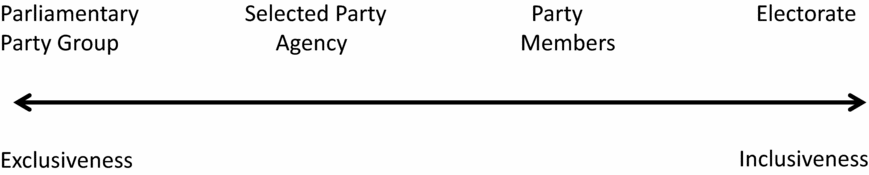
The way to improve inclusiveness varies in different parties and countries. A common way is to expand the leadership selectorate (selection body) to include more rank-and-file members. For example, the most inclusive method would be up to the entire electorate (Kenig, Reference Kenig2008: 244).
Inclusiveness and exclusiveness of party leadership selectorate
Democracy is not only about choices, but also about voices. However, in reality, this is not an easy issue. Even an inclusive process does not necessarily produce the preferred outcomes, such as more inclusiveness of the rank-and-file members. For example, in September 2012, the election of the party leader of the Liberal Democratic Party (LDP) of Japan exhibited how a second runner of the national primary obtained an upsetting final victory in a run-off voting. Shinzo Abe, who was preferred by the Diet members, defeated the nationwide popular candidate, Shigeru Ishiba, with a marginal victory of 108 against 89.
A quick review of the party history shows that the LDP started to reform leadership selection procedures, mainly to include more party members, at the latest in the 1970s. Cross and Blais (Reference Cross and Blais2012a) identify four factors that put pressure on party elites to promote the direct party members voting in the Westminster parties: being in opposition, an electoral defeat, being a new party, and a strong contagion effect within party systems. Does Cross and Blais's analytical framework also hold for Japanese political parties?
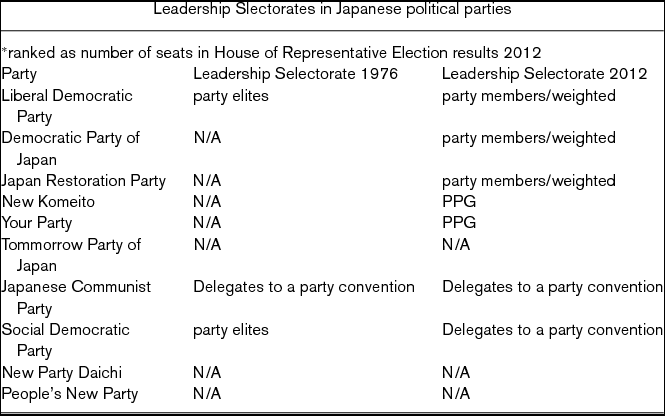
The LDP and DPJ (Democratic Party of Japan) are the only two parties that select leaders via party member voting in Japan. The DPJ have held a national primary three times (2006, 2010, and 2012) since its foundation in 1998. The LDP has been the long-ruling party, only in opposition in 1993–4, 2009–12. Except a devastating loss to the DPJ in the 2009 general election, the LDP has seldom experienced electoral defeat. Being in opposition or having an electoral defeat is not the factor that pushed the LDP elites to share power with the rank and file members. On the other hand, opposition parties in Japan have not been strong enough to challenge the LDP's dominance. A contagion effect previously observed among the European parties is not yet identified in Japan. Contagion effect refers to a situation that once one competitive party in a system expands its leadership selectorate, it becomes more difficult for other parties to resist change (Cross and Blais, Reference Cross and Blais2012a). The new parties, such as the Japan Restoration Party, Your Party, are still at an early stage where the party founder is serving as the party leader. The New Komeito uses a small and exclusive selection body in which only Diet members are eligible to participate (parliamentary party group, PPG). The Japanese Communist Party and Social Democratic Party pick up party leaders at party conventions.
Party leadership slection in Japanese political parties

Japanese political parties do not fit in Cross and Blais's framework. It is even more puzzling to observe the LDP regarding why and how elites in a long-ruling cartel party were willing to share power. From an actor-centered analysis, focusing on the inclusiveness, this paper looks at the reformists’ activities and discusses the process of introducing more inclusive methods to choose a leader in the LDP.
2. Who decides: party leader election in the LDP
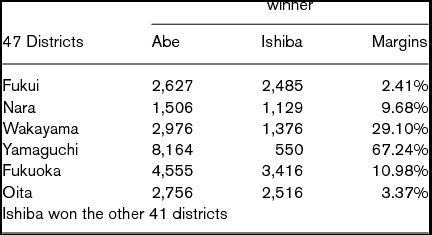
After an abrupt resignation as Prime Minister in 2007, Shinzo Abe came back to contend for the leadership of the LDP against other four candidates in the fall of 2012.Footnote 1All five candidates were hereditary politicians and had previously served in cabinets.Footnote 2 This candidacy likeness made the competition fiercer and nationally debated. The LDP party presidential election in 2012 adopted a two-round voting. The first round included 300 votes in local primaries, determined by the rank-and-file members. If no candidate gained the required 55% of votes, then it would move to a run-off vote between the top two candidates. The run-off vote was exclusive to Diet members from the LDP.Footnote 3 Unlike when the front-runner in 2006, Abe ran second to Shigeru Ishiba, a nationally more popular candidate,Footnote 4 in the party primary. Of 47 prefectural primaries, Abe took only six.
LDP president election outcome, September 2012
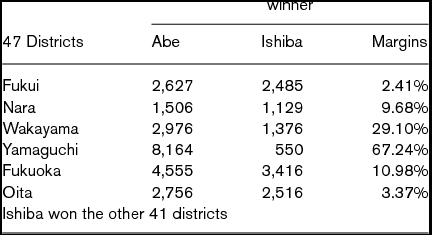
source: LDP homepage. https://www.jimin.jp/sousai12/pdf/votingresults_.pdf (accessed October 2014)
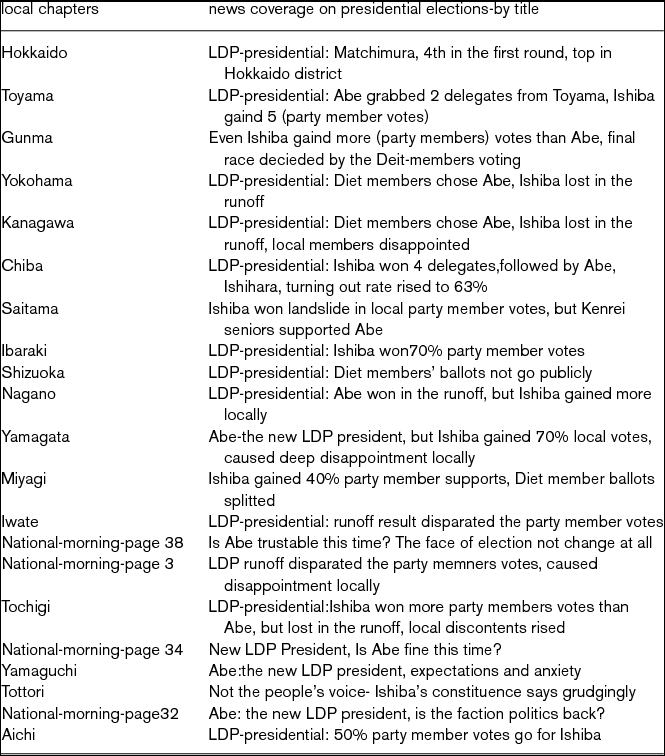
Except for a landslide victory in his constituency home, Yamaguchi, Abe only obtained a first place with small margins in Fukui, Nara, Wakayama, Fukuoka, and Oita. However, Ishiba did not gain the required 55% votes,Footnote 5 and hence the contest preceded to a run-off vote between him and Abe. As a non-faction affiliated member, Ishiba was not a favored candidate among the Diet members. On the other hand, supported by party seniors and those Diet members who voted for Nobuteru Ishihara in the first round, Abe eventually won the run-off voting, 108 against 89. Abe's surprising victory disappointed those rank-and-file members who voted for Ishiba. Not only in Ishiba's constituency home Tottori, supporters in Ibaraki and Yamagata also expressed dissatisfaction. Both national and local news covered Ishiba's surprising loss and concerns over the new Abe leadership.
News coverage of LDP presidential election (Yomiuri Shimbun), 27 September 2012
source: Yomiuri Shimbun Archive
Three months later, the LDP captured a landslide victory in the general election, gaining 294 seats in the 480-member House of Representatives in December 2012. Abe, as the president of the majority party, returned to the Prime Minister's office. Now the question of who decides the party leader became a national issue. The gap between a national primary and run-off result even left people questioning the legitimacy of this new national leader.
The party presidential election is understood as a deciding factor for the development and persistence of factionalism in Japanese politics (Watanabe, Reference Watanabe1958; Kitaoka, Reference Kitaoka1990). Recent research argues that party presidential elections transformed the face of LDP factionalism from cooperative to competitive (Boucek, Reference Boucek2012: 186). Other studies contend that Jun'ichiro Koizumi ascended to the leadership as a direct result of changes to the presidential election procedure (Otake, Reference Otake2003, Reference Otake2006; Uchiyama, Reference Uchiyama2007; Kabashima and Steel, Reference Kabashima and Steel2007; Lin, Reference Lin, Reed and McElwain2009). In this sense, it is more valuable to look into the LDP because the changes in party leadership selection have already had significant consequences for the party organization.
On choosing a candidate for a country's highest office, an increasing number of parties have been seeking to devise more inclusive processes and to open up the leadership selection procedure to wider selection bodies (LeDuc, Reference LeDuc2001; Cross and Blais, Reference Cross and Blais2012b; von dem Berge et al., Reference Von dem Berge, Poguntke, Obert and Tipei2013; Pilet and Cross, Reference Pilet and Cross2014). This trend is not yet universal, but prevails in parliamentary countries, including Japan (Tsurutani, Reference Tsurutani1980; Tanaka, Reference Tanaka1986; Uekami, Reference Uekami2013). The question of how leaders are elected may go back to ‘the iron law of oligarchy’ (Michels, Reference Michels1959). Current literature mainly covers parties in European and English-speaking Westminster-style democracies. But they seldom include Japan (Carty and Blake, Reference Carty and Donald1999; Cross and Crysler, Reference Cross, Crysler, Debardeleben and Pammett2009; Cross and Blais, Reference Cross and Blais2012b). Researchers tend to handle reforms as linear statistical results, thus fail to consider event details. Kenig's ENC (effective number of candidates) measures the selectors’ inclusiveness (Kenig, Reference Kenig2008). Focusing on prefectural ballots, research looks into Diet members’ influence over the rank-and-file members in the primaries (Ehrhardt, Reference Ehrhardt2006). However, they pay less attention to important events. For example, Kenig recognizes the considerable shifts in party leadership selection methods in Japan, but tends to overlook the changed values of the primary votes in different periods. Kenig sorts the LDP as ‘party members/votes weighted’ similar to the Labor Party of United Kingdom. But this typology of Japan seems to be misleading. After Yasuo Fukuda's sudden resignation in September 2008, the LDP had to hold a party leadership election. In the initial round, each prefecture had three electoral-collegeFootnote 6 votes. The candidate who came first in the prefectural primary took the entire three electoral-college votes.Footnote 7 In the final round, a total of 538 people, 387 Diet members, and 141 representatives from the 47 Prefectures were eligible to vote. However, using a postal ballot, prefectural primaries did not take place simultaneously. Thirty-two prefectures announced their results on 21 September, the other 15 prefectures on 22 September. Thus, according to the four-level typology and definitions made by Kenig, the LDP leadership election of 2008 in practice was not ‘party members’, but a weighted party member voting between the ‘selected party agency’ and ‘party members’.
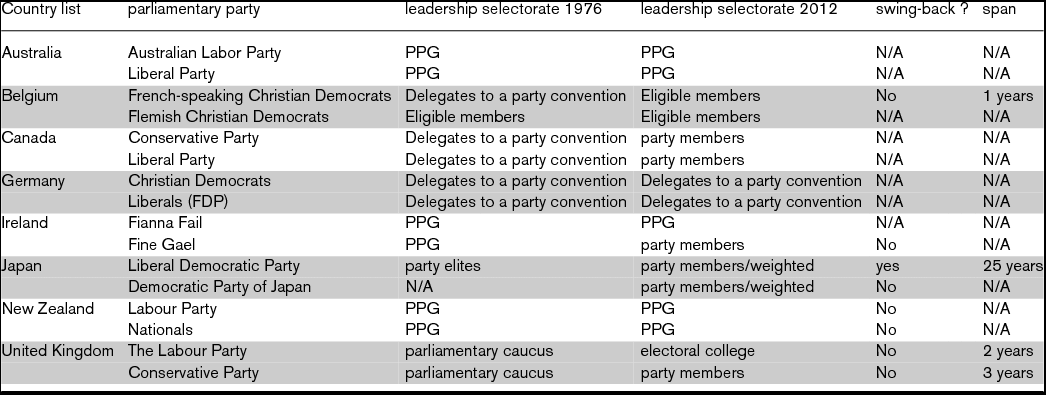
The LDP introduced a primary election in 1978. However, it was not until 2003 that a primary election became a regular way of deciding a party leader. Looking at the various amendments of the party constitution, one finds a swing-back effect (one step forward, two steps backward) in the democratization process of party leadership selection. The swing-back effect in the LDP refers to a sudden pause in the reforms and then a return to an exclusive way of choosing a leader. Between 1981 and 1990, the LDP central executives decided to give up the national primary and went back to the traditional coalition-making politics. Thus, one finds abnormal an rare inactivity and time-lag differences in party reforms. It took almost 25 years to move forward to an inclusive selectorate. A similar short span could also be identified in the parties of Belgium and the United Kingdom. For example, it took the Conservative Party (UK) three years, Labor Party (UK) two years, and the Christian Democrats (Belgium) one year to put an inclusive method into effect. But none of them demonstrated a swing-back effect.
Trends and changes in party leadership selection (1976–2012)
Source: Pilet and Cross (Reference Pilet and Cross2014); Cross and Blais (Reference Cross and Blais2012b); Kenig (Reference Kenig2008)
*swing-back effect: a returning to an exclusive way to choose a leader.
*PPG: Parliamentary Party Group, in Japanese context it means “Diet members of LDP”
*span:time cost of moving forward to a inclusive selectorate
*LDP of Japan: top 2 from causus ballots go into run-off vote among prefectural representatives and PPG
*Conservative Party of UK: top 2 from causus ballots go into run-off vote among eligiable party members
On the other hand, although the DPJ only held national primaries three times (2006, 2010, and 2012), it never went as far as amending its party constitution. Previous studies analyze the cause and outcomes of intraparty democratization (Kenig, Reference Kenig2008; Uekami, Reference Uekami2013), but they tend to neglect the time-lag differences, thus not fully interpreting the uncommon situation in the LDP.
What caused such an interrupted democratizing party leadership selection? Why is the LDP distinct from the lineal pro-democracy reform process of most of the parliamentary parties? The following section analyzes the changes in the reform agenda on leadership election procedures in the LDP over the years.
3. LDP's party leadership election reforms: the rationale and practices
Regarding the introduction of party member voting in the leadership election, the LDP presented a three-staged process. In the first period (1961‒80), it was a tradeoff between ‘bring-down the Miki administration’ and ‘Miki's proposal for party reform’. The reformist Takeo Miki and his group members achieved the reform proposal at the cost of his resigning. Then in the second period (1981‒91), reforms were interrupted due to the discontinuity of reformist actors. The reformists’ breakaway to party the ‘New Liberal Club’, a key leader's sudden pass-away (Masayoshi Ohira in 1980), and the ‘Kanemaru mediation’ (1984) were the main reasons that reforms went backwards. In the third period, reform moved forward again in the early 1990s. Dealing with the money scandal, facing challenges from the new electoral environment, the LDP was forced to resume reforms to maintain strength and electoral survival. Later in 2003, the LDP set up a two-round selection procedure as a regular way of choosing a leader.
Starting in 1978, interrupted in 1984, then resuming 1991, the LDP presented an abnormal inactivity and time-lag differences in democratizing the party leader selection process.
3.1 Reforms began: Miki's proposalFootnote 8
Movement towards ‘modernization’ of party organizations started in the 1960s. The anti-Security Treaty riots of 1960 and the narrowing electoral gap between the LDP and the opposition parties pushed the growth of a reformist movement inside the LDP (Fukui, Reference Fukui1970). It established the Party Organization Research Council, including five sub-committees in January 1961 to deal with the party's finance, organizations, and public relations.
The first round of discussions on how to promote intra-party democratization began in 1963. Secretary-General Takeo Miki made an official proposal to the party president Hayato Ikeda at the third Round Research Committee of Party Organization Reforms. This report proposed that the party should set up a special committee to select and endorse candidates for the party leadership, and also suggested a method of ‘one member, one vote’ (OMOV) to choose a party leader. Four years later, the chairman issued a statement on the necessities of reforming the electoral system and party leadership election procedures. However, instead of making substantial changes, the Research Committee decided to maintain party harmony and not to take any further actions.
In 1971, the Research Committee released a report reviewing how to include more rank-and-file members in the party leadership election. It even started to consider a full membership, making a motion that ‘above all, the party leadership election is the most significant event in our party. It is our great expectation that the election should include all the party members.’Footnote 9 This proposal also stated that it should have three representatives from each of the 47 prefectures. It built the initial blueprint for how to involve local voices.
Inside the party, not satisfied with Miki's attitudes towards the Lockheed scandal, faction leaders were plotting to bring down the Miki administration in February 1976 (Fukunaga, Reference Fukunaga2006: 196‒208). Meanwhile the party's poor performance in the general election of December 1976 woke the LDP central executives to the realization that a party reform was urgently needed. Miki, the reformist and the sitting party leader, managed to reach a compromise with his rival factions to adopt a new procedure for a selecting party leader (Fukunaga, Reference Fukunaga2006: 196‒208). Then he officially resigned and issued a public statement for party reform.
I have said that the root of all the wicked and rigged [in our party] lies in the way we decide the party president. I once proposed a two-stage procedure to elect the party leader: a primary election by the party's mass membership in local prefectures, and then a final selection by the Diet member of the top two primary winners. We must put this plan into practices at the coming Party Convention next January.Footnote 10 (LDP, 2006a: 400)
Miki’ proposal included the following suggestions:
1. It should allow authentic LDP supporters who had paid the annual membership fee for the past two years to participate in the selection of the party leader.
2. The party should be independent of the zaikai financially, and establish its political party funding.
3. The party should break up the current factional groups and stay away from factionalism. The top two primary winners would go into a final selection among Diet members, of which one member owns one vote.
Later in January 1977, based on this proposal, the Research Committee issued a detailed agenda (LDP, 2006a: 408‒9).
A primary election of full members was to be conducted in each prefecture. Party members, who had fully paid the annual membership fee for the past two years, were eligible to vote. Fraternity members of the Liberal National Congress and National Political Association, who had fully paid the annual fee for the past two years, were also eligible to vote. The party member fee was 3,000 yen. The annual member fee of a fraternity member was 10,000 yen at least. For each prefecture, 1,000 mass membership votes equaled one point. In prefectural voting, ballots were to be delivered to the local branches via postal mail. A candidate for the president's post must be a Diet member and have obtained 20 written recommendations from Diet members. Previously, only ten Diet member supporters were needed. The top two primary winners were to go to final selection decided by Diet members, of which one member owned one vote.
Until that time, LDP presidents had always been chosen by the Diet members, numbering around 400 votes gathered at a national party convention in Tokyo (Tsurutani, Reference Tsurutani1980, p. 844). The party leader election in November 1978 marked the first nationwide primary contest. From 1961 to 1978, the reforming processes in the LDP could be interpreted as a movement towards positive inclusiveness, promoting more participation of the rank-and-file members when deciding party issues. This significant change was achieved by a tradeoff between Miki's resignation and Miki's proposal.
It was hardly the end of the reforms, but rather another starting point. In the next period, reforms of party leader election procedures moved in a different direction.
3.2 Reforms interrupted: Kanemaru mediation
In usual cases, ‘when change occurs, party members are given a great say and, at least thus far, there is no going back to more elite-controlled processes’ (Cross and Blais, Reference Cross and Blais2012b: 168). However, the situation was different in Japan. The reforms moved into a negative inclusiveness period. From 1980 to 1991, except for Yasuhiro Nakasone's first term in 1982, not a single LDP leader was elected via a primary election. Moreover, the central executives set rigid limits on the participation of mass membership and increased the requirements on the eligibility of candidates. It shortened the campaign period and changed the mass membership vote so that 10,000 votes equaled one point. A party primary could only be held on the condition of four candidates or above. Each candidate must be endorsed by at least 50 LDP Diet members.
Several factors led to this. The primary reason is the discontinuity of reformist actors in the LDP. Reformists were never the majority, neither were they a strong faction inside the LDP. However, the Lockheed scandal forced the whole party to seek a modern, clean, and reformist image to ensure its electoral survival. Thus, even though the weakest faction, Miki put the reform agenda into the party constitution. Under the new inclusive process, the party leadership election in 1978 went well. But the unsolved disputes between the traditionalists and reformists later ended in the party's biggest intraparty disputes, ‘40-day's crisis’ (1979‒80).Footnote 11 In order to avoid further party divisions, the ‘Kanemaru mediation’ stalled the reform agenda and there was a return to the traditional coalition-making politics decided by faction leaders. For example, the rigid precondition that a national primary would only be held on the condition of four candidates or above was strictly set in accordance with the main five faction groups in the 1980s.
The first national primary to choose a leader was on 26 November 1978. Masayoshi Ohira surprisingly defeated the incumbent candidate, also the mainstream faction leader Takeo Fukuda. Among the 47 Prefectures, Ohira took 25. Before the primary campaign started, Fukuda addressed the party members that ‘if the results of the primary election were clear enough, we must respect the decisions of party members and fraternity members’ (LDP, 2006a: 442). Once the local primary published, Fukuda held a press conference announcing that he decided not to head into the final.
Since I [previously] said we should respect the results of the primary, it is my decision to withdraw from the final. (As the old saying), a defeated General should not talk of the battle. Even the voice of God, sometimes are strange decisions. (LDP, 2006a: 442)
The next day, Asahi Shinbun published an article, reporting it was a victory for the Tanaka Gundan.Footnote 12 According to the election results published by Asahi, Fukuda won his constituency home Gunma, and he also ranked first in those constituencies that belonged to his faction members. On the other side, Fukuda's biggest opponent Kakuei Tanaka supported Ohira. Tanaka faction members mobilized their constituencies to vote for Ohira in the primary. Backed by the largest faction in the LDP, Ohira received a victory in the primary election.
In this regard, Miki's proposal did not moderate traditional factional politics. At this stage, the politics of choosing a party leader was still oligarchic in reality. The faction leaders had powerful control over their followers. Diet members were remarkable in mobilizing their local support groups (Reed, Reference Reed1984). Fukuda's withdrawal from the run-off election avoided further divisions in the party. It hardly meant that it solved the disputes between the Ohira (Tanaka Gundan) and Fukuda groups. Even being a nationwide popular leader, Ohira was still competing against Fukuda inside the party. The LDP's poor performance in the general election of 1978, maintaining only 248 seats, gave a chance to those who were against Ohira. Thus the intra-faction disputes between Ohira and Fukuda evolved into a vote in the Diet, which was to decide who should become the prime minister. These negotiations and votes went on for almost 40 days, ended with 138 votes supporting Ohira, 121 votes for Fukuda. Ohira served as the 69th Prime Minister from 1979 to 1980. Just one year later, the Fukuda faction and other supporters, including Yasuhiro Nakasone, Takeo Miki, and Ichiro Nakagawa, cast a motion of no confidence against the Ohira administration and forced the cabinet to resign.
Furthermore, some LDP members who were in disagreement with the central executives left the party. Supported by some young Diet members, Yōhei Kōno was also aiming for the party leadership. Kōno and his followers expressed discontent at the backroom negotiations to decide the party president. In 1976, Kōno and other five Diet members left the LDP and then started the ‘New Liberal Club’ (LDP, 2006a: 365–6). This party splitting, which more or less was among the reformist groups who were opposed to the traditional coalition-making politics, hence eventually weakened the reformists in the LDP.
Masayoshi Ohira passed away after a massive heart attack on the 12 June 1980, one month after the no-confidence motion against his cabinet. Through backroom negotiations among the party seniors, the central executives picked up Zenkō Suzuki to serve as president from 1980 to 1982. When Suzuki expressed his intention to resign in October 1982, the party executives rushed into several talks to discuss how to choose the next leader. After ten days of negotiations, the party executives decided to have a two-round election on 24 November. Being popular among the rank and file members, Yasuhiro Nakasone gained 57.62% of the votes and ranked first in the prefectural primaries. He was followed by Toshio Komoto, Shintarō Abe, and Ichiro Nakagawa. The top three candidates were supposed to step into a run-off vote among the Diet members. However, Komoto and Abe decided to withdraw from the final. Nakasone became the second party leader chosen via a party primary since 1978.
Two years later, at the end of Nakasone's first term in October 1984, former party presidents, Fukuda and Suzuki, expressed in public that in order to avoid further divisions in the party they preferred to go back to the traditional ‘hanashi-ai seiji’ (coalition making between factions) to choose the next president. By the end of October, the party executives still failed to work out a specific plan of how to decide the next leader. The sitting Chairman of the General Council, Shin Kanemaru, had to conduct closed-door conferences with Fukuda and Suzuki individually on 24 October, and then with Toshio Komoto and Shintarō Abe, who were the candidates competing for the party presidency in 1982. The next day Kanemaru paid a personal visit to Nobusuke Kish, who served as the party president during the anti-security treaty riots. Meanwhile, the senior Acting Secretary-General, Michio Watanabe, went to talk with Takeo Miki. After days of negotiations with those former presidents, called the ‘Kanemaru mediation’, the party executives finally reached a compromise for a second term of Nakasone, without further election. The ‘Kanemaru mediation’ was showing how heavily the faction leaders were resisting to leadership ‘democratization’, an inclusive method of choosing a leader.
Despite a large turnout of 93% in 1982, which showed how much the rank-and-file members welcomed an open primary, the party executives still decided to pause this positive tendency towards inclusiveness, but took an exclusive way of making coalitions between factions. The ‘Kanemaru mediation’ in 1984, which interrupted the reform agenda to include more rank-and-file members to decide their leaders, stalled Miki's proposal. This shaped the reforms into a different direction. If comparing the reform agenda to a pendulum, this period was similar to a pendulum back at its starting point.
3.3 Reforms resumed: the fall of Kanemaru
The resign of Shin Kanemaru in 1992 was a turning point to resume the intra-party democracy reforms. If Miki's Proposal in 1976 was a reformists’ prescription to ensure the party's electoral survival from the Lockheed scandal, Kanemaru's political funds scandal gave the reformist another opportunity to pursue more positive inclusiveness in deciding a leader.
The scandal-ridden Sousuke Uno had to resign as Prime Minister just three months after being picked by the party seniors in 1989. Facing pressures from female supporters, the LDP executives were forced to hold a Diet member voting to decide the next leader. At the Joint Plenary Meeting of Party Members of both Houses of the Diet in August 1989, Toshiki Kaifu, who belonged to the Miki Faction, was elected as the party president. During Kaifu cabinet (1989–91), the LDP was under continuous pressure from the Japan Socialist Party, led by Takako Doi. Reform was a nationwide catch phrase in the early period of the 1990s. To appeal for more support from the local members, LDP politicians were full of enthusiasm about reshaping the party organizations. The Kaifu administration soon drafted a plan of action ‘for an open and modern party leadership election’ to maintain a peaceful power transition after Uno's resignation (LDP, 2006b: 137). Supported by the traditionalist Kanemaru, Kiichi Miyazawa became the party president via an exclusive Diet member voting in October 1991. Being the leader of the biggest faction, Kanemaru served as the vice party president in the Miyazawa administration. On 22 August 1992, Asashi News reported that Kanemaru had accepted an illegal political donation.Footnote 13 Although his office quickly denied this report,Footnote 14 five days later Kanemaru held a news conference and admitted that he had received 500 million yen political donation from the Tokyo Sagawa Express in 1990. Kanemaru resigned on the same day and was then fined 200,000 yen in a summary indictment by Tokyo District Court on 28 August.Footnote 15
On 18 June 1993, a no-confidence motion against the Miyazawa cabinet was passed in the Diet under the coalition between the opposition parties and the LDP rebels led by Tsutomu Hata and Ichiro Ozawa. One week later, Hata and Ozawa left the LDP and started the Japan Renewal Party. Following the party split, the LDP obtained only 223 seats in the general election on 18 June 1993. Unlike the party split of ‘New Liberal Club’ in 1976, which weakened the reformists, this party split pushed the central executives of the LDP to cooperate with the reformists, adopting more inclusiveness.
The fall of Shin Kanemaru in 1992 ended the ‘Kanemaru mediation’, thus ended the exclusive coalition-making way of selecting a party leader. The LDP elites decided to put the plan of action ‘for an open and modern party leadership election’ into effect. This motion stated that the local primary and central Diet members’ voting were to be held on the same day, and the open ballots were to be conducted simultaneously. Furthermore, it introduced a more demographically balanced method of allocating electoral-college votes in the prefectural primary. Based on the size of the listed party members and fraternity members, it also decided that each prefecture should have electoral-college votes ranging from 1 to 4. A candidate, who ranked first in the prefectural primary, was to get the full electoral-college votes. The top two winners of the prefectural primaries were to go into a run-off vote. It maintained the one-member-one-vote method in counting Diet members’ votes.
Later, in the party primary of 2001, each prefecture had three electoral-college votes. For the total 47 prefectures, the rank and file members owned 141 votes. Jun'ichiro Koizumi was the first party president elected under this procedure. Later, in 2003, the LDP issued a revised party constitution, setting the electoral-college vote as the regular way of involving the rank and file members to choose a leader. Since then, Abe (2006, 2012), Fukuda (2007), Aso (2008), and Tanigaki (2009) were all elected via relatively broader participation of the mass membership compared to their predecessors.
The ‘Kanemaru mediation’ was showing how heavily the faction leaders were resisting to an inclusive method of choosing a leader. Three factors pushed the LDP elites to share power with the rank and file members. First of all, as the ruling party, the party leadership election in the LDP is also choosing an organizer and leader for the next general election. The declined party membership and growing ‘floating’ votersFootnote 16 (Tanaka and Martin, Reference Tanaka and Martin2003), pressures from the opposition parties (Reed et al., Reference Reed, Scheiner and Michael2012), and rising mass media's influence in politic issues (Krass, Reference Krass, Pharr and Krass1996; Taniguchi, Reference Taniguchi2007), all force the party to choose a national popular face. Secondly, the introduction of a new electoral system in the House of Representatives weakens the faction's capability of mobilizing support and votes. This significant change forces the party to adopt more inclusive methods to attract more party members and also allows them to participate in deciding party issues (Uekami, Reference Uekami2013: 146, 169‒75). Last, the revised Political Funds Control Law (Seiji Shikin Kisei Hō) and public assistance for political parties (Seitō Jyosei Kin) since 1994 transferred the party financial system from the parliamentarians to the political parties in Japan. In the 1980s, faction leaders had superiority in obtaining political donations and provided financial resources to their followers (Iwai, Reference Iwai1990: 102‒8). After the restrictions on corporate contributions to individual politicians, and also it is the national government that allocates the subsidies to party organizations, it is up to party leaders to decide how much of these funds will be distributed to individual politicians (Carlson, Reference Carlson2012). The current party financial system in the LDP limits the faction leaders’ financial capacity. Thus, this further disqualifies the faction leaders from their previous privileges. Traditionally, a faction leader would be an eligible and competitive candidate to enter the contest for the party leadership (Watanabe, Reference Watanabe1958), however this is no longer the case. For example, Koizumi (2001, 2003) and Abe (2006, 2012) are both non-faction leaders winning the leadership elections. In these cases, instead of the owner of the faction, but a ‘hired leader’ who has no complicated connections to the old and notorious faction politics appears to be more competitive in gaining national support.
4. The pendulum swings: the discontinuity of reformist actors
Reviewing the LDP's practices on democratizing party leadership selection from 1978 to 2012, this article provides empirical findings on how it took 25 years for a ruling cartel party to institutionalize reform agendas. It identifies three stages in the LDP's reformist efforts: reforms began, were then interrupted, and resumed in the 1990s. As they did not fit into the existing analytical framework, the LDP's party leadership election reforms tended to work like a pendulum swinging between a pro-democracy primary and an elite-controlled process.
Pendulum-swing model of party leadership election reform
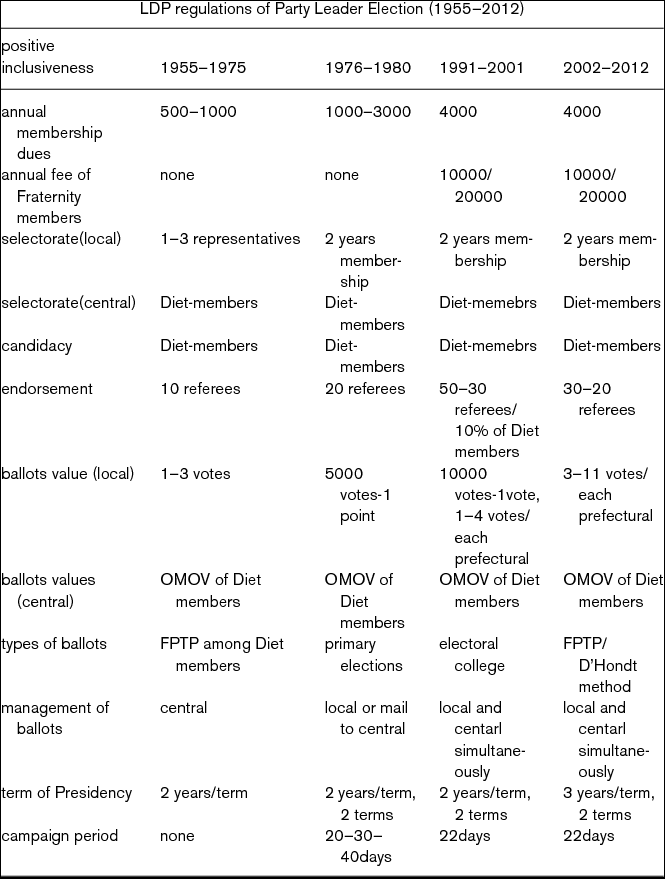
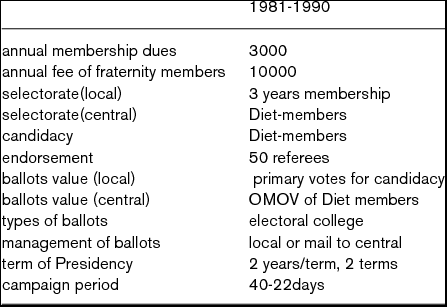
It also observes two trends, positive inclusiveness and negative inclusive involvement of the rank-and-file members. Judged by the size of the selectorate, the way of calculating ballots, terms of presidency, and campaign period, it identifies a swing-back effect (negative inclusiveness) from 1980 to the beginning of 1990s.
Regulations of party leadership election (1955–2012)
source: The 50 Years of Liberal Democratic Party of Japan (2006) (a&b)
Negative inclusivnesss tendency
The reason for this uncommon swing-back is the reformist actor's discontinuity. Applying Miki's proposal, the LDP launched the first nationwide primary election On 26 November 1978. Ohira obtained a surprising victory over the incumbent Fukuda and sustained party leadership in the intraparty disputes ‘40-day's crisis’. Meanwhile Ohira also served as the Chief of Party Reform Promotion Headquarters started in January 1979. According to his previous speeches, he was a firm supporter of promoting reforms of the party organizations. During a joint-interview with Fukuda on 24 September 1975, contrary to Fukuda's statement of maintaining the traditional way of reaching agreement among factions, Ohira expressed his preference for an open election (Ohira, Reference Ohira and Fumio2011: 328–41). Later on 17 October 1978, Ohira told a reporter from the Economist, ‘It is a matter of course we should have party presidential election’ (Ohira, Reference Ohira and Fumio2012: 549–66). However, Ohira's sudden passing away in 1980 put a temporary pause to further efforts of the Party Reform Promotion Headquarters. The party split of ‘New Liberal Club’ in 1976, caused a division among reformist groups inside the LDP, further weakened the reformists. Later ‘Kanemaru mediation’ went back to the old style of behind-the-scenes negations. The chain of events in the late 1970s and early 1980s showed that the discontinuity of the reformist groups and pushed the pendulum of party reform instead of moving forward but even stepped back.
Considering the uncommon ‘swing-back’ effect appeared between 1980s and 1990s, people may ask, would it swing again in the future? Evidence exists to show that the answer tends to be negative for the following two reasons.
First of all, generation changes among LDP politicians weaken those traditionalists who had benefited from the coalition-making politics. The traditionalists, particularly those key figures who successfully managed a counterattack against the introduction of an inclusive way to choose a leader thirty years ago, are mostly retired from politics and no more in powerful positions in the party. Electoral environment changes are also not favorable for them to recruit or keep followers.
Secondly, reformist discontinuity, which caused by the chain of events, reformists splitting, sudden death of leader and counterattack of traditionalists, will hardly occur again. It is quite true that ‘even absent major environmental changes, ‘gaps’ may emerge because the actors who inherit institutional arrangements are not the same as those who designed them’ (Pierson, Reference Pierson2004: 120), particularly when the institutional changes just took place. However, within years of the institutionalization of the party constitution, it is no more a mere power struggle just between the reformists and traditionalists. Once multiple actors are involved, it is difficult and costly for either side to interrupt or accelerate the institutional developments. The recent revision of the party constitution grants 47 prefectural representatives to join the run-off vote. It would require much more to take this privilege away from the local elites, since the LDP is still a ‘flexible cartel party’ which relies on national and prefectural bureaucracies through easy money politics.Footnote 17
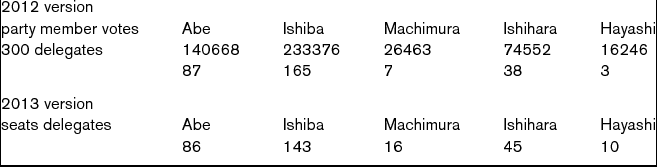
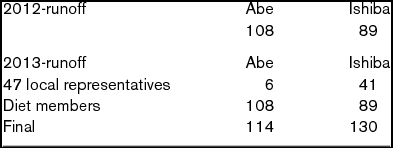
Does this revision make a difference? A reassessed calculation of the presidential contest in 2012 tells us that Ishiba would have been leading in the primary, 142 against 86. Then he would have been the party president by a final vote of 130 against 114.
2012 LDP presidential election primary results (2013 hypothetic)
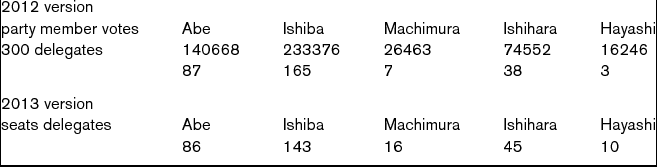
source: LDP Hompage published the local chapters’ voting results.
2012 LDP presidential election runoff (2013 hypothetic)
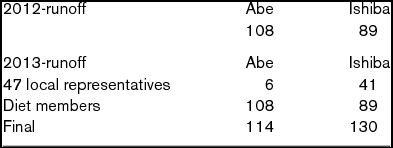
source: calculated based on the 2012 runoff results
The result of 2012 presidential election, in which Abe beat Nobuteru Ishihara from the party elders, shows the declining influence of factions in determining a party leader. The hypothetical assessment reveals that a national favorite candidate from the party's base in the prefectural branches is more likely to capture a final victory under the new rules. Instead of another pendulum swing, an inclusive national primary would remain a regular way to decide a party leader in the LDP.
5. Conclusion
By analyzing the slow and prolonged reforms in the LDP, this study presents a ‘discontinuity of reformists’ argument to explain how a ruling cartel party decided to grant more power to the rank and file members in choosing a party leader and why these reforms were stalled for as long as 25 years. Similar to most of the Westminster parties, the LDP followed the trend of democratizing party leadership selection. However, this study finds that the LDP's experiences present a different process. Working like a pendulum, not following a smooth linear process, it is not until 2003 that the LDP finally institutionalized an inclusive way to choose a leader.
A direct party member voting to decide the party leader is not yet a universal trend in political parties. Even in the LDP, it is still applying a weighted selectorate, which gives more power to the Diet members. Democratizing party leadership selection is still on its way. The previous assessments of the LDP's primary see it as ‘a test of local opinions’,Footnote 18 and ‘extensions of factional votes’.Footnote 19 They undervalue how systematic changes shaped the politics of choosing a leader in the government party in the long term. After years of disputes over the procedures, currently the central and local LDP members are involved simultaneously in the primary and run-off elections. The development of mass media gives the rank-and-file members more influence in the candidate nominations and nationwide campaign activities. Who decides the leader in the LDP, is a nested game among multiple actors, including the central, local executives, and rank-and-file members.
The pendulum's ‘swing-back’ highlights Duveger's concern that electing a party leader might be a process of ‘democratic in appearance and oligarchic in reality’ (Duverger, Reference Duverger1976: 133). It is problematic to assume that institutional arrangements follow a smooth linear process. The discontinuity of reformist actors indicates that an institutional change is a complex and pluralistic outcome, not simply a preoccupation with short-term considerations or performances. In theoretical terms, one tends to privilege institutional changes over stasis. The LDP experiences show that it is equally important to look into institutional development details, particularly not to overlook the stasis.
Different from Cross and Blais's four factors, the LDP's experiences indicate another possible factor which could push the party elites to pursue reforms: dealing with the money politics. Miki's proposal in 1976 was a response to the Lockheed scandal. The resumed reform in 1993 was also a response to the Sagawa scandal, which ended the ‘Kanemaru mediation’. For a long-ruling cartel party, a fatal money scandal is more powerful in convincing the party elites to take meaningful actions to ensure not just the party's survival, but also their individual political career survivals. In a political system where the opposition parties are not strong enough, scandals involved with money politics could be a latent factor to push the party elites to share power with the rank and file members.
Acknowledgement
Earlier versions of this article were presented at several research seminars in the Graduate School of Political Science, Waseda University. I owe particular thanks to Prof. Takashi YOSHINO and various colleagues who have read and given generous comments in the course of preparing this article. Of course, only the author can be held responsive for the remaining shortcomings.
About the author
Ying WANG is a Ph.D. Candidate of Political Science, Waseda University, Japan. She has a master's degree in international relations from Peking University, China. Her academic research mainly explores party politics in Japan, especially election performances and legislative career paths of dynastic politicians after political reform.