Although research regarding child and adolescent aggression has a long history, the predominant focus of this work has been on overt forms of aggressive behavior (i.e., physical and verbal actions, such as hitting, pushing, and name calling). In the last two decades, one additional form of aggression, referred to as relational aggression, has received significant research attention. Relational aggression has been defined as aggression that “involves harming others through purposeful manipulation or damage to their peer relationships” (Crick, Reference Crick1996, p. 2317) or behaviors where “the relationship serves as the vehicle of harm, including spreading malicious rumors, lies, gossip or secrets, as well as intentionally ignoring” (Murray-Close, Ostrov, Nelson, Crick, & Coccaro, Reference Murray-Close, Ostrov, Nelson, Crick and Coccaro2010, p. 393).
One of the legacies of the work by Nicki Crick, her colleagues, and her many students has been research clearly showing that children and adolescents are harmed by relationally aggressive acts against them. Even after controlling for overt physical and verbal forms of victimization, relational victimization has been found to contribute to peer rejection, loneliness, depression, social avoidance, emotional distress, delinquency, and drug use (Crick & Bigbee, Reference Crick and Bigbee1998; Crick & Grotpeter, Reference Crick and Grotpeter1996; see also Rys & Bear, Reference Rys and Bear1997; Sullivan, Farrell, & Kliewer, Reference Sullivan, Farrell and Kliewer2006). Similarly, enacting relational aggression has been linked with peer rejection (Crick, Reference Crick1996; Zimmer-Gembeck, Geiger, & Crick, Reference Zimmer-Gembeck, Geiger and Crick2005), as well as internalizing and externalizing behavior problems such as depression and delinquent behavior (Card, Stucky, Sawalani, & Little, Reference Card, Stucky, Sawalani and Little2008; Crick & Bigbee, Reference Crick and Bigbee1998; Crick, Ostrov, & Werner, Reference Crick, Ostrov and Werner2006; Murray-Close, Ostrov, & Crick, Reference Murray-Close, Ostrov and Crick2007). Given the potentially deleterious effects of relational aggression and victimization, ongoing efforts to enhance our understanding of the interrelations between these phenomena are warranted.
To date, multiple studies of children and early adolescents have found significant correlations between relational aggression and victimization (Crick & Bigbee, Reference Crick and Bigbee1998; Mathieson et al., Reference Mathieson, Murray-Close, Crick, Woods, Zimmer-Gembeck and Geiger2011; Sullivan et al., Reference Sullivan, Farrell and Kliewer2006). For example, Ostrov and colleagues (Ostrov, Reference Ostrov2008; Ostrov & Godleski, Reference Ostrov and Godleski2013) conducted two longitudinal studies aimed at more clearly delineating the association between relational aggression and relational victimization. In both, the social process model proposed by Boivin, Hymel, and Hodges (Reference Boivin, Hymel, Hodges, Juvonen and Graham2001) was tested. According to the authors of this model, children bring with them to their peer interactions relatively stable behavioral tendencies. These tendencies, which include a tendency toward aggression, can in turn lead to problematic peer behaviors, including harassment and victimization. Thus, in this model, it is aggression that is proposed to precede victimization.
In the first longitudinal study to apply this model to relational forms of aggression, Ostrov (Reference Ostrov2008) recruited an early childhood sample (average age = 44 months). Results revealed that girls' relational aggression was a significant predictor of relational victimization across the school year. More recently, Ostrov and Godleski (Reference Ostrov and Godleski2013) also reported that relational aggression in Grade 3 significantly predicted relational victimization in Grade 6, even after gender and physical aggression were controlled for. These studies provide preliminary evidence for the proposition that children who engage in relational aggression are themselves at risk for later relational victimization.
The social process model and other bodies of research on aggression and victimization also identify that such associations between aggression and later victimization may be stronger in some groups of children compared to others. For example, correlations between relational aggression and victimization vary widely and are sometimes much smaller than one might anticipate (range = ~.2 to >.6; see e.g., Matheison et al., 2011; Zimmer-Gembeck & Pronk, Reference Zimmer-Gembeck and Pronk2012), suggesting that certain characteristics of the children sampled might influence the strength of the relationship between relational aggression and victimization. One possibility is that children's own emotional sensitivity may strengthen the link between aggression and victimization. Card and Little (Reference Card, Little, Hawley, Little and Rodkin2007) and Bukowski and Abecassis (Reference Bukowski, Abecassis, Hawley, Little and Rodkin2007) suggest that aggression may be associated with victimization (as well as rejection) when aggressive youth are highly emotionally reactive and have difficulties regulating their emotions in social situations. In contrast, aggression may not lead to negative treatment by peers when aggressive youth are more emotionally competent, in that they can regulate their emotions in social situations. Additional support for these notions can be found in studies of emotional sensitivity, rejection, and loneliness, and in studies of emotional dysregulation and social status with peers. In particular, emotional sensitivities have been found to be elevated among adolescents who have experienced more rejection and feel lonelier (Chango, McElhaney, Allen, Schad, & Marston, Reference Chango, McElhaney, Allen, Schad and Marston2012; London, Downey, Bonica, & Paltin, Reference London, Downey, Bonica and Paltin2007; McLachlan, Zimmer-Gembeck, & McGregor, Reference McLachlan, Zimmer-Gembeck and McGregor2010; Zimmer-Gembeck, Trevaskis, Nesdale, & Downey, Reference Zimmer-Gembeck, Trevaskis, Nesdale and Downey2014), and there is some evidence that young people are less emotionally sensitive when they yield more power and status in the peer group (Frick & Morris, Reference Frick and Morris2004; Hawley, Reference Hawley2003; Hawley, Little, & Card, Reference Hawley, Little and Card2007). Thus, young people with heightened emotional sensitivity may have a poorer history of social relationships with peers and lower status in the peer group, which places them at greater risk of victimization in response to their aggression. When taken together, such findings suggest that the extent of the risk of relational aggression for concurrent and later relational victimization might vary from one child to the next, depending on their tendencies toward emotional sensitivity. Thus, in the present study we examined the association of relational aggression with concurrent and increasing victimization, and tested whether emotional sensitivity intensifies these associations.
Emotional Sensitivity
Another legacy of Nicki Crick is her work on social-information processing theory. In their reformulation of a social-information processing model for child adjustment, Crick and Dodge (Reference Crick and Dodge1994) argued that emotion and emotional sensitivity were integral parts of each social-information processing step. The important role of emotion has also been elaborated further. For example, it has been proposed that emotion-related individual differences (e.g., temperament factors such as emotionality or emotion regulation) contribute to social competence and adjustment (Lemerise & Arsenio, Reference Lemerise and Arsenio2000). Drawing on this premise, the current study examined whether emotional sensitivity, or the degree of distress experienced in relational situations, contributed to greater peer victimization across time via a strengthening of the relational aggression-relational victimization link. Specifically, three indicators of emotional sensitivity were considered: rejection sensitivity, fear of negative evaluation, and intimacy avoidance. These indicators were chosen because they assessed sensitivity linked to three important threats that are commonly encountered when adolescents interact with others: rejection, evaluation, and comfort with peer intimacy.
Rejection sensitivity
Rejection sensitivity is defined as “the disposition to anxiously or angrily expect, readily perceive, and overreact to rejection” (Downey, Khouri, & Feldman, Reference Downey, Khouri, Feldman, Cicchetti and Toth1997, p. 85). Initially examined primarily in university students and adults, research regarding rejection sensitivity has suggested that individuals who are highly sensitive might behave in ways that compromise their relationships, bringing about their feared outcome. For example, in a study of intimate relationships, Downey and Feldman (Reference Downey and Feldman1996) showed that high rejection-sensitive women were more hostile and emotionally unsupportive and high rejection-sensitive men were more jealous than their low rejection-sensitive counterparts. In turn, these behaviors led to greater partner dissatisfaction. Other research focusing on adult romantic relationships has replicated this general finding, showing that those with higher rejection expectations tend to behave in ways that elicit rejection (Downey, Freitas, Michaelis, & Khouri, Reference Downey, Freitas, Michaelis and Khouri1998; Levy, Ayduk, & Downey, Reference Levy, Ayduk, Downey and Leary2001; Smart Richman, & Leary, Reference Smart Richman and Leary2009).
Fewer studies have been conducted among children and adolescents. Nevertheless, there is evidence that supports the self-fulfilling nature of rejection sensitivity. In one study, Marston, Hare, and Allen (Reference Marston, Hare and Allen2010) examined the longitudinal associations between rejection sensitivity and social competence in a sample of 16-year-olds. They found that higher levels of rejection sensitivity predicted lower levels of competence across time. In another study of students in fifth to seventh grades (Downey, Lebolt, Rincon, & Freitas, Reference Downey, Lebolt, Rincon and Freitas1998), rejection sensitivity was associated with poorer social adjustment, including greater aggressive behavior, lower social competence, and greater victimization 1 year later. In yet another study, Zimmer-Gembeck, Nesdale, Fersterer, and Wilson (Reference Zimmer-Gembeck and Nesdale2014) found that children higher in rejection sensitivity were more likely to react with aggression when threatened with rejection. However, it is still unknown whether rejection sensitivity is specifically associated with relational victimization and whether this particular disposition heightens the likelihood of such victimization among adolescents who display relational aggression.
Fear of negative evaluation
Whereas rejection sensitivity relates specifically to the heightened anticipation of rejection, it has been argued that fear of negative evaluation describes a broader construct that involves anxious apprehension regarding others' evaluations (Fang et al., Reference Fang, Asnaani, Gutner, Cook, Wilhelm and Hofmann2011). Fear of negative evaluation can also be conceptualized as a core feature of social anxiety (Weeks et al., Reference Weeks, Heimberg, Fresco, Hart, Turk and Schneier2005), and it is typically this overarching variable that has been examined in relation to peer victimization. For example, Hawker and Boulton (Reference Hawker and Boulton2000), in their meta-analytic study, reported that those higher in social anxiety were more likely to be victimized. Crick and Grotpeter (Reference Crick and Grotpeter1996), considering overt and relational victimization separately, also found social anxiety to be significantly associated with both forms of negative peer interaction.
Moreover, studies that have examined fear of negative evaluation, rather than global social anxiety concerns, have reported findings showing that it is associated with more relational peer victimization. Storch, Brassard, and Masia-Warner (Reference Storch, Brassard and Masia-Warner2003) utilized a sample of adolescents and found greater fear of negative evaluation to be linked to greater relational victimization among both boys and girls. Storch and Masia-Warner (Reference Storch and Masia-Warner2004) subsequently replicated this pattern of findings using a female-only sample.
In explaining these results, the authors acknowledge that the experience of being repeatedly victimized could contribute to the development of a fear of negative evaluation (Storch & Masia-Warner, Reference Storch and Masia-Warner2004; Storch et al., Reference Storch, Brassard and Masia-Warner2003). However, they also highlight the possibility that fear of negative evaluation might precede relational victimization. That is, children who are particularly concerned about how others view them might display overt signs of their fears, thus placing them at risk for being victimized. The current study explored this hypothesis, particularly in relation to those who also engaged in relational aggression.
Intimacy avoidance
A final aspect of emotional sensitivity of interest in the present study was intimacy avoidance, or the desire to avoid close relationships with peers. Although this specific construct has not been considered previously in relation to peer victimization, indirect evidence is available to suggest that avoidance of intimacy could heighten the likelihood of peer victimization experiences.
One source of such evidence is studies that have examined a social process model (e.g., Boivin et al., Reference Boivin, Hymel, Hodges, Juvonen and Graham2001). As described previously, the social process model argues for the important role of children's particular behavioral tendencies for their social interactions. One of these could be a tendency toward social withdrawal. In turn, socially withdrawn children might have less chance to practice their social skills and have greater difficulties with their peers, increasing the chances that they will become the targets of victimization. To examine this proposition, Boivin, Hymel, and Bukowski (Reference Boivin, Hymel and Bukowski1995) followed children (aged 9 to 12 years) over a period of 1 year and found that withdrawal at the beginning of the study did predict victimization 1 year later. Dill, Vernberg, Fonagy, Twemlow, and Gamm (Reference Dill, Vernberg, Fonagy, Twemlow and Gamm2004) obtained a similar result in their 1-year longitudinal study, with a sample of children in third to fifth grades.
Studies focusing on social avoidance, a behavioral symptom of social anxiety, also add to this picture. Considering relational victimization in particular, Storch and colleagues revealed greater social avoidance to be associated with more relational victimization among both boys and girls (Storch et al., Reference Storch, Brassard and Masia-Warner2003; Storch & Masia-Warner, Reference Storch and Masia-Warner2004). However, these studies were cross-sectional in nature and thus do not allow conclusions regarding the direction of this relationship.
Therefore, the current study examined more specifically the nature of the association between intimacy avoidance and relational victimization. Rather than considering withdrawal or avoidance of peers because of shyness or more general anxiety, our focus on intimacy avoidance was more consistent with the other measures of emotional sensitivity in that it assessed sensitivity to interpersonal intimacy and closeness. Because of this focus on interpersonal emotional sensitivity in all three measures, we anticipated that, as per the other two indicators of emotional sensitivity, greater intimacy avoidance would be related to greater concurrent and consequent relational victimization, particularly among those who also engaged in higher levels of relational aggression.
Gender
A final aspect of the present study was its focus on gender. Although relational forms of aggression are often described as “female” forms of aggression, results regarding gender differences vary. A number of studies do show relational aggression to be more prevalent in girls than in boys (e.g., Crick & Bigbee, Reference Crick and Bigbee1998), but others indicate no gender differences in this type of behavior (Atlas & Peplar, Reference Atlas and Peplar1998; Paquette & Underwood, Reference Paquette and Underwood1999). Nevertheless, research does support the notion that girls are more likely to be involved in relational aggression than physical aggression (Geiger, Zimmer-Gembeck, & Crick, Reference Geiger, Zimmer-Gembeck, Crick, Moretti, Odgers and Jackson2004; Zimmer-Gembeck et al., Reference Zimmer-Gembeck, Geiger and Crick2005) and that, compared to boys, girls view the former type of aggression as more harmful (Coyne, Archer, & Eslea, Reference Coyne, Archer and Eslea2006; Galen & Underwood, Reference Galen and Underwood1997).
To further elucidate the role of gender in relation to aggression and victimization, Ostrov and Goldeski (Reference Ostrov and Godleski2010) proposed a model founded on social-information processing theory (Crick & Dodge, Reference Crick and Dodge1994) and gender schema theory (Bem, Reference Bem1981). They argued that children are exposed to gender-specific social environments, and as a result, gender differences in the developmental salience of different forms of aggression emerge, girls having a particular focus on relational aggression and boys on physical aggression. It is further argued that, owing to these differences, gender is an important moderator of the association between aggression and various social–psychological outcomes. Specifically, in terms of relational aggression, it would be anticipated that this form of aggression is more strongly associated with a range of outcome variables among girls than among boys.
In line with this model, evidence has emerged to support the necessity of examining the correlates of relational aggression and victimization separately for boys and for girls. In an early study of this form of aggression, Crick (Reference Crick1996) found that relational aggression did not add to the prediction of adjustment for boys, once overt aggression was controlled for. For girls, the contribution of relational aggression was significant, with those who were relationally aggressive being more rejected and less accepted by their peers. More recently, Ostrov (Reference Ostrov2008) found that relational aggression predicted increases in relational victimization across the school year for girls, but not for boys. In comparison, in their cross-sectional study, Mathieson et al. (Reference Mathieson, Murray-Close, Crick, Woods, Zimmer-Gembeck and Geiger2011) found greater relational victimization to be associated with greater relational aggression among both boys and girls. However, whereas hostile attributional bias and emotional sensitivity moderated this relationship for girls, no such moderation was found for boys.
The Current Study
In summary, the general purpose of the present study was to explore the concurrent and longitudinal associations between adolescents' relational aggression and relational victimization. Of particular interest was the question of whether emotional sensitivity, in the form of rejection sensitivity, fear of negative evaluation, and intimacy avoidance, moderated these associations. It was anticipated that emotional sensitivity would moderate the association between concurrent aggression and victimization, and between aggression and increased victimization over time, with the association between aggression and victimization stronger among adolescents higher in emotional sensitivity. Moreover, these relationships were examined separately for girls and for boys, and it was expected that moderation effects would be particularly strong for girls compared to boys, as has been found in previous research (Matheison et al., 2011). Three-way interactions among relational victimization, emotional sensitivity, and gender were also tested to explicitly determine whether moderation effects differed between boys and girls.
Method
Participants
The participants in this study were 176 boys (49%) and 178 girls (51%) in Grades 5–7 (age 9–13 years, M = 11.0 years, SD = 1.0 year) from two schools in an urban area of Queensland, Australia. The 354 students completed two assessments over a school year, separated by 8 months. Eight of the original 366 students who completed the first wave of the study relocated during the school year and did not complete the second wave of data collection. A further 4 students did not report their gender, so they were excluded from the analyses. The schools contained students from the low-middle to the high-middle range of socioeconomic status, and ethnicity represented the region from which the schools were selected, with approximately 90% White/Australian or New Zealander, and 10% Asian, Aboriginal Australian, Maori, Middle Eastern, or from other sociocultural backgrounds.
Participation in the study required parental consent and adolescent assent. The parental consent rate was 73%, with most of the nonparticipants simply failing to return consent forms rather than declining to participate.
Measures
Relational aggression and victimization
Ten items drawn from Crick and Grotpeter (Reference Crick and Grotpeter1995) were used to gather students' nominations of other adolescents in their classrooms who were aggressive (five items; e.g., “who spreads rumours, gossips, or talks behind others' backs?”) or victimized (five items; e.g., “who tends to get ditched by their friends for others?”). Each item was phrased in order to ask students to nominate up to three others in their classroom who fit each of the series of descriptors. Nominations were summed to provide a total number of nominations for each child for each item. These items were standardized within each classroom to adjust for unequal class sizes. Standardized items were averaged to create total scores for relational aggression (α = 0.87) and relational victimization (α = 0.90).
Rejection sensitivity
Six items from the Children's Rejection Sensitivity Questionnaire (Downey, Lebolt, et al., Reference Downey, Lebolt, Rincon and Freitas1998) measured anxious expectations of rejection. The questionnaire included written vignettes that implied the possibility of not being accepted or being overtly rejected. Vignettes involved teachers (three vignettes) or peers (three vignettes). Two responses to each vignette were used in this study to gauge children's anxious expectations of rejection. An example reads “Imagine that a famous person is coming to visit your school. Your teacher is going to pick five kids to meet this person. You wonder if she will choose YOU.” The first question assessed anxious responses by asking how nervous the student would feel if she were in this situation. Responses to this item ranged from 1 (not at all) to 5 (yes/extremely). The second question assessed perception of the likelihood of an accepting versus rejecting response from the others portrayed in the vignettes. An example item was “Do you think the teacher will choose YOU?” Responses were 1 (NO!), 2 (no, I don't think so), 3 (maybe), 4 (yes, probably), and 5 (YES!). To calculate total rejection sensitivity scores, the response to the anxious item was multiplied by the reversed response to the expectation item. Averaging these scores across the six vignettes produced a single, total rejection sensitivity score. Higher scores represented greater levels of rejection sensitivity, with Cronbach α for the scale of 0.79.
Fear of negative evaluation
To capture adolescents' anxiety about peer relationships, we used the fear of negative evaluation subscale (six items; e.g., “I worry what other kids think of me”) from the Social Anxiety Scale for Children—Revised (La Greca & Stone, Reference La Greca and Stone1993). Responses ranged from 1 (not at all true) to 5 (true all the time). Cronbach α was 0.90. Averaging the six items formed a fear of negative evaluation total score.
Intimacy avoidance
Drawing from theory and guided by items on the Experiences in Close Relationship Questionnaire (Brennan, Clark, & Shaver, Reference Brennan, Clark, Shaver, Simpson and Rholes1998), four items were developed for this study in order to assess adolescents' intimacy avoidance. Because these items had not been used in a previous study, they were subjected to factor analysis to examine whether the items loaded on one factor, as expected. Prior to conducting principal axis factoring, assumptions of this analysis were first investigated. The Kaiser–Meyer–Olkin Measure of Sampling Adequacy for the overall sample was fair (0.61). The Bartlett Test of Sphericity was significant, χ2 (6) = 163.1, p < .001, providing evidence for an acceptable number of significant correlations between variables. A clear one-factor solution was extracted, with an eigenvalue of 1.61. Three of the four avoidance items loaded highly. In a second factor analysis of these three items, they accounted for 50.9% of the variance in the factor and the loadings ranged from 0.41 to 0.62 (see Appendix A). Averaging the three items formed an intimacy avoidance total score. The Cronbach α was 0.51 for the three items.
Procedure
Approvals from the University Human Subjects Review Committee and the state appropriate school administration body were attained prior to the commencement of the study. Prior to the first wave of data collection, schools were visited to distribute parent information sheets and assent forms to students. Students took the forms home to their parents and returned them to the school on completion. Children with parental consent who also assented to participate were given questionnaire booklets during regular class hours within their normal classrooms. At each wave of data collection, questionnaires were completed in two sessions held 2 weeks apart to reduce student fatigue. Students without consent to participate completed an alternate task. It took approximately 20 min for students to complete the items used in this study. Questions were read aloud for the Grade 5 students, but students in Grades 6 and 7 completed the surveys at their own pace. Students were given the opportunity to debrief with a psychologist at each assessment.
Results
Descriptive statistics, association between measures, and comparisons of boys and girls
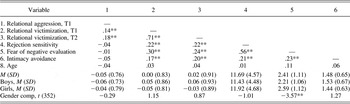
Table 1 provides the means and standard deviations for all measures, correlations between all variables, and gender comparisons of all measures. Relational aggression was associated with more victimization, but it was not associated with rejection sensitivity, fear of negative evaluation, or intimacy avoidance. However, victimization was associated with higher levels of all three emotional sensitivity measures, and the emotional sensitivity measures were intercorrelated with each other. There were no associations with age, but girls reported more fear of negative evaluation than boys reported.
Bivariate correlations between all variables, means and standard deviations, and comparison of boys (n = 176) and girls (n = 178)a

Note: N = 358. T1, Time 1; T2, Time 2.
a Four participants did not provide their gender.
*p < .05. **p < .01.
Associations of aggression and emotional sensitivity with concurrent victimization
We expected that relational aggression would be associated with higher levels of relational victimization, especially among adolescents with high emotional sensitivity. We also expected that these associations would be especially prominent among girls. To test these hypotheses about concurrent associations and moderation, we estimated three hierarchical linear regressions for boys and three for girls. In each model, we had two steps. In the first step, we entered relational aggression and a measure of emotional sensitivity (i.e., rejection sensitivity, fear of negative evaluation, or intimacy avoidance). In the second step, we entered the interaction between these two measures. If an interaction was significant, we reestimated the model using the Statistical Package for the Social Sciences Process macro (Hayes, Reference Hayes2013) and constructed a figure to illustrate the moderation effect,Footnote 1 and we tested the three-way interaction among relational aggression, emotional sensitivity, and gender in a model with all participants in order to determine whether the gender difference in moderation was significant.
Rejection sensitivity as a correlate and moderator
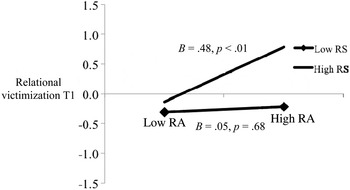
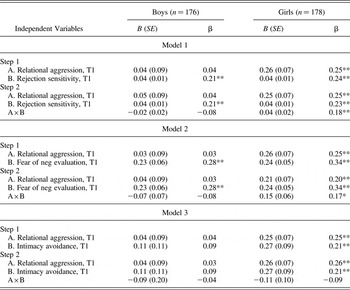
As can be seen in Model 1, estimated separately for boys and girls in Table 2, Step 1 revealed that rejection sensitivity was associated with greater concurrent levels of victimization for boys and for girls. Further, girls who were reported to be more aggressive were also reported as more victimized, but this association was not found among boys. In addition, the interaction between relational aggression and rejection sensitivity was significant for girls, but not for boys, as we had anticipated. Figure 1 illustrates this interaction and shows that the association between relational aggression and victimization was significant only among girls high in rejection sensitivity. This apparent gender difference in moderation was confirmed as significant in a model with all participants testing the three-way interaction of relational aggression, rejection sensitivity, and gender (β = 0.19, p < .05).
The association between girls' relational aggression (RA) and relational victimization at Time 1 (T1) moderated by rejection sensitivity (RS). The three-way interaction of relational aggression, RS, and gender was significant (β = 0.19, p < .05).

Results of regressing Time 1 (T1) victimization on aggression and emotional sensitivity, and tests of the moderating effects of emotional sensitivity

Note: Age was also included in the models, but it is not shown and was never significantly associated with relational victimization. Boys: Model 1: Step 1, R 2 = .06, F (3, 172) = 3.6*; Step 2, ΔR 2 = .01, ΔF (1, 171) = 1.2. Model 2: Step 1, R 2 = .07, F (3, 172) = 5.5**; Step 2, R 2 = .01, ΔF (1, 171) = 1.2. Model 3: Step 1, R 2 = .03, F (3, 172) = 1.4; Step 2, ΔR 2 = .00, Δ F(1, 171) = 0.2. Girls: Model 1: Step 1, R 2 = .10, F (3, 174) = 7.9**; Step 2, ΔR 2 = .03, Δ F (1, 173) = 6.2*. Model 2: Step 1, R 2 = .16, F (3, 174) = 12.6**; Step 2, R 2 = .03, ΔF (1, 173) = 5.6*. Model 3: Step 1, R 2 = .11, F (3, 174) = 7.0**; Step 2, ΔR 2 = .01, ΔF (1, 173) = 1.4.
*p < .05. **p < .01.
Fear of negative evaluation as a correlate and moderator
The results for similar analyses with fear of negative evaluation replacing rejection sensitivity are also provided in Table 2 (Model 2). As was found for rejection sensitivity, Step 1 revealed that fear of negative evaluation was associated with greater concurrent levels of victimization for boys and for girls. In addition, the interaction between relational aggression and fear of negative evaluation was significant for girls, but not for boys, as we had anticipated. Figure 2 illustrates this interaction and shows that the association between relational aggression and victimization was significant only among girls high in rejection sensitivity. This apparent gender difference in moderation was confirmed as significant in a model with all participants testing the three-way interaction of relational aggression, fear of negative evaluation, and gender (β = 0.18, p < .05).
The association between girls' relational aggression (RA) and relational victimization at Time 1 (T1) moderated by fear of negative evaluation (FNE). The three-way interaction of relational aggression, FNE, and gender was significant (β = 0.18, p < .05).

Intimacy avoidance as a correlate and moderator
In the final two models, intimacy avoidance was the emotional sensitivity measure of interest (see Table 2, Model 3). In Step 1, intimacy avoidance was associated with more victimization among girls but not among boys. Interactions between relational aggression and intimacy avoidance, tested in Step 2, were not significant for boys or for girls.
Associations of aggression and emotional sensitivity with victimization over time
The next models tested whether these associations and moderation effects would be found over time by testing whether Time 1 (T1) relational aggression was associated with Time 2 (T2) relational victimization after we had adjusted for T1 relational victimization. For ease of expression, we refer to these models as examining changes in relational victimization over time. In each model, the dependent variable was relational victimization assessed at T2. We again tested three hierarchical linear regressions for boys and three for girls using two steps. In the first step, we entered T1 relational victimization, T1 relational aggression, and a measure of T1 emotional sensitivity. In the second step, we entered the interaction between T1 aggression and T1 emotional sensitivity. As done previously, if an interaction was significant, we reestimated the model using the Statistical Package for the Social Sciences Process macro (Hayes, Reference Hayes2013) and constructed a figure to illustrate the moderation effect. A model including the three-way interaction of relational aggression, emotional sensitivity, and gender was also subsequently tested to determine whether gender differences in moderation were significant.
Rejection sensitivity as a correlate and moderator of changes in relational victimization
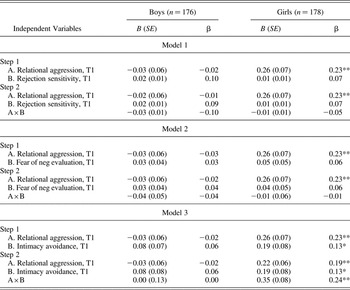
As shown in Table 3, Model 1 revealed no association of rejection sensitivity with changes in relational victimization over time for either boys or girls. However, girls who were identified by their peers as more relationally aggressive at T1 showed more relative increases in victimization from T1 to T2. This association was not found for boys. For these models, the interactions, tested in Step 2, were also not significant for boys or for girls.
Results of regressing Time 2 Victimization (net of Time 1 [T1] victimization) on aggression and emotional sensitivity, and tests of the moderating effects of emotional sensitivity

Note: Age and relational victimization at T1 were also included in the models, but they are not shown here. Boys: Model 1: Step 1, R 2 = .63, F (4, 171) = 72.3**; Step 2, ΔR 2 = .01, ΔF (1, 170) = 5.0*. Model 2: Step 1, R 2 = .61, F (4, 171) = 70.0**; Step 2, R 2 = .00, ΔF (1, 170) = 0.8. Model 3: Step 1, R 2 = .62, F (4, 171) = 1.4; Step 2, ΔR 2 = .00, ΔF (1, 170) = 0.0. Girls: Model 1: Step 1, R 2 = .46, F (4, 173) = 36.1**; Step 2, ΔR 2 = .00, ΔF (1, 172) = 0.8. Model 2: Step 1, R 2 = .45, F (4, 173) = 35.9**; Step 2, R 2 = .00, ΔF (1, 172) = 0.0. Model 3: Step 1, R 2 = .47, F (4, 173) = 38.1**; Step 2, ΔR 2 = .06, ΔF (1, 172) = 20.2**.
*p < .05. **p < .01.
Fear of negative evaluation as a correlate and moderator of changes in relational victimization
Model 2, estimated separately for boys and girls in Table 3, showed no association between fear of negative evaluation and changes in relational victimization over time. The interactions, tested in Step 2, were not significant for boys or for girls.
Intimacy avoidance as a correlate and moderator of changes in relational victimization
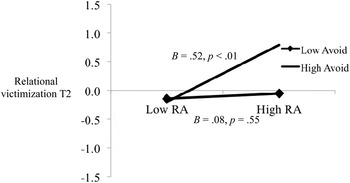
As can be seen in Table 3, Step 1 of Model 3 revealed that girls (but not boys) who reported greater intimacy avoidance at T1 were reported by their peers to be more relationally victimized by T2 relative to T1. In addition, in support of the hypotheses, the interaction between relational aggression and intimacy avoidance was significant for girls, but not for boys. Figure 3 illustrates this interaction and shows that the association between relational aggression and avoidance was significant only among girls high in intimacy avoidance. This apparent gender difference in moderation was confirmed as significant in a model with all participants testing the three-way interaction of relational aggression, intimacy avoidance, and gender (β = 0.18, p < .05).
The association between girls' Time 1 (T1) relational aggression (RA) and Time 2 (T2; relative to T1) relational victimization moderated by intimacy avoidance. The three-way interaction of relational aggression, intimacy avoidance, and gender was significant (β = 0.18, p < .05).

Discussion
The present longitudinal study supported the social process model by showing that relational aggression is associated with increasing relational victimization over time. In addition, we extended this model to show that early adolescents' personal emotional sensitivities strengthen associations between aggression and victimization, especially among girls. Although recent research has supported a social process model by showing that earlier relational aggression predicts increasing victimization over time among young children (Ostrov & Godleski, Reference Ostrov and Godleski2013), to our knowledge, all previous studies on the social process model in combination with the role of emotional vulnerabilities in these social processes have been cross-sectional (see Matheison et al., 2011).
In the present study, multiple aspects of early adolescents' emotional vulnerability were examined, and there was good consistency in the findings across different measures, strengthening support for their importance for understanding relational aggression and its links to victimization. As has been very important in this area of research (Card et al., Reference Card, Stucky, Sawalani and Little2008; Matheison et al., 2011; Rose & Rudolph, Reference Rose and Rudolph2006; Zimmer-Gembeck, Pronk, Goodwin, Mastro, & Crick, Reference Zimmer-Gembeck, Pronk, Goodwin, Mastro and Crick2013), we differentiated all analyses by gender, expecting that our models would apply more strongly to girls than to boys. The results were in line with our expectations. Although victimization and aggression were associated among girls, and more strongly associated among girls higher in emotional sensitivity, they were not associated for boys either concurrently or over time, regardless of the level or type of emotional sensitivity that was under examination.
More specifically, when the associations between relational aggression and concurrent and later relational victimization were examined, small associations were found among the entire sample. However, when these associations were examined separately for boys and for girls in multivariate models (which also accounted for the impact of emotional sensitivity), no association between relational aggression and victimization was found for boys either concurrently or over time. In contrast, girls who were reported by their peers to be more relationally aggressive were more highly victimized concurrently and were victimized increasingly over time. The consideration of emotional sensitivities, including rejection sensitivity, fear of negative evaluation, and intimacy avoidance, helped to explain these associations. When two of these sensitivities, rejection sensitivity and fear of negative evaluation, were heightened in girls, the concurrent association between relational aggression and victimization was particularly strong, but there was no association between aggression and victimization when these sensitivities were low. When longitudinal analyses were conducted, the findings were similar, but the significant moderator was intimacy avoidance. Thus, girls who were reported by their peers to be higher in relational aggression were also reported to experience more relational victimization over time, but this was only the case for girls with heightened intimacy avoidance.
To summarize, the major finding of the present study was that relational aggression does co-occur quite strongly with relational victimization and predict increasing victimization over time, but these associations are made much clearer by also considering gender and emotional sensitivity. Specifically, the association between relational aggression and victimization is significant, but small, when it is examined among all girls and boys, but it is never significant when examined for boys only. For girls only, the associations between relational aggression and victimization are significant for those with heightened emotional sensitivity.
These findings illustrate key propositions of the developmental psychopathology framework by isolating the interplay between psychological and social-contextual elements of functioning and adjustment (Cicchetti & Toth, Reference Cicchetti and Toth2009). In particular, they underscore how similar behaviors can result in different responses from the social world because of personal determinants, which together might explain divergent developmental pathways to social and emotional adaptive or maladaptive outcomes. Thus, building on these findings could identify multifinality, whereby particular behaviors, even in combination with similar emotional sensitivities, might result in a developmental pathway of disorder (e.g., depression and social anxiety) for girls but not for boys.
The fact that the current study shows girls who are highly aggressive to be more highly victimized only when they have high, but not low, emotional sensitivity suggests that relational aggression may provoke two different types of reactions from others, dependent on the girl's level of emotional sensitivity. This raises the question of why some girls can engage in high levels of relational aggression but not encounter victimization in response. The present study findings suggest that high emotional sensitivity is risk producing and low sensitivity is protective of victimization by peers, but there are multiple potential mechanisms regarding how this occurs for aggressive girls.
One possibility is that some girls are low in sensitivity because they have had fewer negative peer experiences, such as rejection. For example, it is known that the emotional sensitivities of rejection sensitivity, fear of negative evaluation, and social withdrawal (which may be associated with intimacy avoidance) are higher among adolescents who have experienced more rejection and feel lonelier (Chango et al., Reference Chango, McElhaney, Allen, Schad and Marston2012; London et al., Reference London, Downey, Bonica and Paltin2007; McLachlan et al., Reference McLachlan, Zimmer-Gembeck and McGregor2010; Zimmer-Gembeck, Trevaskis, et al., Reference Zimmer-Gembeck, Trevaskis, Nesdale and Downey2014). Hence, aggressive girls who are low on sensitivity may have both a history of social relationships and current social relationships with their peers that are more positive than girls who are aggressive and sensitive. It may be positive social history that protects the former group from victimization.
A second possibility is that, rather than being particularly low on peer rejection, girls who are relationally aggressive and low on sensitivity may yield power and status in the group, sending a signal that victimization is not an acceptable response. These girls are able to be relationally aggressive without suffering victimization in return. Such a pattern may identify girls with high status in the peer group who are also able to use relational aggression in a more instrumental manner that is targeted toward resource management and access (Frick & Morris, Reference Frick and Morris2004; Hawley, Reference Hawley2003; Hawley et al., Reference Hawley, Little and Card2007).
Consistent with this second possibility, research has shown that instrumental aggression is more weakly associated with peer victimization and emotional dysregulation than is reactive aggression (Card & Little, Reference Card, Little, Hawley, Little and Rodkin2007). Thus, examining relational aggression in combination with emotional sensitivity may be identifying two different forms of aggression: an instrumental form of aggression that is more common when girls are low in emotional sensitivity and can implement relational aggression somewhat proactively and strategically to gain resources and to avoid peer relationship problems, and a reactive form that occurs more frequently among youth who are more emotionally sensitive and may have difficulties with emotion dysregulation and display some social skill deficits. Such a view also recognizes the possible dyadic nature of aggression, whereby features of the victims of the aggression may partly determine whether victimization occurs in response to aggression. For example, aggressive girls who are not overly emotionally sensitive may be aggressing against peers whom they have selected because they are less likely to respond with victimization. In contrast, aggressive girls who are emotionally sensitive may be less selective because they are highly reactive to social situations. This may mean that they are more at risk of victimization in response to their behavior (Bukowski & Abecassis, Reference Bukowski, Abecassis, Hawley, Little and Rodkin2007; Card & Little, Reference Card, Little, Hawley, Little and Rodkin2007; Sippola, Paget, & Buchanan, Reference Sippola, Paget, Buchanan, Hawley, Little and Rodkin2007).
A third possibility is that girls' misinterpretation of social situations plays a role. For example, girls higher in rejection sensitivity are biased toward perceiving rejection and overreacting to it (Downey, Lebolt, et al. Reference Downey, Lebolt, Rincon and Freitas1998; Levy et al., Reference Levy, Ayduk, Downey and Leary2001; Zimmer-Gembeck, Trevaskis, et al., Reference Zimmer-Gembeck, Trevaskis, Nesdale and Downey2014). One reaction is likely to be aggression (Zimmer-Gembeck & Nesdale, Reference Zimmer-Gembeck and Nesdale2013), and for girls, this will most likely be relational aggression (Crick & Grotpeter, Reference Crick and Grotpeter1995; Geiger et al., Reference Geiger, Zimmer-Gembeck, Crick, Moretti, Odgers and Jackson2004). Thus, their peers may consider their aggressive behavior as more inappropriate to the situation or inexplicable, which results in greater relational victimization as retaliation.
In summary, all of these possibilities have some, but limited, research support. Future research might focus on whether each of these three possible mechanisms of risk for, and protection from, relational victimization as a response to relational aggression operate and, if they do, whether they are all simultaneously important to understanding the dynamics of adolescent aggression and victimization. It will also be important to further consider why these associations are only found for girls and not for boys. In particular, why would emotionally sensitive girls' relational aggression be a spark for relational victimization by peers, but the same pattern is not found for boys? It could be that an examination of multifinality is needed in future research via the investigation of a greater range of peer responses to aggression (Cicchetti & Toth, Reference Cicchetti and Toth2009). In particular, boys' relational aggression could yield responses other than relational victimization from peers. One such peer response could be physical victimization, with previous research showing that different sensitivities and mechanisms account for when and why aggression is associated with physical victimization in comparison to relational forms of aggression and victimization (e.g., Sijtsema, Shoulberg, & Murray-Close, Reference Sijtsema, Shouldberg and Murray-Close2011). It also may be that, because peer groups usually remain gender segregated in early adolescence, girls and boys select different targets for their relational aggression, with girls selecting girls and boys selecting boys. Girls have been found to place more importance on relational aggression and be more reactive to it, so they may be more likely to retaliate with victimization then are boys (Rose & Rudolph, Reference Rose and Rudolph2006; Zimmer-Gembeck et al., Reference Zimmer-Gembeck, Pronk, Goodwin, Mastro and Crick2013). To investigate these potential mechanisms, it would be informative to examine multiple social outcomes of aggression in combination with examining features of the targets of such aggression in future research.
Although relational aggression and victimization were not significantly associated among boys, we did find that boys (and girls) who are higher in emotional sensitivity are reported by their classmates to be higher in relational victimization concurrently. Thus, sensitivity, but not aggression, may place boys at risk for more relational victimization. In particular, it was boys' greater rejection sensitivity and fear of negative evaluation, but not intimacy avoidance, that accounted for peer reports of boys' heightened relational victimization. Boys with such increased sensitivity might show anxiety and vulnerability in social interactions, thus placing them at more risk for relational victimization. These findings, therefore, add to previous research that has shown boys and girls who report elevated levels of social anxiety or social phobia to be more likely to experience concurrent relational victimization (Storch et al., Reference Storch, Brassard and Masia-Warner2003), as well as increasing the likelihood that they will experience increasing victimization over time (Storch, Masia-Warner, Crisp, & Klein, Reference Storch, Masia-Warner, Crisp and Klein2005).
One other set of findings to mention is the lack of gender differences in relational aggression and victimization, as well as the finding of only one difference in emotional sensitivity (girls were higher in fear of negative evaluation than were boys). This means that it is not the level of relational aggression and victimization that differentiates boys and girls, but rather their interrelationship and the moderation of the interrelationship by emotional sensitivity.
The current study had a number of significant strengths, three of which were the longitudinal design, the use of multiple reporters, and the different response formats used to assess the three different emotional sensitivity measures. Despite these strengths, the study also had three primary limitations to acknowledge. First, some analyses were based on cross-sectional data, and the longitudinal findings were based on two waves with 8 months between them. This short time period may have been a study limitation because there was little time for change in victimization to occur. Second, mostly White Australians participated, which limits generalizability. Third, the measure of intimacy avoidance was developed for this study. This measure had a lower reliability than would be ideal, despite being founded on a widely used measure designed for older adolescents and adults. Further research is needed to extend this measure or to replicate this study using a new measure that has been recently published for use with adolescents (Wilkinson, Reference Wilkinson2011).
Investigating pathways and interactions between individual characteristics (such as rejection sensitivity) and social history of relational aggression can be used to identify when and why relational victimization occurs and escalates for some young people, particularly for some girls. Therefore, these empirical findings have applied implications. First, interventions focused on girls' relationally aggressive behavior in combination with their emotional sensitivity might be needed to reduce victimization, as well as aggression, among early adolescents. Although such intervention might benefit the entire peer group of a school, it could also be particularly crucial to the well-being of those girls who are both relationally aggressive and relationally victimized. Studies focusing on more general forms of aggression have highlighted aggressive victims as being at a heightened risk for poorer peer relations and poorer emotional adjustment (Nansel et al., Reference Nansel, Overpeck, Pilla, Ruan, Simons-Morton and Scheidt2001; Schwartz, Reference Schwartz2000; Toblin, Schwartz, Hopmeyer Gorman, & Abou-ezzeddine, Reference Toblin, Schwartz, Hopmeyer Gorman and Abou-ezzeddine2005), with researchers arguing this risk is likely to extend to aggressive relational victims (Crick et al., Reference Crick, Nelson, Morales, Cullerton-Sen, Casas, Hickman, Juvonen and Graham2001).
Second, practitioners should assess a range of specific emotional sensitivities to determine what to address. The sensitivities measured here were varied and included a heightened anxious expectation of rejection, a more general fear of being negatively evaluated by others, and a tendency to de-value intimacy and closeness with peers. One or all of these may be concerns requiring intervention for a single relationally aggressive young person.
Third, peers could be allies in these processes, providing information useful for identifying young people at risk, as well as being important participants in school-based interventions. Peers have the ability to report about who is aggressive and who is victimized in the school, and recent findings show that adolescents can also report about whom among their classmates has heightened rejection sensitivity (Zimmer-Gembeck, Trevaskis, et al., Reference Zimmer-Gembeck, Trevaskis, Nesdale and Downey2014). Evidence regarding the effectiveness of the KiVa antibullying program also highlights the crucial role that peers might play during intervention. A key goal of the KiVa program is to encourage bystanders to take an active role in supporting children who are victimized. Emerging findings support the efficacy of this strategy in reducing bullying and victimization in general (Kärnä et al., Reference Kärnä, Voeten, Little, Poskiparta, Alanen and Salmivalli2011), as well as relational forms of victimization in particular (Salmivalli, Kärnä, & Poskiparta, Reference Salmivalli, Kärnä and Poskiparta2011).
Conclusion
The present study builds upon the huge body of theory and research left to us by Nicki Crick. The findings also are consistent with many developmental psycholopathology propositions (Cicchetti & Toth, Reference Cicchetti and Toth2009), most important the need to examine the interplay between many levels of child and adolescent experiences in order to identify pathways that maintain, enhance, or degrade social or personal adjustment. We have shown that, during early adolescence, relationally aggressive behavior is not always associated with being victimized. Rather, consideration of the additional factors of emotional sensitivity and gender can help to isolate when they are and when they are not linked. For early adolescent girls, relational aggression only predicts concurrent or future victimization among those high in emotional sensitivity, in the form of rejection sensitivity, fear of negative evaluation, and intimacy avoidance. For early adolescent boys, although relational aggression was not a correlate of victimization, two emotional sensitivities (i.e., rejection sensitivity and fear of negative evaluation) did play a role in understanding why certain boys were more highly victimized than others. These findings have applied implications and can be used to strengthen the bridge between research and practice. More intense intervention efforts that address the emotional sensitivities of rejection sensitivity, fear of negative evaluation by others, and the avoidance of intimate peer relationships as risk factors might assist in reducing relational aggression and victimization among both girls and boys.
Appendix A
Intimacy avoidance items and factor loadings
-
Item 1. Nervous when friends want to be around me (0.41)
-
Item 2. Don't want to get to know other kids (0.62)
-
Item 3. Try to avoid other kids (0.52)
Response options = 1 (not at all true about me) to 5 (very true about me)