Introduction
Zeolites are one of the most complex mineral groups in terms of crystal structure and crystal chemistry (Armbruster and Gunter, Reference Armbruster and Gunter2001), which leads to several difficulties in unambiguously defining a zeolite mineral species. Guidelines for nomenclature and distinction rules for new zeolite species by Coombs et al. (Reference Coombs, Alberti, Armbruster, Artioli, Colella, Galli, Grice, Liebau, Mandarino, Minato, Nickel, Passaglia, Peacor, Quartieri, Rinaldi, Ross, Sheppard, Tillmanns and Vezzalini1997) recommend that zeolites with the same topological framework, exhibiting a wide variety of extra-framework cations form a series. The end-members of the series are defined on the basis of the most abundant extra-framework cation in atomic proportions. The disparity in Si:Al ratio, the different hydration levels (i.e. content of H2O), differences in space-group symmetry, and order–disorder distributions of cations at the tetrahedral sites are not sufficient criteria to distinguish a new zeolite mineral species. However, there may be exceptions to all of these rules. Coombs et al. (Reference Coombs, Alberti, Armbruster, Artioli, Colella, Galli, Grice, Liebau, Mandarino, Minato, Nickel, Passaglia, Peacor, Quartieri, Rinaldi, Ross, Sheppard, Tillmanns and Vezzalini1997) give an example of gismondine-Ca, Ca4[Al8Si8O32]⋅16H2O, and garronite-Ca, Ca3[Al6Si10O32]⋅14H2O (Coombs et al., Reference Coombs, Alberti, Armbruster, Artioli, Colella, Galli, Grice, Liebau, Mandarino, Minato, Nickel, Passaglia, Peacor, Quartieri, Rinaldi, Ross, Sheppard, Tillmanns and Vezzalini1997). Both are calcium dominant and are characterised by GIS topology (see the chapter on ‘Crystallography of GIS-type structure’ in the Background information section of Coombs et al., Reference Coombs, Alberti, Armbruster, Artioli, Colella, Galli, Grice, Liebau, Mandarino, Minato, Nickel, Passaglia, Peacor, Quartieri, Rinaldi, Ross, Sheppard, Tillmanns and Vezzalini1997). Nevertheless, garronite-Ca is notable for the disordered Si/Al distribution of the framework, and partial replacement of Ca by Na, resulting in a different space group with respect to gismondine-Ca. The GIS framework-type is also characteristic of alkali-dominant zeolites: fully ordered amicite, K4Na4[Al8Si8O32]⋅10H2O, and (Si, Al) disordered gobbinsite, Na5[Al5Si11O32]⋅11H2O. It is worth adding that monoclinic Ba-dominant gismondine, Ba4[Al8Si8O32]⋅12H2O, has been found only in anthropogenic material hence it is not approved by the Commission on New Minerals, Nomenclature and Classification of the International Mineralogical Association (IMA–CNMNC).
It has been 25 years since Coombs et al. (Reference Coombs, Alberti, Armbruster, Artioli, Colella, Galli, Grice, Liebau, Mandarino, Minato, Nickel, Passaglia, Peacor, Quartieri, Rinaldi, Ross, Sheppard, Tillmanns and Vezzalini1997) published their guidelines for zeolite mineral species. The recent findings of garronite-Na, Na6[Al6Si10O32]⋅8.5H2O, and gismondine-Sr, Sr4[Al8Si8O32]⋅9H2O, have revealed, however, the necessity of reviewing the data of minerals with GIS structure topology. This paper provides new data about gismondine-Sr from its second recorded occurrence at the Bellerberg volcano in Germany. Previously, it has been known only at the Halamish locality from the pyrometamorphic rocks of the Hatrurim Complex, Israel (Skrzyńska et al., Reference Skrzyńska, Cametti, Galuskina, Vapnik and Galuskin2023). Additionally, we provide data on barium-rich gismondine. Finally, we proposed revising the definition and classification for zeolites with GIS framework type.
Background information
Crystallography of the GIS-type structure
The GIS-type structure belongs to the group of doubly connected 4-membered ring chains. It is characterised by two (4- and 8-membered rings of tetrahedra) secondary building units (SBU) (Baerlocher et al., Reference Baerlocher, McCusker and Olson2007). The 4-membered rings are connected by sharing oxygen atoms and form a double crankshaft chain (Fig. 1a). The rings are alternatively oriented upwards and downwards, defining a T–O–T angle and resulting in a ~10 Å periodicity of the chains (Armbruster and Gunter, Reference Armbruster and Gunter2001). Thus, the T–O–T angle is determined by two adjacent rings in the double crankshaft chain pointing in opposite directions. In a gismondine structure-type, there are two systems of double crankshaft chains, which are perpendicular to each other and run parallel to the a and b axis, creating 8-membered ring channels (Fig. 1b). The ellipticity of the 8-membered aperture results from the T–O–T angle in the double crankshaft chain, which is perpendicular to the 8-membered rings window (Fig. 1; Skrzyńska et al., Reference Skrzyńska, Cametti, Galuskina, Vapnik and Galuskin2023). The cage (t-gsm, pore descriptor 4684), which hosts extra-framework cations and water molecules, is formed at the intersection of the perpendicular double crankshaft chains. The type of extra-framework cations in these cages leads to modifications of the flexible zeolite framework (Skrzyńska et al., Reference Skrzyńska, Cametti, Galuskina, Vapnik and Galuskin2023). The symmetry of the GIS structure-type varies from tetragonal to monoclinic (Hansen et al., Reference Hansen, Håkansson and Fälth1990; Håkansson et al., Reference Håkansson, Fälth and Hansen1990). The archetype symmetry (topological symmetry) of the GIS topology is I41/amd. This symmetry corresponds to that of the synthetic phase (called Na-P) – sodium high silica compound (Na4[Al4Si12O32]⋅14H2O; a = 9.9989(4) Å; and c = 10.0697(4) Å) (Baerlocher and Meier, Reference Baerlocher and Meier1972; Håkansson et al., Reference Håkansson, Fälth and Hansen1990, Supplementary Table S1). The topological symmetry is reduced to at least orthorhombic (Fddd) by the ordering of the cations at the framework T-sites. In turn, the ordered arrangement of extra-framework cations lowers the orthorhombic symmetry to monoclinic (Gottardi, Reference Gottardi1979; Gottardi and Galli, Reference Gottardi and Galli1985; Armbruster and Gunter, Reference Armbruster and Gunter2001).
(a) Double crankshaft chain with marked T–O–T angle between upward and downward 4-membered rings; (b) framework of GIS structure-type with 8-membered ring channels. A red colour marks double the crankshaft chains, the first perpendicular to the picture plane and the second parallel to the picture plane (drawn with CrystalMaker ® software).

Minerals with GIS structure type
Gismondine-Ca is the most common species among minerals with GIS topology. It is characterised by a monoclinic structure with (Si, Al) distribution fully ordered at T sites (Table 1). However, the symmetry can change to orthorhombic due to dehydration (van Reeuwijk, Reference van Reeuwijk1971; Vezzalini et al., Reference Vezzalini, Quartieri and Alberti1993; Wadoski-Romeijn and Armbruster, Reference Wadoski-Romeijn and Armbruster2013). The R-value, defined as Si/(Si+Al+Fe), varies from 0.50 to 0.54 (Passaglia and Sheppard, Reference Passaglia, Sheppard, Bish and Ming2001). The monovalent cations are present in negligible amounts (Vezzalini and Oberti, Reference Vezzalini and Oberti1984). Ba-rich gismondine has only been found in weathered lead-smelting slags, therefore, it has not been approved as a new mineral species. Its crystals exhibited monoclinic symmetry and a slight amount of sodium and calcium were revealed in the chemical composition (Braithwaite et al., Reference Braithwaite, Dyer and Wilson2001). Strontium impurities, however, were detected only as insignificant substitutions (Vezzalini and Oberti, Reference Vezzalini and Oberti1984; Passaglia and Sheppard, Reference Passaglia, Sheppard, Bish and Ming2001). Gismondine-Sr has been discovered recently in voids from the pyrometamorphic rock of the Hatrurim Complex in Israel (Skrzyńska et al., Reference Skrzyńska, Cametti, Galuskina, Vapnik and Galuskin2023). Despite the ordered framework and Si/Al ratio equal to 1, its symmetry was found to be orthorhombic (Table 1) with channels that are elliptically deformed with respect to the monoclinic calcium variety (Skrzyńska et al., Reference Skrzyńska, Cametti, Galuskina, Vapnik and Galuskin2023). Gismondine-Sr has a lower water molecule content and a significant substitution of monovalent cations (especially K), arranged randomly in the channels.
Zeolite minerals with GIS framework type.

The GIS zeolite with Si/Al ratio equal to 1 containing K and Na as dominant cations is amicite (Alberti and Vezzalini, Reference Alberti and Vezzalini1979). This is a rare zeolite known only from a few localities (Pekov and Podlesnyi, Reference Pekov and Podlesnyi2004; Calvo et al., Reference Calvo, Viñals, Sanz and Martí2013; Jackson et al., Reference Jackson, Couper, Stan, Ivarsson, Czabaj, Tamura, Parkinson, Miyagi and Moore2019). Similar to gismondine minerals, the R-value is ~0.5. The structure is also monoclinic and perfectly ordered (framework and extra-framework cations, Table 1). The positions of Na and K sites in amicite correspond to the Ca and H2O sites in gismondine, respectively (Alberti and Vezzalini, Reference Alberti and Vezzalini1979). Consequently, amicite has a lower hydration level than monoclinic gismondine-Ca. In addition, amicite shows no significant variation in the chemical composition, and Ca is present in minor amounts (Passaglia and Sheppard, Reference Passaglia, Sheppard, Bish and Ming2001; Pekov and Podlesnyi, Reference Pekov and Podlesnyi2004). Interestingly, amicite can be completely dehydrated retaining the monoclinic symmetry (Vezzalini et al., Reference Vezzalini, Alberti, Sani and Triscari1999; Armbruster and Gunter, Reference Armbruster and Gunter2001).
Other zeolites with GIS framework-type display a lower Si/Al ratio with respect to gismondine and amicite (Table 1). A disordered counterpart of gismondine-Ca is garronite-Ca with an R-value of 0.60–0.65 (Walker, Reference Walker1962; Gottardi and Galli, Reference Gottardi and Galli1985). The symmetry of garronite-Ca is usually described as tetragonal in space group I ${\bar 4}$ m2, which is lowered from the archetype structure due to possible partial ordering of the T sites or cations/water molecules order in the zeolitic cavities (Artioli, Reference Artioli1992; Artioli and Marchi, Reference Artioli and Marchi1999; Armbruster and Gunter, Reference Armbruster and Gunter2001; Passaglia and Sheppard, Reference Passaglia, Sheppard, Bish and Ming2001). However, orthorhombic and monoclinic symmetry have also been reported (Artioli and Marchi, Reference Artioli and Marchi1999; Armbruster and Gunter, Reference Armbruster and Gunter2001). It has also been noticed that the symmetry of the partly dehydrated phase decreased to I2/a and P41212 (Passaglia and Sheppard, Reference Passaglia, Sheppard, Bish and Ming2001). Contrary to gismondine-Ca, samples of garronite-Ca contain a relevant amount of K and especially as Na substitutions. Passaglia and Sheppard (Reference Passaglia, Sheppard, Bish and Ming2001) indicated that the compositional gap between gismondine and garronite relates to Si/Al ratio, not boundaries in extra-framework content.
Garronite-Na, the Na end-member of the garronite series, was first described by Grice et al. (Reference Grice, Rowe and Poirier2016). It differs from the Ca species because of the lower hydration degree and the monoclinic symmetry (Table 1), which can be explained by the partial ordering of the framework cations, as demonstrated by the tetrahedral bond distances. Grice et al. (Reference Grice, Rowe and Poirier2016) found that the naturally occurring garronite-Na is the intermediate phase between two synthetic phases, low-Si garronite Na8(Al8Si8O32)·15H2O (Albert et al., Reference Albert, Cheetham, Stuart and Adams1998) and high-Si garronite Na4(Al4Si12O32)·14H2O (Håkansson et al., Reference Håkansson, Fälth and Hansen1990) (Grice et al., Reference Grice, Rowe and Poirier2016; Supplementary Table S1). Additionally, it was emphasised that the structure of garronite-Na is isostructural to gobbinsite, and the transformation matrix from garronite-Na to gobbinsite is (010/001/100) (Grice et al., Reference Grice, Rowe and Poirier2016).
Gobbinsite was first described by Nawaz and Malone (Reference Nawaz and Malone1982). The structure was obtained by powder X-ray diffraction data and subsequent Rietveld refinement (Nawaz and Malone, Reference Nawaz and Malone1982; Artioli and Foy, Reference Artioli and Foy1994). Regardless of the suggestion above of Grice et al. (Reference Grice, Rowe and Poirier2016), Gottardi and Galli (Reference Gottardi and Galli1985) envisaged that gobbinsite is the sodium equivalent of garronite-Ca and similar to the synthetic compound Na-P1. It should be highlighted that the R-value of gobbinsite corresponds to garronite-Ca. Sodium is consistently a dominant cation in the chemical analyses. However, high substitutions of Ca are regularly present, whereas Mg and K were only detected in minerals from one locality (Passaglia and Sheppard, Reference Passaglia, Sheppard, Bish and Ming2001). In 2010 the crystal structure of gobbinsite was successfully refined from single-crystal X-ray diffraction (SCXRD, Gatta et al., Reference Gatta, Birch and Rotiroti2010). The refinement revealed the orthorhombic space group Pmnb (Table 1). The framework exhibits high disorder, while the calcium and sodium cations occupy two separated sites in the cage. According to Gatta et al. (Reference Gatta, Birch and Rotiroti2010) the gobbinsite structure is consistent with the synthetic zeolite Na4(Al4Si12O32)·14H2O reported by Hansen et al. (Reference Hansen, Håkansson and Fälth1990; Table S1). Furthermore, the authors proposed a general formula for gobbinsite: (Na,K,0.5Ca)5+x[Al5+xSi11–xO32]·12H2O (Gatta et al., Reference Gatta, Birch and Rotiroti2010).
Sample description and methods of investigation
Bellerberg volcano, Germany
The Bellerberg volcano belongs to the Quaternary volcanics in the Eastern Eifel region, Rhineland-Palatinate, Germany (Hentschel, Reference Hentschel1987; Mihajlovic et al., Reference Mihajlovic, Lengauer, Ntaflos, Kolitsch and Tillmanns2004). It is characterised by different thermally metamorphosed xenoliths embedded within the basaltic lava of tephrite–leucite composition (Hentschel, Reference Hentschel1987; Mihajlovic et al., Reference Mihajlovic, Lengauer, Ntaflos, Kolitsch and Tillmanns2004). The xenoliths have unique mineral assemblages crystallised as a result of high-temperature metamorphism and a variety of numerous secondary phases formed at low-temperature conditions and the weathering processes (Mihajlovic et al., Reference Mihajlovic, Lengauer, Ntaflos, Kolitsch and Tillmanns2004; Juroszek et al., Reference Juroszek, Krüger, Marciniak-Maliszewska and Ternes2022). The Bellerberg volcano region is famous for several new mineral findings, including the Sr-rich zeolite bellbergite (Rudinger et al., Reference Rudinger, Tillmanns and Hentschel1993; Irran et al., Reference Irran, Tillmanns and Hentschel1997; Kraus et al., Reference Kraus, Blaß and Effenberger1999; Lengauer et al., Reference Lengauer, Kolitsch and Tillmanns2009; Chukanov et al., Reference Chukanov, Aksenoy, Rastsvetaeva, Blass, Varlamov, Pekov, Belakovskiy and Gurzhiy2015).
Gismondine-Sr was detected in white–grey xenolith samples collected in the ‘Seekante’ district, which is the eastern part of the southern lava flow of the Bellerberg volcano. The primary mineral association of the analysed sample is composed of high-temperature phases such as wollastonite, åkermanite, gehlenite, larnite, combeite, bredigite, fluorapatite and feldspathoids, mostly nepheline and leucite. The abundant accessory assemblages are represented by brownmillerite, shulamitite, perovskite, magnesioferrite, hematite, baghdadite, some rare Ba-minerals such as fresnoite, bennesherite, noonkanbahite, batiferrite and alforsite, as well as Cl- and OH-apatite minerals. Gismondine-Sr was found in the cavities filled with secondary minerals such as flörkeite, strätlingite/vertumnite, baryte, periclase, afwillite, ettringite, and minerals of the tobermorite supergroup (Fig. 2a). The crystals of gismondine-Sr form pseudotetragonal bipyramids and are characterised by distinct cleavage in [101] direction (Fig. 2b).
BSE images. (a) Cavity in xenolith from the Bellerberg volcano filled by gismondine-Sr and flörkeite crystals on tobermorite; (b) gismondine-Sr in the xenolith association. Symbols from Warr (Reference Warr2021): Aeg – aegirine; Åk – åkermanite; Aåk – alumo åkermanite; Cbe – combeite; Gis-Sr – gismondine-Sr; Lct – leucite; Nph – nepheline; and Noo – noonkanbahite.

Hatrurim Complex, Israel
The Hatrurim Complex is a pyrometamorphic complex consisting of several individual outcrops formed by resistant rock nested in a weathered calcium–hydrosilicate mass. The genesis aspect of the rock formations is uncertain. Mud volcanism activity and burning organic matter in bituminous chalk are considered possible sources of heat (Gross, Reference Gross1977; Sokol et al., Reference Sokol, Novikov, Zateeva, Sharygin and Vapnik2008; Geller et al., Reference Geller, Burg, Halicz and Kolodny2012; Novikov et al., Reference Novikov, Vapnik and Safonova2013; Galuskina et al., Reference Galuskina, Vapnik, Lazic, Armbruster, Murashko and Galuskin2014). Indubitably, the conditions of rock formation were high temperature and low pressure, comparable to the Bellerberg volcano conditions. Hornfels-like rocks, containing wollastonite, fluorapatite, minerals of gehlenite–alumoåkermanite series, and Ti-bearing andradite prevail among various rock types of the Hatrurim Complex. They host coarse-grained rocks called paralava despite the absence of glass (Vapnik et al., Reference Vapnik, Sharygin, Sokol, Shagam and Stracher2007; Sharygin et al., Reference Sharygin, Sokol and Vapnik2008; Krzątała et al., Reference Krzątała, Krüger, Galuskina, Vapnik and Galuskin2020). Accessory mineralisation of paralava containing celsian, barioferrite, and Si-rich V-bearing zadovite forms in clusters enriched in Ba, V, P, and rarely U (Krzątała et al., Reference Krzątała, Krüger, Galuskina, Vapnik and Galuskin2020, Reference Krzątała, Krüger, Galuskina, Vapnik and Galuskin2022). The high-temperature rocks contain voids filled by low-temperature mineralisation, in which Ba-rich crystals of the gismondine series have been found. It occurs adjacent to the Ba-rich paralava minerals (Fig. 3a,b). Barium-rich gismondine forms tiny intergrown crystals and is characterised by variable content of Ba, Sr and Ca. In addition to minerals of the gismondine series, flörkeite (PHI type structure), the most abundant zeolite in the pyrometamorphic rock of the Hatrurim Complex, (Skrzyńska et al., Reference Skrzyńska, Cametti, Galuskina, Vapnik and Galuskin2022) has been recorded. Another type of paralava from the Hatrurim Complex is porous and contains mainly gehlenite, wollastonite, kalsilite, fluorapatite, perovskite and chromite (Fig. 3c); the zeolite amicite has also been found forming pseudo-octahedral crystals (Fig. 3d). Moreover, minerals of ettringite–thaumasite series and flörkeite have been revealed in the low-temperature mineralisation.
BSE images of paralava from the Hatrurim Complex, Israel. (a) General view of paralava with voids filled by Ba-rich zeolite, the frame indicates the magnified fragment shown in: (b) crystals of Ba-rich gismondine. (c) General view of paralava with amygdaloidal voids filled by amicite, the frame outlines the magnified fragment in: (d) crystals of amicite in amygdaloidal voids. Symbols from Warr (Reference Warr2021): Adr – andradite, Ami – amicite, Cls – celsian, Fap – fluorapatite, Gh – gehlenite, Ba-rich gis – Ba-rich gismondine, Prv – perovskite, Szh – shenzhuangite, Wol – wollastonite.

Chemical composition
The preliminary chemical composition and crystal habit of the zeolites and mineral association have been investigated using a Phenom XL scanning electron microscope equipped with an energy-dispersive X-Ray spectrometer and back-scattered electron (BSE) detectors (Faculty of Natural Science, University of Silesia, Poland). A Cameca SX100 microprobe analyser was used to obtain quantitative chemical analyses. The gismondine-Sr and amicite were characterised at the Faculty of Geology, University of Warsaw, Poland. The results were obtained at 15 keV and 5 nA. The beam size was 15 μm. The following standards and lines were applied: NaKα (albite); SiKα (diopside); AlKα (orthoclase); KKα (orthoclase); CaKα (diopside); FeKα Fe2O3; SrLα (celestine); and BaLα (baryte). Ba-rich gismondine was studied at the Polish Geological Institute, National Research Institute, Warsaw, Poland. The analyses were carried out at 15 keV and 20 nA with a 5 μm beam size. The following standards and lines were used: NaKα (NaCl); SiKα (wollastonite); AlKα (orthoclase); KKα (orthoclase); CaKα (wollastonite); FeKα (pentlandite); SrLα (celestine); and BaLα (BaSO4).
Raman spectroscopy
Raman spectroscopy analyses were conducted on a WITec alpha 300R confocal Raman microscope (Faculty of Natural Science, University of Silesia, Poland) with a CCD camera operating at –61°C. The spectra were collected with a 488 nm laser. A silicon plate (520.7 cm–1) was used to calibrate the monochromator with a 600 mm–1 grating. Integration time and accumulation were as follows: 15 accumulations with 10 s integration for gismondine-Sr; 30 accumulations with 7 s integration for Ba-rich gismondine; 25 accumulations and 5 s integration for amicite. The spectra deconvolution was performed using the GRAMS package (Thermo Scientific™). For the peak-fitting process, the Gauss–Lorentz function with the minimum number of component bands was used.
Single-crystal X-ray diffraction
Single-crystal X-ray diffraction experiments were conducted using a Rigaku Synergy-S diffractometer equipped with a dual micro-focused source and a Hypix detector (University of Bern, Switzerland). Due to the tiny sizes and brittleness of the zeolite crystals, data could only be obtained successfully on a sample of gismondine-Sr. The data were collected using CuKα radiation (λ = 1.540598 Å). Data reduction and absorption correction procedures were performed by Rigaku CrysalisPro 40.29a. The structure solution and refinement procedure were performed in the WinGX package (Farrugia, 1999) using SHELXS (Sheldrick, 2008) and SHELXL (Sheldrick, 2015), respectively.
Results
Chemical composition
The results of the chemical microanalyses are in Table 2. Water content has been estimated based on the difference to 100%. The following empirical crystal chemical formula has been calculated based on the 16 framework tetrahedral sites and 32 oxygen atoms:
Gismondine-Sr: (Sr1.74Ca1.05K1.56Na0.49Ba0.09)Σ4.93[Al7.98Si8.06O32]⋅9.62H2O;
Ba-rich gismondine: (Ba1.27Sr1.26K1.25Ca0.73Na0.36)Σ4.87[Al7.78Fe0.05Si8.09O32] ⋅8.40H2O;
Amicite: (K3.73Na3.29Ca0.31)Σ7.33[Al8.03Fe0.02Si8.06O32]⋅4.81H2O
Chemical composition of gismondine-Sr from Germany, Ba-rich gismondine and amicite from the Hatrurim Complex.*

* S.D. – standard deviation; n – number of analyses; n.d. – not detected.
Compared to the type locality, the gismondine-Sr crystals from Germany stand out by having significantly higher potassium content. The empirical formula of Ba-rich zeolite revealed relevant Sr- and K- substitutions in the cages. Additionally, both gismondine-Sr, Ba-rich gismondine and amicite display a significant Ca content. In addition, amicite from the Hatrurim Complex exhibits lower water content than the end-member formula (Alberti and Vezzalini, Reference Alberti and Vezzalini1979).
Raman spectroscopy
The Raman spectra in Fig. 4 collected on gismondine-Sr crystals (a), Ba-rich gismondine (b), and amicite (c) are typical of the GIS structure-type. Generally, bands in zeolite spectra can be divided into external- and intra-tetrahedral bands. However, it is not possible to separate them precisely. The external-tetrahedral bands come from the links between TO4. Thus, they depend on the framework type (Auerbach et al., Reference Auerbach, Carrado and Dutta2003; Čejka et al., Reference Čejka, van Bekkum, Corma and Schueth2007; Chester and Derouane, Reference Chester and Derouane2009). The intra-tetrahedral bands are structure insensitive. Hence, they are correlated to tetrahedral modes. All spectra exhibit three framework vibrations regions: 300–500 cm–1, 650–730 cm–1 and 950–1100 cm–1, and vibrations of water molecules (Table 3). In the first framework vibrations region, the strongest band at ~460 cm–1, corresponds to breathing modes of 4-membered rings originating from the symmetric bending O–T–O vibrations of the tetrahedron (Mozgawa, Reference Mozgawa2001; Borodina et al., Reference Borodina, Goryainov, Krylova, Vtyurin and Krylov2022). The bands between 374–407 cm–1 can be assigned to the 8-membered rings deformation vibration (Borodina et al., Reference Borodina, Goryainov, Krylova, Vtyurin and Krylov2022; Skrzyńska et al., Reference Skrzyńska, Cametti, Galuskina, Vapnik and Galuskin2023). Both 460 cm–1 and 374–407 cm–1 regions experience variations in intensity depending on the crystal orientation in terms of laser beam polarisation, and they are classified as external-tetrahedral bands (Skrzyńska et al., Reference Skrzyńska, Cametti, Galuskina, Vapnik and Galuskin2023). The bands around 700 cm–1 are related to the asymmetric O–T–O bending vibrations of the tetrahedrons. However, symmetric stretching vibrations of bridging oxygen atoms between tetrahedra may also appear. Symmetric and asymmetric stretching T–O vibrations occur between 958–1079 cm–1. The bands at ~1650 cm–1 and in the range 3363–3585 cm–1 correspond to the bending and stretching vibrations of the water molecules, respectively.
Raman spectra of (a) gismondine-Sr with corresponding vibrations of a 4-membered ring; (b) Ba-rich gismondine; and (c) amicite.

Assignment of Raman bands for GIS zeolites.

* The main bands are indicated in bold.
SCXRD data and structure description
The crystal structure of gismondine-Sr from the Bellerberg volcano was refined in space group B2212 to R = 0.0440 with the following unit cell parameters: a = 13.9859(2) Å, b = 10.4683(1) Å, c = 13.7542(2) Å and V = 2013.733 Å3 (Table 4). By analogy with the structure from the type locality, the non-standard setting of the unit cell was chosen for similarity with partially dehydrated gismondine-Ca (van Reeuwijk, Reference van Reeuwijk1971; Vezzalini et al., Reference Vezzalini, Quartieri and Alberti1993; Wadoski-Romeijn and Armbruster, Reference Wadoski-Romeijn and Armbruster2013). The atoms of the framework were refined first. The average bond distances of tetrahedra indicated the ordered distribution of Al and Si at the T sites (<Si–O> = 1.61 Å and <Al–O> = 1.73 Å, Supplementary Table S2). After the refinement of the framework atoms, the extra-framework positions were inserted into the model. The two strongest peaks in the electron density maps were refined with the Sr scattering curve (C1 and C2 sites). Then, residual electron density, at ~0.57–0.89 Å distance from Sr cations, was refined with Ca scattering factors (C1A and C1A). Nevertheless, additional electron density was observed near the C2 position. This electron density was modelled as a split potassium site (C2B and C2C). The remaining electron density was assigned to partially occupied water molecules sites (W1, W1A, W2, W3, CW3 and W4). Due to the high-level of disorder and low occupancy of extra-framework sites, the average chemical compositions from microprobe analyses were availed to improve the refinement. Therefore, the C1 position was finally refined with a mixed scattering factor (0.29 Sr and 0.110 K), and the CW3 site was assigned to sodium atoms (Table 5). Due to excessively short distances, not all of the extra-framework positions and water sites can be simultaneously occupied (Table 6). The crystallographic information file has been deposited as Supplementary material (see below).
Crystal data and refined parameters of gismondine-Sr.

Atom coordinates (x,y,z), equivalent isotropic displacement parameters (U eq/U iso*, Å2) and site occupancies.

Interatomic distances of the extra-framework cations in the gismondine-Sr structure.

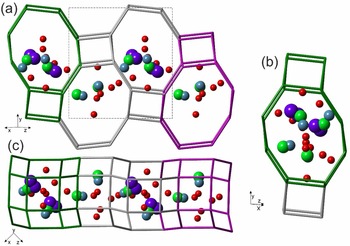
The structure of gismondine-Sr from Germany does not differ significantly from the Israeli (holotype) specimen. The double crankshaft chains and the 8-membered rings are parallel to [101] and [10${\bar 1}$ ] (Fig. 5a). The structure of gismondine-Sr contains two types of non-equivalent symmetry cages, which host randomly distributed extra-framework cations and water molecules (Fig. 5). It is worth highlighting that the cages are topologically the same. They differ only in the extra-framework content. The t-gsm 1 cage (Fig. 5, purple colour) contains two symmetry equivalent partially occupied sites by calcium (C1A) and strontium-potassium (C1). The potassium content t-gsm 2 cage (Fig. 5, green colour) differs from t-gsm 1. Two additional potassium positions (C2B and C2C) are found in t-gsm 2, whereby the C2 position is occupied only by strontium (Fig. 5). The two types of cages occur alternatively in the structure (Fig. 5a), producing an overlapping picture along the channel (Fig. 5b,c).
Framework of gismondine-Sr. (a) Two types of cages filled by distinct extra-framework cations and water molecules, view along [101]; (b) structure presented in (a) rotated by 90° around the b axis; (c) view along [010]; purple colour marks t-gsm 1, green colour marks t-gsm 2. Key: green spheres – strontium cations; blue spheres – calcium cations; purple spheres – potassium cations; red spheres – water molecules; and the dotted grey line – unit cell.

Discussion
Orthorhombic gismondine-Sr differs significantly from monoclinic gismondine-Ca. They vary not only in symmetry but also in water content — gismondine-Sr has only half the water content of the calcium species. Additionally, the monovalent cations have not been detected in the monoclinic gismondine-Ca in contrast to gismondine-Sr (Vezzalini and Oberti, Reference Vezzalini and Oberti1984). These chemical changes lead to the elliptical deformation of the 8-membered rings window in gismondine-Sr (Skrzyńska et al., Reference Skrzyńska, Cametti, Galuskina, Vapnik and Galuskin2023). Nevertheless, according to the guidelines for nomenclature of zeolites (Coombs et al., Reference Coombs, Alberti, Armbruster, Artioli, Colella, Galli, Grice, Liebau, Mandarino, Minato, Nickel, Passaglia, Peacor, Quartieri, Rinaldi, Ross, Sheppard, Tillmanns and Vezzalini1997) the Sr-dominant zeolite with GIS framework type is only classified as a new end-member mineral in the gismondine series (Coombs et al., Reference Coombs, Alberti, Armbruster, Artioli, Colella, Galli, Grice, Liebau, Mandarino, Minato, Nickel, Passaglia, Peacor, Quartieri, Rinaldi, Ross, Sheppard, Tillmanns and Vezzalini1997). Present data on Ba-rich gismondine indicate that the next potential new member of that series is gismondine-Ba. Significant replacement by Ca2+ in gismondine-Sr and by Sr2+ and Ca2+ in Ba-rich gismondine imply the following D2+ → D2+ mechanism of substitution (Fig. 6; Table 2). On the other hand, the high K content in gismondine-Sr and Ba-rich gismondine indicates a possible solid solution between the gismondine series and amicite, K2Na2[Al4Si4O16]⋅5H2O (Fig. 6; Table 2). This is corroborated by the detected Ca substitution in amicite. In addition, the chemical analyses of some crystals of gismondine-Sr from the Bellerberg volcano exhibit the dominance of monovalent cations (i.e. K) in atomic proportions. In both the amicite and gismondine series the R-value is ~0.5, which implies the second substitution D2+ → 2M+. Furthermore, the presence of the K ions explains the lower water content in gismondine-Sr and amicite. As was noted by Bauer and Baur (Reference Bauer and Baur1998), K-exchanged gismondine featured a lower hydration level, probably because of the occupation of the available water sites by potassium, which has nearly the same interatomic distances to framework oxygen atoms (Bauer and Baur, Reference Bauer and Baur1998). This leads to the substitution scheme H2O + D2+ → 2K+. According to the present results, amicite should be regarded as an alkali end-member of the gismondine series. Moreover, amicite and gismondine minerals are characterised by a prominent Raman band at about 460 cm–1. The slight displacement of the main band in Ba-rich gismondine may result from the presence of a heavier cation. Despite framework deformation in gismondine-Sr, the spectra of gismondine-Sr and gismondine-Ca are similar (Table 3), which corroborates the origin of the band at 460 cm–1 from the symmetric-bending O–T–O vibrations of the Al/Si ordered 4-membered rings (Skrzyńska et. al., Reference Skrzyńska, Cametti, Galuskina, Vapnik and Galuskin2023). In conclusion, amicite, gismondine-Ca and gismondine-Sr belong to one series, for which the Si/Al ratio = 1 and the main Raman band around 460 cm–1 is distinctive.
Ternary diagram showing atomic proportions in gismondine-Sr (Gis-Sr) from the Bellerberg volcano, gismondine-Sr, Ba-rich gismondine and amicite from the Hatrurim Complex (Table 2, Supplementary Table S3; Skrzyńska et al. Reference Skrzyńska, Cametti, Galuskina, Vapnik and Galuskin2023).

The next mineral series within the GIS topology is the garronite series, which is characterised by a disordered framework and a higher R (> 0.6) value than the gismondine series. This difference may trigger the displacement of the main band to a higher frequency (Table 3). The garronite series includes the recently described garronite-Na. Albeit, a distinction between gobbinsite and garronite-Na is questionable. Their distinguishing features are slightly different hydration degrees, as well as Si/Al ratio resulting in different Na content (Fig. 7, 8; Table 1). The substitution mechanism from garronite-Na to gobbinsite can be represented as follows: 2M+ + Al3+ → M+ + Si4+. The extra-framework cations content influences the channel diameters, leading to higher ellipticity along [100] in the gobbinsite structure with respect to garronite-Na (Fig. 8; Grice et al., Reference Grice, Rowe and Poirier2016). Recently, Hirahata et al. (Reference Hirahata, Kobayashi and Nishido2022) described Si-rich garronite-Na from Hirado Island in Japan. The empirical crystal-chemical formula (Na1.99K0.27Ca1.61)Σ3.87[Fe0.01Al5.31Si10.64]Σ15.96O32⋅14.3H2O has been calculated based on O = 32. The authors concluded that garronite-Na from Hirado Island, Japan represents a Ca–Na solid solution in the garronite series. However, the crystals can be regarded as Ca-rich gobbinsite, the phase between gobbinsite and garronite-Ca solid solution (Fig. 7). The empirical formula of the crystals from Hirado Island, can be obtained from garronite-Ca or the gobbinsite end-member by combining 2M+ + Al3+ → M+ + Si4+ and D2+ → 2M+ mechanism substitutions. According to the results reported on Si-rich garronite-Na (Hirahata et al., Reference Hirahata, Kobayashi and Nishido2022), the garronite series should include a broader Si/Al ratio range. This finding corroborates the existence of a solid solution between garronite-Ca and gobbinsite (Fig. 7). On the basis of the current rules for zeolite nomenclature (Coombs et al., Reference Coombs, Alberti, Armbruster, Artioli, Colella, Galli, Grice, Liebau, Mandarino, Minato, Nickel, Passaglia, Peacor, Quartieri, Rinaldi, Ross, Sheppard, Tillmanns and Vezzalini1997), the grounds for gobbinsite and garronite-Na distinction would be insufficient. Therefore, we suggest a revision of the nomenclature of zeolites with the GIS framework type.
Compositional diagram for the garronite series and gobbinsite (Walker, Reference Walker1962; Nawaz and Malone, Reference Nawaz and Malone1982; Artioli, Reference Artioli1992; Artioli and Foy, Reference Artioli and Foy1994; Gatta et al., Reference Gatta, Birch and Rotiroti2010; Kónya and Szakáll, Reference Kónya and Szakáll2011; Grice et al., Reference Grice, Rowe and Poirier2016; Popova et al., Reference Popova, Kasatkin, Popov, Nikandrov, Makagonov, Kuznetsov and Škoda2020; Hirahata et al., Reference Hirahata, Kobayashi and Nishido2022; Pauliš et al., Reference Pauliš, Hrůzek, Janeček, Sejkora, Malíková and Pour2015).

Comparison of garronite-Na (Grice et al., Reference Grice, Rowe and Poirier2016) and gobbinsite (Gatta et al., Reference Gatta, Birch and Rotiroti2010) structures along corresponding directions. (a) Structure of garronite-Na, view along [001]; (b) structure of gobbinsite, view along [100]; (c) structure of garronite-Na, view along [100]; (d) structure of gobbinsite, view along [010]; (e) t-gsm cage of garronite-Na; and (f) t-gsm cage of gobbinsite. Red sphere – water molecules; yellow sphere – sodium ions; pale blue sphere – calcium ions.

Summarising, the differences between gismondine-Sr and gismondine-Ca and between garronite-Ca and gobbinsite are similar. Two mineral series can be distinguished within GIS topology. Their end-member formulas should be calculated based on the 16 framework T sites and 32 oxygen atoms (Table 1). The garronite–gobbinsite series includes Ca–Na solid solution with R > 0.60 and consists of garronite-Ca and gobbinsite. The general formula of this series can be written as (MyD0.5(x–y))[AlxSi(16–x)O32]⋅nH2O, where x < 8 and y is the content of the monovalent cations. Amicite, gismondine-Sr and gismondine-Ca belong to the gismondine series including Ca–Sr–K, Na solid solution with R ≈ 0.5. The range of the gismondine series should be extended after a description of gismondine-Ba. The general formula for the series with an R-value of ~0.5 can be written as follows (MyD0.5(8–y))[Al8Si8O32]⋅nH2O. The garronite and gismondine series differ from each other in terms of their R-value. So far, there are no available data on GIS minerals whose composition ranges between the R-value of the garronite and gismondine series. Hence, two separated series can be distinguished. The Raman band between 475 cm–1 and 485 cm–1 is distinctive for the garronite series, whereas the band around 460 cm–1 is characteristic of the gismondine series. The displacement of Raman spectra presumably originates because of different R-values. In contrast, the extra-framework cations have a limited influence on Raman spectra of GIS zeolites.
Supplementary material
The supplementary material for this article can be found at https://doi.org/10.1180/mgm.2023.27.
Acknowledgements
The authors are grateful to Professor Peter Leverett, Structures Editor, an anonymous reviewer, and Professor Igor V. Pekov for their careful revision, which enabled the manuscript and the structure refinement to be improved. Investigations were supported by the National Science Center of Poland Grant [grant number UMO-2019/35/O/ST10/01015] and Preludium Bis 1 project of the Polish National Agency for Academic Exchange.
Competing interests
The authors declare none.