Introduction
Attention-deficit/hyperactivity disorder (ADHD) is a heterogeneous developmental disorder characterized by inattention, impulsivity and hyperactivity. ADHD is one of the most common neurodevelopmental disorders as defined in the Diagnostic and Statistical Manual of Mental Disorders (DSM) with over 5% of the population meeting DSM-IV criteria for this condition. While many children with ADHD present with both hyperactivity/impulsivity and inattention, subgroups (specifiers in DSM-5) presenting with pure inattention or pure hyperactivity/impulsivity have been introduced (American Psychiatric Association, 2013). The severity of symptoms and long-term course of ADHD are variable (Karam et al. Reference Karam, Breda, Picon, Rovaris, Victor, Salgado, Vitola, Silva, Guimarães-da-Silva, Mota, Caye, Belmonte-de-Abreu, Rohde, Grevet and Bau2015). ADHD symptoms, especially hyperactivity and impulsivity, improve with age, but some symptoms including inattentiveness, disorganization and problems in emotion regulation persist into adulthood in many individuals. Evidence also suggests that individuals with ADHD continue to present with cognitive difficulties (Alderson et al. Reference Alderson, Kasper, Hudec and Patros2013; Mowinckel et al. Reference Mowinckel, Pedersen, Eilertsen and Biele2015). While some individuals with ADHD function relatively well and perceive ADHD as a condition with some positive aspects, such as increased creativity, novel problem-solving abilities and multi-tasking at will (Fleischmann & Fleischmann, Reference Fleischmann and Fleischmann2012), the symptoms of ADHD have an overall negative impact on quality of life in many individuals (Danckaerts et al. Reference Danckaerts, Sonuga-Barke, Banaschewski, Buitelaar, Döpfner, Hollis, Santosh, Rothenberger, Sergeant, Steinhausen, Taylor, Zuddas and Coghill2010). This is particularly so in the context of increasing demands of modern life including competitive education and the work environment.
In addition to problems in impulse control, attention and other neurocognitive problems such as working memory, ADHD presents with emotion dysregulation and significant interpersonal problems including conflict with parents, siblings, peers, teachers, which can lead to rejection (Barkley, Reference Barkley1997; Nixon, Reference Nixon2001; Shaw et al. Reference Shaw, Stringaris, Nigg and Leibenluft2014). Indeed, social dysfunction is one of the most debilitating aspects of ADHD (Nijmeijer et al. Reference Nijmeijer, Minderaa, Buitelaar, Mulligan, Hartman and Hoekstra2008). Evidence also suggests that there is significant clinical overlap between ADHD and autism spectrum disorder (ASD) in terms of impairment in social functioning. It seems that there is a subgroup of patients with ADHD with very significant deficits in social functioning comparable with high-functioning ASD. For example, Greene et al. (Reference Greene, Biederman, Faraone, Ouellette, Penn and Griffin1996) reported that 22% of individuals with ADHD have substantial deficits in social functioning. While there are multiple possible clinical and psychosocial determinants for these problems, the ability to recognize another person's emotions and other social cognitive abilities, which have been traditionally associated with diagnosis of ASD (American Psychiatric Association, 2013), can contribute to these difficulties. Social cognition has multiple domains including emotion recognition, theory of mind (ToM), social knowledge, attributional style and social perception (Green et al. Reference Green, Penn, Bentall, Carpenter, Gaebel, Gur, Kring, Park, Silverstein and Heinssen2008) and ADHD might be associated with deficits in each of these domains (Grenell et al. Reference Grenell, Glass and Katz1987; Collett & Gimpel, Reference Collett and Gimpel2004; Uekermann et al. Reference Uekermann, Kraemer, Abdel-Hamid, Schimmelmann, Hebebrand, Daum, Wiltfang and Kis2010; Collin et al. Reference Collin, Bindra, Raju, Gillberg and Minnis2013; McQuade et al. Reference McQuade, Vaughn, Hoza, Murray-Close, Molina, Arnold and Hechtman2014). Two domains of social cognition, recognition of emotional expressions (mostly measured based on sets of still photographs/drawings or recorded vocal expressions of six basic emotions) and ToM, the ability to attribute mental states (feelings, beliefs, intentions and desires) to others and understand and predict others’ behaviour based on their mental states, have been investigated in a sizeable number of studies. However, it is not clear whether emotion recognition and ToM deficits in ADHD are comparable in severity to ASD (Buitelaar et al. Reference Buitelaar, van der Wees, Swaab- Barnevield and van der Gaag1999; Nydén et al. Reference Nydén, Niklasson, Stahlberg, Anckarsater, Wentz, Rastam and Gillberg2010; Baribeau et al. Reference Baribeau, Doyle-Thomas, Dupuis, Iaboni, Crosbie, McGinn, Arnold, Brian, Kushki, Nicolson, Schachar, Soreni, Szatmari and Anagnostou2015). Investigating the developmental course of social cognition in ADHD is also important as there is a significant development in social cognitive abilities during adolescence and adulthood (Choudhury et al. Reference Choudhury, Blakemore and Charman2006; Brizio et al. Reference Brizio, Gabbatore, Tirassa and Bosco2015). Indeed, there is conflicting evidence regarding the persistence of social cognitive deficits in ADHD beyond childhood (Miller et al. Reference Miller, Hanford, Fassbender, Duke and Schweitzer2011; Bagcioglu et al. Reference Bagcioglu, Isikli, Demirel, Sahin, Kandemir, Dursun, Yuksek and Emul2014; Ibáñez et al. Reference Ibáñez, Aguado, Baez, Huepe, Lopez, Ortega, Sigman, Mikulan, Lischinsky, Torrente, Cetkovich, Torralva, Bekinschtein and Manes2014). It is also important to investigate whether social cognitive impairments in ADHD are an independent abnormality or secondary to intellectual abnormalities, as neurocognitive abilities contribute to performance of patients with neuropsychiatric disorders on social cognition tasks (Aboulafia-Brakha et al. Reference Aboulafia-Brakha, Christe, Martory and Annoni2011). Co-morbid ASD in ADHD is common and might potentially contribute to social cognitive impairment (Taylor et al. Reference Taylor, Charman, Robinson, Plomin, Happé, Asherson and Ronald2013). Conduct disorder is another important co-morbidity in ADHD (Pliszka, Reference Pliszka1998). Conduct disorder is associated with significant interpersonal problems and might be relevant for deficits in social cognition in ADHD (Cadesky et al. Reference Cadesky, Mota and Schachar2000).
A meta-analysis of the existing literature can provide the opportunity to reveal the specific nature of social cognitive deficits in ADHD, including at different stages of development and can have important implications for improving social functioning in ADHD. In this meta-analysis, the main goal was to investigate social cognition in ADHD. In this meta-analysis, we compared emotion recognition and ToM deficits in ADHD with healthy controls and ASD by taking into account the relationship of social cognitive deficits with important confounders including age, co-morbidity, ADHD subtypes and intellectual abilities. We hypothesized that ADHD would be associated with significant impairment (but less severe than observed in ASD) in social cognition in comparison with healthy controls.
Method
Study selection
PRISMA (preferred reporting items for systematic reviews and meta-analyses) guidelines were used in conducting this meta-analysis (Moher et al. Reference Moher, Liberati, Tetzlaff and Altman2009). A literature search was conducted using the databases PubMed, PsycINFO and Scopus to identify the relevant studies (January 1987 to June 2015) using the combination of key words as follows: ADHD, emotion recognition, theory of mind and social cognition. Reference lists of published reports were also reviewed for additional studies. Inclusion criteria were studies that: (1) investigated emotion recognition or ToM abilities; (2) reported sufficient data to calculate the effect size and standard error of the emotion recognition or ToM measures including results of parametric statistics (i.e. t and F values); (3) compared the performances of patients with ADHD and healthy controls or ASD (according to DSM-IV, DSM-III-R or similar criteria).
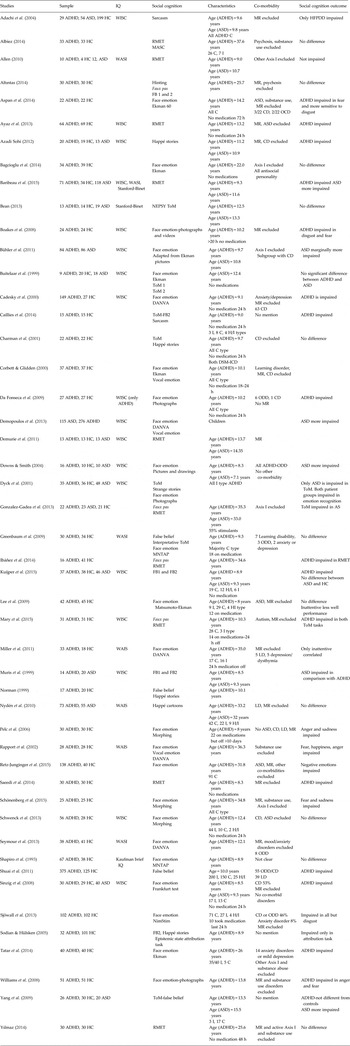
The selection process is summarized in online Supplementary Fig. S1. We contacted three authors of papers that did not report sufficient data to calculate effect sizes in their published abstracts and received relevant data from two of them. Studies investigating emotion recognition abilities with methods other than facial and vocal recognition were excluded as only a few studies used such methods (i.e. body language, scenes). After an initial screening of articles retrieved by literature search, 84 articles were reviewed. Of these, 52 articles met our inclusion criteria. Four studies were excluded as they overlapped with other studies included (studies with most up-to-date, larger sample size were selected). A total of 48 studies were included in the meta-analysis (Table 1).
Studies included in the meta-analysis of social cognition in ADHD in comparison with HC and ASD

ADHD, Attention-deficit/hyperactivity disorder; HC, healthy controls; ASD, autism spectrum disorder; IQ, intelligence quotient; WISC, Wechsler Intelligence Scale for Children; C, combined type; MR, mental retardation; HFPDD, high-functioning pervasive developmental disorder; RMET, Reading the Mind from Eyes Test; MASC, Movie for the Assessment of Social Cognition; I, inattentive type; WASI, Wechsler Abbreviated Scale of Intelligence; FB, False belief task; CD, conduct disorder; OCD, obsessive–compulsive disorder; NEPSY, A Developmental NEuroPSYchological Assessment; ToM, theory of mind; DANVA, Diagnostic Analysis of Nonverbal Accuracy; H/I, hyperactive impulsive type; DSM, Diagnostic and Statistical Manual of Mental Disorders; ICD, International Classification of Diseases; ODD, oppositional defiant disorder; AS, Asperger's syndrome; MNTAP, Minnesota Test of Affective Processing; FB1, first-order FB; FB2, second-order FB;WAIS, Wechsler Adult Intelligence Scale; LD, learning disability.
ADHD v. healthy controls
A total of 44 studies (three of the studies have two ADHD samples) comparing ADHD subjects (n = 1998) (78.8% male) and healthy controls (n = 1725) (64.9% male) were included in the study. There was a significantly higher ratio of males in ADHD in comparison with the control group [relative risk (RR) = 1.24, 95% confidence interval (CI) 1.14–1.34, Z = 4.9, p < 0.001]. There was no significant between-group difference for age (d = 0.03, 95% CI −0.12 to 0.18, Z = 0.40, p = 0.69). Intelligence quotient (IQ) score was significantly lower in ADHD patients in comparison with healthy controls (d = 0.61, 95% CI 0.42–0.80, Z = 6.39, p < 0.001). Ages of the ADHD group ranged between 8 and 36.3 years and clustered as studies in children (mean age range = 8–15 years) and adults (mean age range = 22–37 years). In the studies that gave information about ADHD subtype (n = 1089), combined type (n = 662) followed by inattentive type (n = 373) was most common and very few individuals (n = 54) had a diagnosis of ADHD of the hyperactive/impulsive subtype. ADHD in adulthood was diagnosed at the time of the study (retrospectively).
ADHD v. ASD
A total of 17 studies (two of the studies have two ASD samples) consisting of 772 ADHD (80.1% males) and 710 ASD (84.0% males) patients were included in the meta-analysis. There was no significant between-group difference for the ratio of males (RR = 1.03, 95% CI 0.98–1.08, Z = 1.15, p = 0.25) or age (d = 0.11, 95% CI −0.11 to 0.32, Z = 0.97, p = 0.33). There were no significant IQ differences between ADHD and ASD (d = 0.01, 95% CI −0.28 to 0.30, Z = 0.09, p = 0.93). Only two adult studies investigated differences between ASD and ADHD. The mean age range for childhood studies was 7 to 15 years.
Social cognition measures
Studies have investigated facial emotion recognition with a variety of methods [different sets of images of faces to label: most commonly Ekman and Diagnostic Analysis of Nonverbal Accuracy (DANVA)] (Ekman & Friesen, Reference Ekman and Friesen1976; Nowicki & Carton, Reference Nowicki and Carton1993). Different ToM tasks have been utilized across studies, most commonly the Reading the Mind in the Eyes Task (RMET) and Happé stories; other tasks included different versions of false belief and intention tasks, recognition of faux pax and sarcasm (Happé, Reference Happé1994; Baron-Cohen et al. Reference Baron-Cohen, Wheelwright, Hill, Raste and Plumb2001).
Statistical analyses
Effect sizes for total scores for facial and vocal emotion recognition and individual effect sizes for facial recognition of six basic emotions (happy, sad, anger, disgust, fear and surprise) were calculated. For studies that did not report total scores but only scores for individual emotions, a pooled score of the facial emotion recognition score was calculated. For studies that reported more than one ToM task, a pooled effect size and standard error were calculated. Individual meta-analyses for individual ToM tasks that are reported by at least five studies (RMET, Happé stories) were also conducted. Finally, a mean score for social cognition was calculated for studies reporting both ToM and emotion recognition. Meta-analyses were performed using packages in the R environment (OpenMetaAnalyst, Metafor) and MIX software version 1.7 on a Windows platform (Bax et al. Reference Bax, Yu, Ikeda, Tsuruta and Moons2006; Viechtbauer, Reference Viechtbauer2010; Wallace et al. Reference Wallace, Dahabreh, Trikalinos, Lau, Trow and Schmid2012). Effect sizes were weighted using the inverse variance method and a random-effects model (DerSimonian–Laird estimate) was used because the distributions of effect sizes were heterogeneous for the number of variables. The magnitude of effect sizes was interpreted based on guidelines [d = 0.2–0.5 (small), d = 0.5–0.8 (medium), d > 0.8 (large)] suggested by Cohen (Reference Cohen1988). Homogeneity of the distribution of weighted effect sizes was tested with the I 2 and Q-tests. The I 2 statistic describes the percentage of variation across studies that is due to heterogeneity rather than chance and the Q-test is the weighted sum of squared differences between individual study effects and the pooled effect across studies. A significant Q-test suggests that the distribution of effect sizes is not homogeneous (Lipsey & Wilson, Reference Lipsey and Wilson2001). Tau squared (τ 2), an estimate of between-study variance, was used as a measure of the magnitude of heterogeneity in the random-effects model. The possibility of publication bias was assessed with Egger's test. The fail-safe N test was also used. This test involves computing a combined p value for all studies included in the meta-analysis, and calculating how many additional studies with a zero effect (average Z of zero) would be necessary to create a non-significant p value.
Meta-regression analyses were conducted for variables that are reported by at least 10 samples. These variables included age, gender, ADHD subtype (percentage of individuals with ADHD that met criteria for combined type), co-morbidity (ratio of patients who also met criteria for conduct disorder) and IQ (effect sizes of patient–control differences). Pre-morbid IQ measures and measures only assessing performance IQ (Raven's progressive matrices and Gong's non-verbal IQ) were not included as IQ measures (see Table 1). Meta-regression analyses performed with a random-effects model were conducted using the restricted-information maximum likelihood method with a significance level set at p < 0.05. Subgroup analyses were done for adulthood and childhood ADHD. The Q bet test was used to compare these subgroups.
Results
ADHD v. healthy controls
Social cognition was significantly impaired (d = 0.44) in ADHD patients in comparison with healthy controls (Table 2). When social cognitive domains were investigated separately, ADHD subjects performed significantly more poorly than healthy controls in ToM (d = 0.45) and facial (d = 0.44) and vocal emotion recognition (d = 0.40) (Table 2). There was a significant heterogeneity for distributions of effect sizes for all these social cognition domains (I 2 = 33–59% and p for Q-tests⩽0.001) but magnitudes of heterogeneity were modest (τ 2 = 0.07–0.09) in the random-effects model. There was no evidence of publication bias and fail-safe N values for social cognition measures were very large (n = 454–1734).
Mean weighted effect sizes for social cognition between ADHD and healthy controls

ADHD, Attention-deficit/hyperactivity disorder; d, effect size of between-group difference; CI, confidence interval; bias, p value of Egger's test; ToM, theory of mind; RMET, Reading the Mind in the Eyes Test.
In recognition of individual facial emotions, the most significant impairments were evident in anger (d = 0.49) and fear (d = 0.48). In ADHD, recognition of sad (d = 0.24), surprised (d = 0.27) and happy (d = 0.22) faces were also mildly but significantly impaired. There was no significant between-group difference for recognition of disgust. In individual ToM measures, ADHD was associated with poorer performance than controls for both RMET (d = 0.44) and Happé stories (d = 0.51) tasks. Distributions of effect sizes for RMET, Happé stories, recognition of anger, fear, disgust and happy were significantly heterogeneous (Table 2). However, magnitudes of heterogeneous distributions were modest in the random-effects model (τ 2 = 0–0.21). There was no evidence of publication bias for any of the emotion recognition or individual ToM measures. In a subgroup analysis of studies that explicitly stated ASD co-morbidity as an exclusion criteria, ADHD patients significantly underperformed healthy controls (d = 0.37, 95% CI 0.11–0.63, Z = 2.75, p = 0.006).
Meta-regression analyses
Deficits in social cognition score in ADHD were not significantly related to gender (Z = 0.29, p = 0.97, k = 39), age (Z = −1.95, p = 0.05, k = 45), percentage of individuals with the combined type of ADHD (Z = 0.31, p = 0.75, k = 25), or with co-morbid conduct disorder (Z = −0.41, p = 0.68, k = 12). When meta-regression analyses for age were conducted separately for ToM (Z = −2.83, p = 0.005) and facial emotion recognition (Z = 0.33, p = 0.74), younger age in the ADHD group was associated with more severe ToM but not emotion recognition deficits.
IQ differences between ADHD subjects and healthy controls were significantly associated with more severe social cognitive impairment (Z = 2.45, p = 0.01, k = 24). However, impairment in social cognition was also evident in samples matched for IQ (d = 0.37, 95% CI 0.16–0.59, Z = 3.4, p < 0.001, k = 12).
Childhood v. adulthood ADHD
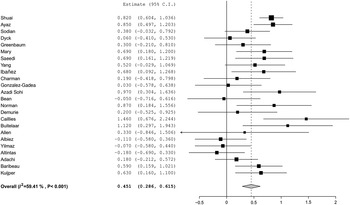
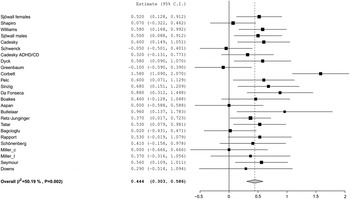
Impairment in social cognition in ADHD was significantly more severe in the child than adult samples (d = 0.52 v. 0.22, Q bet = 15.3, p < 0.001). Among social cognition domains, differences between child and adult samples were even more pronounced for ToM (d = 0.56 v. 0.04, Q bet = 18.0, p < 0.001), with no evidence of ToM impairments in ADHD individuals in adulthood (Fig. 1). Differences between child and adult samples were not significant for facial emotion recognition (d = 0.49 v. 0.33, Q bet = 1.72, p = 0.19) (Fig. 2).
Forest plot for theory of mind differences between attention-deficit/hyperactivity disorder patients and healthy controls. C.I., Confidence interval.

Forest plot for facial emotion recognition differences between attention-deficit/hyperactivity disorder (ADHD) patients and healthy controls. C.I., Confidence interval; CD, conduct disorder.

ADHD v. ASD
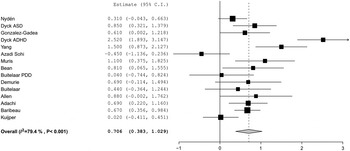
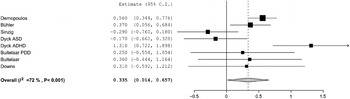
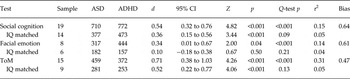
Overall social cognition was significantly impaired (d = 0.54) in ASD in comparison with ADHD subjects. ToM impairment (Fig. 3) was particularly more severe in ASD than ADHD patients (d = 0.77) (Table 3). The between-group difference for facial emotion recognition was small (d = 0.34) but significant (Fig. 4) (Cohen, Reference Cohen1988). There was no evidence of publication bias and the fail-safe N values for social cognition measures were large (n = 30–374). There was significant heterogeneity in the distribution of effects sizes of ToM (τ 2 = 0.14–0.31, I 2 = 72–79%, p for Q tests⩽0.001).
Forest plot for theory of mind differences between autism spectrum disorders (ASD) and attention-deficit/hyperactivity disorder (ADHD). C.I., Confidence interval; PDD, pervasive developmental disorder.

Forest plot for facial emotion recognition differences between autism spectrum disorders (ASD) and attention-deficit/hyperactivity disorder (ADHD). C.I., Confidence interval; PDD, pervasive developmental disorder.

Mean weighted effect sizes for social cognition between ASD and ADHD

ASD, Autism spectrum disorders; ADHD, attention-deficit/hyperactivity disorder; d, effect size of between-group difference; CI, confidence interval; bias, p value of Egger's test; IQ, intelligence quotient; ToM, theory of mind.
In meta-regression analyses, IQ (Z = 4.43, p < 0.0001) but not age (Z = 0.15, p = 0.88, k = 15) and gender (Z = 0.06, p = 0.96) had significant effects on between-group differences for social cognition scores. However, in subgroup analyses of studies matched for IQ, differences between ASD and ADHD were relatively smaller but still significant for ToM (d = 0.52) and overall social cognition score (d = 0.36) but not for facial emotion recognition (d = 0.10). The distribution of effect sizes of all of these measures was homogeneous in IQ-matched samples (τ 2 = 0.04–0.05, p for Q > 0.05).
Discussion
The current meta-analysis investigated social cognition in ADHD patients in comparison with healthy controls and ASD subjects. Emotion recognition and ToM were significantly impaired in ADHD relative to control subjects. In facial emotion recognition, the most severe deficits were evident in recognition of anger and fear. The severity of social cognitive impairment in ADHD subjects was modest and social cognitive deficits were less pronounced in adulthood. ToM deficits were significantly less severe in ADHD compared with ASD patients, even after accounting for the effects of IQ.
ADHD was associated with deficits with medium effect sizes in ToM and emotion recognition. The severity of social cognitive impairment in ADHD patients was comparable with other neurocognitive deficits including verbal memory and most measures of attention and executive functions. Only some aspects of executive functions (i.e. response inhibition) and attention (sustained attention) might be relatively more severely impaired than social cognition in ADHD (Boonstra et al. Reference Boonstra, Oosterlaan, Sergeant and Buitelaar2005; Schoechlin & Engel, Reference Schoechlin and Engel2005; Willcutt et al. Reference Willcutt, Doyle, Nigg, Faraone and Pennington2005; Bálint et al. Reference Bálint, Czobor, Komlósi, Mészáros, Simon and Bitter2009). These findings suggest that a sizeable minority of patients with ADHD have significant difficulties in social cognitive abilities. Interestingly, emotion recognition deficits were relatively specific to anger and fear. This finding is in accordance with findings suggesting abnormal electrophysiological and disrupted temporal lobe activity in response to angry faces compared with happiness and sadness in ADHD (Ichikawa et al. Reference Ichikawa, Nakato, Kanazawa, Shimamura, Sakuta, Sakuta, Yamaguchi and Kakigi2014; Köchel et al. Reference Köchel, Leutgeb and Schienle2014). Difficulties in recognition of anger and fear in others and impairments in more complex aspects of social cognition can contribute to the behavioural and interpersonal problems observed in ADHD. Interventions targeting social cognitive deficits in ADHD patients can potentially improve functioning in ADHD. There is preliminary evidence suggesting that stimulants can improve social cognitive abilities in ADHD, but there is a need for further studies to confirm these early findings (Maoz et al. Reference Maoz, Tsviban, Gvirts, Shamay-Tsoory, Levkovitz, Watemberg and Bloch2014). A number of studies have suggested that cognitive training might improve neurocognitive deficits in ADHD; future studies should consider incorporating social cognition in training programmes to improve social functioning in ADHD (Cortese et al. Reference Cortese, Ferrin, Brandeis, Buitelaar, Daley, Dittmann, Holtmann, Santosh, Stevenson, Stringaris, Zuddas and Sonuga-Barke2015).
Social cognition deficits, especially in ToM, were significantly more pronounced in ASD in comparison with ADHD subjects. This finding is in accordance with the outcome of previous meta-analyses of social cognitive deficits in ASD patients in comparison with healthy controls (Yirmiya et al. Reference Yirmiya, Erel, Shaked and Solomonica-Levi1998; Uljarevic & Hamilton, Reference Uljarevic and Hamilton2013; Lozier et al. Reference Lozier, Vanmeter and Marsh2014), which reported larger effect sizes compared with our meta-analysis findings comparing ADHD and controls. ASD-specific abnormalities in brain structure can contribute to social cognitive differences between ASD and ADHD (Lim et al. Reference Lim, Chantiluke, Cubillo, Smith, Simmons, Mehta and Rubia2015). However, the magnitude of differences, even for ToM, suggests that there is considerable overlap between groups and social cognitive deficits cannot be considered to be specific to ASD. Some of the studies included have excluded co-morbid ASD and other Axis I disorders (Table 1). In studies that explicitly stated co-morbid ASD as an exclusion criteria, social cognitive impairment was still significant (d = 0.37). However, many of these patients might still have subthreshold autistic traits (Taylor et al. Reference Taylor, Charman, Robinson, Plomin, Happé, Asherson and Ronald2013). There is a need for studies investigating the effect of autistic traits in ADHD on social cognition.
Another important point is the heterogeneity of ADHD patients including in their neurocognitive profile (van Hulst et al. Reference van Hulst, de Zeeuw and Durston2015). One of the studies included in the meta-analysis compared ToM abilities of three subtypes of ADHD and did not find any difference (Shuai et al. Reference Shuai, Chan and Wang2011). There was no significant effect of the ratio of inattentive and combined subtypes of ADHD on social cognition in the current meta-analysis. This finding suggests that social cognitive abilities do not differ between these two subtypes but this finding needs to be confirmed by studies directly comparing these subtypes. Also, an only small minority of individuals with ADHD had hyperactive/impulsive type in this meta-analysis. Therefore, there is a need for further studies exploring social cognition in subtypes of ADHD. Our meta-analysis has suggested that social cognitive deficits in ADHD were not related to having co-morbid conduct disorder. ADHD symptoms are also associated with other neurodevelopmental disorders including learning disorders and can precede adult-onset neurodevelopmental disorders (Semrud-Clikeman et al. Reference Semrud-Clikeman, Biederman, Sprich-Buckminster, Lehman, Faraone and Norman1992; Peralta et al. Reference Peralta, de Jalón, Campos, Zandio, Sanchez-Torres and Cuesta2011). Recent familial and genetic studies in ADHD also found evidence of partial overlap with autism, neurodevelopmental disorders, schizophrenia and bipolar disorder (Cross-Disorder Group of the Psychiatric Genomics Consortium, 2013). All of these disorders are associated with significant social impairment and social cognitive deficits (Yirmiya et al. Reference Yirmiya, Erel, Shaked and Solomonica-Levi1998; Bora et al. Reference Bora, Vahip, Gonul, Akdeniz, Alkan, Ogut and Eryavuz2005; Bora & Pantelis, Reference Bora and Pantelis2013). It can be hypothesized that in some patients with a diagnosis of ADHD, inattention, impulsivity and hyperactivity symptoms might be markers of more widespread neurodevelopmental problems, neuroanatomical abnormalities and neurocognitive deficits (including social cognition) rather than reflecting a more limited developmental abnormality associated with problems in higher-order functional organization [i.e. maturational delay in default mode network and its connections (Bush, Reference Bush2010; Sripada et al. Reference Sripada, Kessler and Angstadt2014)]. Identifying patients with broad neurodevelopmental problems is important as these individuals might have a higher risk of developing adult-onset disorders (such as psychotic disorders) and can have substantial impairment in social functioning in adulthood.
Our findings suggest that age plays an important role in the differences found between ADHD and controls. In paediatric samples, deficits with medium effect sizes were observed in social cognition. As a limitation, there was no information available for the deficit in social cognition in adolescent and young adults with ADHD (mean age 15–22 years). However, in adulthood, the effect size of the social cognitive deficit was small and was non-significant for ToM. This finding cannot be considered as a ceiling effect as adult ADHD studies have mainly used advanced ToM tasks that were sensitive to ToM impairment in psychiatric disorders such as bipolar disorder (Bora et al. Reference Bora, Bartholomeusz and Pantelis2015). Potential age-related improvements in ADHD have been also reported for other neurocognitive abilities (Coghill et al. Reference Coghill, Hayward, Rhodes, Grimmer and Matthews2014). These findings support the views that consider ADHD as a disorder characterized by delay in neurodevelopment of high-order functions in most patients (Shaw et al. Reference Shaw, Eckstrand, Sharp, Blumenthal, Lerch, Greenstein, Clasen, Evans, Giedd and Rapoport2007; Sripada et al. Reference Sripada, Kessler and Angstadt2014); it seems that performances of these individuals with ADHD catch up with non-ADHD subjects as they get older. A delayed developmental trajectory for acquisition of social cognitive abilities in ADHD can also explain more pronounced problems in recognition of anger and fear, as the ability to recognize these emotions fully develops later than for happiness and sadness (Boyatzis et al. Reference Boyatzis, Chazan and Ting1993). However, it is also important to consider the possibility that individuals with adult ADHD perform better in social cognitive tasks because many individuals with ‘adult ADHD’ might be misdiagnosed with a childhood neurodevelopmental disorder based on self-report and do not have ‘true ADHD’ (Moffitt et al. Reference Moffitt, Houts, Asherson, Belsky, Corcoran, Hammerle, Harrington, Hogan, Meier, Polanczyk, Poulton, Ramrakha, Sugden, Williams, Rohde and Caspi2015). It is also important to note that clinically, the developmental trajectory of most individuals with ADHD differs from ASD. The developmental trajectory of ASD might be characterized by increasingly falling behind the trajectory of a healthy population in some cognitive domains. Thus, the rate of improvement in a healthy population (typically developing children and adolescents) may accelerate faster that for ASD, given the findings of another meta-analysis suggesting that difficulties in facial emotion recognition can actually increase with age in ASD (Lozier et al. Reference Lozier, Vanmeter and Marsh2014). It is important to increase our efforts to map the trajectories of ADHD and other childhood-onset psychiatric disorders and investigate relationships between abnormal cortical development and the trajectory of symptoms and cognitive deficits during development (Shaw et al. Reference Shaw, Malek, Watson, Greenstein, de Rossi and Sharp2013; Cropley & Pantelis, Reference Cropley and Pantelis2014; Giedd et al. Reference Giedd, Raznahan, Alexander-Bloch, Schmitt, Gogtay and Rapoport2015; Zalesky et al. Reference Zalesky, Pantelis, Cropley, Fornito, Cocchi, McAdams, Clasen, Greenstein, Rapoport and Gogtay2015). Better definition of the longitudinal course of broad categories such as ADHD can help us to characterize more valid subtypes of neurodevelopmental disorders and improve our management strategies.
Another important consideration is the effect of neurocognition on ADHD–healthy control and ADHD–ASD differences. Our findings have suggested that IQ was a significant confounder for between-group differences in social cognition. There were more differences between ASD and ADHD on social cognition tasks when IQ was significantly lower in ASD in comparison with ADHD. IQ has also played a significant role in comparison of group differences between ADHD and controls in social cognition tasks. However, even in IQ-matched groups, there was a significant difference in the severity of social cognitive impairment between ADHD and ASD and controls. These findings suggest that more general cognitive impairment can partially account for group differences between ADHD and ASD and healthy controls.
The current meta-analysis has a number of limitations. One consideration is the potential effect of medications on social cognition deficits in ADHD. We were not able to explore the relationship between stimulant use and the observed impairment in social cognition due to lack of details and paucity of medication-naive samples. However, many of the studies included ADHD subjects that had been taken off their medications within the last 24–72 h, suggesting that impact of medications as a confounder of performance was relatively minimized. Another limitation was the lack of sufficient data to explore the effect of neurocognition other than IQ on between-group differences in social cognition tasks. Also, we were not able to explore differences in social cognition between ADHD and ASD in adults as only two of the studies included compared two patient groups in this age group. We were not able to include social cognitive domains other than emotion recognition and ToM in ADHD as no sufficient published data were available. Finally, our findings only reflect cross-sectional comparisons, as there were no available data to investigate development trajectories of these deficits in ADHD.
As a conclusion, ADHD is associated with social cognitive deficits with medium effect sizes, which are less severe than in ASD. Our findings also suggest that impairments in social cognition might improve with age in ADHD. Our findings indicate the need for longitudinal studies investigating the development of social cognition in ADHD.
Supplementary material
For supplementary material accompanying this paper visit http://dx.doi.org/10.1017/S0033291715002573
Acknowledgements
C.P. was supported by a National Health and Medical Research Council Senior Principal Research Fellowship (ID: 628386).
Declaration of Interest
Over the last 2 years, C.P. has participated on advisory boards for Janssen-Cilag and Lundbeck. He has received honoraria for talks presented at educational meetings organized by Janssen-Cilag, Astra-Zeneca, Shire and Lundbeck. E.B. has no conflict of interests to be reported. Neither of the authors has financial or personal relationships, interests or affiliations relevant to the subject matter of this paper.