I. INTRODUCTION
Tungsten (W) plays a pivotal role in many high-temperature applications ranging from filaments in light bulbs, cathodes in high-power lamps to rocket nozzles in spacecrafts.Reference Bao and Wan1–Reference Ryu, Sohn, Hwang and Fang4 In addition, it is also an excellent material for use in contact plugs and bit lines in microelectronic field because of its larger work function (4.6 eV) and compatibility to Si-based complementary metal-oxide semiconductor devices.Reference Samanta, Yoo, Samudra, Tok, Bera and Balasubramanian5–Reference Rossnagel, Noyan and Cabral9 The main structures of tungsten are α-phase (bcc crystal structure) and metastable β-phase (A15 crystal structure). It is observed that the performances of α-W are superior to those of β-W in terms of electrical conductivity, mechanical strength, and good metal barrier property.Reference Liu, Huang, Ma and Xu10 The α-form of W has remarkably lower electrical resistivity of 20 μΩ·cm when compared to β-W (150 μΩ·cm), which makes it an ideal electronic contact material for microelectronic applications.Reference Chen, Yang, Tian and Hsu6
Manufacture of metallic tungsten powder is a critical step in tungsten alloy production because powder properties significantly affect the subsequent operations such as processing and sintering. Tungsten nanopowders promise to yield very hard, strong, and wear-resistant materials via press-sinter route. Earlier reports indicate that the onset of sintering can take place at a significantly lower temperature with nanopowders compared to micron-sized powders.Reference German, Ma, Wang and Olevsky11, Reference Malewar, Kumar, Murty, Sarma and Pabi12 In this purview, prominence is laid on the effective control of particle sizes and thus have drawn more attention in recent years.Reference Bouziane, Mamor and Meyer7–Reference Rossnagel, Noyan and Cabral9, Reference Malewar, Kumar, Murty, Sarma and Pabi12
Present commercial routes for the production of tungsten depend on conversion of two main natural resources wolframite and scheelite ores to ammonium paratungstate, which is subsequently calcinated in oxygen-bearing atmosphere between 600 and 850 °C and is followed by reduction of tungsten oxides with H2. Though these procedures are cheaper, it is difficult to produce tungsten nanopowders by using conventional methods because of high temperature during processing steps.Reference Magnusson, Deppert and Malm13 Various methods have been explored to obtain tungsten nanoparticles (W-NPs), such as electrical explosion of wires,Reference Gromov, Kwon and Choi14 high-energy ball milling,Reference Ricceri and Matteazzi15 molten salt–assisted self-propagating high-temperature synthesis,Reference Nersisyan, Lee and Won16 physical vapor deposition,Reference Gleiter17 gas-phase combustion synthesis,Reference Axelbaum, Huertas, Lottles, Hariprasad and Sastry18 sealed tube synthesis,Reference Chang, Wang, Chiu, Cheng, Yen and Chiu19 chemical reduction process,Reference Gao, Zhao, Zhu, Ma, Su and Wang20, Reference Welham21 and solvothermal decomposition method.Reference Sahoo, Kamal, Premkumar, Jagadeesh Kumar, Sreedhar, Singh, Srivastava and Chandra Sekhar22 Chemical methods have been widely used to synthesize nanomaterials because of their easy operational procedure and potential for scaling-up. There are several chemical synthesis procedures for synthesizing nanoparticles, of which thermolytic decomposition is well known.Reference Esumi, Tano, Torigoe and Meguro23 Chemically synthesized W-NPs have the advantage of uniform particle size and desired crystal structure (α-W). Size and shape of W-NPs can be controlled by adjusting the reaction parameters such as reaction time and temperature.Reference Sahoo, Kamal, Premkumar, Jagadeesh Kumar, Sreedhar, Singh, Srivastava and Chandra Sekhar22 Success of any material development program depends on the analytical results obtained from various characterization techniques. Chemical, structural, and morphological characterizations are the first and foremost steps carried out while developing a new material. Hence, the analytical results obtained from various characterization tools play a crucial role in the development of strategic materials. Therefore, this study focuses on spectral, compositional, structural, and morphological characterization of W-NPs synthesized by thermolytic decomposition technique.
II. EXPERIMENTAL DETAILS
A. Materials
Tungsten hexacarbonyl [W(CO)6; (99.9%)], diphenyl ether (98%), oleic acid (90%), oleyl amine (90%), ethanol (99.8%), and hexane (99%) were purchased from Acros Organics (Belgium, IL), and were used to prepare W-NPs.
B. Synthesis
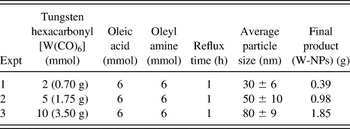
To a 250-mL three-neck distillation flask containing 40 mL of solvent diphenyl ether, a (1:1) mixture of surfactants oleic acid and oleyl amine (6 mmol each) were added and mixed thoroughly. High purity nitrogen was flushed into the system for 10 min to eliminate any traces of oxygen. The reaction mixture was preheated to 100 °C for 5 min and then W(CO)6 at various concentrations (2–10 mmol) were added into the system, and reaction mixture was refluxed for 1 h. The details of experimental conditions and respective particle sizes with standard deviations are given in Table I. On heating for 1 h, the solution turns from pale yellow to brown and subsequently to black color, which indicates completion of W(CO)6 decomposition. On cooling to room temperature, a well-dispersed solution was obtained without any precipitates at the bottom. W-NPs were recovered from the reaction mixture by treating it with ethanol (60 mL) under ambient conditions and centrifuging the solution at 6000 rpm for 15 min. Recovered W-NPs were subsequently washed several times with ethanol and redispersed in hexane.
Experimental conditions with varying W(CO)6 concentration.

C. Measurements and analysis
Fourier transform infrared spectroscopy (FTIR) measurements of as-synthesized W-NPs have been carried out using a Spectrum GX FTIR system (Perkin-Elmer, Waltham, MA) in 400–4000 cm−1 frequency region. Samples for FTIR measurements were prepared by mixing the as-synthesized W-NPs amounting to 1 mg and KBr (spectral purity) amounting to 200 mg and pressing them into a tablet form with a diameter of 13 mm under a press loading of 10 tons/cm2.
Further examinations of the surfactant capping mechanisms on the surface of nanoparticles were carried out using x-ray photoelectron spectrometer (XPS) model (AXIS 165, Kratos, Shimadzu, Germany) with an Al Kα monochromator x-ray source running at 15 kV with a hemispherical electron energy analyzer and a multichannel detector. Pressure inside the test chamber was kept below 2 × 10⁻⁹ Torr during spectral acquisition, and a low-energy electron flood gun was used to neutralize possible surface charge. XPS binding energy (BE, 284.6 eV) was referenced to the C (1s) peak. Low-energy electron flood gun was used to neutralize the possible surface charge.
Powder x-ray diffraction (XRD) of as-synthesized and annealed W-NPs was measured using a PHILIPS-PW3020 diffractometer (Philips, Westborough, MA) with a Cu Kα radiation source (λ = 1.5418 Ả ), and data interpretation was carried out with the help of JCPDS database. Average crystallite size was determined from peak broadening of XRD peaks using Scherrer’s equation.
The W content in nanopowders (experiment 1–3) was obtained as weight% using inductively coupled plasma–optical emission spectrometer (ICP-OES; model, JY ULTIMA, HORIBA Jobin Yvon, Longjumeau, France). Approximately 0.1 g of W-NPs was weighed and transferred into a microwave digestion vessel, and subsequently 8 mL of aqua regia (HCl + HNO3 in 3:1 ratio, respectively) and 0.5 mL of HF were added. The reaction vessel was kept in a microwave-accelerated reaction system (Model: MARS 5, CEM Corporation, Matthews, NC) for dissolution. After dissolution, the samples were analyzed by ICP-OES using single element standard solutions (ICP-OES standards, M/s. Fisher Scientific, Dublin, Ireland).
The W-NPs were then analyzed for carbon, oxygen, and nitrogen contents using Leco gas analyzers (model: CS-444 and TC-600, LECO Corporation, St. Joseph, MI). Approximately 0.1 g of nanopowders was weighed on an analytical balance, and the weights were entered into the program. The analytical methods were calibrated using steel and titanium alloy standards with known carbon, oxygen, and nitrogen contents before analysis.
A transmission electron microscope (TEM) of Philips TECHNAI FE-12 (Philips, Westborough, MA) was used to image W-NPs. For TEM imaging, a drop of dispersion containing W-NPs was placed on a 3-mm copper grid with a continuous carbon film and the sample was dried under vacuum at room temperature.
III. RESULTS AND DISCUSSION
In the synthesis of W-NPs, metal precursor W(CO)6 was decomposed in diphenyl ether in presence of oleic acid and oleyl amine. Choice of diphenyl ether as solvent with a boiling point of 220 °C was based on decomposition temperature of 140 °C for W(CO)6. The choice of surfactants was based on previous literature that oleic acid and oleyl amine stabilizes a variety of colloids. A synergistic effect of mixture of these two surfactants was much more profound than that of their individual contributions.Reference Yan and Jie24 Present reaction process takes the advantage of oleic acid and oleyl amine as a means to passivate the surface and render W-NPs stable with respect to coarsening or aggregation.
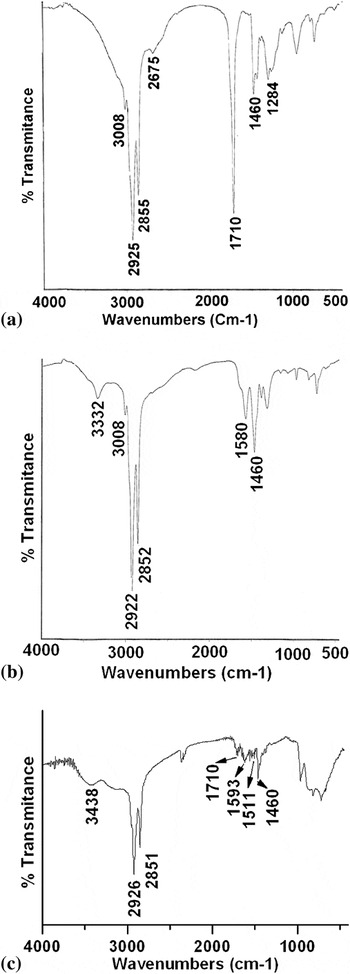
Figure 1 shows FTIR spectra of oleic acid, oleyl amine, and as-synthesized W-NPs. For oleic acid, peaks at 2855 cm−1 and 2925 cm−1 are due to symmetric and asymmetric CH2 stretching modes [Fig. 1(a)]. The peak at 3008 cm−1 is due to υ(C–H) stretching mode of C–H bond adjacent to C = C bond, and peak at 1710 cm−1 is due to υ(C = O) stretching mode. Peak at 1284 cm−1 is due to υ(C–O) stretching mode and weak mode at 2675 cm−1 is due to υ(O–H) stretching of dimerized acid. The spectrum of oleyl amine [Fig. 1(b)] shows peaks of oleyl group in 2850–3010 cm−1 region. In addition, there are peaks of amine group: peak at 1580 cm−1 due to NH2 scissoring mode and peak at 3332 cm−1 due to υ(N–H) stretching mode.
FTIR spectrum of (a) oleic acid, (b) oleyl amine, and (c) as-synthesized tungsten nanoparticles (W-NPs) (experiment 2).

A representative FTIR spectrum of W-NPs synthesized from experiment 2 [Fig. 1(c)] shows same characteristic peaks in the region of 2850–3000 cm−1. Peak at 1710 cm−1 is due to υ(C = O) stretching mode and indicates that some fraction of oleic acid is either free or bonded to W-NPs in monodentate form. Peak at 1511 cm−1 is due to υ(−COO) vibrational mode, indicating the presence of bidentate carboxylate bonding to W-NPs and confirms that some fraction of oleic acid is bonded in bidentate form.Reference Sahoo, Kamal, Premkumar, Jagadeesh Kumar, Sreedhar, Singh, Srivastava and Chandra Sekhar22 Observation of both υ(COO) and υ(C =O) vibrational modes indicates that oleic acid acts both as a monodentate and bidentate ligand while binding to W-NPs via oxygen atom. Peak at 969 cm−1 indicates the presence of trans-substituted unsaturated alkyl groups.Reference Shukla, Liu, Jones and Weller25 During synthesis of W-NPs, isomerization of oleyl form (cis-9-octadecenoyl) to elaidy form (trans-9-octadecenoyl) occurs. The peak at 1593 cm−1 is due to NH2 scissoring mode, which suggests that oleyl amine is adsorbed with NH2 group to W-NPs surface. The peak due to N–H stretching mode vibration in free oleyl amine appears at 3332 cm−1, which undergoes a red shift of 106 cm−1, supporting the notion that amine group faces W-NPs. This observation is consistent with previous results obtained for silver nanocrystals.Reference Nath, Praharaj, Panigrahi, Kundu, Ghosh, Basu and Pal26 Peak at 1460 cm−1 arises from υ(CH3) bending mode, which was present in all three oleic acid, oleyl amine, and W-NPs with passivating ligands.
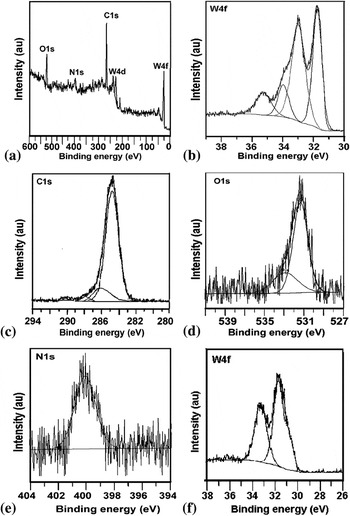
To further examine the capping mechanisms of surfactants on W-NPs surface, XPS spectra of W4f, C1s, O1s, and N1s were obtained from the nanopowders produced from experiment 2 (Fig. 2). Figure 2(a) shows the XPS spectrum of freshly prepared W-NPs. Characteristic peaks of tungsten, carbon, oxygen, and nitrogen are observed in Fig. 2(a), which confirms the presence of above elements in W-NPs. The W4f doublet with the BEs of 33.1 and 35.4 eV implies the W–O bond formation, while the W4f doublet with BEs of 31.7 and 33.9 eV corresponds to elemental tungsten atoms underneath the chemisorbed carboxylate [Fig. 2(b)]. Four C1s peaks observed at 284.8, 286.3, 288.1, and 290.1 eV can be ascribed to the carbon atoms in C–C/C–H, C–O, C = C/C–N, and C = O moieties, respectively [Fig. 2(c)]. Two O1s peaks at 531.2 and 533.0 eV are observed in as-synthesized W-NPs, which correspond to oxygen atoms in C–O and C = O groups, respectively [Fig. 2(d)]. The C1s peaks at 286.3 (C–O) and 290.1 eV (C = O) and O1s peaks at 531.2 (C–O) and 533.0 eV (C = O) show the presence of both the monodentate and bidentate bonding of oleic acid on W-NPs surface through oxygen atom of carboxylate moiety (COO−). The C1s peak intensity at 290.1 eV (C = O) is lower when compared to the intensity at 286.3 eV (C–O), and O1s peak intensity at 533.0 eV (C = O) is lower when compared to the intensity at 531.2 eV (C–O), which points out that most of the oleic acid molecules bonded to the W-NPs surface are in bidentate form.Reference Wu, Fu, Su, Aslam, Wong and Dravid27 N1s peak at 400.5 eV is observed in as-synthesized W-NPs. The N1s peak shifting of 1.1 eV from the reference N1s peak (399.4 eV) confirms the binding of oleyl amine to tungsten atoms on W-NPs surface through nitrogen atom of amine (–NH2) group [Fig. 2(e)].Reference Li, Chen, Bao and Gao28 When the W-NPs were being bombarded with argon ions (emission current = 10 mA, accelerating voltage = 3 kV), evolution of XPS spectrum was observed. Disappearance of carbon after an erosion time of 4 min suggests that carbon is present only on the surface of W-NPs, and simultaneously it was accompanied by the disappearance of both peaks at 33.1 and 35.4 eV in W spectra, which indicates that the W–O bonding is only at the surface and the inner core comprises of only W in its zero oxidation state as shown in Fig. 2(f).
X-ray photoelectron spectra of (a) as-synthesized W-NPs (experiment 2), (b) W4f, (c) C1s, (d) O1s, (e) N1s, and (f) W4f (after erosion time of 4 min).

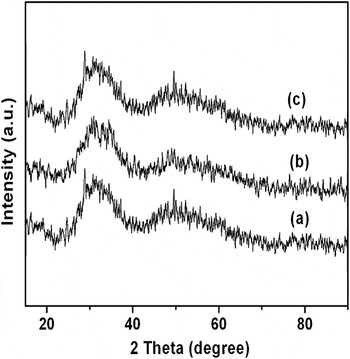
Figure 3 shows XRD patterns of as-synthesized powders prepared by thermolytic decomposition of W(CO)6 (experiment 1–3). A typical XRD pattern was obtained for all the as-synthesized W-NPs exhibiting only two broad peaks. Absence of sharp diffraction peaks in the spectrum reveals that as-synthesized nanopowders are amorphous in nature.
X-ray diffraction patterns of as-prepared tungsten nanopowders synthesized with varying W(CO)6 concentrations: (a) 2 mmol, (b) 5 mmol, and (c) 10 mmol.

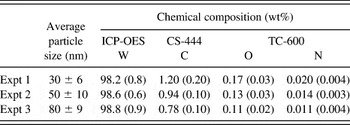
Elemental analyses of as-synthesized W-NPs (experiment 1–3) are tabulated in Table II. All the values reported in Table II are in weight% and an average of three readings with their standard deviations in parenthesis. From the chemical analyses results, it could be observed that the major constituent of the products was tungsten (98.2–98.8%). Carbon, oxygen, and nitrogen contents in the as-synthesized W-NPs were in the range of 0.78–1.20%, 0.11–0.17%, 0.011–0.020%, respectively. These nonmetal impurities were completely removed in the analyzer furnace at temperatures between 950 and 1050 K. Complete removal of these impurities at low temperature confirms that the presence of C, O, and N are only due to surfactant mixture oleic acid and oleyl amine.Reference Krasovskii, Blagoveshchenskii and Grigorovich29 Presence of oxygen in low levels (0.11–0.17%) points out that the products obtained are predominantly W0, and it is in good agreement with XPS results. Low-level nitrogen content (0.011–0.020%) infers that the oleyl amines are washed off easily when compared to oleic acids on several washings with ethanol.Reference Kamal, Sahoo, Vimala and Durai30 When the particle size increases from 30 to 80 nm, it is accompanied by the corresponding decrease in nonmetal concentrations such as C, O, and N (Table II). This could be attributed to the decrease in surface to volume ratio of W-NPs with increase in particle size from 30 to 80 nm.
Chemical composition of tungsten nanoparticles obtained from experiments 1–3.

Values in parenthesis are standard deviations obtained from three measurements.
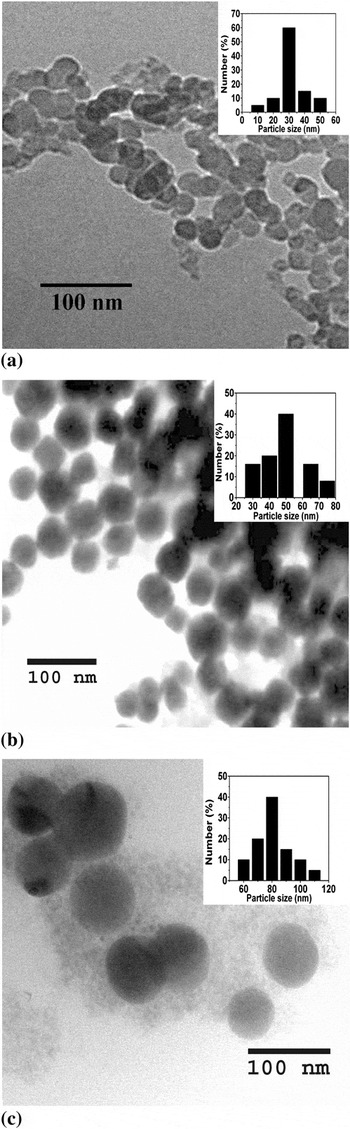
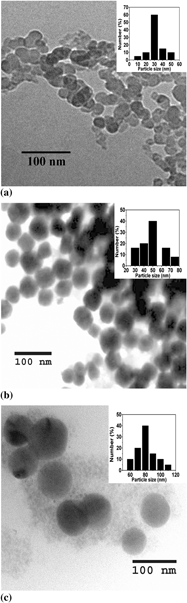
Figures 4(a)–4(c) show TEM images and particle size distributions (inset) of W-NPs synthesized by thermolytic decomposition process with varying W(CO)6 concentrations from 2 to 10 mmol. The histograms of particle size distributions were obtained by analyzing 100 particles from different portions of the grid. TEM images show that as-synthesized W-NPs are spherical in shape with average diameters of 30 ± 6, 50 ± 10, and 80 ± 9 nm when precursor [W(CO)6] concentration taken for the reaction were 2, 5, and 10 mmol, respectively. The histograms [inset in Figs. 4(a)–4(c)] of particles show that the as-prepared materials have a tight size distribution. These results reveal that the particle size increases with increase in precursor concentration.
TEM image with particle size distribution (inset) of as-prepared W-NPs synthesized with varying molar concentrations of [W(CO)6]: (a) 2 mmol (b) 5 mmol, and (c) 10 mmol.

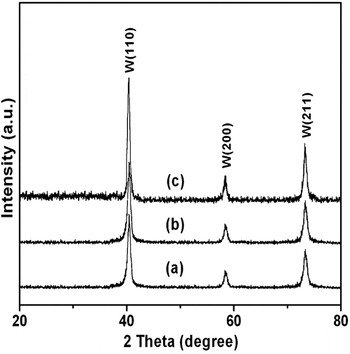
After annealing at 600 °C for 1 h in nitrogen atmosphere, amorphous W-NPs (experiment 1–3) get converted to bcc structure with following d spacing values: d 110 = 2.237, d 200 = 1.579, and d 211 = 1.290 Å, which are close to that of JCPDS Card. No. 04-0806 as shown in Fig. 5. Crystallite size measurements were carried out from the peak broadening using Debye–Scherrer equation, and the average crystallite size of W-NPs synthesized from experiments 1, 2, and 3, are 13.8, 14.6, and 15.5 nm, respectively. These results also confirm that the larger particles lead to larger crystallite sizes on annealing.
X-ray diffraction patterns of annealed tungsten nanopowers synthesized with varying W(CO)6 concentrations: (a) 2 mmol, (b) 5 mmol, and (c) 10 mmol.

IV. CONCLUSIONS
Spherical-shaped W-NPs with average sizes ranging between 30 and 80 nm were synthesized by thermolytic decomposition of W(CO)6 in presence of (1:1) surfactant mixture of oleic acid and oleyl amine under a blanket of nitrogen gas. FTIR and XPS spectra reveal that both oleic acid and oleyl amine are bonded through their functional groups. Isomerization of surfactants from oleyl form (cis) to elaidyl form (trans) during the reaction process helps in providing better stability to W-NPs. XPS measurements also show that carbon is present only on the surface of W-NPs. Amorphous W-NPs provide a great advantage during compaction and sintering, as the amorphous state is converted to nanocrystalline form of α-W, which is very useful for various applications in end products.
ACKNOWLEDGMENTS
We thank Defence Research and Development Organisation, Ministry of Defence, Government of India, for financial support. We also thank the Director, Defence Metallurgical Research Laboratory (DMRL), and Division Head, Materials Science Division-II (MSD-II), for their keen interest in this work and also for permitting us to publish this work.