Introduction
Cortisol, a glucocorticoid hormone secreted by the hypothalamus–pituitary–adrenal (HPA) axis, is involved in the regulation of many systems critical for attention, behavioral activation and stress response. Cortisol typically follows a time-dependent pattern of secretion, with higher levels at awakening, followed by a peak roughly 30 min thereafter and a decrease over the remainder of the day until a minimum is reached around midnight (Stone et al. Reference Stone, Schwartz, Smyth, Kirschbaum, Cohen, Hellhammer and Grossman2001). Diurnal cortisol secretion receives attention because of its proposed impact on physical, emotional and behavioral problems (Fries et al. Reference Fries, Hesse, Hellhammer and Hellhammer2005). Central to this hypothesis are the notable inter-individual differences in diurnal cortisol secretion. A considerable part of these differences is thought to stem from differential exposure to environmental circumstances (Lupien et al. Reference Lupien, McEwen, Gunnar and Heim2009). During stress, cortisol is elevated above normal levels to mobilize energy stores and facilitate behavioral responses to threat (Gunnar & Quevedo, Reference Gunnar and Quevedo2007). However, consistently high levels of cortisol can be harmful, as chronically stressed individuals may become ‘threat-sensitized’, resulting in either an over-reaction or an under-reaction of the HPA system to stress (Miller et al. Reference Miller, Chen and Zhou2007).
The HPA system is particularly responsive to stressors that have a socio-evaluative component (Dickerson & Kemeny, Reference Dickerson and Kemeny2004). One of the most prevalent adverse social experiences for children and adolescents is physical or psychological victimization by peers, with between 20% and 25% of youth being bullied (Craig & Edge, Reference Craig and Edge2011). The few studies in this context show an association between peer victimization and lower levels of diurnal cortisol as measured via salivary cortisol (Vaillancourt et al. Reference Vaillancourt, Duku, Decatanzaro, Macmillan, Muir and Schmidt2008; Knack et al. Reference Knack, Jensen-Campbell and Baum2011). It remains unclear, however, to what extent these associations indicate true environmental influences, as many (positive and negative) social experiences partly arise as a function of individuals’ genetic makeup (Jaffee & Price Reference Jaffee and Price2007). Evidence from genetically informed research such as twin studies indeed suggests that heritable factors explain over half of inter-individual differences in peer victimization among youth (Brendgen et al. Reference Brendgen, Boivin, Dionne, Barker, Vitaro, Girard, Tremblay and Pérusse2011). Genetic influences have also been found on diurnal cortisol secretion (Bartels et al. Reference Bartels, de Geus, Kirschbaum, Sluyter and Boomsma2003; Gustafsson et al. Reference Gustafsson, Gustafsson, Anckarsäter, Lichtenstein, Ljung, Nelson and Larsson2011; Ouellet-Morin et al. Reference Ouellet-Morin, Brendgen, Girard, Lupien, Dionne, Vitaro and Boivin2016). The observed association between peer victimization and altered diurnal cortisol secretion may thus at least partly be explained by genetic factors. Controlling for genetic etiology is crucial to identify the ‘true’ environmental effect of social stressors such as peer victimization on diurnal cortisol secretion.
Equally important is the consideration of the potentially cumulative influence of stress in other social relationships, specifically with parents and the best friend, on diurnal cortisol secretion (Hostinar & Gunnar, Reference Hostinar and Gunnar2013). Whereas positive relationships may have a beneficial effect on physiological stress reactivity by providing external coping resources, problematic relationships may add to the potentially detrimental effect of peer victimization on cortisol secretion. Indeed, problematic relationships with parents or friends have been associated with lower morning cortisol in adolescents (Booth et al. Reference Booth, Granger and Shirtcliff2008; Byrd-Craven et al. Reference Byrd-Craven, Auer, Granger and Massey2012). However, these studies often included only single-day cortisol assessments and did not simultaneously assess the three most common indicators of diurnal cortisol [i.e. the awakening level, the cortisol awakening response (CAR), and the diurnal change]. Moreover, genetic influences that may affect both cortisol secretion and social experiences were not controlled.
The present study
The present study aimed to test the potential additive environmental influences of peer victimization and relationship quality with parents and with friends on diurnal cortisol secretion in mid-adolescence. To this end, we used the monozygotic (MZ) twin-difference design (Vitaro et al. Reference Vitaro, Brendgen and Arseneault2009), which allows control for family-wide (i.e. shared environmental and genetic) influences. This control is achieved by calculating differences between the two twins of a pair with respect to the predictor and outcome variables. Because MZ twins do not differ genetically and grow up in the same shared family environment, phenotypic differences between the two twins reflect the influence of differential environmental experiences unique to each twin (Neale, Reference Neale and Kim2009). Thus, an association between twin differences in peer victimization and twin differences in diurnal cortisol secretion may be interpreted as a unique environmental influence of peer victimization on cortisol. Based on the scarce studies with singletons, we expected that peer victimization as well as problematic social relationships with the mother, the father and the best friend would be linked to lower cortisol awakening levels, CAR and diurnal change over the day.
These associations were examined while controlling for a host of potential confounders. Thus, birth weight, body mass index (BMI), pubertal stage, depression symptoms and general physical health status may not only influence cortisol levels but also social relationships (Steinberg, Reference Steinberg1987; Kiess et al. Reference Kiess, Meidert, Dressendorfer, Schriever, Kessler, Kounig, Schwarz and Strasburger1995; Craig et al. Reference Craig, Pepler, Connolly, Henderson, Juvonen and Graham2001; Janssen et al. Reference Janssen, Craig, Boyce and Pickett2004; Prinstein et al. Reference Prinstein, Borelli, Cheah, Simon and Aikins2005; Wüst et al. Reference Wüst, Entringer, Federenko, Schlotz and Hellhammer2005; Jessop & Turner-Cobb, Reference Jessop and Turner-Cobb2008; Van den Bergh & Van Calster, Reference Van den Bergh and Van Calster2009; Branje et al. Reference Branje, Hale, Frijns and Meeus2010; Reijntjes et al. Reference Reijntjes, Kamphuis, Prinzie and Telch2010; Brendgen et al. Reference Brendgen, Girard, Vitaro, Dionne, Tremblay, Pérusse and Boivin2014). To tease apart stable from ‘situation-specific’ variation of cortisol secretion and thus obtain more reliable indicators of diurnal cortisol patterns, we included four assessment points per day for 4 days over a 2-week period.
Method
Sample
The participating 136 MZ pairs (74 female pairs) were part of a population-based sample of MZ and dizygotic twin pairs (Boivin et al. Reference Boivin, Brendgen, Dionne, Dubois, Pérusse, Robaey, Tremblay and Vitaro2013a ). Participants were recruited at birth from the Québec Newborn Twin Registry, which identified all twin births occurring in the Province of Québec between 1995 and 1998. All families (n = 989) in the registry living in the Greater Montreal area were asked to enrol and 662 families agreed to participate. Twins were first seen at 5 months of age and then prospectively assessed for a variety of child and family characteristics. Of the parents, 95 % lived together, 44% of the twins were the firstborn children, 66% of mothers and 60% of fathers were between 25 and 34 years old, 17% of mothers and 14% of fathers had not finished high school, 28% of mothers and 27% of fathers held a university degree, 83% of the parents were employed, 10% of the families received social welfare or unemployment insurance, and 30% of families had an annual income of < $ 30 000. Most families were of European descent (87%), 3% were of African descent, 3% were of Asian descent, and 1% were native North Americans. Zygosity was assessed with 8–10 highly polymorphous genetic markers. Twins were diagnosed as MZ when concordant for every genetic marker. When genetic material was insufficient, zygosity was determined based on physical resemblance at ages 18 months and 9 years (Spitz et al. Reference Spitz, Carlier, Vacher-Lavenu, Reed, Moutier, Busnel and Roubertoux1996). The comparison of both methods in a subsample of 237 same-sex pairs revealed a 94% correspondence rate. The present study includes data collected in grades 4 to 8 (mean age in grade 4 = 10.00 years, s.d. = 0.26, and mean age in grade 8 = 14.07 years, s.d. = 0.30). Valid data on cortisol, which was assessed in grade 8, were available for 136 MZ twin pairs, of whom 86% had collected saliva at each of the four collection days.
Procedure
Letters explaining the objectives of the study were sent to the families, followed by a home visit. After obtaining informed consent from the parents and assent from the participants, research assistants explained the collection protocol, which consisted of sampling saliva at four time points during the day (at awakening, 30 min later, late in the afternoon and bedtime) on four collection days (Tuesdays and Thursdays on two consecutive weeks) as well as the one-time completion of an interview-based questionnaire by the twins. Research assistants ensured that participants (and their parents) were familiar with the material. Families were visited a second time to gather the saliva tubes and conduct the interviews with the twins. Instruments and study procedures were approved by the institutional review board of the Ste-Justine Hospital.
Main measures
Saliva collection and cortisol analysis in grade 8
Participants were provided with saliva tubes (Sarstedt©), diaries to report collection times and instructions for collection. Saliva samples were first placed in the participants’ refrigerator during data collection days and then stored in freezers at −20°C once returned to the laboratory until cortisol determination using a high-sensitivity enzyme immune assay kit (catalog no. 1–3102; Salimetrics®, USA). Frozen samples were brought to room temperature to be centrifuged at 15 000 g (3000 rpm) for 15 min and all analysed in one batch. The range of detection for this assay is between 0.012 and 3 µg/dl (0.33–82.76 nmol/l). We identified 1% cortisol samples with a value greater than 3 s.d.s above the mean of their respective sampling time and replaced them by the last value within 3 s.d.s. Participants were considered ‘compliant’ if their awakening and +30 min samples were separated by at least 20 min and less than 40 min, the awakening collection was completed within the first 15 min following awakening and not distinct between the twins (⩽8 min). A total of 8.61% of the samples were discarded due to non-compliance. Cortisol values were converted into nmol/l (to convert μg/dl to nmol/l, multiply by 27.588) and naturally log transformed before analyses.
We combined the information from the single-point cortisol measures to three global diurnal cortisol indicators, i.e. (a) the CAR, (b) the mean level of cortisol at awakening (intercept), and (c) the change that took place thereafter (slope). Creating aggregated indicators of cortisol across several days is recommended when examining individual characteristics or experiences in relation to cortisol levels (Adam & Gunnar, Reference Adam and Gunnar2001; Nicolson, Reference Nicolson, Luecken and Gallo2008). A detailed description of the different analytical steps for deriving these indicators is provided elsewhere (Ouellet-Morin et al. Reference Ouellet-Morin, Brendgen, Girard, Lupien, Dionne, Vitaro and Boivin2016). Briefly, we first derived an indicator of CAR for each day of saliva collection by subtracting the awakening level from the one collected 30 min later. Second, we performed growth curve analyses using mixed modeling for longitudinal data to capture the cortisol diurnal rhythm on each collection day by estimating the mean level of cortisol at awakening (intercept) and the change that took place thereafter (slope). The second saliva sample (30 min following awakening) was excluded from these analyses, as estimation of spline models would require more than the available four time points. Growth curve estimates showed that a significant decrease in cortisol levels took place from awakening to evening each day. The expected brief spike in cortisol levels 30 min after awakening (CAR) was also found. Third, we tested whether intercept, slope and CAR estimates were affected by a wide range of potential confounders (e.g. sex, time of awakening, sampling time, sleep duration and quality, time of onset and duration of physical exercises, medications, menstruation for girls, current health conditions such as cold, fever, allergies, as well as persistent health conditions such as diabetes). Significant confounders were statistically controlled in the subsequent step. Fourth, the four intercept estimates (one for each collection day) were included in a confirmatory factor analysis (CFA) to derive a more stable indicator free from situational-specific variation. Similar CFAs were conducted for the slopes and CAR estimates. All analyses were conducted in Mplus version 6.11 using maximum likelihood estimation and the COMPLEX option adjusting standard error estimates to correct for the non-independence of observations. The CFAs confirmed that the respective estimates derived at each collection day could be grouped into three global factors of CAR, intercept and slope. Factor scores were saved for further analyses (intercept mean = 7.62 nmol, s.d. = 1.86 nmol, minimum = 3.67, maximum = 15.55; slope mean = −0.09 nmol, s.d. = 0.01 nmol, minimum = −0.11, maximum = −0.03; CAR mean = 3.43 nmol, s.d. = 4.14 nmol, minimum = −8.00, maximum = 20.13).
Quality of relationships
Relationship quality with the mother, father and best friend was evaluated in grade 8 by each twin based on items from the Network of Relationships Inventory (Furman & Buhrmester, Reference Furman and Buhrmester1992). Separately for each relationship, six items focused on positive features [e.g. ‘Do you feel loved and/or appreciated by your (mother/father/best friend)?’; ‘When things go wrong, can you count on…to provide you comfort?’] and four items focused on negative features (e.g. ‘Do you get angry at…?’; ‘Do you fight with…?’). Each item was rated on a five-point Likert scale ranging from 1 (not true at all) to 5 (very true). Separately for each relationship, individual item scores were averaged to compute scales scores for positive and negative relationship aspects, respectively (Cronbach's α for positive relationship aspects ranged from 0.80 to 0.89 and Cronbach's α for negative relationship aspects ranged from 0.81 to 0.85). Separately for each relationship, the negative score was then subtracted from the positive score to indicate the overall relationship quality (mother–child relationship mean = 1.44, s.d. = 1.26, minimum = −2.83, maximum = 4.00; father–child relationship mean = 1.27, s.d. = 1.46, minimum = −3.33, maximum = 4.00; friend–child relationship mean = 1.80, s.d. = 1.19, minimum = −1.92, maximum = 4.00).
Peer victimization
Peer victimization was assessed in grades 4, 6, 7 and 8 using twins’ self-reports on nine items derived from the Social Experiences Questionnaire (Crick & Grotpeter, Reference Crick and Grotpeter1996) (e.g. ‘During this school year, how many times has another kid called you names or said mean things to you?, … .stopped you from being in his or her group although you wanted to be?, … .pushed, hit or kicked you?, … .threatened you or said mean things about you via e-mail, chat room, or cell phone?’). Responses were given on a three-point scale ranging from 1 (never), 2 (once or twice) to 3 (often). Separately for each of the four assessment times, item scores were averaged to yield a yearly victimization score (Cronbach's α ranged from 0.75 to 0.79). For grades 4, 6 and 7, yearly victimization scores were dichotomized such that participants with a mean victimization score greater than 1 in a given year were considered as victimized during that year. Next, the percentage of time a participant was victimized from grades 4 to 7 was calculated to indicate the severity of past victimization. The current (i.e. grade 8) victimization score was then weighted by the proportion of time the participant was victimized in the past to compute a global (i.e. current and past) victimization score. Thus, a high score indicates high levels of current victimization, in addition to high levels of past victimization by peers (mean = 1.38, s.d. = 0.52, minimum = 1.00, maximum = 4.44).
Additional control variables
Depression symptoms were assessed in grade 8 via the brief version of the Children's Depression Inventory (Kovacs, Reference Kovacs1992). Twins rated the frequency of seven items primarily concerned with depressive affect (e.g. ‘I feel like crying’) during the previous 2 weeks on a scale from 0 (rarely) to 2 (often). Item scores were averaged (Cronbach's α = 0.73, mean = 0.34, s.d. = 0.32, minimum = 0.00, maximum = 1.40).
Physical health problems were assessed in grade 8 via self-reports on 10 items from a widely used self-reported physical health complaints scale (Pennebaker, Reference Pennebaker1982). Symptoms included digestive tract problems (nausea, stomach aches), migraines, vertigo, asthma attacks, nose–throat infections, chest pains, heart palpitations, and loss of consciousness. Responses ranged from 0 (never) to 3 (often). The respective item scores were averaged to represent the overall level of current physical health problems (mean = 1.56, s.d. = 0.34, minimum = 1.04, maximum = 2.96).
Pubertal status was assessed in grade 8 with the Pubertal Development Scale (Petersen et al. Reference Petersen, Crockett, Richards and Boxer1987). Participants rated their physical development on a four-point scale (1 ‘no development’ to 4 ‘development is complete’) on several characteristics, including: growth spurt in height, pubic hair, and skin change for boys and girls; facial hair growth and voice change in boys; breast development and menarche in girls. Participants were then classified according to Tanner's (Reference Tanner1962) pubertal development stages: 1 = prepubertal (1%); 2 = early pubertal (11%); 3 = midpubertal (68%); 4 = late pubertal (20%); 5 = postpubertal (0%) (mean = 2.5, s.d. = 0.49, minimum = 1.00, maximum = 3.60).
Birth weight in kg was derived from birth records (mean = 2.48, s.d. = 0.50, minimum = 1.17, maximum = 3.73).
BMI in grade 8 was calculated as the participant's self-reported weight in kilograms divided by self-reported height in meters squared (BMI = kg/m2) (mean = 20.47, s.d. = 3.76, minimum = 13.74, maximum = 33.95).
Analyses and results
Preliminary analyses
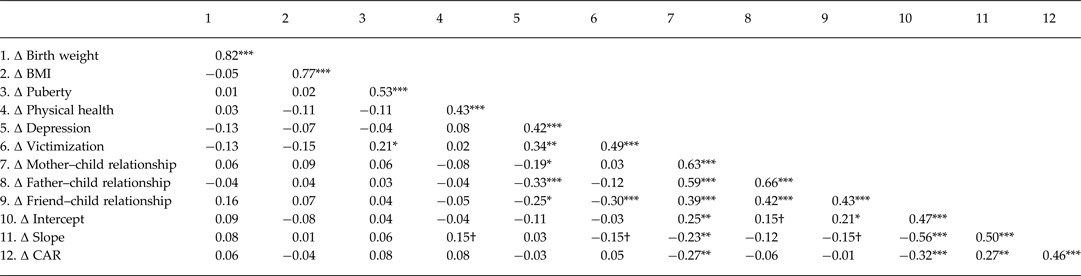
Prior to creating within-pair difference scores, within-pair correlations of all study variables were examined (see diagonal of Table 1). Within-pair correlations varied between r = 0.42 and r = 0.82, indicating significant shared familial (including genetic) influences on all variables. To control for these influences, we followed the strategy most commonly used in MZ-differences studies (Vitaro et al. Reference Vitaro, Brendgen and Arseneault2009). Specifically, relative twin-difference scores were derived by subtracting twin no. 2's scores from twin no. 1's scores, with rank order between twins in a pair determined at random. Thus, a high positive difference score indicates that twin no. 1 had a much higher value on that variable than the co-twin, whereas a high negative difference score indicates that twin no. 1 had a much lower value on that variable than the co-twin.
Within-pair correlations of the study variables and bivariate correlations of the MZ-twin difference Δ scores of the study variables a , b

MZ, Monozygotic; BMI, body mass index; CAR, cortisol awakening response.
a Δ = Relative MZ twin-difference score (a higher value indicates a higher level of the variable than the co-twin).
b Within-pair correlations of the study variables are shown on the diagonal. Bivariate correlations of the relative twin-difference scores of the study variables are shown below the diagonal.
* p ⩽ 0.05, ** p ⩽ 0.01, *** p ⩽ 0.001.
† p ⩽ 0.10.
Bivariate correlations of the twin-difference scores of the study variables are shown below the diagonal in Table 1. MZ-twin differences in all three cortisol indicators were significantly correlated with each other, as were twin differences in most relationship variables. Moreover, twin differences in all relationship variables were correlated with twin differences in at least one indicator of diurnal cortisol, either significantly or with a statistical trend. In light of these correlations, subsequent regression analyses to examine the unique associations of each relationship variable with each indicator of diurnal cortisol were warranted.
Main analyses
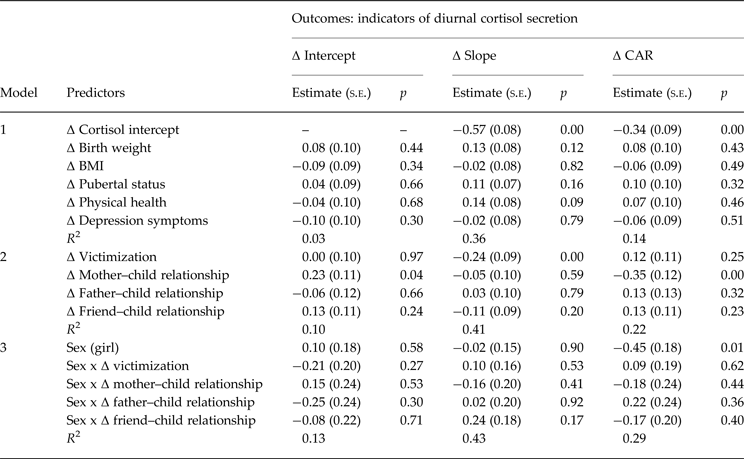
Using the twin pair as unit of analysis, three series of hierarchical multiple linear regressions were performed to test the predictive associations of twin differences in peer victimization and in the quality of the relationship with the mother, father and best friend with twin differences in the three daily cortisol indicators. Twin differences regarding confounders were entered in block 1 and twin differences regarding peer victimization and the three relationship variables were added in block 2 (with interactions between these variables and sex entered in block 3). Multiple (i.e. 100) imputations were used to account for missing data (9% of data points). For conservative testing, twin differences in the previously mentioned control variables were also included. In the regressions predicting to twin differences in the slope and in the CAR, we also controlled for their overlap with twin differences in the intercept. To simplify interpretation of regression coefficients, difference scores were Z-standardized prior to analyses. Bonferroni correction with a critical p value of 0.017 was applied to control for multiple testing (i.e. three identical multiple regressions to predict each cortisol indicator).
As shown in Table 2, results from block 1 showed that participants with higher awakening cortisol showed a steeper decrease (slope) of cortisol over the day and a weaker CAR than their co-twin. Contrary to expectations, twin differences in confounding variables were not significantly associated with twin differences in the cortisol indicators. Results from block 2 revealed that participants who had a more problematic mother–child relationship than their co-twin showed lower awakening cortisol (intercept), but this association was no longer significant after Bonferroni correction. However, twin differences in peer victimization were uniquely associated with twin differences in the diurnal decrease of cortisol, even after Bonferroni correction. Specifically, participants who were more victimized by their peers showed a steeper decrease of cortisol over the day, once the effects of the intercept and confounders were held constant. Moreover, participants who had a worse relationship with their mother than their co-twin also showed a stronger CAR even after Bonferroni correction. Sex moderation of these associations, examined in block 3, was not found.
Multiple linear regressions predicting to MZ differences Δ in cortisol intercept, slope and CAR a , b

MZ, Monozygotic; CAR, cortisol awakening response; s.e., standard error; BMI, body mass index.
a Δ = Relative MZ twin-difference score.
b All regression coefficients estimates and associated s.e.s are based on multiple imputations; no model fit statistics are available for multiple imputations.
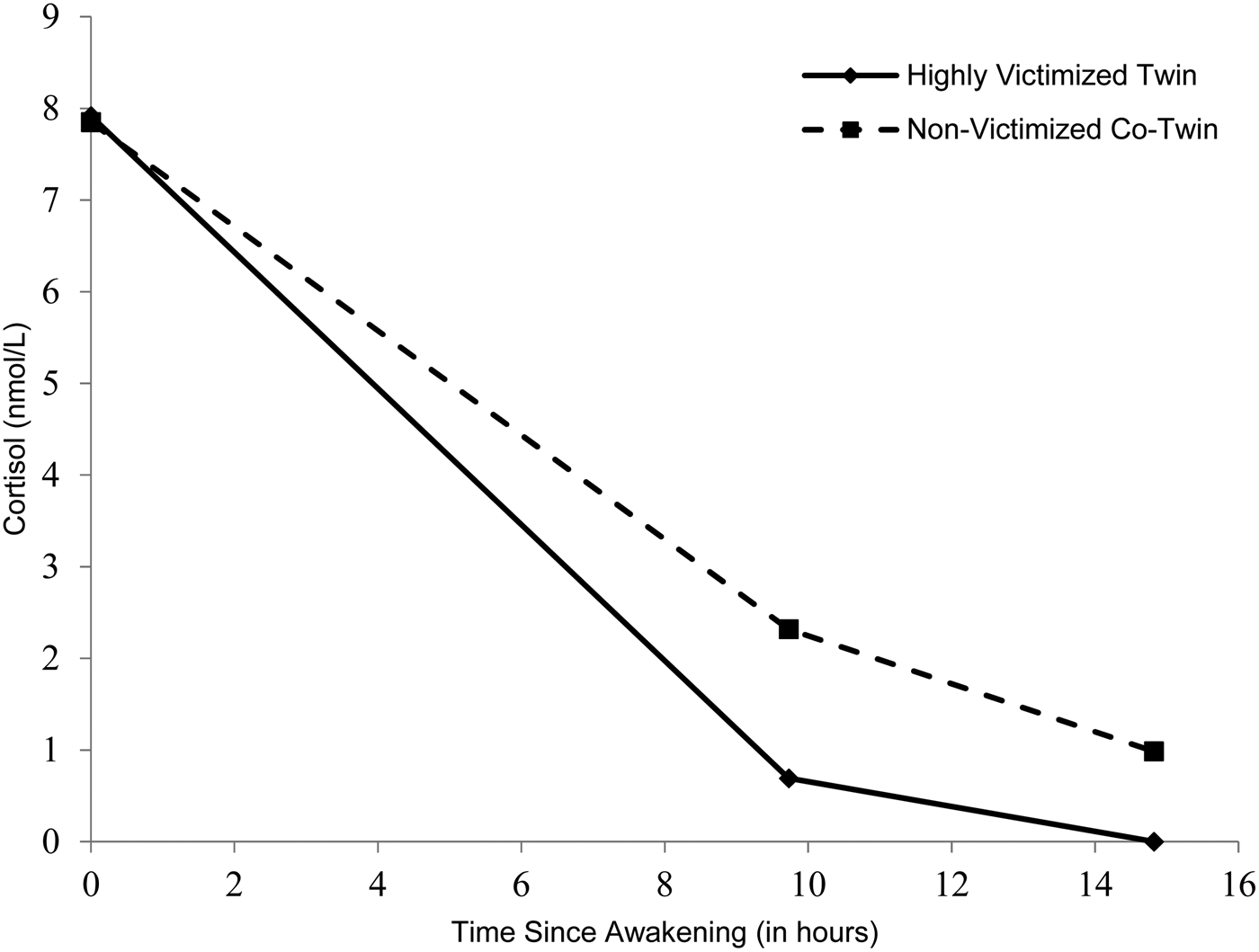
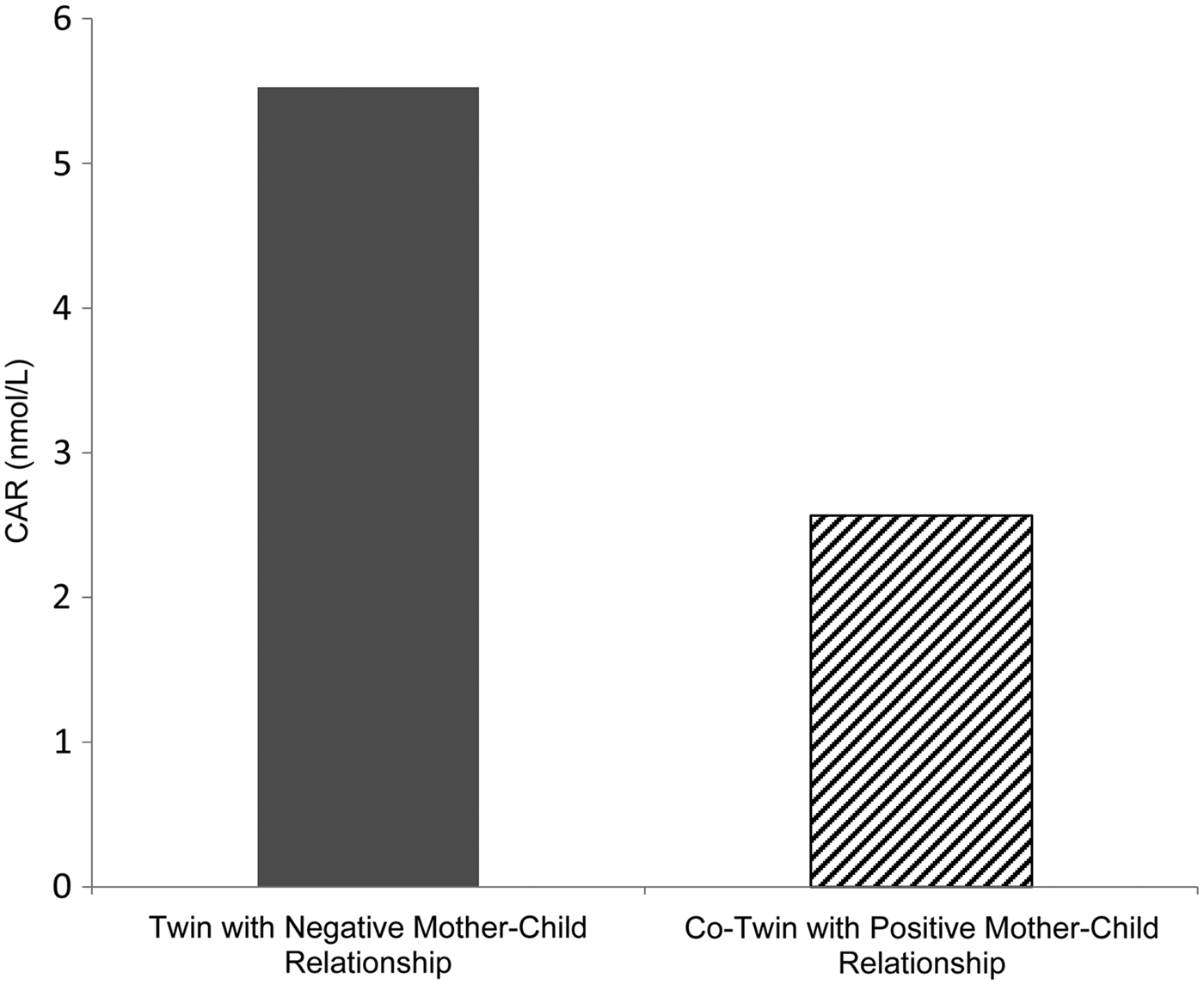
The differential patterns of diurnal cortisol secretion (intercept and slope) of a pair consisting of a highly victimized twin (i.e. with the observed maximum score of 4.44, indicating frequent victimization in both primary and high school) and a non-victimized co-twin (i.e. a score of 1, indicating no victimization) are illustrated in Fig. 1. The differential CAR patterns of a pair consisting of a twin with a very positive mother–child relationship (i.e. observed maximum score of 4.00) and a co-twin with a very negative mother–child relationship (i.e. observed minimum score of −2.83) are illustrated in Fig. 2.
Differential diurnal cortisol secretion pattern of a sample pair consisting of a highly victimized twin (i.e. with the observed maximum score of 4.44, indicating frequent victimization in both primary and high school) and a non-victimized co-twin (i.e. a score of 1, indicating no victimization).

Differential diurnal cortisol secretion pattern of a sample pair consisting of a twin with a very positive mother–child relationship (i.e. observed maximum score of 4.00) and a co-twin with a very negative mother–child relationship (i.e. observed minimum score of −2.83). CAR, Cortisol awakening response.

Discussion
This study investigated the potential environmental effects of peer victimization and the quality of the relationships with parents and best friend on diurnal cortisol secretion in mid-adolescence. Utilizing the MZ twin-difference design allowed us to control for family-wide – including genetic – effects and thus identify environmental influences unique to each child (Vitaro et al. Reference Vitaro, Brendgen and Arseneault2009). To tease apart more ‘stable’ from more ‘situation-specific’ variation of cortisol secretion, we used composite indices of the awakening cortisol level, the CAR and the diurnal change in cortisol secretion based on four assessments per day for 4 days over a 2-week period. Overall, we observed the typical diurnal pattern of cortisol secretion, with relatively high levels at awakening, a further increase roughly 30 min thereafter and a decrease over the rest of the day. However, there was also notable within-pair variability in the three cortisol indicators, indicating that diurnal cortisol secretion is also influenced by environmental factors unique to each child.
Controlling for potential confounders, twin differences in peer victimization and a problematic mother–child relationship were significantly linked to twin differences in diurnal cortisol secretion. The contributions of peer victimization and a problematic mother–child relationship were not additive, however, but concerned different indicators of cortisol. Whereas twin differences in peer victimization were unrelated to twin differences in cortisol secretion in the morning (i.e. intercept or CAR), twins who were more victimized than their co-twin showed a stronger decrease of cortisol until bedtime (controlling for awakening levels). In contrast, twin differences in the mother–child relationship quality were unrelated to twin differences in cortisol secretion later in the day (i.e. the diurnal slope). However, twins with a more problematic mother–child relationship than their co-twin showed a stronger awakening response than their co-twin (controlling for awakening levels). It is interesting that a problematic mother–child relationship was associated with cortisol secretion in the morning, whereas peer victimization was linked to HPA axis functioning later in the day. While speculative, this divergence might reflect differences in the ‘timing’ of exposure to the social stressor: whereas most adolescents with a problematic mother–child relationship probably experience stressful interactions with mothers already in the morning, they typically spend the remainder of the day until late afternoon in school, where bullying by peers may occur. Our findings thus suggest that diurnal cortisol secretion may be sensitive to and shaped by the timing of daily occurring stressors.
The blunted diurnal pattern of cortisol secretion in peer-victimized youth is in line with findings based on singleton samples (Vaillancourt et al. Reference Vaillancourt, Duku, Decatanzaro, Macmillan, Muir and Schmidt2008; Knack et al. Reference Knack, Jensen-Campbell and Baum2011). Because our measure of peer victimization reflected cumulative adverse experiences with peers since primary school, the observed lower cortisol secretion may have resulted from chronic exposure to peer stress and thus indicate a down-regulation of the stress-response system in highly victimized youth (Miller et al. Reference Miller, Chen and Zhou2007). Some findings also suggest that a change may occur during puberty in how adversities affect the HPA axis, with cortisol hyper-secretion before age 11 years and hypo-secretion thereafter (Bosch et al. Reference Bosch, Riese, Reijneveld, Bakker, Verhulst, Ormel and Oldehinkel2012). Unfortunately, blunted cortisol levels might indicate insufficient physiological responses to stress and aggravate vulnerability for adverse health outcomes (Pruessner et al. Reference Pruessner, Béchard-Evans, Boekestyn, Iyer, Pruessner and Malla2013).
At least during awakening, lower cortisol was also predicted by a problematic mother–child relationship, although this association failed to retain significance after Bonferroni correction. Relationship quality with the mother was only assessed in grade 8, but may nevertheless also reflect more chronic relationship problems for some. Especially for youth who already have highly negative parent–child interactions during childhood, relationship quality seems to decline further from age 11 years onwards (Laursen et al. Reference Laursen, DeLay and Adams2010). Why, then, did youth with a problematic mother–child relationship show an increased – not decreased – awakening response, controlling for awakening levels? Some researchers conceptualize the awakening response as a ‘cortisol mobilization response’ that enables individuals to face potential stressors (e.g. Tops et al. Reference Tops, Riese, Oldehinkel, Rijsdijk and Ormel2008). Youth with a problematic mother–child relationship may engage in severe arguments right after awakening and the increased CAR may reflect a direct or anticipatory HPA response to such stressful interactions.
Interestingly, analyses showed no links between the relationship with the father or best friend and diurnal cortisol levels. Previous studies reporting such associations did not control for the overlap between different social relationships or for genetic influences (Booth et al. Reference Booth, Granger and Shirtcliff2008; Byrd-Craven et al. Reference Byrd-Craven, Auer, Granger and Massey2012). Such control is important, however, as peer victimization and relationship problems with parents or friends often go hand in hand (Boulton et al. Reference Boulton, Trueman, Chau, Whitehand and Amatya1999; Beran, Reference Beran2009). Moreover, heritable factors can influence not only adolescents’ diurnal cortisol secretion (Ouellet-Morin et al. Reference Ouellet-Morin, Brendgen, Girard, Lupien, Dionne, Vitaro and Boivin2016) but also the quality of relationships with parents and friends (McGue et al. Reference McGue, Elkins, Walden and Iacono2005). Methodological control for genetic influences may also explain why, unlike other studies, confounding variables did not significantly predict cortisol secretion in our study.
Strengths and limitations
Our study shows that stressful relationships with peers and with the mother are uniquely associated with altered patterns of diurnal cortisol secretion. Because familial (including genetic) influences were methodologically controlled through the MZ-twin design, these associations may be interpreted as indicating unique environmental effects on HPA axis functioning. By collecting salivary diurnal cortisol over 4 days, we obtained more reliable measurements than single-day assessments (Kraemer et al. Reference Kraemer, Giese-Davis, Yutsis, O'Hara, Neri, Gallagher-Thompson, Taylor and Spiegel2006).
Still, our study is not without limitations. While saliva samples obtained at home allowed us to measure cortisol levels in a natural environment, the sampling procedure could not be directly controlled. Despite detailed instructions, compliance in collecting saliva samples at specific times at home is not always satisfactory (Kudielka et al. Reference Kudielka, Broderick and Kirschbaum2003). Nevertheless, the mean sampling times indicated that most participants adhered well to the sampling protocol. Control of the sampling time when calculating the three cortisol indicators also helped minimize potential bias. Another limitation concerns the sole use of self-reports to assess problematic social relations. However, evidence suggests that subjective rather than objective stress makes an impact on the physiological stress response and health outcomes (Adler et al. Reference Adler, Epel, Castellazzo and Ickovics2000).
Also, the blunted cortisol secretion associated with peer victimization may be specific to adolescents. Indeed, adverse experiences may be associated with higher cortisol in pre-pubertal children (Bosch et al. Reference Bosch, Riese, Reijneveld, Bakker, Verhulst, Ormel and Oldehinkel2012). Generalization could also be limited since data were based on twins. However, twins do not differ from singletons in the level of peer victimization, the relationship with parents or friends (Thorpe, Reference Thorpe2003; Lytton & Gallagher, Reference Lytton, Gallagher and Bornstein2005; Boivin et al. Reference Boivin, Brendgen, Vitaro, Dionne, Girard, Pérusse and Tremblay2013b ), mood levels or cortisol reactivity to daily stressors (Jacobs et al. Reference Jacobs, Myin-Germeys, Derom, Delespaul, van Os and Nicolson2007). Moreover, although twins more often have low birth weight, they do not differ from singletons in regard to other confounders, such as BMI or pubertal status (Kaprio et al. Reference Kaprio, Rimpelä, Winter, Viken, Rimpelä and Rose1995). These variables were also controlled in our study. Finally, our results cannot be generalized to clinical populations, as individuals with psychiatric disorders show different patterns of diurnal cortisol secretion (Goodyer et al. Reference Goodyer, Herbert, Altham, Pearson, Secher and Shiers1996).
Despite these limitations, this study provides further insights about the role of stressful relationships with peers or the mother in the alteration of biological stress systems, even when controlling for genetic vulnerabilities. Given the importance of the HPA axis in the development of mental and physical health problems, these results underscore the need for a better understanding of the biological mechanisms linking social stress and developmental outcomes.
Acknowledgements
Funding for this study was provided by the Social Sciences and Humanities Research Council of Canada and the Canadian Institutes of Health Research. We thank Jocelyn Malo and Marie-Elyse Bertrand for coordinating the data collection and Hélène Paradis for data management and preparation. We also thank the twins and their families as well as their classmates for participating in this study.
Declaration of Interest
None.