Introduction
Centre-based childcare plays a pivotal role in enhancing women’s work-life balance and facilitating their labour market participation. A substantial body of research has underscored the importance of formal childcare in enabling female employment (Gornick et al., Reference Gornick, Meyers and Ross1998; Kreyenfeld and Hank, Reference Kreyenfeld and Hank2000; Van der Lippe and Van Dijck, Reference Van der Lippe and Van Dijk2002). Evidence from industrialised countries further demonstrates that access to formal childcare not only supports women’s sustained workforce engagement but also positively shapes fertility decisions (Hank and Kreyenfeld, Reference Hank and Kreyenfeld2003; OECD, 2011). In Western nations, the redesign of childcare systems has often responded to their post-industrial transformations in labour markets and family structures (Esping-Andersen, Reference Esping-Andersen1999; Lewis, Reference Lewis2006), marked by rising female employment, declining marriage rates, increasing divorce rates, and a growing prevalence of single-person households (Lesthaeghe, Reference Lesthaeghe2010). These demographic and social changes have disrupted traditional gender-based divisions of labour and driven the defamilialisation of caregiving, prompting governments either to expand public care services or to reinforce traditional family-based care through policy support (Gauthier, Reference Gauthier2002).
The development of childcare systems in China and Central and Eastern European (CEE) countries has followed a trajectory distinct from that of Western nations, shaped primarily by political economic transitions rather than post-industrial dynamics. This shared origin as state-led socialist planned economies, which supported high female employment and publicly subsidised childcare (Kocourkova, Reference Kocourkova2002), explains the common divergence from Western pathways. However, their subsequent policy choices have diverged. While the CEE cases have received some scholarly attention (see Polese et al., Reference Polese, Morris, Kovács and Harboe2014; Szelewa and Polakowski, Reference Szelewa and Polakowski2020), China’s recent efforts since 2019 to expand its childcare system remain largely underexplored.
Facing rapid ageing and low fertility rates in the 2010s (Mai et al., Reference Mai, Peng and Chen2013), the Chinese government introduced a series of policies to promote formal childcare services to encourage childbirth. However, existing research has largely concentrated on the country’s historical service development (Li, Reference Li2017; Ji et al., Reference Ji, Wang, Liu, Xu and Zheng2020; Wallace Reference Wallace2020) or the current high demand for formal childcare (Liu et al., Reference Liu, Abdul Rahman, Wang and Mao2022a; Hong et al., Reference Hong, Liu, Zhang and Li2022). Particularly absent is an examination of the central government’s childcare development model and its implementation at the local level.
This article addresses this gap by examining policies introduced by the Chinese central government since 2019 to promote formal childcare, along with the corresponding developments in three selected county-level regions. It investigates the following questions: What policies has the Chinese central government introduced, and what are their key features? How is formal childcare developing at the local level? What type of developmental model is emerging in China, and what challenges does it encounter? Finally, how does the Chinese experience of childcare provision compare with that of other countries adopting similar development models? By addressing these questions, this article offers a comprehensive account of China’s recent efforts to expand formal childcare. It contributes more specifically by conceptualising China’s emerging childcare approach as a tailored third way model within Mahon’s typology, thereby offering insights into comparative debates on childcare provision.
Childcare welfare models
Mahon’s typology
While various theoretical frameworks exist to classify welfare regimes (Esping-Andersen, Reference Esping-Andersen1990; Lewis, Reference Lewis1992), a notable framework for analysing childcare is Mahon’s (Reference Mahon2002) typology. Derived from a comparative study of European childcare policies, it systematically delineates the roles and interactions of the state, the market, and the family in childcare provision, offering a coherent analytical tool for cross-contextual policy comparison through three ideal types: the egalitarian, the neofamilial, and the third way.Footnote 1 The egalitarian model is distinguished by a strong commitment to gender equality, achieved through parental leave systems that enable both parents to equitably share childcare responsibilities. It prioritises universal accessibility and affordability, ensuring the provision of high-quality services for families across all socioeconomic levels, which supports equal opportunities for children and aids parents in balancing work and family life. Skilled care providers are central to this model, with policies emphasising fair compensation and favourable working conditions for them (Himmelweit and Sigala, Reference Himmelweit and Sigala2004). Importantly, the egalitarian model views access to childcare as a fundamental right for children, independent of their parents’ employment status, and values democratic control over the childcare system by integrating parental and community voices into service provision, thereby fostering transparency and accountability (Jensen, Reference Jensen2009). Denmark and Sweden are often cited as representative cases of the egalitarian model.
In contrast, the neofamilial model embodies conservative perspectives on gender roles, emphasising women’s choices between caregiving at home and workforce participation. This model of childcare provision operates in tandem with other state support for family welfare, typically including extended parental leave and child allowances that enable parents, particularly mothers, to stay at home after childbirth, as practiced in countries such as Finland and France. However, these policies reinforce traditional gender norms, potentially discouraging maternal employment. Thus, they are often criticised for marginalising women in the labour market and widening gender disparities (Lewis, Reference Lewis2006; Van Lancker, Reference Van Lancker2013).
The third way model, exemplified by the Netherlands and the United Kingdom, occupies an intermediate position. It adopts a more gender-equal approach compared to the neofamilial model by facilitating mothers’ return to work and advancing the defamilialisation of care through the expansion of formal childcare services. However, unlike the egalitarian model’s reliance on extensive public investment, the third way approach places greater emphasis on market-based service provision. Although governments may provide targeted subsidies or tax incentives to support low-income families, this model has been criticised for potentially leading to unequal access to childcare for disadvantaged groups and may push low-income mothers into insecure, low-wage jobs (Lister, Reference Lister2001; Rush, Reference Rush2006).
Building on this typology, this article investigates the emerging model of childcare service development in China, and analyses its distinctive features and the challenges it poses in terms of social and gender inequalities.
Soviet model and afterwards in China
Childcare services constituted a key component of the social welfare system in countries that adopted the Soviet-style welfare model. In both CEE countries and China, the state monopolised welfare resources during the socialist era, delivering childcare and other services through state-owned enterprises (SOEs, also known as work units or danwei in the Chinese case) (Szikra and Tomka, Reference Szikra, Tomka, Cerami and Vanhuysse2009; Polese et al., Reference Polese, Morris, Kovács and Harboe2014; Wu et al., Reference Wu, Li and Cao2024). Generous government funding allowed parents easy access to affordable formal services, which substantially facilitated the reconciliation of work and life for parents and contributed to higher female labour force participation rates in these countries (Teplova, Reference Teplova2007; Lokshin, Reference Lokshin2004). For example, data from the World Bank show that Chinese women’s labour force participation rate reached 72.6 per cent in 1991, far exceeding the global average of 51.3 per cent.Footnote 2
However, childcare provision in China drastically changed after the central leadership determined to develop a market-oriented economy. In 1995, the State Council mandated SOEs to ‘establish modern management systems’ to reduce costs and better adapt to market competition. For this purpose, social service functions were required to be separated from SOEs, and accordingly, childcare centres, kindergartens, and affiliated schools operated must be handed over to local governments. As in CEE countries (Kocourkova, Reference Kocourkova2002; Teplova, Reference Teplova2007), most publicly subsidised care centres in China were closed due to a lack of government funding following the reform. Consequently, Chinese families were compelled either to depend on a limited number of costly private providers or shoulder the caregiving responsibility themselves (Ji et al., Reference Ji, Wang, Liu, Xu and Zheng2020), often resorting to the tradition of grandparenting (Chen et al., Reference Chen, Liu and Mair2011).
China’s declining fertility rate and rapid population ageing in the 2010s eventually prompted a renewed policy interest in formal childcare. The country’s total fertility rate sunk from 2.7 in 1980 to 1.7 in 2014,Footnote 3 while the proportion of the population aged sixty and over reached 15.5 per cent by the end of the same year (Ministry of Civil Affairs, 2015). In response, the Chinese government initiated a series of policies aimed at building a ‘fertility-friendly society’, with the expansion of centre-based childcare identified as a central component. This policy orientation reflects widespread public concern that the lack of childcare services constitutes a major obstacle to childbirth (Jin et al., Reference Jin, Song and Chen2016). Alongside efforts to improve elderly care services, childcare provision has become one of the two principal policy responses to the country’s worsening demographic trends (State Council, 2021). Since market-oriented reforms, China’s childcare provision has undergone two major shifts, driven first by economic restructuring and more recently by demographic pressures. Yet, the central government’s recent childcare model remains underexplored and deserves further investigation.
Research method
Analysing policy texts is essential for understanding the childcare development model designed by the Chinese government in 2019 and its potential impacts. Policy documents not only articulate official goals and priorities but also reflect the governance logic and values within specific socio-economic contexts (Yanow, Reference Yanow1996). By interpreting these texts, researchers can uncover the interplay between explicit objectives and implicit assumptions, enabling an assessment of policy coherence and feasibility (Fischer, Reference Fischer2003). This study begins by compiling recent policy documents related to childcare issued by the Chinese central government. It proceeds to analyse their key contents and policy instruments, with a focus on the roles assigned to the state, market, and family in childcare expansion.
To further illustrate the recent development of formal childcare in Chinese localities, this study also draws on field research conducted in three county-level regions in Shaanxi Province between 2021 and 2023. Shaanxi is a province with a mid-tier economy in China regarding its Gross Domestic Production in China. The three research sites, namely W District, C County, and L County, vary significantly in their fiscal capacities, representing high, average, and low government revenue regions within the province.Footnote 4 Although the study does not aim to produce statistically generalisable findings, the observed developments in these regions should offer valuable insights into broader national patterns. The fieldwork involved semi-structured interviews with ten local government officials directly responsible for childcare policy implementation, three childcare centre managers, and thirty urban and rural residents. These participants offered valuable perspectives on the implementation of central policies, as well as the supply and demand of formal care services in Chinese localities.
Childcare service expansion – the case of China
Central policies for childcare development
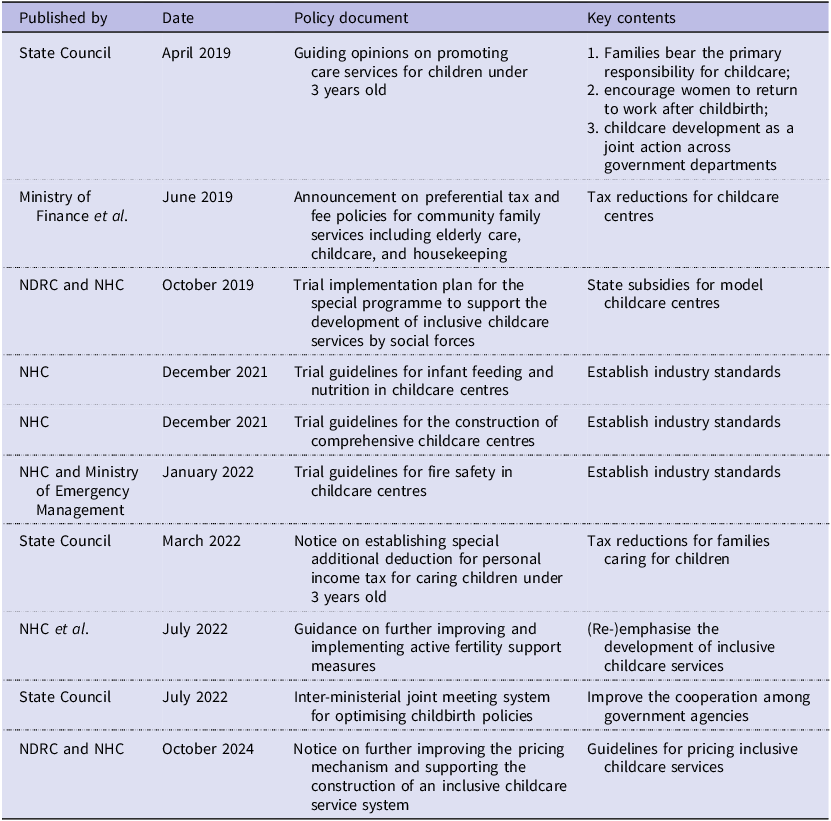
The restart of childcare service development in China was signalled by the central government’s release of the Guiding Opinions on Promoting Care Services for Children Under 3 Years Old in 2019 (see Table 1), which underscores the importance of establishing inclusive care centres within Chinese society. Notably, the term ‘inclusive’ in this context implies that these services should be understood as affordable commodities for the general population, rather than the fully state-funded welfare programmes of the socialist era. Crucially, the central policy expressly stipulates that marketisation should serve as the primary mechanism for increasing service provision and ‘play a decisive role in resource allocation’. It further designates ‘social forces’, which euphemistically refer to private capital, as the principal investors in formal childcare services, rather than governments at any level. Although local governments are encouraged to provide support through measures such as free venues or rental subsidies, these provisions are non-compulsory. Moreover, despite the policy’s emphasis on promoting childcare centres, formal care is explicitly defined as supplementary, with families expected to bear the primary responsibility for childcare. This has also been written into the ‘first basic principle’ of childcare service development in China.
Chinese central government’s policies for childcare service development

Source: Authors’ compilation.
To facilitate the expansion of inclusive childcare, the central government introduced tax incentives in June 2019, including exemptions or reductions on value-added tax, income tax, and land-use fees for service providers. In October of the same year, the National Development and Reform Commission (NDRC) and the National Health Commission (NHC) jointly initiated a special project to fund the construction of model childcare centres. These model centres are intended to serve as elite service providers that guide the development of the childcare industry while encouraging the establishment of additional care facilities across the country. Under this programme, the central government has allocated generous financial support, providing a lump-sum grant of RMB 10,000 per childcare slot. However, access to these funds requires a joint application from the childcare centre and its local government, with both parties expected to fulfil specified commitments regarding service quality and support policies. Local governments, in particular, are urged to provide robust support – especially in financial terms – for the development of these model institutions.
Further regulatory measures were introduced in early 2022, including detailed standards for the construction, operation, and fire safety of childcare centres. In March 2022, a personal income tax deduction was introduced to provide indirect financial relief for Chinese families with young children. Later, in July 2022, the central government once again called for an expansion of inclusive services and more preferential policies from local governments. A joint interministerial mechanism involving seventeen government departments was established to enhance cross-sectoral coordination and ensure effective implementation of fertility-support policies, with childcare development identified as a key component. The most recent policy, issued in October 2024 by the NDRC and NHC, sets pricing standards for inclusive childcare services.
The release of this series of policies clearly demonstrates that the expansion of formal childcare services has become a policy priority for the Chinese government since 2019. Bloom and Pebley (Reference Bloom and Pebley1982) argue that any expansion of childcare provision must consider three fundamental questions: (1) Should the government intervene by directly establishing public care centres or by subsidising private providers? (2) To what extent should government support be provided? (3) Should public funds be allocated to formal care centres or informal settings? In the Chinese context, it can be seen that the current approach to childcare service development aligns with the national strategy that has been in place since the market-oriented reforms. Service provision is expected to rely primarily on private actors, with the state assuming a regulatory and facilitating role rather than a direct care provider. The government has refrained from re-establishing publicly funded care centres and instead focuses on creating an enabling environment for private providers through tax relief and regulatory guidance. Financial support remains narrowly targeted, with generous subsidies limited to a small number of model centres. Moreover, apart from the personal income tax deduction,Footnote 5 Chinese families receive no direct financial assistance, as child allowances are not part of the current policy framework.
Local evidence of recent service expansion
The role of local governments in the expansion of childcare services also deserves attention. While they are expected to formulate concrete support measures to facilitate childcare service development (State Council, 2019), their contributions are not mandated, making formal childcare growth in practice heavily reliant on their engagement. Fieldwork conducted for this study reveals that local authorities are generally reluctant to invest in formal childcare, and such a reluctance is closely tied to the central government’s development strategy and funding policies. Most interviewed officials identified declining local fiscal revenues as a primary constraint. As one health bureau leader put it:
Since the 2016 reform replaced the business tax with the value added tax (VAT), our county revenues have kept shrinking, and we simply have no money left for childcare centres.Footnote 6 Without financial support from upper‑level governments, there is nothing we can do. (HBL, C0822)
Consequently, local governments have become increasingly reliant on transfer payments from higher-level authorities to maintain public expenditure. However, in the absence of earmarked funding from either the central or provincial governments specifically designated for childcare development, local authorities face significant difficulties in offering substantial support.
At the time of the fieldwork, none of the three local governments had implemented the support measures recommended by the central government, such as reducing or waiving rent for childcare centres. The only exception was W District, which subsidised local service providers with an annual RMB 400 per enrolled child. Moreover, local officials openly expressed their unwillingness to participate in the model childcare centre programme. As an interviewee explained: ‘Central government funding [for the programme] is not easy to obtain, because there is intense competition among localities. To stand a chance, we have to offer incentives like rent-free venues or large subsidies. But that will put even more pressure on our already tight budget’ (HBL, L1021).
All interviewed officials from the three research sites made it clear that they would not introduce additional support for childcare service development unless higher-level governments established specific funding policies and, most importantly, provided the necessary financial resources.
Finally, local governments’ reluctance to invest has resulted in a severe shortage of affordable childcare options. During the fieldwork, only a small number of private for-profit childcare centres were operating across the three research sites, and their fees were beyond most local families’ reach, typically accounting for one-third or more of a household’s monthly disposable income.Footnote 7 Consequently, only a few economically better-off families could afford such expensive services. As a childcare centre manager commented, ‘most of them are civil servants or local business owners’ (CCM, W0423). In contrast, all rural parents indicated that they would rely on grandparental care.Footnote 8 Evidently, the current childcare system falls far short of being inclusive, particularly for low-income families in rural China.
A third way between family and market
Family responsibility and marketisation of service provision
The Chinese government’s approach to childcare service development clearly diverges from the egalitarian model described by Mahon, which envisions the state as an active welfare provider, committed to promoting gender equality and supporting women’s participation in the labour market. In contrast, central policies in China explicitly define childcare as a private family responsibility rather than a form of public welfare, as illustrated by the ‘first basic principle’ outlined in national policy (State Council, 2019). Accordingly, Chinese families are assigned the primary responsibility for childcare, while formal services are framed as supplementary, serving only those ‘in real need’. The state has withdrawn from direct service provision, instead relying on private capital to establish and operate childcare centres. This orientation is further reinforced by China’s highly unequal parental leave system, which offers 158 days for mothers and fifteen days for fathers, thereby exacerbating gendered caregiving roles. In official discourse, women are still portrayed as those who ‘hold up half the sky’, and mothers are explicitly encouraged to return to work after childbirth. Yet this rhetoric is undermined by a fundamental tension with institutional design, given that the asymmetrical leave system institutionalises women as primary caregivers, reinforcing workplace discrimination and intensifying work–family conflicts (Song, Reference Song2017; Yu and Xie, Reference Yu and Xie2018). Although policy texts repeatedly stress support for women’s labour market participation, the underlying institutional logic continues to reproduce maternalist gender norms. At the same time, central policy defines centre-based childcare as a ‘supplement to family responsibility’ rather than a universal public good, further entrenching the implicit expectation that mothers should bear the primary burden of caregiving duties and highlighting the contradiction between ‘discursive equality’ and ‘institutional inequality’. These features sharply distinguish China’s childcare provision from those of egalitarian welfare states.
At the same time, China’s approach also deviates from the neofamilialist model. This distinction is evident not only in contrast with industrialised countries but also with CEE countries. Following post-socialist transitions, many CEE countries reverted to traditional family values and a gendered division of labour, shifting caregiving responsibilities back onto mothers (Glass and Fodor, Reference Glass and Fodor2007; Saxonberg and Szelewa, Reference Saxonberg and Szelewa2007). While childcare was similarly defined as a family concern (Gradskova, Reference Gradskova, Carlbäck, Gradskova and Kravchenko2012: 178), countries such as Poland and Hungary introduced child allowances to encourage women to embrace caregiving roles (Szelewa and Polakowski, Reference Szelewa and Polakowski2020). In stark contrast, the Chinese Communist Party (CCP) has not abandoned communism as its official ideology. Instead of promoting traditional gender norms of women as homemakers and caregivers, the Chinese government continues to uphold women as those who ‘hold up half the sky’ and expressly advocates mothers to rejoin the workforce after parental leave (State Council, 2019). Despite the current lack of substantial financial support, the Chinese government has placed the expansion of formal childcare services high on the policy agenda, framing it as a strategic countermeasure against the country’s declining fertility rates. This approach superficially aligns with features of defamilialisation (Esping-Andersen, Reference Esping-Andersen1999: 45). Moreover, China lacks the institutional infrastructure typically used to promote traditional caregiving roles, such as child allowances or flexible employment systems, which are common in neofamilialist states.
The Chinese government has, in practice, adopted a pragmatic third way, positioning itself between the egalitarian and neofamilial models by integrating family responsibility into formal childcare development while relying on private investment. Assigning primary childcare responsibility to families represents a strategic attempt to avoid a substantial increase in public spending. As a rapidly industrialising country, China prioritises cost-effective measures for formal childcare expansion over extensive welfare provisions. While this strategy reflects the productivist legacy of East Asian countries, where social policy often serves economic growth (Holliday, Reference Holliday2000), China’s recent trajectory differs from that of Japan and South Korea, which have increasingly expanded public subsidies to ease care burdens (Peng, Reference Peng2012). Instead, China’s emerging model remains firmly committed to marketisation with limited state funding. This approach also aligns with the deeply rooted tradition of grandparental caregiving in Chinese society.
To avoid an abrupt shift in official ideology, the Chinese government, at least self-allegedly, continues to advocate for maternal labour force participation, even as it seeks to encourage higher birth rates. The dual objective is planned to be achieved through the expansion of formal childcare services, which enable women to better reconcile their work and family obligations. In fact, both formal childcare and women’s employment are framed as key pillars of China’s ‘fertility support policy system’ (CCP Central Committee and State Council, 2021). Nevertheless, while the state’s promotion of market-based childcare appears to fit the definition of ‘defamilialisation’, China’s practice reveals a form of gendered defamilialisation. Rather than liberating caregiving responsibilities equally from the family, this model often shifts women’s unpaid domestic labour into costly market services or forces them to make difficult trade-offs between employment and childcare. For many families, when market services are unaffordable, women withdraw from the labour market or turn to informal employment to shoulder caregiving duties (Cook and Dong, Reference Cook and Dong2011; Jia and Dong, Reference Jia and Dong2013). In this sense, the expansion of childcare has so far functioned less as genuine defamilialisation than as a redistribution or repackaging of burdens, with the ultimate responsibility for care still falling on women.
Moreover, unlike egalitarian welfare states, China lacks a structured, long-term, and stable system of public funding to support the construction and operation of childcare centres. The Chinese government primarily acts as a regulatory designer, confining its role to setting industry standards and overseeing care centre operations. The expansion of formal childcare services is planned to primarily depend on private capital with minimal state subsidies, while families receive indirect assistance in the form of tax deductions. This strategy reflects the third way’s preference for market mechanisms over direct public ownership and is mirrored in the development of China’s elderly care sector, where service delivery has increasingly been outsourced to for-profit private providers (Maags, Reference Maags2022).
Nevertheless, compared to other developed countries that have adopted third way models, China’s approach demonstrates markedly weaker state support. For example, the Dutch government provides partial reimbursement of childcare expenses based on household income, parental working hours, and the type of care arrangement. This system has substantially reduced the financial burden of market-based childcare for low-income families (Bettendorf et al., Reference Bettendorf, Jongen and Muller2015), and has, in turn, contributed to an increase in female labour force participation (Blanden et al., Reference Blanden, Del Bono, Hansen and Rabe2021). By contrast, similar demand-side subsidies remain absent in China, while there are insufficient incentives for private providers to engage in service delivery. In sum, China constitutes a distinctly tailored third way model that prioritises market provision and family responsibility to minimise public spending, yet rejects a full neofamilial turn by actively promoting formal services to support female employment.
Accessibility and equity challenges
Consequently, the development of formal childcare in China is confronted with pressing challenges related to unequal access, particularly for disadvantaged groups. Existing research emphasises childcare prices and places as critical factors shaping parents’ caregiving decisions (Meyers and Jordan, Reference Meyers and Jordan2006; Abrassart and Bonoli, Reference Abrassart and Bonoli2015). Consistent with these findings, this study’s fieldwork reveals a limited availability of inclusive services in Chinese localities, with formal childcare disproportionately accessed by economically better-off families. Such uneven distribution raises growing concerns about deepening social inequality in contemporary China.
Studies on market-oriented childcare systems in countries such as the Netherlands and the United Kingdom have shown key deficiencies in their service provision, including rising costs, declining service quality, and biased access (Lloyd and Penn, Reference Lloyd and Penn2010; Akgündüz and Plantenga, Reference Akgündüz and Plantenga2014). In particular, childcare costs in the UK remain among the highest across OECD countries, while expenses in the Netherlands have continued to rise, imposing greater financial pressure on families. Moreover, the rapid expansion of care centres often leads providers to prioritise cost control over service quality, making it difficult to ensure consistent service standards across providers, despite strict standards and regulatory frameworks in both countries. Market forces further tend to concentrate services in more profitable, higher-income regions, leading to a persistent undersupply in economically disadvantaged communities. Consequently, families with greater financial resources are significantly more likely to access high-quality childcare. Such access is linked not only to enhanced cognitive and language development in children, but also to improved emotional security and peer relationships (Esping-Andersen et al., Reference Esping-Andersen, Garfinkel, Han, Magnuson, Wagner and Waldfogel2012; Verhoef et al., Reference Verhoef, Plagnol and May2018). This unequal distribution of quality care may result in divergent developmental outcomes across income groups, thereby reinforcing intergenerational social inequalities.
These international experiences offer critical insights for understanding the challenges facing China’s emerging childcare system. Although concerns about service quality have not yet become salient given the sector’s early stage of development, issues of affordability and unequal access are already evident. Firstly, if financially constrained Chinese families are forced to withdraw from the labour market or engage in self-employment to provide care, their household income may diminish, widening their economic disparities with higher-income groups. Secondly, unequal access to formal childcare risks reinforcing disparities in social capital among Chinese children from different income groups. In particular, children from lower-income and rural households are more likely to be excluded from services due to overly high costs, leaving them at a disadvantage in terms of early development and long-term life opportunities. Thirdly, when families struggle to cope with childcare costs, they are more likely to revert to the traditional male breadwinner model, which reinforces women’s primary caregiving role and constrains their career prospects. This gendered dynamic is also reflected in labour market outcomes, as World Bank data show that Chinese women’s labour force participation has fallen sharply from 72.6 per cent in 1991 to 59.6 per cent in 2024,Footnote 9 a decline that coincides with the marketisation of childcare and the state’s retreat from direct provision. Empirical research further demonstrates that rising childcare expenses tend to drive mothers to reduce their participation in paid work while increasing the time devoted to housework and childcare (Liu et al., Reference Liu, Qi and Xiong2022b). Consequently, China’s third way model, in the absence of substantial public support and gender-equality measures, has not effectively sustained women’s employment but instead tends to further marginalise them in the labour market.
As in the Netherlands and the United Kingdom, the Chinese case indicates limitations of the third way model in ensuring accessible and equitable formal childcare. These limitations further stress the necessity of complementing market-based service expansion with stronger government intervention. As Lloyd and Penn (Reference Lloyd and Penn2010) argue, countries adopting third way models should treat childcare as a public good, thus increasing public financing and state regulation accordingly. While demand-side subsidies can stimulate service use, they must be regularly adjusted to address rising service costs and inflation (Akgündüz and Plantenga, Reference Akgündüz and Plantenga2014). Moreover, policymakers should go beyond economic or employment goals by recognising the provision of high-quality care for disadvantaged children as a key policy lever to reduce social inequality (Verhoef et al., Reference Verhoef, Plagnol and May2018). This can be achieved, for example, through the improvement of caregiver training and reducing child-to-staff ratios.
All of these policy insights offer important guidance for optimising childcare provision in countries following a third way model, including China. However, current policies released by the Chinese central government suggest that such considerations have yet to be incorporated into its childcare agenda. A key priority should be rebalancing the reliance on private capital with stronger public responsibility. While marketisation may contribute to expanding service availability, it must be accompanied by sustained public investment to ensure that affordable formal childcare is accessible to all families. In addition, the Chinese government should strengthen quality regulation and enhance targeted support for vulnerable groups to promote universal access and equity across income groups, which is essential not only for maximising the developmental benefits of formal childcare but also for breaking down entrenched gender roles. Equally important, childcare policy reform should be explicitly linked to gender equality objectives. Extending paternity leave and fostering public discourse on fathers’ involvement in caregiving are also crucial to ensure that the expansion of formal childcare leads to genuine defamilialisation rather than a mere redistribution of care burdens within families. Future policies should therefore address both the supply of services and the institutional design of gender equality measures.
Conclusion
Unlike Western countries, where the transformation of childcare service models has typically been driven by rising female labour force participation and the broader dynamics of the second demographic transition, China’s recent expansion of childcare services is primarily a policy response to declining birth rates and rapid population ageing. Rather than reverting to traditional gender roles, the Chinese government has emphasised the development of formal care services and actively encourages maternal employment. However, this expansion relies predominantly on market mechanisms, with the state offering only limited indirect support to providers through preferential tax policies. Families likewise receive only modest tax deductions rather than more substantial measures such as child allowances, even though they continue to bear primary caregiving responsibilities. Taken together, these features reflect China’s adoption of a tailored third way model, which combines state-guided marketisation with limited public funding and strong expectations of family responsibility.
The current structure of childcare services in China also exemplifies the typical challenges associated with third way approaches. The lack of substantial public funding has led to the high cost of centre-based childcare, resulting in significant disparities between the central government’s stated goal of universal access to inclusive services and the reality of limited affordability. Given that only a small proportion of wealthier families can afford formal childcare, access remains uneven across income groups and interacts with China’s gender-unequal parental leave system, raising concerns about the potential exacerbation of both social and gender inequalities. Unlike in many developed countries (Van Lancker and Ghysels, Reference Van Lancker and Ghysels2012; OECD, 2011), this issue has yet to receive significant policy attention in China. More concerningly, inadequate service availability and affordability may fail to improve Chinese couples’ work-life balance and the country’s fertility level, thus undermining the very objective that prompted the government’s push for formal childcare development in the first place. These challenges point to the urgent need for enhanced governmental financial commitment and more active intervention in childcare provision. As in other third way contexts, the Chinese case highlights the importance of finding a better balance between market mechanisms and public responsibility. At the same time, it points to the necessity of integrating gender-equality objectives into care policies if childcare expansion is to achieve genuine defamilialisation.
This study contributes updated insights into the recent development of formal childcare provision in China. By examining the state’s current childcare model, it advances understanding of alternative approaches to childcare and enriches comparative research on childcare policies in both post-socialist contexts and countries adopting third way models. To further deepen knowledge of China’s third way approach, future research should conduct in-depth empirical investigations across regions with diverse socio-economic profiles. It is also important to observe whether the Chinese government will adjust its policies to improve service accessibility, including through increased direct funding and regulatory oversight. Finally, this study calls for further research that situates China’s childcare policy within a broader international comparative framework.
Acknowledgements
The authors wish to thank the anonymous reviewers and editors of Social Policy and Society for their valuable comments and suggestions.
Financial support
This research was supported by the National Social Science Foundation of China under grant number 23&ZD185.