Introduction
In many societies, domestic violence against women across their life-course is considered to be normal behaviour, not only by men but also by women (Cook & Bewley, Reference Cook and Bewley2008; Devries et al., Reference Devries, Mak, Garcia-Moreno, Petzold, Child and Falder2013; García-Moreno et al., Reference García-Moreno, Zimmerman, Morris-Gehring, Heise, Amin and Abrahams2015). Domestic violence by an intimate partner is one of the worst forms of abuse, with women having to face it from the person whom they should otherwise trust above all. According to the World Health Organization, intimate partner violence (IPV) is ‘… any behaviour within an intimate relationship that causes physical, psychological or sexual harm to those in the relationship, including acts of physical aggression, sexual coercion, psychological abuse, and controlling behaviours’ (WHO, 2002).
The World Health Organization, based on 48 surveys around the world, has reported that between 10% and 69% of women face IPV at some point in their lives. Globally, on average, 30% of women experience IPV, but the rate is considerably higher in South Asia (38%) (Bates et al., Reference Bates, Schuler, Islam and Islam2004; García-Moreno et al., Reference García-Moreno, Jansen, Ellsberg, Heise and Watts2006; Naved et al., Reference Naved, Azim, Abbas and Persson2006; WHO, 2013). In India, a substantial proportion of women face violence in both rural (43%) and urban (33%) settings (Jeyaseelan et al., Reference Jeyaseelan, Sadowski, Kumar, Hassan, Ramiro and Vizcarra2004, Reference Jeyaseelan, Kumar, Neelakantan, Peedicayil, Pillai and Duvvury2007; Peedicayil et al., Reference Peedicayil, Sadowski, Jeyaseelan, Shankar, Jain, Suresh and Bangdiwala2004). Physical IPV is the most common form of violence in the country, with one in every five women experiencing physical IPV – double and quadruple the number facing emotional and sexual IPV, respectively (IIPS & ICF, 2017).
IPV has primarily been attributed to gender inequity norms and traditional beliefs about gender roles and labour (WHO, 2009; Taylor et al., Reference Taylor, Nair and Braham2013). The socioeconomic transition in gender roles from traditional to modern societies gives rise to women’s agency and fosters resistance towards undesired and risky behaviours of husbands and partners (Jewkes et al., Reference Jewkes, Levin and Penn-Kekana2002; Wendt, Reference Wendt2009; Cardoso et al., Reference Cardoso, Gupta, Shuman, Cole, Kpebo and Falb2016). Other key factors that disempower women and lead to IPV are lower age at marriage, family composition, lower education, type of occupation, lower economic bargaining power and unintended pregnancy or unintended birth (Moore, Reference Moore1999; Bacchus et al., Reference Bacchus, Mezey and Bewley2004; ICRW, 2006; Koenig et al., Reference Koenig, Stephenson, Ahmed, Jejeebhoy and Campbell2006; Hines, Reference Hines2007; Cripe et al., Reference Cripe, Sanchez, Perales, Lam, Garcia and Williams2008; WHO, 2009; Barber et al., Reference Barber, Kusunoki, Gatny and Budnick2010; Babu & Kar, Reference Babu and Kar2010; Krishnan et al., Reference Krishnan, Rocca, Hubbard, Subbiah, Edmeades and Padian2010; Babu & Kar, Reference Babu and Kar2012; VanderEnde et al., Reference VanderEnde, Yount, Dynes and Sibley2012; Dixit et al., Reference Dixit, Ram and Dwivedi2012; Das et al., Reference Das, Bapat, More, Alcock, Joshi, Pantvaidya and Osrin2013; Walker et al., Reference Walker, Bowen and Brown2013; Bessa et al., Reference Bessa, Drezett, Rolim and Abreu2014; Shorey et al., Reference Shorey, Tirone and Stuart2014; Goli, Reference Goli2016; Johnson-Mallard et al., Reference Johnson-Mallard, Kostas-Polston, Woods, Simmonds, Alexander and Taylor2017). The prevalence of unintended births is considerably higher in India than in other developed and many developing countries. This study aims to examine the question of how far unintended births affect physical IPV in India.
Unintended births and IPV
Unintended birth is defined as any birth to a mother identified as either mistimed (the birth occurred earlier than the time they desired) or unwanted (at the time of pregnancy, the woman did not want to have any more births) (National Research Council, 1995; Mosher et al., Reference Mosher, Jones and Abma2012). An estimated 80 million unintended pregnancies take place each year all over the world (Bradley et al., Reference Bradley, Croft and Rutstein2011). Almost half of all unintended pregnancies result in unintended births. The unintended pregnancy rates in developing and developed countries are 59 and 44 per thousand, respectively, among women aged 15–44 years (Sedgh et al., Reference Sedgh, Singh and Hussain2014). A recent study from India estimated that 48.1 million pregnancies occur at the rate of 145 per thousand women in the reproductive age group (15–49 years); the rate of unintended birth is 70 per thousand women in the same age group (Singh et al., Reference Singh, Shekhar, Acharya, Moore, Stillman and Pradhan2018). In the context of India and some other developing countries, the reporting of the unwantedness of a child depends upon the sibling sex composition, which might lead to post-birth rationalization. A female child is more likely to be reported as unwanted than a male child due to a high preference for sons (Clark, Reference Clark2000; Khattak, Reference Khattak2014).
Unintended pregnancies and births are important public health issues, especially in developing countries, and play a major role as both causes and consequences of IPV. Most contemporary studies that deal with the issue of unintended births in the context of IPV consider IPV as the cause of unintended pregnancies and births (Cripe et al., Reference Cripe, Sanchez, Perales, Lam, Garcia and Williams2008; Stephenson et al., Reference Stephenson, Koenig, Acharya and Roy2008; Rahman et al., Reference Rahman, Sasagawa, Fujii, Tomizawa and Makinoda2012; Kamal, Reference Kamal2013; Anand et al. Reference Anand, Unisa and Singh2017), while a few studies have also drawn attention to the effect of unintended pregnancy and births on IPV (Barber et al., Reference Barber, Kusunoki, Gatny and Budnick2010). With the exception of sexual violence, IPV does not have a direct correlation with unintended pregnancy. Moreover, existing evidence clearly suggests that unintended births and IPV have negative effects on the mental and physical health of women and newborn children (Moore, Reference Moore1999; Cripe et al., Reference Cripe, Sanchez, Perales, Lam, Garcia and Williams2008; Bacchus et al., Reference Bacchus, Mezey and Bewley2004; Babu & Kar, Reference Babu and Kar2012; Das et al., Reference Das, Bapat, More, Alcock, Joshi, Pantvaidya and Osrin2013; Bessa et al., Reference Bessa, Drezett, Rolim and Abreu2014).
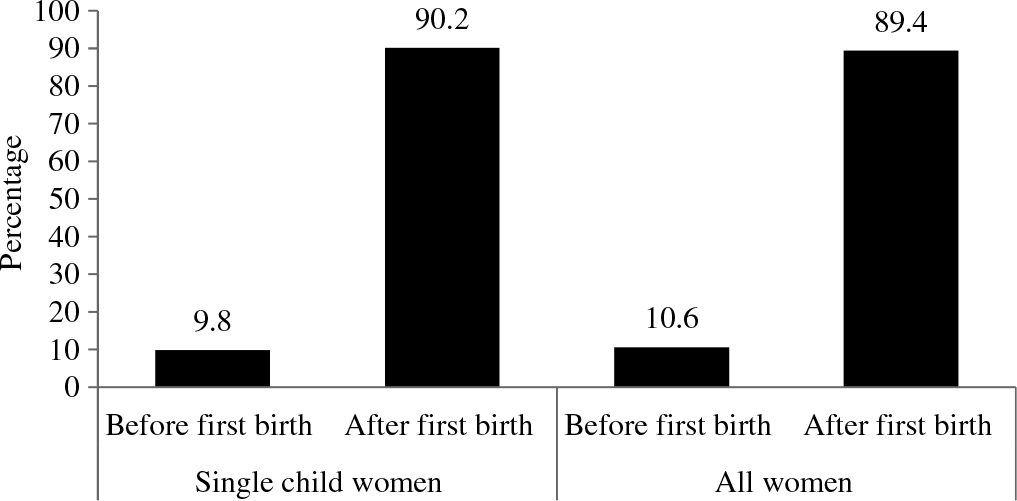
In general, the transition to parenthood promotes several changes in mental health and the sharing of household and childcare responsibilities between the couple, which leads to tensions and conflicts in the relationship between spouses. Transformation starts from the advent of pregnancy and continues in later life (after giving birth to the child), and the situation becomes worse when the pregnancy is unintended (Barber et al., Reference Barber, Kusunoki, Gatny and Melendez2017). The social and economic burden of unintended children can lead to conflict post-partum, especially if the mother suffers from post-partum depression (Kung, Reference Kung2000; Lilja et al., Reference Lilja, Edhborg and Nissen2012), including conflicts about care-taking responsibility. Such conflicts manifest themselves as tension and disagreements due to new parental roles (St John et al., Reference St John, Cameron and McVeigh2005). Changes in lifestyle (for instance, partners having difficulty finding time for each other, fathers having difficulty finding time for childcare, returning to work and accepting their spouse as the primary caregivers) (Deave & Johnson, Reference Deave and Johnson2008; Chin et al., Reference Chin, Daiches and Hall2011) accelerate the issues of depression, stress, conflict among couples and poorer quality marital relationships, often leading to IPV (Johnson-Mallard et al., Reference Johnson-Mallard, Kostas-Polston, Woods, Simmonds, Alexander and Taylor2017). It is obvious that the propensity for conflict and violence will be greater for unintended pregnancies and births than for intended pregnancies and births. Evidence based on the latest National Family Health Survey (NFHS) in India suggests that in 90% of cases, the timing of the first event of physical IPV against women starts after giving birth to a child (Fig. 1). However, in the existing literature, there is no detailed empirical evidence showing physical violence to be a consequence of unintended birth. Thus, this study examines the links between physical IPV and unintended births by taking the later as a predictor.
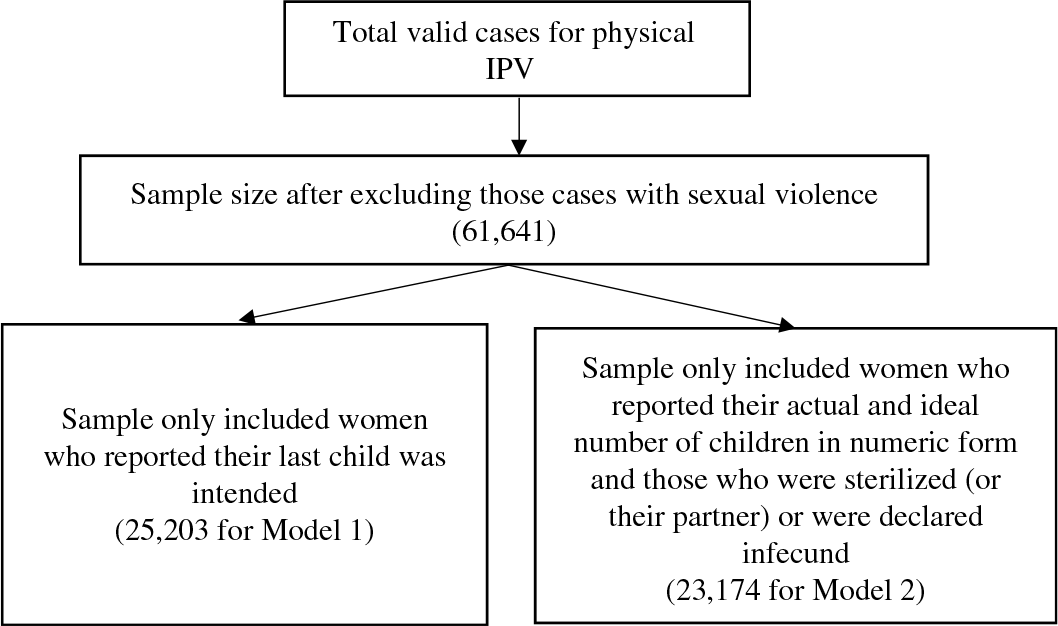
Flow chart showing the breakdown of sample sizes for the analysis of the effect of unintended births on physical IPV.

Methods
Data
The data for the study were taken from the fourth round of the NFHS conducted during 2015–16. The primary objective of the NFHS is to provide essential data on health and family welfare, as well as data on emerging issues, such as IPVs. The NFHS-4 sample was derived from multi-stage stratified systematic sampling. A total of 699,686 women aged 15–49 years were interviewed during the survey. The questions relating to IPV were included in the state module, where about 15% of the total sample were selected for interview. A total of 66,013 women responded to the questions on violence. Sexual violence may lead to unintended birth, so to avoid any reverse causation, those cases (n=4372) who ‘have faced any sexual violence by husband/partner’ and ‘ever been physically forced to perform sexual acts which the respondent did not want to’ were excluded from the study.
Furthermore, an important point to be noted is the exclusion of emotional violence in this study. Given the educational standards of women in India, women’s consequent knowledge about the nature of violence and its recognition has been a problem, so under-reporting of it in typical multi-topic cross-sectional surveys like NFHS has been identified as a very common problem. Women’s attitude towards violence, especially less-severe violence, is quite different in developing compared with developed countries. Most often, women failed to report it (García-Moreno et al., Reference García-Moreno, Jansen, Ellsberg, Heise and Watts2006). This is the case in India. Examination of the prevalence of the reporting of emotional violence by Indian state shows it to be greater in the more socioeconomically and demographically better-off states (for instance 21% in Tamil Nadu against 14% in Uttar Pradesh), while unintended births are more frequent among their counterparts. This doesn’t mean that emotional violence is less prevalent in socioeconomically and demographically disadvantaged states, but that they are reported less because of women’s attitude towards such violence is different. However, such anomalies are relatively fewer in the case of physical violence (IIPS & ICF, 2017, p. 591). Thus, this analysis of the link between IPV and unintended births was restricted to physical violence.
The main study predictor was the intendedness of births. Two sets of samples were used for statistical analyses because the predictor (i.e. intendedness of births) was measured in two ways. The first definition (Model 1) was based on women who reported that their last child was ‘wanted then', ‘wanted later’ or ‘wanted no more’. Here, women whose last birth was ‘wanted later’ were considered as having ‘mistimed’ births and those with ‘wanted no more’ were identified as having ‘unwanted’ births. The second definition of intendedness of births (Model 2) was ‘unwantedness of births’, and was derived from two questions addressing the respondents’ actual and desired number of children. The difference between the actual number of children and the desired number of children was calculated, and the women who had more children than desired were considered to have ‘unwanted’ births. Thus the sample sizes for the statistical analysis using predictor variables for the two different definitions were different: the sample size for the predictor variable intendedness of last birth in Model 1 was 25,302; and the sample size for the predictor variable unwanted births in Model 2 was 23,174 (Fig. 1). A woman having a higher ideal number of children than actual number of children in the younger age group might yet have more children in the future, which would also change her categorization as having wanted and unwanted births. Therefore, inclusion of such women in the calculation of ‘unwanted births’ would have a truncated bias by the second definition. To avoid this, the analysis was restricted to women who were sterilized (or whose partners were sterilized) or declared as infecund at the time of interview.
Outcome variables
Physical IPV was defined as any type of physical violence experienced by a woman at the hands of husband/partner, including: (i) ever having been pushed, shaken or had something thrown at them; (ii) ever having been slapped; (iii) ever having been punched with fist or hit by something harmful; (iv) ever having been kicked or dragged; (v) ever having been strangled or burnt; (vi) ever having been threatened with knife/gun or other weapon; and (vii) ever having had arm twisted or hair pulled by husband/partner. Another question was posed to the respondents about violence during pregnancy. Compiling these two variables (physical IPV during pregnancy and the non-pregnancy period), the outcome variable was categorized into three groups: ‘no physical IPV’ (n=17,974), ‘physical IPV during only non-pregnancy state’ (n=6,419), and ‘physical IPV during both pregnancy and non-pregnancy periods’ (n=810), which also included a small sample size of the category of ‘physical IPV during only pregnancy period’ (n=77). Physical IPV was categorized into two groups (‘physical IPV during only non-pregnancy state’ and ‘physical IPV during both pregnancy and non-pregnancy period’) because the women might face a higher risk to life and negative pregnancy outcomes if they face physical IPV during pregnancy as compared with the non-pregnancy period. The situation becomes more dangerous if they face physical IPV during both the ‘pregnancy’ and ‘non-pregnancy’ periods (Barber et al., Reference Barber, Kusunoki, Gatny and Melendez2017). Thus, women who reported physical IPV during both pregnancy, and the non-pregnancy period, were combined into a single category.
Predictors
The intendedness of birth was measured from two definitions that were used in two separate models with different sample sizes. First, the intendedness of the last child was categorized according to whether the women having the last child thought it ‘wanted’, ‘mistimed’ or ‘unwanted’. Second, women with an ‘unwanted’ child were derived from the difference between their actual number of children and their desired number of children. This difference was grouped into two: a higher actual number of children than the desired number of children (considered as unwanted) and a lower or equal actual number of children than the desired number of children (considered as wanted). Also, some socioeconomic and demographic variables were controlled in each of the multivariate regression models, such as parity, age at marriage, current age, place of residence, religion, caste, educational level of women and their partner, working status, wealth quintiles, exposure to mass media and household size. These confounders were grouped into convenient categories for statistical analyses (see Table 1).
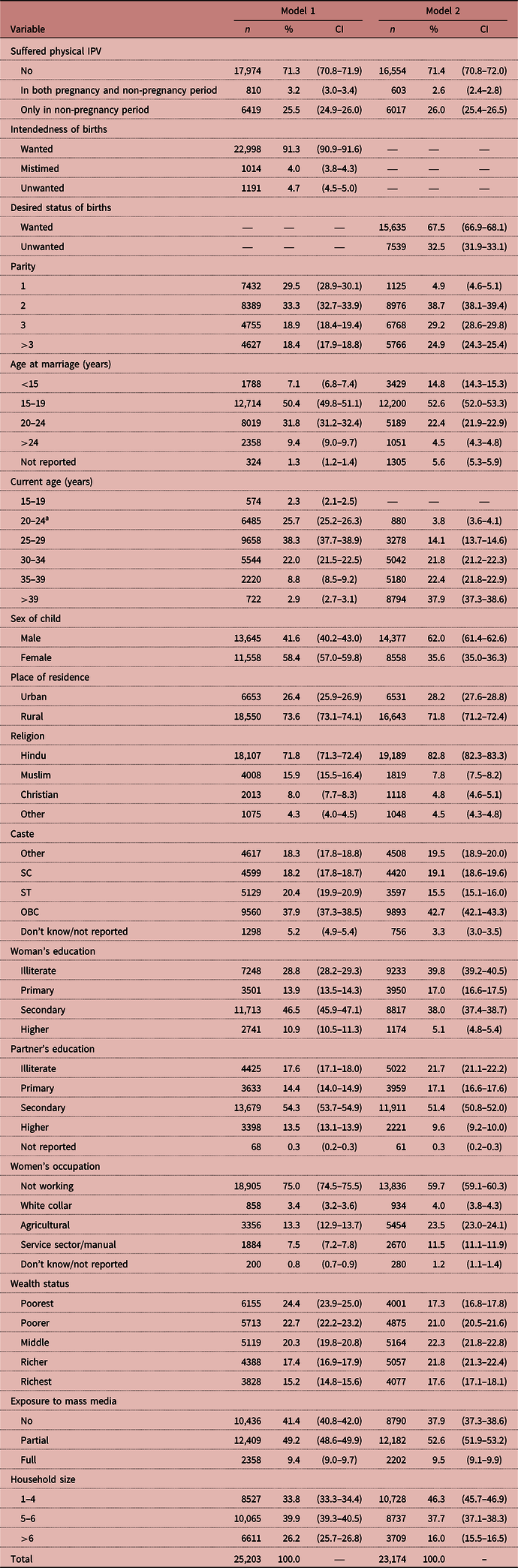
Univariate descriptive statistics of the sample women who responded to the NFHS-4 questions on IPV

Lower and upper limits of 95% confidence intervals are given in parentheses.
The overlapping samples of violence during pregnancy and non-pregnancy were merged with violence with pregnancy due to their small size.
a The samples for age groups 15–19 and 20–24 were merged due to the small sample size in Model 2.
Statistical analyses
Univariate, bivariate and multivariate statistical analyses were carried out. To understand the robustness of the sample size and nature of the sample distribution, the univariate descriptive statistics of the study variables by different categories were estimated and presented. Bivariate analysis was performed for the bivariate distributions of physical IPV by the independent socioeconomic and demographic factors. Multinomial logistic regression models were applied to assess the relationship between delivering unintended births and physical IPV. The predicted probability was estimated from the multinomial logistic regression models using Multiple Classification Analysis (MCA). For ease of interpretation, the predicted probability was converted into an adjusted percentage by multiplying by 100 (Retherford & Choe, Reference Retherford and Choe2011).
Results
Sample characteristics
To understand the characteristics of the study population, univariate descriptive statistics are presented in Table 1. Among the sample women who reported the intendedness of their last birth, about 3% and 25% reported that they faced physical IPV during both the pregnancy and non-pregnancy periods and during the non-pregnancy period only, respectively (Model 1). The data in the second sample (Model 2) followed a similar distribution. The proportions of women whose last child was mistimed and unwanted at the time when they were born were 4% and 5% respectively (Model 1). About 33% of the women reported that their actual number of children was higher than desired.
Prevalence of physical IPV by intendedness of births
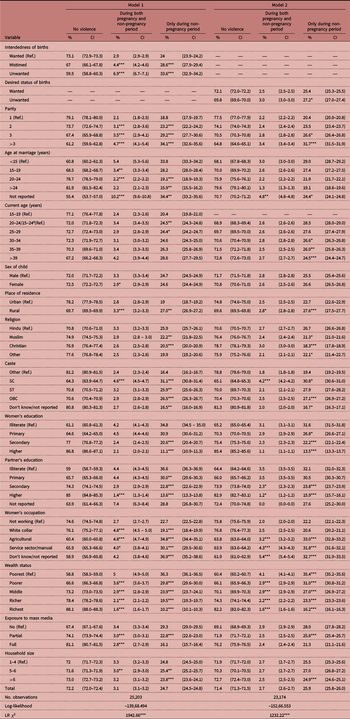
Table 2 presents the adjusted percentage of women who had faced physical IPV by the intendedness of births after controlling for socioeconomic and demographic background factors in a multinomial logistic regression estimate. The results from Model 1 show that the risk of physical IPV during both pregnancy and non-pregnancy was higher among women with mistimed (4%, p<0.001) and unwanted (7%; p<0.001) births compared with those with wanted births (3%). Similarly, physical IPV during the non-pregnancy period was higher among those with mistimed (29%, p<0.001) and unwanted (34%, p<0.001) births in comparison with those with wanted births (24%).
Prevalence (in adjusted percentage) of physical IPV by intendedness of births for women by background characteristics, India, 2015–16

Lower and upper limits of the 95% confidence intervals are given in parentheses.
The estimates are weighted with national violence weight; Ref.: Reference group.
*p<0.05; **p<0.01; ***p<0.001.
a Applicable to Model 2 only; the samples for age groups 15–19 and 20–24 were merged due to the small sample size.
Model 2 demonstrates the adjusted relationship between unwanted births and physical IPV after controlling for socioeconomic and demographic confounders. The results show that among the women who faced physical violence during pregnancy, the likelihood of physical IPV was higher among those with unwanted births (27%, p<0.05) compared with those with wanted births (25%).
Several other socioeconomic factors were found to be associated with physical IPV, e.g. age at marriage, religion, caste, women and partner’s education level, wealth status and exposure to mass media. Physical IPV during both pregnancy and non-pregnancy was greatest among Hindus, followed by Muslims and Christians, whereas there was a significantly higher risk of physical IPV among Christian women during the non-pregnancy state only. Compared with other castes, the prevalence of physical IPV against women was consistently high for Scheduled Castes (SCs), Scheduled Tribes (STs) and Other Backward Class (OBCs). The results validate the fact that, with an increase in the education level of both women and their partners, the prevalence of physical IPV against women decreases significantly. In particular, physical IPV is usually greater for women engaged in agricultural activities than among those involved in the service sector and in white-collar jobs. The analysis found that physical IPV decreased with increasing wealth status. Furthermore, physical IPV was less prevalent among women who had exposure to mass media than their counterparts who had no exposure.
Discussion
This study makes a comprehensive fresh assessment of the relationship between physical IPV and unintended births in India by presenting unintended births as a driving factor behind physical IPV. This is against a background of prior studies which have suggested that IPV is a cause of unintended births. The evidence from data from the fourth round of the NFHS suggests that the majority of women (89%) experienced the first physical violence event from their partner after childbirth. Furthermore, the estimate based on the first parity sample also suggests that about 90% of all women with a single child faced physical IPV after childbirth (Fig. 2). The comparison of probability of first event of physical IPV before child birth between single and multiple parity women shown in Figure 2 suggests hardly any difference, so analyses were carried out on the complete sample of women who reported to the question on physical IPV irrespective of parity. Furthermore, the findings show a chronology of the incidence of physical IPV and its association with unintended pregnancy and births that has not been reported in previous studies. It was found that the prevalence of physical IPV was highest among women who had unwanted births, followed by those who had mistimed births, during both pregnancy and non-pregnancy periods.
Timing of first event of physical IPV against women (before and after first birth) for all sample women and those with a single child.

The links between unintended births and the occurrence of physical IPV can be explained through existing demographic theories and evidence from previous studies. Three possible explanations for the links between unintended births and physical IPV are proposed. First, according to conventional theories, as long as wealth flows from children to parents, children are considered as assets, as security in old age, and as labourers who can contribute and assist in the household and fields. Under such conditions, children are not treated as burdens (Caldwell Reference Caldwell1976). However, when wealth flows from parents to children, the demand for children is determined by the potential output of the children. In the present context, demand for children is determined by the potential purchasing power of the parents, which leads to purposeful investment for highest return and maximizing utility, considering family as the productive unit. The increasing economic cost of the bringing up of children regarding expenditure in health and education is advancing the idea of considering a greater number of children as a burden, and the situation becomes worse when the child is undesired (Becker, Reference Becker1965; Leibenstein, Reference Leibenstein1974; Easterlin, Reference Easterlin1975; Caldwell, Reference Caldwell1976). The burden of undesired children is often put on women, who are vulnerable to a patriarchal setup. In the socio-cultural traditions of India, any additional children are considered burdens not only for women but also to their natal family, as most women go to their mother’s houses for delivery. Often, the natal family is obligated to provide additional resources or dowry to support the bringing up of children. If women refuse to take the responsibility and fail to fetch additional resources from their natal family, this might become a matter of conflict between the couple.
Second, India has a high son preference. In the process of achieving the desired sex composition in the family, couples often end up producing more than they can afford, which increases the burden on household resources. Anomalies in the sharing of responsibility for children increase with additional children and the demand for additional resources for sustainability leads to trauma and conflict between spouses. Moreover, the unfulfillment of the desired sex composition in a family is also linked with increasing birth parity and violence, where the female child is considered unwanted and an additional burden for the family under existing socio-cultural practices. It is the women who are often blamed for an undesired sex composition in a family and who are often forced to go for sex-selective abortions, and who thus face both mental and physical abuse from the husband/partner (Clark, Reference Clark2000; Diamond-Smith et al., Reference Diamond‐Smith, Luke and McGarvey2008; Babu & Kar, Reference Babu and Kar2012; Khattak, Reference Khattak2014).
Third, failure of contraceptives could be a major reason for unwanted pregnancy and unintended births. When a couple realize there is an unwanted pregnancy, husbands often force women to go for abortion. Any reasonable resistance to unsafe abortion from women often leads to violent reactions from their husbands, and this might continue in later life (Bradley et al., Reference Bradley, Croft and Rutstein2011; Salazar & San Sebastian, Reference Salazar and San Sebastian2014).
Although this study used cross-sectional data, which created difficulty in searching for the trail of life-course events, and the reporting of unintended births also suffered from the post-birth rationalization by women, this study makes some genuine contributions to the demographic and public health literature and public policy. It advances and empirically supports the hypothesis that unintended birth leads to physical IPV in India. Furthermore, IPV has adverse effects not only on maternal, physical and mental health but also on fathers’ mental health, and as a consequence has negative repercussion for child development and family well-being as a whole (Bacchus et al., Reference Bacchus, Mezey and Bewley2004; Mavranezouli, Reference Mavranezouli2009; WHO, 2012; Lindberg et al., Reference Lindberg, Maddow-Zimet, Kost and Lincoln2015; Bahk et al., Reference Bahk, Yun, Kim and Khang2015; Herd et al., Reference Herd, Higgins, Sicinski and Merkurieva2016). Therefore, avoiding unintended pregnancy and IPV is critical for child development and family well-being. As unintended pregnancies can be the outcome of non-use or failure of contraceptive methods, they can be avoided by providing reproductive health knowledge, access to effective family planning services and avoiding socio-cultural barriers to access contraception. The use of contraception has been declining or stalling in India and in several states, and as a result unintended pregnancies continue to occur (Dixit et al., Reference Dixit, Ram and Dwivedi2012; IIPS & ICF, 2017). This study promotes the unfinished agenda of family planning in India and the necessity of the implementation of the integration of family planning with RMNCH services, which can have multiple benefits, such as the elimination of IPV.
Funding
This study was funded by the Bill and Melinda Gates Foundation Grant No. OPP1142874.
Conflicts of Interest
The authors have no conflict of interest to declare.
Ethical Approval
This study used publicly available secondary sources of data, and thus did not require ethical approval.