INTRODUCTION
Cotton–wheat is one of the major cropping systems in South Asia. This system not only ensures food and fibre security to a large population, but also is a big source of foreign exchange earnings (Javed et al., Reference Javed, Sultan, Hassan and Asghar2009). However, insect pests are severe threat for successful production of cotton crop as many sucking and chewing pests may cause 30–40% yield reduction (Abro et al., Reference Abro, Syed, Tnuio and Khuro2004; Men et al., Reference Men, Ge, Liu and Yardin2003). Transgenically modified cotton (BT cotton, expressing insecticidal protein derived from Bacillus thuringiensis Berliner) was introduced as a safe and an effective tool to cotton pests.
Benefits associated with the introduction of BT cotton include substantial decrease in the use of conventional and broad-spectrum insecticides, target pest specificity, improved yield, decrease in production costs and compatibility with other biological control agents (Men et al., Reference Men, Ge, Liu and Yardin2003). However, with the inclusion of BT cotton in cotton–wheat cropping system; wheat is being eliminated from the system due to an overlapping period of 30–45 days between wheat harvest and cotton sowing. This compels many of the growers to plant BT cotton during early March to harvest its maximum production potential but at the cost of wheat. However, this practice may cause severe food security threat as wheat is the staple in the region.
Thus, management alternatives are required to eliminate the time conflict between both crops in this system. Adjustment of sowing time of BT cotton by transplanting of 30–45 days old seedlings of BT cotton just after the harvest of wheat is one of the options to tackle this serious concern without compromise in net economic returns. Transplanting is beneficial as it doesn't involve thinning, optimizes use of limited water resource and adjustment of other crops in existing cropping pattern of the region. Low temperature and light intensity are some other issues for early planted cotton; this influences the germination and stand establishment (Bange and Milroy, Reference Bange and Milroy2001). Raising nursery seedlings in plastic paper pots (Jahromi and Mahboubi, Reference Jahromi and Mahboubi2012) and transplanting in the main field help in maintaining the required crop stand, escaping early season abiotic stresses, achieving earlier maturity and harvesting better yield (Jahromi and Mahboubi, Reference Jahromi and Mahboubi2012; Rajakumar et al., Reference Rajakumar, Gurumurthy, Pandian and Thiyagarajan2010).
On the face of decreasing water resources and environmental issues related with the conventional systems, conservation agriculture systems are getting momentum worldwide. Conservation agriculture systems help reduce soil erosion, enhance soil quality, increase fertility and improve the soil water holding capacity (Farooq and Siddique, Reference Farooq and Siddique2015; Farooq et al., Reference Farooq, Flower, Jabran, Wahid and Siddique2011; Kaspar et al., Reference Kaspar, Radke and Laflen2001; Reeves, Reference Reeves1997), and reduce the turn over time between two crops (Farooq and Siddique, Reference Farooq and Siddique2015). Moreover, it improves soil structure, and reduces the production cost involved in seedbed preparation under conventional tillage systems (Farooq and Nawaz, Reference Farooq and Nawaz2014).
To best of our knowledge, no study has compared the performance of transplanted BT cotton and field sown wheat crop under conventional and conservation tillage systems in BT cotton–wheat cropping systems in Punjab, Pakistan. It was hypothesized that raising BT cotton nursery and its transplanting in the wheat vacated fields may help to remove the time conflict and improve the system productivity of BT cotton–wheat system in Punjab, Pakistan. Therefore, this study was conducted to assess the productivity and economic feasibility of transplanting BT cotton in BT cotton–wheat cropping system of Punjab, Pakistan.
MATERIALS AND METHODS
Experimental details
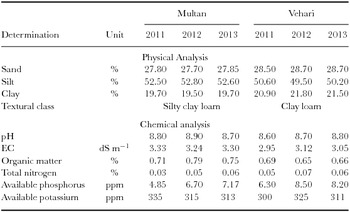
This study was conducted during 2011–2012 and 2012–2013 at Agronomic Research Farm, Bahauddin Zakariya University, Multan (71.50°E, 30.26°N, altitude 123 m) and farmer's field in district Vehari (71.44°E, 29.36° N and altitude of 135 m), Pakistan. The climate of both sites is semi-arid sub-tropical. Experimental soil was silty clay loam at Multan and clay loam at Vehari. Physico-chemical analysis of experimental soil is given in Table 1. Weather data, of both experimental sites, during the course of study is given in the Table S1 in supplementary material, available online at http://dx.doi.org/10.1017/S0014479716000338.
Soil physico-chemical properties of experimental sites.

Seeds of wheat cultivar Punjab-2011 and BT cotton genotype MNH-886, used as experimental material, were obtained from Punjab Seed Corporation, Khanewal, Pakistan. Treatments included in the study were: flat sown wheat (FSW) – zero-tilled cotton (ZTC), FSW – conventional-tilled cotton (CTC), ridge sown wheat (RSW) – ridge-transplanted cotton (RTC) (30 days old seedlings), RSW – RTC (45 days old seedlings), bed sown wheat (BSW) – bed-transplanted cotton (BTC) (30 days old seedlings) and BSW – BTC (45 days old seedlings).
In case of FSW, seedbed was prepared by two cultivations followed by levelling and wheat seeds were drilled in 25 cm spaced rows. For RSW, seedbed was prepared like FSW; 60 cm spaced ridges were prepared and wheat seeds were drilled on both sides of ridges. For BSW, after preparing seedbed as described above, 75 cm wider beds were prepared with 25 cm wide furrows and four lines of wheat were drilled on each bed.
For ZTC, cotton seeds were drilled without cultivation and removal of stubbles in 75 cm spaced rows. For CTC, seedbed was prepared by two cultivations followed by levelling, and crop was drilled in 75 cm spaced rows. In case of RTC, seedbed was prepared like CTC; 75 cm spaced ridges were prepared, and cotton seedlings were transplanted on ridges as per treatment. For BTC, the field was prepared like CTC, 75 cm wider beds were prepared by bed maker and cotton seedlings were transplanted on both sides of beds. Treatments were imposed in same plots during both years of trial.
The experiment was conducted in randomized complete block design in split–split plot arrangement considering years as main plots, locations as sub plots and cropping systems in sub-sub plots. The experiment was replicated thrice for both crops with a net plot size of 3.0 m × 5.0 m.
Crop husbandry
Wheat: Prior to seedbed preparation, pre-soaking irrigation of 10 cm was given. When soil reached to a workable moisture level; seedbed was prepared by cultivating field for two times with cultivator each followed by planking. Wheat was planted on flat seedbed, ridges or beds using seed rate of 125 kg ha−1 on 15th and 17th of November in Multan and Vehari, respectively during both experimental years. At both sites, based on soil analysis report and recommendations for the region, nitrogen, phosphorus and potash were applied at 120, 65, 30 kg ha−1, respectively during both years. Whole of phosphorus and potash and half of nitrogen were applied as basal dose, and rest half of nitrogen was applied in two equal splits each at crown root initiation and leaf boot stage. Overall, four irrigations were applied in order to avoid moisture stress. Weeds were controlled by hoeing. There was no attack of insect-pests on wheat crop during both years of study. Wheat was harvested at maturity on 18th and 20th of April in Multan and Vehari, respectively during both years of study.
Cotton: After the harvest of wheat, cotton was sown, as per treatment, in 75 cm spaced rows keeping plant to plant distance of 20 cm. Cotton nursery was sown on 5th and 20th March to get 30 and 45 days old seedling, respectively for transplanting. Transplanting of 30 and 45 days old nursery seedlings of cotton was done in standing water on 75 cm spaced ridges and beds by maintaining plant to plant distance of 20 cm. At both sites during both years, cotton was fertilized at 250 and 200 kg ha−1 nitrogen and phosphorus, respectively. Whole of phosphorus was applied as basal dose, whereas nitrogen was applied in three equal splits each at sowing, 1st and 2nd irrigations. Weeds were controlled by manual hoeing. Irrigations were done applied as per crop requirement to avoid moisture stress. Imidacloprid (Confidor 200-SL) was applied to keep the crop free from sucking insect-pests. Final picking was taken during last week of October during both years at both sites.
Evaluations and observations
Wheat: Productive tillers were counted at four different positions, each of 1 m × 1 m, from each plot. Twenty main tillers were randomly harvested from each plot; spike length was measured with a measuring scale, each individual spike was threshed separately to note grains per spike. Two central rows were harvested, sun-dried, tied into bundles and weighed to record biological yield, and were threshed. Grains were separated and weighed on an electric balance to record grain yield. Grain yield was then adjusted to 10% moisture contents. Five random samples of thousand grains were taken at random from each plot seed lot, weighed on an electrical weighing balance and averaged to record 1000-grain weight. Straw yield was estimated as difference of biological yield and grain yield.
Cotton: Ten randomly selected plants from each experimental unit were tagged to record number of monopodial and sympodial branches, and number of bolls per plant. Twenty randomly selected mature bolls were weighed to record boll weight in grams. Mature bolls were thrice picked on regular intervals up to 15th October from each plot and total weight was expressed as seed cotton yield in kg ha−1. To determine lint yield, three dry and clean samples of 100 g seed cotton from each plot were ginned by single roller electrical gin machine to separate lint. Lint so obtained was weighed, and was then expressed as kg ha−1.
Statistical analysis
The collected data were statistically analysed by Fisher's analysis of variance technique. Homoscedasticity of the data set was tested before analysis of variance technique. Least significant difference (LSD) test was used for mean separation (Steel et al., Reference Steel, Torrie and Dicky1997).
Economic and marginal analysis
Economic analysis was conducted to determine the economic feasibility of different sowing methods suitable for BT cotton production in BT cotton–wheat cropping system. Cost involved for seedbed preparation, purchase of seed, sowing of crop, fertilizers, crop protection measures, land rent and harvesting of crops were added to estimate the production cost of both crops. Gross income was estimated according the current average market prices of wheat grains, straw, seed cotton yield and cotton stalk in Pakistan (1 USD = 101.95 PKR). After that, net income was estimated by deducting total expenses from gross income and benefit-cost ratio (BCR) determined as ratio of gross income to total production cost. Marginal analysis was done following the procedure devised by CIMMYT (1988).
RESULTS
Wheat
Analysis of variance indicated that year effect was not significant for population of productive tillers, spike length and number of grains and grain weight; however, grain and straw yields of wheat differed significantly between the years (Table S2 in supplementary material). Planting systems significantly affected the yield and related traits of wheat. However, locations only differed for spike length, grains per spike and grain and straw yields. Interactive effect of years and locations was significant for number of grains, grain weight and straw yield; while interaction of years and planting systems was significant only for grain and straw yields of wheat (Table S2 in supplementary material). However, interactive effect of experimental locations and wheat planting systems was significant only for number of grains per spike and grain yield. Nonetheless, three way interaction of years, locations and planting system for yield and related traits of wheat was not significant (Table S2 in supplementary material).
FSW had less productive tillers, spike length, 1000-grain weight, grain yield and straw yield than RSW and BSW wheat at both locations during both years of study (Tables 2 and 3). BSW had more productive tillers, spike length and grains per spike (Table 2), 1000-grain yield, grain yield, and straw yield (Table 3) during both years of trial at both locations; however, better performance in terms of above parameters, was noted at Vehari (Tables 2 and 3).
Influence of different planting systems on the yield-related traits of wheat at two locations.

Means sharing the same letter, for a parameter during a growing season, do not differ significantly at p ≤ 0.05.
Influence of different planting systems on 1000-grain weight, and grain and straw yield of wheat at two locations.

Means sharing the same letter, for a parameter during a growing season, do not differ significantly at p ≤ 0.05.
Cotton
Analysis of variance indicated that years, locations and cropping systems had significant effect on seed cotton and lint yields, and all related traits except non-significant effect of years on monopodial branches per plant and boll weight (Table S3 in supplementary material). Interaction of years and locations was significant only for seed cotton yield, lint yield and boll weight; whereas interaction of years and cropping systems was significant for all yield-related persona of cotton but not the lint yield. However, interaction of locations and cropping systems was significant only for sympodial branches per plant and seed cotton yield (Table S3 in supplementary material). Nonetheless, three way interactions of years, locations and cropping system was significant only for number of bolls per plant and seed cotton yield (Table S3 in supplementary material).
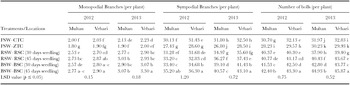
Transplanting 45 days old seedlings on beds after BSW had the maximum number of monopodial and sympodial branches per plant at both locations (Multan and Vehari) during 2012 and at Vehari during 2013 (Table 4). However, zero-tilled cotton (ZTC) following FSW had the minimum number of monopodial and sympodial branches per plant at both locations during both years (Table 4). Similarly, transplanting 45 days old BT cotton seedlings on beds following BSW produced more bolls per plant both at Multan and Vehari during 2012 and only at Vehari site during 2013 (Table 4). However, ZTC following FSW had least bolls per plant at both locations during 2013 and at Multan during 2012 (Table 4).
Influence of different BT cotton–wheat cropping systems on number of monopodial and sympodial branches, and bolls per plant of BT cotton.

Means sharing the same letter, for a parameter during a growing season, do not differ significantly at p ≤ 0.05.
FSW = Flat sown wheat, ZTC = Zero-tilled cotton, CTC = Conventional-tilled cotton, RSW = Ridge sown wheat, RSC = Ridge sown cotton, BSW = Bed sown wheat, BSC = Bed sown cotton.
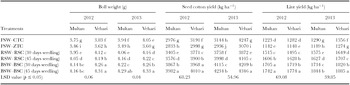
Transplanting 45 days old BT cotton seedlings on beds following BSW had more boll weight at Vehari during 2012 and at both locations during 2013 against the minimum boll weight recorded from ZTC following FSW at both locations during both years of experimentation (Table 5). Likewise, transplanting 45 days old BT cotton seedlings on beds following BSW had higher seed cotton and lint yields compared with all other BT cotton–wheat cropping systems under study at both locations during 2012 and at Vehari during 2013 (Table 5). However, ZTC following FSW had the minimum seed cotton and lint yields in Multan during both years of experiment (Table 5). Nonetheless transplanted BT cotton either on ridges or beds using 30 and 45 days old seedlings performed better compared with ZTC and conventional-tilled cotton (CTC) following FSW (Table 5).
Influence different BT cotton–wheat cropping systems on boll weight, and seed cotton and lint yield of BT cotton at two locations.

Means sharing the same letter, for a parameter during a growing season, do not differ significantly at p ≤0.05.
FSW = Flat sown wheat, ZTC = Zero-tilled cotton, CTC = Conventional-tilled cotton, RSW = Ridge sown wheat, RSC = Ridge sown cotton, BSW = Bed sown wheat, BSC = Bed sown cotton.
Economic and marginal analysis
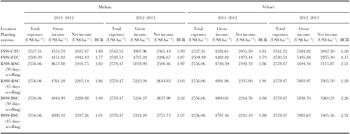
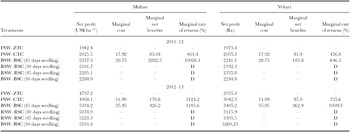
Economic analysis indicated that transplanting 30 and 45 days old seedlings of BT cotton either on ridges or beds following RSW and BSW was more profitable (Table 6). However, maximum net income and BCR (Table 6) and marginal rate of return (Table 7) were recorded from transplanting 45 days old seedlings of BT cotton on beds following BSW during both years at both locations (Table 6). Comparison of locations indicated more profitability from Vehari than Multan (Tables 6 and 7).
Economic analysis of different BT cotton–wheat cropping systems at two locations.

FSW = Flat sown wheat, ZTC = Zero-tilled cotton, CTC = Conventional-tilled cotton, RSW = Ridge sown wheat, RSC = Ridge sown cotton, BSW = Bed sown wheat, BSC = Bed sown cotton, 1 US$ = Rs. 101.95, BCR = Benefit: cost ratio.
Marginal analysis of different BT cotton–wheat cropping systems at two locations.

FSW = Flat sown wheat, ZTC = Zero-tilled cotton, CTC = Conventional-tilled cotton, RSW = Ridge sown wheat, RSC = Ridge sown cotton, BSW = Bed sown wheat, BSC = Bed sown cotton, 1 US$ = Rs. 101.95, D = Dominated due to less profits than the preceding treatment.
DISCUSSION
This study indicated that transplanting nursery seedlings of BT cotton is the best option to evade wheat elimination from the system without shortening the BT cotton growth period in Punjab, Pakistan (Tables 2–5).
Performance of BSW was better, which was followed by RSW; however, performance of wheat sown on flat surface was poor than BSW and SW at both sites during both years (Tables 2 and 3). Likewise, transplanting BT cotton on beds and ridges produced better seed cotton and lint yields than the BT cotton directly sown either as conventionally tilled or zero-tilled crop on flat surface (Table 5). Actually, ridges and beds provide loose layer of fertile soil, which may facilitate the germination, stand establishment and root growth (Das et al., Reference Das, Bhattacharyya, Sudhishri, Sharma, Saharawat, Bandyopadhyay, Sepat, Bana, Aggarwal, Sharma, Bhatia, Singh, Datta, Kar, Singh, Singh, Pathak, Vyas and Jat2014) as indicated by increase in productive tillers of wheat (Table 2). Well developed and proliferated root system assist in water and nutrient uptake (Anwar et al., Reference Anwar, Gill and Zaki2003; Hobbs and Gupta, Reference Hobbs, Gupta, Ladha, Fischer, Hossain, Hobbs and Hardy2003; Khan et al., Reference Khan, Yousaf, Hussain, Haq, Lee and Farooq2012; Sun and Wang, Reference Sun and Wang1996; Zhu and Gao, Reference Zhu and Gao1993), by crops raised on beds, may thus contribute to increase in yield and related traits of both crops. Increase in yield related traits like number of monopodial and sympodial branches, number of bolls per plant, and the boll weight contributed for better performance of transplanted cotton than its direct sowing (Tables 4 and 5). Comparison of locations indicated better yield of both wheat (Table 3) and cotton (Table 5) and more profitability (Tables 6 and 7) from Vehari during both years of experimentation. Low temperature during grain filling of wheat, fruiting of cotton and better and timely precipitation (Table S1 in supplementary material), at Vehari, may be attributed to better performance of both wheat and cotton than Multan. Productivity of both wheat and crops, in all planting and cropping systems, remained better during second growing season at both experimental locations, which may be attributed to more precipitation in second year February and March at both locations (Table S1 in supplementary material).
The yield of BT cotton sown as ZTC was the least at both locations during both years of study (Table 5) possibly due to compact upper soil layer in zero tillage (Braim et al., Reference Braim, Chaney and Hodgson1992), which might impacted the stand establishment and nutrient, and water uptake by the plants (Qin et al., Reference Qin, Stamp and Richner2006). Nonetheless, bed planting helped in improving crop stand establishment (Table 2) and may also help reducing lodging (Hobbs and Gupta, Reference Hobbs, Gupta, Ladha, Fischer, Hossain, Hobbs and Hardy2003; Kumar et al., Reference Kumar, Aggarwal and Nanwal2007; Quanqi et al., Reference Quanqi, Chen, Liu, Xunbo, Yu and Dong2008). Crop planted on beds may also complete different phenological events rapidly (Farooq and Nawaz, Reference Farooq and Nawaz2014) owing to better light penetration and interception. Plants raised on beds may acquire thermal degree days, required for switching to next phase, rapidly than other tillage systems (Quanqi et al., Reference Quanqi, Chen, Liu, Xunbo, Yu and Dong2008). However, residue retention with raised beds may further increase the productivity, profitability and resource conservation of cotton–wheat cropping system of South Asia (Das et al., Reference Das, Bhattacharyya, Sudhishri, Sharma, Saharawat, Bandyopadhyay, Sepat, Bana, Aggarwal, Sharma, Bhatia, Singh, Datta, Kar, Singh, Singh, Pathak, Vyas and Jat2014). Conservation agriculture, a suit of technologies including minimum soil disturbance, residue retention and diversified crop rotation, has been proposed as sustainable way for harvesting better crop yields, and economic and environmental benefits (Farooq and Siddique, Reference Farooq and Siddique2015).
Commercial adoption of any innovation/new technique on large scale purely depends on its economic feasibility. Although cost of production and labour requirement were low in ZTC sowing (Table 6); however, the harvested yield was quite low (Table 5). Transplanting involves additional cost of raising and transplanting nursery seedlings (Table 6); nonetheless it is extremely beneficial as it ensures the sustainability of cotton–wheat cropping system. Economic and marginal analysis conducted highlighted the dominance of transplanting 45 days old seedlings BT cotton following BSW in terms of net income, BCR (Table 6) and marginal rate of return (Table 7). This higher system productivity was only due to increase in seed cotton yield and wheat grain yield. Though sowing of BT cotton as ZTC following CTW was the least expensive, time and energy saving but overall performance of the system was poor compared with transplanted BT cotton either on ridges or beds primarily due to low seed cotton yield.
CONCLUSION
Transplanting of 45 days old seedlings on beds was highly beneficial in preventing the wheat elimination from cotton–wheat cropping system without decreasing the production and profitability of both crops; rather this increased the BCR and marginal rate of return. The findings of this study are expected to help the growers in cotton–wheat cropping zone of the region to make their BT cotton–wheat cropping system more productive and ensure food security by evading wheat exclusion from the system.
SUPPLEMENTARY MATERIALS
For supplementary material for this article, please visit http://dx.doi.org/10.1017/S0014479716000338.