Introduction
According to Butler's definition of ageism as “a process of systematic stereotyping and discrimination against people because they are old” (Butler, Reference Butler and Maddox1995), ageism is expected to be more pronounced in younger than in older people. Indeed, it has been demonstrated that ageism decreases with age (Rupp et al., Reference Rupp, Vodanovich and Crede2005), and that older adults hold more positive attitudes towards older target groups (Chasteen et al., Reference Chasteen, Schwarz and Park2002), and have more complex views of older people as a group than younger people (Laditka et al., Reference Laditka, Fischer, Laditka and Segal2004). Nevertheless, an increasing number of studies report what can be interpreted as intra-generational ageism of older adults, i.e. older adults’ lack of favoritism towards people of their own age, and even a negative bias of older people when group identity is defined around old age (Kite and Wagner, Reference Kite, Wagner and Nelson2002). The current review describes how and why ageism exists among younger and older people, suggests several ways for moderating ageism, and offers several key areas and research questions to be investigated in future research.
Modern aging, ageism, and its impact on older people
Although all human beings age and, barring an early demise, eventually become older adults themselves (e.g. Kite and Wagner, Reference Kite, Wagner and Nelson2002), many are reluctant to join this group. The extension of the lifespan after institutionalized retirement exposes elderly people to physical and mental deterioration (e.g. decreased attractiveness, degenerative illnesses, depression), and forces them into social isolation. Technological advances in Western countries have made the job experience of many elderly adults redundant, urbanization has driven younger people from their families and loosened their ties with their grandparents, and public education has replaced the elders’ long-held position as transmitters of cultural knowledge and wisdom. Although longevity is considered a blessing, the aging process in modern and Western societies is not pleasant and is associated with more losses than gains (see Cuddy et al., Reference Cuddy, Norton and Fiske2005).
Studies have found that during the past two decades, non-Western societies have become influenced by modernization tendencies (e.g. China and South Korea), and demonstrate an intergenerational climate which is even more problematic than the one that exists in Western countries (e.g. U.S.A. and Australia; Giles et al. Reference Giles, McCann, Ota, Noels, Kaplan, Henkin and Kusano2002, McCann and Giles, Reference McCann, Giles and Nelson2002). A cross-cultural sample of college students in six countries found the stereotyped view of elders as warm but incompetent to be held quite universally, even in the most collectivist samples (Hong Kong, Japan and South Korea), with no differences between collectivist and individualistic cultures (Cuddy et al., Reference Cuddy, Norton and Fiske2005). Other cross-cultural investigations found even more negative attitudes toward older people in collectivist societies, both in the Far East (e.g. China, Japan, Thailand; see Cuddy et al., Reference Cuddy, Norton and Fiske2005) and in the Middle East (e.g. Turkey; see McConatha et al., Reference McConatha, Schnell, Volkwein, Riley and Leach2003). For example, a comparison between the attitudes of Americans and South Koreans toward anxiety about aging demonstrated that Koreans portray higher overall levels of anxiety about aging and greater fear of older people (Yun and Lachman, Reference Yun and Lachman2006), and a recent study showed that agist attitudes can be generalized to Israel (Bodner and Lazar, Reference Bodner and Lazar2008), a country which is considered more collectivistic than the U.S.A. (Oyserman et al., Reference Oyserman, Coon and Kemmelmeier2002). Ageism has become a universal reality. Ageism is evident in both genders (although it is more pronounced among men, see Kalavar, Reference Kalavar2001; Rupp et al., Reference Rupp, Vodanovich and Crede2005). It is spreading into different social structures and contexts, exhibits a diversity of forms, and operates in many life areas (Palmore et al., Reference Palmore, Branch and Harris2005). It develops from a very early age. Children as young as three who were asked to report their impressions of a drawing of an older man, mostly regarded the older man as “helpless, incapable of caring for himself, and generally passive” and many reported negative feelings in response to the question: “How would you feel about becoming an elderly person?” (Seefeldt et al., Reference Seefeldt, Jantz, Galper and Serock1977). According to Levy and Banaji (Reference Levy, Banaji and Nelson2002), young people appear to be highly susceptible to negative stereotypes of older people, partly because as young people they have no psychological need to defend themselves against these stereotypes since they do not apply to them, only to others. However, Levy and Banaji (Reference Levy, Banaji and Nelson2002) argue that these internalized expectations will be activated in old age, such that elderly people will direct these negative stereotypes against their own age group.
In society, ageism is apparent at the individual level, the institutional level, and the societal level. At the individual level, ageism is visible in the avoidance of contact with older people, age denial, agist humor, and holding negative attitudes and stereotypes about older adults (for an overview, see Palmore et al., Reference Palmore, Branch and Harris2005). Elderly people are considered less intelligent, less ambitious, and less responsible than younger adults. Regardless of gender, older people are rated as more feminine and less masculine than younger people. It was also demonstrated that older employees are believed to be less efficient than younger employees in various job-related tasks (Palmore et al., Reference Palmore, Branch and Harris2005).
At the institutional level, ageism can involve discrimination in housing, employment, mandatory retirement, public policy, and inappropriate care in institutional settings (Palmore, Reference Palmore2004). Seventy-two percent of American elders and 68% of Canadian elders have reported experiences of personal and institutional discrimination (Palmore, Reference Palmore2004). The median award in U.S. age discrimination lawsuits between 1994 and 2000 was $268,926, and several settlements (e.g. Westinghouse, Lennox, Continental Airlines, First Union) ranged from $6.2 million to $58.8 million (McCann and Giles, Reference McCann, Giles and Nelson2002). The increase in age discrimination is evident in U.S.organizations as well as in organizations in other countries.
Societal aspects of ageism include age norms, patronizing, agist language, and age segregation (Butler, Reference Butler2009; Palmore et al., Reference Palmore, Branch and Harris2005). People are more likely to attribute memory failures of older adults to intellectual incompetence, and memory failures of younger adults to lack of attention or effort. Studies have shown that younger people automatically tend to adopt patronizing language when speaking to older adults. This language includes shorter words and sentences. Nursing home caregivers were found to use baby talk when addressing residents, regardless of a particular resident's physical or cognitive health (for reviews on these aspects of ageism, see Levy and Banaji, Reference Levy, Banaji and Nelson2002).
Age segregation is one of the most problematic societal aspects of ageism (Palmore et al., Reference Palmore, Branch and Harris2005). Friendship patterns in the U.S.A. reflect age homogeneity in friendship networks, especially in non-family networks (Uhlenberg and de Jong Gierveld, Reference Uhlenberg and de Jong Gierveld2004). An analysis of network data from the 1985 U.S. General Social Survey revealed that only 6% of the people aged 60 years and older reported that their non-family discussion partners were younger than 36. Data from the Netherlands also found that less than 10% of respondents above the age of 65 reported having a non-family network member younger than 35 (Uhlenberg and de Jong Gierveld, Reference Uhlenberg and de Jong Gierveld2004). Living in societies which consider old age as a weakness may have a devastating effect on the life quality of older adults.
Studies have demonstrated that negative stereotypes towards aging can decrease motivation, the sense of self-efficacy and cognitive performance in elderly people (Levy, Reference Levy1996). A 20-year follow-up of 241 individuals aged 50–80 who participated in the Ohio Longitudinal Study of Aging and Retirement (OLSAR) found that individuals with more positive self-perceptions of aging tended to practice more preventive health behaviors (this effect was preserved after controlling for age, education, functional health, gender, race, and self-rated health; Levy and Myers, Reference Levy and Myers2004). Another study which examined 546 community-dwelling persons aged 70–96 found that participants with more negative and more external age stereotypes demonstrated a decrease in screened hearing after a 36-month period, after adjusting for baseline-screened hearing, age, and other relevant variables (Levy et al., Reference Levy, Slade and Gill2006). Another study, which exposed older individuals to negative aging stereotypes, demonstrated heightened cardiovascular responses (elevated systolic and diastolic blood pressures and heart rate), and elevated skin conductance, compared with those exposed to positive aging stereotypes (Levy et al., Reference Levy, Hausdorff, Hencke and Wei2000). According to the authors, these findings indicate that negative aging stereotypes may contribute to adverse health outcomes in elderly persons without their being aware of this. A similar effect of negative stereotypes about aging was found with reference to stability and walking speed in elderly people, such that elderly who held less negative stereotypes about old age exhibited better stability and walking speed (Hausdorff et al., Reference Hausdorff, Levy and Wei1999). Finally, an examination of 66,000 people aged 50 and above who participated in the Ohio Longitudinal Study of Aging and Retirement (OLSAR) community-based survey, demonstrated that older individuals with more positive self-perceptions of aging measured up to 23 years earlier, and lived 7.5 years longer than those with less positive self-perceptions about aging (Levy et al., Reference Levy, Slade, Kunkel and Kasl2002).
What underlies ageism?
Although the benefits of positive attitudes towards aging and old age were clearly demonstrated (Levy et al., Reference Levy, Slade, Kunkel and Kasl2002; Levy and Myers, Reference Levy and Myers2004), ageism is still evident among both young and elderly people. In order to cope with its impact, it is necessary to understand what underlies ageism, i.e. why it is evident across gender and age, and operates in many fields of life (Palmore et al., Reference Palmore, Branch and Harris2005). Two leading theories in the field of social psychology, Terror Management Theory (TMT; Greenberg et al., Reference Greenberg, Solomon, Pyszczynski and Zanna1997) and Social Identity Theory (SIT; Tajfel, Reference Tajfel1981), provide useful conceptual frameworks for the psychological functions fulfilled by negative attitudes and stereotypes held by people of any age toward older people.
Social Identity Theory
According to SIT (Tajfel, Reference Tajfel1981), people form group identities based on minimal criteria and then demonstrate biases which favor their own group. Tajfel (Reference Tajfel1981) theorized that this occurred because the group identity that participants formed was also part of their own self-identity, and because people strive to maintain a positive self-regard. For that to happen, SIT argues that individuals would be motivated to promote their own group (the ingroup) over others (outgroups). Applying SIT to aging research suggests that younger and older people would evaluate their own age group more positively than other age groups (Kite and Wagner, Reference Kite, Wagner and Nelson2002), a process referred to as ingroup bias. For young adults, SIT suggests that ageism allows younger individuals to distance themselves positively from older people to the extent that they subtly cease to identify with their elders as human beings (Butler, Reference Butler1975; Reference Butler2009). Indeed, several studies demonstrated that, in general, young adults hold negative attitudes toward older people (e.g. Rupp et al., Reference Rupp, Vodanovich and Crede2005; Bodner and Lazar, Reference Bodner and Lazar2008) and positive attitudes towards young targets (Kite et al., Reference Kite, Stockdale, Whitley and Johnson2005, also for exceptions), even when positive age-stereotyped incongruent information is provided about people presented as “older adults” (Kite et al., Reference Kite, Stockdale, Whitley and Johnson2005). However, it is the process of aging (mainly the physical aspect) that is viewed negatively, not just old age (Slotterback and Saarnio, Reference Slotterback and Saarnio1996).
The theory underlying the attitude held by older adults towards younger adults and towards adults of their own age is more complicated. According to SIT, when an individual is a member of a group that is often perceived as having a lower status (e.g. being old), this individual will adopt one or more strategies to maintain a positive self-identity. One strategy can be to focus on the positive aspects of aging. Another strategy may be to perceive threatening younger outgroups more negatively, while identifying the older ingroup as superior to the younger groups in certain aspects. Another possible way can be by dis-identifying with their ingroup and distancing themselves by perceiving other older persons as a negative outgroup. Such a strategy may imply that ageism is so internalized that older adults lead themselves to outgroup favoritism, and develop intra-generational ageism, i.e. they develop a negative bias toward older people when the group identity is defined around old age.
There is mounting evidence of younger people's views of older people. However, stereotypes that the latter have about younger adults have been studied primarily indirectly, with younger targets serving as a control group for the older adults who serve as targets of interest to be evaluated. The few studies that have included older as well as younger participants found that stereotypes about typical younger adults are often more positive than negative and independent of the participants’ own age (Matheson et al., Reference Matheson, Collins and Kuehne2000).
Findings are even less consistent when examining older people's views about their own age group. Some studies have shown that older people are not prejudiced against their own group (Rupp et al., Reference Rupp, Vodanovich and Crede2005). Rather, they hold more positive attitudes toward older target groups (Chasteen et al., Reference Chasteen, Schwarz and Park2002) and have more complex views of older people as a group than do younger respondents (Laditka et al., Reference Laditka, Fischer, Laditka and Segal2004). It has been found that older adults may also focus on the positive aspects of aging, such as being a grandparent (Cuddy et al., Reference Cuddy, Norton and Fiske2005). It has been demonstrated that older adults perceive threatening younger adults more negatively than people of their own age group, while identifying their age ingroup as superior to the younger adults in certain aspects (e.g., being warmer and more experienced than young people; Cuddy et al., Reference Cuddy, Norton and Fiske2005). However, it was also demonstrated that some older adults perceive older persons as an inner negative outgroup, by trying to maintain a youthful appearance, or even develop a negative bias towards older people when the group identity is defined around old age (Kite and Wagner, Reference Kite, Wagner and Nelson2002). Nosek et al. (Reference Nosek, Banaji and Greenwald2002) found that attitudes that elders express toward their own group are as negative as those expressed by the young toward the old, and Levy and Schlesinger (Reference Levy and Schlesinger2001) found that the older participants in a national sample were more likely than younger participants to oppose federal programs that benefit the old. Expressing agist sentiments may allow some elderly persons to differentiate themselves positively from those they believe to be “really old people”. One study found evidence of a high rate of ingroup ageism among elderly subjects who were hospitalized in a geriatric ward (Davidovic et al., Reference Davidovic, Djordjevic, Erceg, Despotovic and Milosevic2007). The authors suggested that this phenomenon could be due to continuous exposure to the downsides of aging. Another societal factor that could lead to ingroup ageism is the prevalence of ageism in television shows, coupled with seniors’ tendency to spend much of their leisure time watching television (Donlon et al., Reference Donlon, Ashman and Levy2005), thus increasing their tendency to internalize agist beliefs.
Based on these findings, it appears that the affinity of younger adults to the young age group is certain, whereas the older individual's affinity to the old age group is doubtful. In line with the SIT framework (Tajfel, Reference Tajfel1981), younger and older adults can have an identical intergroup bias (i.e. both ascribe themselves to the young age group and therefore value young adults and devalue old adults), or have a symmetrical intergroup bias (i.e. both ascribe themselves to separate age groups and hence value their ingroup and devalue their outgroup).
Terror Management Theory
TMT (Greenberg et al., Reference Greenberg, Solomon, Pyszczynski and Zanna1997) represents another useful perspective on ageism, and refers to the impact that death anxiety has on people's social behavior. According to TMT, humans have created psychological anxiety buffers consisting of a cultural worldview (CWV) and self-esteem in order to cope with the potentially threatening unconscious awareness of their inevitable death. A cultural worldview is a shared conception of reality that provides meaning, order, permanence, stability, and the promise of literal or symbolic immortality (e.g. an afterlife or living on through one's children) to individuals who live up to the standards of value created by the culture. Self-esteem is the belief that one is living up to the standards of value prescribed by the CWV. The CWV and self-esteem together guarantee that the individual is a valuable member of a meaningful world and provides protection against the fear of death. TMT has been tested with research focused on two general hypotheses (for a review, see Greenberg et al., Reference Greenberg, Solomon, Pyszczynski and Zanna1997). The anxiety-buffer hypothesis asserts that if a psychological structure provides protection against anxiety, then strengthening this structure should reduce anxiety in response to subsequent threats. Studies supporting these ideas have shown that both a high state or trait of self-esteem and the opportunity to validate an important aspect of one's CWV reduce a variety of defensive responses typically produced by thoughts of death. The complementary hypothesis, i.e. the mortality salience (MS) hypothesis, states that reminding people of their death increases their need for the same psychological structures that protect them from death awareness. To date, there have been over 300 experiments conducted in 15 different countries that provide support for these hypotheses (for a review, see Solomon et al., Reference Solomon, Greenberg, Pyszczynski, Greenberg, Koole and Pyszczynski2004). Among the many findings that support this hypothesis with reference to a variety of domains are the findings that MS reinforces prejudicial tendencies and stereotypical beliefs (Greenberg et al., Reference Greenberg1990).
Social ingroups play a crucial role in TMT research, principally because they are the sources for cultural worldviews and self-esteem (Solomon et al., Reference Solomon, Greenberg, Pyszczynski, Greenberg, Koole and Pyszczynski2004). Indeed, it had been demonstrated that increased mortality salience is associated with social phenomena such as pro-social behavior toward ingroup members, outgroup derogation, ingroup entitativity perceptions, and identification with the ingroup, aggression towards outgroups, and stereotypical thinking (Solomon et al., Reference Solomon, Greenberg, Pyszczynski, Greenberg, Koole and Pyszczynski2004). These studies are in agreement with the SIT argument that people naturally tend to over-evaluate their ingroup and devaluate their outgroups and strengthen their evaluation by showing this tendency to be influenced by existential concerns (Tajfel, Reference Tajfel1981).
Human physicality poses another threat to terror management defenses and findings suggest that an unconscious link exists between the creatureliness of the human body and death concerns (for a review, see Goldenberg et al., Reference Goldenberg, Heflick and Cooper2008). From an intergroup relations perspective, studies have shown that MS increases distancing from people with severe physical injuries (Hirschberger et al., Reference Hirschberger, Florian and Mikulincer2005) and terminal illness (Pyszczynski et al., Reference Pyszczynski, Greenberg, Solomon, Cather, Gat and Sideris1995). An encounter with such individuals leads to feelings of vulnerability and poses a troubling reminder of the fragility and susceptibility of human beings to severe injury and death. People therefore seek to distance themselves from such threatening reminders. Because older people also tend to be associated with death, younger persons may adopt agist attitudes and behaviors to distance themselves from older people in order to deny the reality that they, too, will eventually become part of that outgroup and die. The above-mentioned findings when investigating stereotypes, that the most frightening aspect of old age is bodily deterioration, are consistent with TMT, since they remind us of our animalistic and finite nature.
Only two publications relate to the TMT perspective on the backlash of younger from older adults. According to Martens et al. (Reference Martens, Goldenberg and Greenberg2005), elderly people do not only remind us that we may lose our humanism due to deterioration of bodily functions, but also represent a future in which death is inevitable, and cause us to become aware of our future cognitive and social decline, which will result in a loss of self-esteem. They serve as powerful reminders of the fact that even if we manage to avoid accidents (by driving carefully), terminal illnesses (by maintaining a healthy way of life), or cruel terror attacks (by staying at home), we can never escape our common fate – old age followed by death. They may raise the sights, sounds and smells of deteriorating bodily functions (smells of urea and feces, tremor, dirt, distorted organs, saliva, physical imbalance, immobility, vision and hearing loss), thereby reminding us how animalistic we are. They may also point to our future loss of self-esteem, i.e. loss of strength and masculinity in men, beauty and femininity in women, and work productivity and efficiency in both genders.
Martens et al. (Reference Martens, Greenberg, Schimel and Landau2004) conducted three experiments among undergraduate students in order to examine whether older people raise death associations in young adults. In the first experiment they presented their young participants with pictures on which they were asked to perform several judgments. One group was presented with four pictures of young people and the other group with two pictures of young people and two pictures of elderly people (the researchers did not use pictures of elderly people only, so as not to arouse possible suspicion that they were interested in the effects of viewing elderly people). The participants were then asked to fill out a death accessibility measure, i.e. they were asked to complete 26 word fragments with the first word that comes to mind (e.g. COFF_ could either be completed as COFFEE or COFFIN). Participants who saw photos of elderly people subsequently completed more death related words than participants who saw photos of only younger people.
Martens et al. (Reference Martens, Greenberg, Schimel and Landau2004) performed a second experiment on college students in order to examine whether negative attitudes toward elderly people can serve as a defensive measure against death awareness. One group was asked to write a short narrative about the emotions and thoughts that their death arouses in them, and another group (a control group) – to write a short narrative about a subject that is not related to death but to another unpleasant experience (dental pain). Both groups were then asked to rate the extent to which each of 16 statements describing various behaviors (e.g. I'm a very friendly person) suited them. They were then asked to rate the extent to which elderly people and adolescents would evaluate these statements as suitable for them, and finally – to rate the extent to which they consider these behaviors as desirable. Participants who were manipulated into mortality salience evaluated themselves as less similar to elderly people, and ascribed more statements they considered as describing undesired behaviors to elderly people than participants in the control group. In the third experiment, Martens et al. found that distancing from elderly people and derogation of elderly people after mortality salience occurred only in participants who, weeks before the experiment, rated their personalities as relatively similar to the average elderly person.
The study of Martens et al. (Reference Martens, Greenberg, Schimel and Landau2004) supports the argument that exposure to the image of elderly people evokes death-related associations in young people. It also upholds the contention that young people try to cope with the threat of death by defining themselves differently from elderly people, and by holding negative attitudes toward older people. It seems that when young adults define elderly adults as different and inferior to them, they can temporarily distance their future aging and thus preserve their self-esteem.
It is not clear whether old age also serves as a cultural reminder of death for older individuals, and if so, to what extent. In fact, terror management theory has very little to say about how elderly people relate to death. Most studies on terror management were conducted with younger adults (for a review, see Solomon et al., Reference Solomon, Greenberg, Pyszczynski, Greenberg, Koole and Pyszczynski2004). Given their long life expectancies and relatively young age, young adults probably perceive death as more unacceptable and thus exhibit greater variability in death anxiety. The elderly have more death-related experiences and are described as more accepting of their mortality (Neimeyer and van Brant, Reference Neimeyer, van Brant, Wass and Neimeyer1995). Older people are thus expected to exhibit less death anxiety than younger adults, and consequently have less need for terror management.
McCoy et al. (Reference McCoy, Pyszczynski, Solomon, Greenberg and Tomer2000), in the first attempt to investigate terror management in older populations, compared life expectancy after mortality salience manipulation in young-old (aged 57–72) and old-old adults (aged 73–87), who scored high and low on a neuroticism scale. They expected that elders who scored high on the neuroticism scale would ascribe themselves a longer life expectancy after a mortality salience manipulation regardless of age differences. However, they found that only young-old adults who scored high on the neuroticism scale demonstrated this pattern. The other three groups (young-old who scored low, and old-old who scored high or low on the neuroticism scale) did not ascribe themselves a longer life expectancy after a mortality salience manipulation. McCoy et al. interpreted this finding as supporting the idea that the elderly in general show acceptance of death and thus rely on death-denying coping mechanisms to a lesser extent than younger adults.
This view is also supported by Maxfield et al. (Reference Maxfield2007) who conducted two experiments in younger and older adults, aiming to explore age differences in the defensive tendency to adhere to one's cultural worldview in response to reminders of death. In order to examine adherence to a cultural worldview, they measured evaluations of 20 moral transgressions. In study 1 they manipulated the effect of mortality salience by asking the participants to answer a Fear of Death Scale which consists of 15 true–false statements regarding fear of death, or parallel questions about dental pain, in order to provide a control group with questions about an aversive topic not associated with death. They then measured evaluations of moral transgressions and found that younger adults exhibited the typical pattern of harsher judgments in response to mortality salience, whereas older adults did not. In study 2 they compared younger and older adults’ responses to the typical mortality salience induction, i.e. the short narrative method, as well as to a more subtle death reminder, a word puzzle containing death-related words. Specifically, participants were asked to find a list of neutral words such as computer and baseball which are embedded within a matrix of letters that consist of death-related words such as death and burial. The results of the second experiment demonstrated that younger adults responded to both mortality salience inductions with harsher evaluations, whereas older adults made significantly less harsh evaluations only after the subtle mortality salience induction. The authors speculated that the increased temporal proximity to death, coupled with more frequent reminders of mortality, might stimulate older adults to better defuse the potential for anxiety and shift their affective balance in a more positive and receptive direction.
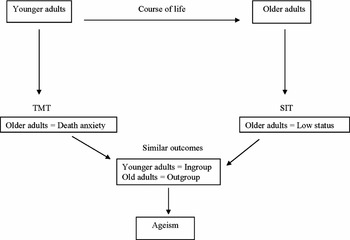
The abovementioned findings are described by the etiological model for ageism among younger and older adults shown in Figure 1.
An etiological model for ageism among younger and older adults

The study by Martens et al. (Reference Martens, Greenberg, Schimel and Landau2004) shows that ageism in young adults may serve as a defense mechanism against death anxiety. It thus seems that TMT may serve as a suitable theoretical framework for understanding ageism among young adults. However, the studies of McCoy et al. (Reference McCoy, Pyszczynski, Solomon, Greenberg and Tomer2000) and Maxfield et al. (Reference Maxfield2007) on death anxiety in elderly people demonstrate that older adults are less fearful of death than younger adults, perhaps because they accept their future death more than young adults. It is therefore plausible to contend that the reasons for ageism in elderly people may lie in their attitudes towards their age group, and not in their unconscious anxiety of their future death, i.e. ageism in elderly people can be explained by using SIT (Tajfel, Reference Tajfel1981) and not TMT (Greenberg et al., Reference Greenberg, Pyszczynski, Solomon and Baumeister1986). SIT can accept the phenomenon of intra-generational ageism of older adults by interpreting it as demonstrating the tendency of these older adults to relate to young adults as their ingroup and to older adults as their outgroup. The two theoretical routes (i.e. TMT and SIT) lead to ageism among younger (e.g., Palmore et al., Reference Palmore, Branch and Harris2005) as well as older adults (e.g. Nosek et al., Reference Nosek, Banaji and Greenwald2002; Davidovic et al., Reference Davidovic, Djordjevic, Erceg, Despotovic and Milosevic2007).
Conclusions and recommendations
Further empirical research needs to be undertaken in order to validate the model presented in Figure 1. In the next section of this review I present some key areas to be developed and a list of research questions to be tested. Until such an empirical inquiry is performed, the following conclusions and recommendations drawn from this model can only serve as possible hypotheses.
As explained earlier, ageism in elderly people is associated with serious impairments in the quality of life (i.e. cognitive defects; Levy, Reference Levy1996), an increase in health problems (Levy et al., Reference Levy, Hausdorff, Hencke and Wei2000; Reference Levy, Slade and Gill2006; Levy and Myers, Reference Levy and Myers2004), and shorter longevity (Levy et al., Reference Levy, Slade, Kunkel and Kasl2002). In the event that the etiology of ageism is different for younger and older adults, suggestions for minimizing ageism in younger and older adults deserve different points of view. In line with the TMT etiological model for ageism in young adults, a disassociation of the linkage between death and old age for young adults can be proposed. Similarly, in line with the SIT etiological model for ageism in older adults, some ways for improving the value of being an older person for elderly people may be offered, so that they will appreciate the concealed advantages in referring to older adults as their ingroup.
Minimizing ageism in young adults
A dissociation of the linkage between death and old age can be achieved by two distinct yet complementary actions: (a) changing the concept of death, (b) changing the concept of old age.
Changing the concept of death
The concept of death can be treated indirectly by educating people to accept death as an integral part of their lives. Classes that teach about death and dying (Martens et al., Reference Martens, Goldenberg and Greenberg2005) are a possible way to lead to such acceptance. However, while such classes appear to have a positive impact on people, they may also increase death anxiety (see Maglio and Robinson, Reference Maglio and Robinson1994 for a comprehensive review). For example, Davis-Berman (Reference Davis-Berman1998/99) compared students’ attitudes toward aging and fear of death before and after completion of a course on aging or a course on death and dying. On the one hand, the researcher found dramatic decreases in fear of death in both classes in the post-test. On the other hand, despite the reduction in fear, the death class maintained negative attitudes toward aging, whereas the aging class managed to maintain positive attitudes toward older adults while at the same time reducing death anxiety. Research on the implications of death education for ageism in young people is therefore still necessary. Furthermore, it may be worthwhile to invest effort in the development of effective anxiety-reducing contents for these classes. For example, changing the concept of death in young Western adults by adapting some ideas from Buddhist philosophy may be beneficial (Martens et al., Reference Martens, Goldenberg and Greenberg2005). Buddhist philosophy educates towards acceptance of facts concerning death, such as: (a) life passes swiftly, and (b) people tend to adhere to symbolic meanings they impose on the world (e.g. a high social status) or to strive to own material objects which they consider important (e.g. have a bigger house, a new car). The willingness to acknowledge these facts may release people from the fear of losing their possessions through aging and death, which is perceived by Buddhist philosophy as self-imposed suffering. Such acknowledgement can be achieved by focusing young people on their ability to love, or to be a good friend, instead of earning more money or advancing their social status. The ability to love and be a good friend does not diminish with age, unlike social status or the ability to make money, and may even improve (Lang and Carstensen, Reference Lang and Carstensen2002).
Following the recommendations of Martens et al. (Reference Martens, Goldenberg and Greenberg2005), reinforcement for these philosophical ideas may come from Western existentialist philosophy, which basically criticizes superficial lifestyles as contributing to the view that the end of life is despairing and terrifying. Existentialistic philosophy may assist people in changing their point of view from a perspective which emphasizes the losses and hence the threats of becoming old and the dying process to a perspective which shows the importance of searching for meaning in their lives. Such a search can be liberating and may open the possibility of finding ways to create sense and meaning in one's life. Such a change in young peoples’ values may assist them in accepting the ephemeral nature of their “promising” youth and in coming to terms with their mortality.
Changing the concept of old age
Studies have demonstrated that very young children: (a) have a view of older people which is restricted to terms of their physical appearance, behaviors, age, and previous personal interactions (Dobrosky and Bishop, Reference Dobrosky and Bishop1986), (b) hold primarily negative attitudes toward older persons (Hickey et al., Reference Hickey, Hickey and Kalish1968), and (c) prefer to be with younger people and express negative feelings about their own aging (Page et al., Reference Page, Olivas, Driver and Driver1981). Exposure to elderly people which begins in early childhood may contribute to the creation of positive schemas of elderly people which may become part of the child's self-concept.
There is some evidence that intergenerational programs which gather children together with older persons in order to promote more positive attitudes and stereotypes towards old age may be effective (e.g. see the program designed by Meshel and McGlynn (Reference Meshel and McGlynn2004) for middle school adolescents). Positive experiences with elderly people during childhood and adolescence may create an opportunity for them to associate old age with nostalgic memories from their childhood when they grow older. Therefore, associating elderly people with memories from childhood may weaken the threatening association between old age and death (Martens et al., Reference Martens, Greenberg, Schimel and Landau2004), and thereby minimize ageism.
Minimizing ageism in older adults
Three possible ways are suggested to improve the value of being an older person: (a) by encouraging social contacts in which older adults contribute to the lives of younger adults; (b) by dismantling the devastating effect that age stereotypes presented on TV have on the elderly or even by changing the ways elderly people are presented on TV; and (c) by creating programs that will prepare middle-aged adults for living healthy lives as older adults.
Social contacts
Social contacts between elderly and young people can take place in the family and in other social contexts. Several studies have shown that older family members in families that have enduring relationships are judged less stereotypically and more positively than older strangers (e.g. Harwood et al., Reference Harwood, Hewstone, Paolini and Voci2005). The interaction with grandchildren is considered a particularly important opportunity for interpersonal satisfaction and affection (Clavan and Vatter, Reference Clavan and Vatter1972), and for enhancing self-worth in elderly adults, who experience their grandchildren's accomplishments as their own (Bengtson and Robertson, Reference Bengtson and Robertson1985). Timberlake (Reference Timberlake1980) proposed eight positive functions fulfilled by social contacts between elderly adults and their grandchildren: (1) providing stability and structure to the elders’ life; (2) improving the perception of continuity in their lives, (3) bestowing the feeling that they are needed, (4) enabling interpersonal close and physical contact, (5) providing them with novel and exciting experiences, (6) validating their sense of accomplishment, (7) enabling them to influence others’ lives, and (8) reflecting on their achievement in having a family over those who do not. In a recent Norwegian study of 5,600 persons aged 40 to 79, those individuals with no ties (i.e. who had neither children nor grandchildren) were the least likely to participate in volunteer work, whereas grandparents participated the most (volunteering is connected with positive aging; e.g, Shmotkin et al., Reference Shmotkin, Blumstein and Modan2003). Therefore, strengthening family ties may be an important step toward improving interpersonal satisfaction and affection in elderly people and consequently for minimizing ageism in this group. However, more research on the impact of being a grandparent on ageism in the elderly is required.
Presence on tv
In the U.S.A., only 1.5 percent of characters on TV are older people, and those programs that do include elderly actors allow them only minor roles (Zebrowitz and Montepare, Reference Zebrowitz, Montepare, Heatherton, Kleck, Hull and Hebl2000). Moreover, elderly adults are usually presented in TV shows in comic ways that emphasize physical, cognitive and sexual ineffectiveness (Zebrowitz and Montepare, Reference Zebrowitz, Montepare, Heatherton, Kleck, Hull and Hebl2000). There is ample evidence that the longer people watch television, the more negative their view of elderly people becomes (Passuth and Cook, Reference Passuth and Cook1985). Elders watch more television than any other age group, and this dependence carries the risk that elders will not be aware of the agist messages being conveyed and will internalize them uncritically (Donlon et al., Reference Donlon, Ashman and Levy2005). Donlon et al. studied 76 participants, ranging in age from 60 to 92, and demonstrated a correspondence between greater television exposure and more negative images of aging in these participants.
Previous studies have demonstrated that critical TV watching may decrease the persuasive power that stereotypes have on the viewers (Devine and Monteith, Reference Devine, Monteith, Chaiken and Trope1999). Donlon et al. (Reference Donlon, Ashman and Levy2005) therefore designed an intervention aimed at increasing elders’ awareness of the stereotypical and infrequent portrayal of elderly people on TV. They found that the intervention group that was asked to evaluate the way older characters were presented on TV every day for a one week period developed a greater awareness of how elders are presented on television, and expressed their intention to reduce the amount of television they watch in the future. Although no differences were revealed between the intervention and control groups with reference to their age stereotypes after the intervention, the study of Donlon et al. (Reference Donlon, Ashman and Levy2005) demonstrates that even a modest short-term intervention can have some effect on the way elders view stereotypes of elders on TV. It is therefore recommended to elaborate interventions that decrease the devastating effect that stereotypes presented in TV programs have on the elderly. Another recommendation can be to convince TV producers to present older characters more frequently and show them in a non-stereotypical manner (with the limitation that the contents presented on TV must take the economic benefits to stockholders and advertisers into account).
Prevention programs for the middle-aged
If we want to influence ageism, we must begin prevention programs during midlife, because agist attitudes are present before old age, and are only activated when the individual becomes old (Levy and Banaji, Reference Levy, Banaji and Nelson2002). Midlife is an appropriate time to start, because the middle-aged begin to acknowledge they are on the verge of old age, but are not quite ready to accept its coming (Montepare and Lachman, Reference Montepare and Lachman1989). Therefore, such programs will be perceived as having self-relevance for people of this age.
Prevention programs should use measures found to be effective in lowering the level of ageism among the elderly. Levy (Reference Levy1996) suggested that positive self-stereotypes of aging can serve as a buffer against negative self-stereotypes of aging, at least for a short period, and recommended developing appropriate techniques for extending the impact of positive self-stereotypes of aging, “both on an individual level where aging stereotypes operate, and on a societal level where aging stereotypes originate” (Levy, Reference Levy2003, p. 209). Levy (Reference Levy2003) recommended providing elders with knowledge about the causes and effects of aging self-stereotypes, and suggested that this process should be planned in two phases: (a) teaching the elderly that stereotypes may operate in everyday encounters, and (b) explaining that they may unknowingly engage in this distortion themselves. The study of Donlon et al. (Reference Donlon, Ashman and Levy2005) is a good example of how awareness of an agist way of thinking (on television) may serve as a buffer for elderly people against the negative influences of ageism.
Another focus of preventive measures for the middle-aged who are not young, but are still not considered as older persons, can be to strengthen the tendency found in elderly people to prioritize goals such as nurturing emotionally meaningful relationships (Lang and Carstensen, Reference Lang and Carstensen2002), and to moderate the habit of young people to emphasize relationships that provide the individual with knowledge or instrumental benefits. Another tendency reported among elderly people that such programs may support is concerned with generativity (Lang and Carstensen, Reference Lang and Carstensen2002). Specifically, this means encouraging the middle-aged individual to take part in volunteer activities, in teaching and providing knowledge, and in the creation of ideas that will assist others.
Future research directives
The debate about the origins of ageism among younger and older individuals can only be determined by a thorough investigation of both theories in both age groups, and not just among younger adults as performed by Martens et al. (Reference Martens, Greenberg, Schimel and Landau2004). Several directions of inquiry can be suggested. The exploration can focus on age-related cues that influence ageism, on the cognitive processes they trigger, and on the impact of death awareness on agist tendencies.
Age-related cues
The first line of investigation should identify and quantify age-related cues which drive older and younger adults to relate defensively in an agist manner to themselves and to younger and older people. To date we have only a general idea that continuous exposure to the downsides of aging (e.g. exposure to patients in a geriatric ward; Davidovic et al., Reference Davidovic, Djordjevic, Erceg, Despotovic and Milosevic2007) increases the tendency of older adults to internalize agist beliefs. However, we do not know much about the specific age-related cues which increase ageism in elderly people. Future exploration in this field can provide answers to questions such as: (1) What cues can trigger ageism in older adults (reference to chronological age, physical appearance)? (2) Do these cues acquire different meanings in younger and older people and in various social contexts (e.g. at work, during leisure time)? (3) With what aspects of the self are they connected (e.g., are they associated with physical deformations, with psychological deficiencies, with social limitations)?
Cognitive processes
The second line of inquiry should concentrate on the cognitive processes that age-related cues trigger in younger and older adults. The semantic content of these cognitions and the nature of the cognitive process instigated by these cognitions should be the focus of such inquiry. The aim of this line of research would be to explore the answers to questions such as: (1) Are these age-related cues processed in ways which support TMT (Greenberg et al., Reference Greenberg, Pyszczynski, Solomon and Baumeister1986), i.e. activate death-related cognitions, or SIT (Tajfel, Reference Tajfel1981), i.e. trigger cognitions relating to affiliation to an age group? (2) How are they processed (e.g. is the individual aware of their impact, or are they processed unconsciously)? (3) Are they processed differently by younger and older adults?
Death awareness
Another line of investigation could concentrate on the impact that mortality salience may have on the tendency of older and younger adults to stereotype an age-based outgroup. It could compare the stereotypes younger and older adults have about each other after being primed with death reminders (e.g. a short narrative about one's future death, a word puzzle containing death-related words), and under control conditions (when not primed with death reminders). Such a study could provide answers to two important questions: (1) Is there a basic tendency for older individuals to relate to their current age group as their ingroup and a younger age group as their outgroup (a symmetrical intergroup bias; Tajfel, Reference Tajfel1981) or do they refer to their age group as their outgroup and prefer to consider the younger age group as their ingroup, as do younger adults (an identical intergroup bias)? (2) What impact do death reminders have on this tendency? If it is death anxiety which affects agist attitudes in the elderly, then they will only demonstrate an identical intergroup bias when primed with death reminders, as a means to distance themselves from their threatening ingroup, due to its association with death and decline. However, if death anxiety does have a similar effect on older adults as on younger adults (McCoy et al., Reference McCoy, Pyszczynski, Solomon, Greenberg and Tomer2000; Maxfield et al., Reference Maxfield2007), no difference will be found between older adults who were primed and those who were not primed with death reminders.
Epilog
Butler (Reference Butler2009, p. 211) emphasizes that our attitudes toward older people are not only tied to historic and economic conditions but also “derive from deeply held human concerns and fears about the vulnerability inherent in the later years of life.” Old age is embued with many age-related cues which may instigate fears such as death-related cognitions or concerns about a declining social status. These fears, as Butler (Reference Butler2009) noted, nourish our ageism. Further exploration into the changes in these fears along the life cycle can enrich our theoretical understanding of ageism. Developing a comprehensive theoretical framework for understanding ageism among younger and older adults can then enable practical steps to diminish ageism, which may benefit those who will eventually grow old.