Overview
Marjane Satrapi’s graphic memoir Persepolis, which rocked the world of comics with its emotionally saturated minimalist style, its original voice, and its fresh subject matter, was soon followed by the rise of a movement of Iranian diaspora comics.Footnote 1 The success of Satrapi’s book made a convincing case that not only contemporary Iranian life, both domestic and abroad, can be the subject of a graphic narrative, but that the literary market of Europe and North America has a taste for such stories. Her work, heavily influenced by the American and the French traditions of comics, in its own turn became the harbinger for politically charged graphic narratives that document civil life in post-revolutionary Iran.Footnote 2 A representative example is the pseudonymous Zahra’s Paradise, first published as a web series and later as a single print volume in 2011, which recounts the story of an Iranian household in the turmoil of the 2009 Green Movement. The authors, Amir and Khalil, offer a mixture of reportage and fiction, a sketch of the political polyphony of middle-class Iranians through the narrative framework of a family’s desperate quest to find their young son, who disappeared in a public rally on the streets of Tehran. In terms of technique, Zahra’s Paradise stands at a diametric contrast to Persepolis; the latter is terse and austere in style, but the pages of the former are densely populated with visual details, from wall decorations to fabric textures, and from background characters’ facial expressions to minute architectural details. In terms of the ideological framework and the imagined readership, however, the two works have much in common. Satrapi’s book is simultaneously a personal memoir of girlhood, a narrative of coming-of-age during the most turbulent years in modern Iran, and a literary document of oral history. Zahra’s Paradise is, likewise, both a deeply personal story of a mother’s quest to find her son, and a historical record of the largest popular anti-government resistance movement in Iran since the 1979 revolution. Both of these works tend to recount intimate memories within a larger project of bearing witness to an unrecorded history.
What links the two works even more is that neither is written with an Iranian audience in mind. Both of these graphic narratives offer their take on Iranian life and politics to a western readership, familiarizing the strange experience of living in the Islamic Republic era for non-native readers, whose sympathy, judgment, and engagement is thereby sought. The impressive ambition of recording the ordinary lives of Iranians during the high tide of political upheaval is clear from the authors’ interviews. Speaking with BBC Persian, Amir, the co-author of Zahra’s Paradise, says, “While telling this story, I try to narrate the history of Iran in my own language.” He maintains that, although he was not living in Iran during the Green Movement rallies, he does feel a personal responsibility to his compatriots. This comic book, he explains, “is all I can do from this long distance.”Footnote 3 This attitude is similar to Satrapi’s comment on why she started drawing Persepolis: “The fact is that the image of my country has been so misrepresented, and it was so removed from what I knew, that I felt compelled to talk.”Footnote 4 There is a proclaimed sense of social responsibility, a self-identified task of witnessing and remembering, that shape these graphic narratives. From a certain perspective, they are, at least partly, what Joe Sacco’s Safe Area Goražde (2000) is to the Bosnian War and Art Spiegelman’s Maus (1986) is to the Jewish Holocaust: a mixture of visual and textual recording of a dark collective history from an intimately personal perspective.
A more recent Iranian graphic memoir that follows the burgeoning path of Persepolis and Zahra’s Paradise, but problematizes many of their assumptions and representational politics, is Mana Neyestani’s An Iranian Metamorphosis, the story of the author’s own traumatic experience after one of his seemingly innocuous cartoons causes local riots and puts him behind the bars in the notorious Evin Prison. The book recounts his agonizing interrogations, his solitary confinement, the long wait for bail, the escape from the country hoping to find political refuge in Europe and North America, his desperation after several embassies reject his asylum request, the perilous decision to put his fate in the hands of human smugglers in Malaysia, who promise to give him a fake identity, and, finally, his arrest at the Chinese border after the illegal scheme fails. It is tempting to see Neyestani’s book as a continuation of the literary trend that Persepolis established. Published in French, and later English (plus a few other western languages), it is a graphic memoir about the artist’s life under the dark brutality of the theocratic government. It is full of scenes that convey the harshness of what a “normal” Iranian life comes to mean. But, as I will argue in the following pages, there is much more to An Iranian Metamorphosis than a personal record of a national history, or a documentation of oral testimonies. Indeed, if Satrapi opened a new chapter in Iranian diaspora literature, in both content and form, I contend that Neyestani does not simply follow, but transcends the scope and style of Iranian comics by challenging the assumed position of his international readership, perpetually undermining the possibility of its success in bearing testimony to a national history, and resisting a morally straightforward interpretation of his experience.Footnote 5 The last point in particular is most clearly visible in comparison to Amir and Khalil’s comic book, which I flesh out with one example. The good and the bad in Neyestani’s story are far from the uncomplicated account of Zahra’s Paradise that directly associates evil with the governing hegemony.
Irony and Meta-narration
At the outset, we can note that in contrast to Persepolis and Zahra’s Paradise, Neyestani’s narrative has little to offer in terms of situating itself at a turning-point in contemporary history. The book does not narrate the cartoonist’s experience against the backdrop of any large-scale political upheaval, but only a short-lived local unrest. Apart from a brief but powerful reference to the years of the Iran‒Iraq War and a few allusions to the ultra-conservative government of Mahmoud Ahmadinejad, the book does not delve into any critical moment of contemporary Iranian history. There is nothing about the Green Movement—except one quick mention in the “Epilogue”—and only an implied reference to the dark episode of mass execution of political prisoners, which plays an essential role in Satrapi’s narrative. Neyestani’s memoir does not seem to be fueled by the same sense of historiographical obligation that drove the other graphic narratives mentioned. For him, the main goal, if we allow ourselves such a reductive claim, is not exactly to have a record of an untold Iranian history, although, as we will see, his narrative does offer a few invaluable glimpses of an acute historical sensibility. The book reads less like an informative account of Iranian life and politics for the curious western reader, and more like a personal quest for a mature selfhood, the voyage of a traumatized artist, whose coerced passage into darkness must be observed as more than the inevitable outcome of an unjust political system. It is, as I argue by the end of this essay, a metamorphosis of the artist, a transformation in understanding of his own artistic duties and abilities, particularly regarding the political reality of his country.
I should note that my analysis of the politics of remembering and recording in Neyestani’s narrative is also against the backdrop of a trend in the literary market in North America, spearheaded by Azar Nafisi’s controversial best-seller, Reading Lolita in Tehran (2003), which Fatemeh Keshavarz calls the “New Orientalist narrative,” and condemns for its “selective remembering, lack of sensitivity to traditional cultures, and basic contempt for religious practice.”Footnote 6 This trend in Iranian diaspora life writing has been the subject of analytical criticism since the early 2000s, and particularly after the surprising success of both Nafisi and Satrapi in the American market. Gillian Whitlock, for instance, is astutely on point when remarking, “Western readers emerge from the experience of reading Nafisi’s memoir without being shaken or stirred by the rich traditions and repertoire of Persian culture,” and comparing it with Persepolis, in which “differences of emotion, personality, and physique” of the characters, including the veiled girls and women, is well pronounced.Footnote 7 Alongside Whitlock, Naghibi and O’Malley focus on an example of the satiric commingling of classic western art and the Iranian indigenous condition in Satrapi, to show how the formal structure of comics works in tandem with the author’s rectifying approach regarding the public image of her homeland. In her entry exam to an art school, the book’s author and protagonist draws a version of Michelangelo’s La Pieta (Virgin Mary holding the crucified Jesus in her arms), but replaces Mary with a grieving mother carrying a martyr of the Iran‒Iraq War. In studying Satrapi’s style in this case, the scholars reach a similar conclusion: “the assumptions of recognition and familiarity experienced by a Western reader are constantly undermined by the interjection of culturally specific and unfamiliar references.”Footnote 8 Looking at this body of scholarship on Iranian diaspora literature, one is left with little doubt that while a good number of works tend to propagate a simplified image of post-revolutionary Iran, some, like Satrapi, bring out the heterogeneity of Iranian life and confront the readers with their own limits of recognition. Neyestani’s book, as I argue, acknowledges this dichotomy, but instead of placing itself on either side of the representational spectrum—either following Nafisi and company or emulating Satrapi—he ventures to transcend this dichotomy by refusing to be just a voice of Iran for the non-Iranians.
In an interview after the book’s publication in North America, Neyestani, responding to the question about future projects, says that he has another book translated into French, but has not yet found a publisher, because, “It seems that they do not expect [him] to do a funny surrealist comic.”Footnote 9 Place the two other writers’ comments on the responsibility of an Iranian author for transmission of authentic accounts of national history beside Neyestani’s view, and you will see how iconoclastic his approach to narrating a personal history is. “If you are a Western author you would be considered just as ‘an author’,” he continues in the same interview, “but if you are a Middle Eastern author you are considered to be ‘Middle Eastern’ to them more than ‘author,’ and be expected to tell about your exotic country.”Footnote 10 In addressing his non-Iranian readership, Neyestani is not primarily seeking to remedy an international discourse on the lives and the politics of contemporary Iranians, but wants to assert his own singular journey as an author-in-the-making. Accordingly, his narrative is best viewed as a vehicle for displaying how he has acquired the sensibility for political observation as a cosmopolitan artist. The author’s mature voice percolates through the memoir and manifests itself in fragments of meta-narrative commentary that often confront the readers with their own anticipations, shaped by the tradition of Iranian exile memoirs, travelogues, and biographies. The author, like Satrapi and others, is wary of the misrepresentations of Iran in the public western discourse, but instead of offering his work as a straightforward counter-narrative to any distorted vision of Iran, he plays with the pre-judgments that readers may themselves bring to his work.
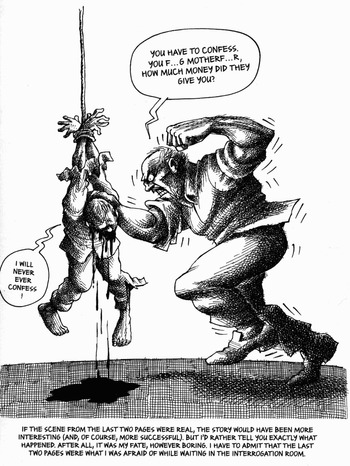
Neyestani’s account of his interrogation exemplifies this meta-narrative acumen that shows a clear sense of the implied reader’s expectation and its anomaly with what he has to offer. His cartoon of a cockroach for Iran-Jomᶜeh’s weekly children’s supplement, which was supposed to be a health message about dealing with household pests, is blown out of proportion because of his usage of a common Turkish Azeri phrase, “namana,” meaning “what,” as spoken by the anthropomorphic insect, which was taken to be an intentional ethnic insult and a planned attempt against national security. He is asked to report to the Evin Prison for questioning, where he is immediately detained without bail for several months. The account of his first day of interrogation begins with an interesting insertion of Neyestani’s meta-narrative voice. He is blindfolded and walked through the ward’s corridors, where he “could hear cries for help emanat[ing] from half-open doors of other cells.”Footnote 11 The chilling voices of other inmates under interrogation surround him, as he hears someone say, “I didn’t know them. I swear on my mother’s grave,” only to receive the interrogator’s invective reply, “F … your mother! We know all the details. Why did you let them use your home?”Footnote 12 This prepares him for his own questioning, which starts in the next frame within the same page. A brute muscular man, with jagged teeth and savagely wide eyes accusatorily shouts at him, “Okay! Then you accepted money from Anti-Revolutionaries to provoke unrest in Azerbaijan.” All that Neyestani could say before receiving his first punch in the face is, “No! I didn’t get any money. It was just a kids cartoon!”Footnote 13 The next page’s only frame shows the inquisitor with a furious face and an ape-like physique, pummeling the cartoonist, who is suspended from the ceiling by his two tied hands, blood dripping from his face and making a puddle on the ground, while all he says in response to his torturer’s abusive insults is, “I will never confess!”Footnote 14 The narrative comes to a halt when Neyestani as the author intercedes: “If the scene from the last two pages were real, the story would have been more interesting (and, of course, more successful). But I’d rather tell you exactly what happened. After all, it was my fate, however boring.”Footnote 15 Only at this point is it divulged that his real interrogation did not resemble this cinematically gruesome scene that would perfectly meet the expectation of a harrowing inquisition (Figure 1). His narrative voice not only uses this violent and dismal point to stop and create an ironic distance between his experience and a stereotypical “torture,” but implies another torturous condition: the narration of pain as intimately as it has happened, without any bruise or blood, or without jostling it into a narrative cliché.
Neyestani, An Iranian Metamorphosis, 43 (2014). Reproduced by permission of Uncivilized Books.

His actual interrogator turns out to be a calm, slender man, wearing a slim pair of reading glasses and an ominous smile. He does not have the muscles for, nor the proclivity to, exert any bodily harm on the protagonist. He patiently asks the cartoonist to sit down and write why he drew the problematic cockroach picture. After several attempts at writing his impromptu confessions, and hearing the interrogator—who goes by the alias Maleki—rejecting his account as insufficient and urging him to it write again, the cartoonist realizes he is being asked to act as a collaborator against his fellow journalists.Footnote 16 Neyestani’s situation as the narrator is complicated by, on the one hand, the absurd reality of undergoing such agonies for a tiny cartoon in a children’s magazine, and, on the other hand, the problem of negotiating his narrative with the expectation that is assumed of an exiled Iranian author. His note that what happened to him may be “boring” for the readers is a double-edged rhetorical blade. It anticipates the risk of disappointing his assumed western audience by offering, and then immediately rejecting, a clear-cut display of pain and terror; but also by playing with the implied reader’s appeal for an informative documentation of Iranian life, it does offer the chance for a deeper engagement. “I have to admit,” he continues, “that the last two pages were what I was afraid of while waiting in the interrogation room.”Footnote 17 The author offers a hermeneutical olive branch, as it were, to the reader, whose expectation was manipulated. Breaking the scene of a fictitious confession, his meta-narrative voice does confess his own predisposition to the same mistake that now chagrins the readers. If he momentarily alienates his audience by undermining an easily digestible version of horror, he then simultaneously links his own experience to the readers’ perturbation. This narrative strategy—disappointing the readers’ familiar anticipation while highlighting such a disappointment as an integral element for maintaining empathy—becomes the book’s signature diegetic formula. Neyestani encounters the inherent problem of Iranian diaspora literature—i.e. the dichotomy between authenticity and efficacy—and decides to face it head-on instead of ignoring, bypassing, or internalizing it. The book contends that an intimately felt experience of trauma is impossible to convey to a global audience without any reductionism, but contrary to, say, the authors of Zahra’s Paradise, he pivots his whole narrative around such an intrinsic impossibility.
To make a short comparison between the two books’ representational strategies, one can look at the point in each narrative when one of the most notorious legal officials in the Islamic Republic is introduced. Saeed Mortazavi, the former prosecutor general of Tehran, appears in person in Neyestani’s narrative, and is mentioned a few times in Zahra’s Paradise. Mortazavi, whose name is readily known to the Iranian readership for years of service in the judiciary system as a judge and a prosecutor, was responsible for injunctions against several reformist newspapers in the 1990s and early 2000s, and was responsible for the death of the journalist Zahra Kazemi during her detention in 2003.Footnote 18 The narrative problem of familiarizing the unfamiliar is evident in the two books’ attempts at introducing this character to their non-Iranian readers. Zahra’s Paradise uses a combination of graphic elements and an appendix glossary, which matches its purported goal as a textual documentary. In the second chapter of the book, after the public protests the anxious crowd waiting outside Evin’s gate for any news of their missing relatives talk about Mortazavi. Individuals in the uneasy crowd ask one another who Mortazavi is and what he has done, and they take turns talking about him. One makes a note of his reputation as “the Butcher of the Press,” while another reminds them of Zahra Kazemi, and a third informs the rest about the unsuccessful lawsuit against him on the charge of murder.Footnote 19 These conversations, obviously aimed at the uninitiated reader, cannot hide their own artificiality, as it appears that the individuals who address one another with brief comments about Mortazavi are all already aware of him and his record, and yet they seem to pursue questions whose answers they most likely know, only for the sake of instructing the reader. Nevertheless, this informative simulacrum of a conversation does not fully transmit the horrendous picture of Mortazavi that a native reader could immediately grasp. The glossary at the end of the book intends to amend this communicative shortcoming. There, the description, after reviewing his career in the judicial system, reads, “Following the Kahrizak Prison scandal, he was removed from office, only to be appointed Iran’s drug czar.” The text offers no further explanation on what exactly an Iranian “drug czar” is, and whether it is the vernacular equivalent of an official position—note that it does not even put it in italics or between quotation marks to imply any sarcastic or slang connotation.
The phrase drug czar, exclusively used in American political discourse, was coined in 1982 as an informal title for the US director of national drug control policy.Footnote 20 Apart from an inaccuracy in applying it to Mortazavi, who was appointed the head of the “Task Force Against Smuggling,” which is not the same as Iran’s “Drug Control Task Force” (both work under the auspices of the president), the text’s reference is quite problematic. The original usage of drug czar does not connote any negative meaning; it is not the same as, say, a drug overlord. On the contrary, the drug czar is the highest US executive against drug trafficking with long-standing bipartisan support. The appropriation of this term would only be successful in portraying a dark picture of Mortazavi if taken outside of its initial context. The Iranian readership, which was not the book’s target, would not be able to grasp this local American reference, and the American readers would have a hard time seeing its relevance. For the latter, neither the graphic medium nor the descriptive glossary can produce a picture of Mortazavi tantamount to an Iranian’s familiar grasp of his appalling reputation; the visual narrative produces a contrived discussion with a vaguely infomercial-like tone, and the brief description in the glossary, as a way to imply his corruption, takes recourse to an opaque and misplaced epithet.
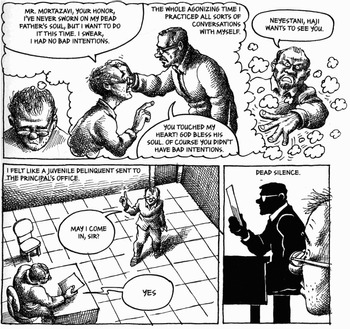
Neyestani’s treatment of Mortazavi is only slightly better than Zahra’s Paradise in terms of effectively orienting the western reader. However, what makes his approach more interesting is the author’s awareness of this representational impasse, and his deliberate underlining of this problem. The meta-awareness of Neyestani’s narrator appears again to create an ironic distance between the expectation and the reality, through which the readers can reconcile with their own position in the narrative. Like Zahra’s Paradise, he also makes an effort to introduce Mortazavi by referring to him as “The Press Executioner,” and the “main interrogator” responsible for Zahra Kazemi’s death.Footnote 21 In the story, on his way to the prosecutor’s office, where Neyestani is hoping to ask for bail, he imagines Mortazavi as a kindhearted man, who, against all that the author knows about him, would patiently listen to his true confessions about the cockroach cartoon and its unintended consequences. The unrealistic idea of a compassionate Mortazavi, drawn in the cloud of the cartoonist’s imagination, creates a sharp contrast with what is actually going to happen. The next two frames in the same page show only a silhouette of Mortazavi, sitting behind his desk, in “dead silence”Footnote 22 (Figure 2). He appears in full figure on the next page, makes the same accusations that Maleki has made before, and sends the protagonist back to prison, without any promise of bail. The last frame shows the notorious judge again in dark shadow, uttering a diabolic threat against any resistance to confessing, “We’ll get the experts in enhanced interrogation techniques to get the truth out of you.”Footnote 23
Neyestani, An Iranian Metamorphosis, 63 (2014). Reproduced by permission of Uncivilized Books.

Neyestani’s usage of this curious phrase, “enhanced interrogation,” instantly reminds the contemporary Anglophone readers of the euphemism for torture popularized by US officials during the George W. Bush administration, employed in an ostensibly apologetic sense to describe the techniques used by the Central Intelligence Agency and Department of Defense in Guantanamo, Abu Ghraib, Bagram, and other detention facilities around the world. The phrase entered public English-language discourse after several members of the Bush cabinet used it in their public speeches during their last years in the office.Footnote 24 What makes Neyestani’s reference to this term a bit peculiar is that it would be unlikely (though not entirely impossible) for Mortazavi to have used an exact verbatim Persian equivalent of the phrase that was yet to become so well-known. While no observer of contemporary Iranian politics is in doubt of the state’s widespread use of torture, it comes as a bit of a surprise to see the officials refer to their systematic inquisition methods with the very same words that the Anglo-American public immediately attributes to the Bush era. Because Neyestani’s book, just like Satrapi’s and Amir and Khalil’s, was originally written in a western language, there is no way to examine what the author reports in the characters’ native tongue. The translation, in other words, is the original, and vice versa; therefore, “enhanced interrogation,” as Neyestani means it, does not have to be the exact counterpart of a certain Persian phrase. For all that is available to us, the author’s application of this specific phrase may or may not be a mistranslation; nevertheless, it seems a deliberate choice to familiarize the intended audience with the Iranian judicial system.Footnote 25
At first glance, Neyestani’s approach is similar to Zahra’s Paradise with its reference to “drug czar,” as they both exert an authorial license in their exposition of such an infamous figure, but the crucial difference between the two should not go unnoticed. The latter offers a straightforward image of corruption whose effect requires forgoing the original context of its borrowed reference, while Neyestani’s narrative generates the possibility of an unexpected comparison between the acts of an emblematic figure of the Iranian legal system and the dark record of those who called the Iranian regime part of the Axis of Evil. An Iranian Metamorphosis, regardless of the nationalist exclusivism that its title may suggest, makes considerable efforts to narrate the author’s ordeal in a global framework. It may be irreducibly Iranian in one sense, but its narrated fear is not incomparable to what happens outside the national borders. By implying an analogy between Mortazavi and the US officials responsible for abuse in Abu Ghraib and elsewhere, the author kills two birds with one rhetorical stone: he offers a tangible comparative point of reference in order for his western readers to be able to realize the intensity of the encounter with one of Iran’s most fearsome legal figures, but also disrupts the black-and-white moral demarcation of the Islamic Republic as essentially evil, which would consequently make its adversaries virtuous by default.
The observations by Whitlock, Naghibi, and others on Satrapi’s satiric approach in her graphic recollection of life in Iran, which complicates the artist’s encounter with her western readers, is apropos to Neyestani’s outlook, too. Yet he takes the matter one step further by not only expressing his ordeal in Iran, but also adding to it the excruciating alienation he endures outside of Iran; his narrative does not just point out, but indeed exists, within the problematic sphere of “New Orientalism,” to borrow Keshavarz’s phrase. In this vein, the metamorphosis of the Iranian cartoonist only begins, but does not conclude, with his traumatic experiences in Evin Prison. We should note that about half of his narrative occurs abroad, where Neyestani and his wife desperately seek refuge through all the possible legal—and later illegal—channels. The opening pages of the story create a juxtaposition that can only be fully appreciated in rereading: the officer in the United Nations Refugee Agency office in Turkey looks down at the protagonist, asking him, “Write down the whole story!” and after seeing him struggle with the single sheet of paper that is obviously too small to fit his whole story, shouts at him for going over the page limit.Footnote 26 This is set side-by-side with Maleki, the interrogator at Evin, who asked him the very same question, but with the reverse attitude, “Mr. Neyestani, write the whole story. All the details please.”Footnote 27 The UN officer is a mirror image of the Iranian inquisitor: they are only opposite to one another in asking for, or dismissing, the details of his story, but both intimidate him in their own ways, and neither is interested in what his real story is; and, of course, neither is his ally, yet they both identify themselves as such.
This ironic connection creates a distancing effect reminiscent of the type of dark humor that occasionally appears in Satrapi’s works. In a famous scene, for instance, at the beginning of Persepolis 2, the young Marjane, now living in Europe, is introduced by her friend in a way that both underlines her unique position due to the lived experience in post-revolutionary Iran, and mildly questions if such an experience makes her an entirely different person. “This is Marjane,” says her friend, “She’s Iranian. She’s known war.” The Austrian boy to whom she is introduced asks in amazement, “You’ve already seen lots of dead people?” to which she replies, “Um … a few.”Footnote 28 The young expatriate girl, who is trying her best to blend into her new social circle, after having left her country in the high tide of war and social unrest, has to ponder, albeit momentarily, what it really means to have known a war. Two decades later, the exiled cartoonist has to ask himself what his whole story entails, when in prison even his most detailed account is rejected by his interrogator as insufficient, and on the other side of the border, in an entirely different milieu, the story is only acceptable if stripped of its crucial details down to sheer banality, reduced to the same level of satiric platitude that “knowing war” exemplifies. Satrapi projects the distance between the two worlds against the backdrop of her own coming-of-age story, delineating the wide gap between the perceptions of normalcy in her two different lives, but Neyestani steers his similar observation into a different direction. He bridges the gap of recognition by underlining, so to speak, the indefinite article in An Iranian Metamorphosis: it is not a narrative of an exclusively Iranian experience that could only be transmitted in fragments to non-Iranians. It is Iranian only in a nominal sense; it could happen elsewhere in the world, because the conditions that contributed to his catastrophic fate are readily observable in other national contexts. To make this point clear, Neyestani offers a brief parallel storyline.
A Chinese man, a border police officer in Guangzhou Airport, is introduced in short installments at the beginning of chapters twelve to fifteen, each time only on one page. The reader is left in suspense to find out the plot link between this (probably fictional) character and the rest of the story, until in the penultimate chapter it appears that the man is the one officer who checks the counterfeit passports that the cartoonist and his wife acquired from the human smuggler in Malaysia. While the minor subplot of the Chinese man is left in the periphery of the main storyline to create a climactic recognition, it does also provide an analogy that broadens the narrative’s overall scope. The man, named Tang Lu, is the son of a poet and intellectual, who was “arrested during the Cultural Revolution for his ‘imperialistic tendencies’ and died in prison during an unusually cold year,” leaving his son with a stigma of humiliation for the rest of his life.Footnote 29 It eventually becomes clear that Tang Lu is a low-level officer waiting patiently for a paltry promotion to prove his worth in spite of the damning legacy of his father. His short and intermittent presence in the narrative makes a striking case in comparison to Neyestani’s own condition, not only because of hints in their biographies—Neyestani’s own father was also a poet—but also because Tang Lu’s fate presents a glance at a history of totalitarianism and anti-intellectualism similar to the one that appalled the Iranian cartoonist. The narrative does not go as far as ignoring the nuances in the modern history of Iran and China to offer a garbled direct correlation between the two; just an inkling of similarity is suggested, enough to make the reader pause for a moment and consider the possibility that what happened to the Iranian cartoonist could have—and perhaps does—happen to many people elsewhere. This attitude is integral to the proclaimed transformation of the artist into a cosmopolitan citizen of the world, which bleeds into another recurring motif of the narrative: the metamorphosis.
Metamorphosis
The most original aspect of Neyestani’s memoir, conspicuously reflected in the title, is its thematic reference to Franz Kafka’s The Metamorphosis, an allusion that is not without foundation. A wide variety of Kafkaesque events color his narrative, beginning with the long, traumatic internment for drawing a children’s cartoon, but the references to Kafka are also construed from the fitting link of the cockroach that he drew. If Kafka’s narrative begins with a man turning into a verminous bug, Neyestani suggests, so does his story begin with the coming-to-life of an insect, although he hastens to remind the readers that his story “is slightly different.”Footnote 30 The drawn cockroach becomes a leitmotif, appearing also as a character in a dream sequence. The young cartoonist sees the insect for the first time near the wash basin of his prison cell and kills it with his slippers, only to see it rise again, quickly grow into human size and attack him, shouting, “Did you think I’m so easy to get rid of?”Footnote 31 The same cockroach appears through several turning points of the story, usually as a silent observer in the corner of a frame—e.g. in the cartoonist’s first meeting with an arrested Azeri protestor in prison,Footnote 32 after his plane from Tehran takes off,Footnote 33 and at his arrival in Malaysia to meet a human smuggler.Footnote 34 This continual reference to the insect’s presence throughout his journey reaches its climax in the final chapter, when he again has to spend the night in a prison cell, this time in China. In his night before deportation, in the Chinese cell that evidently reminds him of his time back in Evin, he again sees the cockroach, which goes through the same rapid growth to human size. This time, however, the insect does not attack him, but asks perplexedly, “Why do you keep killing me … Do you know who I am?,” at which point the comic frames show its face alongside the cartoonist’s own face to display the final stage of a metamorphosis; the cartoonist realizes he is looking at himself.Footnote 35 The story ends shortly after that scene on a mixed note. The cartoonist and his wife have to fly back to Malaysia, penniless and petrified, with the cockroach, now back to its original size, sitting on the seat beside him, in an apparent truce with its hapless creator.
This ambiguity of the cockroach’s symbolic role in the story has caused some disgruntled readings of the book. A reviewer comments that while “The overgrown roach that taunts Neyestani embodies [his cartoon’s] controversy, taking a form that also captures the persistence of Neyestani’s tormentors,” it does create a confusion when “the talking cockroach” is coupled with the “Kafka reference.”Footnote 36 This “thematic muddle,” he argues, is because the book “draws parallels between its protagonist and [Kafka’s] Gregor Samsa while also positioning an insect character (an insect motif, at least) against its protagonist.”Footnote 37 The objection to this convoluted allusion, which the reviewer goes as far as calling “distracting, and basically disappointing,” is understandable but misplaced. In resolving the hermeneutic problem of the insect reference, the main question to ask is what exactly Neyestani’s metamorphosis entails: from what state is he transformed to what? Any direct comparison to Kafka’s novella only augments the perplexity. Gregor Samsa’s literal transformation into an insect is famously sudden and abstruse. It is almost impossible to realize whether it was a torment brought upon him by the outside circumstances or a manifestation of his own personality.Footnote 38 The reader of Kafka is left alone in the unmanageable task of deciding if his protagonist should be empathized with or not, if he is a tragic hero or the subject of an ironically dark comedy. Furthermore, a hallmark of Kafka’s literary style is to integrate the figurative language with the literal. “His stories,” writes Walter Sokel, “tend to present enactments of metaphors buried in language … . Basic metaphors by which prescientific language expresses experiences, attitudes, and relationships become events in Kafka’s tales.”Footnote 39 The telling example of this style is the central event in The Metamorphosis itself. “German usage applies Ungeziefer (vermin) to persons considered low and contemptible, even as our [English] usage of ‘cockroach’ describes a person deemed a spineless and miserable character,” Sokel explains. “The traveling salesman Gregor Samsa … is ‘like a cockroach’ because of his spineless and abject behavior and parasitic character. However, Kafka drops the word ‘like’ and has the metaphor become reality.”Footnote 40 The protagonist of Neyestani’s narrative is not, at least not in this sense, like a cockroach, nor does he become one.
The traumatic experience of the cartoonist that likens his fate to Kafka’s narrative is the abrupt and painful realization of living in a political atmosphere that breaches the fine border between the literal and the metaphorical. The author plainly remarks in an interview that a constant challenge for a cartoonist like him is “always that risk, that possibility, that the authorities will find a political dimension to your drawing.”Footnote 41 The unescapable havoc that ruled Neyestani’s life, as it turns out, is the rhetorical practice of the Kafkaesque—the distortion of the boundary between the figurative and verbatim language—by the hegemonic power in Iran. The story of Neyestani’s horrid experiences culminates in understanding that there is no such a thing as innocuous language or apolitical cartoon when the interpretive arbitration is out of the cartoonist’s own hands. If Gregor Samsa had to come to terms with his literal transformation, the young cartoonist of Neyestani’s account, likewise, has to realize that the decision on his cartoon’s meaning and its consequences are fait accompli. The “metamorphosis” of the cartoonist is the realization that when hegemonic power determines a political interpretation of your work, you are effectively positioned in a locus of resistance from which there is no evasion. His maturation is in welcoming this initially unintended label of resistance, cherishing it as a critical laurel, and redefining his professional identity based on it. The young Neyestani at the beginning of the journey only wanted to “quit drawing political cartoons” and work for a children’s publication because “it seemed less risky.”Footnote 42 The metamorphosed author, through whose voice the whole story is told, is reconciled with the fact that in such an inverted Kafkaesque world, where everything can become a metaphor and every metaphor can be summoned to life, the convenient option of evading politics is not tenable. The apparently crestfallen cartoonist in the book’s last chapter is, therefore, at peace with his drawn creature; he no longer blames his own creation because there is nothing to blame.
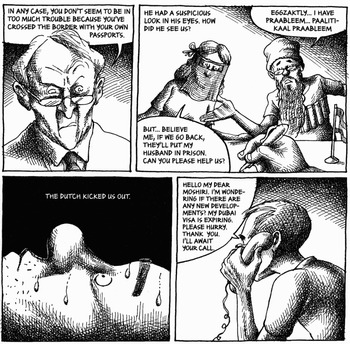
The thematic connection between Kafka’s story and Neyestani’s is also present in the larger sketch of the former’s narrative: Samsa undergoes not one, but two processes of metamorphosis. The first one is the sudden transformation to an insect, but he also experiences a gradual process of isolation and dehumanization. Initially, he “comes to be considered by the family as a threat and an obnoxious burden,” but gradually they get used to his presence as vermin, deride him, occasionally become bemused by him, and finally completely ignore him.Footnote 43 A common interpretation of Kafka’s ending is, “It is not just the initially-given metamorphosis, but the gradual unfolding of the plot that makes Gregor Samsa the ultimate metaphor of extreme human alienation.”Footnote 44 The fate of Neyestani’s protagonist after his attempt to flee the country is the counterpart of Samsa’s second round of transmutation. The cartoonist’s metamorphosis is the product of finding himself abandoned by the foreign agencies, which he had naively assumed to be his saviors. He was also isolated, because he found himself trapped in the twilight zone between nonconformity to the Islamic Republic’s ideology and neglect by the western officials. In this sense, Neyestani’s allegorical treatment of his own metamorphosis goes back to the same confrontation with the simplified image of his character as an Iranian, the one that Satrapi and the authors of Zahra’s Paradise attempt to redress, and the one that Nafisi and her followers are accused of propagating. The three panels in which he sums up his interview with an officer in the Dutch embassy offers a telling example of what the cartoonist sees as his predicament between a rock and a hard place (Figure 3). Thinking why his case was dismissed, he conjectures how the European interviewer might have perceived them. The next frame reverses the perspective of the interview, and the cartoonist is bearded, wears a row of dynamite sticks around his waist, and his wife’s face is indistinguishable under a burqa. One does not need to look any further for a visual representation of “New Orientalism.” The protagonist is, against his will, and perhaps against his knowledge at the time, metamorphosed, but this time it is not a misreading of a politically inert cartoon; it is a misinterpretation of his identity as a whole.
Neyestani, An Iranian Metamorphosis, 147 (2014). Reproduced by permission of Uncivilized Books.

Neyestani’s memoir encapsulates many of the merits and limits of the Iranian diaspora literature, but in lieu of presenting his work as a rectification of the Iranian image in the West or blindly furthering any stereotype of his country, he draws upon his traumatic memories from the vantage point of negotiating the impossible: whether to exhibit his story as an allegorical tale of a nation, or to capture a uniqueness to his condition that makes it painfully personal. The resolution to this impasse is the self-confessedly “boring” narrative in a dialogic relationship with what it resists becoming—i.e. a tale of political trauma ready to make a best-seller. His determination not to turn his experience into a typical narrative of an Iranian Everyman, but to keep the focus on his painful path in acquiring, and sharpening, a unique artistic sensibility, is the driving force behind his story. Whether the outcome is truly boring or not rests upon every individual reader’s judgment; it is, nevertheless, evident that his story is itself the embodiment of a transformation from shunning the politics of exilic literature to welcoming its challenges.