Giant ragweed, a native of North America, is a summer annual broadleaf weed mainly found in midwestern and eastern corn and soybean production fields in the United States (Johnson et al. Reference Johnson, Loux, Nordby, Sprague, Nice, Westhoven and Stachler2006) and eastern Canada (Vink et al. Reference Vink, Soltani, Robinson, Tardif, Lawton and Sikkema2012). Giant ragweed can reach up to 6 m in height, depending on the density of the neighboring plants or the crop infested (Abul-Fatih and Bazzaz Reference Abul-Fatih and Bazzaz1979). It is aggressive, and early-season growth gives giant ragweed a competitive advantage over other weed and crop species (Abul-Fatih and Bazzaz Reference Abul-Fatih and Bazzaz1979). Baysinger and Sims (Reference Baysinger and Sims1991) identified giant ragweed as one of the most competitive weeds in soybean, causing up to 50% yield reduction at a density of 1 plant m–2. Giant ragweed’s ability to outcompete soybean early in the season as well as its continuing vigorous growth within the soybean canopy makes it a highly competitive weed in soybean (Ganie et al. Reference Ganie, Sandell, Mithila, Kruger, Marx and Jhala2016; Kaur et al. Reference Kaur, Sandell, Lindquist and Jhala2014; Webster et al. Reference Webster, Loux, Regnier and Harrison1994). Previous studies determined that corn yield was reduced by 14% with a giant ragweed density of 1 plant per 10 m–2 (Harrison et al. Reference Harrison, Regnier, Schmoll and Webb2001). Recently, Ganie et al. (Reference Ganie, Lindquist, Mithila, Kruger, Marx and Jhala2017) reported 50% yield loss in corn due to giant ragweed escapes at a density of 8.4 plants m–2 in the presence of management practices including tillage followed by (fb) PRE and/or POST herbicides in Nebraska.
Since the commercialization of glyphosate-resistant (GR) soybean and corn, glyphosate has been extensively used in POST applications to control problematic weeds, including pigweeds (Amaranthus species) and giant ragweed (Ferrell and Witt Reference Ferrell and Witt2002). However, the evolution of glyphosate- and acetolactate synthase (ALS) inhibitor–resistant giant ragweed biotypes has limited the number of POST herbicide options available for effective control, specifically in soybean (Ganie et al. Reference Ganie, Sandell, Mithila, Kruger, Marx and Jhala2016; Steckel Reference Steckel2007). The management of giant ragweed has further become challenging due to the occurrence of late-emergence cohorts, particularly in agronomic crops in the eastern Corn Belt (Regnier et al. Reference Regnier, Harrison, Loux, Holloman, Venkatesh, Diekmann, Taylor, Ford, Stoltenberg, Hartzler, Davis, Schutte, Cardina, Mahoney and Johnson2016; Schutte et al. Reference Schutte, Regnier and Harrison2012; Sprague et al. Reference Sprague, Wax, Hartzler and Harrison2004).
Giant ragweed’s seed production varies from 500 to 5,000 seeds per plant (Baysinger and Sims Reference Baysinger and Sims1991; Goplen et al. Reference Goplen, Sheaffer, Becker, Coulter, Breitenbach, Behnken, Johnson and Gunsolus2016), although only 60% to 70% of seeds are fully developed and potentially viable (Goplen et al. Reference Goplen, Sheaffer, Becker, Coulter, Breitenbach, Behnken, Johnson and Gunsolus2016; Vitolo and Stiles Reference Vitolo and Stiles1987). The seed size of giant ragweed is variable, and the presence of both large- and small-sized seeds is considered important for seasonal emergence and persistence in the soil seedbank (Schutte et al. Reference Schutte, Reginer and Harrison2008). Giant ragweed seeds have a variable dormancy period, with germination occurring only after extended periods of burial in the soil and cold stratification (Schutte et al. Reference Schutte, Regnier and Harrison2012). Typically, giant ragweed emergence in Nebraska occurs from March to June (Kaur et al. Reference Kaur, Werle, Sandell and Jhala2016b); however, late-emerging giant ragweed populations have been reported in Illinois, Indiana, and Ohio (Regnier et al. Reference Regnier, Harrison, Loux, Holloman, Venkatesh, Diekmann, Taylor, Ford, Stoltenberg, Hartzler, Davis, Schutte, Cardina, Mahoney and Johnson2016; Shutte et al. 2012; Sprague et al. Reference Sprague, Wax, Hartzler and Harrison2004).
In some weed species, late-season emergence provides an opportunity to escape early- or mid-season POST herbicide applications (Clay and Griffin Reference Clay and Griffin2000). For example, common waterhemp (Amaranthus rudis Sauer) shows an extended emergence pattern, with several cohorts emerging throughout the growing season (Refsell and Hartzler Reference Refsell and Hartzler2009; Wu and Owen Reference Wu and Owen2014). Depending on the weed species and density, late-season emergence may or may not lead to yield losses through crop-weed competition, but it usually causes disruption in harvesting operations and plays an important role in the replenishment of the soil seedbank (Cardina and Norquay Reference Cardina and Norquay1997). Therefore, late-season herbicide applications provide an opportunity to control those weed cohorts that have escaped previous control measures (Walker and Oliver Reference Walker and Oliver2008). Additionally, herbicide application at or near flowering or seed set has the advantage of decreasing weed seed production, eventually allowing the depletion of the soil seedbank (Bennet and Shaw Reference Bennet and Shaw2000; Jha and Norsworthy Reference Jha and Norsworthy2012; Taylor and Oliver Reference Taylor and Oliver1997; Walker and Oliver Reference Walker and Oliver2008). Unfortunately, a late-season weed infestation is often ignored because decisions to control weeds are often based upon the weed’s ability to penalize crop yield (Bagavathiannan and Norsworthy Reference Bagavathiannan and Norsworthy2012; Baumann et al. Reference Baumann, Potter and Muller-Scharer1993), and because late-season herbicide applications are not practical due to preharvest interval restrictions. Furthermore, late-season control becomes more important when growers are unable to apply preplant or PRE herbicides due to poor weather or soil conditions such as heavy rain and have to rely on POST, in-crop herbicides for weed control. Late-season (rescue) herbicide applications may not provide very effective weed control; however, they can potentially reduce weed seed bank additions during a growing season.
In a previous research, Jha and Norsworthy (Reference Jha and Norsworthy2012) reported 78% to 95% reduction in Palmer amaranth (Amaranthus palmeri S. Wats) seed production with glufosinate, 2,4-D, or dicamba applied when the first signs of inflorescence appeared. Kumar and Jha (Reference Kumar and Jha2015) observed that late-season (early bloom stage) application of dicamba, glyphosate, glufosinate, or paraquat had up to 98% control and up to 99% seed reduction of kochia [Kochia scoparia (L.) Schrad]. Taylor and Oliver (Reference Taylor and Oliver1997) found that dicamba, glyphosate, glufosinate, or paraquat applied at the flowering to 9-cm pod growth stage in sicklepod [Senna obtusifolia (L.) H.S. Irwin & Barneby] led to an 80% to 100% reduction of seed production. Several other studies also reported that a single application of glyphosate, 2,4-D, dicamba, or glufosinate at the flowering to initial seed set stages of giant foxtail (Setaria faberi Herrm.), common lambsquarters (Chenopodium album L.), redroot pigweed (Amaranthus retroflexus L.), velvetleaf (Abutilon theophrasti Medik.), and sicklepod resulted in as much as a 99% reduction in seed production (Biniak and Aldrich Reference Biniak and Aldrich1986; Fawcett and Slife Reference Fawcett and Slife1978; Taylor and Oliver Reference Taylor and Oliver1997).
Glufosinate-resistant soybean and cotton (Gossypium hirsutum L.) have been adopted by growers in the southeastern United States, especially in fields infested with GR Palmer amaranth (Riar et al. Reference Riar, Norsworthy, Steckel, Stephenson and Bond2013). It is also likely that the planting of glufosinate-resistant corn and soybean will increase in the Midwest in the near future, as the need for controlling GR weeds, including giant ragweed, increases (Aulakh and Jhala Reference Aulakh and Jhala2015; Kaur et al. Reference Kaur, Sandell, Lindquist and Jhala2014). Glyphosate plus glufosinate-resistant corn is available in the marketplace and has been successfully adopted by growers. Similarly, new multiple herbicide–resistant crops including 2,4-D plus GR corn, cotton, and soybean, as well as dicamba plus GR cotton and soybean, have been developed. The commercialization of the aforementioned stacked herbicide-resistant crop traits will provide an opportunity to use multiple sites-of-action herbicides for POST weed control in crops, with an extended window of application.
Previous field experiments in Nebraska suggested that giant ragweed is very sensitive to dicamba and 2,4-D, and more than 90% control was achieved with preplant applications of 2,4-D in soybean and with POST applications in corn (Ganie et al. Reference Ganie, Sandell, Mithila, Kruger, Marx and Jhala2016; Jhala et al. Reference Jhala, Sandell and Kruger2014; Kaur et al. Reference Kaur, Sandell, Lindquist and Jhala2014). However, scientific literature is not available on the effect of late-season POST herbicide applications on inflorescence and seed production in giant ragweed. The objectives of this study were to evaluate the effect of late-season single or sequential applications of 2,4-D, dicamba, glyphosate, and glufosinate on inflorescence, plant height, and seed production of GR giant ragweed under greenhouse and field conditions. We hypothesized that late-season sequential applications of herbicides will result in greater inflorescence injury and reduction in giant ragweed seed production compared with a single application.
Materials and Methods
Field Study
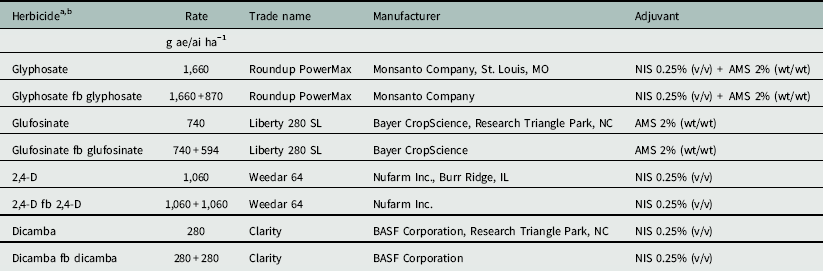
Field experiments were conducted under noncrop (bare ground) conditions at David City, NE (41.24°N, 97.13°W), in 2012 and 2013 in a grower’s field infested with GR giant ragweed. GR giant ragweed with 9- to 14-fold level of resistance compared to a susceptible biotype was confirmed in this field in 2011 (Rana et al. Reference Rana, Nedeljkovic, Scott, Sandell and Knezevic2013). The soil type at David City was fine, smectitic, mesic Udic Argiustolls (Hastings series) with a silty clay loam texture (18% sand, 50% silt, 32% clay), 2.1% organic matter, and a pH of 5.4. The individual plots were 3 m wide and 9 m long, with a natural infestation of GR giant ragweed at a density ranging from 25 to 32 plants m─2. The experiment was arranged in a randomized complete block design with four replications. A total of eight late-season herbicide treatments were compared (Table 1). A nontreated control was included for comparison, and a glyphosate treatment was included to demonstrate the presence of GR giant ragweed and to serve as a comparison with other herbicide treatments.
List of herbicide products, rates, manufacturers, and adjuvants used in field and greenhouse studies in Nebraska in 2013 and 2014.

a Abbreviations: AMS, ammonium sulfate (DSM Chemicals North America Inc., Augusta, GA); fb, followed by; NIS, nonionic surfactant (Induce Helena Chemical Co., Collierville, TN).
b First herbicide applications were made when glyphosate-resistant giant ragweed was nearly 40 to 45 cm tall and were followed by a second application after an interval of 40 to 45 days.
Late-season herbicide treatments were applied when giant ragweed plants were 40 to 45 cm tall with less than 10% plants showing initiation of male inflorescence, and a sequential application was made 40 to 45 d after the first application when 30% to 50% of the flowering had initiated. Herbicides were applied with a CO2-pressurized backpack sprayer calibrated to deliver 140 L ha─1 at 276 kPa equipped with a four-nozzle boom fitted with AIXR 110015 or TT 110015 (for glufosinate) flat-fan nozzles (TeeJet, Spraying Systems Co., P. O. Box 7900, Wheaton, IL 60189).
The effect of late-season herbicide application on giant ragweed inflorescence was visually estimated at 28 d after sequential (second) herbicide application on a scale of 0% to 100%, with 0% equaling no visible inflorescence injury or complete seed set and 100% equaling no presence of inflorescence, completely damaged inflorescence, or no seed set. Plant height (cm) was measured by randomly selecting ten plants per plot at the time of giant ragweed seed harvest. Similarly, at maturity seed heads were hand-harvested from ten randomly selected plants per plot, kept in separate paper bags, thoroughly cleaned, and the number of seeds per plant was counted.
Greenhouse Study
Seeds of GR giant ragweed were collected in the fall of 2012 from David City, NE, sown in germination trays measuring 58 by 42 by 15 cm, and kept in a freezer (0 C) for 3 months to break dormancy before they were transferred to the greenhouse (Kaur et al. Reference Kaur, Aulakh and Jhala2016a). After emergence, individual 4- to 5-cm-tall seedlings were transplanted into free-draining pots (13 cm diam and 24 cm deep). The soil used in the pots was a mixture of 80% silt-loam soil (25% clay, 24% sand, and 51% silt) and 20% potting mixture (Berger BM1 All-Purpose Mix, Berger Peat Moss Ltd., Saint-Modeste, Quebec, Canada). Plants were maintained at a temperature ranging from 25 to 27 C during the day and from 20 to 22 C during the night, with a 14 h photoperiod throughout the experiment. The greenhouse experiment was arranged in a randomized complete block design with four replications and repeated twice.
A preliminary study was conducted in the greenhouse and repeated to determine late-season herbicide application timing before giant ragweed flowering initiation. Giant ragweed plants in the greenhouse started flowering earlier (38 to 42 cm height) than those in field conditions (data not shown). Herbicides were applied when giant ragweed plants were 30 to 35 cm in height, and the sequential (second) application was made 28 d after the first application using a cabinet spray chamber calibrated to deliver 140 L ha–1 at 206 kPa. Visual estimates of herbicide injury on giant ragweed inflorescence and plant height were recorded at the time of giant ragweed seed harvest using a scale as described in the field study. Seed heads were harvested manually and cleaned, and seeds were counted to determine seed production per plant.
Statistical Analysis
Data were subjected to ANOVA using the PROC GLIMMIX procedure in SAS version 9.3 (SAS Institute Inc, Cary, NC). Data were checked for normality with the use of the PROC UNIVARIATE procedure in SAS, and all data followed a non-Gaussian distribution. Therefore, data of inflorescence injury, plant height, and seed production were arcsine square-root transformed before analysis; however, back-transformed actual mean values are presented based on interpretation from the transformed data. In the model, herbicide treatment was considered a fixed effect, whereas replication nested within year (field study) or experimental run (greenhouse study) was considered a random effect. Where the ANOVA indicated treatment effects were significant, means were separated at P≤0.05 using Tukey-Kramer’s pairwise comparison test.
Results and Discussion
Plant Height
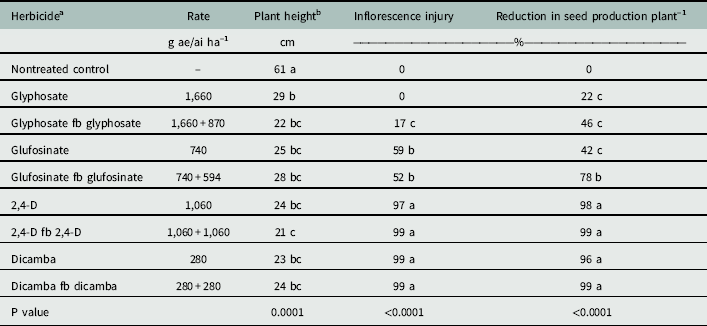
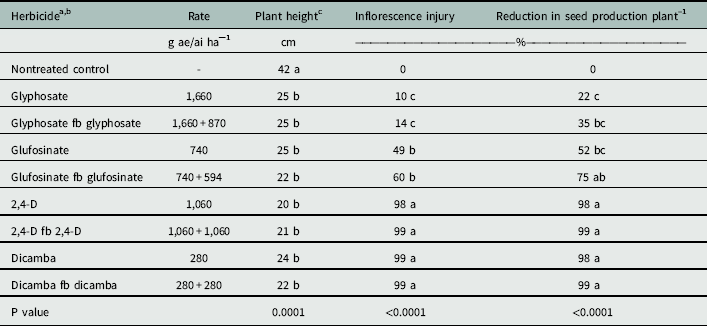
The average height of the giant ragweed plants in the nontreated control was 61 cm compared to 21 to 29 cm in the herbicide treatments with no difference among them in the field study (Table 2). Surprisingly, glyphosate applied as a single or sequential application reduced plant height of GR giant ragweed, consistent with other late-season herbicide treatments; however, inflorescence injury with glyphosate was only 17% (Table 2). Nonetheless, giant ragweed in the greenhouse study was shorter compared to giant ragweed in the field study, with an average height of 42 cm in the nontreated control and 20 to 25 cm under the herbicide treatments (Table 3). While scientific literature on the effect of herbicides on giant ragweed plant height is not available, late-season herbicide application is known to affect weed height. For instance, Sather et al. (Reference Sather, Roberts and Bradley2013) reported 13% to 40% and 28% to 45% reduction in tall fescue [Lolium arundinaceum (Schreb.) S.J. Darbyshire] plant height when metsulfuron-containing herbicides (metsulfuron, metsulfuron plus aminopyralid, metsulfuron plus chlorsulfuron) were applied at the vegetative and boot stages, respectively. However, in the same study, less reduction in tall fescue plant height was reported with metsulfuron plus 2,4-D plus dicamba.
Effect of single and sequential applications of herbicides on glyphosate-resistant giant ragweed plant height, inflorescence injury, and seed production in 2013 and 2014 in field experiments conducted at David City, NE.

a Herbicide treatments were applied when giant ragweed plants were 40 to 45 cm tall, and a sequential [followed by (fb)] application was made 40 to 45 d after the first application, when 30% to 50% of the flowering had initiated.
b Data were arcsine square-root transformed before analysis; however, back-transformed actual mean values are presented based on interpretation from the transformed data. Means presented within each column with no common letter(s) are significantly different according to Fisher’s protected LSD test, where P≤0.05. Giant ragweed inflorescence injury and seed production data (0%) of the nontreated control were not included in the analysis.
Effect of single and sequential application of herbicides on glyphosate-resistant giant ragweed plant height, inflorescence injury, and seed production in greenhouse experiments conducted at the University of Nebraska–Lincoln.

a Abbreviation: DAT, day after treatment.
b Herbicide treatments were applied when giant ragweed plants were 30 to 35 cm tall, and a sequential application was made 40 to 45 d after the first application, when 30% to 50% of the flowering had initiated.
c Data were arcsine square-root transformed before analysis; however, back-transformed actual mean values are presented based on interpretation from the transformed data. Means presented within each column with no common letter(s) are significantly different according to Fisher’s protected LSD test, where P≤0.05. Giant ragweed inflorescence injury and seed production data (0%) of the nontreated control were not included in the analysis.
Inflorescence Injury
A single (740 g ha–1) or sequential (740 fb 594 g ha–1) application of glufosinate resulted in 52% to 59% injury to inflorescence of GR giant ragweed in the field study (Table 2). In contrast, irrespective of single or sequential application, 2,4-D or dicamba resulted in 97% to 99% inflorescence injury. Comparable results were observed under greenhouse conditions, with glyphosate, glufosinate, and 2,4-D or dicamba resulting in 10% to 14%, 49% to 60%, and ≥98% inflorescence injury, respectively (Table 3). Previous studies have mostly reported weed control with late-season herbicide applications, but literature on the effect of herbicides on weed inflorescence is limited. In one example, Jha and Norsworthy (Reference Jha and Norsworthy2012) reported significant inflorescence injury that resulted in 52% to 74% control of Palmer amaranth biotypes from Arkansas with glufosinate, 2,4-D, or dicamba applied when the first signs of inflorescence appeared. Similarly, glufosinate and dicamba resulted in ≤70% control of sicklepod when the plants were treated at the early flowering stage (Taylor and Oliver Reference Taylor and Oliver1997). Paraquat alone or tank-mixed with atrazine, linuron, or metribuzin applied at the early bloom stage to kochia resulted in 100% control, in contrast with <70% control with dicamba, dicamba plus 2,4-D, or diflufenzopyr plus dicamba plus 2,4-D (Kumar and Jha Reference Kumar and Jha2015). Similarly, a late-season application of glyphosate reduced the aboveground biomass production in barnyardgrass (Echinochloa crus-galli (L.) Beauv.) (22% to 27%), Palmer amaranth (93% to 99%), pitted morningglory (Ipomoea lacunosa L.) (74% to 90%), and prickly sida (Sida spinosa L.) (76%) (Walker and Oliver Reference Walker and Oliver2008). Inflorescence injury potentially reduces the seed set and interrupts the development of the growing embryo, resulting in seeds with reduced viability (Maun and Cavers Reference Maun and Cavers1969).
Seed Production
Giant ragweed seed production in the nontreated control was 480 to 1,260 seeds plant–1 in the field study (data not shown). Glyphosate applied alone at 1,660 g ha–1 resulted in 22% reduction in seed production compared to the nontreated control, and sequential application (1,660 fb 870 g ha–1) resulted in 46% reduction. Similarly, in the greenhouse study, single and sequential glyphosate applications resulted in 22% and 35% reduction in seed production, respectively (Table 3). Reduction in seed production due to glyphosate may indicate that GR giant ragweed plants need to spend energy in handling the glyphosate and presence of segregating population. Single (740 g ha–1) and sequential (740 fb 594 g ha–1) application of glufosinate reduced seed production of GR giant ragweed by 42% and 78%, respectively, compared with 96% to 99% reduction with 2,4-D and dicamba (Table 2). Likewise, in the greenhouse study, single and sequential applications of glufosinate resulted in 52% and 75% reduction in seed production, respectively, compared to ≥98% reduction with 2,4-D or dicamba (Table 3). Previous studies have evaluated the potential for late-season herbicide applications to alter weed seed production. For example, 2,4-D or dicamba plus glyphosate reduced seed production in common ragweed (Ambrosia artemisiifolia L.) by 80% when treatments were applied before or at the first appearance of male flowers (Bae et al. Reference Bae, Nurse, Simard and Page2017). Similarly, 2,4-D applied before or just after flower initiation reduced seed production in common lambsquarters, redroot pigweed, and jimsonweed (Datura stramonium L.) by 99%, 84%, and 100%, respectively (Fawcett and Slife Reference Fawcett and Slife1978). Jha and Norsworthy (Reference Jha and Norsworthy2012) also reported 75% to 87% reduction in Palmer amaranth seed production with a single application of 2,4-D, dicamba or glufosinate at initial seed set. A reduction in seed production after late-season herbicide (2,4-D, chlorimuron and imazaquin, dicamba, glyphosate, glufosinate, and paraquat plus diquat) application has also been reported in prickly sida, pitted morningglory, barnyardgrass, and rigid ryegrass (Lolium rigidum Gaudin) (Isaacs et al. Reference Isaacs, Murdock, Toler and Wallace1989; Steadman et al. Reference Steadman, Eaton, Plummer, Ferris and Powles2006; Walker and Oliver Reference Walker and Oliver2008).
Targeting weed seed production provides an effective tool for reducing the spread of herbicide-resistant weeds by preventing their establishment, spatial distribution, and buildup of seed reservoirs in the soil seedbank (Bagavathiannan and Norsworthy Reference Bagavathiannan and Norsworthy2012; Neve et al. Reference Neve, Norsworthy, Smith and Zelaya2011). Reducing weed seed production also has the potential to delay the evolution of new herbicide-resistant weeds by reducing the number of plants exposed to herbicide selection pressure. Inhibition of weed seed production is particularly important for weed species that have already evolved resistance to glyphosate, such as giant ragweed (Norsworthy et al. Reference Norsworthy, Jha, Steckel and Scott2010, Reference Norsworthy, Riar, Jha and Scott2011), and is at a high risk of evolving resistance to other currently used herbicide sites of action due to its wide genetic diversity and facultative outcrossing nature (Johnson et al. Reference Johnson, Loux, Nordby, Sprague, Nice, Westhoven and Stachler2006; Regnier et al. Reference Regnier, Harrison, Loux, Holloman, Venkatesh, Diekmann, Taylor, Ford, Stoltenberg, Hartzler, Davis, Schutte, Cardina, Mahoney and Johnson2016). Nonetheless, in the present scenario with increased occurrence of herbicide-resistant weeds, control of weed seed production may require a zero-tolerance approach (Crow et al. Reference Crow, Steckel, Hayes and Mueller2015; Norsworthy et al. Reference Norsworthy, Ward, Shaw, Llewellyn, Nichols, Webster, Bradley, Frisvold, Powles, Burgos, Witt and Barrett2012); otherwise, even a few weed escapes can restore the soil seedbank to its initial levels, particularly in species with relatively high seed production potential. For instance, Norsworthy et al. (Reference Norsworthy, Griffith, Griffin, Bagavathiannan and Gbur2014) reported that a weed management approach that allowed a single GR Palmer amaranth plant to escape in a cotton field led to the spread of resistance in the entire field within 3 yr. Similarly, after a 5-yr weed-free period, broadleaf and grass weed seed density in the soil decreased by 95%, but during the sixth year, when herbicide use was eschewed, the seed density increased to 90% of the original level at two out of five locations in Nebraska (Burnside et al. Reference Burnside, Moomaw, Roeth, Wicks and Wilson1986).
Compared to Palmer amaranth and common waterhemp, late-season weed seed control will have far-reaching practical applications in controlling GR giant ragweed because of its sensitivity to synthetic auxin based herbicides, modest seed production potential, and relatively low seed viability. The results of this study indicated that 2,4-D and dicamba were the most effective late-season herbicides, resulting in maximum injury to GR giant ragweed inflorescence and reducing the seed production by more than 95%. The purpose of sequential late-season herbicide application in this study was to ensure giant ragweed seed prevention. However, the results from this study indicate that there may not be an additional benefit of a sequential application of the late-season herbicides tested, specifically when giant ragweed is a predominant weed species in the field.
Practical Implications
Dicamba- and 2-4,D-resistant soybean will provide an opportunity to apply dicamba and 2,4-D up to the R1 and R2 growth stages, respectively (Anonymous 2016; Anonymous 2017). Growers can utilize a single late-season application of 2,4-D or dicamba for effectively reducing GR giant ragweed seed production from survivors in dicamba- and 2,4-D-resistant soybean, and as such it should serve as an additional tool for integrated management of giant ragweed. Nevertheless, to avoid overdependence on late-season herbicide applications, other methods, such as cleaning weed seeds from harvesting equipment, the use of a harvest weed seed destructor (Buhler et al. Reference Buhler, Hartzler and Forcella1997; Walsh et al. Reference Walsh, Newman and Powles2013), and other similar strategies should be considered for reaching the goal of reducing soil weed seedbank replenishment. The use of late-season weed seed control investigated in this research, in addition to other integrated giant ragweed management strategies including preplant tillage and effective PRE and POST herbicides (Ganie et al. Reference Ganie, Sandell, Mithila, Kruger, Marx and Jhala2016, Reference Ganie, Lindquist, Mithila, Kruger, Marx and Jhala2017), will potentially be effective for controlling giant ragweed, including GR biotypes, in corn–soybean production systems.