Introduction
Substantial economic and environmental advantages (e.g. reduced insecticidal sprays) have resulted from the growing of transgenic (Bt) cotton (Gossypium hirsutum L.) in Australia (Fitt et al., Reference Fitt, Mares and Llewellyn1994; Fitt, Reference Fitt2000, Reference Fitt and Swanepoel2004), which reduces feeding damage from key pests, Helicoverpa armigera (Hübner) and H. punctigera (Wallengren) (Lepidoptera: Noctuidae). These transgenic cotton varieties are currently based on Bollgard II®, which incorporates the genes for two insecticidal toxins, Cry1Ac and Cry2Ab. Bollgard II® replaced Ingard® cotton in 2004, which only included the gene for Cry1Ac. Approximately 80% of the national crop is now Bt cotton (Downes et al., Reference Downes, Mahon, Rossiter, Kauter, Leven, Fitt and Baker2010b). However, development of resistance to Bt in Helicoverpa moths is the most important entomological risk facing the industry (Fitt, Reference Fitt2000). Helicoverpa armigera has already proven capable of developing resistance to several other insecticides in the field (Forrester et al., Reference Forrester, Cahill, Bird and Layland1993; Fitt, Reference Fitt1994) and to Bt in laboratory cultures (Akhurst et al., Reference Akhurst, James, Bird and Beard2003). Resistance to Bt crops in the field has been reported elsewhere in the world in other insect pests (Tabashnik et al., Reference Tabashnik, Gassmann, Crowder and Carrière2008; Huang et al., Reference Huang, Andow and Buschman2011). There are also unexpectedly high baseline levels of resistance to Cry2Ab in field populations of H. armigera and H. punctigera (Mahon et al., Reference Mahon, Olsen, Garsia and Young2007; Downes et al., Reference Downes, Mahon and Olsen2007, Reference Downes, Parker and Mahon2009, Reference Downes, Parker and Mahon2010a, Reference Downes, Mahon, Rossiter, Kauter, Leven, Fitt and Bakerb). A Resistance Management Plan (RMP) has been implemented in Australia to delay field-scale resistance to Bt (Roush et al., Reference Roush, Fitt, Forrester, Daly, Zalucki, Drew and White1998; Farrell, Reference Farrell2006). Part of this plan requires growers of Bt cotton to provide suitable refuge crops (no Bt exposure for the insects) as reliable sources of large numbers of non-selected and, hopefully, Bt susceptible moths that will mate with potentially resistant moths coming from the Bt crops, thus reducing the likelihood of resistance emerging. Successful field performance of refuges in this regard has been argued by several authors (e.g. Tabashnik et al., Reference Tabashnik, Dennehy and Carrière2005, Reference Tabashnik2008; Tabashnik, Reference Tabashnik2008; Huang et al., Reference Huang, Andow and Buschman2011). Originally, there were several refuge crop options available to Australian cotton farmers, pigeon pea (Cajanus cajan (L.), conventional cotton, maize (Zea mays L.) & sorghum (Sorghum bicolor (L.); but, more recently (starting in the 2010–11 cotton growing season), this has been reduced to just pigeon pea and cotton, because of an increased recognition of a risk of Bt resistance in H. punctigera. Maize and sorghum are known to be poor hosts for H. punctigera (Baker et al., Reference Baker, Tann and Fitt2007).
The relative production of Helicoverpa moths from the various (original) refuge crop options has been identified (Tann et al., Reference Tann, Fitt and Baker2002; Baker et al., Reference Baker, Tann and Fitt2007). This has, in turn, determined the amounts of each crop that must be grown by farmers in association with the Bt cotton sown (e.g. 5 ha of pigeon pea, which is regarded as the most productive refuge, per 100 hectares of Bt cotton). There is also extensive knowledge of various aspects of the ecology of Helicoverpa spp. in Australian agricultural landscapes (Zalucki et al., Reference Zalucki, Daglish, Firempong and Twine1986, Reference Zalucki, Gregg, Fitt, Murray, Twine and Jones1994; Fitt, Reference Fitt1989; Fitt & Cotter, Reference Fitt, Cotter and Sharma2004; Zalucki & Furlong, Reference Zalucki and Furlong2005; Baker et al., Reference Baker, Tann and Fitt2011). However, we need to be sure that sufficient moth movement is occurring on the landscape and that moths from different crop sources are indeed inter-mating. A primary assumption of the RMP is that mating is random amongst moths originating from separate plant hosts. This paper particularly tests if this assumption is supported.
The use of stable carbon isotope compositions or signatures (13C/12C, usually referred to as δ13C) as natural markers of the host plant upon which larvae of Lepidoptera have fed has proven useful in tracing the origins of captured moths, in particular H. zea in the USA (Gould et al., Reference Gould, Blair, Reid, Rennie, Lopez and Micinski2002). C3 and C4 plants possess different photosynthetic pathways. Such plant groups differ in the relative abundance of naturally occurring carbon isotopes, and they pass such differences on to insect herbivores which feed on them (Smith & Epstein, Reference Smith and Epstein1971; O'Leary, Reference O'Leary1988; Ambika et al., Reference Ambika, Sheshshayee, Viraktamath and Udayakumar2005). In general, C4 plants are tropical plants or summer growing annuals in temperate regions. The main group of C4 plants are grasses, including sorghum and maize. There is evidence that some Chenopodeaceae and many herbaceous weeds may also be C4. C3 plants include legumes such as pigeon pea, as well as cotton, sunflower (Helianthus annuus (L.)), wheat (Triticum aestivum L.) and soybean (Glycine max Merr.). Pigeon pea has been a particularly popular choice as a refuge option for use with Bt cotton in Australia because of its high production of Helicoverpa (and hence less area required under the RMP per unit of Bt cotton, compared with other refuge options).
In the present study, we analysed H. armigera moths, including pairs of mating moths, captured in cotton fields in northern New South Wales (NSW) and southern Queensland (Qld), Australia, for stable carbon isotope signatures to identify their likely host plant origins and to determine the mating patterns among moths from different host plant sources. We also analysed for stable nitrogen isotope signatures (15N/14N, hence δ15N) in the same moths, in the expectation that these would further help discriminate host plant sources, in particular between C3 legumes (e.g. pigeon pea) and non-legumes (e.g. cotton) (Ambika et al., Reference Ambika, Sheshshayee, Viraktamath and Udayakumar2005).
Materials and methods
Stable isotope analyses of moths of known host plant origins
To identify the carbon isotope signatures of H. armigera moths that have fed as larvae on common host plants within production landscapes in eastern Australia and which were designated refuge crops at the time of collection, pupae were collected from soil beneath two weed-free C3 crops (conventional cotton and pigeon pea) and two weed-free C4 crops (sorghum and maize) in the vicinity of Narrabri, northern NSW, during summer 2006 (table 1) (fig. 1). Collections were repeated in summer 2007 (same four crop types) and summer 2008 (conventional cotton, pigeon pea and maize only). The pupae were reared to moths in the laboratory, dried before feeding, and then analysed individually (4–5 mg of head, with proboscis removed, and wings) for carbon isotopes using mass spectrometry (Carlo Erba MS) at the University of New England, NSW. δ13C was calculated for each moth as per Gould et al. (Reference Gould, Blair, Reid, Rennie, Lopez and Micinski2002). Analyses of the moths collected in 2007 and 2008 included nitrogen isotopes (to enable calculation of δ15N).
Locations of the major cotton production valleys in eastern Australia, with an expanded section showing details of moth collection sites. Site numbers represent: 1 and 14, Keytah; 2, Myall Downs; 3, Drayton; 4, Battery Hill; 5, Shangri-la; 6, South Callandoon; 7, Redcamp; 8 and 19, Taratan; 9, Doreen; 10, Morella; 11 and 20, Tucka Tucka; 12, Warendi; 13, Kangaloon; 15, Longview; 16, Iona; 17, Currawidgen; 18, Havana.

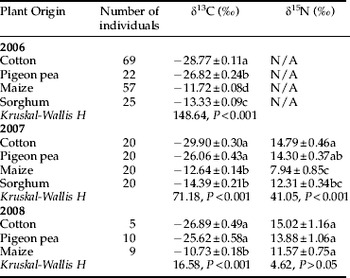
Stable isotope signatures (δ13C and δ15N) for Helicoverpa armigera moths of known host plant origin (mean ± SE). Different letters after means indicate significant differences (at P < 0.05) within a particular year.

On a separate occasion, in the summer of 2005, a smaller number of pupae of H. armigera were collected from beneath conventional cotton, pigeon pea, sunflower and maize crops near Narrabri, and the resultant moths that were reared from them were dissected into (i) heads and wings, and (ii) abdomens. These different moth parts were also analysed for stable isotope signatures (carbon only).
Stable isotope analyses of moths of unknown plant host origins
Over seven consecutive cotton growing seasons, we collected H. armigera moths, both mating and non-mating, by hand at night within 20 cotton fields from four cotton producing regions (fig. 1): at Keytah (Gwydir Valley) and Myall Downs (Macintyre Valley) in 2002–03; Drayton and Battery Hill (Namoi Valley) in 2003–04; Shangri-la (Namoi Valley) and South Callandoon (Macintyre Valley) in 2004–05; Redcamp, Taratan and Doreen (Namoi Valley) in 2005–06; Morella, Tucka Tucka and Warendi (Macintyre Valley) and Kangaloon (Namoi Valley) in 2006–07; Keytah (Gwydir Valley), Longview (Namoi Valley) and Iona (St George) in 2007–08; and Currawidgen, Havana and Taratan (Namoi Valley) and Tucka Tucka (Macintyre Valley) in 2008–09. All but one of these collections (Drayton in summer 2004) was made within Bt cotton crops. The collection at Drayton was within a conventional cotton crop, with sorghum growing nearby. The dedicated refuge crops associated with the Bt cotton crops varied; on some occasions, they were C4 plants (sorghum or maize) (e.g. Battery Hill in 2003–04, Shangri-la in 2004–05), whilst on other occasions they were pigeon pea (e.g. Taratan in 2005–06, Havana and Tucka Tucka in 2008–09) or unsprayed conventional cotton (e.g. Redcamp in 2005–06, Keytah in 2007–08) (table 3). Each collection occurred over one or two nights. Moths were collected from the top of the cotton canopy. They were located using a head-torch which caused a bright reflection from the moths' eyes. Collections began at approximately 22:00 h and continued until 03:00 h. Collectors moved along entire rows of crop (usually 0.5–1 km in length, running parallel to the edge separating the Bt cotton crop from the refuge crop) gathering the moths. Collection usually started at least ten rows from the edge of the refuge crop. At the end of this ‘first’ row, the collector returned along a new row, at least 20 rows further into the field, and so on. Occasionally, the opposite approach was taken, i.e. starting well into the Bt cotton field and moving progressively closer to the field edge. The time of collection was recorded for each moth to enable a crude measure of where moths were collected within fields. Altogether, 2887 moths, including 648 mating pairs, were collected. These moths were analysed for carbon isotopes as described above. Note, however, heads and a small part of the thorax were analysed for moths collected during 2002 to 2004 (i.e. the first four sampling occasions listed in table 3), and heads and wings thereafter.
Moths were also analysed for N isotopes using the same collections referred to above re C isotopes, but only from 2005–06 and later. We expected legumes to have a lower δ15N than non-legumes, because of their fixing of atmospheric N (Wanek & Arndt, Reference Wanek and Arndt2002; Ambika et al., Reference Ambika, Sheshshayee, Viraktamath and Udayakumar2005), and that such a difference would be passed on to larvae when feeding on the various plants.
On seven occasions (moths collected at Redcamp and Taratan in the summer of 2006, Morella in 2007, Keytah, Longview and Iona in summer of 2008, and Tucka Tucka in summer 2009, i.e. when relatively large numbers of either or both singleton moths and mating couples were collected), we compared the δ13C and δ15N values between the sexes and, for singleton vs mating moths, to determine if such factors might contribute to observed variability in the collected stable isotope data.
The various crops that occurred within the landscapes immediately surrounding the collection sites, whilst recorded, are not presented here, except for mention of the dedicated refuges (table 3). Such local variability within the nearby landscapes may have influenced the composition of the catches we made, but our collections at each site were restricted to only one or two nights within growing seasons. Moths are capable of dispersing several km per night (Fitt, Reference Fitt1989), and their emergence from different crops within landscapes can wax and wane as seasons progress (e.g. as a result of ovipositional bias by moths for flowering plants). It is, thus, quite possible that the catches we made within Bt cotton crops do not necessarily reflect crop composition per se in the immediately adjacent landscapes. To dwell on such here may serve little purpose. The actual sources of the moths we collected could well have been beyond that.
Data analyses
Statistical tests were applied using Statistix® (Analytical Software, 2000). Non-parametric tests (e.g. Kruskal-Wallis one-way ANOVA) were used where variances were too different to be adequately transformed. Otherwise, t-tests (paired or two-sample) were used to compare means. Non-random mating was assessed using multinomial tests.
Results
Stable isotope signatures of moths from known host plant origins
In 2006, δ13C varied significantly amongst moths reared from the pupae collected in soil beneath all four crops (table 1). In the other two years, the C3 and C4 plant origins were discernible amongst the moths, but differences between host plants within these two categories of plants were not demonstrated.
Differences were less clear in the case of δ15N. In 2007, moths derived from cotton had a higher δ15N than those from maize and sorghum, but this was not so in 2008 (at least not for a cotton maize comparison). Although pigeon pea is a legume, it did not lead to moths with a significantly lower δ15N than cotton (non-legume), as might have been expected.
There were no significant differences in δ13C between heads and wings vs abdomens in H. armigera that originated from cotton, pigeon pea or maize sources (table 2), but δ13C was slightly (but significantly) higher for the heads and wings of moths from sunflower compared with the δ13C measured using their abdomens. δ13C was similar between years for moths collected from pigeon pea but varied much more in moths from cotton and maize (tables 1, 2). Note, collection sites differed between years.
Stable isotope signatures (δ13C) for Helicoverpa armigera moths of known host plant origin (mean ± SE), collected near Narrabri during summer 2005.

Stable isotope signatures of moths from unknown host plant origins
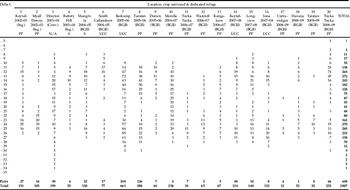
Table 3 provides the frequencies of moths collected at night at each of the 20 sites in relation to the δ13C values recorded from carbon isotope analyses. Bimodal distributions were apparent in the data sets at most sites, with the majority of moths bearing δ13C values similar to those of C3 and C4 plants (i.e. –20‰ to –35‰ and –9‰ to –16‰, respectively: O'Leary, Reference O'Leary1988; Coleman & Fry, Reference Coleman and Fry1991; Ambika et al., Reference Ambika, Sheshshayee, Viraktamath and Udayakumar2005; data in tables 1, 2), especially where large numbers of moths were collected. A notable exception occurred at Drayton, where two peaks in the data were not obvious. Overall, slightly more moths seemed to have originated from C4 compared with C3 host plants.
Frequency of Helicoverpa armigera moths with different δ13C values collected at night over cotton fields (Conv., conventional; Ing., Ingard®; or BGII, Bollgard II®) at 20 sites in northern NSW and southern Qld. Dedicated refuge crops were either sorghum (S), maize (M), pigeon pea (PP) or unsprayed, conventional cotton UCC).

N/A, not applicable.
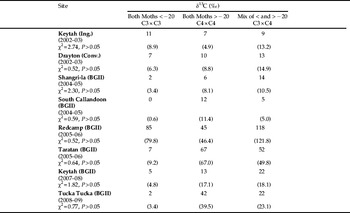
Based on what seems a reasonable assumption, that a δ13C value of <–20‰ is indicative of a moth arising from a C3 host plant and a δ13C ≥ –20‰ is indicative of a moth resulting from a C4 host plant (–20‰ was the least frequent value recorded between the overall bimodal peaks in table 3), table 4 indicates the observed frequencies of matings between moths (i) where both were of C3 origin, (ii) where both were of C4 origin, and (iii) where one moth was of C3 origin and the other of C4 origin, for each of eight collections in cotton fields, where the numbers of mating moths were large enough to warrant such calculations. Expected occurrences of such matings were generated from the total captures (mating and single moths) in each field, again taking a δ13C of –20‰ as the discriminating value. The results of multinomial tests are included in table 4. In all cases, the frequencies of the observed mating combinations were not significantly different from what would have been expected if mating occurred at random.
Observed incidence of pairs of mating Helicoverpa armigera moths with different δ13C values, collected at night over cotton fields (Conventional, Ingard® or Bollgard II®) at eight sites in northern NSW and southern Qld. Multinomial test results are included. Expected values (based on frequencies of moths with δ13Cs < or >–20‰) are included in parentheses.

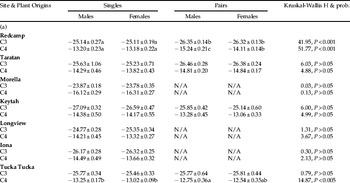
Small, but significant, differences were detected between the δ13C values for singleton and mating moths, and between males and females, at some sites (at Redcamp in summer 2006 and Tucka Tucka in summer 2009) (table 5a). Reasons for these differences are not known, but their scale was trivial compared with those displayed between moths of C3 and C4 plant host origins (tables 1, 5).
(a) Mean δ13C (±SE) (‰) for Helicoverpa armigera moths from C3 and C4 host plant origins, caught over Bt cotton at Redcamp, Taratan, Keytah and Tucka Tucka in the summers of 2006, 2006, 2007 and 2009, respectively. Different letters after means indicate significant differences (at P < 0.05) within moths of C3 or C4 origins at each site. (b) Similar for mean δ15N (±SE) (‰). Collections not separated into moths of C3 and C4 origins. N/A, too few individuals to calculate meaningful means.

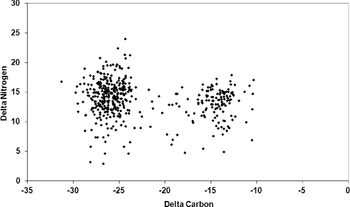
In general, calculations of δ15N led to no further separation of moths into groups that might potentially have different host plant origins. Figure 2 illustrates the type of bi-plot that resulted from assessing both δ13C and δ15N from individual moths at most sites (in this case, Redcamp in summer 2006). There were no significant differences in δ15N between the sexes of H. armigera at Redcamp (table 5b) nor at any of the other six sites at which they were compared. In most cases, no differences were detected between singleton and mating moths, the exception being Taratan where δ15N was lower for singletons (reasons unknown). The average δ15N values for the total moths at all individual sites varied from 9.20‰ (at Kangaloon) to 13.78‰ (at Redcamp). Moths with δ15N > 20‰ were rarely obtained. Curiously, there were differences in δ15N between males of H. armigera from C3 and C4 plant origins at some sites, e.g. Redcamp (C3 = 14.35 ± 0.25, C4 = 12.80 ± 0.40; t = 3.26, P < 0.005) and, likewise, females from C3 and C4 origins (C3 = 13.94 ± 0.24, C4 = 12.93 ± 0.27; t = 2.58, P < 0.05), but such differences were only ever small.
Bi-plot of stable carbon and nitrogen isotope analyses (δ13C & δ15N (‰)) of H. armigera moths collected within a Bt cotton crop at Redcamp in summer 2006. Mating pairs and singletons are pooled in this case.

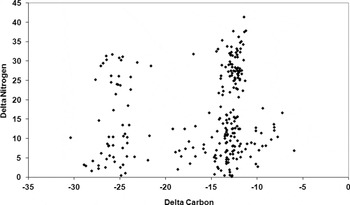
However, the moths at one site, Tucka Tucka in summer 2009 (fig. 3), differed from all other sites in that they, in particular those with a δ13C typical of C4 plants, were quite obviously differentiated into two distinct δ15N sub-groups (separated at approximately δ15N = 20‰). When the C4 origin moths from Tucka Tucka were split into high (H) and low (L) δ15N traits (at >20‰ and < 20‰, respectively), there were 70 individuals classed as the former and 121 individuals classed as the latter. Of the 42 pairs of moths included amongst these individuals, there were ten H × H matings, 12 L × L matings, and 20 H × L matings. This was not significantly different from what would be expected at random (multinomial test: = 4.78, P > 0.05; where expected numbers were 5.64, 16.86 and 19.50 for H × H, L × L and H × L matings, respectively, based on all moths collected – i.e. pairs and singletons). Given that no significant differences were detected in δ15N between the males and females of H. armigera, nor singleton and mating moths, at Tucka Tucka the groupings depicted in fig. 3 cannot be explained by sex or mating status differences amongst the moths.
Bi-plot of stable carbon and nitrogen isotope analyses (δ13C & δ15N (‰)) of H. armigera moths collected within a Bt cotton crop at Tucka Tucka in summer 2009. Mating pairs and singletons are pooled in this case.

On most occasions, there was no convincing pattern in the δ13C and δ15N values related to time of collection (and hence distance from the refuge crop). However, at Redcamp in summer 2006, all the moths collected between 00:37 h and 01:15 h (and nearest to the edge of the Bt cotton crop) had C3 signatures; but those collected earlier, between 10:25 h and 00:21 h (and further into the Bt crop) had a mix of C3 and C4 signatures (53% and 47%, respectively).
Discussion
Overall, 53% of the moths collected within cotton crops had δ13C signatures suggestive of C4 plant origins (i.e. δ13C > –20‰). This perhaps suggests that unstructured refuges can be very influential in producing Bt susceptible moths on cotton landscapes. However, on some occasions when moth collections were made, C4 plants were being grown as the dedicated refuge associated with the Bt cotton crop being studied (e.g. sorghum, prior to it being removed as a recognised refuge option). Care, therefore, needs to be taken when referring to what was the unstructured refuge at the time in question, although C4 plant refuges were only ever a minority at best (<7%) of the choices made by farmers (Downes et al., Reference Downes, Mahon, Rossiter, Kauter, Leven, Fitt and Baker2010b). However, we recorded several instances where a large percentage of the moth population captured over the cotton crop was of C4 origin(s), yet the dedicated refuge crop was pigeon pea or unsprayed, conventional cotton. For example, one of these was at Tucka Tucka in 2008–09, where 77% of the moths captured in the Bt cotton crop were C4. Such moths must have come from elsewhere in the landscape besides the dedicated (pigeon pea) refuge. Indeed, that year much more sorghum than cotton was grown in the local Namoi Valley (88,449 ha cf. 22,621 ha: Australian Bureau Statistics, 2011), i.e. as a crop in its own right. Another example was Taratan (also in the Namoi Valley) in 2005–06, where 73% of the moths captured in the Bt cotton crop were C4. In this case, the dedicated refuge was again pigeon pea; but a maize crop (non-refuge), 1 km from the Bt crop, had large numbers of Helicoverpa larvae on it in the weeks prior to collecting the moths in the Bt cotton. That maize crop may well have been a source of the captured moths. In 2005–06, the areas used for sorghum, maize and cotton production in the Namoi Valley were 136,491, 5896 and 65,327 ha, respectively (Australian Bureau Statistics, 2011).
On the other hand, 47% of the moths captured over cotton had δ13C signatures suggestive of C3 plant origins. All but one of these cotton crops used for collections was Bt cotton (the exception being the conventional cotton field used at Drayton in 2003–04). Helicoverpa larvae and pupae are usually rare in Bt cotton crops (Baker et al., Reference Baker, Tann and Fitt2007), although they can occasionally survive there in small numbers (Downes et al., Reference Downes, Mahon, Rossiter, Kauter, Leven, Fitt and Baker2010b). It seems, therefore, unlikely that many of the moths caught at these sites, with C3 signatures, originated from the Bt crops themselves. Redcamp (2005–06, Namoi Valley), for example, had crops of sorghum, maize, sunflowers and unsprayed conventional cotton nearby (the latter being the dedicated refuge), which did have large numbers of Helicoverpa larvae on them in advance of the moth collections. These crops could well have provided the moths of both C3 and C4 origin caught within the Bollgard II® cotton crop at Redcamp.
A core assumption of the RMP for Bt cotton is that mating between H. armigera individuals is random, i.e. irrespective of their host plant origin. In particular, moths generated from refuge crops and Bt cotton should mate with each other. The work reported here supports the RMP assumption by suggesting that mating between moths from separate plant sources (and within Bt cotton crops) is indeed common, and likely to occur at random. However, Li et al. (2005) have suggested differential mating, according to host plant origin, can occur in H. armigera, based on laboratory studies. Whether or not the production and/or fitness of H. armigera offspring might vary according to the host plant origins of their parent moths, in particular, where mixed origin matings occur, is, however, unknown.
The precise locations of the mating moths we collected in the Bt crops were not recorded. Nevertheless, by recording the time of collection for each moth, we had a crude surrogate for its distance from the dedicated refuge crop. At least for the 2006 collections at Redcamp, δ13C values of moths varied spatially (but no similar variation was seen for δ15N). It seems most likely that the observed predominance of C3 origin moths near the edge of the Bt cotton crop at Redcamp simply reflected a high output from a well-functioning conventional cotton refuge crop at the time of our collection. Approximately ten days prior to this moth collection, the refuge crop was very heavily infested with Helicoverpa larvae. Further into the Bt cotton crop, we presumably moved into the range of other (C4) sources of moths. Note also, we collected mating moths near the edge of the field at approximately 3.5 times the rate (132 pairs in 38 mins) compared with further away (116 pairs in 119 mins). In future surveys, it would be useful to gather more spatially explicit data on the abundance of moths with different stable isotope signatures within Bt cotton fields. This should better indicate the efficacy of coverage of cotton crops by moths from different host sources.
Refuge crops are highly variable in their production of moths (Baker et al., Reference Baker, Tann and Fitt2007). The success of the refuge strategy will be measured more by the collective production of refuges within landscapes than by pairwise comparisons of individual Bt crops and their dedicated refuges per se. Spatial patterns in the locations of refuges within landscapes and factors influencing moth dispersal (e.g. wind) will very probably influence the efficiency with which refuge crops provide coverage of Bt cotton crops. A complementary study of such efficiency of refuges at landscape scale (cotton production valley) will be published separately.
The moths we collected had δ13C values which varied between sites, as did the moths we reared from pupae collected under specific crops. Reasons for this variability remain unknown but seem more likely to have been due to variability between the sites of origin rather than differences in the degree of adult feeding. If the latter were to be important, more variability in δ13C within samples taken from abdomens cf heads and wings might have been expected than proved to be the case.
This study ignored how many times the collected moths had mated. Helicoverpa moths are known to mate several times. Baker et al. (Reference Baker, Tann and Fitt2011) reported that female H. armigera moths, when collected in light traps in the Namoi Valley, contained up to six spermatophores, and 45% of mated moths had mated more than once. H. armigera moths mate first at about three days old and peak in oviposition at seven days, but the timings of the later matings, the locations of all matings relative to the crop origins of the moths and their contributions to overall egg production are poorly understood. Sperm precedence is known to occur in some Lepidoptera (Bissoondath & Wiklund, Reference Bissoondath and Wiklund1997; Higginson et al., Reference Higginson, Morin, Nyboer, Biggs, Tabashnik and Carrière2005), but the influence of mating order on the paternity of offspring varies considerably between species. When endeavouring to manage Bt resistance and, in particular, ensuring that matings between moths from refuges and Bt crops are effective, it is desirable to understand if the order of mating affects sperm precedence and, if so, when and where it is likely to occur. Recent studies with females mated sequentially to two different males (S. Downes, personal communication) suggest that sperm precedence can occur in H. armigera, but there is no consistent advantage that relates to the order in which mating occurs. That result suggests that sperm precedence according to mating order might impede Bt resistance management, but only partially.
Stable C isotope analyses were not sensitive enough to separate host plant origins within C3 and C4 categories (e.g. cotton from pigeon pea or maize from sorghum) (see also Abney et al., Reference Abney, Sorenson, Gould and Bradley2007 for difficulties re C3 host plant origins for H. virescens). We did hope, however, that also measuring δ15N for H. armigera moths might assist with further sensitivity in host plant identification. In particular, we expected that legumes might be differentiated from non-legumes (especially the C3 plants, pigeon pea and cotton), due to differences in their levels of atmospheric N fixation. But, in general, this proved not to be the case. Perhaps pigeon pea was a poor N fixer, or the common practice of gassing N into cotton production soils masked any plant host differences that might otherwise have been identified. On one occasion (Tucka Tucka, summer 2009), δ15N analysis did separate moths of C4 origin into two sub-groups, which appeared to be mating at random, but the host plants (or perhaps sites with different N fertiliser regimes) these sub-groups represented, remain unknown. A more reliable chemical discriminator to help distinguish origins within both C3 and C4 moths is still required. This would be particularly useful if it could separate moths from cotton and pigeon pea origins, thus refining our understanding of the relative contributions of these important crops to the landscape-scale dynamics of H. armigera. One possibility is to measure the content of the plant secondary metabolite, gossypol, in the moths as a discriminator of cotton origins, as done by Orth et al. (Reference Orth, Head and Mierkowski2007) for Heliothis virescens in the USA and Brévault et al. (Reference Brévault, Nibouche, Achaleke and Carrière2012) for H. armigera in West Africa.
Acknowledgements
This research was funded by the Cotton Research and Development Corporation. We especially thank Ms Leanne Lisle, University of New England, for analysing the moths for carbon isotopes, Caitlin Johns, Donna Jones, Judy Nobilo, Julia Penner, Karen Stanford and Ruth Williams for assistance with night catches, and Gary Fitt and Peter Gregg for advice along the way.