INTRODUCTION
Improving palliative and end-of-life care has received increased attention within the last several years (Smedley et al., 2002; Ferrell et al., 2005). The World Health Organization (Stjernsward et al., 1996) defined palliative care as the active, total care of patients whose disease is not responsive to curative treatment, including control of pain, other symptoms, and psychological, social, and spiritual problems. Generally speaking, palliative care involves improving quality of life as well as quality of dying.
The decision to provide palliative care is often complex and involves a high degree of physician discretion (Christakis & Iwashyna, 1998; Fetters et al., 2001). As cited by the Agency for Healthcare Research and Quality (Kass-Bartelmes & Hughes, 2004), patients who talk about their preferences for end-of-life care with their physician and family members feel less anxiety, feel more involved in their medical decision making, and perceive their physician as having a better understanding of their needs (Daaleman & VandeCreek, 2000; Ditto et al., 2001). However, research indicates that many terminally ill patients are not participating fully in advance care planning and sometimes receive care that is inconsistent with their preferences (Haidet et al., 1998; Happ et al., 2002). For example, Coppola et al. (2001) reported that physicians were only 65% accurate in predicting patient preferences even after reviewing the patient's advance directive. Provision of end-of-life care requires skills and knowledge in a variety of domains, including collaborative decision making, communication, and psychosocial factors that can impact a terminal patient's care preferences (von Gunten et al., 2000, 2003).
Despite this recognition of the need to improve the quality of care at the end of life, as well as the important role physicians play in decision making, physicians' beliefs and practices related to end-of-life care remain underinvestigated. The purpose of this study was to describe physicians' end-of-life training and practices and perceptions regarding end-of-life care and characterize any differences based on selected physician characteristics, including specialty (oncology, cardiology, primary care) and geography. An additional goal was to illuminate physicians' perceptions about differences among their African-American and Caucasian patients' preferences for end-of-life care.
BACKGROUND
Several characteristics may impact physician's beliefs and practices at the end of life. Those might include age, gender, race, specialty, and geographic location.
Physician Specialty Differences and End-of-Life Care
The majority of research on physicians' approach to palliative care has focused on oncologists, likely due to the fact that cancer patients typically experience a more predictable prognostic trajectory than other patients with serious illness (Teno et al., 2001) such as congestive heart failure (Levenson et al., 2000). The National Comprehensive Cancer Network (2004) recently published multidisciplinary clinical practice guidelines in oncology. However, despite the depth of experience in end-of-life care and the recognition of their role in the provision of palliative care, discrepancies exist in medical oncologists' beliefs and practice regarding end-of-life care. Cherny and Catane (2003) found that although 88.4% of responding medical oncologists stated that they should coordinate care among cancer patients at all disease stages, only 43% of respondents commonly coordinate such care and less than 50% collaborate with supportive/palliative care clinicians. In an observational study of patient/physician communication, Detmar et al. (2001) found that oncologists spent less than one-quarter of their time discussing quality-of-life issues that appeared to be most important to their terminally ill patients. Although oncologists appear to be most closely connected with patients suffering from a prolonged and progressive terminal illness, there appears to be incongruence between what oncologists' role “should” be and what actually transpires.
Unlike oncologists, who have been the primary focus of palliative care initiatives, cardiologists have been less represented in research about physician practices at end of life. Congestive heart failure (CHF) is one of the leading causes of death in the United States (National Center for Health Statistics, 2003) but until recently, has not gained attention in the palliative care literature (Mehta et al., 2001). In a British study of patients with terminal cancer, chronic respiratory failure, or end-stage cardiac disease, Exley et al. (2005) found those living with cardiorespiratory disease were less likely to be aware that they were dying and receive other information regarding end-of-life care than cancer patients. An unpredictable illness trajectory (Levenson et al., 2000) and need for cross-specialty care (Hanratty et al., 2002) have been cited to account for the unmet needs of these patients at the end of life. Additionally, end-of-life care topics are underrepresented in cardiology journals (Mehta et al., 2001). Basta (2004) recently suggested that technological advances in cardiology have “fragmented” the discipline into well-defined procedure specialties, such as transplantation and electrophysiology, that emphasize technical achievements and undermine patients' desire to address comprehensive psychosocial and palliative care needs. However, it appears that despite the low rate of actual end-of-life communication, many practitioners acknowledge an increased need for palliative care services targeting end-stage heart failure patients (David et al., 2002; Goodlin et al., 2004). Although there has recently been an increased awareness of the needs for palliative care of patients in the terminal phase of heart failure, as the diagnosis produces high levels of distress and difficult symptoms (Levenson et al., 2000), it remains unclear how cardiologists view the role of palliative care with their patients and whether these differ from other specialties.
Some clinician–researchers have argued that primary care physicians would be most appropriately positioned to lead multidisciplinary care of patients with heart failure (Gottlieb, 2003) and other terminal illness, particularly in rural areas (Evans et al., 2003). Steinmetz et al. (1993) found that primary care physicians reported that the care of dying patients is an important component of their practice and desired more extensive training in end-of-life care. Some residency training programs have successfully integrated palliative care and primary care education (von Gunten et al., 2003). Nevertheless, others argue that the trajectory and symptoms of some terminal diseases are more appropriately managed by a specialist (Hanratty et al., 2002; Wotton et al., 2005).
Race Differences and End-of-Life Care
Along with specialty differences, studies have suggested that the race of the physician and the patient can have an impact on physician behavior and the delivery of health care (Ashton et al., 2003).
For example, studies have reported a correlation between race of patient and the likelihood of receiving lung cancer surgery (Bach et al., 1999, 2002). The results of the Study to Understand Prognoses and Preferences for Outcomes and Risks of Treatment (SUPPPORT) indicated that African-American patients were less likely to have discussions with their physicians regarding do-not-resuscitate orders than patients of other races (Borum et al., 2000). Bach et al. (1999) found that lower survival rates among African-American patients with early-stage non-small-cell lung cancer, as compared with White patients, were largely accounted for by the lower rate of surgical treatment among patients with CHF (Auerbach et al., 2000). Similarly, van Ryn and Burke (2000) reported that African-American patients with coronary artery disease were more likely to be perceived to be at risk for noncompliance and substance abuse and viewed as less intelligent than Caucasian patients. African-American patients have been reported to die more frequently as inpatients and have much higher end-of-life costs than Caucasian patients (Hogan et al., 2001; Flory et al., 2004). However, inconsistencies exist in the literature regarding the role of race in patient–physician communication at the end of life. For example, Goldstein et al. (2005) recently reported that physicians were more likely to have discussions about prognosis with their non-White and lower income terminally ill patients than their White and wealthier counterparts.
Race of physician, although not as extensively studied as patient race, has been documented to impact end-of-life decision making. Mebane et al. (1999) found that Caucasian physicians more often believed that tube feeding in terminally ill patients was “heroic” than African-American physicians. Additionally, Caucasian physicians were more likely than African-American physicians to consider physician-assisted suicide an acceptable treatment alternative. Further, although the majority of physicians would not want to receive aggressive treatment in response to irreversible brain damage, significantly more African-American physicians would choose aggressive treatment than Caucasian physicians. These findings underscore the importance of the examination of physicians' attitudes towards end-of-life care.
Geography and End-of-Life Care
Location of physician is another, yet less studied, characteristic that may impact palliative care processes of care. Evans et al. (2003) conducted a literature review of the influence of urban versus rural practice location. Important observations about barriers for primary care professionals practicing in a rural area included difficulty in obtaining further relevant training, difficulty in symptom control for their patients, and poorer access to psychological and specialty care services. Recently, Bach et al. (2004) found that most black patients were treated by a small group of physicians who were less well trained and had less access to clinical resources than physicians treating White patients. Physicians who typically treated African-American patients were located in areas, including rural areas, that made it difficult to provide access to high-quality subspecialists, diagnostic imaging, and other quality ancillary services. Geographic location, in combination with differences in specialty and race, could have significant impact on physician attitudes and behavior in end-of-life care.
Age Differences and End-of-Life Care
Research findings regarding the impact of physician age have been mixed. Some studies have reported age- or experience-related differences in processes of care such as specialty referral patterns (Chan & Austin, 2003). Other studies have reported no differences (Preisser et al., 1998; Gross et al., 2003). In one of the few studies describing the relationship of age of physician with end-of-life care practice, Wilson et al. (1997) surveyed seriously ill patients and their intern and attending staff physicians. Specifically, physicians were questioned about their patients' preferences for cardiopulmonary resuscitation and current quality of life. Although attending physicians had more years of experience and expressed more certainty regarding their knowledge of their patients' preferences, both interns' and attendings' perceptions were only moderately related to the patients' actual preferences. Although physician age has not been demonstrated to be a particularly robust factor in processes of care, these results underscore that physician–patient communication patterns can be improved, even among those with extensive experience.
Physician Gender Differences and End-of-Life Care
Physician gender has been linked to a variety of outcomes, including communication style, patient satisfaction, and adherence to clinical recommendations (Stewart, 1996). Bertakis et al. (2003) videotaped medical encounters of both male and female primary care physicians and found that female physicians spent significantly more time on preventive services and counseling than male physicians. Additionally, patients of female physicians reported being more satisfied than were those of male physicians, even after adjusting for patient characteristics, visit length, and practice style behaviors. In a meta-analytic review of physician gender effects in medical communication, Roter et al. (2003) indicated that, overall, female primary care physicians engage in more patient-centered communication. The authors concluded that a patient-centered communication style “inspires patient reciprocation and is likely to reflect a more intimate therapeutic milieu of heightened engagement, comfort, and partnership.” However, it should be noted that most studies evaluating the impact of physician gender on medical encounters are based on small samples sizes with limited studies outside of primary care. It is currently unclear how physician gender might impact the provision and discussion of end-of-life care within the palliative setting.
METHODS
Participants and Recruitment
A data set of physicians practicing in South Carolina was obtained from the South Carolina Medical Board of Examiners. A convenience sample of internal medicine, family practice, oncology, and cardiology physicians, who were either Caucasian or African-American, were recruited. Participants were sought from five geographic regions of South Carolina to obtain a rural and urban distribution. The database was stratified first by ethnicity (African-American/Caucasian), then by geographic region (rural/urban), and then by specialty (internal medicine/family practice, cardiology, oncology). Because the frequency distribution by specialty and geography of African-American physicians was limited, random sampling was not feasible. Physician's offices were contacted to confirm that he/she was a practicing physician. Once this was established, a letter describing key elements of the research study was mailed to potential physician participants. One week to 10 days later, one of the project investigators, a physician, contacted each potential participant, asked if the letter was received, answered questions, and confirmed interest and willingness to participate. If the physician agreed, he/she was mailed a packet of information regarding the interview process. One week later, a race-matched interviewer contacted the physician and scheduled the interview. Interviewers were a master's prepared social worker and nutritionist, each with extensive clinical experience with chronically ill patients (hospital and nursing home environments). Interviews typically lasted 20 min to 1 h depending on the number of comments made by the physician. Physicians received a $100 honorarium for their time.
A number of physicians also identified patients for a larger project evaluating patient perceptions and experiences related to physician–patient communication (DesHarnais et al., 2005; Zapka et al., in press).
Instrument Development and Measures
Interview questions assessed physicians' characteristics and communication and processes of care at the end of life. A final version was created after the interview was pretested on four internal medicine physicians (two African-American, two Caucasian).
The content of the interview included the following topics: formal training experiences in palliative care, processes for developing treatment plans, relationships with hospice, attitudes toward discussing religious and spiritual influences regarding treatment preferences, and perceived differences in end-of-life preferences between African-American and Caucasian patients including pain management. Questions consisted of quantitative and qualitative items that allowed for more in-depth responses. For all open-ended items, interviewers recorded each participant's narrative response. Specific items and response format are described below.
Training and Practice
Physicians were asked if they had received any “formal training in end-of-life issues, including courses in pain management, symptom management, or palliative care.” Physicians who answered affirmatively typically volunteered the sources of their training experiences. Physicians were also asked to describe how they go about developing treatment plans for their terminally ill patients.
Interviewers asked several questions regarding hospice. Specifically, participants were questioned as to whether there was a hospice in the physician's geographical region, and if so, did the participant have a working relationship with that hospice. Physicians who endorsed a working relationship with a local hospice were asked to indicate how many patients he/she referred to hospice per year. Physicians were asked whether there were any reasons why they would not recommend hospice for one of their patients. A follow-up question asked these physicians to describe the reasons for their decision to not recommend hospice.
Physicians were asked to describe any personal experiences that had influenced their attitudes toward end-of-life decision making for their patients, including training, religion, and family. Physicians were asked to indicate the frequency with which they discussed the patient's religious or spiritual influences regarding treatment preferences. Response choices were “always,” “sometimes,” and “never.” The majority of participants volunteered qualitative comments to this item.
Perceived Differences in Preferences for End-of-Life Care
Interviewers questioned participants about their perceived differences among their Caucasian and African-American patients' preferences for end-of-life care. Specifically, physicians were asked, “In general, have you observed any differences in preferences for various end-of-life care options between your African-American and Caucasian patients?” Those physicians who answered affirmatively were asked to describe those perceived differences. In addition, physicians were asked how they account for those differences and why they believe the differences exist.
In addition to perceived differences regarding patients' general preferences for end-of-life care, physicians were asked if they had “observed differences in preferences for pain management between African-American and Caucasian patients?” Physicians who indicated “yes” were then asked to describe the differences they had observed.
Data Collection and Management
Interviews were conducted by an interviewer racially matched with the physician. Shortly after the interview, the information reported on the source interview document was transcribed onto a case report form (CRF) version of the instrument. The CRF was specifically formatted to aid in the electronic capture of the data and reflected the exact content of the source document. To assess the accuracy of data reported on the CRF, a study investigator performed source document verification comparing the data transfer from all source documents to CRFs. Each CRF was reviewed prior to data entry for data consistency and then independently double-keyed entered into the research database. If data inconsistencies were identified as a result of the data management process, queries were resolved by comparing the CRF data with the source document by one of the investigators. To assess the precision of the data management process, a random sample of 20% of the CRFs was selected for CRF to database verification. Once all data management verification was complete, the database was locked and translated into SAS data files for analysis.
Analysis
Univariate frequencies were computed, followed by group comparisons across race, geographic setting, and specialty. Descriptive statistics comparing percentages and group differences were assessed using chi-square and Fisher's exact tests. If the percentage of cells was small then Fisher's exact test was used to report the observed level of statistical significance; otherwise, the p value for Pearson's chi square statistic is reported.
The responses to the several open-ended question responses were categorized by a coder and then verified by a second coder. The coders examined responses for key words and statements that captured respondents' perceptions of specific end-of-life issues. This process led to a gradual definition of themes. The two coders compared their findings and resolved any divergent coding. This modest qualitative synthesis offers illustrative examples of the physicians' comments.
FINDINGS
Nonrespondent/Respondent Analyses
Of the 160 physicians initially identified as eligible, 11 (6.9%) were not reached for further verification of eligibility and 69 (43.1%) consented to participate in the study. The remaining 80 physicians did not consent to participate. Reasons for not participating include open refusals (n = 33) as well as screening failures (n = 47). Reasons for not participating differed by specialty. Significantly more cardiologists openly declined (n = 14, 63.6%) to participate in the project than did primary care (n = 16, 32.6%) and oncology physicians (n = 3, 33.3%) (chi-square = 6.28, degrees of freedom (df) = 2, p = .043). Differences in the rate of consent were found by location. A higher percentage of rural physicians (n = 29, 56.9%) consented to participate in the study than did urban physicians (n = 40, 36.7%) (chi-square = 5.76, df = 1, p = .016). Differences were also found for specialty. Primary care (n = 37, 60.7%) and oncology physicians (n = 16, 84.2%) were significantly more likely to participate than cardiologists (n = 16, 48.5%) (chi-square = 6.48, df = 2, p = 0.039).
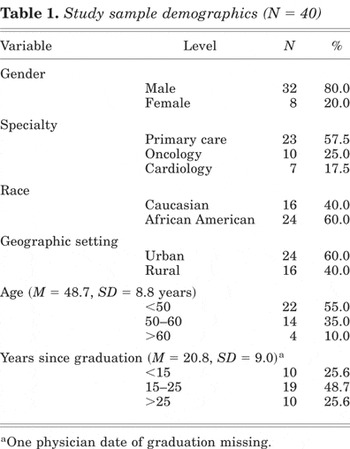
The characteristics for the 40 physicians participating in the interview are reported in Table 1. The majority of participants were male. Of the 23 primary care physicians, 16 (69.6%) were family practice and 7 (30.4%) were internal medicine physicians. A greater proportion of the sample are primary care physicians, African-American, and from urban areas.
Study sample demographics (N = 40)

End-of-life Training and Practice
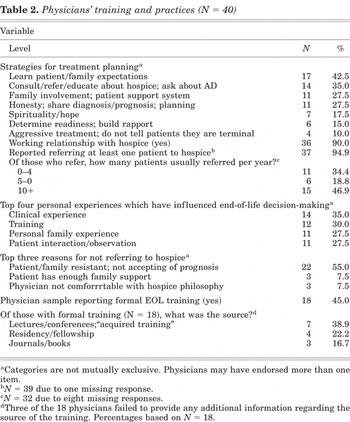
With respect to physicians' reports of formal training, 45.0% (18/40) indicated that they had received some formal training in end-of-life care, including courses or training in pain, symptom management, or palliative care. There were no statistically significant differences for formal training in end-of-life care by race, specialty, or location of physician. Out of the 18 physicians who reported formal training, 38.9% (n = 7) of those indicated that they had received training through lectures/conferences and “acquired training” through their job.
When asked about how they go about developing treatment plans for their terminally ill patients, 42.5% (n = 17) indicated that they are guided by their patient's and the patient's family's input. For example, comments made by physicians included “I investigate who in the family has knowledge of what's going on with the patient and get them involved,” “I talk openly and honestly with patients about what they want and get family involved at an early point.” About a third of the respondents made some reference to hospice and advance directives, educating patients about options, and offering consultation. Many offered comments about building trust, being honest, and encouraging hope and spiritual perspective. Three physicians, representing each specialty, location, and race category, indicated they advocated aggressive treatment or did not tell their patients they were terminal.
The vast majority (n = 36, 90%) responded that they had a working relationship with hospice. Significantly more oncologists and primary care physicians had working relationships with hospice than did cardiologists (Fisher's exact, p = .015). Almost 95% of physicians reported that they had referred at least one patient to hospice care during the course of their practice. Frequencies of referrals per year are presented in Table 2. Urban physicians referred their patients to hospice significantly more than rural physicians (Fisher's exact, p = .018). In addition, Caucasian physicians referred more often than African-American physicians (Fisher's exact, p = .015). The most commonly reported reason for not recommending hospice was patient's reluctance to accept diagnosis or resistance from family members. Fifty-five percent (22/40) of physicians endorsed this item, and very few physicians (less than 3) endorsed other reasons, including reservations of level of care provided by hospice, aggressive treatment in progress, and financial issues.
Physicians' training and practices (N = 40)

Physicians' reports of “what personal experiences have influenced their attitudes toward end of life decision-making” are also presented in Table 2. Although approximately a third of respondents note their training as influential, clinical and personal experience is clearly important. Several physicians recounted their own painful experiences with their own dying family members whose quality of life issues were not addressed by their doctors. They noted that these personal family experiences profoundly influenced their own clinical perspectives regarding end-of-life care with their patients. Responses did not significantly differ across race, specialty, or location of physician.
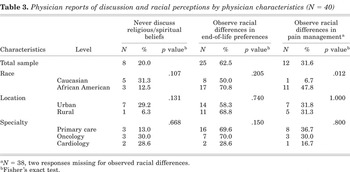
Eighty percent of physicians indicated that they “always” or “sometimes” discuss their patients' religious or spiritual influences regarding treatment preferences. There were no significant differences for race, specialty, or location of physician, though there were some marginally significant differences among groups, as noted in Table 3. More Caucasian and urban physicians responded that they “Never” discuss religion or spirituality with their patients than their African-American or rural counterparts. Many physicians volunteered comments that they “will discuss spiritual issues only if the patient brings it up.” Despite this, physicians indicated that religion and spirituality do influence their patients' beliefs about death and can impact discussions regarding quality of life and beliefs about death. Physicians also noted that they remain open in order to facilitate the “permission” of patients and their families to discuss their beliefs as they relate to the end of life, though some do not see this as part of their role as physician. Some examples: “I always open the door to permit communication about religion … makes for a better patient/physician relationship,” “Never disregard patient's spirituality … piggybacks on patient's beliefs to help explain disease state and medical limitations, physician's job is to provide patient with as much information as possible and permit the patient to make his own informed decision.” However, a few do not see this as part of their role, for example, “Never initiate, if patient does, (I) refer out,” “(I) am a ‘hands-off’ consultant.”
Physician reports of discussion and racial perceptions by physician characteristics (N = 40)

Perceived Racial Differences in Preferences for End-of-Life Care
Over 62% of physicians indicated they have observed differences in preferences for end-of-life care options between their African-American and Caucasian patients. Column 3 in Table 3 reports this reported observation by physician race, specialty, and location. Primary care (n = 16, 69.6%) and oncology physicians (n = 7, 70.0%) were significantly more likely to perceive differences than were cardiologists (n = 2, 28.6%; Fisher's exact, p = .150). There were no significant differences in perceptions according to location and race of physician.
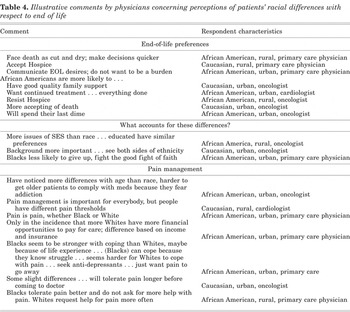
Physicians who reported that they have observed differences in patients' preferences were asked to describe those differences. Illustrative comments of qualitative data are presented in Table 4. The most commonly reported differences included the perceptions that Caucasian patients “accept hospice more readily and communicate end-of-life preferences more openly.” African-American patients are reportedly more likely to “want to continue treatment, resist hospice, have family support and involvement, and prefer to be at home.” Although these perceptions regarding African-American patients were reported by both races, they were more common among African-American physicians (Fisher's exact, p = .006).
Illustrative comments by physicians concerning perceptions of patients' racial differences with respect to end of life

When asked what accounted for perceived differences, physicians identified dissimilar experiences with access to and knowledge of health care options as well as spiritual/religious differences. Several physicians voluntarily indicated that these differences stemmed from disparity in socioeconomic, educational, and geographical factors rather than race. For example, one African-American oncologist commented that differences were more “an issue of SES [socioeconomic status] than race; … educated [patients] have similar preferences.”
Perceived Differences in Preferences for Pain Management
In addition to observations about general preference differences, physicians were asked specifically if they have observed differences in preferences for pain management among their African-American and Caucasian patients. Thirty-one percent of physicians indicated they have observed differences in preferences for pain management between their African-American and Caucasian patients. The majority of those physicians reporting perceived differences were African-American (Fisher's exact, p = .012). See Table 3, Column 4, for reported differences by race, specialty, and location. Physicians did not significantly differ by specialty or location regarding their perceptions for differences in pain management between their Caucasian and African-American patients.
Illustrative qualitative comments regarding the types of differences perceived are reported in Table 4. Reported differences included the perception that African-American patients are “less likely to request pain meds, are more stoic, and less focused on comfort.” However, it should be noted that several physicians voluntarily commented that their perceived differences in pain management preferences were more often confounded by other factors. For example, age and financial capability were important rather than race. “I have noticed more differences with age than race…. It's harder to get older patients to comply with medication because they fear addiction” was stated by one African-American oncologist.
DISCUSSION
The role of primary care and specialty physicians in improving quality of care at the end of life is pivotal. Results of the present study do indicate racial and specialty differences among physicians regarding end-of-life care experience and practice and suggest differences in physicians' perceptions of end-of-life care preferences of their terminally ill African-American and Caucasian patients. Additionally, this study exemplified the difficulties in recruiting physicians to assess their end-of-life practices.
Several findings are consistent with previous research. In our sample, cardiologists report different experiences than their oncology and primary care colleagues in end-of-life care. Although increased attention has been given to the role of palliative care in cardiology patients (Gottlieb, 2003), previous studies also indicate that cardiology journals publish fewer articles on end-of-life care than other medical journals or the lay press (Mehta et al., 2001). Perhaps this reflects the emphasis on other important invasive and medical options in cardiology in comparison to palliative care, but results in lower exposure levels and avenues for continued medical education.
Additionally, the current study found that providers believe that African-American patients have preferences regarding end-of-life care that are different from the preferences of their Caucasian patients, which parallels previous studies. Interestingly, primary care providers and oncologists, who traditionally have more palliative care experience than cardiologists, perceived more racial differences in certain aspects of their patients' needs for pain and symptom control. This finding is intriguing, as it may suggest that these differences have been shaped, at least in part, by professional experience and the physician's own role perception.
The end-of-life trajectory for patients with terminal cancer differs from that of patients with end-stage heart failure (HF) (Gottlieb, 2003). Physicians in general may be more willing to discuss end-of-life issues with cancer patients than with HF patients, because the expected decline in function leading to death is more predictable with cancer patients. Many physicians also report difficulty shifting from a focus on cure to providing maximal comfort care when cure is no longer possible. Communication focused on advance care planning, including referral to hospice, may not follow until the physician has accepted the inevitability of death for the patient with end-stage HF. In a Swedish study evaluating the transition from curative treatment to palliative care, 76% of nurses reported that they should have more involvement in end-of-life discussions with patients (Lofmark et al., 2005). Perhaps within the palliative care setting, increased collaboration in decision making among health care staff is warranted.
How perceptions about patient preferences impact physicians' decisions to initiate discussions and care for patients has important implications for quality of care at the end of life. Currently, some reports indicate that African-Americans underutilize hospice services when compared with Caucasians (Burrs, 1995; Gordon, 1996; Reese et al., 1999; Karim et al., 2000; National Hospice and Palliative Care Organization, 2000; Greiner et al., 2003), perhaps partially due to different patterns of Medicare utilization (Gornick, 2003). However, if perceptions limit the education about and recommendation to hospice options to patients, it follows that utilization of hospice services by these patients will be lower than expected. This could be particularly true within the African-American community, as previous studies indicate a gap in knowledge of and education about hospice between both African-American patients and those who provide care to this community as compared to those in predominately Caucasian communities (Reese et al., 1999; Crawley et al., 2000; Jenkins et al., 2005). If assumptions regarding end-of-life preferences drive patient education, particularly among patients who are unaware of hospice or who believe that they cannot qualify for such services (Payne et al., 2003), communication between patient and provider may be hampered, thus decreasing patient autonomy (Azoulay & Pochard, 2003). There is also the perception among some patients and their families that hospice means giving up. There is an obvious need to educate patients and their families as well as physicians regarding the value of the hospice Medicare benefit in enhancing quality of life at the end of life.
Previous research supports actual differences in preferences in treatment at the end of life between African-American and Caucasian patients, with African American patients preferring more intensive interventions (Diringer et al., 2001). Several explanations for these differences have been suggested including mistrust of the medical system as a result of historical experiences (Tucker, 1994). Consequently, wariness regarding the motives of health care providers who suggest less aggressive forms of intervention at the end of life may shape medical decision making (Hauser et al., 1997). Several authors have suggested that the disparity in end-of-life care, resulting in decreased quality of life, stems from the disparities experienced by these patients in other parts of the health care system (Degenholtz et al., 2003). A recent Institute of Medicine (IOM) report (Smedley et al., 2002) cites several sources of continued health care disparities, including clinical decision making under uncertainty and time constraints, implicit stereotypes, health care provider prejudice/bias, and patient mistrust. The IOM has developed a comprehensive action plan to reduce the impact of these factors.
Several initiatives, such as increased communication and education, better assessment of health care disparities, and efforts to increase cultural sensitivity, could lessen these differences.
In addition, the IOM report suggests addressing these challenges at a systems level by instituting changes in policy designed to decrease socioeconomic disparities and promote the use of clinical guidelines. In another example of system-wide change, the IOM (Foley & Gelband, 2001) recommends that Comprehensive Cancer Centers lead the way in increasing education, research, and provision of palliative care services and suggests that palliative care be integral to their mission.
The current study did not find statistically significant differences in perceptions of end-of-life care due to location. Previous studies have demonstrated that geographic location can have an effect on utilization on hospice service. For example, studies indicate that rural patients are less likely to receive hospice care than urban patients (Hunt & McCaul, 1998), but these results may vary due to factors such as transportation infrastructure and the number of hospice providers in a given area. Because the current study was conducted within one state, there may have been less variability in these factors as compared to other states or regions.
Additionally, we did not find statistically significant differences among groups in regard to the discussion of spirituality in end-of-life care. The majority of physicians reported discussing spiritual/religious issues with their patients, whether this discussion was physician or patient initiated. Trends indicating African-American and rural providers are more likely to have these discussions indicates that these variables should be examined more fully in relation to the role of religion in the care of terminal patients. Qualitative data suggesting that some physicians attempt to provide an open environment that “permits” the patient to discuss these issues is congruent with the desire that some terminal patients have reported that they do not want to be “preached to” (Hart et al., 2003).
Unfortunately, the current study population did not provide sufficient age and gender variation to support meaningful data analysis. However, previous research suggests that it may be important to further explore the role of gender and age of physician on perceptions regarding end-of-life care in future studies. In addition to the demographic factors described in the study, other, unmeasured variables may be responsible for the present results. For example, several physicians noted that differences in the use of pain medication were more often related to patient age rather than race. It is quite possible that other covariates, such as SES or education, could impact a patient's interest in or awareness of palliative care and/or a physician's perception of this interest. However, Mebane's et al. (1999) study of physician attitudes toward their personal end-of-life care preferences provided some control for these factors and found considerable differences between Caucasian and African-American physicians. Results of our study show physicians have a wide variety of personal experiences with end-of-life care, and the differences found by Mebane et al. could reflect, at least partially, the early experiences of these physicians. Interestingly, however, cardiologists did not differ from other specialties in their reported training background in end-of-life issues. It should be noted that less than one-half of the sample reported formal training in end-of-life care. This finding is consistent with a recent study by Ramondetta and Sills (2004) evaluating approaches to end-of-life care among gynecologic oncologists (OGs). In that study, less than half of the OGs surveyed believed that their medical training helped them deal with terminally ill patients and only 38% reported having had medical ethics training. As with Ramondetta's study, our findings suggest that, despite increased awareness, the need still exists for expanded palliative care training in medical schools. It is noteworthy that although OGs in the Ramondetta study reported they did not feel adequately trained for dealing with terminally ill patients, 77% “agreed” or “strongly agreed” that additional training through educational workshops, teaching emphasis, and/or taped practice sessions would help them be better prepared. At least among these OGs, the message appears to be that a recognition of the problem exists as well as a belief that the problem can be mitigated by more formal training in end-of-life care.
The present study has several limitations, notably the small sample size and the focus on physicians in South Carolina. Sample size did not permit analysis of gender and age differences. The results may be generalizable to other rural Southern U.S. states, but may not be generalizable to other geographic regions. In addition to generalizability and subgroup analyses, the small sample limited statistical power. As such, the null findings should be regarded as nonconclusive. A further limitation is the selection bias introduced by the pattern of participation. A lower proportion of cardiologists and urban physicians consented to participate. Recruitment of physicians, especially cardiologists, into the study proved to be challenging. The limited participation by cardiologists in this palliative care study may reflect the lack of emphasis on end-of-life issues within the field and physicians' perception of their consultative and clinical role.
The small sample also precluded multivariate analyses of several important but confounding measures that should be a priority for future research. There is potential confounding of race, specialty, and location. Seventy-five percent of the African-American physicians who participated in the study were primary care clinicians. Likewise, African-American physicians were more likely to be practicing in rural areas. Although a limitation of the study, the sample population is consistent with physician demographic profiles in many areas of the country. African-American physicians have been reported to be underrepresented in specialty areas such as oncology and cardiology (American Medical Association, 2004–2005) It is currently unclear to what degree race, specialty, and location of physician independently contribute to physicians' perceptions and practices regarding various end-of-life issues.
Conclusions
The results of the current study suggest that the patterns of physician attitudes and communication with patients regarding end-of-life care vary according to demographic variables of physicians and patients. Some of these differences might be driven by the varying symptomatology and illness trajectories that are commonplace in these specialties.
Slowly, cardiology has begun to address end-of-life care, despite the unique challenges of palliative care in this specialty. As palliative care issues continue to become an integral component of medical education across specialties, these differences may begin to decrease.
Understanding physicians' approaches to processes of care is paramount to improving the quality of palliative care to all patients. The current study points specifically to the importance of improved communication between physician and patient. Physicians, like all people, rely upon perceptions and beliefs to make decisions. Less than optimal patient–provider communication, in combination with possibly faulty perceptions, could result in palliative care decisions that are not in keeping with the patient's wishes. Despite reported racial differences in preferences for end-of-life care, patients have individualized needs for information, discussion of emotions, and decision-making collaboration. Physician's must be mindful of heterogeneity within race, and caution against making assumptions about the preferences of their Caucasian and African-American patients (Blackhall et al., 1995; Crawley et al., 2000; Selecky et al., 2005). A trend toward a collaborative yet patient-centered approach to communication that acknowledges and addresses emotional needs appears to be most desired by patients (Dowsett et al., 2000). Ashton et al. (2003) provide several suggestions to enhance patient-centered communication, such as providing openings to patients to allow them to provide their health history, ask questions, express concerns, and to state their wishes. Tulsky (2005) recently provided an informative overview of communication and intervention research within the palliative care setting. Although many gaps in communication for both African-American and Caucasian patients exist, research suggests that health care professionals can be taught improved communication, resulting in improved patient outcomes (Fallowfield et al., 2002). It is currently unclear how the race of the patient and the physician may impact the effectiveness of communication interventions targeting end-of-life care.
There are significant differences in how physicians discuss advance care planning with their patients as a function of diagnosis. Patients with end-stage HF often do not have thet benefit of adequate communication regarding advance care planning when compared with patients diagnosed with terminal cancer (Horne & Payne, 2004). There is a need for cardiologists to have enhanced communication with their patients diagnosed with end-stage heart disease, with a particular focus on advance care planning. Some physicians described their impression that African-American patients may have higher pain thresholds than Caucasian patients, and it would be of further interest to determine whether these opinions vary consistently by race of the physician. Because there is no physiological basis for differences in pain threshold, this may be one important factor resulting in the undertreatment of pain as experienced by African-American patients on a national level. Interestingly, in the SUPPORT trial, patient race was not associated with level of pain nor with pain control (Borum et al., 2000). More research is needed to clarify the role of the race of the patient/physician in the experience of pain by patients as well as actual delivery of pain management in the final stages of life. In the interest of all patients, there is continued need to correct the misperceptions regarding the myth of addiction while treating pain during terminal illness. The ongoing need for physician and patient education is great.
ACKNOWLEDGMENTS
The authors gratefully acknowledge the contribution of Vicki Ott and Geneva Fleming for interviewing, Caroline Cranos for data management and coding, and Shannon Hancock for manuscript preparation. This study was funded by the Agency for Healthcare Research and Quality (PO11HS10871).