Introduction
Field bindweed (Convolvulus arvensis L.) is a persistent, perennial species that was first introduced to North America from Eurasia in the 1700s (Weaver and Riley Reference Weaver and Riley1982). While the exact vector by which this species was introduced to North America is unknown, it is possible that it was through a contaminant of crop seeds (Anderson Reference Anderson1999). Convolvulus arvensis is among the top 10 most frequently listed noxious weeds in the United States and Canada (Skinner et al. Reference Skinner, Smith and Rice2000) and is on 22 state noxious weed lists (USDA 2018). It can be found in a variety of climates, ranging from temperate to Mediterranean, and across most parts of the United States, Canada, and in parts of Africa, South America, Southeast Asia, Australia, and the Pacific Islands (Weaver and Riley Reference Weaver and Riley1982). Convolvulus arvensis grows on a variety of soils and occurs across a wide range of settings such as agricultural fields, pastures, lawns, roadsides, and other disturbed areas, making this plant a widespread weed (Weaver and Riley Reference Weaver and Riley1982).
The ability of C. arvensis to invade and persist in a variety of habitats can be explained by its specific traits. Convolvulus arvensis is capable of vegetative reproduction through adventitious buds on its extensive root system, and its long-lived seeds (e.g., 20 or more years) further complicate management (Timmons Reference Timmons1949; Weaver and Riley Reference Weaver and Riley1982). Convolvulus arvensis can store carbohydrate reserves in its roots, enhancing survival and making management more challenging (Wiese and Rea Reference Wiese and Rea1962). Additionally, certain management techniques, such as mechanical disturbance, can exacerbate the problem by spreading vegetative propagules (Hakansson Reference Hakansson2003).
Convolvulus arvensis has direct and indirect economic impacts across agricultural systems. The plant has a twining growth habit, forming dense tangled mats that can interfere with harvest procedures in annual cropping systems (Weaver and Riley Reference Weaver and Riley1982). It competes for soil moisture and nutrients, resulting in reduced crop yield (Weaver and Riley Reference Weaver and Riley1982). Boldt et al. (Reference Boldt, Rosenthal and Srinivasan1998) estimated that C. arvensis infestations resulted in crop losses of more than $377 million per year in 10 selected states in the United States. Impacts of C. arvensis in rangelands and perennial forage systems are not as well documented, but perennial weeds such as C. arvensis can have effects on perennial systems, including decreased forage production and native plant diversity, toxicity to livestock, and changes to ecological function (DiTomaso Reference DiTomaso2000). Convolvulus arvensis has been noted as a problematic weed in turfgrass (Guntli et al. Reference Guntli, Pfirter, Moenne-Loccoz and Defago1998; Timmons Reference Timmons1950) and is a concern in perennial pastures, as it contains alkaloids that are toxic in high doses and can cause digestive disturbances to pigs and horses (Burrows and Tyrl Reference Burrows and Tyrl2013; Todd et al. Reference Todd, Stermitz, Schultheiss, Knight and Traubdargatz1995). While C. arvensis is not as competitive in perennial pastures and forages compared with annual cropping systems, controlling this species is particularly critical if perennial systems are going to be rotated into annual crop production where C. arvensis can result in significant yield and economic losses (Boldt et al. Reference Boldt, Rosenthal and Srinivasan1998).
Although stand-alone tactics, such as repeated use of cultivation (Bell Reference Bell1990) and herbicides (Westra et al. Reference Westra, Chapman, Stahlman, Miller and Fay1992; Wiese and Rea Reference Wiese and Rea1959), along with integrated management techniques (Wiese and Rea Reference Wiese and Rea1959) have been suggested as viable approaches to managing C. arvensis, it continues to invade and persist in temperate regions of the world. Reviewing previous literature and systematically summarizing results from past studies may improve management strategies for C. arvensis, and meta-analysis is a useful statistical tool to achieve this goal (Koricheva and Gurevitch Reference Koricheva and Gurevitch2014). Meta-analyses are frequently used in agronomy to identify promising management practices for maximizing crop production or quality, or for reducing pest pressure (Philibert et al. Reference Philibert, Loyce and Makowski2012). For example, through a meta-analysis of 100 articles, Davis et al. (Reference Davis, Mangold, Menalled, Orloff, Miller and Lehnhoff2018) found that while herbicides may control the problematic weed Canada thistle [Cirsium arvense (L.) Scop.], integrated multitactic techniques were more effective than herbicides alone for long-term control in both annual cropping systems and perennial systems.
We conducted a series of meta-analyses to systematically review and summarize results from previously published studies involving C. arvensis management in annual cropping (row crop and fallow fields) and perennial (pasture, rangeland, and natural areas) systems. We analyzed annual cropping system studies separately from perennial systems, but due to the limited number of studies in perennial systems, some objectives could only be assessed in annual systems. Our objectives were to (1) assess the effectiveness of weed management techniques for controlling C. arvensis, (2) compare short- and long-term efficacy of different herbicide mechanism of action (MOA) groups for controlling C. arvensis in annual cropping systems, (3) compare effects of management techniques for C. arvensis on crop yield, and (4) identify research gaps in the management of C. arvensis.
Materials and Methods
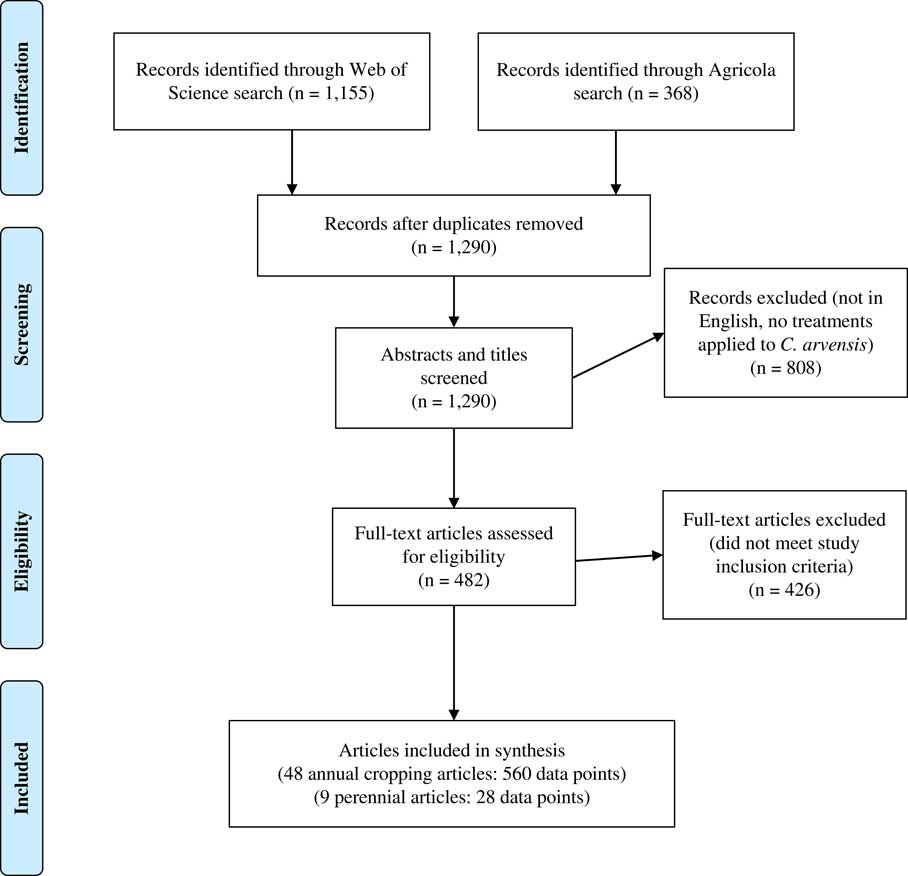
We performed a literature search and series of meta-analyses on C. arvensis management following procedures described in Davis et al. (Reference Davis, Mangold, Menalled, Orloff, Miller and Lehnhoff2018). Briefly, we first conducted a literature search of the Web of Science® (1864–2015) and Agricola® (1927–2015) databases in September 2015 using the key words “Convolvulus arvensis,” “field bindweed,” “creeping jenny,” and “perennial morning glory.” This resulted in 1,290 records after duplicates from the two databases were removed (Figure 1). Following guidelines by Koricheva et al. (Reference Koricheva, Gurevitch and Mengersen2013), all references underwent a filtering and inclusion process identical to Davis et al. (Reference Davis, Mangold, Menalled, Orloff, Miller and Lehnhoff2018) in which 1,290 abstracts and titles were screened for relevancy, and the subsequent 482 full texts were examined to determine whether studies met our preestablished inclusion criteria (Figure 1). We included field studies that were replicated and examined the relative efficacy of stand-alone or integrated weed management techniques taking place in annual cropping or perennial systems. We recorded means, measures of variation, and sample sizes for both control and treatment plots from text, tables, or figures of the selected literature following Gurevitch and Hedges (Reference Gurevitch and Hedges2001). Means were quantitative response measurements for aboveground density, cover, biomass, frequency, survival, or percent control of C. arvensis. We extracted additional information on type of system (annual vs. perennial), study duration, and details of the treatment applied (e.g., herbicide type and rate, herbicide MOA group). Data points using herbicides were included only if the applied herbicide was approved for use in the United States and if it was applied within label recommended rates (Greenbook 2017; Shaner Reference Shaner2014). Herbicide MOA groups were as follows: 2 (acetolactate synthase or acetohydroxy acid synthase inhibitors), 3 (inhibitors of microtubule assembly), 4 (synthetic auxins), 5 + 6 + 7 (inhibitors of photosynthesis at photosystem II site A or B), 9 (inhibitor of 5-enolypyruvyl-shikimate-3-phosphate synthase), 14 (inhibitors of protoporphyrinogen oxidase), 15 (inhibitors of synthesis of very-long-chain fatty acids), and 27 (inhibitors of 4-hydroxyhenyl-pyruvatedioxygenase) (Shaner Reference Shaner2014). We included a “mix” herbicide MOA group, which we defined as an herbicide application including two or more herbicides from different MOA groups. We also extracted data on crop yield, when available, to examine how C. arvensis management techniques impacted annual crop yields.
Flow diagram depicting criteria applied during literature screening portion of the meta-analysis of Convolvulus arvensis management. In each box, “n” is the number of articles described in that step.

Following Davis et al. (Reference Davis, Mangold, Menalled, Orloff, Miller and Lehnhoff2018), we used the log response ratio (lnR) as our effect size measurement, where
 $${\rm lnR}{\,\equals \,}{\rm ln}\left( {X^{{\rm E}} /X^{{\rm C}} } \right)$$
and X E and X C are means of experimental (treated) and control (nontreated) groups, respectively (Hedges et al. Reference Hedges, Gurevitch and Curtis1999). For example, a 50% reduction in C. arvensis relative to a control group is equivalent to an effect size of −0.7. We selected the response ratio for our analyses, because it can be estimated without knowledge of sample sizes or variances (Adams et al. Reference Adams, Gurevitch and Rosenberg1997), as only 6% of data points from annual cropping systems and 4% of data points from perennial systems reported measures of variation. The response ratio cannot be calculated when data points have response measurements equal to zero, because one cannot take a logarithm of a zero value (Koricheva et al. Reference Koricheva, Gurevitch and Mengersen2013). Furthermore, transformation of data points by adding a small number to the numerator and denominator of the ratio usually results in abnormally large effect size estimates and is not recommended (Koricheva et al. Reference Koricheva, Gurevitch and Mengersen2013). Therefore, 30 data points from annual cropping systems (5% of data) and 7 data points from perennial systems (20% of data) were excluded from the analyses.
We used a nonparametric bootstrapping approach similar to Adams et al. (Reference Adams, Gurevitch and Rosenberg1997), weighting each response ratio using sample sizes with the function FN, where
 $${\rm F}_{{\rm N}} {\equals}\left( {n_{{\rm E}} {\times}n_{{\rm C}} } \right)/\left( {n_{{\rm E}} {\plus}n_{{\rm C}} } \right)$$
and n E and n C represent the number of replicates for the experimental (treated) and control (nontreated) groups, respectively. We used bootstrapping methods to calculate 95% confidence intervals around the pooled effect size mean, with 1,000 iterations for each management technique or herbicide MOA group (Adams et al. Reference Adams, Gurevitch and Rosenberg1997). Individual management techniques or herbicide MOA groups were considered effective at reducing C. arvensis if the mean response ratio was negative and the 95% confidence interval did not overlap zero (Adams et al. Reference Adams, Gurevitch and Rosenberg1997; Gurevitch et al. Reference Gurevitch, Morrow, Wallace and Walsh1992). Mean response ratios from different management techniques or herbicide MOA groups were considered different from one another if their 95% confidence intervals did not overlap (de Graaff et al. Reference de Graaff, van Groenigen, Six, Hungate and van Kessel2006; Ferreira et al. Reference Ferreira, Castagneyrol, Koricheva, Gulis, Chauvet and Graca2015). Management techniques or herbicide MOA groups that only had one data point were included in figures to note knowledge gaps and were not compared statistically with other management techniques or herbicide MOA groups, because confidence intervals could not be calculated. All summaries and analyses were conducted in R statistical software v. 3.3.2, including the ‘plyr,’ ‘ggplot2,’ and ‘cowplot’ packages (R Core Team 2016).
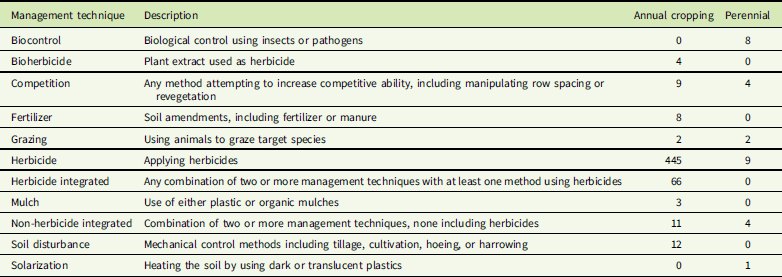
We conducted separate meta-analyses corresponding to each objective. First, we evaluated efficacy of management techniques for C. arvensis control separately for annual cropping and perennial systems (Table 1). In addition to stand-alone practices, we included the categories of herbicide integrated (i.e., any combination of two or more management techniques with at least one method using herbicides) and non-herbicide integrated (i.e., combination of two or more management techniques, none including herbicides). In annual cropping systems, we only used response measurements that considered a single year of treatment to accurately compare short- and long-term effectiveness of C. arvensis management. While land managers may conduct management strategies every year for multiple years in a row, we wanted to make valid comparisons between management techniques in different time periods as is commonly evaluated in the literature. If responses to a single year of treatment were measured over multiple dates, we extracted data from three defined time periods (<1 yr, 1–2 yr, and >2 yr after treatment) when possible and conducted separate analyses to compare management across different study durations. Next, we examined efficacy of different herbicide MOA groups in annual cropping systems using the same time periods as we used for general management techniques. Finally, for annual cropping systems, we compared the effect of management techniques on crop yield. For this analysis, a positive response ratio indicated an increase in yield, while 95% confidence intervals overlapping zero indicated we could not detect an effect of the management technique on yield (Gurevitch et al. Reference Gurevitch, Morrow, Wallace and Walsh1992).
Descriptions of Convolvulus arvensis management techniques used in articles included in meta-analyses with the number of data points associated with each type of system indicated.

In perennial systems, we conducted one meta-analysis examining general management techniques because there were insufficient data (28 data points total) to split the analysis into time periods or herbicide MOA groups or to examine how management impacted desired plant communities. We did not compare additional specifics of individual management techniques (e.g., timing, types of biocontrol agents, herbicide rates), because this level of detail was outside the scope of our questions of interest, and there was insufficient replication of specific practices within management techniques to adequately compare them.
Results and Discussion
Convolvulus arvensis Management in Annual Cropping Systems
From a total of 1,290 records, we extracted data from 48 articles published between 1947 and 2015 (Supplementary Appendix S1), resulting in 560 total data points (Figure 1). The majority of these studies were conducted in North America (28 articles), while the remaining took place in South Asia (12 articles), Europe (7 articles), and Australia (1 article). Studies took place across a variety of cropping systems (e.g., wheat (Triticum aestivum L.), corn (Zea mays L.), bean (Phaseolus vulgaris L.)) and in fallow fields (Supplementary Table S1).
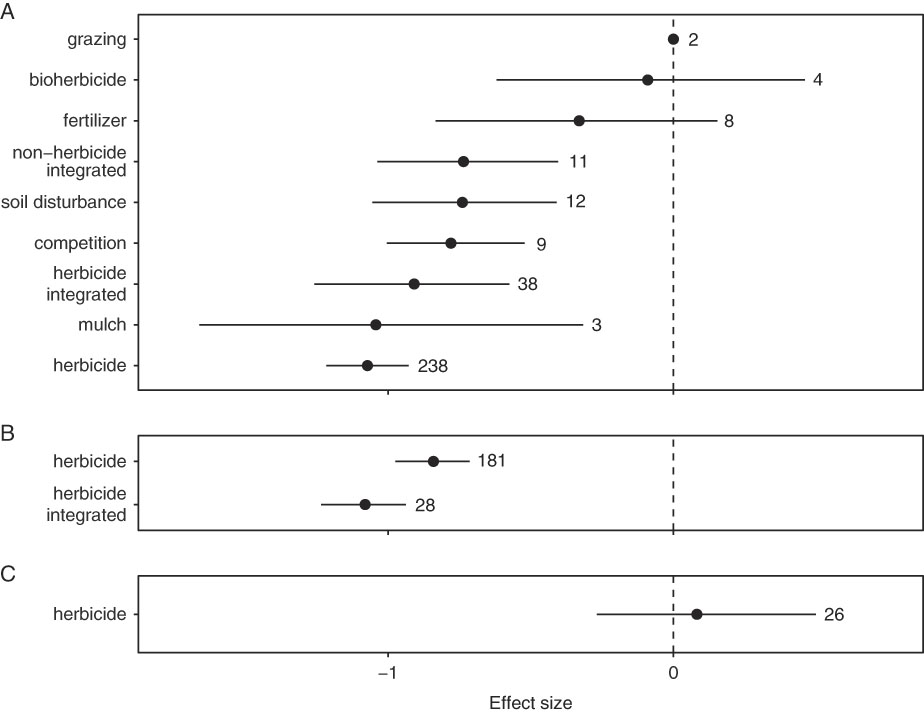
Six management techniques were effective at reducing C. arvensis <1 yr posttreatment: competition, herbicide, herbicide integrated, mulch, non-herbicide integrated, and soil disturbance (Figure 2A). Bioherbicide, fertilizer, and grazing had no effect on C. arvensis <1 yr posttreatment (Figure 2A). Only two management techniques were examined 1 to 2 yr posttreatment: herbicide and herbicide integrated, and both were equally effective (Figure 2B). Herbicide was the only management technique investigated >2 yr posttreatment (n=26), and a single application was not effective at reducing C. arvensis, suggesting the reapplication of herbicides is necessary for effective long-term management (Figure 2C).
Mean effect size (lnR) and 95% confidence intervals for Convolvulus arvensis abundance measured (A) <1 yr, (B) 1–2 yr, or (C) >2 yr after treatment in annual cropping systems as a function of management techniques. For each management technique, the number next to the confidence interval represents the number of data points used to calculate the mean.
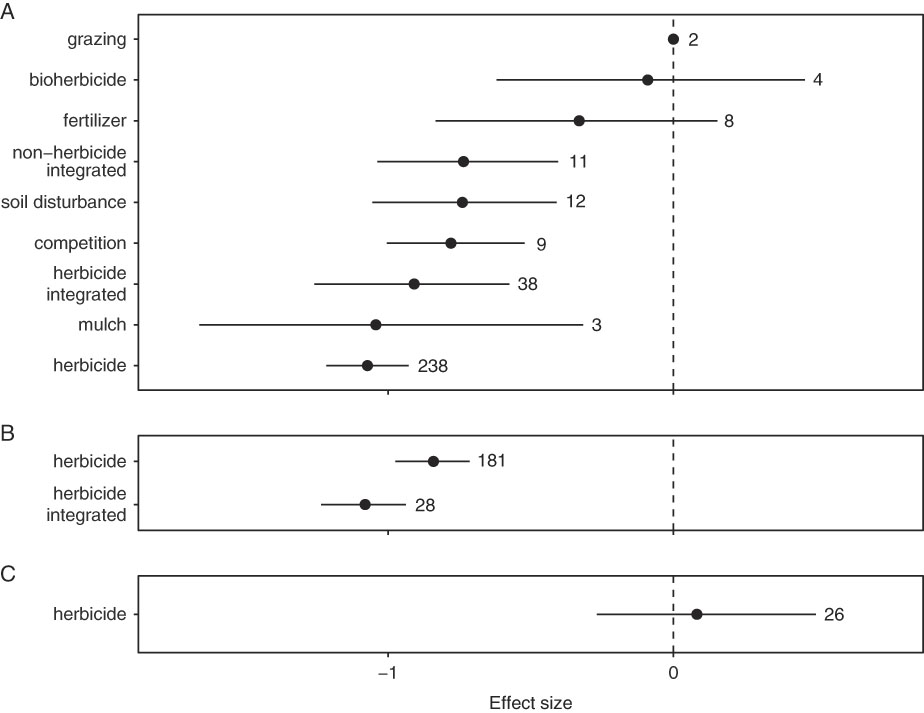
Herbicide, which was the most frequently evaluated management technique (included in almost 80% of annual cropping system data points), performed similarly to other effective management practices. Five nonchemical and integrated management techniques were as effective as herbicide within the first year of treatment (Figure 2A), and herbicide integrated was as effective as herbicide 1 to 2 yr posttreatment (Figure 2B). Our results are similar to a meta-analysis on C. arvense management in which herbicide was the most studied management technique, yet integrated management, with or without herbicides, was as effective as or more effective than sole use of herbicides (Davis et al. Reference Davis, Mangold, Menalled, Orloff, Miller and Lehnhoff2018). The economics associated with different management strategies may influence which strategy is the best choice for managers, especially if two appear to be equally effective. An evaluation of the best set of management practices to control C. arvensis should include not only the potential economic advantages of herbicides but also the environmental, social, and biological consequences (e.g., herbicide resistance and non-target effects) of such decisions (Liebman et al. Reference Liebman, Mohler and Staver2001). Although conventional agriculture relies heavily on synthetic herbicides to manage weeds, this can potentially lead to overuse and the selection of herbicide-resistant biotypes (McErlich and Boydston Reference McErlich and Boydston2014; Menalled et al. Reference Menalled, Peterson, Smith, Curran, Páez and Maxwell2016). While the occurrence of herbicide resistance across C. arvensis populations is relatively rare, one case of resistance to paraquat has been reported (Ghosheh and Hurle Reference Ghosheh and Hurle2011). In addition, DeGennaro and Weller (Reference DeGennaro and Weller1984) reported differential sensitivity of C. arvensis wild biotypes to glyphosate, suggesting that the selection of resistant biotypes could occur.
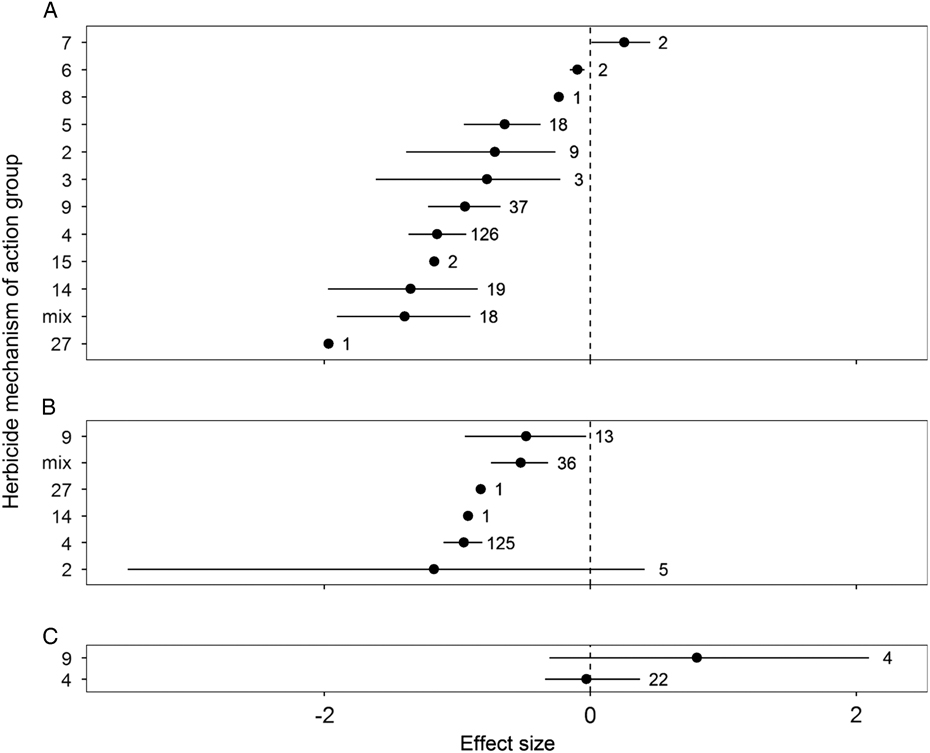
Overall, there were few differences among herbicide MOA groups in terms of efficacy on C. arvensis in annual systems. Nine of the 12 herbicide MOA groups examined within 1 yr postapplication reduced C. arvensis, and most were similarly effective (Figure 3A). Herbicide MOA Group 7 was the only ineffective herbicide MOA group, but data were limited for this group (n=2). While herbicide MOA Groups 8 and 27 had negative effect sizes, they only had one data point each, so comparisons to other herbicide MOA groups cannot be made. Six herbicide MOA groups were examined 1 to 2 yr postapplication, and half were effective at reducing C. arvensis (herbicide MOA Groups 4 and 9 and a mix of groups; Figure 3B). Herbicide MOA Group 2 had no effect on C. arvensis abundance, and herbicide MOA Groups 14 and 27 had one data point each, so comparisons to other herbicide MOA groups were not made. Only herbicide MOA Groups 4 and 9 were examined for efficacy >2 yr postapplication, and neither was effective for this time period (Figure 3C).
Mean effect size (lnR) and 95% confidence intervals for field bindweed Convolvulus arvensis abundance measured (A) <1 yr, (B) 1–2 yr, or (C) >2 yr after treatment in annual cropping systems as a function of herbicide mechanism of action groups. For each group, the number next to the confidence interval represents the number of data points used to calculate the mean. Groups are as follows: 2, acetolactate synthase or acetohydroxy acid synthase inhibitors; 3, inhibitors of microtubule assembly; 4, synthetic auxins; 5, inhibitors of photosynthesis at photosystem II site A; 6, inhibitors of photosynthesis at photosystem II site B; 7, inhibitors of photosynthesis at photosystem II site A (different binding behavior from Group 5); 8, inhibitors of lipid synthesis (not acetyl-CoA carboxylase inhibition); 9, inhibitor of 5-enolypyruvyl-shikimate-3-phosphate synthase; 14, inhibitors of protoporphyrinogen oxidase; 15, inhibitors of synthesis of very-long-chain fatty acids; 27, inhibitors of 4-hydroxyhenyl-pyruvatedioxygenase; and mix, includes two or more herbicides from different groups.

Our results showed that some herbicide MOA groups have been studied more than others for C. arvensis management. Herbicide MOA Groups 4 and 9 were the most studied groups across all time periods (61% and 12%, respectively) and were the only groups assessed for long-term efficacy (Figure 3A–C). These two groups include systemic herbicides that translocate to the root system, potentially providing long-term control for weeds that can resprout from underground structures (Lindenmayer et al. Reference Lindenmayer, Nissen, Westra, Shaner and Brunk2013). Common MOA Group 4 herbicides used in studies included 2,4-D (24%), dicamba (13%), and a mix of two or more Group 4 herbicides (44%). Other MOA Group 4 herbicides making up 19% of data points included dichlorprop, fluroxypyr, MCPA, MCPB, mecoprop, picloram, quinclorac, and triclopyr. MOA Group 9 herbicides (glyphosate) were used in 12% of data points across all time periods.
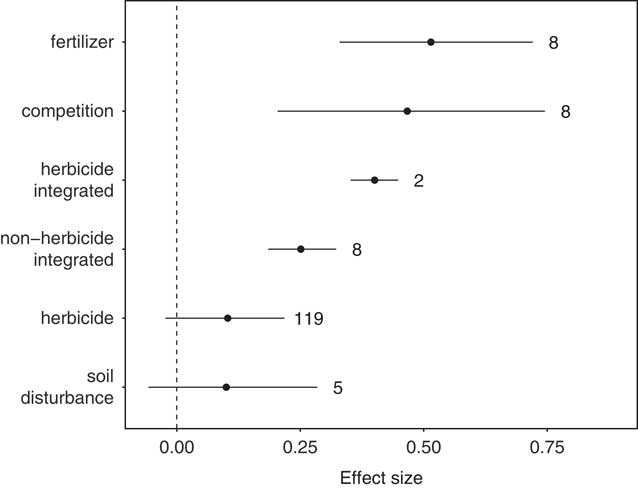
In our selected literature, 27% of data points reported on how various management techniques for C. arvensis impacted crop yield, specifically corn, flax (Linum usitatissimum L.), lentils (Lens culinaris Medik.), mustard (Brassica cretica L.), potatoes (Solanum tuberosum L.), sorghum [Sorghum bicolor (L.) Moench], and wheat (Figure 4). Convolvulus arvensis management via herbicide (n=119) or soil disturbance (n=5) did not have a positive effect on crop yield relative to untreated controls, suggesting that competition with C. arvensis was not limiting crop production. Other environmental or biological variables (soil nutrient and moisture status, crop injury, pathogen or pest pressure, etc.) may have been more limiting in the studied conditions. All other management techniques (i.e., competition, fertilizer, and integrated management with or without herbicides) improved crop yield. While fertilizer increased crop yield, it was not an effective technique for C. arvensis management (Figure 2A). Integrated multitactic techniques, with or without herbicide use, resulted in improved crop yield but were studied less frequently (n=2 and 8, respectively) than herbicide alone (n=119).
Mean effect size (lnR) and 95% confidence intervals for crop yield in annual cropping systems as a function of Convolvulus arvensis management techniques. For each management technique, the number next to the confidence interval represents the number of data points used to calculate the mean.

Convolvulus arvensis Management in Perennial Systems
There were relatively few studies on managing C. arvensis in perennial systems compared with annual cropping systems. We extracted data from nine articles published between 1947 and 2010 (Supplementary Appendix S2), resulting in 28 total data points (Figure 1). The majority of these studies took place in North America (6 articles), and the remaining took place in Europe. Studies were conducted in forage fields, pastures, and lawn/turf (Supplementary Table S2).
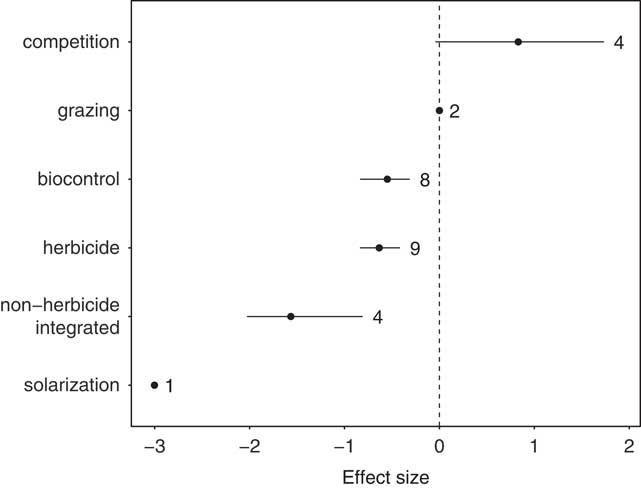
Six different management techniques were studied in perennial systems: biocontrol, competition, grazing, herbicide, non-herbicide integrated, and solarization. Half of these techniques (biocontrol, herbicide, and non-herbicide integrated management) were equally effective at reducing C. arvensis (Figure 5). Non-herbicide integrated management strategies used in perennial systems included combining competition (i.e., grass seeding) and water manipulation (Timmons Reference Timmons1950), as well as competition (i.e., grass seeding) and biocontrol (i.e., the fungus Sclerotinia minor) (Abu-Dieyeh and Watson Reference Abu-Dieyeh and Watson2007). Competition and grazing had no effect on C. arvensis in perennial systems (Figure 5). Only one data point existed for the impact of solarization on C. arvensis, so comparisons with other management techniques could not be made.
Mean effect size (lnR) and 95% confidence intervals for Convolvulus arvensis abundance in perennial systems as a function of management techniques. For each management technique, the number next to the confidence interval represents the number of data points used to calculate the mean.

Overall, low sample sizes among individual management techniques (n<10) limited our inference within perennial systems and did not allow us to examine the effectiveness of management techniques in different time periods or across herbicide MOA groups. Also, due to the lack of reported studies, we were unable to analyze how C. arvensis management techniques impacted abundance of desired plants or any other ecosystem service provided by perennial systems.
Research Gaps
Despite the importance of long-term control and impacts to crop yield in the management of C. arvensis, we found relatively few studies that investigated these factors. Our meta-analyses in annual cropping systems showed that most management techniques were examined <1 yr after treatment, highlighting the importance of following studies beyond a growing season to develop sustainable weed management programs. Similarly, in a review of invasive plant control research papers, Kettenring and Adams (Reference Kettenring and Adams2011) found that the time frames of most studies were short; 51% evaluated control after one growing season or less. Furthermore, our results showed that certain management techniques that are effective within a year of being applied may not be effective after 2 yr. We also found that almost 75% of data points from our analysis did not describe how a particular management practice impacted crop yield, emphasizing the need for holistic studies that measure the effects of weed management on desired species.
Our results showed that herbicide was the most frequently studied management technique in both annual cropping and perennial systems, but there were other less studied management techniques that were equally effective as herbicides (i.e., integrated practices and certain nonchemical practices). In addition to being understudied, we found that many management techniques included in our meta-analyses only took place in one country (e.g., bioherbicide [United States], fertilizer [India], grazing [United States], mulch [Greece]), suggesting the need to evaluate techniques in a broader diversity of environments. When weed management practices are combined, techniques may interact to alter the effects on efficacy, crop performance, or environmental services in either positive or negative ways, and these interactions may be contingent on the environment and cropping system. Researching nonchemical management practices will provide land managers with broader options for long-term management of C. arvensis. However, switching to more nonchemical management practices will require a major shift in research priorities across the public and private sectors (Young et al. Reference Young, Pitla, Van Evert, Schueller and Pierce2017). For example, $2.52 billion was spent in 2014 by leading crop-protection companies to conduct research and development on chemical control, but less than 10% of that amount ($180 million) was spent to assess the potential efficacy of biological control products (Phillips McDougall 2016). The shift to more nonchemical management practices also suggests the need for an interdisciplinary approach to address economic, ecological, and crop yield considerations of different management options compared with traditional weed management approaches (Ward et al. Reference Ward, Cousens, Bagavathiannan, Barney, Beckie, Busi, Davis, Dukes, Forcella, Freckleton, Gallandt, Hall, Jasieniuk, Lawton-Rauh, Lehnhoff, Liebman, Maxwell, Mesgaran, Murray, Neve, Nuñez, Pauchard, Queenborough and Webber2014).
We found that some herbicide MOA groups have been widely studied for C. arvensis management in annual cropping systems (e.g., MOA Groups 4, 9, and 14, and mixes), but there are other herbicide MOA groups that show promise yet have been researched less frequently. For example, investigating the potential of herbicide MOA Groups 14 and 27 may be beneficial to weed management, as these groups had negative effect sizes 1 to 2 yr postapplication but only had a sample size of one data point. Herbicide labels within these MOA groups claim to provide some control of perennial weed species similar to C. arvensis.
Given that C. arvensis is on the noxious weed lists of many states, we were surprised by the paucity of studies that tested management techniques in perennial systems. We recommend careful examination of the impacts of C. arvensis in such systems, and if significant, further research in this area. Additionally, few studies (<10% of data points) in our meta-analyses included estimates of variability; reporting such measures of variation can expand upon possible meta-analytical approaches used in the future.
Supplementary material
To view supplementary material for this article, please visit https://doi.org/10.1017/wsc.2018.25
Acknowledgments
The authors would like to thank the Montana Noxious Weed Trust Fund and the Montana Wheat and Barley Committee for funding this research. We thank Sean McKenzie for his assistance with statistical analysis. No conflicts of interest have been declared.