Introduction
Siblings form a relationship that can last throughout their entire lives (Cicirelli, Reference Cicirelli1995). Although siblings can be very close to each other, especially if they are of the same sex and the age difference is moderate (Brody, Reference Brody1996; Dunn & Kendrick, Reference Dunn and Kendrick1982), the nature of this family tie has been described as inherently ambivalent, with high degrees of both altruism and competition (Deater-Deckard et al., Reference Deater-Deckard, Dunn and Lussier2002). Sibling competition over parental resources is known to be most severe in childhood and adolescence, when parental investment matters most (Salmon & Hehman, Reference Salmon and Hehman2014). Due to the growth in rates of divorce and re-marriage, blended families are becoming increasingly common in Europe (Chapple, Reference Chapple2009; Kreyenfeld & Martin, Reference Kreyenfeld and Martin2011), fuelling also the interest of scholars in the dynamics of different sibship constellations. Here, the occurrence of sibling conflicts in full- and maternal half-sibling households using UK data is explored.
Kin relations are characterized by altruistic behaviour, which is ultimately explained by Hamilton’s (Reference Hamilton1964) theory of inclusive fitness. It argues that an individual can enhance its inclusive fitness (the spread of its genes in future generations) by supporting the reproductive success of closely related kin. Among humans this means that, all else being equal, individuals should feel more close to, and should invest more resources (such as time, money, emotional support) in, genetically closer kin compared with more distantly related kin and to non-kin.
Altruism between close kin has been documented in many studies: parents and grandparents, for instance, tend to invest more in their genetically related (grand)children than in step- (grand)children (e.g. Anderson, Reference Anderson2011; Coall et al., Reference Coall, Hilbrand and Hertwig2014; Euler, Reference Euler2011). People also tend to feel closer to, and have more contact with, their full-siblings, with whom they share on average half of their genes, compared with their half-siblings, with whom they share around one-quarter of their genes (e.g. Jankowiak & Diderich, Reference Jankowiak and Diderich2000; Pollet, Reference Pollet2007; Tanskanen & Danielsbacka, Reference Tanskanen and Danielsbacka2014).
Close kin relations are also characterized by conflicts. Indeed, kin competition can be so extreme that it negates any possible influence of kin altruism (West et al., Reference West, Pen and Griffin2002). However, Hamilton’s (Reference Hamilton1964) rule does not take into account or make predictions about competition, which especially characterizes ‘horizontal’ kin relations compared with ‘vertical’ relations (Voorpostel & van der Lippe, Reference Voorpostel and van der Lippe2007; Rotkirch et al., Reference Rotkirch, Lyons, David-Barrett and Jokela2014). Sibling relations are usually horizontal, since siblings tend to belong to the same generation. Resources are often transferred from the older generation to the younger, so that members of the same generation compete for attention and resources from the elders.
Sibling conflict stems from parent–offspring conflict (Trivers Reference Trivers1974). From the offspring’s perspective, the more parental resources s/he gets the better, since the offspring is more genetically related to her/himself than to her/his sibling (with the exception of monozygotic twins, see Segal et al., Reference Segal, Seghers, Marelich, Mechanic and Castillo2007; Segal & Marelich, Reference Segal and Marelich2011). From the parental perspective, by contrast, it may sometimes be more evolutionarily beneficial to invest in other existing or potential offspring. Therefore siblings are predicted to compete with each other over access to parental resources (Salmon & Malcolm, Reference Salmon and Malcolm2011).
Sibling competition ranges from small disputes to aggressive interaction including siblicide (Michalski et al., Reference Michalski, Russell, Shackelford and Weekes-Shackelford2007). Siblicide is rare in humans (Daly & Wilson, Reference Daly and Wilson1988; Hudson & Trillmich, Reference Hudson and Trillmich2008), but milder conflicts and disagreements between siblings are frequent and may include verbal and physical aggression (Pollet & Hoben, Reference Pollet and Hoben2011).
The occurrence of sibling conflicts is influenced by several child and family characteristics. Boys are more likely to have sibling conflicts than are girls (Brody et al., Reference Brody, Stoneman, MacKinnon and MacKinnon1985; Salmon & Hehman, Reference Salmon and Hehman2015). Also, the number of siblings and birth order are known to affect sibling relations (e.g. Salmon & Daly, Reference Salmon and Daly1998; Salmon, Reference Salmon1999, Reference Salmon2003; Lawson & Mace Reference Lawson and Mace2009; Damian & Roberts, Reference Damian and Roberts2015). The smaller the age difference, the more intensively do siblings compete over similar parental resources, while large age differences tend to lower sibling competition (Salmon & Hehman, Reference Salmon and Hehman2014). Sibling competition may vary by ethnic group (Tanskanen et al., Reference Tanskanen, Danielsbacka and Rotkirch2015). Socioeconomic status may also influence sibling competition, which has been predicted to increase with lower status due to resource scarcity (Pollet & Hoben, Reference Pollet and Hoben2011). On the other hand, sibling competition may be more severe when there is ‘more to compete about’, e.g. in parental resources or inheritance.
Sibling conflicts are important to study since they may influence child psychopathology, for instance through raised stress levels (Buist et al., Reference Buist, Deković and Prinzie2013) or unintended injuries (Tanskanen et al., Reference Tanskanen, Danielsbacka and Rotkirch2015). Sibling conflicts can also include outright bullying, which has been shown to be associated with health and emotional problems in early adulthood (Copeland et al., Reference Copeland, Wolke, Lereya, Shanahan, Worthman and Costello2014; Wolke et al., Reference Wolke, Tippett and Dantchev2015).
While research on step-families and sibling relations is expanding (Kreyenfeld & Martin, Reference Kreyenfeld and Martin2011), studies of sibling competition between full- and half-siblings remain scarce and have mixed findings. Ganong and Coleman (Reference Ganong and Coleman1993) studied 105 families and found interactions between full- and half-siblings to be more positive than between unrelated siblings. Deater-Deckard and colleagues (Reference Deater-Deckard, Dunn and Lussier2002) measured sibling negativity (conflict and aggression) among 5-year-old children and found it to be higher among full- compared with half-siblings. Similarly, Salmon and Hehman (Reference Salmon and Hehman2015) reported that college students between the ages 18 and 22 had more conflicts with co-residing full-siblings compared with half-siblings.
Based on Hamilton’s (Reference Hamilton1964) rule, sibling competition is usually predicted to increase with decreasing genetic relatedness (Schlomer et al., Reference Schlomer, Del Giudice and Ellis2011; Salmon & Hehman, Reference Salmon and Hehman2014). Therefore Salmon and Hehman (Reference Salmon and Hehman2015) predicted that non-biological siblings would have the most conflict, followed by half-siblings, and then full-siblings. Their results showed that non-biological siblings did indeed have the most conflict, while – contrary to what was expected – half-siblings had fewer conflicts than full-siblings. No theoretical explanation for their findings was provided.
In contrast to predictions based on kin altruism, predictions based on parent–offspring conflict can lead us to expect more competition over parental resources between full-siblings than half-siblings. Full-siblings compete over resources from the same parents while half-siblings also have the additional option to receive support from their other biological parent. For instance, children who live in the same household with their biological mother and stepfather may also receive investment from their non-resident biological father. At least in some circumstances (e.g. when both parents continue investment after divorce) the competition for parental resources between half-siblings may thus be lower than between full-siblings.
The UK has one of the highest divorce rates in Europe today (OECD, 2014) and over a third of children have experienced parental separation by age 11 (Connelly et al., Reference Connelly, Joshi and Rosenberg2014). Eleven per cent of children in England and Wales were living in stepfamilies in 2011 (Office of National Statistics, 2014). While children stay with their mothers most of the time following parental separation, it is increasingly common for the biological fathers to continue to keep in touch and invest in their children from previous unions (Skinner & Davidson, Reference Skinner and Davidson2009). Many children of divorced parents regularly live with their other parent part of the time or regularly visit him or her, e.g. during weekends and holidays (Modecki et al., Reference Modecki, Hagan, Sandler and Wolchik2015); in the UK a great majority of fathers have contact with their non-resident children at least occasionally (O’Brien & Speight, Reference O’Brien and Speight2013).
Half-siblings may occur from either the paternal or maternal side. Paternal half-siblings typically occur in polygynous societies, when a male can have several wives simultaneously. Re-marriages following widowhood, which were common in pre-industrial Europe, can create sibships who are either maternal or paternal half-siblings (Pettay et al., Reference Pettay, Rotkirch, Courtiol, Jokela and Lummaa2013). By contrast, re-marriages in contemporary Western societies usually create sibships with full-siblings and maternal half-siblings, since children tend to stay with their biological mothers following divorce. Thus European co-residing half-siblings typically have the same mother and different biological fathers (Skinner & Davidson, Reference Skinner and Davidson2009; OECD, 2014). Forms of sibling competition may vary with family structure and mating systems. Here, competition within sibships with full- or maternal half-siblings has been studied, since that is by far the most common type of half-sibships in the current study population. Assuming that sibling conflicts reflect competition over parental resources and attention, this study explored one of the implications of living in different sibship types: do children living with full-siblings have more frequent conflicts compared with children living with maternal half-siblings?
When investigating sibling conflicts, several sibship characteristics such as gender, age, age difference between siblings and birth order were controlled for, because these are known to be associated with sibling competition as described above. Measures of the quality of the relationship between adult carers in the household were also included, assuming that when the relationship between parents is conflict-prone there are also more conflicts between siblings, and vice versa (McHale et al., Reference McHale, Crouter, McGuire and Updegraff1995). Changes in household composition may also influence the family environment, since previous studies have shown that the relationship between the biological mother and father is often strained after the separation but changes for the better over time (Modecki et al., Reference Modecki, Hagan, Sandler and Wolchik2015). Maternal involvement with children is also associated with sibling dynamics (Jenkins et al., Reference Jenkins, Rasbash, Leckie, Gass and Dunn2012) and is included as a variable. In order to measure the effects of socioeconomic status on sibling competition, both maternal education and family income are included in the analyses.
Methods
The data in this study come from the Millennium Cohort Study (MCS), a representative longitudinal survey carried out in the UK. The aim of the MCS is to collect information on children born at the beginning of the new millennium. Data from the fifth wave of the MCS were analysed. The fifth wave data were gathered in 2012–2013 when the cohort member children were approximately 11 years old (mean age=134 months, SD=3.90). In the survey, cohort member children answered questions concerning their sibling relationships. In addition, their parents or parental figures (i.e. main respondents) answered questions concerning themselves and the family. In total the fifth survey wave reached 13,287 responding families and the response rate was 69%. The data have been described in detail by Hansen (Reference Hansen2014).
For the analytic sample, cases where the main respondents were the biological mothers of the respondent child (in the fifth wave over 95% of all main respondents) were selected. Analyses were restricted to households where respondent children were living with biological mothers and biological fathers or stepfathers (i.e. dual-carer households). Single-mother households were excluded since in these families siblings compete with each other only for the investment and attention of one parent on a daily basis. However, sensitivity analyses including also single-mother households produced results similar to the main analyses presented in this article (results not shown). In addition, only cases where the mothers lived in the same household as the cohort member child were included. Children typically reside mainly with the mother after a divorce in the UK (Connelly et al., Reference Connelly, Joshi and Rosenberg2014). Cases where children resided with their biological fathers but not their biological mothers were too few to be included in the analyses, which is why the focus is on maternal siblings. In the case of twins and triplets, only one child of the twin or triplet set was included. Finally, only cohort member children who had at least one full- or maternal half-sibling (who was not a twin or triplet) living in the same household were included. After these exclusions the analytic sample included 7527 cohort member children.
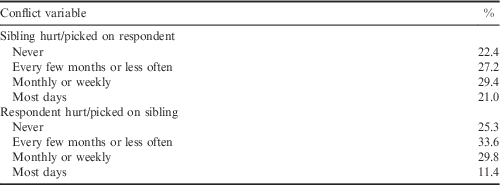
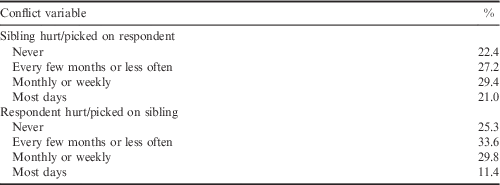
In all analyses the dependent variables measure sibling conflicts, defined as self-reported frequencies of hurting or picking on siblings. In the fifth wave of the MCS children were asked two questions: ‘How often do your brothers or sisters hurt you or pick on you on purpose?’ and ‘How often do you hurt or pick on your brothers or sisters on purpose?’ The responses were classified in four categories (0=never, 1=less often than monthly, 2=monthly or weekly, 4=most days). The distributions of the dependent variables are presented in Table 1.
Distribution of sibling conflict variables, n=7527
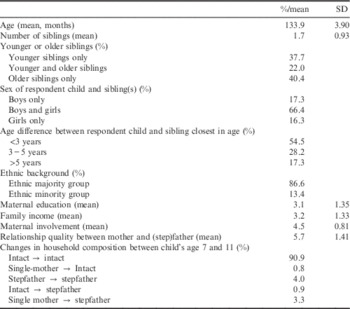
The main explanatory variable measures whether the cohort member child lived in the same household with full- or half-siblings. Due to the data structure all half-siblings were maternal siblings, as explained above. The scale was classified into three categories: 1=lived with full-sibling(s) only, 2=lived with full- and maternal half-sibling(s), 3=lived with maternal half-sibling(s) only. In the study sample 86% of children were living with full-sibling(s) only, 8% with full- and maternal half-sibling(s) and 6% with maternal half-sibling(s) only. Siblings living only with maternal half-siblings had bigger age differences (i.e. age difference between respondent child and sibling closest in age): in 57% of households with full-siblings only, 66% of households with full- and maternal half-siblings but 8% of households with only maternal half-siblings did the siblings have an age difference of less than 3 years. For the average sibling age difference of 3–5 years the respective proportions were 29, 24 and 19%, and for sibling age differences of more than 5 years respective proportions were 14, 10 and 73%. Thus age differences between respondents living with full-siblings only and living with both full- and maternal half-siblings were quite similar, while a higher proportion of respondents living only with maternal half-siblings had larger age differences compared with the first two groups.
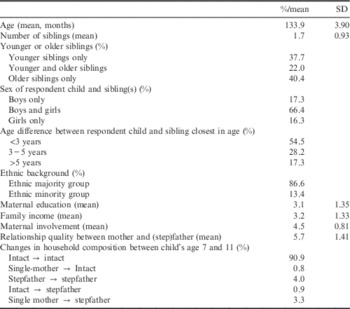
Given that the outcome variables had four ordered categories without equal spacing between the categories (i.e. 0=never, 1=less than monthly, 2=monthly or weekly, 3=most days), the regression models were fitted with ordered logistic regression (‘ologit’ command in Stata 13.1; see Liu, Reference Liu2009). The analyses included several potential confounding variables. These were country (England, Wales, Scotland, Northern Ireland), respondent child’s age (in months), ethnic background, number of siblings, whether respondent child had younger or older siblings in household, sex of respondent child and of sibling(s), age difference between respondent child and the sibling closest in age, maternal education, family income, parental relationship quality and changes in household composition between child’s age 7 and 11. Maternal education was measured by the National Vocational Qualification (NVQ), where a higher level of NVQ means higher qualification (ranging from 0=none to 5=NVQ level 5). Family income was measured by equalized income quintiles based on the UK income distribution (ranging from 1=bottom to 5=top). The relationship quality between mothers and (step)fathers was based on maternal reports of how happy she was in her current relationship (ranging from 1=very unhappy to 7=very happy). Compared with households with full-siblings only, mothers in households with full- and maternal half-siblings and only maternal half-sibling reported on average lower relationship quality (full-siblings=ref.; full- and maternal half-siblings ß=−0.21, p=0.001; maternal full-siblings only ß=0.21, p=0.002). Maternal involvement was measured by how often mothers talk to the cohort member child about things that were important to the child (ranging from 1=less than monthly to 5=every day). There were no significant differences in maternal involvement in different sibling constellations. Finally, using longitudinal information from MCS rounds four and five, a variable measuring changes in household composition was constructed. Descriptive distributions of these variables are presented in Table 2.
Descriptive statistics of respondent children (%/mean), n=7527
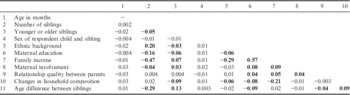
The bivariate correlations of independent variables are provided in Table 3. The highest correlations were found between maternal education and family income and between family income and number of siblings. Maternal education correlates with increased family incomes, while family incomes correlate with decreased number of siblings.
Bivariate correlations between independent variables for respondent child, n=7527
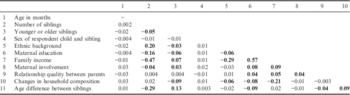
Bold numbers indicate significant associations: p<0.05
In the Results section it was first investigated whether there are more conflicts in full- than maternal half-sibling households. For sensitivity purposes, the analyses were also run using analysis weights calculated by the MCS team. Since the results were similar whether the weights were used or not, only unweighted results are shown. In the second phase, interaction terms were included in the models investigating the interactions between socioeconomic characteristics (maternal education and family income) and sibling constellation (full-siblings only, full- and maternal half-siblings or maternal half-siblings only).
Results
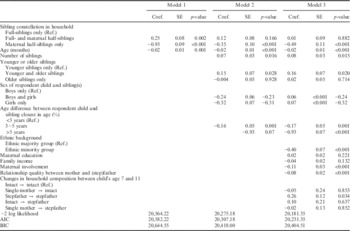
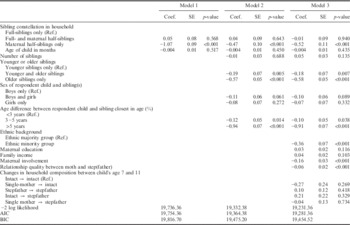
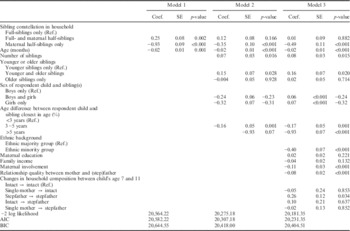
Associations between a sibling picking on or hurting the respondent, and the respondent picking on or hurting siblings, were studied in two separate multivariate regressions. The results are presented in Tables 4 and 5, respectively. In the first regression model (Table 4), only the age of child was included in addition to the main sibling constellation variable. In this model, full-siblings have a greater probability of reporting conflicts compared with the groups ‘full- and maternal half-siblings’ and ‘maternal half-siblings only’.
Sibling hurt/picked on respondent: stepwise ordinal regression analyses (country fixed effects), n=7527
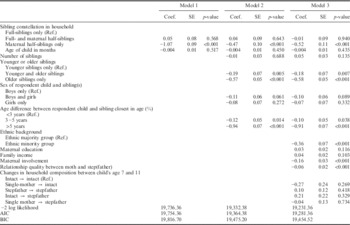
Respondent hurt/picked on sibling: stepwise ordinal regression analyses (country fixed effects), n=7527
In the second regression model, variables measuring sibling characteristics were added to the model (Table 4). These variables were number of siblings, whether the respondent had younger or older siblings, child and sibling gender, and the age difference between the respondent child and the sibling closest in age. Including these variables removed the difference between ‘full-siblings only’ and ‘full- and maternal half-siblings’ found in Model 1. However, the difference between ‘full-siblings only’ and ‘maternal half-siblings only’ remained statistically significant, although the magnitude of the coefficient decreased from −0.93 to −0.35.
In addition to other variables, the third model controlled for ethnicity, maternal education, family income, maternal involvement, parental relationship quality and changes in household composition. After controlling for these variables in Model 3, full-siblings still have a higher likelihood of conflicts compared with maternal half-siblings. Adding these variables influenced effect size so that the coefficient increased from −0.35 to −0.49.
Next, the likelihood that a respondent had hurt or picked on a sibling was studied (Table 5). In all three regression models, the group ‘full-siblings only’ had a significantly higher probability of conflicts than the group ‘maternal half-siblings only’. There were no statistically significant differences between the groups ‘full-siblings only’ and ‘full- and maternal half-siblings’ in any of these regression models.
The final regression models (Model 3) in both multivariate regressions (Tables 4 and 5) show how several other factors also correlated with sibling conflicts. In the case of both conflict measures, a lower age difference between siblings increased the probability of conflicts. Members of ethnic minority groups were less likely to report conflicts compared with respondents belonging to the ethnic majority. Higher levels of maternal involvement and a higher parental relationship quality were associated with decreased probability of conflicts. Children with both younger and older siblings more often reported that their siblings had hurt or picked on them compared with children who only had younger siblings. In addition, for a respondent having hurt or picked on a sibling (Table 5, Model 3), those who had only older siblings had a significantly lower probability of conflicts than those who had younger siblings only. Some variables were associated with statistically significant differences only in the case when the sibling had hurt or picked on a respondent (Table 4, Model 3). Sibships with only boys tended to have more sibling conflicts compared with other gender combinations. Children who had lived with their stepfather at ages 7 and 11 had higher risk of conflicts than children who had lived with both biological parents. The probability of conflicts also increased with the number of siblings.
Next, sensitivity analyses were conducted in order to compare conflicts between full- and maternal half-sibling households within different age-difference groups. Analyses show that in the largest age-difference group (5 or more years between respondent child and sibling closest in age) full-siblings had significantly more conflicts than maternal half-siblings did (sibling hurt/picked on respondent (n=1301): full-siblings only (reference group), full- and half-siblings, Coef.=−0.02, SE=0.29, p=0.946, half-siblings only, Coef.=−0.57, SE=0.14, p<0.001; respondent hurt/picked on sibling (n=1301), full-siblings only (reference group), full-siblings and half-siblings, Coef.=−0.002, SE=0.29, p=0.994, half-siblings only, Coef.=−0.52, SE=0.15, p<0.001).
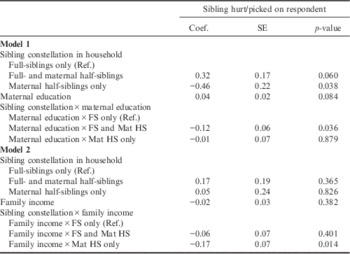
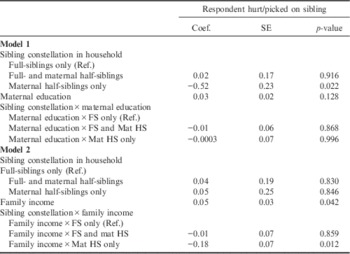
Interestingly, measures of socioeconomic status – maternal education and family income – were not associated with conflict occurrence in Tables 4 or 5. Therefore the interactions between sibling constellation and socioeconomic factors were explored (Tables 6 and 7). Low maternal education was associated with sibling conflicts more strongly among full-siblings and maternal half-siblings compared with families with only full-siblings (Table 6, Model 1). Low family income was related to sibling conflicts more strongly in families of maternal half-siblings compared with families of full-siblings (Model 2 in both Table 6 and Table 7).
Associations between socioeconomic factors and sibling conflicts by sibling constellation: ordinal regression analyses (country fixed effects), n=7527
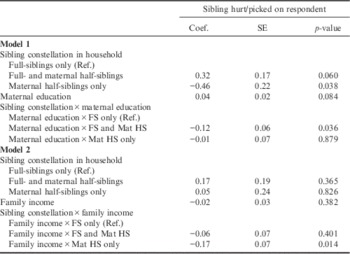
FS: full-siblings. Mat HS: maternal half-siblings.
Associations between socioeconomic factors and sibling conflicts by sibling constellation: ordinal regression analyses (country fixed effects), n=7527
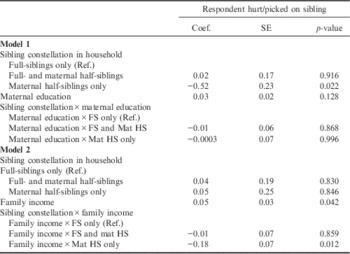
FS: full-siblings. Mat HS: maternal half-siblings.
Discussion
This study analysed whether the degree of genetic relatedness is associated with frequency of sibling conflicts, as measured by survey reports of siblings picking on, or hurting, each other. Parent–offspring conflict theory (Trivers, Reference Trivers1974) suggests that sibling conflicts reflect competition over parental resources. Conflict occurrence is predicted to vary with different sibship constellations and family resources. The present study hypothesized that children living with their full-siblings only would have conflicts more often compared with children who live with maternal half-siblings only, because the former compete for resources from the same set of parents, while the latter may receive investment also from non-resident biological fathers. The results supported this prediction, and hold even after several potential confounding factors were controlled for. The picture is thus the opposite to that predicted by general kin altruism theory.
Full-siblings tend to be closer to each other (Pollet & Hoben, Reference Pollet and Hoben2011), but based on the present study they also have more conflicts. In many species it is common for individuals to grow up with their half-siblings. This is typical for non-monogamous mating systems: for instance, among our closest relatives the chimpanzees and bonobos, the majority of siblings are half-siblings (Chapais, Reference Chapais2008). Studies from other species also suggest that full- and half-sibling relationships may be qualitatively different. For instance, among Belding’s ground squirrels, female half-siblings were found to be less co-operative and more antagonistic towards each other than female full-siblings were (Holmes & Sherman, Reference Holmes and Sherman1982).
The results of the present study are supported by Deater-Deckard and colleagues (Reference Deater-Deckard, Dunn and Lussier2002), who found that among 5-year-old children, sibling negativity was higher among full- compared with half-siblings. Similarly, Salmon and Hehman (Reference Salmon and Hehman2015) found that college students who were living together with siblings had more conflicts with full- than half-siblings. However, compared with these previous studies, the present study has several strengths. Deater-Deckard and colleagues’ (Reference Deater-Deckard, Dunn and Lussier2002) sample was much smaller (n=192 families) than the large MCS data, and thus they could not restrict the analyses to dual-earner and dual-carer families. As for Salmon and Hehman (Reference Salmon and Hehman2015), they used a small-scale (n=345 young adults) and non-representative sample of college students.
In addition to genetic relatedness, several other factors were found to be associated with sibling conflicts. As expected, higher levels of both maternal involvement and spousal relationship quality were associated with decreased likelihood of conflicts, while living with a stepfather between the ages 7 and 11 was associated with an increased likelihood of sibling conflicts. The probability of sibling conflicts was smaller in ethnic minority than ethnic majority groups, which is in line with a previous study that analysed unintended injuries in full- and half-sibling households in the UK (Tanskanen et al., Reference Tanskanen, Danielsbacka and Rotkirch2015). Siblings were more likely to have picked on the respondent when there were only boys in the household. This gender effect is partly similar to previous results (Brody et al., Reference Brody, Stoneman, MacKinnon and MacKinnon1985; Campione-Barr & Smetana, Reference Campione-Barr and Smetana2010) showing that boys, but also opposite-sex siblings, have more conflicts in childhood and adolescence. Also in line with previous research, the more siblings in the household, the higher the probability of conflicts between them (Lawson & Mace, Reference Lawson and Mace2009). In addition, the age difference between siblings was associated with conflicts as assumed: siblings with a larger age difference were less likely to report conflicts with each other. With regards to birth order, middle children were more likely to report being picked on or hurt by a sibling, while the oldest children were most likely to report having picked on their siblings themselves.
Contrary to what has been suggested by Pollet and Hoben (Reference Pollet and Hoben2011), higher socioeconomic status (measured by maternal education and family income) was not associated with decreased likelihood of sibling conflicts. Instead, while the overall effect of status was found to be negligible, low family income was associated with sibling conflicts more strongly among children who only had maternal half-siblings compared with children with full-siblings. Moreover, lower maternal education was associated with sibling conflicts more strongly among full-siblings and maternal half-siblings compared with full-siblings only. Thus access to more family resources may decrease sibling competition in situations where half-siblings are present.
What explains the present findings about the difference between maternal half- and full-siblings? The concept of brood competition may be useful for thinking about siblings in blended families (Parker et al., Reference Parker, Royle and Hartley2002; Schlomer et al., Reference Schlomer, Del Giudice and Ellis2011). In intra-brood competition, siblings are born at around the same time to the same parents and compete for similar investments (e.g. maternal milk). In inter-brood competition, siblings are of different ages and may have different parents. Inter-brood competition is generally less intense and may involve children competing for different resources (e.g. milk or time) from the same parent (Parker, Reference Parker1985; Schlomer et al., Reference Schlomer, Del Giudice and Ellis2011). The distinction into one or several broods is not clear-cut with regards to humans, since birth intervals vary and parental investment does not stop at a certain age but typically continues well into adulthood. Nevertheless, one could say that in contemporary societies, with re-marriages and blended families following parental divorce, siblings from the same parents represent intra-brood competition, while half-sibling relations may rather resemble inter-brood competition. Differential access to parental resources of available biological and step-parents may explain the higher amount of sibling conflict between full- compared with maternal half-siblings. The present study found that higher socioeconomic status was associated with increased conflict propensity more among full-siblings than among other sibling constellations. This indicates that parental resources tend to shape human family relations differently based on the degree of relatedness.
One of the main strengths of the present study is that the results are based on a survey of 11-year-old children, representing an age of intense sibling conflict. Moreover, the MCS provided large-scale and representative data allowing the researchers to explore the effects and associations of different variables. Because of the data structure in the study population, all half-siblings were maternal ones. Even though this reduced the potential confounding impact of paternity uncertainty, it may also influence the results. Future studies should investigate whether full-siblings also have more conflicts than paternal half-siblings.
Among the study limitations is the fact that the data included information about sibling conflicts from different sibship constellations in the household, rather than conflicts between specific sibling pairs. Also, it was not possible to analyse types of sibling conflicts other than picking on and hurting. The data had no information on the sources of these sibling conflicts. In addition, the conflict measures were based on children’s subjective assessments, and some children may have either under- or overstated the number of conflicts. Finally, the data were cross-sectional, although it is known that the amount as well as type of conflicts may change over time and with age. For instance, a recent study from the UK showed that 3-year-old children who were living in the same household with their half-siblings had a higher risk of unintended home injuries compared with children who were living with their full-siblings only (Tanskanen et al., Reference Tanskanen, Danielsbacka and Rotkirch2015).
Finally, the results of the present study highlight the importance of future studies on sibling relations across the life course. It would be valuable to have more diverse measures of sibling conflicts, at which stage of life they occur and information about both milder and more severe conflicts, in order to get a fuller picture of both the co-operation and the conflicts among brothers and sisters. Several studies have shown that children in blended families score worse on socio-emotional and cognitive development compared with children from biologically intact families (see McHale et al., Reference McHale, Updegraff and Whiteman2012 for review), and that stepfathers tend to invest less in their acquired children compared with biological fathers (see Anderson, Reference Anderson2011, for review). Sibling relations can moderate and protect children from the challenges caused by parental divorce and household changes, and the present findings point to one of the positive sides of living with half-siblings.
Acknowledgments
This study was funded by the Academy of Finland (grants No. 250620 and 266898). The authors are grateful to the Centre for Longitudinal Studies, Institute of Education, for the use of these data and to the UK Data Archive and Economic and Social Data Service for making them available. However, those organizations bear no responsibility for the analysis or interpretation of these data.