INTRODUCTION
In arid and semi-arid regions, the good quality resources of soil and water are limited; moreover, they are becoming degraded (Singh, Reference Singh2010). Crop production needs to be maintained using such degraded resources in order to provide food for the burgeoning global population (De Fraiture and Wichelns, Reference De Fraiture and Wichelns2010; Rasul and Thapa, Reference Rasul and Thapa2004), which is expected to increase by another 2.25 billion people before levelling off at around 9.25 billion by 2050 (United Nations, 2008). Over the past few decades, the threat of irrigation-induced soil and groundwater salinization has increased and is becoming a major concern because of its implication for food security and environmental conservation (Kaledhonkar and Keshari, Reference Kaledhonkar and Keshari2006; Singh, Reference Singh2011). In India, it is estimated that about 8.4 Mha is affected by soil salinity and alkalinity, of which about 5.5 Mha is also waterlogged (Ritzema et al., Reference Ritzema, Satyanarayana, Raman and Boonstra2008). Due to the ‘Green Revolution’ in India during 1970s, there was a continuous expansion of farmland (Singh et al., Reference Singh, Krause, Panda and Flugel2010), and dual cropping on existing farmland occurred in the northwest of the country, particularly in the states of Haryana and Punjab. This generated the need for more canal water for irrigation as the annual rainfall in this area is low and uncertain (Jalota and Arora, Reference Jalota and Arora2002; Ji et al., Reference Ji, Kang, Chen, Zhao, Zhang and Jin2007; Li et al., Reference Li, Li and Li2004). During recent decades, most of the canal-irrigated areas of Haryana State, the majority of which are underlain by saline water, have faced rising groundwater levels, and problems of waterlogging and soil salinization are emerging (Boumans et al., Reference Boumans, van Hoorn, Kruseman and Tanwar1988; Singh, Reference Singh1999, Reference Singh2010). It is estimated that about 500 000 ha of the State is waterlogged; in addition, the problem is spreading in more canal-irrigated areas and creating hydrological imbalances (Singh et al., Reference Singh, Krause, Panda and Flugel2010). Leakages from the irrigation system and lack of use of saline groundwater are the major factors contributing to this phenomenon. In order to prevent further salinization and to maintain the productivity of these degraded lands, lowering of the water table below the critical depth (root-zone) is a necessity. One way in which the water table could be lowered again in these areas of inadequate rainfall could be through the judicious use of saline groundwater either separately or in conjunction with canal water to attain sustainable crop production. This might be achieved by growing salt-tolerant crops such as mustard, barley (Kahlown et al., Reference Kahlown, Akram, Soomro and Kemper2009; Singh, Reference Singh1999) and some varieties of wheat (Chauhan et al., Reference Chauhan, Singh and Gupta2008) in well-drained sandy and loamy-sandy soils. In the past, various researchers across the world have demonstrated the successful use of saline water for crop production (Ahmadi and Ardekani, Reference Ahmadi and Ardekani2006; Ayars et al., Reference Ayars, Hutmacher, Schoneman, Vaid and Pflaum1993; Beltran, Reference Beltran1999; Hoffman et al., Reference Hoffman, Rawlins, Oster, Jobes and Merril1979; Khosla and Gupta, Reference Khosla and Gupta1997; Kumar, Reference Kumar1984; Mass and Poss, Reference Mass and Poss1989; Malash et al., Reference Malash, Flowers and Ragab2008; Minhas et al., Reference Minhas, Dubey and Sharma2007; Oster and Grattan, Reference Oster and Grattan2002; Rhoades et al., Reference Rhoades, Kandiah and Mashali1992; Sharma and Minhas, Reference Sharma and Minhas2005; Willardson et al., Reference Willardson, Boels and Smedema1997).
Mustard is an important oil seed crop in India but limited published information is available on its salt tolerance (Singh, Reference Singh1999). As far as we are aware, there has been one previous study (Kumar, Reference Kumar1984) of the salt tolerance of Indian mustard under irrigated conditions, and this species was not mentioned in recent reviews of crop salt tolerance by Steppuhn et al. (Reference Steppuhn, van Genuchten and Grieve2005a, Reference Steppuhn, van Genuchten and Grieveb). However, the previous study, which was conducted during 1978/79 (Kumar, Reference Kumar1984), failed to establish that mustard can be grown under saline shallow groundwater conditions. It also failed to provide information on the effect of using saline groundwater in conjunction with good quality water to irrigate a mustard crop. This paper, therefore, tests the hypothesis that poor quality water can be used for mustard production under saline shallow groundwater conditions in semi-arid regions. It also investigates whether plant yield is related to the average salinity of the root zone during growth or to the temporal extremes of salinity in the root zone. The results of the uses of different qualities of irrigation water on Indian mustard (Brassica juncea, cv. RH–30) crop growth, yield, water use efficiency and soil salinity are presented in this paper.
MATERIALS AND METHODS
Experimental site and hydrometeorology
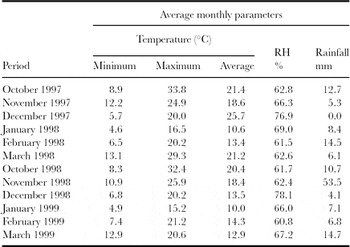
The experiment was conducted at Shahpur village near Chaudhary Charan Singh (CCS) Haryana Agricultural University, Hisar, Haryana, India, located at 29°10′N latitude and 75°46′E longitude, and approx. 215 m above mean sea level. The climate at the site is semi-arid with an average annual rainfall of 385 mm, about 80% of which falls during July–September from the southwest monsoon while the rest is more or less equally distributed during the rest of the year. A typical year has 29–34 rainy days and the maximum dry spell within the monsoon season is between 41 and 48 days. The mean annual pan evaporation of the study area is approx. 2150 mm. The mean maximum and minimum temperatures show a wide range of fluctuation during summer and winter months. A maximum temperature around 48 °C during summer and a temperature about 2 °C accompanied by frost in winter are common in the region. The weather data during the cropping period (Table 1) were collected from the meteorological observatory located at CCS Haryana Agricultural University, about 5 km away from the field site.
Weather data for the cropping period.

RH: relative humidity.
Irrigation system and soil
The selected field was supplied with canal water through the outlet no. 5205/R of Kabir Minor of Balsamand Distributery of the Bhakra Irrigation System. The full supply discharge of Kabir Minor and outlet 5205/R were 0.736 and 0.035 m3 s−1, respectively. The distribution of canal water in the area is regulated by the warabandi irrigation system which allows the owner of a certain plot to use the entire watercourse or field channel flow for a fixed duration of time proportional to the plot size (Singh et al., Reference Singh, Krause, Panda and Flugel2010).
The soil at the experimental site was well-drained loamy-sand with a hydraulic conductivity of 1.0 m d−1. The bulk density was 1.50 Mg m−3 with a saturation water holding capacity of 40.0% (v/v), moisture retention of 21.6% (v/v) at field capacity (–33 kPa) and 10.6% (v/v) at wilting point (–1500 kPa), and the clay content was low at 11.3%. The average electrical conductivity of the saturation paste extract (ECse) at the time of sowing was 2.15 dS m−1.
Treatments, experimentation and crop cultivation
The experiment with the mustard crop was conducted for two consecutive seasons during 1997–99. In the second season the experiment was conducted on a new site in a neighbouring field, having similar agro-hydro-climatic, groundwater and soil conditions. Treatments consisted of combinations of irrigation with saline groundwater (SW, electrical conductivity (EC) 7.48 dS m−1, residual sodium carbonate 0.6 meq l−1, sodium adsorption ratio 7.47, chloride ion 18.0 meq l−1) and good quality canal water (CW, EC 0.4 dS m−1, residual sodium carbonate 0.1, sodium adsorption ratio 0.1, chloride ion 1.1) applied either alone, as a blend or in alternate applications of each water source. Specifically, these treatments were:
T1: Irrigated with CW at 30 and 64 days after sowing (DAS)
T2: Irrigated with SW at 30 and 64 DAS
T3: Irrigated with 50:50 CW: SW mix at 30 and 64 DAS
T4: Irrigated with CW at 30 DAS and SW at 64 DAS.
The experiment was laid out in a randomized block design with four replications; the size of each plot was 16 m2 (4 m × 4 m). As most crops are highly sensitive to salt stress at the germination and seedling stages (Hamdy et al., Reference Hamdy, Abdel-Dayem and Abu-Zeid1993; Minhas and Gupta, Reference Minhas and Gupta1992, Reference Minhas and Gupta1993; Minhas et al., Reference Minhas, Dubey and Sharma2007; Rhoades et al., Reference Rhoades, Kandiah and Mashali1992), a pre-sowing irrigation of 70 mm with CW was applied to all plots for proper germination and establishment of the crop during both the years. The mustard crop was sown at 6 kg ha−1 on 18 October 1997 (first season) and 24 October 1999 (second season). A distance of 0.40 m was kept between two rows. The crop received 65, 15 and 16 kg ha−1 of fertilizer nitrogen (applied as urea), phosphorus (applied as superphosphate) and potassium (applied as potassium chloride), respectively in each year. The post-sowing irrigations at 30 and 64 DAS coincided with the rosette and flowering stages of the crop, respectively; 60 mm of water was applied at each irrigation which was not sufficient to cause drainage below 90 cm depth (Singh, Reference Singh1999). The plots were bunded to prevent runoff during irrigation. Common crop management practices were for all treatments. Thinning was done at 14 days after emergence of seedlings to maintain proper plant-to-plant distance and to avoid inter-plant competition. Weeding was done manually. A systemic insecticide was sprayed on the foliage as a prophylactic measure to avoid aphid infestation. The crops were harvested on 28 March 1998 (first season) and 2 April 1999 (second season).
Measurement of crop growth, yield and water use efficiency
Germination percentage, plant height and leaf area index (LAI) were recorded weekly. The average germination percentage in each treatment was calculated by dividing the germinated seeds by the total number of seeds. Leaf area index, as one of the main plant growth indicators (Singh, Reference Singh1999; Singh et al., Reference Singh, Mishra and Imtiyaz1991), was measured weekly for each plot. Leaf area was determined from plants harvested from 50-cm long portion of a row, which represents an area of 0.20 m2. The leaf laminae from each plant were removed and wiped free of dust before measuring the leaf area. Leaf area index was calculated as, LAI = leaf area (m2) per meter square land area. Grain and straw yields of each plot were measured. The average yield of the four replications under each treatment were computed and reported.
Six soil samples from one location at the centre of each replication were collected at 15 cm intervals to 30 cm and at 30 cm intervals to 150 cm soil depth. Samples were taken at the time of sowing, before and after each irrigation, and at harvest of the crop. Measurements were made of soil water content and EC of the saturation paste extract. The average soil moisture content at 0–15 cm depth was 16.6% (v/v) at sowing, 11.8% at 30 DAS, 15.6% at 64 DAS and 8.9% at harvest. The quantity of water used was calculated as difference in soil storage during the crop season plus irrigation and rainfall. The water use efficiency (WUE, kg ha-mm−1) was calculated as the ratio of yield (kg ha−1) to WU (mm), under each treatment.
Statistical analyses
The statistical analysis of yearly experimental data was done with treatments as the factor. The analysis of variation (ANOVA) technique was carried out on the data for each parameter as applicable to randomized block design (Gomez and Gomez, Reference Gomez and Gomez1984). The significance of the treatment effect was determined using a t-test, and to determine the significance of the difference between the means of the two treatments, least significant differences were estimated. Differences in our study are termed significant at p < 0.05.
RESULTS
Germination and plant growth
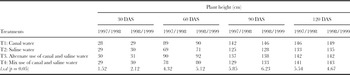
The average germination percentages across all the plots were high (>97%) in both the years; no saline water had been applied prior to or during germination. Moreover, pre-sowing irrigation with good quality canal water had played an important role in reducing the salt level in these cases at the time of germination (Chauhan et al., Reference Chauhan, Singh and Gupta2008). The plant heights recorded at different growth stages showed no variation until the first irrigation was applied at 30 DAS (Table 2). Among treatments, the maximum height was 1.46 m and 1.49 m in T1, while, lower maximum heights, caused by the salinity of the irrigation water were 1.33 m and 1.35 m in T2 during the seasons 1997/98 and 1998/99, respectively.
Plant heights of mustard crop under different treatments.

l.s.d: least significant difference; DAS: days after sowing.
Leaf area index
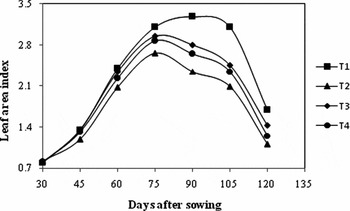
The analysis of data showed there were no significant differences in LAI values during two seasons, thus only the values for the first season are presented (Figure 1). Treatment differences (compared with T1) would be expected to develop after day 30 (when T2 and T4 plants were salinized) and after day 64 (when the T3 plants were salinized). The data for T1 and T3 were not significantly different up to day 60; after that, LAI increased in both the treatments but it was larger in T1 because the second post-sowing irrigation at 64 DAS was given with good quality CW under treatment T1. After day 30, the highest LAI was always associated with T1 and the lowest LAI was always associated with T2. This could be attributed to the fact that both the post-sowing irrigations used good quality CW alone and poor quality SW alone in T1 and T2 treatments, respectively. Further, irrespective of treatments, LAI increased with the advancement of time due to the emergence and enlargement of new branches and leaves during the rosette stage. The peak LAI came earlier in T2, T3 and T4 because there was more salt stress after the second post-sowing irrigation at 64 DAS with different composition of SW, which gradually decreased soil moisture availability, in these treatments due to increased osmotic pressure (Kumar et al., Reference Kumar, Jhorar and Agarwal1996). The trend is almost the same for both years. The effect of irrigation water quality was prominent in leaf area duration also, for instance the LAI in T2 remained below 2.70 and 2.77 throughout the growing period, while it was above 2.70 and 2.77 for about 42 and 45 days in T1, 30 and 33 days in T3 and about 20 and 22 days in T4 during the seasons 1997/98 and 1998/99, respectively.
Leaf area index of mustard crop under different treatment.

Soil salinity
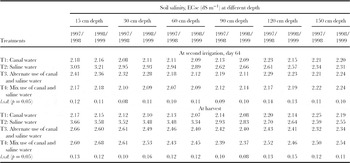
The recorded soil salinity data show no significant differences in ECse values under different treatments at day 30, as no saline treatment had been given before then, thus the ECse values at the time of first irrigation is not reported in the paper. The salinity of the soil profile at the time of second irrigation at day 64 and at the time of harvest for all the treatments for both seasons is presented in Table 3. The results at the second irrigation show that ECse values of upper layer increased under the treatments T2 and T3 where plants were salinized at day 30. At the time of harvest, the soil salinity increased mainly under treatment T2, where both irrigations used water with EC of 7.48 dS m−1; it was lowest in T1. The buildup of soil salinity in soils was directly related to the proportion of SW used in various modes of irrigation. However, the salinities were highest under T2 for obvious reason of applying more saline water during irrigations.
Salinity of soil profile at each depth under different treatments.

l.s.d: least significant difference; ECse: electrical conductivity of the saturation paste extract.
Seed, straw yield and water use efficiency
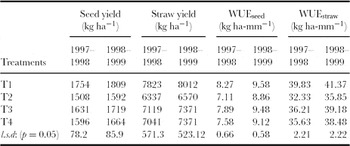
The seed and straw yield data for the four treatments, during both seasons are reported in Table 4. The highest seed and straw yield was recorded in T1. However, T3 and T4 treatments, where irrigation were applied with SW in conjunction with CW, were not significantly different and produced greater seed and straw yield than treatment T2, where both the irrigations were applied with SW. Seed yields were recorded at 93 and 95% of T1 in T3 and 91 and 92% of T1 in T4 treatments, during the seasons 1997/98 and 1998/99, respectively, while straw yields were 91 and 92%, and 90 and 92% of T1, for the corresponding periods. Lowest yields were in T2, where seed and straw yielded at 86 and 88%, and 81 and 82% of T1 during both years. The WUE with respect to both seed yield (WUEseed) and straw yield (WUEstraw), as shown in Table 4, decreased with the decrease in yields. They were maximum in T1 and minimum in T2. Among treatments, the order of WUE was same as it was for seed and straw yield.
Seed, straw yield and water use efficiency of mustard crop under different treatment.

l.s.d: least significant difference; WUE: water use efficiency.
DISCUSSION
The study reveals that use of the most saline groundwater (T2) increased the salinity (ECse) of the upper soil profile from about 2.1 to 3.5 dS m−1, which decreased grain yields in mustard by 12–14% and straw yields by 18–19%. In contrast, use of a mixture of canal water with saline groundwater for two irrigations (T3) or an application of canal water followed by saline water (T4) produced intermediate effects with 5–9% decreases in seed yield and 8–10% decreases in straw yield. Thus, the results suggest that with temporal variation in salinity, mustard yield responds to the average salinity of the soil during the growing season. These results are in conformity with the results obtained for different crops by Bielorai et al. (Reference Bielorai, Shalhevet and Levy1978), Hoffman et al. (Reference Hoffman, Catlin, Mead, Johnson, Francois and Goldhamer1989) and Minhas and Gupta (Reference Minhas and Gupta1993). The salinity buildup was noticed mainly in the agriculturally most important soil layer, i.e. top 30 cm of the root zone (Minhas et al., Reference Minhas, Dubey and Sharma2007) in all the salinity treatments. Similar reports on salt accumulation in soils due to irrigation with poor quality water have come from northwest India (Bajwa and Josan, Reference Bajwa and Josan1989; Chauhan et al., Reference Chauhan, Chauhan and Minhas2007; Kumar et al., Reference Kumar, Jhorar and Agarwal1996; Minhas and Gupta, Reference Minhas and Gupta1992; Minhas et al., Reference Minhas, Dubey and Sharma2007) and elsewhere in the world (Beltran Reference Beltran1999; Jalali, Reference Jalali2007; Rhoades et al., Reference Rhoades, Kandiah and Mashali1992; van Hoorn and van Alphen, Reference van Hoorn, van Alphen and Ritzema1994). Since both treatments using saline water (T3 and T4) produce the same salinity effects, farmers have considerable management flexibility in when and how to apply saline groundwater. The critical factor for farmers is that canal water is becoming scarcer and groundwater is becoming shallower. Farmers are therefore looking for management solutions that simultaneously overcome both these problems. The obvious solution is to devise solutions for crop growth based on irrigation with both canal water and groundwater. However, such solutions are not likely to be accepted if they result in substantial decreases in crop yield. This study concluded that the growth reductions due to saline irrigation are minimized if the application of groundwater occurs later in the growing season, or if this groundwater is mixed with other non-saline water from earlier in the growing season at the same net load of total salt to the soil. The slightly better results during the season 1998/99 over the season 1997/98 are attributed to the fact that during the second season, heavy rains just after first post-sown irrigation leached the salts away from the root zone.
Since good quality water resources are limited and at the same time the water table is also rising continuously and creating environmental hazards of waterlogging and soil salinity in some arid and semiarid regions, it is advisable to use saline groundwater either alone or in conjunction with good quality canal water as supplemental irrigation for crop production and to protect water resources from further salinization. From this study, it can be concluded that saline groundwater is a good source to exploit for supplemental irrigation for salt-tolerant crops like mustard, in which saline groundwater with an EC of 7.48 dS m−1 can be used safely to supplement all post-sowing irrigation with marginal decline in crop yield. This strategy enables mustard production with saline groundwater, giving a yield as high as 95% of the optimum crop yield obtained with good quality canal water. The study needs to be extended to other crops and agro-hydroclimatic areas to explore the possibility of using poor quality water for crop production. Besides substantial increase in production and water resources conservation, this strategy would lend sustainability to agricultural production by impeding the environmental hazards of waterlogging and soil salinization.
Acknowledgement
The financial support provided by the Indian Council of Agricultural Research to conduct the experiment is thankfully acknowledged. The assistance of officials at the Department of Soil and Water Engineering, College of Agricultural Engineering and Technology, Chaudhary Charan Singh Haryana Agricultural University, Hisar, India, during field experimentation and data analysis is duly acknowledged. The authors are also grateful to the editors and referees for their thoughtful comments and constructive suggestions.