Glaucoma is a progressive optic neuropathy leading to blindness if untreated. Worldwide, glaucoma is the leading cause of irreversible blindness and open-angle glaucoma (OAG) accounts for approximately 50 percent of glaucoma blindness (Reference Quigley and Broman22). In a developed country setting, the majority of OAG cases will remain undiagnosed by current case finding strategies (Reference Burr, Mowatt and Hernandez11).
Risk factors for developing OAG are raised intraocular pressure (IOP), increasing age, black ethnicity, family history of glaucoma, myopia, and diabetes (Reference Burr, Mowatt and Hernandez11). A key criterion for a screening program is that early detection leads to a better outcome than late detection. A systematic review (two trials, 500 patients) of treatment effectiveness, demonstrated that treatment reduces the risk of progression in early disease (Reference Maier, Funk, Schwarzer, Antes and Falck-Ytter19). Population screening for OAG might allow the early treatment and, hence, reduce the incidence of visual impairment and blindness. However, it is important to know if the screening for OAG is cost-effective, but existing economic evaluations are insufficient for evidence-based recommendations (Reference Hernandez, Rabindranath and Fraser15). The aim of this study was to model the cost-effectiveness of screening for OAG compared with current practice, in the United Kingdom, of opportunistic case finding.
METHODS
The Model
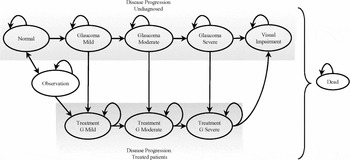
We developed a Markov model (MM) (Figure 1) (Reference Briggs and Sculpher8;Reference Sonnenberg and Beck24). Health state definitions (see Supplementary Box 1, which can be viewed online at http://www.journals.cambridge.org/jid_thc) were based on the severity of binocular visual field loss, adapted from a scoring system of the integrated visual field, reported by Crabb and colleagues (Reference Crabb, Fitzke, Hitchings and Viswanathan12).
Markov model for open-angle glaucoma. Circles represent health states, and the arrows show the possible directions in which individuals could move at the end of each cycle, depending on the transition probabilities. The states considered in the model were those thought to reflect care pathways for people with and without glaucoma. The first line represents the pathway for undiagnosed individuals, whereas the bottom section of the figure reflects glaucoma progression for treated patients. The observation state includes individuals considered suspect but without a definite diagnosis.

The model structure allows individuals to enter as healthy (no OAG), and at varying degrees of OAG severity. Over time, healthy individuals can develop OAG (i.e., new incident cases), whereas those with OAG can develop more severe disease and eventual visual impairment. The treatment states refer to treated disease at each stage. The absorbing state in the model is death and individuals can move into this state from any other state within the model.
The model allows for a cohort of the population, some with OAG, to pass through different strategies. The model identifies that strategy that leads to the largest proportion of individuals with OAG “crossing the bridge” into treatment (Figure 1). A complete version of the model can be obtained from the authors.
Model Strategies
We considered three strategies within the model: current practice and two alternative screening strategies. Current UK practice involves the opportunistic identification of cases by community optometrists as part of a routine eye test. There are many tests and configurations of testing arrangements that are potentially suitable for an OAG screening program; the modeled pathways were determined by consensus by an expert panel. The two alternative screening strategies vary in how screening would be organized. In one, individuals are invited for a screening examination by a glaucoma trained optometrist and undergo a complete glaucoma assessment involving a measure of IOP, an assessment of the optic nerve, and a visual field test. In the second strategy, individuals are invited for an automated test quantifying functional visual field loss or structural damage of the optic nerve, together with a measurement of IOP, by a technician and individuals identified as at risk are then referred for a full glaucoma assessment by a glaucoma optometrist. In all three strategies, any individual identified as positive at the end of screening or case finding would be referred to an ophthalmologist for definitive diagnosis and, if necessary, treatment.
Glaucoma Treatments
Once OAG is diagnosed, we have assumed that treatment would be initiated. There is a cascade of eye drop treatment options for each disease stage as well as their combination with laser or surgical treatment. Evidence on their effectiveness suggested that these could be approximated by a single effect size, but treatment might vary by OAG severity and progression rate (Reference Burr, Mowatt and Hernandez11). We assumed initial medical treatment by a beta blocker or prostaglandin analogue, followed by an additional drop of another class of medications if initial treatment was ineffective. For those for whom this strategy fails, argon trabeculoplasty or surgery (trabeculectomy) is the next treatment step. In addition to medications, treatment involves visits to the ophthalmologist every 6 weeks at the beginning of treatment and a full assessment every 6 months. After surgery, the patient would be seen at an ophthalmology outpatient clinic at 1, 2, 4, 8, 12, and 26 weeks after surgery.
Parameter Estimates Used in the Model
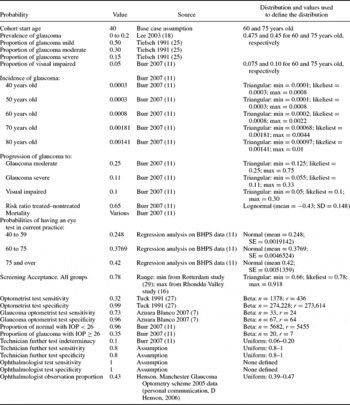
We obtained the model parameter estimates (Tables 1a, b) from a series of systematic reviews of test accuracy, epidemiology, treatment effectiveness, and cost-effectiveness as well as other systematic, focused searches. Detailed description of the parameters estimates can be found in Burr and colleagues (Reference Burr, Mowatt and Hernandez11).
Model Parameter Inputs

IOP, intraocular pressure; BHPS, British Household Panel Survey.
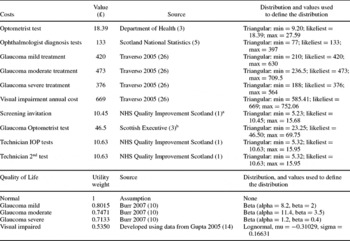
Model Parameter Inputs: Costs and Utilities

aTake into account the cost for national coordination, local health board coordination, screening offices and call and recall, development and maintenance of call and recall software, and development and maintenance of image capture software.
bThe Scottish eye examination includes a full eye examination, visual field, and IOP (e.g., with non-contact tonometry), and supplementary exams if clinically indicated (e.g., applanation pressures and threshold fields).
NHS, National Health Service; IOP, intraocular pressure.
Probabilities
Table 1a reports the prevalence, incidence, and progression of glaucoma parameters used. As there were many potential target groups, each with different risk levels, we ran the model for a range of prevalence values, aiming to identify a prevalence where screening might be considered worthwhile, and thus the population most likely to benefit from screening.
Data on the annual probabilities of having an eye test, by sex and age, came from the British Household Panel Survey (BHPS) (4). We obtained screening acceptance data from the epidemiology review (Reference Burr, Mowatt and Hernandez11). We did not identify any studies reporting the diagnostic accuracy of current practice, thus we derived sensitivity and specificity estimates from Tuck (Reference Tuck27), the most appropriate, in terms of geographical coverage, number of patients seen, and number of participating optometrists.
The accuracy of the glaucoma optometrist testing was taken from a recent study by Azuara-Blanco and colleagues (Reference Azuara-Blanco, Burr, Thomas, MacLennan and McPherson7), a Scottish comparative, masked, performance study. Data from the Baltimore Eye Survey (Reference Sommer, Tielsch and Katz23) were used for the estimation of the proportion of normal or OAG patients with one of the main risk factors for OAG, IOP ≥ 26 mm Hg (Reference Sommer, Tielsch and Katz23). Estimation of the proportion of people able to perform the test (rate of indeterminacy) required for the “technician” screening strategy came from the systematic review of screening tests (Reference Burr, Mowatt and Hernandez11). The model used sensitivity and specificity values for the technician further test equal to or greater than 0.8. As the systematic review showed that no one test or test combination was clearly more accurate and acceptable, we included a range of sensitivity and specificity values in the model, rather than modeling the performance of one test or combination thereof. Finally, ophthalmologist assessment was assumed as the reference standard. For probabilistic sensitivity analysis, we assumed beta distributions for all parameters except for technician further test indeterminacy, sensitivity, and specificity, and the proportion of people referred for observation as glaucoma suspects by an ophthalmologist's diagnostic assessment (uniform distributions).
Costs
Table 1b shows the cost data used (2006 pounds sterling). We used a 2 percent inflation rate for adjustments into a common price year, where no inflation rate indices were available. Where no information on ranges was obtainable, we assumed a triangular distribution and rates of 0.5 and 1.5 times the likeliest value were used as lower and upper limits. We obtained the cost for the optometrist test from the National Health Service (NHS) “sight” test fees (3). For the purposes of costing, we assumed that the IOP testing used Goldmann applanation tonometry (GAT) with disposable tips and that the glaucoma optometrist assessment used the same test combination as ophthalmologist diagnosis (a combination of IOP measurement by GAT, slit lamp examination, funduscopy, and a visual field test). The cost of ophthalmologist diagnosis was based on the cost of two standard ophthalmology outpatient consultations (5) and for the observation state cost where patients judged at risk would be seen yearly for up to 5 years or until OAG was diagnosed.
We estimated the treatment costs from a European study including data from 194 patients, containing data for the United Kingdom by severity of glaucoma (Reference Traverso, Walt and Kelly26). The likeliest value for the cost of visual impairment was taken to be the mean value of the last two disease stages (Reference Traverso, Walt and Kelly26) as these corresponded to the visual impairment category used in this study. We assumed a triangular distribution for probabilistic sensitivity analysis. We used the NHS fees for optometrists in Scotland for the glaucoma optometrist assessment (2), and costs for the “technician screening strategy” from the Scottish Diabetic Retinopathy Screening study (1), and the screening invitation costs (Table 1b) from the same study.
Quality of Life and Utilities
We used EQ-5D utility estimates from a recent UK study involving almost 300 participants (Reference Burr, Kilonzo, Vale and Ryan10), including a subjective and objective assessment of glaucoma severity. We used the objective scores for each health state for the base-case and subjective scores in the sensitivity analysis (Table 1b). We developed the utility state for visual impairment using weight data for the glaucoma severe state and the relative difference from Gupta and colleagues (Reference Gupta, Srinivasan and Mei14). We attached beta distributions to these glaucoma utility weights parameters (Reference Briggs, Sculpher and Claxton9). We assumed that there were no differences in the utility between undiagnosed OAG and treated OAG at each level of severity.
Base-Case Analysis
We ran the base-case analysis for cohorts of 40-, 60-, and 75-year-old males, for a range of prevalence values, for a lifetime horizon with screening occurring every 3 years, and conducted from the UK NHS perspective. The cycle length was set at 1 year, and a 3.5 percent discount rate was used (6). The results are presented in incremental cost-effectiveness ratios (ICERs). We undertook probabilistic analyses for ranges of OAG prevalence from 0.1 percent to 10 percent.
Sensitivity Analysis
One-way, two-way, and multiway sensitivity analyses for the main parameters within the model were conducted, almost all of which were combined with probabilistic sensitivity analysis. In these analyses, we explored the effects of longer screening intervals (e.g., 5 and 10 years) and varying the annual probability of a community optometrist eye test (2 percent, 13 percent, 37 percent) uptake rates using one-way sensitivity analysis. We varied the sensitivity and specificity of the technician test within plausible ranges of 0.5 to 1.0 for sensitivity and 0.8 to 1.0 for specificity.
Additionally, we performed several targeted sensitivity analyses on a 40-year-old cohort, at a 5 percent (except where otherwise stated) OAG prevalence rate and a 10-year screening interval (a combination that seemed most likely to be cost-effective). As the group of individuals with higher OAG prevalence rate would have a higher chance of visiting the optometrist, we conducted an analysis assuming 1.5 times and twice the probability of having an eye test for current practice strategy. We used alternative triangular probability distributions for progression and incidence using lower and upper base-case limits as more likely values. We also explored the impact of using subjective glaucoma severity-based health state utilities (Reference Burr, Kilonzo, Vale and Ryan10). We also conducted high and low cost scenario analyses.
Finally, we used one-way sensitivity analysis to identify threshold values for the annual cost of visual impairment to explore the effect of widening the perspective of the analysis. This final analysis was conducted for 1 percent and 5 percent prevalence rate of OAG.
RESULTS
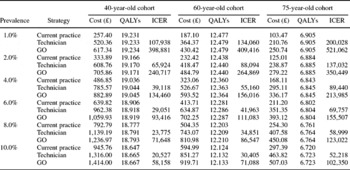
Table 2 reports the estimated relative cost-effectiveness by screening strategy at different levels of prevalence of OAG for cohorts 40, 60, and 75 years of age, respectively. In each analysis as prevalence increases, costs increase and quality-adjusted life-years (QALYs) fall for all three strategies and all age cohorts. In each analysis at each prevalence level and age group considered, current practice is the least costly but also the least effective of the three strategies. Adopting a “technician” strategy is more effective but more costly than current practice and screening by a glaucoma optometrist is more effective but more costly than the “technician” screening strategy.
Base-Case Results: Incremental Cost-Effectiveness for the Selected Start Age Cohorts by Prevalence Rate

ICER, incremental cost-effectiveness ratio; QALYs, quality-adjusted life-years; GO, “glaucoma optometrist” strategy.
For each age group considered, the ICER from adopting “technician” screening compared with current practice falls as prevalence increases. Similarly, for each age group considered, the ICER gained from adopting “glaucoma optometrist” screening compared with “technician” screening also falls as prevalence increases.
In the base-case analysis for a 40-year-old cohort, a “technician” screening strategy compared with current practice has an ICER that society might be willing to pay when prevalence is approximately 6 percent to 10 percent (Table 2) and over 10 percent for a 60-year-old. For a 75-year-old cohort, current practice strategy might be considered worthwhile (Table 2), even when prevalence level is 20 percent (not shown). Furthermore, for no age cohort and no prevalence level is screening by the glaucoma optometrist instead of screening by the technician associated with an ICER < £30,000.
Sensitivity Analysis Performed around the Base Case
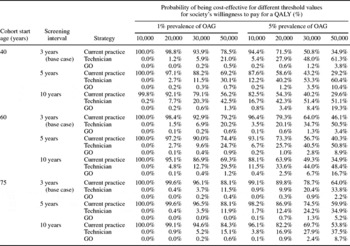
The probabilistic sensitivity analysis (Table 3) indicates that, for every cohort group and at prevalence levels of 1 percent or less, the likelihood that any screening strategy would be more cost-effective than current practice is small. At 5 percent prevalence for the 40-year-old cohort level, there is less than 50 percent likelihood that “technician” screening might be considered cost-effective at a willingness to pay for a QALY of £30,000. Glaucoma optometrist screening is unlikely to be considered cost-effective.
Likelihood of a Strategy Being Cost-Effective for Selected Age Cohorts Start Age and Screening Intervals

QALYs, quality-adjusted life-years; OAG, open-angle glaucoma; GO, “glaucoma optometrist” strategy.
Increasing the screening interval reduces the ICER for each age group and each prevalence level, as OAG on average, progresses relatively slowly and QALY reduction is more than compensated for by costs reduction. Varying the annual uptake rates for community optometrist testing led to both cost and QALYs rising as uptake increased. The higher the uptake, the better the current practice strategy performs. The results of the sensitivity analysis on sensitivity and specificity of the test following the measurement of IOP in the “technician” strategy indicate that the ICER is relatively insensitive to changes in these variables.
Targeted Sensitivity Analyses
Further sensitivity analysis for a 40-year-old cohort, 10-year screening interval and a 5 percent OAG prevalence indicated that screening with the “technician” strategy might be considered worthwhile (see Supplementary Table 1a, which can be viewed online at http://www.journals.cambridge.org/jid_thc). Probabilistic sensitivity analysis demonstrates that the uncertainty around model parameter estimates was important, for example, even though the ICER for the comparison of the “technician” with the current practice strategy is £20,571, there is only 42 percent likelihood that the cost per QALY would be less than £20,000.
Furthermore, sensitivity analyses on uptake of community optometrist testing demonstrated that the QALY gain for the current practice strategy more than compensates for its higher cost. The ICER of the “technician” strategy compared with current practice increased, as did the ICER for the comparison of the “glaucoma optometrist” strategy compared with the “technician” strategy. Changes to the rate of OAG incidence did not greatly alter cost-effectiveness, however; as the rate of progression increased (see Supplementary Table 1b “high,” which can be viewed online at http://www.journals.cambridge.org/jid_thc), then the likelihood that either screening strategies could be considered cost-effective increased, as screening is likely to detect more cases and, hence, delay progression. Using alternative valuations for health utilities, varying the cost of diagnosis by the ophthalmologist, the costs of treatment, inviting people to be screened, or their subsequent tests had little effect on cost-effectiveness.
The threshold analysis for the cost of visual impairment and 1 percent OAG prevalence shows the “technician” strategy dominates the current practice strategy when the annual cost for visual impairment is around £16,000; moreover, the ICER is less than £30,000 if the cost of visual impairment is greater than £8,800. For the “glaucoma optometrist” strategy to be considered cost-effective compared with the “technician” strategy would require the annual cost of visual impairment to be greater than £40,000 (see Supplementary Figure 1, which can be viewed online at http://www.journals.cambridge.org/jid_thc).
DISCUSSION
We conducted a model based cost-utility analysis of the screening for OAG that compared technician- or glaucoma optometrist-based screening with current practice (e.g., opportunistic case finding). Data to populate this model came from a series of systematic reviews of the literature and incorporated extensive sensitivity analyses to the imprecision surrounding parameter estimates and other forms of uncertainty. The distributions used to characterize the statistical imprecision varied by parameter but were consistent with prior experience about which type of distribution would be appropriate for the type and nature of the data available (Reference Iversen17;Reference Philips, Ginnelly, Sculpher, Claxton, Golder, Riemsma, Woolacoot and Glanville21). Although, the best use was made of, in some cases, limited data, further information on the value of almost all parameter estimates would be useful.
Our study suggests that general population screening is unlikely to be cost-effective as the prevalence of OAG in the younger cohorts (estimated 0.9 percent at age 50), most likely to enjoy the benefits of screening for longer, is too low. However, screening might be cost-effective for selected “at risk” subgroups. Targeted screening of 40 to 50 year olds with a risk factor (e.g., black ethnicity or those with a family history of glaucoma) is more likely to be cost-effective assuming a prevalence of OAG between 3 and 4 percent and a screening interval of 10 years. These groups account for approximately 6 percent of the UK population.
In our model, costs increase as prevalence increases because a larger proportion of individuals in the cohort incur the costs of diagnosis and the continuing costs of treating the OAG. The mean cost per person and estimated QALYs are higher for the 40-year-old cohort than the older cohorts because they are less likely to die during the time horizon of the model. Estimated mean QALYs fall as prevalence increases because a greater proportion of the cohort experiences the adverse health effects of OAG.
The model was sensitive to the annual costs for visual impairment (VI). The higher the annual cost of VI, the more likely screening is to become cost-effective. The thresholds for this to happen are not dissimilar to the costs estimated by Meads and Hyde (Reference Meads and Hyde20) (e.g., annual cost of VI of approximately £7900 for the first year and £7700 for subsequent years).
The more likely people are to have an eye test in the current practice strategy (i.e. the comparator), the less likely screening is cost-effective. A relative high attendance for eye tests in the current practice setting might explain the somewhat counterintuitive results.
A review of other cost-effectiveness evaluations of screening for OAG (Reference Hernandez, Rabindranath and Fraser15) identified only one previous study that attempted to compare an active screening strategy with current practice (Reference Gooder13). This study also concluded that screening for OAG was not cost-effective. However, a recently published cost-utility analysis of OAG screening in Finland (Reference Vaahtoranta-Lehtonen, Tuulonen and Aronen28) concluded that a screening program could be cost-effective, especially in older groups for whom prevalence rates are higher. In contrast to the Finnish analysis, our model assumes that no one in the cohorts was receiving treatment before screening or opportunistic case detection. The net effect of relaxing this assumption is unclear. Stopping inappropriate glaucoma treatment could make screening more cost-effective. However, care should be taken to consider cost and consequences of those individuals identified as inappropriately treated (e.g., raised IOP but no glaucomatous visual field loss). Furthermore, if individuals were treated appropriately, there would be no benefit from screening and its cost-effectiveness would be lower. A further factor driving the difference between the conclusions of the Finnish study and our work was the inclusion by the Finnish study of the costs of visual impairment. Our results were also sensitive to the inclusion of these higher costs.
One limitation of our study was that the utility associated with treated and untreated glaucoma was assumed to be the same. This strategy ignores any utility loss associated with adverse effects of treatment. Adverse treatment effects are estimated to reduce quality of life by between 7 and 11 percent, depending upon severity of these effects, as estimated by Burr and colleagues (Reference Burr, Kilonzo, Vale and Ryan10). Future studies should consider using a measure appropriate for use within an economic evaluation in people whose glaucoma has not progressed, both before and after treatment has started.
The systematic review identified insufficient evidence to meaningfully distinguish between the variety of tests that might be used in practice. This finding led to the simplification of the care pathways where the battery of tests used by a glaucoma optometrist was represented by a single value for sensitivity and specificity of a test. This and other simplifications (such as the small number of stages to represent disease progression) were made after consultation with experts. Further research to develop the model structure and the associated parameter values is required.
Overall, although the evidence on cost-effectiveness should be treated cautiously, the results indicate some patient groups for which the organization of targeted screening, that is, a surveillance program, might be given further consideration. However, care pathways would need to be in place for those not eligible for screening. In situations where it might be feasible to organize a service for the target population further primary research on the effectiveness and cost-effectiveness of such a program is required. A randomized controlled trial is the optimal study design, but before such a study being undertaken, further research is needed to develop feasible strategies to identify individuals in “at risk” groups and the optimal configuration of screening strategies to maximize screening attendance.
CONCLUSION
General population screening is unlikely to be considered cost-effective. However, screening for OAG is associated with an ICER that society might be willing to pay for particular cohorts of patients, namely, targeted screening for 50 year olds at high risk (e.g., family history and/or black ethnicity) may be worthwhile. Results are sensitive to the assumed annual cost of VI. Further data related to both improving the estimates available for some of the parameters in the model and also from a well-designed controlled study comparing viable screening strategies in the cohorts of patients for whom this research has indicated that screening might be potentially cost-effective are required to confirm the findings.
CONTACT INFORMATION
Rodolfo A. Hernández, MSc, Lic (r.a.hernandez@abdn.ac.uk), Research Fellow, Jennifer M. Burr, MRCOphth, MBChB, MSc (j.m.burr@abdn.ac.uk), Clinical Epidemiologist, Luke D. Vale, PhD (l.vale@abdn.ac.uk), Professor, Health Economics Research Unit, University of Aberdeen, Foresterhill, Aberdeen, Scotland, AB25 2ZD, UK