Introduction
The lesser grain borer, Rhyzopertha dominica (Fabricius) (Coleoptera: Bostrichidae), is one of the most devastating insect pests of stored products worldwide. The eggs of R. dominica are laid externally to the grain, and the first larvae bore into the kernel and develop there until reaching the adult stage (Edde Reference Edde2012). This life cycle makes R. dominica difficult to control, and the current management strategies for this pest are increasingly focussed on the use of semiochemicals (Phillips Reference Phillips1997). Like most arthropods, these pests use olfactory sense to locate suitable hosts on whom they aggregate and mate. Aggregation pheromones are released by males that have previously attacked grains and are attractive to both sexes (Khorramshahi and Burkholder Reference Khorramshahi and Burkholder1981; Edde and Phillips Reference Edde and Phillips2006).
Previous studies have shown that volatile molecules are detected by olfactory sensory neurons (OSNs), which are housed within special sensilla that are usually distributed on the antennomeres and, to a lesser extent, on the maxillary palps (Andersson et al. Reference Andersson, Grosse-Wilde, Keeling, Bengtsson, Yuen and Li2013; Manoharan et al. Reference Manoharan, Fuchs, Sowdhamini and Offmann2013). Diverse olfactory genes, including odorant-binding proteins (OBPs), odorant-degrading enzymes (ODEs), odorant receptors (ORs), ionotropic receptors (IRs), and sensory neuron membrane proteins (SNMPs), are involved in olfactory sensation (Leal Reference Leal2013). Generally, OBPs are thought to mediate reception of the external environment by ORs. The OBP family can be divided into five major subclasses, including classic (six cysteines), minus-C (absence of the second and fifth cysteines), plus-C (eight cysteines and one proline), atypical OBPs, and dimer OBPs (Zhou et al. Reference Zhou, Huang, Zhang, Pickett and Field2004; Gong et al. Reference Gong, Zhang, Zhao, Xia and Xiang2009; Vieira and Rozas Reference Vieira and Rozas2011). Odorants that enter through cuticular pores are bound and solubilised by OBPs, transported through the sensillar lymph, and finally are degraded by ODEs (Leal Reference Leal2013). IRs were recently identified as another class of receptors involved in chemoreception, and are related to the ionotropic glutamate receptors (iGluRs) that function in synapse communication, but have atypical binding domains (Benton et al. Reference Benton, Vannice, Gomez-Diaz and Vosshall2009; Croset et al. Reference Croset, Rytz, Cummins, Budd, Brawand and Kaessmann2010). SNMPs are proteins of the CD36 family that associate with pheromone-responding OSNs (Vogt et al. Reference Vogt, Miller, Litvack, Fandino, Sparks and Staples2009).
Despite the economical importance of R. dominica and the development of semiochemicals for pest control (Phillips Reference Phillips1997; Edde Reference Edde2012), data about the olfactory genes involved in olfaction by this pest have not been reported. Here, we used RNA-seq (Grosse-Wilde et al. Reference Grosse-Wilde, Kuebler, Bucks, Vogel, Wicher and Hansson2011) to gain insights into the complexity of the antenna transcriptome and to identify genes related to R. dominica olfaction. Our study could provide useful information about chemosensory gene families that are needed to achieve a better understanding of olfaction by this pest. Specifically, the transcriptome data presented in this report could facilitate a better understanding of the olfactory mechanisms used by this pest. Identification of the chemosensory genes expressed by these devastating insect pests is especially important for achieving integrated pest control.
Materials and methods
Insects and RNA isolation
Beetles were reared in a laboratory with wheat grains at 28°C, 75% relative humidity, and an 8:16-hour-light:dark photoperiod. For Illumina sequencing, total RNA was extracted from 400 mixed antennae from male and female R. dominica. Mixed RNA extracts were subjected to Solexa sequencing at the Beijing Genomics Institute (Shenzhen, China).
cDNA library construction and illumina sequencing
Samples for transcriptome analysis were prepared using an Illumina kit following the manufacturer’s recommendations. We purified mRNA from 44.4 µg total RNA using oligo (dT) magnetic beads, and then fragmented the mRNA in fragmentation buffer into 200–700 nucleotide sections. The first-strand cDNA was synthesised using random hexamer primers with the fragmented mRNA as templates. The second-strand cDNA was synthesised by adding DNA polymerase I, RNaseH, and dNTPs, and was purified using a QiaQuik PCR Extraction Kit (Qiagen, Hilden, Germany). The cDNA was eluted ethidium bromide buffer for end reparation, poly (A) addition, and connected using sequencing adapters. Fragments of different sizes were selected by agarose gel electrophoresis, and the appropriately sized fragments were subjected to polymerase chain reaction amplification. The library was sequenced using Illumina HiSeqTM 2000 (Illumina, San Diego, California, United States of America).
De novo assembly of sequencing reads
Original image data were processed using Illumina GA Pipeline v1.3 (Illumina, San Diego, California, United States of America) with raw data. The raw reads were cleaned by removing the reads with unknown sequences (“N”) or low quality reads (base quality value Q⩽10 more than 20%, Q 20). De novo transcriptome assembly was carried out using a short reads assembling program, Trinity (Grabherr et al. Reference Grabherr, Haas, Yassour, Levin, Thompson and Amit2011). First, we connected overlapping reads of certain lengths to form longer fragments, which are generally called contigs. Then, reads were mapped to contigs, and the paired-end reads allowed the detection of contigs from the same transcripts and the calculation of distances between contigs. Using Trinity, we combined contigs together to form unigenes that could not be extended on either end. To make the nonredundant unigenes as long as possible, we used the sequence clustering software TGICL v2.1 to process unigenes by sequence matching and redundancy removal (Pertea et al. Reference Pertea, Huang, Liang, Antonescu, Sultana and Karamycheva2003).
Unigene annotation and classification
To validate and annotate the assembled unigenes, we conducted sequence similarity searches using Non-redundant GenBank (NR), Swiss-Prot (Bairoch and Boeckmann Reference Bairoch and Boeckmann1991), Kyoto encyclopaedia of genes and genome (KEGG) (Kanehisa et al. Reference Kanehisa, Araki, Goto, Hattori, Hirakawa and Itoh2008), and cluster of orthologous groups of proteins (COG) (Tatusov et al. Reference Tatusov, Galperin, Natale and Koonin2000) using BLASTX (E-value<1e−5) (Sotiriades and Dollas Reference Sotiriades and Dollas2007) and, for the nucleic-acid database, BLASTN (NT, E-value<1e−5). After NR annotation, Blast2GO was used for gene ontology (GO) annotation of unigenes. After GO annotation of each unigene (Conesa et al. Reference Conesa, Götz, García-Gómez, Terol, Talón and Robles2005), WEGO software was used for GO functional classification of all unigenes and macro distributions of gene functions (Ye et al. Reference Ye, Fang, Zheng, Zhang, Chen and Zhang2006). The KEGG database was used to study genes in complex biological behaviours, and KEGG annotation was used for the pathway annotation of unigenes (Kanehisa et al. Reference Kanehisa, Araki, Goto, Hattori, Hirakawa and Itoh2008). When predicting CDSs, we aligned unigenes to NR, Swiss-Prot. KEGG and, finally, COG. Unigenes aligned to a higher priority database were then not aligned to lower priority databases. Proteins with the highest BLAST rank results were used to determine the coding regions of unigenes, and coding regions were translated into amino sequences using a standard codon table. This method acquired both the nucleotide sequences (5′–3′) and amino acid sequences of unigene coding regions. Unigenes that could not be aligned to any database were scanned by ESTScan for both the nucleotide sequence (5′–3′) direction and amino acid sequence of the predicted coding region.
Gene identification and phylogenetic analyses
To annotate ORs, IRs, pheromone-binding proteins (PBPs), OBPs, CSPs, and SNMPs, contigs were analysed by tBLASTx searches against customised databases and the nonredundant nucleotide collection at NCBI. We identified nonredundant translated proteins by reciprocal BLAST using the comprehensive datasets available for putative chemosensory genes (Nichols and Vogt Reference Nichols and Vogt2008; Vieira and Rozas Reference Vieira and Rozas2011).
Phylogenetic reconstructions of OBPs, PBPs, and CSPs were performed using MEGA5.2.2 software (Tamura et al. Reference Tamura, Peterson, Peterson, Stecher, Nei and Kumar2011). First, we found the best types of protein models. The best protein model for the analysis of OBPs, PBPs, and CSPs was the WAG Model. The rates among sizes for OBPs, PBPs, and CSPs were gamma distributed (G) with invariant sites (I). Then, using the best models, we constructed a maximum likelihood tree (Zhou et al. Reference Zhou, Sun, Ma, Chen and Wang2014). Node support was assessed using bootstrapping with 1000 replicates.
Data deposition
Illumina sequences from R. dominica antennae were submitted to the NCBI Sequence Read Archive under accession number SRP035527.
Results
Rhyzopertha dominica antenna cDNA sequencing and de novo assembly
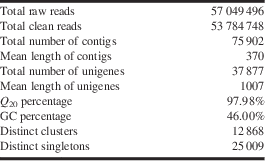
We generated 57 049 496 raw sequencing reads using paired-end sequencing. After stringent quality checks and data cleaning, 53 784 748 high-quality reads were obtained with 97.98% Q 20 base (Table 1). The assembly resulted in 75 902 contigs, with the mean length of 370 base pairs. Clustering of unigenes using TGICL software resulted in 37 877 unigenes with 12 868 distinct clusters and 25 009 distinct singletons. The mean unigene size was 1007 base pairs.
Summary for the antennal transcriptome of Rhyzopertha dominica.

Unigene annotation and classification
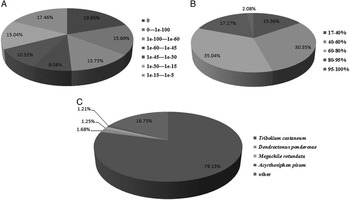
The number of unigenes annotated in each database is shown in Supplementary Table 1. For the homology searches of unigenes against to known proteins in NR, the E-value distributions of the top hits ranged from 0 to 1.0e−5 (Fig. 1A) and the similarity distribution of the top BLASTX hits for each sequence ranged from 17% to 100% (Fig. 1B). For species distribution, analysis of R. dominica antenna-specific transcripts revealed putative orthologs for 79.13% of sequences that matched Tribolium castaneum (Herbst) transcripts, 1.68% of sequences that matched Dendroctonus ponderosae Hopkins, 1.25% of sequences that matched Megachile rotundata (Fabricius), 1.21% of sequences that matched Acyrthosiphon pisum Harris, and 16.73% of sequences that matched other species (Fig. 1C).
Characteristics of homology search of Illumina sequences against the Non-redundant GenBank (NR). A: E-value distribution of BLAST hits for each unique sequence with a cut-off E-value of 1.0e−5. B: Similarity distribution of the top BLAST hits for each sequence. C: Species distribution is shown as a percentage of the total homologous sequences with an E-value of at least 1.0e−5. We used the first hit of each sequence for analysis.

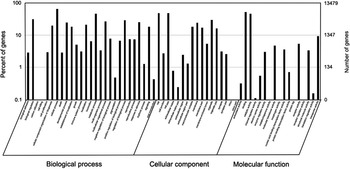
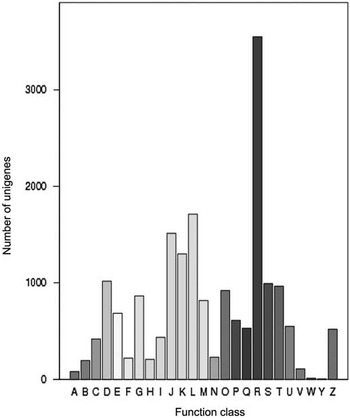
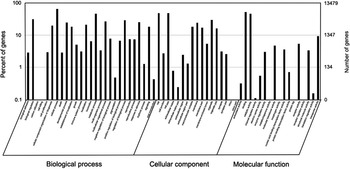
To identify biological pathways active in R. dominica antennae, we mapped the 37 877 sequences to canonical reference pathways in KEGG, assigning 18 159 sequences to 258 KEGG pathways (Supplementary Table 2). The GO term distribution of the unigene set is shown in Fig. 2. Unigenes with GO terms related to olfaction such as “binding”, “signalling”, and “metabolic process” were identified (Fig. 2), and 9190 unigenes had a COG classification (Fig. 3 and Supplementary Table 3).
Histogram presentation of gene ontology classification in Rhyzopertha dominica. The results are summarised in three main categories: biological process, cellular component, and molecular function. The right y-axis indicates the number of genes in a category. The left y-axis indicates the percentage of a specific category of genes in that main category.
Cluster of orthologous groups of proteins function classification. A: RNA processing and modification; B: chromatin structure and dynamics; C: energy production and conversion; D: cell cycle control, cell division, chromosome partitioning; E: amino acid transport and metabolism; F: nucleotide transport and metabolism; G: carbohydrate transport and metabolism; H: coenzyme transport and metabolism; I: lipid transport and metabolism; J: translation, ribosomal structure, and biogenesis; K: transcription; L: replication, recombination, and repair; M: cell wall/membrane/envelope biogenesis; N: cell motility; O: posttranslational modification, protein turnover, chaperones; P: inorganic ion transport and metabolism; Q: secondary metabolites biosynthesis, transport, and catabolism; R: general function prediction only; S: function unknown; T: signal transduction mechanisms; U: intracellular trafficking, secretion, and vesicular transport; V: defense mechanisms; W: extracellular structures; Y: nuclear structure; Z: cytoskeleton.

Identification of candidate OBPs, CSPs, and PBPs
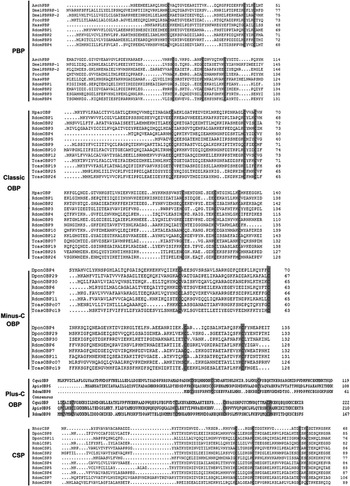
Bioinformatics analysis identified 12 candidate OBPs, among which only RdomOBP9 was not a full-length transcript, although it possessed all of the conserved sites (six cysteines). Of the 12 OBPs, RdomOBP6, RdomOBP7, and RdomOBP11 belong to the Minus-C OBPs, which lack the second and fifth cysteines; RdomOBP1, RdomOBP2, RdomOBP3, RdomOBP4, RdomOBP5, RdomOB9, RdomOBP10, and RdomOBP12 are classic OBPs with six cysteines; and RdomOBP8 is a Plus-C OBP, as characterised by additional cysteine residues (Fig. 4). Accession numbers for the amino acid sequences of OBPs, CSPs, and PBPs used in the Fig. 4 are listed in Supplementary Table 4.
Alignment of amino acid sequences of pheromone-binding proteins (PBPs), odorant-binding proteins (OBPs), and chemosensory proteins (CSPs) of Rhyzopertha dominica. The conservative areas are highlighted in black.

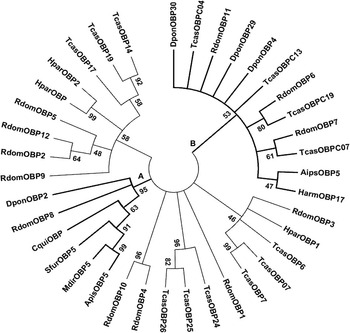
In the OBPs phylogenic tree (Fig. 5), RdomOBP8 was grouped with DponOBP2, CquiOBP, SfurOBP5, MdirOBP5, and ApisOBP5; only Plus-C OBPs (marked as A) were branched to others. Similarly, RdomOBP7 was grouped with TcasOBPC07, and RdomOBP6 was grouped with TcasOBPC19 (two Minus-C OBPs from T. castaneum); both were of Minus-C types that branched with other Minus-C OBPs (RdomOBP11, DponOBP30, DponOBP29, DponOBP4, TcasOBPC04, TcasOBPC013, ApisOBP5, and HarmOBP17), which are marked as B (Fig. 5). The remaining RdomOBPs belonged to the classic OBPs. Among these, RdomOBP, RdomOBP2, RdomOBP5, RdomOBP9, and RdomOBP12 showed higher homology than RdomOBP1 and RdomOBP3. Additionally, RdomOBP4 and RdomOBP10 formed a branch of classic OBPs. Accession numbers for the amino acid sequences of OBPs, CSPs, and PBPs used in the phylogenetic analyses are listed in Supplementary Table 4.
Phylogenetic tree of Rhyzopertha dominica candidate odorant-binding proteins (OBPs) compared with OBPs from other species insects. Included are OBPs from R. dominica (Fabricius) (Coleoptera: Bostrichidae) (Rdom), A. pisum Harris (Hemiptera: Aphididae) (Apis), Culex quinquefasciatus Say (Diptera: Culicidae) (Cqui), Dendroctonus ponderosae Hopkins (Coleoptera: Curculionidae) (Dpon), Helicoverpa armigera Hübner (Lepidoptera: Noctuidae) (Harm), Holotrichia parallela Motschulsky (Coleoptera: Scarabaeidae) (Hpar), Metopolophium dirhodum (Walker) (Hemiptera: Aphididae) (Mdir), Spodoptera frugiperda Smith (Hemiptera: Delphacidae) (Sfru), and Tribolium castaneum (Herbst) (Coleptera: Tenebrionidae) (Tcas).

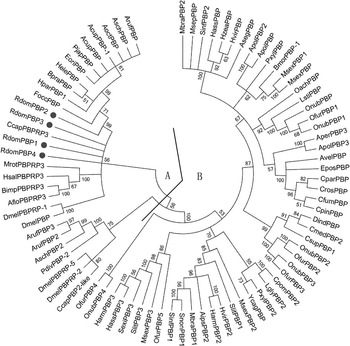
We identified four transcripts encoding putative PBPs in R. dominica; all represented full-length genes. Alignment of the amino acid sequences of all four RdomPBPs revealed the six conserved cysteine residues (Fig. 4). In the phylogenetic tree, the four RdomPBPs were found closely grouped together. The PBPs from Lepidoptera clustered together as area B (Fig. 6), whereas the RdomPBPs clustered with the PBPs from the other species in area A.
Phylogenetic tree of Rhyzopertha dominica candidate pheromone-binding proteins (PBPs) compared with PBPs from other species of insects. Included are PBPs from R. dominica (Fabricius) (Coleoptera: Bostrichidae) (Rdom), Agrotis ipsilon (Hufnagel) (Lepidoptera: Noctuidae) (Aips), Agrotis segetum Denis and Schiffermüller (Lepidoptera: Noctuidae) (Aseg), Anomala cuprea Hope (Coleoptera: Scarabaeidae) (Acup), Anomala octiescostata Burmeister (Coleoptera: Scarabaeidae) (Aoct), Anomala orientalis (Waterhouse) (Coleoptera: Scarabaeidae) (Aori), Anomala rufocuprea Motschulsky (Coleoptera: Scarabaeidae) (Aruf), Anomala schonfeldti Ohaus (Coleoptera: Scarabaeidae) (Asch), Antheraea pernyi (Guérin-Méneville) (Lepidoptera: Saturniidae) (Aper), Antheraea polyphemus (Cramer) (Lepidoptera: Saturniidae) (Apol), Apis florea (Fabricius) (Hymenoptera: Apidae) (Aflo), Argyrotaenia velutinana (Walker) (Lepidoptera: Tortricidae) (Avel), Bombus impatiens Cresson (Hymenoptera: Apidae) (Bimp), Bombyx mori Linnaeus (Lepidoptera: Bombycidae) (Bmor), Brachysternus prasinus Guérin-Méneville (Coleoptera: Scarabaeidae) (Bpra), Ceratitis capitata Wiedemann (Diptera: Tephritidae) (Ccap), Chilo suppressalis (Walker) (Lepidoptera: Pyralidae) (Csup), Choristoneura fumiferana (Clemens) (Lepidoptera: Tortricidae) (Cfum), Choristoneura parallela Robinson (Lepidoptera: Tortricidae) (Cpar), Choristoneura pinus Freeman (Lepidoptera: Tortricidae) (Cpin), Choristoneura rosaceana (Harris) (Lepidoptera: Tortricidae) (Cros), Cnaphalocrocis medinalis Guenée (Lepidoptera: Crambidae) (Cmed), Cydia pomonella Linnaeus (Lepidoptera: Tortricidae) (Cpom), Diaphania indica (Saunders) (Lepidoptera: Crambidae) (Dind), Drosophila melanogaster Meigen (Diptera: Drosophilidae) (Dmel), Epiphyas postvittana (Walker) (Lepidoptera: Tortricidae) (Epos), Frankliniella occidentalis (Pergande) (Thysanoptera: Thripidae) (Focc), Harpegnathos saltator Jerdon (Hymenoptera: Formicidae) (Hsal), Helicoverpa armigera Hübner (Lepidoptera: Noctuidae) (Harm), Helicoverpa assulta (Guenée) (Lepidoptera: Noctuidae) (Hass), Helicoverpa zea (Boddie) (Lepidoptera: Noctuidae) (Hzea), Heliothis virescens (Krieger et al.) (Lepidoptera: Noctuidae) (Hvir), Holotrichia parallela Motschulsky (Coleoptera: Scarabaeidae) (Hpar), Hylamorpha elegans (Burmeister) (Coleoptera: Scarabaeidae) (Hele), Leguminivora glycinivorella (Matsumura) (Lepidoptera: Tortricidae) (Lgly), Loxostege sticticalis (Linnaeus) (Lepidoptera: Crambidae) (Lstic), Mamestra brassicae (Linnaeus) (Lepidoptera: Noctuidae) (Mbra), Manduca sexta (Linnaeus) (Lepidoptera: Sphingidae) (Msex), Megachile rotundata (Fabricius) (Hymenoptera: Megachilidae) (Mrot), Mythimna separate (Walker) (Lepidoptera: Noctuidae) (Msep), Orthaga achatina (Butler) (Lepidoptera: Pyralidae) (Oach), Ostrinia furnacalis (Guenée) (Lepidoptera: Pyralidae) (Ofur), Ostrinia nubilalis (Hübner) (Lepidoptera: Pyralidae) (Onub), Phyllopertha diversa Waterhouse (Coleoptera: Scarabaeidae) (Pdiv), Plutella xylostella (Linnaeus) (Lepidoptera: Plutellidae) (Pxyl), Popillia japonica Newman (Coleoptera: Scarabaeidae) (Pjap), Sesamia inferens (Walker) (Lepidoptera: Noctuidae) (Sinf), Sesamia nonagrioides Lefèbvre (Lepidoptera: Noctuidae) (Snon), Spodoptera exigua (Hübner) (Lepidoptera: Noctuidae) (Sexi), Spodoptera littoralis Boisduval (Lepidoptera: Noctuidae) (Slit), and Yponomeuta cagnagellus (Hübner) (Lepidoptera: Yponimeutidae) (Ycag).

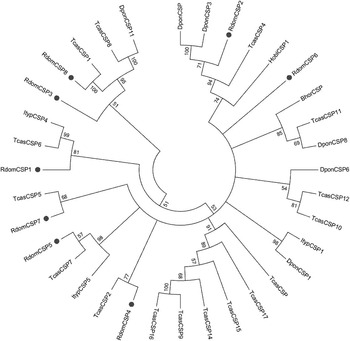
A total of eight transcripts encoding putative CSPs were identified in R. dominica, including two transcripts (RdomCSP3 and RdomCSP5) that were not full-length, but possessed all of the conserved sites, whereas the other six represented full-length genes. Alignment of the amino acid sequences of all eight RdomCSPs showed the four characteristic conserved CSP cysteine residues (Fig. 4). In the CSP phylogenic tree (Fig. 7), RdomCSP8 shared the same branch with TcasCSP1 (a Coleoptera gene), and both were closely related to TcasCSP8 and DopnCSP11 (another Coleoptera gene); all of these CSPs were distantly related to RdomCSP3. Similarly, RdomCSP7, RdomCSP5, and RdomCSP4 shared the same branches with TcasCSP5, TcasCSP7, and TcasCSP2, respectively. RdomCSP2 was deeply rooted with CSPs from D. ponderosae. In that clade, RdomCSP6 could also be found, but did not share a branch with any sequence. We must note that despite the use of a large number of CSPs downloaded from NCBI, the RdomCSPs shared branches only with D. ponderosae and T. castaneum. This pattern was true for multiple alignments (Fig. 4).
Phylogenetic tree of Rhyzopertha dominica candidate chemosensory proteins (CSPs) compared with CSPs from other species of insects. Included are CSPs from R. dominica (Fabricius) (Coleoptera: Bostrichidae) (Rdom), Dendroctonus ponderosae Hopkins (Coleoptera: Curculionidae) (Dpon), Batocera horsfieldi (Hope) (Coleoptera: Cerambycidae) (Bhor), Holotrichia oblita Faldermann (Coleoptera: Scarabaeidae) (Hobl), Ips typographus (Linnaeus) (Coleoptera: Curculionidae) (Ityp), and Tribolium castaneum (Herbst) (Coleptera: Tenebrionidae) (Tcas).

Identification of other chemosensory genes
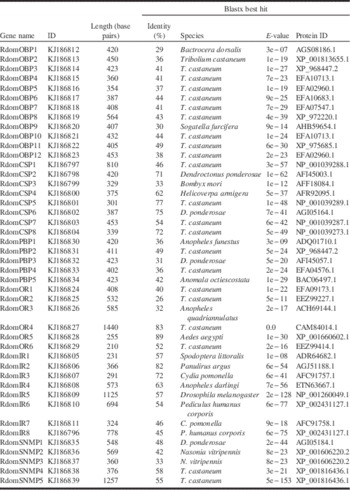
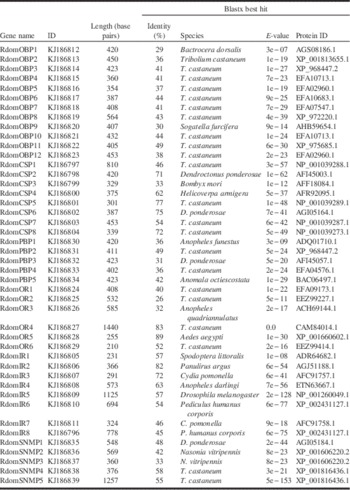
We found five orthologues of SNMP, but only one (RdomSNMP5) was detected as a full-length transcript that encoded 418 amino acids. Six ORs encoding transcripts were annotated in the R. dominica transcriptome. RdomOR4 was a complete open reading frame with 479 amino acids, whereas the other RdomORs all had short amino acid lengths.
We identified eight transcripts for putative IRs in R. dominica, but they were all partial length transcripts. Information about these genes is listed in Table 2.
The information about the odorant-binding proteins (OBPs), chemosensory proteins (CSPs), and pheromone-binding proteins (PBPs) from Rhyzopertha dominica.
Discussion and conclusions
In insects, recognition of odorants occurs through a complex series of events that involve a variety of proteins, such as OBP, CSP, or OR. To identify R. dominica olfactory genes, we sequenced the R. dominica antennal transcriptome. By BLASTX comparative analysis, the transcripts of R. dominica showed the most similarity to T. casteneum (79.13%), followed by D. ponderosae (1.25%), and M. rotundata (1.21%), while 16.73% sequences matched to other species. Possible reason for this result is that T. casteneum, D. ponderosae, and R. dominica are Coleoptera. Elucidating the relationships among these species will require further study. GO annotation indicated that binding and catalytic activities were the most abundant and enriched GO terms, and among the 25 COG function categories, the cluster for “general function prediction” alone (3549; 19.22%) represented the largest group.
Overall, we identified 12 OBPs, four PBPs, eight CSPs, six ORs, eight IRs, and five SNMPs. The numbers of these chemosensory genes identified in the antenna transcriptomes of R. dominica were clearly lower than the numbers of D. ponderosae (31 OBPs) (Andersson et al. Reference Andersson, Grosse-Wilde, Keeling, Bengtsson, Yuen and Li2013), ant (11–21 CSP), Megacyllene caryae Gahan (57 ORs) (Mitchell et al. Reference Mitchell, Hughes, Luetje, Millar, Soriano-Agatón and Hanks2012), or T. castaneum (265 Ors, 49 OBPs, and 19 CSPs) (Richards et al. Reference Richards, Gibbs, Weinstock, Brown, Denell and Beeman2008); 454 pyrosequencing for M. caryae and Illumina sequencing for R. dominica likely account for this difference. For D. ponderosae, the more tissues and development stages might become the reasons for this difference. Some transcriptome sequencing results showed a similar number of some putative olfactory genes as our transcriptome data, such as Anopheles gambiae Giles (Diptera: Culicidae) (16 OBPs), Aedes aegypti (Linnaeus) (Diptera: Culicidae) (17 OBPs), and Culex quinquefasciatus Say (Diptera: Culicidae) (12 OBPs) (Vogt Reference Vogt2002; Zhou et al. Reference Zhou, Huang, Zhang, Pickett and Field2004; Pelletier and Leal Reference Pelletier and Leal2009; Vieira and Rozas Reference Vieira and Rozas2011), while the number of chemosensory genes identified in Agrilus planipennis Fairmaire (Coleoptera: Buprestidae) is even smaller (nine OBPs, two ORs, and one SNMP; Mamidala et al. Reference Mamidala, Wijeratne, Wijeratne, Poland, Qazi and Doucet2013). However, it might be a mistake to compare the number of genes identified in a genome with the number of transcripts in a specific tissue at a specific life stage (Andersson et al. Reference Andersson, Grosse-Wilde, Keeling, Bengtsson, Yuen and Li2013). Indeed, many factors, including developmental stages (Engsontia et al. Reference Engsontia, Sanderson, Cobb, Walden, Robertson and Brown2008; Xia et al. Reference Xia, Wang, Buscariollo, Pitts, Wenger and Zwiebel2008), mating (Allen and Wanner Reference Allen and Wanner2011), sexes and tissues (Li et al. Reference Li, Zhang, Chen, Zhang and Wang2014) could affect gene expression patterns and/or levels. For example, one third of the transcripts encoding OBPs identified in D. ponderosae were not found in the antennal cDNA library, but rather in the cDNA libraries from other body parts (Andersson et al. Reference Andersson, Grosse-Wilde, Keeling, Bengtsson, Yuen and Li2013). Identified cDNAs representing five pheromone binding proteins (PBPs) in Asian corn borer, and PBP2 and PBP3 transcripts were expressed at high male-biased levels (Allen and Wanner Reference Allen and Wanner2011). In other insects, some OBPs and CSPs are expressed only in nonolfactory tissues, suggesting that these proteins might have physiological functions that are independent of olfaction (Galindo and Smith Reference Galindo and Smith2001; Wanner et al. Reference Wanner, Isman, Feng, Plettner and Theilmann2005; Pelosi et al. Reference Pelosi, Zhou, Ban and Calvello2006). Therefore, comparing the number of genes identified in a genome with the number of transcripts in a specific tissue at a specific life stage might yield misleading results. In insects, olfaction is used to recognise volatile cues to detect food, predators, and mates. The results from the present study will be fundamental for future functional studies of this process.
Acknowledgements
This study was supported and funded by Fundamental Research Funds for the Central Universities (2013PY046).
Supplementary material
To view supplementary material for this article, please visit http://dx.doi.org/10.4039/tce.2015.13