Introduction
How are HR policies decided in academia and by extension in high skills sectors? In this article, we use a bargaining framework to explain one particular HR policy, maternity leave generosity, and University of Hamburg, Germany across UK universities.
The importance of maternity and childcare entitlements has been widely acknowledged by both scholars and policy-makers: evidence shows that well paid, non-transferable and flexible provisions with respect to maternity and child care-giving mitigate the “baby penalty” women face in the labour market and help reduce gender inequalities both in the household and at the workplace (Gornick et al. Reference Gornick, Meyers and Ross1997; Mandel and Semyonov Reference Mandel and Semyonov2006; Kleider Reference Kleider2015; Farré Reference Farr2016). Many OECD countries have embarked on a number of changes of parental leave policies in the last decadesFootnote 1, particularly in Europe, under the homogenising pressure of the European Union. Yet, and despite these legislative changes, the generosity of parental leave entitlements varies significantly not only across countries but, within a country, and also across and within sectors.
Why, despite pressures, do we still observe a large variation in maternity provisions? To shed more light on this issue, we focus on one sector in a single country, where data are available, namely the Higher Education sector in the UK. This has multiple advantages. First, detailed data on maternity provisions exist for the entire universe of institutions in this sector. Second, the academic environment is characterised by human capital as main input, reducing the influence of unobservable characteristics, such as production technology. Third, there exists an independent measure of the quality of British higher education institutions provided by the Research Excellence Framework based both on research outputs (e.g. publications, performances, and dissemination) and the impact beyond academia of the research produced. This assessment allows us to gauge the impact of institutional quality on Human Resources policies, at least in the context of the UK university sector.
We analyse 214 maternity schemes across 160 Higher Education Institutions (HEIs) in the UK and show that there is a significant variation in the generosity of maternity leaves even in this sector: only seven universities entitle mothers to up to 6 months of full salary replacement, many universities grant only 4 weeks of fully paid leave while some institutions offer no maternity provisions on top of the statutory entitlements.Footnote 2 In addition, there is also a stark variation between maternity schemes and eligibility criteria, with staff on fixed-term contracts, such as researchers and teaching fellows frequently excluded from most of the occupational maternity schemes provided on top of the statutory provisions.Footnote 3
We employ a bargaining model to explain this significant variation in maternity provisions across UK universities. In a bargaining framework, factors that enhance the negotiating position of female employees are associated with more generous maternity packages, whereas features that increase the bargaining strength of employers are associated with lower generosity. As a result, our theory predicts that universities with higher shares of unionised employees, those with a larger proportion of female professors, and institutions which put greater emphasis on research offer better maternity provisions. In contrast, universities with higher student-to-staff and admin-to-academic ratios grant less generous policies. According to our model, universities’ income plays a very limited role in explaining the generosity of maternity policies.
The bargaining framework performs very well in the data. Most of our predictions are empirically supported. In particular, universities’ income has no effect on maternity generosity. The only exception is the level of unionisation, which is statistically insignificant. This might be due to the fact that unions have many constituencies, which are not all concerned with maternity policies. We also show which universities – given their characteristics – over- or underprovide in terms of maternity and childcare benefits.
Our research contributes to the wider literature on gender equity in childbearing and rearing entitlements and capabilities. Many scholars in this literature analyse the institutional channels of agency inequality between mothers and fathers in taking childbearing and caring decisions and highlight the role that institutions play in shaping human capabilities (Hobson et al. Reference Hobson, Fahln and Takcs2011; Reference Hobson, Duvander and Halldén2006; Hobson and Lindholm Reference Hobson and Lindholm1997, inter alia). We add further evidence of a large variation in the institution-based constraints and incentives that hinder or enhance the effective possibility to exercise parental and childcare entitlements in a human capital intensive sector, the UK academic sector. Our research also contributes to the larger debate on women’s under-representation in qualified and competitive sectors by examining the structural conditions that encourage maternity and child caring across UK higher education institutions.
Our article is structured as follows: in the next section, we place our research within the wider theoretical and empirical literature on maternity and parental leave provisions. In the third section, we present a parsimonious and stylised bargaining model to illustrate our main hypotheses on the variation of maternity and childcare benefits across UK higher education institutions (HEIs). Data, variables and research design are presented in the fourth section. We discuss our findings and the robustness of our empirical analysis in the fifth section while the final section concludes and points to future research avenues.
Parental leave and work-life balance policies in organisations
This article speaks to a wide range of theoretical and empirical research on maternity and parental leave provisions. Many papers in this literature stress the importance of considering both length and generosity in designing maternity arrangements. As for length, empirical evidence suggests a U-shaped relationship between the duration of maternity leave and female participation in the labour force (Akgunduz and Plantenga Reference Akgunduz and Plantenga2013; Genre, Salvador and Lamo 2010; Pettit and Hook Reference Pettit and Hook2005). Very long or too short leaves are associated with a lower share of working women but, at middling levels, maternity leaves increase retention of mothers in the workforce.Footnote 4 Long leaves, however, generate cascade effects on several other dimensions as they typically translate to lower levels of work experience, higher chances of career interruption and lower levels of productivity, thereby reducing the incentives for the firm to invest in mothers on leave (Del Rey et al. Reference Del Rey, Racionero and Silva2017; Ulker and Guven Reference Ulker and Guven2011; Genre et al. Reference Genre, Gomez-Salvador and Lamo2010; Albrecht et al. Reference Albrecht, Edin, Sundstrm and Vroman1999).Footnote 5
In contrast to these works, our article focuses on the generosity of maternity leaves rather than the length which is fully determined by statutory provisions. Well paid maternity benefits with high replacement incomesFootnote 6 are consistently associated with higher employment and retention rates of mothers and higher levels of well-being and job satisfaction of women employees; scarcely paid or unpaid leaves correspond to having no leave at all.Footnote 7 We analyse the variation in the generosity of occupational maternity pay, and borrow from this research, three measures of maternity scheme generosity – namely, full week salary replacement; number of weeks for which salary replacement is granted, either fully or partially; and the so called full weeks’ equivalent, which estimates the full monetary value of the paid maternity benefits. We complement this literature by documenting a large variation in the generosity of maternity leaves even in a relatively homogeneous sector, the UK university sector.
Our article also intersects with the wide research on work-life balance provisions in organisations. Like our own, many papers in this literature link the variation in maternity policies to firms and organisations’ characteristics and find that size, the composition of the workforce and the share of women in executive positions are likely predictors of generous maternity provisions both in for-profit and not-for-profit sectors (Galinsky and Bond, Reference Galinsky and Bond1998; Konrad and Mangel, Reference Konrad and Mangel2000; Secret et al. Reference Secret, Sprang, Rompf and Anderson2000; Evans Reference Evans2001; Pitt-Catsouphes et al. Reference Pitt-Catsouphes, Swanberg, Bond and Galinsky2004).Footnote 8 Unlike these papers, however, our research shows that universities’ budgets and financial resources have little effect on the provisions of generous maternity benefits. Scholars in this literature, moreover, examine the business benefits and the costs of work-life balance policies across sectors and in a cross-country perspective (White et al. Reference White, Hill, Mcgovern, Mills and Smeaton2003; Yasbek Reference Yasbek2004). In contrast, our research focuses on a relatively homogeneous environment within a single country, which allows for the identification of local causal effects conditional on the specific context, but cautiously extendible to high-skilled and competitive sectors.
In this sense, our article is in closer conversation with the “capabilities approach” to work-life balance, which emphasises the institutional context and the extent to which institutions allow converting rights and entitlements into de facto opportunities to exert them (Hobson et al. Reference Hobson, Fahln and Takcs2011, Reference Hobson, Duvander and Halldén2006, Hobson and Fahln Reference Hobson and Fahln2009; Hobson and Lindholm Reference Hobson and Lindholm1997; Gregory and Milner Reference Gregory and Milner2009; Lewis Reference Lewis2009; Bovin and Orton Reference Bovin and Orton2009; Dean et al. Reference Dean, Bovin, Vielle and Farvaque2005).Footnote 9 Likewise, a host of theoretical and empirical papers explore the variation in the generosity of social policies through the lenses of institutions and welfare state regimes and the type of incentives provided to workers in liberal versus coordinated market economies (Iversen and Rosenbluth Reference Iversen and Rosenbluth2006; Estevez-Abe Reference Estevez-Abe2006; Soskice Reference Soskice2005; Misra Reference Misra1998; Lewis 1992). Our research establishes and provides some explanations for the large variation in maternity provisions within a country, the UK, where “reconciliation” policies until 1997 have been traditionally left to the initiative of the private market,Footnote 10 and within a single homogeneous sector, the higher education system.Footnote 11 In doing so, we add higher internal validity to our findings and advance the likely determinants of maternity generosity in a skilled environment, which cross-sectors and cross-country comparisons are unlikely to capture.
Variation in maternity provisions across UK universities: a bargaining framework
We explain the variation in maternity leaves across UK universities within the framework of a bargaining model (Binmore et al. Reference Binmore, Rubinstein and Wolinsky1986), which, we believe, is able to capture the employees-employers’ dynamics in the context of Higher Education Institutions in the UK (we provide a stylised formalisation of our framework in Appendix A).
Changes in occupational maternity pays across HEIs are proposed by Human Resources teams, which review the existing provisions and suggest potential changes to the relevant university bodies (council, senate, management teams). Occupational maternity benefits in the UK university sector are usually changed concomitantly with changes in statutory provisions or when the government promotes gender oriented activities (such as the Athena Swan or Gender Equality mark programs).Footnote 12 The rationale for policy changes is based among others, on the following considerationsFootnote 13: the current benefits for recruitment and retention of staff; the feedback from employees (generally through surveys); consultation with relevant groups of staff members (for example, female professors); recommendations raised by programs advancing gender balance such as Athena Swan (this is more recent); benchmarking to peer universities or institutions in the public and civil service sectors; and finally, a cost-benefit analysis for the sustainability of the proposed changes.
In a nutshell, maternity leave provisions result from implicit or explicit negotiations between the organisation board and the bargaining units representing the workforce. In the context of UK universities, the two sides involved in this bargaining process are the university management and the female employees. Within this framework, we obtain clear predictions. First, factors which raise the bargaining power of women employees, especially academic women, increase maternity benefits. Second, determinants which increase the cost of providing maternity benefits reduce the generosity of maternity provisions.Footnote 14 Finally, factors that increase the institution’s incentives to retaining mothers in the workforce will also increase the generosity of maternity pay. From the onset, let us stress that most of our results carry through if we only focus on the university’s cost-benefit analysis (indeed, the formal model shows that a cost-benefit analysis is a special case of our framework). The only exceptions are factors that enhance the bargaining position of employees which play no role then.
Maternity benefits in academia: bargaining power of mothers
We posit that one specific condition is likely to affect the bargaining power and the weight of women in this negotiation process and this is the number of female full professors.
Arguably, women in higher academic positions are more likely to influence the policy choices set at university level given that full professors participate in academic committees, which decide on policies and strategies. Since women have a vested interest in better work-life-balance provisions, we argue that a larger share of female professors involved in university policy making, positively affects the generosity of occupational maternity packages.
Second, trade unions usually pursue better work-life balance and parental leave policies and push for these types of policies to be implemented and improved by employers. The University and College Union (UCU) in the UK in general is concerned with employment conditions of university staff in the UK higher education sector. The UCU more specifically aims at implementing better work-life balance policies within UK universities and thereby follows a strategy jointly developed with the German Education Union (GEW), and the Swedish Association of University Teachers (SULF).Footnote 15 Given this stated goal we expect more unionised universities, i.e. higher education institutions with a higher union density, to be better able to negotiate more generous maternity leave policies.
This allows us to derive the following hypotheses:
H1: The larger the previous share of female full professors in a university, the more generous the provision of maternity policies is.
H2: The higher the union density in a university, the more generous the provision of maternity policies is.
Maternity benefits in academia: costs for employers
Along with the conditions that increase the bargaining power of female academics, the decision to grant generous maternity provisions also depends on the costs that these policies impose on the employing institution. We identify three likely restraints: financial resources, workforce composition (academic-to-admin ratio), and student-to-staff ratio, which we discuss in turn.
One intuitive difference between higher education institutions rests on their financial resources. Some universities are richer than others and can grant more generous leaves to their employees. Yet, university income comes into play only if the costs of maternity leave provisions hit the university’s budget constraint (i.e. the costs are higher than the resources the university can reasonably allocate to maternity benefits, which then, and only then, become a function of the university budget). Therefore, we expect the effect of greater financial resources to be only weakly positive.
A second factor likely to affect the costs of providing favourable maternity schemes is the academic-to-admin ratio. The levels of education, training, qualification and skills required for administrative tasks are arguably lower than those necessary to become an academic. While differences in skills and qualifications usually translate into different salary schemes, institutions cannot discriminate female academics and female support staff in granting maternity provisions (and rightly so). We posit that universities employing a higher number of female academic staff (to total members of female administrative staff) are likely to grant relatively less generous maternity policies. As for retail, construction and wholesale industries, the presence of less qualified workforce in universities with a higher proportion of support staff is likely to push up the maternity benefits granted to female employees because salary replacement in this case is cheaper. We therefore expect that the generosity of maternity arrangements is likely to decrease as the ratio between female academic and administrative staff increases.
Indeed, the skill specificity of academic jobs is much more pronounced than for administrative jobs. An administrator in a biology department can relatively easily move across to a similar job in the Humanities or Social Sciences while a sociologist can hardly do the job of a biologist. Also, it is costlier for the universities to invest in skills and productivity of female academics than female administrators. Comparing the sheer numbers of female academics and administrators, the supply of female academics (particularly at senior levels) is much lower. It is therefore harder to replace academic mothers not returning to their job after maternity than mothers with administrative duties. We therefore posit that the bargaining process is geared toward female academics, especially at child bearing age, much more than towards female administrators. For this reason, we expect that the generosity of maternity pay is not influenced by the share of senior female administrators or female administrative staff at child bearing age.
Finally, we argue that the costs of maternity allowances increase with higher student-to-staff ratio across universities. If we assume that teaching, admin, pastoral care, and supervision duties are equally shared among members of staff, as the student-to-staff ratio increases, that is, the number of students per academic member of staff becomes higher, the absence or leave of any academic member generates externalities, in terms of higher workloads, for all the remaining ones. By way of example, suppose there are 20 students allocated across 10 members of staff. If one member leaves, the costs for the remaining member of staff, in terms of workload, are negligible compared to a case where 20 students have to be re-allocated across 4 members only. In this latter case, each academic member becomes highly indispensable and generous leave policies become costlier in terms of re-allocation of pastoral, teaching, and supervision tasks among other academics. We expect that universities with a higher student-to-staff ratio are therefore less generous in granting maternity leaves compared to universities with lower student-to-staff ratios.
We draw the following hypotheses:
H3: The larger the universities’ budget, the more (weakly) generous the provision of maternity policies is.
H4: The higher the academic-to-admin ratio, the less generous the provision of maternity policies is.
H5: The higher the student-to-staff ratio in a university, the less generous the provision of maternity policies is.
Maternity benefits in academia: retention of academic staff
Our discussion of the determinants of maternity provisions across higher education institutions in the UK has identified a number of factors that are either likely to increase the bargaining power of women in academia (i.e. number of female professors) or to increase the costs of generous provisions across institutions (i.e. university income, academic-to-admin ratio and student-to-staff ratio).
There is, however, an additional factor, ingrained in the UK academic system, which affects both women’s bargaining power and universities’ incentives to retain productive mothers, that is the research intensity of the institution as measured for example through the REF – Research Excellence Framework.Footnote 16 The REF is a process of expert review, which assesses the quality of the outputs, the impact, and the environment of the research produced in the UK higher education institutions. REF scores serve both as benchmarks for the allocation of public investments in research activities and as indicators of the quality of research carried out across British universities. Higher scores in the REF entail a larger amount of funding and higher reputational returns for the academic institutions.Footnote 17
We argue that research intensity is an important predictor of the generosity of maternity policies offered to women in academia for two reasons. First, research intensive universities are equipped with screening and recruitment mechanisms that select high-quality and highly productive academic profiles (researchers who publish four-star or three-star articles, to use the language of the REF), or high-impact scholars. Given the high costs of recruitment, highly ranked universities have greater incentives to retain productive scholars by “attracting” them with additional benefits such as more generous maternity provisions. Second, highly productive academics are also more likely to be poached by competing universities and to obtain outside offers, which increase their bargaining power. Both effects lead to the same predictions, namely that research intense universities have more generous maternity policies in place than less research oriented academic institutions in order to retain highly productive mothers.Footnote 18
We derive the following final hypotheses:
H6: The higher the research intensity of the university, the more generous the provision of maternity policies is.
H7: The higher the share of female academics at child rearing age, the more generous the provision of maternity policies is.
Summary of hypotheses
We expect the generosity of maternity leaves across UK universities to increase as the bargaining power of academic women increases and the relative costs of maternity pay decrease. Women’s bargaining position is expected to be higher in unionised universities and those with higher shares of female professors. The costs of granting favourable maternity policies are likely to depend on academic-to-admin ratio and student-to-staff ratio, while the institution’s income is expected to have a limited effect on maternity leave generosity. Finally, we predict that maternity leaves are more generous in institutions with a higher share of female academics at child bearing age and research oriented universities, where academic women have more bargaining power and the costs of generous policies are offset by the higher returns of hiring highly productive researchers.
Data and empirical analysis
Maternity leave policies across UK universities
Maternity and parental leave policies have a two-fold aim: to sustain the well-being of women before and after childbirth by entitling them to take time off from working without losing their jobs (maternity length); and to ensure financial support to mothers and parents during their period of protected leave (leave generosity).
In the UK, women employees are entitled to Statutory Maternity Pay (SMP) if they have worked for the same employer continuously for at least 26 weeks up to the 15th week before the expected week of childbirth and they earn on average at least 109 GBP a week. Women that qualify for the SMP get 90 percent of the average weekly earnings (before tax) for the first 6 weeks and the lower of 140.98 GBP or 90 percent of the average weekly earnings for the next 33 weeks.
Given the meagre benefits granted through statutory maternity pay to women in the UK (as compared to other European countries),Footnote 19 most UK universities provide Occupational Maternity Pay (OMP) that tops up the Statutory Maternity Pay in the first 39 weeks of maternity leave. The eligibility criterion to access the OMP usually depends on the length of service and both the payment and the eligibility criteria vary across institutions. For example, the University of Liverpool’s OMP, regardless of the length of service, allows for full salary replacement for the first 8 weeks, half salary plus the SMP rate for the next 16 weeks and only the SMP for the last 15 weeks of ordinary maternity leave. The London School of Economics and Political Science instead grants full salary replacement for the first 18 weeks and the SMP (at the lowest rate) for the last 21 weeks, if the woman has been employed for at least 26 continuous weeks before the expected date of childbirth.
Other universities may offer 2 or more different OMP schemes that either depend on the length of service of the employee (in such cases the employee cannot choose the OMP she prefers), or may not depend on eligibility criteria and the employee is free to choose between different salary replacement schemes. For instance, at the University of Durham women can choose, if they satisfy the unique eligibility criterion, the salary replacement scheme they prefer during the ordinary maternity leave period.
There are two types of schemes in cases where universities offer more than one occupational maternity package. Type one consists of HEIs offering different maternity packages where one is more generous in terms of salary replacement than the other. This depends, usually, on different eligibility criteria, e.g. longer service is required for the more generous package. Type two involves HEIs offering different packages that are roughly similar in terms of monetary value but entail a trade-off between salary and time, namely between a higher level of salary replacement for a shorter period of time and a longer but less paid leave. The choice between the two packages is usually not determined by different eligibility criteria.
Only 30 out of the 160 HEIs, for which data on occupational maternity benefits were available, offer more than 1 package – usually 2. Only eight of the universities with different packages have different eligibility criteria for the different schemes; typically, they require a longer period of service to become eligible for more generous maternity pay.Footnote 20 In the other 22 cases, the two (or more) schemes require the same length of prior employment and have the same monetary value but the maternity pay is split up into different periods with full or partial salary replacement, e.g. 8 weeks of full pay plus 16 weeks of half pay vs. 16 weeks of full pay (e.g. University of Warwick).
Measuring generosity
Arguably the best indicator for the generosity of maternity benefits is the number of weeks for which full salary replacement is paid. On the one hand, if women can take more time out of work – without income cuts – they are certainly advantaged in terms of adapting to their motherhood status without being pressured by income concerns or the need to multi task administration, teaching, and research activities. This increases the probability that women return to their research position without having to take a career break and with possibly minor effects on research and publication activity. On the other hand, salary replacement represents the costliest part of maternity packages for universities.
A look at generosity of maternity pay across British HEIs reveals a large variance across universities which cannot only be explained by different financial constraints faced by the university. We collected data on occupational maternity provisions for 214 different packages across 160 different UK HEIs.Footnote 21
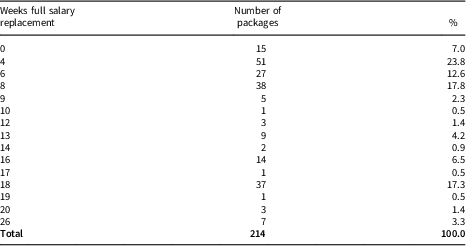
Table 1 gives a summary of our main measure of generosity – weeks with full salary replacement.Footnote 22
Generosity of OMPs across UK HEIs
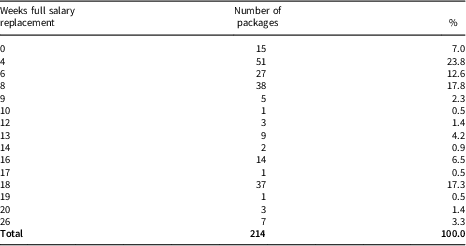
As Table 1 shows, there is a significant variation in the generosity of maternity leaves across UK universities: 15 packages do not top up statutory pay, a large number (51) of provisions grant up to 4 weeks of full pay, and only 7 HEIs provide mothers with up to 6 months of full salary replacement. The number of weeks for which full salary replacement is granted to women on maternity leave varies from 0 – or just statutory maternity pay (e.g. Leeds Metropolitan University) to 26 weeks (e.g. Manchester University). Places as diverse as Bristol, Kent or Goldsmith College only grant 8 weeks of fully paid maternity leave compared to the 18 weeks of full salary replacements provided by Keele University or Cambridge University, inter alia.
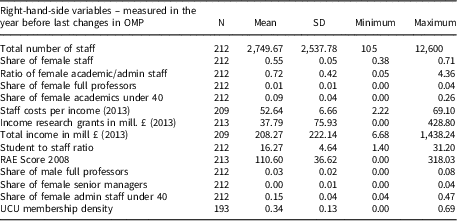
From the collected raw data, we also calculate slightly different measures of generosity for robustness purposes. First, we looked at the number of weeks for which salary replacement is granted, either fully or partially. This variable does not necessarily provide a good measure for generosity because the percentage of salary replaced might be very low but over a longer period of time so that the monetary value of the maternity pay scheme is not automatically correlated with this measure. Second, we calculate an often-used measure that allows an easier comparison across benefits, the so called full weeks’ equivalent which estimates the full monetary value of the paid maternity benefits.Footnote 23 Table 2 provides the descriptive statistics for these different measures.
Descriptive statistics for generosity measures

We use all three measures as dependent variables in the subsequent analyses. Weeks of full salary replacement and full weeks’ equivalent clearly measure the overall generosity of a maternity package and are highly correlated (0.84). The number of weeks for which some salary replacement is granted seems to be a less precise measure of generosity since a package could offer many weeks with very low pay or only a few weeks with full salary replacement. This variable thus co-varies to a lesser extent with weeks of full salary replacement (0.3) and full weeks’ equivalent (0.5).
To operationalise the main explanatory factors of the generosity of maternity benefits derived from our theoretical discussion we include a number of variables that proxy costs and benefits, bargaining power of female academics, and research intensity. We also include several control variables, especially other university characteristics that should account for some variation in the generosity of occupational maternity packages. Most of these variables are available yearly and for each HEI from the Higher Education Statistical Agency (HESA). From HESA, we obtain institutional data on the share of female full professors, the share of female academics at child bearing age (defined as below 40-years old), the ratio of female academic to administrative staff, and the student-to-staff ratio. As a proxy for research intensity of a university we employ the 2008 overall RAE score also provided by HESA.Footnote 24 We measure the universities’ budget as total yearly income (in millions of GBP). Finally, we operationalise the bargaining power of unions with union density data obtained from the UCU for several years (2007, 2013, 2015 and 2018).Footnote 25
As additional control variables we use the total number of staff, which can be regarded as a measure for institutional size, staff costs as share of university income as an alternative cost measure, a proxy for the university’s budget constraint, and the income generated from research grants (in million GBP) as an alternative measure for research intensity.Footnote 26
As a kind of placebo test, we use the share of male professors, the overall share of female staff, the share of female senior managers, and the share of female administrative staff at child bearing age (under 40).Footnote 27 Given our bargaining argument, these groups should be either unable to affect maternity provisions, or alternatively the university management has no incentives to provide these groups with their preferred maternity option.
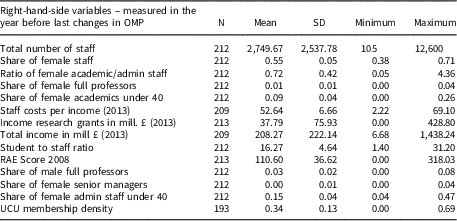
Finally, we use membership in university groups, such as the Russell Group or the post ‘92 new universities, to control for potential peer-group effects and tackle potential spatial correlation across maternity packages.Footnote 28 To avoid potential endogeneity, particularly reverse causality issues, we measure the variables that affect decisions on generosity (but are potentially also determined by maternity generosity) in the year before each university implemented changes in maternity schemes. For example, if the maternity policies were changed in 2008, we look at these variables in 2007. For robustness, we also look at these variables uniformly in 2006, 2005, and 2004 – before the last major change in statutory provisions in 2007 (Table C2 in Appendix C). In fact, most HEIs majorly adjusted their occupational maternity packages between 2008 and 2013 after the last round of modifications in the UK statutory provisions Were implemented on 1st April 2007 when the flat rate payment period was extended from 20 to 33 weeks.Footnote 29 We therefore measure university characteristics that should affect maternity provisions but not vice versa co-temporarily in 2013. Table 3 depicts some descriptive measures for these variables.
Descriptive statistics for other right-hand-side variables
Empirical specification: accounting for differences in generosity
We test the seven hypotheses derived above with data on generosity of maternity provisions collected for 160 UK HEIs. Our main measure of generosity is the number of weeks with full salary replacement granted by the most recent occupational maternity package. Since this is a count variable, a Poisson or Negative binomial model potentially represent adequate estimation choices.Footnote 30 However, weeks of full salary replacement are not typically Poisson distributed, which would imply many observations for smaller values decreasing with higher values, e.g. fewer universities grant 16 or 18 weeks of full salary replacement. We therefore estimate also a Negative binomial model and test whether there is significant over-dispersion (this seems to be the caseFootnote 31).
In addition, we expect that there is some interdependence across institutional maternity packages especially within peer-groups. This implies that dispersion of generosity is not equal across university groups but is rather smaller within more homogeneous institutions with clear research goals (e.g. Russell Group and Golden Triangle.Footnote 32 We thus also employ a generalised negative binomial model which allows dispersion to be both different across groups and directly estimated.Footnote 33 We employ robust standard errors across all specifications to allow arbitrary heteroscedasticity across all observations.Footnote 34
Our empirical investigation is based on purely observational data, which makes it hard to draw any causal conclusions from the findings. Our empirical strategy therefore combines careful model specification with sanity checks for potential endogeneity issues, for example we measure the relevant explanatory factors in the year before a new maternity policy was decided upon and implemented. This strategy follows the idea of a difference-in-difference specification. We also employ a large number of robustness checks to give our derived hypotheses the hardest possible test. Still, empirical results have to be interpreted carefully with regards to causal claims.
We first present a set of baseline results for the main hypotheses. We subsequently look at whether these findings remain robust to a number of modifications of the research design, such as alternative measures of maternity generosity, placebo tests and the evaluation of right-hand-side variables for different years prior to changes in occupational maternity pay.
Baseline results: what affects the generosity of maternity pay?
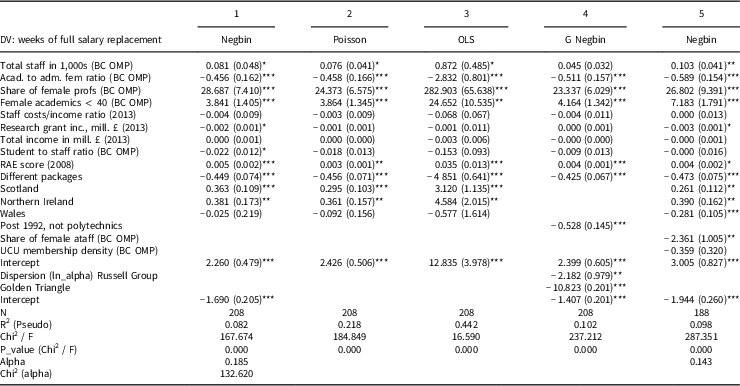
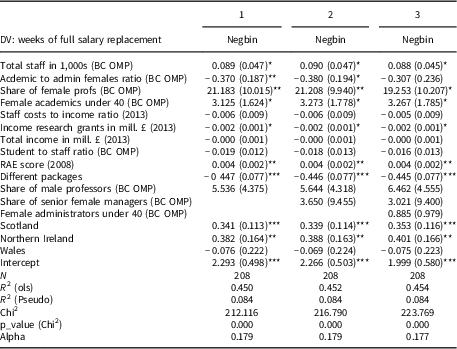
In this section, we present different specifications for a direct test of the main hypotheses derived from our theoretical discussion. Table 4 presents these baseline estimation results. Models 1, 4 and 5 display our preferred Negative binomial specification (which is more appropriate given that the variance is significantly over-dispersed (model 1 –
 $$\alpha $$
,
 $$\chi ^{2} $$
). Models 2 and 3 show that the results remain strongly robust when using other (less appropriate) estimators such as simple OLS (model 3) and Poisson (model 3) that – in our case – wrongly assumes equi-dispersion (mean=variance). Model 4 directly allows dispersion to be heterogeneous across different peer university groups, and Model 5 adds union density to the list of explanatory variables.Footnote 35
Explaining the generosity of maternity provisions across UK HEIs
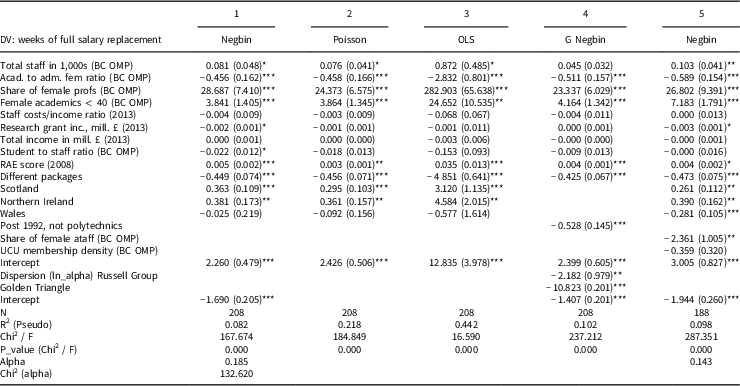
Robust standard errors in parentheses, * p≤0.1, ** p≤0.05, *** p≤0.01, BC OMP=year before the last change in occupational maternity package.
The empirical results lend ample support to several of our derived hypotheses.Footnote 36 In terms of bargaining power, we find, as predicted, a previously large share of female professors affects the generosity of maternity benefits, positively (H1). This points to the observation that if women are in decision making positions, family policies become more salient and support for female academics increases. However, it does not seem to be the case that a stronger union representation increases the generosity of maternity benefits (H2, model 5). Union density seems to exert no significant effect on the generosity of institutionally provided maternity benefits. We check the robustness of this finding in appendix F by including each year available for UCU density into the right-hand-side of the estimation. The results are interesting. If anything union density affects the generosity of maternity benefits negatively (if we use density measures from 2007 and 2013 these effects are significant). We can only speculate about this result. One explanation might be that unions do not bargain over this specific issue, namely maternity policy. Unions seek to represent all employees, many of them being males and not necessarily concerned about maternity policies. Unfortunately, it was impossible to get a gender breakdown of union density by institution. It would be conceivable that as union density increases, more men become members (this is clearly just a conjecture) and that maternity benefits become less salient overall in terms of union priorities.
Turning to institutional incentives, with respect to retention our results show that indeed the previous share of female academics at child bearing age (under 40 years) increases the generosity of maternity pay (H7).Footnote 37 Two interpretations seem likely: first, there might be a lobbying effect due to the increase in bargaining power of female academics, and second, university managers might be aware that they could lose a large share of their academic staff if there are many women at child bearing age employed. We also find strong support for the hypothesis that more research-intensive universities (in terms of REF score) have stronger incentives to keep productive academics and thus reward them with more generous maternity benefits (H6). More generous benefits should allow female academics to stay in touch with research due to the prolonged and more generous maternity pay, without the continuous burden of carrying out teaching and administrative duties.
Finally, regarding the cost of generous maternity pay, we find, in line with our theoretical expectations, that the student-to-staff ratio affects the generosity of maternity pay (H5) negatively. All coefficients point in the right direction and are marginally significant. This supports the argument that when academic staff members have to teach and advise more students, replacement is harder and thus fewer weeks of full salary replacement are offered. Our estimation results also show that the ratio of female academics to female administrators, tout court, affects the generosity of maternity provisions negatively, because it increases overall costs associated with replacing higher salaries of academic staff (H4). Yet the financial resources available to an institution (measured as total income) do not affect occupational maternity pay (H3).Footnote 38 This runs against the general belief that richer universities provide better maternity leave policies. We unpack the income effect in Appendix D: total income is potentially multi-collinear with other university characteristics such as research income, research intensity, size in terms of staff, and staff cost as share of income. When we run models including each of the highly correlated indicators separately we find a small positive, marginally significant effect of institutional income on generosity lending some support to hypothesis 3 (model 3 in Table D2).
The generalised negative binomial specification (model 4) tests, to some extent, the peer group effects on maternity generosity. We find two results that are consistent with our expectations. First, the dispersion of the generosity of benefits is significantly smaller for Russell Group members as well as for universities that belong to the Golden Triangle. These universities are leading institutions, in terms of research intensity, and therefore offer more generous maternity pay. They are also relatively more homogeneous in their goals and thus provide very similar packages with relatively high generosity levels.Footnote 39 Second, we find that new universities, which were founded after 1992 and had not been previously polytechnics, grant less generous maternity pay but their packages still vary across group members. This is likely to depend on the heterogeneous nature of this association that includes all post-1992 non-polytechnics. In addition, these newly founded universities are mostly teaching institutions that grant professional certificates rather than research degrees such as PhDs.Footnote 40
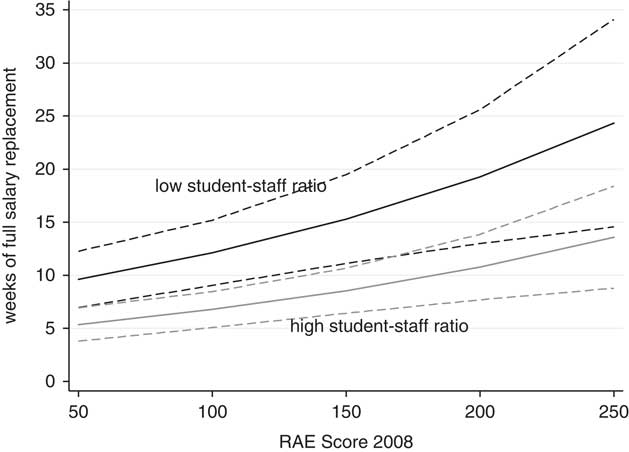
To sum up, our results lend considerable support to most of our hypotheses but, in order to understand whether these effects are substantial we need to investigate their magnitude and size. We use the estimates of the Negative Binomial model (Table 4, model 1) to assess the economic relevance of these effects. Figure 1 displays the combined effect of universities’ research intensity (x-axis) and the student to staff ratio (small – black, large – grey)Footnote 41 We can see that research intense universities with a small student to staff ratio are 5 times as generous in their maternity provisions as compared to teaching oriented HEIs with a large student-to-staff ratio. Also, the positive effect of research strength is considerably stronger in institutions with a more favourable student-to-staff ratio. While teaching institutions with a high student-to-staff ratio offer provisions close to the observed minimal generosity (5 weeks of full salary replacement), the most research intense universities with a small student-to-staff ratio are predicted to offer benefits close to the observed maximum – 25 weeks of full salary replacementFootnote 42
Predicted weeks of full salary replacement dependent on student-staff ratio and research intensity

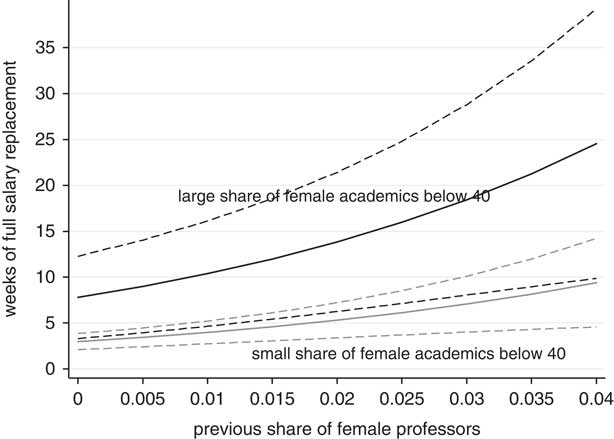
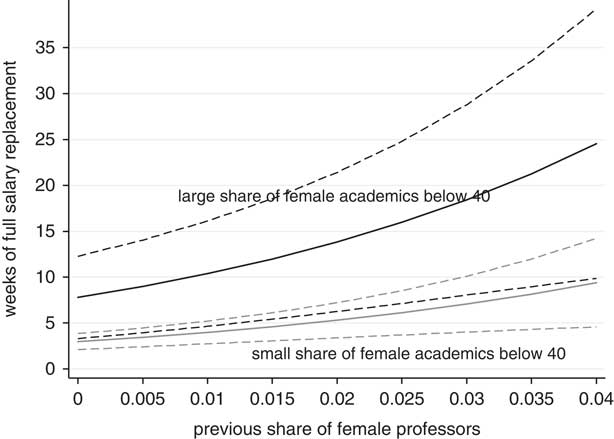
Similar combined effects can be observed for the previous share of female professors and the share of academic women at child bearing age (Figure 2). Again, the predicted number of weeks with full salary replacement is more than five times larger in institutions with a large share of both female professors and female academics at child bearing age. Indeed, when the share of female professors is minimal the predicted generosity only varies between 3 and 8 weeks of full salary replacement.
Predicted weeks of full salary replacement dependent on previous share of female professors and female academics at childbearing age
Based on the factors we are taking into account to explain institutional generosity of maternity pay, we compare our predictions to the actually observed number of weeks with full salary replacement and discuss some interesting discrepancies. For example, given its research intensity, student-to-staff ratio, share of female professors and female academics at child bearing age, income etc., the University of Nottingham is predicted to offer 18 weeks of full pay but only offers 8 weeks – a stark discrepancy. Similarly, our model over-estimates the expected generosity of the LSE (21 weeks predicted, vs. 18 weeks offered), Warwick university (20 vs. 16), Liverpool (12 vs. 8), Glasgow (25 vs. 16) and UCL (23 vs. 18). Contrarily, some universities are more generous than expected. For example, Southampton is predicted to offer 18 weeks of full pay given its characteristics but grants 26 weeks of full salary replacement. We find similar results for the London Business School (14 predicted, 18 offered), and Oxford (22 predicted, 26 offered). These findings do not suggest any normative conclusions but show empirically that these institutions either over-provide or under-provide maternity benefits given their measurable characteristics. For a large number of universities, our simple baseline model makes exact predictions: Cambridge (18), Aberdeen (18), Lancaster (18), Leeds (16), Strathclyde (16), Northampton (6), Winchester (6), Cumbria (6) and the London University of Arts (4), inter alia.
Alternative generosity measures
We use alternative measures of generosity (full weeks’ equivalent and weeks of full and partial salary replacement) as robustness checks. Table 5 presents the estimation results.
Alternative measures of maternity benefit generosity

Robust standard errors in parentheses, * p≤0.1, ** p≤0.05, *** p≤0.01, BC OMP=year before the last change in occupational maternity package, all models negative binomial.
First, if we look at full weeks’ equivalent – which is very closely related to weeks with full salary replacement – our results remain stable, both in size and significance which lends more robust support to our claims.Footnote 43 Second, the results differ in interesting but predictable ways for the other measure – number of weeks with full or partial salary replacement. This measure is often used in cross-country analyses because it is usually easier to collect it, but it does not really capture generosity since it gives higher values to schemes that grant very limited amounts of money for a large number of weeks (like the statutory pay in the UK which only offers 140.98 GBP but for 33 weeks). In this case, only two variables significantly affect the outcome: the student-to-staff ratio and union density. The student-to-staff ratio is a pure cost indicator underlining our argument that generosity is important for research oriented universities, which have an incentive to retain female academics and allow them to climb the career ladder to full professorship. Union density exerts a positive significant effect on the number of weeks with some salary replacement. From this finding we might speculate that unions are more interested in length than generosity of maternity leave. In addition, the overall explanatory power (
 $$R^{2} $$
) halves for these models lending further support to the conclusion that other factors predict maternity provisions that are not related to generosity.
Placebo tests: administrators and male academics
As robustness test, we first run the same specification as in Table 4 (model 1) but we add some additional variables to the right-hand-side in order to check the consistency of our findings and to understand whether factors, which based on our theoretical discussion should have no effect, indeed turn out to be statistically insignificant. We call this a placebo test. Specifically, we want to test whether the share of senior male academics (full professors) influences the generosity of maternity packages. We find this variable has no effect, which is in line with our expectation. We also argue that female academics (full professors and those at child bearing age) hold the main bargaining power because of the skill specificity of their jobs and the universities’ investment in their recruitment and productivity. We therefore expect that the presence of a large share of senior female managers or female administrators at child bearing age should have no effect on the generosity of maternity provisions, and we find ample support for this prediction. All other results correspond closely in direction, significance, and size to our baseline findings. Estimation results can be found in Table 6.Footnote 44
Placebo tests – effect of male professors and female administrators
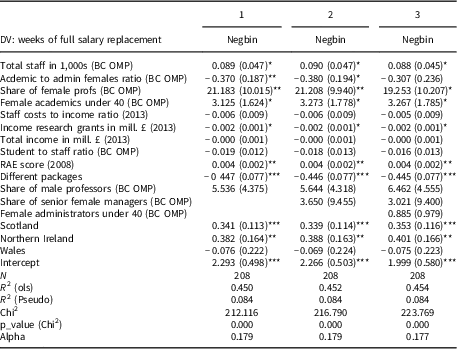
Robust standard errors in parentheses, * p≤0.1, ** p≤0.05, *** p≤0.01, BC OMP=year before the last change in occupational maternity package.
Discussion: what factors determine the generosity of occupational maternity pay?
UK higher education institutions vary greatly in the generosity of the occupational maternity pay they grant to their employees. We find that much of this variation can be explained with a bargaining model in mind that distinguishes between the factors that increase the bargaining power of female academics, the incentives for universities to invest in the retention of female talents, and the costs imposed by generous maternity provisions. Differences in the structural characteristics of these institutions contribute to these different incentives. The sheer size, in terms of employees, but also structural factors, such as the student-to-staff ratio, help to account for differences in generosity because these features describe how the potential costs of women taking maternity leave can be redistributed across other staff members. Interestingly, size, in terms of overall income, does not help much to explain the variance in generosity of maternity benefits. Thus, it seems that decisions on maternity benefits are closely related to the strategic goals universities pursue. One of the driving factors behind the design of maternity pay is the research orientation of the university under investigation. Highly research intense institutions have a vested interest in retaining productive mothers both at the hiring stage as well as during their employment at the university. Better maternity provisions are very likely to be used in these cases as a reward and a means to keep mothers productive and satisfied with their work environment, thus allowing them to invest in research activities. More generally, it seems that the rigorous hiring process across research intense universities serves as a screening device.
The bargaining power of female academics (who can affect the process of deciding over maternity benefits) is mainly strengthened by both the share of female professors in place when decisions are made and the share of female academics at child bearing age. Female professors can be compared to women in executive positions in other sectors and can influence policy outcomes at universities; the number of female academics at child bearing age increases the probability that the university loses many talented and productive women if maternity provisions are sparse. We also argue – and empirically support – that the same logic is not at play for female administrators, arguably because they can be replaced more easily, their share is generally large, and the university’s investment in administrative staff is comparatively lower. Neither the share of female senior managers nor female administrators at child bearing age, have an effect on maternity provisions.
Certainly these results have to be taken with some caution given the observational nature of the analysis. However, all specifications and not withstanding any robustness checks, alternative measures, and placebo tests, point in the same direction and effect sizes remain stable as well. We are therefore cautiously confident that the correspondence between theoretical derivation of hypotheses and the empirical investigation of these allow us drawing some conclusions on how HEIs decide on maternity and parental leave benefits.
Conclusion
Maternity and parental policies are costly and their costs and benefits are widely debated beyond the normative aspect of allowing women to have children without sacrificing their professional careers. Understanding how and why institutions decide to implement certain levels of generosity in maternity pay may help to unpack the potential costs and benefits of maternity leaves. This work uses a bargaining model to account for the variation in maternity policies across Higher Education Institutions in the UK. The model and our empirical analysis show that both structural characteristics but also strategic goals of universities help explain the generosity of maternity pay across UK universities. Research-intensive universities have much stronger incentives to implement generous maternity pay provisions – from which follows that the potential benefits of maternity provisions might be stronger for such institutions.
Research shows that maternity and parental policies are crucial to keep female talent in the labour market, reduce the pay gap and allow women to climb the career ladder (Ginther and Khan Reference Ginther and Khan2004; Ginther and Hayes Reference Ginther and Hayes2003; Waldfogel Reference Waldfogel1998; Mason and Goulden Reference Mason and Goulden2004; Reference Mason and Goulden2002). Our work highlights the institutional-based constraints and incentives offered to women in the UK academic sector and represents a first step in unpacking the causes and consequences of generous maternity benefits. In a companion research paper, we investigate how differences in maternity benefits affect productivity, career paths, pay, and job satisfaction of female academics. We show that the generosity of maternity leaves exerts significant effects on career paths of female academics at the aggregate level, with more generous provisions likely to lead to a higher share of female professors and female academics in the highest salary bracket, especially at research intense universities. At the individual level, we can identify a positive effect of generosity on productivity, speed of career progression, and income in the medium term.
From our perspective, the UK higher education sector provides fertile ground for such investigations because maternity benefits vary widely across universities and the productivity and career paths can be measured straightforwardly at the individual level. We believe that the implications of our research extend beyond higher education institutions and offer further insights into the determinants of the under-representation of women in qualified and competitive sectors. Moreover, given that the generosity of statutory maternity pay in the UK is one of the lowest across EU countries, our research can help inform policy reforms in this area. Of course, we do not claim that our results allow us to extend our conclusions to other sectors. Rather, the identification revolution in social sciences is increasingly pressuring scholars to identify local causal effects that are highly conditional on the context and inferences beyond this specific context are usually hard to draw. Yet, our theoretical argument regarding how these policies are implemented, clearly draws on broader bargaining theories that do not apply to the university sector only. Though with caution, our results can help interpret the variation in maternity policies in other sectors.
Supplementary material
To view supplementary material for this article, please visit https://doi.org/10.1017/S0143814X19000059
Data Availability Statement
The replication files for the empirical data analysis can be found on the Harvard Dataverse: https://doi.org/10.7910/DVN/HMKHFB
Acknowledgement
We thank Stephane Wolton for his advise on modelling the underlying bargaining process formally. This paper has been presented at the EPSA Annual Meeting 2018; the MPSA Annual Meeting 2017; the Women in political economy workshop in Falset, Priorat 2018; at King’s College London; Texas A&M; Nuffield College, Oxford; the Cabinet Office, and the Department for Business Energy and Industrial Strategy. We thank all participants for their valuable input. All errors are ours. This work has been discussed in the Guardian and at BBC4 women’s hour, and has led to the University of Exeter changing their maternity benefits to the most generous in the Russell Group.