Introduction
The benefits of physical activity and exercise are well-documented, for instance, improved quality of life, muscle strength and joint flexibility, and decreased likelihood of depression and cardiovascular disease (e.g. Aoyagi et al. Reference Aoyagi, Park, Park and Shephard2010; Barreto Reference Barreto2009; Barbour, Edenfield and Blumenthal Reference Barbour, Edenfield and Blumenthal2007). These benefits have been demonstrated in both clinical and non-clinical populations across the lifespan. Nevertheless, physical activity levels decrease progressively with age, with many older adults perceiving age and/or poor health as barriers that prevent them from being physically active (Whaley and Ebbeck Reference Whaley and Ebbeck2002; Wurm, Tomasik and Tesch-Römer Reference Wurm, Tomasik and Tesch-Römer2010).
Improving physical activity participation in older people is increasingly pertinent in the context of a rapidly ageing global population, with the number of individuals over 60 years of age projected to surpass one billion within ten years (United Nations Population Fund 2012). The United Nations Population Fund has argued that good health must lie at the core of society's response to population ageing, and governmental policies should promote healthy lifestyles. The challenge of optimising physical activity in an increasingly elderly and sedentary population is exacerbated as traditional models of service delivery may not adequately meet the needs of older people (e.g. due to poor access or transport; Victor Reference Victor2014). Thus, exploring how older people experience and respond to physical activity programmes informs both public health promotion and service design, potentially reducing health inequalities evident in this group.
A consequence of ageing for many is the experience of a fall, with one out of three adults over 65 years of age falling each year (Masud and Morris Reference Masud and Morris2001). The problem of physical inactivity is exacerbated in older people who have fallen, as falling often has a number of psychological consequences (fear of falling, loss of confidence and activity avoidance) that present further barriers to being physically active (see Jørstad et al. Reference Jørstad, Hauer, Becker and Lamb2005). However, at-risk elderly people, including falls patients, can benefit from physical activity and exercise interventions, achieving improvements in functional status, physiological and psychological health (e.g. perceived health status; Barreto Reference Barreto2009) and reducing decrements arising from secondary ageing (environmental and lifestyle factors; Hunter, McCarthy and Bamman Reference Hunter, McCarthy and Bamman2004).
Experiencing a fall clearly has implications for the individual's social, physical and psychological wellbeing, and places demands on health-care resources (National Service Framework for Older People; Department of Health 2001). Therefore, it is important to ensure that older individuals, including those who have fallen, initiate and adhere to physical activity programmes, and maintain physical activity on programme completion. For at-risk elderly people, developing a physically active identity and transforming the traditional view of the ageing body from rest, incompetence and increasing immobility, to malleable bodies, prone to improved physiological and biomechanical functioning (Tulle Reference Tulle2008), is especially important.
Physical activity identity
It has been argued that examining the development and maintenance of an exercise identity in older adults is critical to understanding their physical activity behaviour (Whaley and Ebbeck Reference Whaley and Ebbeck2002). Older adults who more strongly associate with a physical activity identity (identified via a higher rating on physical activity identity scales) report higher levels of physical activity, wellbeing, more physical activity-related goals and higher levels of self-regulatory self-efficacy (i.e. confidence that they could remain physically active even when faced with barriers such as bad weather; Strachan et al. Reference Strachan, Brawley, Spink and Glazebrook2010). There are, however, some nuances in terms of how older populations might view exercise and physical activity. The few studies that have focused on older people have identified that they may see developing an exercise identity as less important than avoiding an identity as someone who is old, and that they associate themselves more with a physical activity identity than with the identity of a traditional ‘exerciser’ (Strachan et al. Reference Strachan, Brawley, Spink and Glazebrook2010; Whaley and Ebbeck Reference Whaley and Ebbeck2002). This creates socio-demographic and intrapersonal barriers when attempting to engage older adults in leisure-based schemes (Victor Reference Victor2014), which is the standard practice for exercise referral programmes.
Whilst these studies suggest that it is the norm for older adults not to see a physically active self as central to their identity, this is not the case for all older adults. A number of recent studies have presented evidence of alternative identities in older adults that place physical activity at the core of their identity. These include older adults for whom a physically active lifestyle and participation in sport are integral to their wellbeing (e.g. competitive masters bodybuilders; Phoenix Reference Phoenix2010; Phoenix and Smith Reference Phoenix and Smith2011; Phoenix and Sparkes Reference Phoenix and Sparkes2009). Whilst these emerging explorations of active older adults begin to challenge negative stereotyping of older people and the dominant social narrative of age-associated decline (e.g. Phoenix and Griffin Reference Phoenix and Griffin2013), their focus on ‘exceptional’ adults may limit the extent to which this is successful. In the present study, we focus on physical activity identity changes in those who are more typical of the older adult population in terms of their physical activity levels.
Identifying ways to promote and support the internalisation of an active identity is particularly relevant for an ageing population given that, as previously discussed, these individuals are likely to have low physical activity levels and may have dissociated from physical activity. However, as O'Brien Cousins (Reference O'Brien Cousins2003) has highlighted, we know little about the ways in which older people think about their health behaviours, and prospective studies that explore change in motivation and physical activity over time will add considerably to our understanding (Strachan et al. Reference Strachan, Brawley, Spink and Glazebrook2010). Hence, the primary aim of the present study was to examine changes in older adults' physical activity-related identities during the early phases of an exercise referral programme. We aimed to identify the ways in which a novel behaviour promoted by an intervention (in this case, a physical activity programme for fallers or those at risk of falling) was internalised into participants' identities. A key aim of the study was to explore the cognitions of the participants during this transitional period, and to identify whether they might underpin any identity changes observed.
Cognition and identity change
Cognition relating to goal-directed behaviour can be conceptualised as self-talk, that is, the internal dialogue we have with ourselves. Self-talk has previously been shown to mediate the relationship between social messages and changes in one's self-concept (Burnett Reference Burnett2003), suggesting that cognitions may help drive changes in the way we see ourselves. Indeed, work by Lawrence and Valsiner (Reference Lawrence and Valsiner2003) models self-talk as a way in which new ideas are interpreted, assessed and debated internally, before becoming fully integrated into the self. Given that the process of internalising new behaviours, such as physical activity, requires people to understand and synthesise both the values of and the behaviour itself (Deci and Ryan Reference Deci and Ryan2000), we posit that self-talk might act as a mechanism through which identity change occurs through enabling this understanding to develop. Studying cognitions related to exercise during a period of behaviour change would seem useful for understanding how motivation for physical activity is internalised. This is consistent with claims that studying the inner dialogue of newly active individuals may help to understand why people fail or succeed in their attempts to be physically active (O'Brien Cousins and Gillis Reference O'Brien Cousins and Gillis2005).
Recent work (e.g. Oliver, Markland and Hardy Reference Oliver, Markland and Hardy2010) has suggested employing a framework provided by cognitive evaluation theory (CET; Deci and Ryan Reference Deci and Ryan1985) to explain how intrapersonal events such as self-talk might facilitate internalisation and behaviour change. Housed within self-determination theory (Deci and Ryan Reference Deci and Ryan1985, Reference Deci and Ryan2000), CET argues that if events support innate basic needs for autonomy and competence, this enables individuals to transform actively the values of significant others into their own (Deci and Ryan Reference Deci and Ryan2000). That is, if events create a sense of freedom, volition and self-endorsed action (autonomy), and provide feedback engendering effectiveness and mastery over one's surroundings (competence), these conditions will support internalisation. In the context of new identities, need-supporting conditions will facilitate an integrated and endorsed identity whereas need-thwarting conditions will not.
Importantly, CET makes no distinction between external social contextual events, such as the provision of feedback or rewards by others, and intrapersonal events, such as self-monitoring, self-reinforcement and self-control (Deci and Ryan Reference Deci and Ryan1985). Instead, CET proposes a distinction between internally informational regulating episodes processed by the individual and experienced as free from pressures, and internally controlling regulation in which the individual pressurises themselves to act (Ryan Reference Ryan1982). Deci and Ryan (Reference Deci and Ryan1985) argue that to regulate oneself informationally is quite different from regulating oneself through control, and that controlling self-regulation is likely to have negative consequences for motivation and wellbeing.
Drawing on this theoretical framework, the present study adopts the position that self-talk represents an internal regulatory event that can be experienced as informational (need-supportive) or controlling (need-thwarting), with subsequent differential consequences for behavioural and affective outcomes. Importantly, the emphasis in CET is on the functional significance of events, that is, how one experiences or interprets specific events, rather than their nature per se. In the context of self-talk, it is proposed that how one interprets or experiences self-talk is considered to be independent of its content. For example, the phrase ‘concentrate’ may be experienced as pressurising and commanding, or as supportive and encouraging. This is aligned with contemporary literature which emphasises the need to consider the significance and meaning of inner speech to the individual. For example, Wiley (Reference Wiley2006) argues that our self-speech is intra-subjective, as a result of obtaining its meaning from events peculiar to us, and therefore it is necessary to examine the interpretation and experience of such speech from the perspective of the individual.
Thus, we anticipated that informational self-talk (that supports basic needs) is likely to facilitate identity change and to increase as behaviour becomes more internalised (i.e. as physical activity identities become more pronounced, and in the later stages of the exercise programme). Conversely, negative or controlling self-talk (e.g. pressurising statements that undermine autonomy; critical statements that undermine competence) is likely to be associated with a non-internalised exercise identity, worries and concerns, present early during the programme, and which remain present when identity is resistant to change. Some support for this can be drawn from findings in an educational context linking informational self-talk with more positive affective states, and controlling self-talk with greater anxiety (Oliver, Markland and Hardy Reference Oliver, Markland and Hardy2010), when learning novel material.
In sum, the aim of the present study was to respond to calls for research that explores how health behaviours are changed in older people (Strachan et al. Reference Strachan, Brawley, Spink and Glazebrook2010), potentially informing the delivery of public health interventions for this sector of the population. Understanding the thought processes underlying identity change may enable more targeted and effective support during such interventions; the study focused on exploring the self-talk and concurrent identity changes of participants referred to an exercise-focused behaviour change intervention. As previously noted, current understanding of active identities in older people is weak and to an extent focuses on atypically highly active individuals (e.g. masters athletes), thus the study sought to obtain rich and detailed data by following a specific cohort through the first phases of a programme typifying standard referral scheme delivery. The research employed a mixed-method approach to facilitate depth of understanding of the nature of the identity changes as well as enable application of an existing theoretically grounded model classifying types of self-talk. Where related ideas emerged, the analytical convergence of the two strands of self-talk and identity-related data (cf. Bryman Reference Bryman2007) allowed for augmented interpretation; giving meaning to the numbers, but also precision to the narrative data (Collins, Onwnegbuzie and Sutton Reference Collins, Onwuegbuzie and Sutton2006; Jick Reference Jick1979; Rossman and Wilson Reference Rossman and Wilson1985).
Method
Participants
Six participants (one male, five females) aged between 79 and 89 years were recruited from a cohort registered on a Postural Stability Instruction (PSI) course of 32 weeks duration. All participants had been referred to the programme based on a rating of between 1 and 3 on the Falls Risk Assessment Tool, that is, they had either had no previous falls (N = 3), a fall resulting in soft tissue injury (N = 1) or a fall resulting in a fracture (N = 2). Referral routes were based on a perceived need and varied from primary care to leisure services. The course was held in a local leisure centre in a rurally located coastal town and all participants were living independently in the community, either alone or with a spouse. None of the participants were living with a disability but all were diagnosed with comorbidities, as might be expected given the age range of the group. All programme participants were initially approached individually by the programme instructors, with a follow-up by the research team, and provided written consent to take part in the research. Ethical approval was provided by the North Wales Research Ethics Committee.
Quantitative measures
Physical activity identity
Strachan et al.'s (Reference Strachan, Brawley, Spink and Glazebrook2010) modified version of the Exercise Identity questionnaire (Anderson and Cychosz Reference Anderson and Cychosz1994) was administered. The nine-item questionnaire focused on an over-arching physical activity identity (rather than exercise identity per se), and was scored on a seven-point Likert scale (1 = strongly disagree; 7 = strongly agree). Participants rated the extent to which they identified with being a physically active person on items including ‘I consider myself a physically active person’; with higher scores indicating a stronger identity. The modified scale has demonstrated internal consistency, validity and structural integrity (Strachan et al. Reference Strachan, Brawley, Spink and Glazebrook2010).
Self-talk
The informational and controlling nature of participants' self-talk was assessed using the functional significance of self-talk questionnaire (FSTQ; Oliver, Markland and Hardy Reference Oliver, Markland and Hardy2010). Based on CET principles, the FSTQ assesses the motivational interpretation of an individual's self-talk and has demonstrated reliability and structural validity in an educational sample (Oliver, Markland and Hardy Reference Oliver, Markland and Hardy2010). In the present study, minor amendments were made to the instructional set to make the FSTQ applicable to an exercise context. The original informational and controlling self-talk questionnaire was comprised of 11 items, loading on to two subscales (seven informational items, four controlling items). Participants were asked to rate the extent to which their self-talk ‘told me what I should be doing’ (controlling) or ‘made me feel I was in control’ (informational), using a five-point Likert-type scale ranging from 1 (not at all) to 5 (very much so). Ongoing development of the FSTQ has resulted in the addition of a third sub-scale, aligned with the original triadic conceptualisation of functional significances in CET (i.e. events vary in terms of their informational, controlling and amotivational significance). Amotivational events facilitate perceptions of incompetence and promote amotivation, that is, a state in which people lack an intention to engage in behaviour. Amotivational items generated from pilot work (Oliver Reference Oliver2010) were included in this study: ‘made me feel incompetent’, ‘made me feel I could not do the exercises’, ‘made me feel useless’ and ‘made me feel unable to complete the class’.Footnote 1
Examinations of the full 32-week programme, and beyond to 48 weeks, are reported elsewhere (Hudson, Day and Oliver Reference Hudson, Day and Oliver2015; Hudson et al. Reference Hudson, Oliver, Thomas and Higgs2011). These studies focus on physical and functional outcomes (e.g. ‘timed up and go’, functional reach), and changes in participants' life narratives.
Qualitative interviews and procedure
Following receipt of informed consent, participants completed the study measures prior to starting the programme, and then weekly following their exercise class. Participants attended an individual interview with a member of the research team at the commencement of the PSI programme and at week 10, which was conducted either face-to-face or via the telephone. In addition, at each of weeks 1–6 participants completed the self-talk measure (FSTQ) immediately after their exercise session.
A semi-structured interview guide was developed in line with the recommendations of Morgan and Krueger (Reference Morgan and Krueger1998), focusing on six key questions. The first three related to self-talk and cognition more broadly, for example ‘describe some of the things that go through your mind (1) before; (2) during; and (3) immediately after, and (4) in the days following an exercise session’. The second three key questions focused on identity, for example, ‘how would you currently describe yourself at the moment’? Participants were presented with a summary of their comments at the end of the interview and asked whether there was anything they would like to add or that they felt the researchers might have missed or misinterpreted. Consent for further contact was sought after every interview. Interviews were recorded or shorthand notes were made where recording was not feasible.
Analyses
The qualitative data were analysed using thematic content analysis, adopting a deductive approach beginning with the ideas promoted by CET (Deci and Ryan Reference Deci and Ryan1985) and Lawrence and Valsiner's (Reference Lawrence and Valsiner2003) laminal model. Interview notes and transcripts were read and re-read to gain a full sense of the participant's background, physical activity history, reasons for attending the PSI programme and experiences on the programme. The analysis then involved highlighting quotes that referred to two themes: (a) identity and (b) self-talk or cognitions relating to physical activity, and how these might interrelate. These raw data were clustered into emergent themes which shared similar meaning across participants. This process was carried out on the data obtained at both interview points and the themes identified at these two points were then compared to explore changes or similarities evident between the two. Interviews were initially analysed by the co-authors independently of each other and these analyses were then discussed between researchers to allow the themes and interpretations of these to be challenged for integrity and meaning by each researcher acting as a critical friend. Any divergence in terms of interpretation between researchers was discussed until consensus was reached. This approach was implemented as it allowed a more thoughtful conceptualisation of the resulting themes than agreement methods with a nomothetic base (Hill, Thompson and Williams Reference Hill, Thompson and Williams1997). The qualitative data themes are presented below in narrative form, and, to represent the developmental experiences of the participants most appropriately and comprehensively, data from both interview time-points are integrated and discussed in tandem. This qualitative data analysis was supplemented by analysis of changes in quantitative data drawn from existing measures of physical activity identity and self-talk. Where appropriate below, to add further insight into participants' experiences, qualitative and quantitative findings are discussed alongside each other.
SPSS® version 21 was used to conduct quantitative analyses. Repeated-measures analyses of variance (one per self-talk type: informational, controlling, autonomous; with six levels of the independent variable, weeks 1–6) were conducted to explore weekly changes in participants' self-talk. Paired-samples t-tests were employed as post hoc follow-ups of significant effects. A paired-samples t-test was also employed to compare physical activity identity at weeks 1 and 10. However, given the lack of power the reader may wish to refer primarily to the percentage changes in variables as these provide information in a clinically relevant format (cf. Vickers Reference Vickers2001, for a discussion of issues associated with percentage change). Whilst we recognise that identity development is likely to be dynamic and continue post ten weeks, given our theoretical interest in how novel behaviours become internalised we focused on changes during initial activity uptake, rather than during activity maintenance.
The reader should be aware that although both the FSTQ and the exercise identity scale have demonstrated validity in their unmodified forms, their use has been limited; hence, results pertaining to these variables should be interpreted with caution. Analysis of the reliability of the measures using conventional methods (e.g. Cronbach's alphas) was unsuitable given the small sample size. Indeed, minimal sample sizes of 300 have previously been advocated for reliable estimation of population coefficient alphas (Kline Reference Kline1986). Hence, descriptive changes of sample means and standard deviations (SD) are presented with the intention that these are interpreted in conjunction with the qualitative data.
Results and discussion
Physical activity identity
Initial self-perceptions
At week 1, descriptions of the self tended to be negative (e.g. ‘I'm slow’, ‘I don't do anything’); some positive comments were made and these tended to be conveyed with a surprise at avoiding expected age-related decline (e.g. ‘I've still got all my marbles’; ‘I was part of the air force … they got us quite fit for that, probably why I've lasted so long’). In contrast, quantitative assessment suggested that participants embarked on the programme with already high self-ratings of physical activity identity that underwent little change, with only an 8.35 per cent increase for the group between weeks 1 and 10 of the programme (mean = 4.43, SD = 0.78, and mean = 4.80, SD = 0.72; maximum = 5). Not surprisingly, this difference was non-significant, t 5 = −0.961, p = 0.381.
Dissociation from the physical self (the ‘me’ I've become)
Participants spoke of a separation of the physical self from ‘who they were’ due to a sense of unhappiness with this aspect of their identity. For example, one participant described how when seeing one's reflection, ‘shop windows are dreadful and you get an awful shock’, with another stating that they consciously ‘don't look’ at themselves. Linguistically one interesting comment was made, before being corrected, that ‘my legs couldn't control me … I couldn't control them’. This again suggests the separation of the self, ‘me’, from the physical body, and implies a lack of control over the physical self, to the extent that it becomes the controller. This sense of unease or unhappiness with the self appeared linked to negative affective outcomes, with participants feeling ‘bored’, ‘fed up with self’ or more generally that ‘I don't feel right’.
Despite this, there was also some humour evident in comments relating to physical identity (e.g. ‘getting to 80, I wouldn't recommend it’ and ‘pure fat, I have more spare tyres than ATS [car tyre supplier]’). Nevertheless, these asides conveyed a certain dehumanisation or degradation of the physical self. For some participants, feeling disappointed in one's self was expressed explicitly, and one noted that they felt like a burden ‘holding everyone back’. In terms of defining their identity, participants tended to use past comparisons at week 1, for example ‘I was only a skinny thing when I was young’.
Rejuvenation of a previous self
By week 10 clear changes in participants' identity were evident, with participants reporting feeling ‘more confident’, ‘exhilarated’ and ‘happier’, with some referencing the change that had occurred – ‘instead of feeling sorry for myself I'm getting a bit of “I can do everything”’. Although comparisons to past identities were still made, these tended to employ a more positive reference point (e.g. ‘when I stand up straight I look ten years younger’) and for some the new self was incomparable to previously held beliefs, suggesting a change in personal narratives of decline: ‘I'm doing things which I would never have dreamt of doing’. These changes are in contrast to quantitative physical activity identity ratings, suggesting that changes in self-perception did occur during this period but these were more complex than a shift in degree of association of physical activity with one's personal identity.
Self-talk
Initial self-control and criticism
Initial self-talk was reported as being negative (e.g. ‘I don't think I can do this’) and was ‘very critical’ during the classes. There were also examples of a defeatist approach when things were not going well (‘oh sod it’), and some indication of a lack of perceived competence and control (‘I just hope I can do it, I don't think I can do it’). By week 10 there was an absence of these types of phrases, with participants instead reporting more positive reassurances (e.g. ‘it's alright’). One participant recalled that, in comparison to week 1, ‘I don't say “I can't be fagged [bothered] to go”, but I don't say the opposite yet’ – the use of ‘yet’ perhaps implying an expectation that this will develop in time. It should be noted that not all participants reported a change in their self-talk, with one individual reporting that his thoughts were ‘perfectly positive’ from the outset.
It was also noticed that participants' self-talk at week 1 was frequently discursive in nature with an apparent function to exert self-control. For example, one participant described an internal conversation in which one voice queried, ‘do I have to go out on a day like today?’, with a second voice arguing ‘yes you have [to]’. Second-person phrasing was also used within the class, particularly when participants were struggling with exercises, in phrases such as ‘pull yourself together’ and ‘you could have done better here’.
Much of this second-person self-talk seemed to be self-critical in nature. Such dualistic self-talk or internal ‘dissenting voices’ are a characteristic of Lawrence and Valsiner's (Reference Lawrence and Valsiner2003) model associated with the early stages of processing of social messages. Importantly, Deci and Ryan (Reference Deci and Ryan1985) argue that controlling self-regulation is likely to have negative consequences for motivation and wellbeing, and controlling environments and stimuli have negative effects on long-term persistence, engagement and health (e.g. Pelletier et al. Reference Pelletier, Fortier, Vallerand and Brière2001). Given clear evidence of deleterious effects of controlling health messages (e.g. Miller et al. Reference Miller, Lane, Deatrick, Young and Potts2007; Vansteenkiste, Lens and Deci Reference Vansteenkiste, Lens and Deci2006), raising practitioner and client awareness of these is important. Thus, we suggest that instructors should be aware of the potential for participants to engage in controlling self-talk and help them to restructure this into more informational self-talk. That is, participants should aim to use self-talk to encourage and inform, rather than to self-control. Further, health promotion campaigns, intervention literature and leaflets, and verbally delivered instruction should take care to emphasise empowerment and autonomy, as controlling environments have been shown to engender more controlling intrapersonal self-talk (Oliver et al. Reference Oliver, Markland, Hardy and Petherick2008).
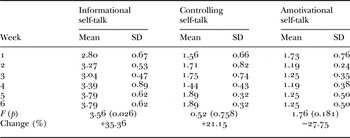
The importance of external encouragement to avoid the use of controlling self-talk seems particularly pertinent when quantitative reports on its use are considered. Ratings of controlling self-talk use were low and did not change significantly throughout the assessment period (F (5,15) = 0.519, p = 0.758), clearly contrasting with the controlling self-talk discussed in interviews. Our interview data also indicate that some participants struggled with the identification and reporting of specific self-talk phrases. Indeed, several participants initially indicated that they did not recall using any purposeful self-talk, with one noting ‘no, I concentrate and watch X [the instructor] most of the time’. This highlights a potential problem with self-report measures of self-talk and the need for multiple methods in its assessment, to which we return later.
Progression in self and self-talk: ‘I can do this’
As might be expected, when discussing their self-talk use throughout the first ten weeks of the programme, participants reported that the majority of their physical activity-related self-talk took place on the day of, during or immediately after the classes, while physical tests that were part of course participation also acted as prompts for specific reflection for some individuals, particularly with respect to their progress (e.g. ‘there's a way to go yet before I can do this’). Participants mainly reported using self-talk prior to classes as a stimulant for action, e.g. to ‘egg myself up’ or that ‘[I] geared myself up to come’. This motivational aspect of self-talk was also reported during classes as participants both encouraged and berated themselves (e.g. ‘I can do this’; ‘[I] got cross with myself deliberately’).
These qualitative data present similar patterns to the quantitative reports of self-talk use (see Table 1). Already low levels of amotivational self-talk did not change (F (5,15) = 1.76, p = 0.181) but informational self-talk significantly increased over the six-week period, F (5,15) = 3.56, p = 0.026; differences were significant between weeks 3 and week 6, with differences between weeks 1 and both weeks 5 and 6 approaching significance (p = 0.036, 0.083 and 0.061, respectively).
Functional significance of self-talk in weeks 1–6

Note: SD: standard deviation.
With respect to self-talk, the clearest change during the examined period was the progression from amotivational, competence-undermining phrases to more informational, supportive phrases. Although the decrease in amotivational self-talk was not statistically significant, the percentage change is noteworthy especially when considered in conjunction with the qualitative data. When commencing a novel behaviour or any new activity, it is not surprising that initially self-talk may reflect a lack of perceived competence, with a focus on perceived problems and task failures. By engaging in the classes, participants gained tangible evidence they could complete the exercises, with the resulting physical improvements enabling greater participation in a range of activities outside the classses. The observed shift in self-talk to focus on succesful task completion and ability gains is therefore logical. This pattern mirrrors improvements in efficacy observed in individuals taking part in exercise intervention programmes (e.g. McAuley Reference McAuley1992), and suggests the importance of a progressive programme enabling participants' improvements to be noted and reinforced. In addition, it highlights the need for instructors to target participants' amotivation in early classes to avoid potential decreases in engagment and scheme withdrawals (e.g. Thøgersen-Ntoumani and Ntoumanis Reference Thøgersen-Ntoumani and Ntoumanis2006).
Talking it up: self-talk and identity development
Self-talk was of particular interest in the present study as a process by which social messages and promoted values might be internalised and a coherent, endorsed physical activity identity developed. Consistent with Valsiner's (Reference Valsiner1997) laminal model, self-talk seemed to reflect the processing stage between the perception of a social message and its integration into a personal position. Reported self-talk changes mirrored the progressive development described in Valsiner's model as initially statements tended to be more generalised, subsequently developing into a critical dialogue integrating existing knowledge and emotional reflections. Although the design of the study was not intended to test mediational models explicitly, it is notable that there was some consistency in changes in individuals' self-talk and the extent to which they endorsed and felt comfortable with a physically active identity. For example, the quantitative data support a concurrent increase in the informational nature of participants' self-talk and their physical activity identity. Further, the observed shifts in self-talk phrasing (e.g. ‘I was’ to ‘I am’) and progression from a rejected physical self to an accepted physical state, imply a less fragmented and more confident, active and present-focused self.
Study reflections
Whilst the interviews quite literally gave participants a voice to share their experiences, the qualitative exploration of self-talk use was limited by a reliance on retrospective recall, as many struggled to remember if and when they had used self-talk. This is a common issue with self-talk research; it is difficult to recall and report as it has been estimated that inner speech takes place approximately ten times faster than outer speech (Korba Reference Korba1990), with internal utterances condensed and abbreviated for efficiency (Wiley Reference Wiley2006). In the present study, the use of weekly questionnaires that focused on the overall interpretation of self-talk, rather than specific phrases, was designed to obtain theoretically meaningful information, supplemented by in-depth interview recall. We recognise the inherent limitations and difficulties when exploring self-talk, and endorse the perspective that multiple methods of investigation are best combined to obtain a full picture of self-talk and its effects (Hardy, Oliver and Tod Reference Hardy, Oliver, Tod, Mellalieu and Hanton2009). Future work audibly monitoring on-task self-talk (e.g. via worn recorders) and activation of language centres in the brain (for static tasks) is particularly promising in this regard.
As the first examination of older adults' self-talk within this context, these findings highlight some considerations for intervention design, health promotion and optimal service delivery. With regard to the flux in identity that participants experienced during the programme, service providers may wish to consider how best to integrate wider support systems during lifestyle-changing interventions. Mobilising peer support networks, using virtual communities or utilising partnerships with the voluntary sector may be viable ways of doing this, though more formal support beyond the capabilities of such a referral scheme may be required for participants experiencing significant difficulties during the process. Further, although this represents an attempt to explore behaviour change as a process, examining internalisation over a longer time period (e.g. 6, 12 and 18 months), may provide a ‘fuller’ picture of how identity is adapted. Given that internalising new behaviours requires people to understand and synthesise new values (Deci and Ryan Reference Deci and Ryan2000), this is unlikely to be linear, as individuals reflect on, assess, debate and evaluate the novel behaviour whilst attempting to integrate it with existing value systems. We acknowledge that the ten-week duration of the present study may only illustrate initial fluctuations in identity rather than the full internalisation process.
Despite the emergence of useful findings pertaining to the changes older adults experience when adopting a novel behaviour, the sample size and its homogeneity raise problems if seeking to form generalised opinions regarding the experiences of older adults on behaviour-change programmes. Far from claiming to provide a conclusive representation of these, the present study merely provides insight into the degree of identity changes experienced by such participants, and provides some data to suggest that changes in cognitions related to physical activity are linked to identity formation. Given this, application of the study's findings should not overreach. Whilst traditional tests of significance are reported for the quantitative data, we reiterate that data trends (i.e. the direction and degree of change) are best interpreted in terms of clinical rather than statistical significance.
Our sample was drawn from a rural community where changes in population demographics are exacerbated, with a growing imbalance in the age profile (Hartwell et al. Reference Hartwell, Kitchen, Milbourne and Morgan2007). This is typically attributed to out-migration of younger groups for employment or housing reasons (Stockdale Reference Stockdale2004), and in-migration of older individuals (e.g. those retiring). As such, understanding how best we can deliver and support lifestyle change for older individuals in such communities is important for policy makers and practitioners alike. In the context of reducing health inequalities, it has been estimated that up to 70 per cent of those classed as living in poverty in developing countries are living in rural areas (International Fund for Agricultural Development 2011); although beyond the scope of the present study, optimising health service provision for hard-to-reach groups, including both the elderly and those living in rural areas, is an important issue for future research to consider.
Concluding comments
The present study explored changes in older adults' physical activity-related cognition and subsequent identity changes during the early stages of uptake of physical activity. Collectively, participants' use of informational self-talk significantly increased over the initial six weeks of the programme, with a trend for participants to develop a stronger, more active and empowered physical identity. Qualitatively derived identity themes reflected the transition from the traditional view of the ageing body – a physically impaired, fragmented and negative self – to a more future-orientated, capable and integrated self (Tulle Reference Tulle2008). It is hoped that this work adds to a growing literature (e.g. Phoenix and Griffin Reference Phoenix and Griffin2013) challenging this dominant social construction of ageing, and in turn highlights the potential for lifelong development and change in terms of our active identities.
In sum, the emergent findings of the present study add to a sparse literature about how novel health behaviour interventions are experienced at an advanced age. Researchers and practitioners applying health behaviour models with this population should be aware of the cognitive processes underlying complex identity change that is required for long-term behavioural engagement, and should be aware that identity remains dynamic throughout later life. Whilst the present study focuses on individual-level processes involved in activity uptake, its findings should be considered with reference to our understanding of the broader environmental and social determinants of physical activity, particularly barriers identified for older adults (e.g. physical health and major life events, Koeneman et al. Reference Koeneman, Verheijden, Chinapaw and Hopman-Rock2011; geographical and cultural residency, Sun, Norman and White Reference Sun, Norman and White2013).
Acknowledgements
The authors would like to acknowledge the contributions of Clare Horton, Emma Quaeck and Rachel Roberts to the successful administration of the project as well as their thought-provoking discussion of the themes raised in this paper. The contribution of Dr Melanie Day in terms of considering the data is also acknowledged. Ethical approval was provided by the North Wales Research Ethics Committee and the Ethics Committee of Aberystwyth University. This project was not funded by any external organisations. All co-authors have read the paper and are aware of its submission. All named authors have made a substantial contribution to the conception and design, or analysis and interpretation of data; the drafting of the article or revising it critically for important intellectual content; and approval of the version to be published. The authors have no conflicts of interest to declare.