INTRODUCTION
In many rocky marine systems, substrate is generally the limiting resource for different benthic organisms, sometimes resulting in the same species being used as a secondary substrate by many others. Secondary substrate supply plays an important role in maintaining the diversity and richness of communities by providing a suitable habitat for other sessile species (Creed, Reference Creed2000; Olabarria, Reference Olabarria2000). Species sharing specific resources could trigger competition, but often they coexist indefinitely due to organism traits or ecological processes that reduce or prevent competition (Dudgeon et al., Reference Dudgeon, Steneck, Davison and Vadas1999). Coexistence requires species to differ in the way they affect, and are affected by, resources and natural enemies; although intraspecific competition may be stronger than interspecific competition (Chesson, Reference Chesson2000a; Noda, Reference Noda2009). In a spatially homogeneous environment (i.e. absence of disturbance) coexistence is most likely to occur as a result of interspecific trade-offs between life history attributes that influence competition (e.g. fecundity and longevity) and those that allow species to escape or minimize competition (e.g. dispersal and size; Amarasekare, Reference Amarasekare2003; Noda, Reference Noda2009).
Competition for space between sessile species commonly involves the overgrowth of a part or all of the organism by another (Dayton, Reference Dayton1971; Russ, Reference Russ1982). For example, in southern Chile the giant kelp Macrocystis pyrifera recruits and grows on the shells of the large filter-feeding slipper limpet Crepipatella fecunda (Buschmann, Reference Buschmann and Seeliger1992; Graham et al., Reference Graham, Vásquez and Buschmann2007; Henríquez et al., Reference Henríquez, Buschmann, Maldonado, Graham, Hernández-González, Pereda and Bobadilla2011). Kelp overgrowth can affect the host adversely by smothering (Connell, Reference Connell1961), interfering with suspension feeding (Paine, Reference Paine1976), eroding the host shell (Korringa, Reference Korringa1951) or causing the host to be dislodged from the substrate (Witman & Suchanek, Reference Witman and Suchanek1984; Witman, Reference Witman1987). Overgrowth is frequently assumed to result in the death of the underlying organism. However, some species can survive (Rutzler, Reference Rutzler1970; Jackson, Reference Jackson1977; Kay, Reference Kay1980). Moreover, organism size may directly determine the ‘winner’ in competitive encounters (Ayala, Reference Ayala, Hecht and Steere1970; Buss, Reference Buss1980) and the persistence of certain cohabiting sessile species (Sebens, Reference Sebens1982).
Macrocystis pyrifera populations found in protected areas in southern Chile (around 42°S) have an annual life cycle (Buschmann et al., Reference Buschmann, Vásquez, Osorio, Reyes, Filún, Hernández-González and Vega2004, Reference Buschmann, Moreno, Vásquez and Hernández-González2006). These populations are only reproductive during the austral summer, followed by a 3–4 month period (June–September) when the sporophyte disappears (Buschmann et al., Reference Buschmann, Moreno, Vásquez and Hernández-González2006; Graham et al., Reference Graham, Vásquez and Buschmann2007). This temporal variability in the life cycle is atypical and introduces a totally different ecological context to the understanding of kelp dynamics (Graham et al., Reference Graham, Vásquez and Buschmann2007). Another unique feature of some populations is the restriction of sporophyte recruitment to the secondary substrate provided by the slipper limpet Crepipatella fecunda during the austral spring (Buschmann, Reference Buschmann and Seeliger1992; Graham et al., Reference Graham, Vásquez and Buschmann2007; Henríquez et al., Reference Henríquez, Buschmann, Maldonado, Graham, Hernández-González, Pereda and Bobadilla2011). In some areas, the low intertidal and shallow subtidal zones (6–8 m deep) are covered almost entirely by C. fecunda. Recently, Henríquez et al. (Reference Henríquez, Buschmann, Maldonado, Graham, Hernández-González, Pereda and Bobadilla2011) concluded that the key for M. pyrifera recruitment success in southern Chile is its capacity to colonize the secondary substrate provided by C. fecunda. The ecological interactions that maintain both species are unknown, as are the potential effects (positive/neutral/negative) of M. pyrifera overgrowth on C. fecunda.
Crepipatella fecunda (formerly Crepidula fecunda; Collin, Reference Collin2003) is a Calyptraeidae gastropod that can be highly abundant in some areas of southern Chile (>75% cover and ≥500 individuals m−2, Henríquez et al., Reference Henríquez, Buschmann, Maldonado, Graham, Hernández-González, Pereda and Bobadilla2011). This gastropod lives in stacks on hard natural substrates, or as epibionts (Gallardo, Reference Gallardo1977, Reference Gallardo1979). Species within the genus Crepipatella are protandric hermaphrodites (Chaparro et al., Reference Chaparro, Pereda and Bahamondes-Rojas2001, Reference Chaparro, Thompson and Pereda2002) with a large sessile filter-feeding female, and a number of small grazing males living on the female shell (Chaparro et al., Reference Chaparro, Thompson and Pereda2002). This highly abundant mollusc could have an important ecological role, providing a substrate for epibionts, a refuge against predation, protection from physical and physiological stress, and transport of particles and solutes (Gutiérrez et al., Reference Gutiérrez, Jones, Strayer and Iribarne2003).
Using in situ assessment approaches, this study describes M. pyrifera–C. fecunda ecological interaction in southern Chile, where the giant kelp uses the gastropod as a secondary substrate for recruitment and growth. We hypothesized that the stress imposed by kelp overgrowth (by constraining resource acquisition, i.e. interfering with suspension feeding) could affect the nutritional condition (measured as biochemical composition, i.e. protein, carbohydrate, lipid and also total energy) in the gastropod tissue. These potential effects (+/0/−) may be detected in the biochemical and/or total energy content, which were used as a ‘snapshot’ of the organism's nutritional condition at the time of collection. Thus, protein, carbohydrate and lipid concentrations were used as a proxy for understanding the relationship between benthic organism feeding and environmental factors (Dahlhoff, Reference Dahlhoff2004; Rossi et al., Reference Rossi, Snyder and Gili2006). This study covers the entire M. pyrifera–C. fecunda annual interaction from August 2009, when the microscopic stages germinated and recruited on the limpet shell, through to July 2010, when the macroscopic sporophyte disappeared from the study site.
MATERIALS AND METHODS
Study site
This study was carried out in Metri Bay, southern Chile (Figure 1). In this wave-protected rocky area, M. pyrifera is the only kelp species inhabiting the area comprising the low intertidal zone down to a depth of 6 m (Buschmann, Reference Buschmann and Seeliger1992). These populations exhibit a clear annual cycle, with high recruitment occurring in mid to late spring with the canopy developing during the austral summer (December–February), after which the canopy declines until it has fully disappeared (Buschmann et al., Reference Buschmann, Vásquez, Osorio, Reyes, Filún, Hernández-González and Vega2004, Reference Buschmann, Moreno, Vásquez and Hernández-González2006). In this bay, the most abundant understory species are the red alga Sarcothalia crispata and the green alga Ulva sp. In addition, the slipper limpet C. fecunda is highy abundant throughout the year (Henríquez et al., Reference Henríquez, Buschmann, Maldonado, Graham, Hernández-González, Pereda and Bobadilla2011). Experimental studies have demonstrated that this limpet significantly enhances the recruitment success of M. pyrifera (Henríquez et al., Reference Henríquez, Buschmann, Maldonado, Graham, Hernández-González, Pereda and Bobadilla2011). On the other hand, this study area is highly protected from wave action (Buschmann et al., Reference Buschmann, Vásquez, Osorio, Reyes, Filún, Hernández-González and Vega2004) and interaction with kelp will be restricted to the summer months, when the swell will act on adult kelp individuals, increasing the drag on the limpets. In all other seasons, as the life strategy of these kelp populations is annual their drag effect will be reduced to zero.
Map showing the study site at Metri Bay (square; 41°35′S 72°42′W) to the south-east of Puerto Montt, Chile.

Field studies
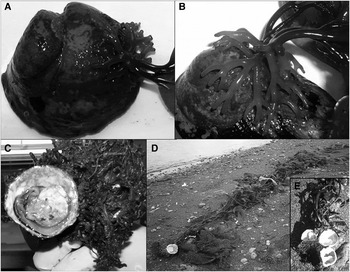
As M. pyrifera settles on the shells of C. fecunda and the holdfast develops in size, the degree of overgrowth on the slipper limpet shell increases. Therefore the overgrowth was evaluated using the following discrete scale: low overgrowth <20% of shell coverage; medium overgrowth 20–80%; and high overgrowth >80% (Figure 2A–C, respectively). Kelp overgrowth degree was established by collecting sporophytes and also in situ submarine photography. This procedure for describing the interaction of M. pyrifera and C. fecunda was conducted over a 10 month period, starting in October 2009, when the first Macrocystis recruits became visible to the naked eye, and ending in July 2010, when the decline in the Macrocystis population showed the lack of sporophytes at the study site. Every month, 20 sporophytes were collected by scraping the kelp and the limpet from the primary substrate. These samples were used to record the frequency and degree of kelp overgrowth on C. fecunda individuals. In addition, to infer the effect of the kelp drag on C. fecunda after a wind storm, a 100 m transect along the coastline near Metri Bay was examined. The number of stranded kelp, with and without C. fecunda attached to the holdfast, were counted. In addition four C. fecunda females with kelp attached were separated to measure shell length (SL) and holdfast diameter (±1 mm precision).
Photographs showing the overgrowth degree of Macrocystis pyrifera on Crepipatella fecunda: (A–C) low, medium and high overgrowth (%); (D, E) drifting Macrocystis pyrifera with Crepipatella fecunda attached (arrow) found after a storm. Figures A, B and C = 1 cm, D and E = 5 cm.

The drag force of kelp on C. fecunda was evaluated by measuring in situ the tenacity of Macrocystis on the primary (rock) and secondary (limpet shell) substrate. The tenacity was expressed as the force per unit area required for dislodging an individual sporophyte from the substrate (Denny, Reference Denny1988). A survey was performed in February 2010 in the low subtidal zone (4 m deep) to measure the tenacity of Macrocystis. A dynamometer (Pocket Balance; Germany) was hooked by SCUBA divers to the kelp's holdfast attached to the rock and/or C. fecunda substrates, then it was pulled up to the surface until the plant was dislodged from the substrate (N = 19). The force (kg-force) required to dislodge the holdfast was registered. The kg-force data were converted formed to Newtons (N) by multiplying by a factor of 9.8 (Online Unit Converter: http://online.unitconverterpro.com/). Then, the holdfast diameter of dislodged sporophytes was registered onshore, using a calliper to standardize tenacity in relation to holdfast size. The following algorithm was used to calculate Macrocystis tenacity (Pa):
 $${\rm Pa\lpar N}\, {\rm m}^{ - 2} \rpar = \displaystyle{{{\rm Dislodge}\, {\rm force}\lpar {\rm N}\rpar } \over {{\rm Holdfast}\, {\rm area}\lpar {\rm m}^2 \rpar }}$$
To obtain a physiological status proxy of the effect of kelp overgrowth on the physiological condition of the slipper limpet, proteins, carbohydrates, lipids and total energy content of the limpet tissue were determined. It is known that these parameters can reflect the degree of stress on the nutritional condition of an invertebrate as a consequence of biotic or abiotic factors (Ojea et al., Reference Ojea, Pazos, Martinez, Novoa, Sanchez and Abad2004; Peteiro et al., Reference Peteiro, Labarta and Fernández-Reiriz2007; Zarnoch & Schreibman, Reference Zarnoch and Schreibman2008). Sessile females of C. fecunda (average size: 45.2 ± 6.5 mm SL) with (N = 20) and without (N = 20; control group) kelp overgrowth were haphazardly collected at monthly intervals by SCUBA divers, between October 2009 and July 2010. Samples were kept in plastic bags and transported to the laboratory in a cooler. Limpet SL, width and height were measured in the laboratory using a precision calliper. Individuals were dissected to separate foot and viscera. Wet weight (WW) of foot and viscera was determined using an analytical balance (Precisa XB 220 A; Dietikon, Switzerland) with 0.0001 g precision. Then, foot and viscera samples were stored at −85°C for subsequent biochemical analyses.
Biochemical analyses
The slipper limpet foot and viscera tissues (N = 320 for each measurement) were freeze-dried (Thermo Savant; Modulyod-230 Lyophilizer) and weighed on an analytical balance (Precisa XB 220 A) to record total dry weight (TDW). Dry tissue was ground and homogeneous subsamples were taken to quantify protein, carbohydrate and lipid content following the methods described below. The colorimetric determination of these components was measured with a spectrophotometer (UV-VIS Spectrophotometer; TU-1800).
Protein content was quantified following the method described by Lowry et al. (Reference Lowry, Rosebrough, Farr and Randall1951) and modified by Raghupathi & Diwan (Reference Raghupathi and Diwan1994), using bovine serum albumin (BSA) as the standard. Carbohydrate was determined by the colorimetric phenol–sulphuric acid method of Dubois et al. (Reference Dubois, Gilles, Hamilton, Rebers and Smith1956), after extracting the sample in hot 5% trichloroacetic acid (TCA) containing 0.1% silver sulphate (Barnes & Heath, Reference Barnes and Heath1966). Glucose was used as the standard. Lipids were extracted from dry tissue with chloroform:methanol (2:1 v/v), sonicated for 2 min, centrifuged and the lipid phase was collected. The chloroform was allowed to evaporate and the lipid residue heated with concentrated sulphuric acid before being analysed by the of Marsh & Weinstein (Reference Marsh and Weinstein1966) colorimetric method, using tripalmitin as the standard. Protein, carbohydrate and lipid data were converted into energy equivalents by using coefficients of 24.0, 17.5 and 39.5 J mg−1, respectively (Gnaiger, Reference Gnaiger, Gnaiger and Forstner1983).
To test the effects of kelp overgrowth on C. fecunda the biochemical (proteins, carbohydrates and lipids) and energy content of limpets, with and without kelp overgrowth, were compared among factors using a three-way ANOVA (STATISTICA 8.0 for Windows XP) with interaction time (10 months: October–June), kelp effect (with and without kelp) and tissue (foot and viscera) as factors. Where no differences between foot and viscera content were found, the biochemical composition of both tissues was pooled. To determine the significant differences (P < 0.05) between group means, Tukey multiple comparison tests were performed.
RESULTS
M. pyrifera–C. fecunda interaction timeline
Results show that the giant kelp M. pyrifera grew annually on the limpet C. fecunda in a closed co-habiting relationship. The development of this ecological interaction followed the stages of M. pyrifera annual populations inhabiting protected areas of southern Chile, previously described by Buschmann et al. (Reference Buschmann, Moreno, Vásquez and Hernández-González2006). Thus, in the early austral spring (August–September) M. pyrifera microscopic stages recruit onto the limpet shell triggering the development of sporophytes attached to the secondary substrate. Changes in frequency of individuals with higher, and lower degrees of overgrowth, showed that the kelp overgrowth occurred over a 7 month (October–April) period of interaction (Figure 3). From late spring to early summer (October–January) the average holdfast on the limpet shells increased to 5–7 cm in size, by extending and branching its haptera, until finally reaching the rocky substrate (Figure 2). Up to two plants overgrowing one C. fecunda female were found, as well as one plant overgrowing two stacks of sessile females (a stack comprises two and up to four females growing one over the other). These stacks were either attached directly to the primary substrate, or as epibionts on the mussel Aulacomya ater (Figure 2B). By late summer (March) the adult plants have an average holdfast diameter of 12 ± 2.3 cm, twice the average length of a limpet shell (up to 6.5 cm). Thus, during summer and early winter (January–April) the holdfast was large enough to cover the limpet and to reach the primary substrate (Figures 2 & 3). From late summer to early autumn (February–April) the haptera of the holdfasts supported a community of benthic animals, mainly filter feeding assemblages. From May onwards, the decline in the M. pyrifera population in the study area marked the end of overgrowth and the kelp–invertebrate ecological interaction. From late autumn to early winter (May–July) there was evidence of old sporophytes, dark-brown in colour with necrotic holdfasts.
Frequency of kelp overgrowth on Crepipatella fecunda: low <20%; medium 20–80% and high >80% of shell cover. Numbers above bars indicate the mean diameter (cm) of holdfasts during the respective month (data from Buschmann et al., Reference Buschmann, Moreno, Vásquez and Hernández-González2006).

M. pyrifera–C. fecunda complex stranding
In late summer (March), and after a storm, a mass stranding of Macrocystis pyrifera carrying sessile females of Crepipatella fecunda attached to their holdfasts was observed near the study site (Figure 2D). The stranded algal material consisted of entangled Gracilaria chilensis, Ulva sp., S. crispata and M. pyrifera forming a dense rope-like strand-line. Up to three sessile females were found attached to one sporophyte (Figure 2E). Average C. fecunda SL and M. pyrifera holdfast diameter were 40.4 ± 9.8 and 80.5 ± 19.0 mm, respectively (N = 4), and ~50% of the kelp holdfasts had at least one C. fecunda shell attached.
Macrocystis drag force on C. fecunda
During the sporophyte detachment studies, all attempts (100%) resulted in dislodgement of Macrocystis pyrifera alone, either from the primary or the secondary substrates, while C. fecunda remained attached to the primary substrate. These results suggest that C. fecunda tenacity to the primary substrate—on the application of perpendicular force at the surface—is higher than the tenacity of M. pyrifera to the primary and secondary substrates. Mean dislodgement force was 127.9 ± 53.6 N and mean plant tenacity was 12.2 ± 6.4 kN m−2 (≈kPa). Moreover, the diameter and basal area of the detached holdfasts were 12 ± 2.3 cm and 1.16 × 10⁻² ± 0.43 × 10⁻² m2 respectively (N = 19).
Biochemical composition and energy content in C. fecunda
Biochemical results indicate that the Crepipatella fecunda tissues are composed principally of organic matter, mainly proteins (78.2%) followed by a lower carbohydrates (20.4%) and lipids (1.4%) contents. Crepipatella fecunda protein content was significantly affected by time and tissue factors, but was not affected by the kelp effect factor (Table 1). Thus, protein content in C. fecunda individuals varies seasonally, reaching minimum and maximum mean values of 417.9 ± 109.9 and 798.1 ± 74.8 mg g−1 during January and August, respectively (Figure 4). At the tissue level, C. fecunda have significantly higher protein content in the foot compared with the viscera, with mean values of 570.6 ± 114.2 and 465.3 ± 128.8 mg g−1, respectively. Carbohydrate content was significantly affected by time, kelp effect and tissue factors, showing a significant interaction between most of the factors (Table 2). Thus, carbohydrate content (Figure 5) changed seasonally, reaching minimum and maximum mean values of 74.8 ± 24.1 mg g−1 (August) and 242.5 ± 39.4 mg g−1 (January), respectively. At the tissue level, carbohydrate content of C. fecunda was significantly higher in the foot compared with the viscera, with mean values of 142.3 ± 32.2 and 126.3 ± 30.3 mg g−1, respectively. The a posteriori analysis indicated that during February (highest degree of overgrowth) C. fecunda individuals without M. pyrifera overgrowth had a significantly higher mean carbohydrate content (α = 0.05; MS = 1099.4; df = 245) than individuals with kelp overgrowth. Lipid content was affected by the time factor but was not affected by the kelp effect and tissue factors (Table 3). Thus, lipid content varied seasonally, reaching minimum and maximum mean values of 12.9 ± 3.5 and 15.9 ± 4.2 mg g−1 during September and February, respectively (Figure 6). At the tissue level, C. fecunda had similar lipid content in the foot and the viscera, with mean values of 9.63 ± 2.01 and 9.59 ± 2.21 mg g−1 respectively. Total energy content was significantly affected by time and tissue factors, but was not affected by kelp overgrowth (Table 4). Thus, total energy content of C. fecunda individuals varied seasonally, reaching minimum and maximum mean values of 14.2 ± 2.6 and 21.9 ± 3.6 kJ g−1 during April and August, respectively (Figure 7). At the tissue level, C. fecunda individuals had a total energy content that was significantly higher in the foot compared with the viscera, with mean values of 17.1 ± 3.1 and 14.2 ± 3.5 kJ g−1, respectively.
Mean (±standard error; N = 20) annual variation of carbohydrate content in (A) foot and (B) viscera of sessile Crepipatella fecunda females with (□) and without (■) kelp overgrowth. Horizontal line over the x-axis indicates the degree of overgrowth over time. Dashed line indicates the recruitment and senescence periods of Macrocystis. Asterisk over the data indicates statistical differences (P < 0.05).

Mean (±standard error; N = 20) annual variation of protein content in (A) foot and (B) viscera of sessile Crepipatella fecunda females with (□) and without (■) kelp overgrowth. Horizontal line over the x-axis indicates the degree of overgrowth over time. Dashed line indicates the recruitment and senescence periods of Macrocystis.

Mean (±standard error; N = 20) annual variation of lipids content in Crepipatella fecunda individuals (foot + viscera), with (□) and without (■) kelp overgrowth. Horizontal line over the x-axis indicates degree of overgrowth over time. Dashed line indicates the recruitment and senescence periods of Macrocystis.

Mean (±standard error; N = 20) annual variation of total energy content in (A) foot and (B) viscera of sessile Crepipatella fecunda females with (□) and without (■) kelp overgrowth. Horizontal line over the x-axis indicates the degree of overgrowth over time. Dashed line indicates the recruitment and senescence periods of Macrocystis.

Results of a three-way analysis of variance (three-way ANOVA) testing the factor effects on Crepipatella fecunda carbohydrate content.

Results of a three-way analysis of variance (three-way ANOVA) testing the factor effects on Crepipatella fecunda protein content.

Results of a three-way analysis of variance (three-way ANOVA) testing the factor effects on Crepipatella fecunda lipid content.

Results of a three-way analysis of variance (three-way ANOVA) testing the factor effects on Crepipatella fecunda total energy.

DISCUSSION
Macrocystis pyrifera and Crepipatella fecunda coexist annually in wave protected areas in southern Chile, under a commensal ecological relationship. Both species coexist by sharing the limiting resource, i.e. substrate, only competing during periods of high overgrowth (i.e. competitive coexistence, sensu Chesson, Reference Chesson2000b). Kelp overgrowth only reduced carbohydrate concentration in the gastropod tissue during one month of the sampling period (February—the month with the highest degree of overgrowth), but without affecting protein, lipid and total energy content over the entire interaction period. This suggests that kelp overgrowth could interfere, to some extent, with C. fecunda feeding, triggering the use of some of the tissue reserves (i.e. carbohydrates). However, the short period of kelp overgrowth (annual populations of M. pyrifera) and the large size reached by the C. fecunda females (up to 65 mm SL in this study), would allow for the rapid recovery of limpet individuals, avoiding competitive exclusion.
High C. fecunda abundance on the rocky bottom of Metri Bay restricts annual M. pyrifera sporophytes recruitment on the gastropod shell (Henríquez et al., Reference Henríquez, Buschmann, Maldonado, Graham, Hernández-González, Pereda and Bobadilla2011). During the interaction period (August–April) the species share the common resource ‘substrate’ and an overlap pattern of resource use is observed (Connell, Reference Connell1972; Dudgeon et al., Reference Dudgeon, Steneck, Davison and Vadas1999). Classical ecological theories predict that species that exploit a limited common resource cannot coexist indefinitely. However, in Metri Bay both species coexist throughout most of the year (August to April) by sharing the substrate, even when a certain degree of competition can be observed during the highest overgrowth period. Results indicated that during February, the gastropod requires a higher quantity of carbohydrates to deal with the environmental changes (i.e. higher kelp overgrowth). From May onwards, the senescence of M. pyrifera sporophytes releases the gastropod from the kelp overgrowth, allowing individuals to recover quickly. Crepipatella fecunda and M. pyrifera differ with regards to the time when the resource is exploited, i.e. temporal niche partitioning (Armstrong & McGehee, Reference Armstrong and McGehee1980; Chesson, Reference Chesson2000a, Reference Chessonb). This is related to the different reproductive strategies of each species; while C. fecunda present direct development, high fecundity and are reproductive almost all year round (Gallardo, Reference Gallardo1979; Chaparro et al., Reference Chaparro, Saldivia, Pereda, Segura, Montiel and Collin2005), M. pyrifera have a reduced reproductive potential, with fertile tissues only present during the summer and austral autumn, recolonizing the area during a limited 2 month period (August–September, Buschmann et al., Reference Buschmann, Vásquez, Osorio, Reyes, Filún, Hernández-González and Vega2004, Reference Buschmann, Moreno, Vásquez and Hernández-González2006). Therefore, the C. fecunda reproductive strategy enables it to exploit the benthic space and disperse its offspring over a wider period of time than the reproductive propagules of M. pyrifera (Pacala & Rees, Reference Pacala and Rees1998; Bolker & Pacala, Reference Bolker and Pacala1999). Therefore, the annual reproductive cycle of M. pyrifera generates the ‘break’ required by the C. fecunda population to avoid being affected by kelp overgrowth. Furthermore it was not possible to determine whether kelp induced mortality on limpets, increasing availability of free space, as the number of removals induced by kelp seems to have a ‘negligible’ effect on slipper limpet abundance. However, most importantly, free space may not be relevant for C. fecunda as new recruits (mobile males) settle on conspecific's shell (sessile females) and, therefore, recruitment is independent of the availability of free substratum, and as limpets can stack, substratum may not be a relevant ecological factor (Douros, Reference Douros1987; McShane & Naylor, Reference McShane and Naylor1995).
Although field experience indicated that the tenacity of M. pyrifera on the primary (i.e. the rock) and secondary substrate is lower than that measured for C. fecunda, the evidence of stranding of both species in Reloncaví Bay suggests that kelp overgrowth may increase the risk of limpet dislodgement during periods of storm waves. In this context, C. fecunda individuals with kelp growing on the shell face greater hydrodynamic forces than those without kelp, thus increasing the risk of dislodgement and mortality (Witman & Suchanek, Reference Witman and Suchanek1984; Witman, Reference Witman1987). Moreover, during storm events these hydrodynamic forces would be continuous and enhanced by the increase in moving water, to the point of exceeding the tenacity of C. fecunda and M. pyrifera on the primary substrate. Mortality due to dislodgement has been described previously for mussels inhabiting wave exposed habitats (Witman & Suchanek, Reference Witman and Suchanek1984; Witman, Reference Witman1985, Reference Witman1987). Even though it is possible to associate limpet mortality with kelp overgrowth, these episodes are sporadic and the mortality effect is at the individual but not at the populational level, due to the high C. fecunda abundance reported in the study area and the kelp density. This effect is only restricted to the summer months when the kelp population develops using the limpets as substrate.
Two opposing processes have been described in rocky intertidal systems: interference competition and facilitation, which can act simultaneously (Callaway & Walker, Reference Callaway and Walker1997; Kawai & Tokeshi, Reference Kawai and Tokeshi2006) and the net effect of one species on another represents the sum of negative and positive components (Goldberg, Reference Goldberg, Grace and Tilman1990; Callaway & Walker, Reference Callaway and Walker1997; Kawai & Tokeshi, Reference Kawai and Tokeshi2006). We have shown that C. fecunda does not suffer changes in the main organic constituents, or in total energy content, that might be attributable to strong competition for space with M. pyrifera. Thus, the potential effect on limpet dislodgement and the point effect on carbohydrate constituents, as well as the reproductive strategy described for the species (being able to spawn up to seven times per year, except May and June, sensu Chaparro et al., Reference Chaparro, Saldivia, Pereda, Segura, Montiel and Collin2005) suggest that, mainly, kelp overgrowth has a neutral effect on C. fecunda. This evidence, together with the positive effect of C. fecunda on M. pyrifera recruitment (Henríquez et al., Reference Henríquez, Buschmann, Maldonado, Graham, Hernández-González, Pereda and Bobadilla2011), enables us to characterize this ecological interaction as commensalism (0/+). Therefore, kelp overgrowth only causes sublethal effects on C. fecunda females, which would be quickly offset by the gastropod when the kelp disappears from the system.
As the period of high overgrowth occurs during the austral summer, when kelp sporophytes reach their largest sizes (Buschmann et al., Reference Buschmann, Moreno, Vásquez and Hernández-González2006), and after determining that dislodgement of one individual of Macrocystis can cause the mortality of up to three C. fecunda females, if we consider that the mean density of M. pyrifera can reach up to 5–6 individuals m−2 in this period (summer) (Buschmann et al., Reference Buschmann, Vásquez, Osorio, Reyes, Filún, Hernández-González and Vega2004), the mortality of the limpet induced by Macrocystis overgrowth may reach a maximum of 15–18 individuals m−2, which represents less than 4% of the C. fecunda population (density of up to 500 individuals m−2). Even though the evidence provided in this study about the effect of the kelp overgrowth on the nutritional condition of the slipper limpet may not be extrapolated to the population level, the chemical constituents measured at the individual level, suggest that these effects are reduced to a short period and only affect carbohydrate content. In conclusion, biochemical changes and mortality in C. fecunda related to M. pyrifera overgrowth may not represent an important ecological factor for the former species.
Over recent decades the important facilitation role that some species play as ecosystem engineers or niche constructors has been demonstrated (Bruno & Bertness, Reference Bruno, Bertness, Bertness, Hay and Gaines2001; Odling-Smee et al., Reference Odling-Smee, Laland and Feldman2003). Recently, Henríquez et al. (Reference Henríquez, Buschmann, Maldonado, Graham, Hernández-González, Pereda and Bobadilla2011) showed that C. fecunda females play an important role as a facilitator, by increasing the recruitment success of M. pyrifera in Metri Bay. Therefore, C. fecunda could extend the range of M. pyrifera realized niche by enhancing its recruitment success in channels and fjords of the Chiloé region. In general, we conclude that the secondary substrate provided by C. fecunda shells may increase the habitat heterogeneity and complexity (Botts et al., Reference Botts, Patterson and Schloesser1996), determining the success of algal colonization of benthic spaces. Thus, C. fecunda may play a role as niche constructor by direct facilitation of limited resource substrate for other sessile species development (e.g. M. pyrifera, S. crispata and Ulva sp., this study). Moreover, Henríquez et al. (Reference Henríquez, Buschmann, Maldonado, Graham, Hernández-González, Pereda and Bobadilla2011) suggest that C. fecunda would indirectly favour M. pyrifera by controlling green algae abundance, which may compete with M. pyrifera for light, space and nutrients.
ACKNOWLEDGEMENTS
The collaboration of Luis Henríquez and Miguel Maldonado during the field sampling process and of Juan Cabrera in the laboratory analyses, is gratefully acknowledged. Finally, many thanks to Dr Matthew R. Lee for checking English use and spelling in this manuscript, and also for his valuable comments.
FINANCIAL SUPPORT
Funding was provided by FONDECYT grant 1080144.