






1. Introduction
James Webb Space Telescope (JWST) observed several fields repeatedly. These fields can be used to search for high-redshift transients like supernovae (SNe). The JWST Advanced Deep Extragalactic Survey (JADES, Eisenstein et al. Reference Eisenstein, Johnson, Robertson, Tacchella, Hainline, Jakobsen, Maiolino, Bonaventura, Bunker, Cameron, Cargile, Curtis-Lake, Hausen, Puskás, Rieke, Sun, Willmer, Willott, Alberts, Arribas, Baker, Baum, Bhatawdekar, Carniani, Charlot, Chen, Chevallard, Curti, DeCoursey, D’Eugenio, de Graaff, Egami, Helton, Ji, Jones, Kumari, Lützgendorf, Laseter, Looser, Lyu, Maseda, Nelson, Parlanti, Rauscher, Rawle, Rieke, Rix, Rujopakarn, Sandles, Saxena, Scholtz, Sharpe, Shivaei, Simmonds, Smit, Topping, Übler, Venturi, Williams, Witstok and Woodrum2023) field was among the first JWST deep fields that were repeatedly observed. By performing image subtractions, 79 SNe were identified up to  $z=5$ by using the first multiple images in the field separated by one year (DeCoursey et al. Reference DeCoursey, Egami, Pierel, Sun, Rest, Coulter, Engesser, Siebert, Hainline, Johnson, Bunker, Cargile, Charlot, Chen, Curti, DeFour-Remy, Eisenstein, Fox, Gezari, Gomez, Jencson, Joshi, Khairnar, Lyu, Maiolino, Moriya, Quimby, Rieke, Rieke, Robertson, Shahbandeh, Strolger, Tacchella, Wang, Williams, Willmer, Willott and Zenati2025). The subsequent follow-up observations identified a Type II SN at
 $z=3.6$ (Coulter et al. Reference Coulter, Pierel, DeCoursey, Moriya, Siebert, Joshi, Engesser, Rest, Egami, Shahbandeh, Chen, Fox, Strolger, Zenati, Bunker, Cargile, Curti, Eisenstein, Gezari, Gomez, Guolo, Hainline, Jencson, Johnson, Karmen, Maiolino, Quimby, Rinaldi, Robertson, Tacchella, Sun, Wang and Wevers2025), a Type Ia SN at
 $z=2.9$ (Pierel et al. Reference Pierel, Engesser, Coulter, DeCoursey, Siebert, Rest, Egami, Chen, Fox, Jones, Joshi, Moriya, Zenati, Bunker, Cargile, Curti, Eisenstein, Gezari, Gomez, Guolo, Johnson, Karmen, Maiolino, Quimby, Robertson, Shahbandeh, Strolger, Sun, Wang and Wevers2024), and a Type Ic-BL at
 $z=2.8$ (Siebert et al. Reference Siebert, DeCoursey, Coulter, Engesser, Pierel, Rest, Egami, Shahbandeh, Chen, Fox, Zenati, Moriya, Bunker, Cargile, Curti, Eisenstein, Gezari, Gomez, Guolo, Johnson, Joshi, Karmen, Maiolino, Quimby, Robertson, Strolger, Sun, Wang and Wevers2024).
In particular, six confident Type II SNe in  $0.675\leq z\leq 3.61$ were identified through spectroscopy and multi-epoch photometry (Moriya et al. Reference Moriya, Coulter, DeCoursey, Pierel, Hainline, Siebert, Rest, Egami, Gomez, Quimby, Fox, Engesser, Sun, Chen, Zenati, Gezari, Joshi, Shahbandeh, Strolger, Wang, Alberts, Bhatawdekar, Bunker, Rinaldi, Robertson and Tacchella2025). Type II SNe have been only discovered up to
 $z\sim 0.3$ (de Jaeger et al. Reference de Jaeger, Stahl, Zheng, Filippenko, Riess and Galbany2020). Thus, JWST is very much extending the redshift range of Type II SN discovery.
Type II SNe consist of about 70% of core-collapse SNe (Shivvers et al. Reference Shivvers, Modjaz, Zheng, Liu, Filippenko, Silverman, Matheson, Pastorello, Graur, Foley, Chornock, Smith, Leaman and Benetti2017). Thus, the properties of Type II SNe can be regarded as general properties of core-collapse SNe that can be compared with theoretical explosion models. Comparing high-redshift Type II SN properties to local Type II SN properties allows us to explore the differences in core-collapse SN properties caused by, e.g., metallicity.
In this work, we estimated the properties of six high-redshift Type II SN properties and checked if there are any potential differences between high-redshift and local Type II SNe. For the full details, we refer to Moriya et al. (Reference Moriya, Coulter, DeCoursey, Pierel, Hainline, Siebert, Rest, Egami, Gomez, Quimby, Fox, Engesser, Sun, Chen, Zenati, Gezari, Joshi, Shahbandeh, Strolger, Wang, Alberts, Bhatawdekar, Bunker, Rinaldi, Robertson and Tacchella2025).
2. High-redshift Type II SN sample from JWST
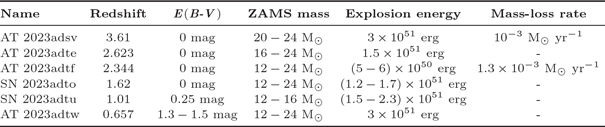
Table 1 summarizes the properties of the JWST high-redshift Type II SNe. The redshifts were obtained by either the SN spectra or from the pre-explosion host galaxy spectra. We estimated the explosion properties by modeling the multi-color light curves provided by JWST. We first developed  $0.1~\mathrm{Z_\odot}$ progenitors with the zero-age main-sequence (ZAMS) mass of 12,16,20, and
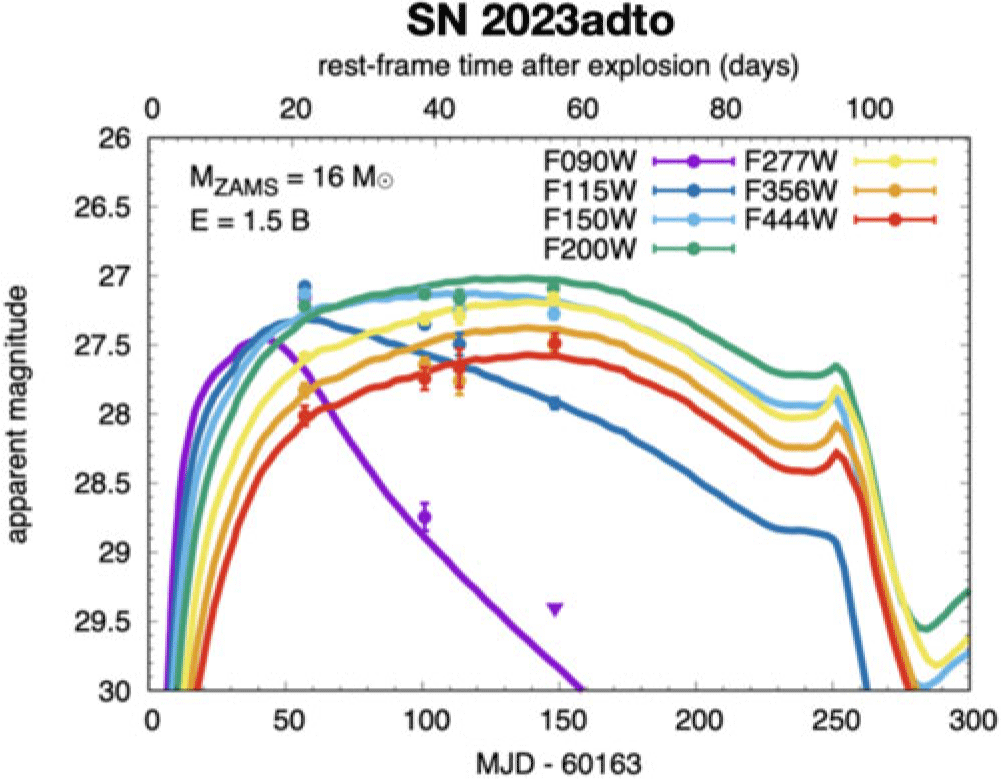
 $24~\mathrm{M_\odot}$ by using Modules for Experiments in Stellar Astrophysics (MESA, Paxton et al. Reference Paxton, Bildsten, Dotter, Herwig, Lesaffre and Timmes2011). Then synthetic light curves from these progenitors were obtained by using one-dimensional multi-frequency radiation hydrodynamics code STELLA (Blinnikov et al. Reference Blinnikov, Eastman, Bartunov, Popolitov and Woosley1998). STELLA can obtain spectral energy distributions (SEDs) in each timestep. We shifted synthetic SEDs to the observer frame so that we can directly compare the observed light curves to synthetic light curves. Figure 1 shows an example of the comparison between the observed and synthetic light curves. When the observed color is too red to match the synthetic light curves, we introduce extinction.
JWST high-redshift Type II SN properties.

Table 1 Long description
A table comparing properties of JWST high-redshift Type II supernovae. The table has six rows and six columns. Column headers are Name, Redshift, E(B-V), ZAMS mass, Explosion energy, and Mass-loss rate. Row 1: AT 2023adv, 3.61, 0 mag, 20-24 M sun, 3 times 10 to the power of 51 erg, 10 to the power of -3 M sun per year. Row 2: AT 2023adte, 2.623, 0 mag, 16-24 M sun, 1.5 times 10 to the power of 51 erg, not available. Row 3: AT 2023adtf, 2.344, 0 mag, 12-24 M sun, 5-6 times 10 to the power of 50 erg, 1.3 times 10 to the power of -3 M sun per year. Row 4: SN 2023adtu, 1.62, 0 mag, 12-24 M sun, 1.2-1.7 times 10 to the power of 51 erg, not available. Row 5: SN 2023adtu, 1.01, 0.25 mag, 12-16 M sun, 1.5-2.3 times 10 to the power of 51 erg, not available. Row 6: AT 2023adtw, 0.657, 1.3-1.5 mag, 12-24 M sun, 3 times 10 to the power of 51 erg, not available.
Observed light curves of Type II SN 2023adto discovered by JWST at  $z=1.62$ (points). They are compared with synthetic light curves (lines) to estimate their explosion properties (Moriya et al. Reference Moriya, Coulter, DeCoursey, Pierel, Hainline, Siebert, Rest, Egami, Gomez, Quimby, Fox, Engesser, Sun, Chen, Zenati, Gezari, Joshi, Shahbandeh, Strolger, Wang, Alberts, Bhatawdekar, Bunker, Rinaldi, Robertson and Tacchella2025). The synthetic light curve in this figure is from an explosion of a
 $16~\mathrm{M_\odot}$ (ZAMS mass) progenitor with the explosion energy of
 $1.5\times 10^{51}~\mathrm{erg}=1.5~\mathrm{B}$. No CSM is assumed in the synthetic light curves in this figure.

3. High-redshift Type II SN properties
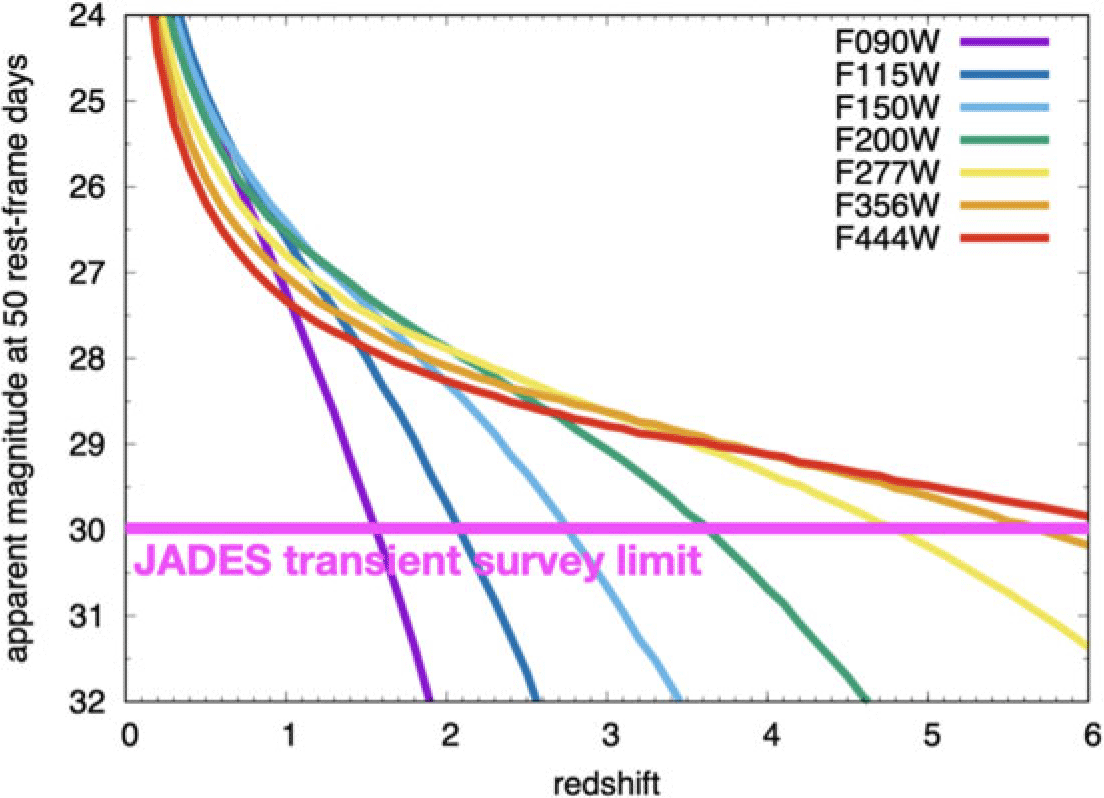
The estimated properties of high-redshift Type II SNe from JWST are presented in Table 1. The ZAMS mass is difficult to constrain because we do not have good constraints on the duration of the plateau phase. The plateau brightness, which are strongly affected by explosion energy, is known. Thus, we have a better idea of explosion energies. Among six Type II SNe, we found that two Type II SNe have relatively high explosion energies of  $3\times 10^{51}~\mathrm{erg}$. Such high explosion energy is not often estimated in local Type II SNe (Martinez et al. Reference Martinez, Bersten, Anderson, Hamuy, González-Gaitán, Förster, Orellana, Stritzinger, Phillips, Gutiérrez, Burns, Contreras, de Jaeger, Ertini, Folatelli, Galbany, Hoeflich, Hsiao, Morrell, Pessi and Suntzeff2022). One may think that Type II SNe with higher explosion energies are brighter and thus they are easier to discover. However, the JWST transient survey limit (around 30 mag) is deep enough to discover Type II SNe with typical explosion energy (around
 $10^{51}~\mathrm{erg}$) in the redshift range of our interest (Figure 2). Thus, the discovered preference to have high explosion energy may not be observed bias but an intrinsic property of high-redshift Type II SNe. However, more high-redshift Type II SNe are required to confirm.
Brightness of Type II SNe during the plateau phase as a function of redshift (Moriya et al. Reference Moriya, Coulter, DeCoursey, Pierel, Hainline, Siebert, Rest, Egami, Gomez, Quimby, Fox, Engesser, Sun, Chen, Zenati, Gezari, Joshi, Shahbandeh, Strolger, Wang, Alberts, Bhatawdekar, Bunker, Rinaldi, Robertson and Tacchella2025). An explosion of  $12~\mathrm{M_\odot}$ (ZAMS) mass with
 $10^{51}~\mathrm{erg}$ is assumed in this model.

Type II SNe in the local Universe are generally observed to experience interaction between SN ejecta and dense confined circumstellar matter (CSM, Förster et al. Reference Förster, Moriya, Maureira, Anderson, Blinnikov, Bufano, Cabrera-Vives, Clocchiatti, de Jaeger, Estévez, Galbany, González-Gaitán, Gräfener, Hamuy, Hsiao, Huentelemu, Huijse, Kuncarayakti, Martínez, Medina, Olivares, Pignata, Razza, Reyes, San Martín, Smith, Vera, Vivas, de Ugarte Postigo, Yoon, Ashall, Fraser, Gal-Yam, Kankare, Le Guillou, Mazzali and Walton2018). The ultraviolet brightness of AT 2023adsv and AT 2023adtf were rather high and it can be better explained by adding dense confined CSM. The estimated mass-loss rates of their progenitors shortly before the explosion is around  $10^{-3}~\mathrm{M_\odot~yr^{-1}}$ (a wind speed of
 $10~\mathrm{km~s^{-1}}$ is assumed), which is similar to those estimated for local Type II SNe. This indicates that the mass-loss enhancement of Type II SN progenitors also occurs at high redshifts, and the unknown mechanism for the mass-loss enhancement is likely metallicity independent.
4. Summary and future prospects
We are starting to recognize the extraordinary ability of JWST to discover high-redshift transients. The initial JWST discoveries of high-redshift Type II SNe indicate that they may have higher explosion energies than those in the local Universe. The dense confined CSM around Type II SN progenitors seems to exist at high redshifts as well. However, our sample size is still rather small. We need to have more high-redshift Type II SNe to confirm the existence of such a difference. Fortunately, JWST keeps exploring time domain. There are several ongoing programs to explore time domain with JWST. In addition, some JWST Director’s Discretionary Time (DDT) is decided to be allocated for high-redshift transient exploration. In the coming years, we will start to have many high-redshift SNe with which we can fully explore the properties of SNe and their progenitors in the primoridal Universe.
 z=1.62
 16 M⊙
 1.5×1051 erg=1.5 B
 12 M⊙
 1051 erg


