Introduction
Cysticercosis is caused by the larvae of the tapeworm Taenia solium in humans. Urban cysticercosis is presently a major public health problem but is not studied frequently. Often asymptomatic, cysticercosis can nevertheless provoke different kinds of diseases especially when involving the central nervous system. The classic life cycle of T. solium includes humans as the definitive host and swine as the intermediate host. After eating undercooked pork containing viable cysticerci, humans develop an intestinal tapeworm infection, thus completing the natural evolutionary cycle. However, humans can also become intermediate hosts by ingestion of food contaminated with T. solium eggs or directly ingesting T. solium eggs from faeces of human carriers of the parasite. Human T. solium cysticercosis is therefore a human-to-human infection acquired by faecal–oral contamination in areas with poor hygiene and sanitation. Indeed, the high prevalence of taeniasis found in cases of massive cysticercal infection suggests that autoinfection occurs in most of these patients by the faecal–oral route.
Human T. solium cysticercosis is common in developing countries where economics are based on breeding livestock, especially pigs, with low hygiene standards. Neurocysticercosis, caused by the migration of the larvae of the pork tapeworm in the central nervous system, is the leading cause of acquired epilepsy in adults in Central and South America, sub-Saharan Africa, Madagascar and La Réunion, East and South Asia, and Oceania. More than 50,000 new neurocysticercosis-related deaths occur annually. This makes neurocysticercosis a large public health problem in developing countries (Sotelo & Del Brutto, Reference Sotelo and Del Brutto2002).
Two clinical cases of neurocysticercosis have been observed recently in Haiti. Imported cases were also reported in Haitian immigrants living in the USA (Anonymous, 1984; Fleet et al., Reference Fleet, Morgan and Lile1990), Canada (Leblanc et al., Reference Leblanc, Knowles, Melanson, MacLean, Rouleau and Farmer1986) and the French West Indies (Caparros-Lefebvre et al., Reference Caparros-Lefebvre, Lannuzel, Alexis, Strobel and Janky1997; Roudier et al., Reference Roudier, Maillard, Brousse, David and Huerre2000). Besides, human intestinal taeniasis has been reported regularly by epidemiological surveys in Haiti, with a prevalence varying from 0.2 to 1.9% (Ripert & Avouac-Borzee, Reference Ripert and Avouac-Borzee1975; Raccurt et al., Reference Raccurt, Vial and Pierre-Louis1977; Champetier de Ribes et al., Reference Champetier de Ribes, Fline, Désormeaux, Eyma, Montagut, Champagne, Pierre, Pape and Raccurt2005). To date, no recent information is available for the West Indies. In order to evaluate the prevalence of human T. solium cysticercosis in Haiti, we undertook a cross-sectional serological retrospective survey, testing sera provided by workers in Port-au-Prince where sewage systems are rare and swine roam freely throughout the area.
Material and methods
Two hundred and sixteen anonymized serum samples, provided by healthy adults seen in the work setting of periodical medical visits, were tested retrospectively (after preservation by freezing at − 20°C) using a Western blotting test (LDBIO Diagnostics®).
The Western blot assay was performed with strips and reagents provided with the kit, according to the manufacturer's instructions. Briefly, the strips were incubated with sera diluted 1:50 in Tris–NaCl sample buffer for 90 min. After a washing step with Tris–NaCl washing buffer, the strips were incubated with an anti-human immunoglobulin G–alkaline phosphatase conjugate for 60 min. After another washing step, the protein fractions recognized by the sera were revealed by the corresponding substrate–chromogenic solution containing nitroblue tetrazolium and 5-bromo-4-chloro-3-indolyl phosphate. The reaction was stopped by washing the strips with distilled water. The strips were dried and glued to paper for reading and storage. Positive and negative controls were tested in each assay.
Results
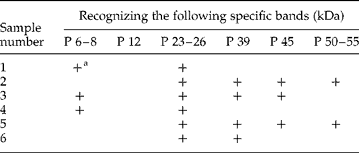
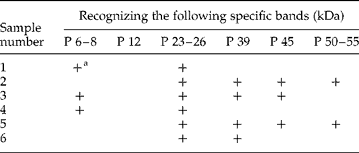
Six serum samples were positive by T. solium Western blot assay test, each reacting at two, three or four specific antigenic bands. The frequency of antibodies in serum samples of the study population was 2.8%. As shown in table 1, the immunodominant bands most frequently recognized by Western blot were 23–26 kDa (100%) and 39 kDa (67%).
Frequencies of different antigenic fractions reacting with sera from six healthy adults from Port-au-Prince, Haiti.
a +, Positive.
Discussion
Relatively little is known about the epidemiology of cysticercosis, and diagnosis may be difficult, even with capacities for serological diagnosis. These are two of the reasons why cysticercosis is a largely unrecognized burden on the welfare and economies of developing countries. Poor hygiene and living conditions, allowing pigs access to human faeces, put people at risk of developing cysticercosis (Garcia et al., Reference Garcia, Gilman, Martinez, Tsang, Pilcher, Herrera, Diaz, Alvarado and Miranda1993; Garcia-Noval et al., Reference Garcia-Noval, Allan, Fletes, Moreno, DeMata, Torres-Alvarez, Soto de Alfaro, Yurrita, Higueros-Morales, Mencos and Graig1996; Sanchez et al., Reference Sanchez, Gomez, Allebeck, Cosenza and Ljungström1997). The development of improved immunodiagnostic tools has contributed to our knowledge of the importance of taeniasis/cysticercosis by enabling sero-epidemiological surveys and community-based studies to be carried out. However, because the accuracy of these tests relies on the highly variable humoral immune response of the host against cysticerci, they have unsatisfactory sensitivity and specificity (Sotelo & Del Brutto, Reference Sotelo and Del Brutto2002). As in Ecuador, where cysticercosis is widely prevalent in urban, middle-class areas (Goodman et al., Reference Goodman, Ballagh and Carpio1999), this serological survey in Port-au-Prince shows, for the first time, a high prevalence of seropositivity in a healthy adult population. Migration from the countryside and the rise of urban slums obviously influence the changing epidemiology of cysticercosis in the world (Pal et al., Reference Pal, Carpio and Sander2000). Presently, more than 2 million people live in Port-au-Prince, a city that has shown rapid growth during past decades. It is noteworthy that numerous pigs and other animals rove freely on the streets. In major parts of the city, people live in an overcrowded environment with very low hygiene standards. Human and animal faecal contamination of the soil is particularly heavy, and faeco-oral transmission of pathogens is often a hazard.
As standard enzyme-linked immunosorbent assay (ELISA) techniques have disappointing sensitivity and specificity in routine epidemiological use (Schantz et al., 1994), we chose enzyme-linked immunoelectrotransfer blot (EITB) assays on serum to investigate seropositivity in our population sample, as recommended by Tsang et al. (Reference Tsang, Brand and Boyer1989), assessing much higher claimed sensitivity (95%) and specificity (100%). But, if serum EITB is recognized as highly sensitive and specific for the diagnosis of human cysticercosis, results reported by others have been disappointing. One shortcoming of the test is the high incidence of false-negative results in patients harbouring a single cerebral cyst; in such cases, the sensitivity of EITB decreases to 30%. An assay conducted in patients with calcified lesions is also less likely to demonstrate a positive result than in those with active disease (Sotelo & Del Brutto, Reference Sotelo and Del Brutto2002). The EITB test alone is insufficient to detect cysticercosis in the population, as shown in Ecuador where more than 50% of patients with neurocysticercosis diagnosed by computed tomography (CT) were negative by EITB test (Goodman et al., Reference Goodman, Ballagh and Carpio1999). False-negative results are related to local production of antibodies within the central nervous system without a parallel increase of antibodies in peripheral blood, or to immune tolerance to the parasite without production of anticysticercal antibodies; this is mostly the result of previous contact with the parasite or to cross-reactivity with other helminths, which is particularly frequent in individuals from endemic areas such as Haiti.
ELISA, for the detection of parasite antigens in faecal samples, and DNA hybridization techniques, for the detection of eggs in stools, are useful methods for the diagnosis of the adult stage of T. solium in humans (Flisser et al., Reference Flisser, Plancarte, Correa, Rodriguez-Del-Rosal, Feldman, Sandoval, Torres, Meza, Parkhouse and Harrison1990). In this study, conducted retrospectively on frozen sera, no stool specimens from the surveyed population were available. Nevertheless these preliminary results confirm for the first time the human endemicity of cysticercosis in Haiti, where systems for disposal of human faeces are deficient, and where wandering pigs are as common in urban areas as in the open country. The human taeniasis/cysticercosis prevalence found using a Western blotting assay test on serum samples provided from healthy adults is similar to that reported in other Latin American and African countries.
Epilepsy, like neurocysticercosis, is a largely unrecognized but increasing burden on the welfare and economies of developing countries. Many studies from Latin America have shown that infection of the brain by the larvae of the pork tapeworm T. solium is an important cause of epileptic seizures in endemic communities (Medina et al., Reference Medina, Rosas, Rubio-Donnadieu and Sotelo1990; Garcia et al., Reference Garcia, Gilman, Martinez, Tsang, Pilcher, Herrera, Diaz, Alvarado and Miranda1993; White, Reference White1997). No recent data are available for Haiti, where epilepsy is, nevertheless, frequent and often interpreted by the local population as a sign of Voodoo possession (Carrazana et al., Reference Carrazana, De Toledo, Tatum, Rivas-Vasquez, Rey and Wheeler1999). Also, in Haiti, neuroimaging methods are too expensive for the majority of the population. Population-based studies of epilepsy, using clinical and laboratory techniques, must be undertaken to determine its prevalence in Haiti and the role of neurocysticercosis in the occurrence of cases associated with epileptic seizures.
Cysticercosis endemic in Haiti must be also documented by surveys of the reservoir among pigs.
These results reinforce the urgent need for control and prevention measures to be taken by the local public health services. Updated information on diagnosis and management of cysticercosis is required, especially for clinicians who are unfamiliar with its wide array of clinical presentations.