Introduction
Data from large-scale U.S. surveys show that marijuana/hashish (marijuana hereafter) is the most commonly used illicit substance among older adults in the general population. Using data from the 1999–2001 National Household Surveys on Drug Abuse (NHSDA) – now called the National Surveys on Drug Use and Health (NSDUH) – Colliver et al. (Reference Colliver, Compton, Gfroerer and Condon2006) reported that 1.1% of older adults were past-year marijuana users, and they predicted that figure would grow to 2.9% by 2020. That figure is being achieved sooner than expected. In the 2008 NSDUH, 2.8% of those in the 50–64 age group reported past-year marijuana use (Substance Abuse and Mental Health Services Administration (SAMHSA), 2009).
Survey figures may underestimate illicit drug use, especially among older adults. In a study of emergency department patients, Rockett et al. (Reference Rockett, Putnam, Jia and Smith2006) found that compared to 18–24-year olds, those aged 65 and over were more likely to under-report substance use that was identified by toxicology screens. In a similar study conducted in Denmark, Glintborg et al. (Reference Glintborg, Olsen, Poulsen, Linnet and Dalhoff2008) also found that though illicit drug use was rare in older adults, there was some under-reporting of benzodiazepine and cannabinoid use.
Colliver et al. (Reference Colliver, Compton, Gfroerer and Condon2006) and Blazer and Wu (Reference Blazer and Wu2009) examined demographics and other correlates of illicit drug use among older adults in the U.S.A. Blazer and Wu found that among older adults, marijuana use was more likely among the younger cohort (50–64 years), men, the unmarried, and those with major depression. Colliver et al. found that the odds of past-year marijuana use were greater among those with less than a high school education, those who had used cocaine, heroin or hallucinogens, and those who had initiated marijuana use by age 16.
SAMHSA (2007) reported that the proportion of older adults in substance abuse treatment increased from 8% to 10% between 2001 and 2005. Gfroerer et al. (Reference Gfroerer, Penne, Pemberton and Folsom2003) predicted a threefold increase in the number of older adults in substance abuse treatment from 2000/2001 to 2020. Gfroerer and Epstein (Reference Gfroerer and Epstein1999) also predicted a nearly 60% increase in the need for treatment related to marijuana use among older adults by the year 2020 based on marijuana initiation rate data from the 1995 and 1996 NHSDA. Regardless of initiation rates, treatment need will remain high due to the aging baby boomers (those born from 1946 to 1964) who were more likely than previous generations to have been exposed to illicit drugs in their youth.
Unlike drugs such as cocaine and heroin, there is considerable debate about the benefits of marijuana use. In recent years, therapeutic applications of cannabinoids for reducing muscle spasms and pain associated with neurological conditions like multiple sclerosis and Parkinson's disease, chronic intractable pain, and nausea and fatigue associated with chemotherapy have shown some effectiveness (Williamson and Evans, Reference Williamson and Evans2000). Potential applications for glaucoma, asthma and cardiovascular conditions have also been studied. Anecdotal reports indicate that given publicity about the benefits of medical marijuana and efforts to legalize it, older adults may be attracted to marijuana to ease pain or other symptoms of medical conditions that worsen in older adulthood. Others may use marijuana for pleasure. A recent Associated Press article (Sedensky, Reference Sedensky2010) quotes a 66-year-old as saying:
The kids are grown, they're out of school; you've got time on your hands; and frankly, it's a time when you can really enjoy marijuana . . . Food tastes better; music sounds better; sex is more enjoyable.
Despite its potential for clinical use or other perceived benefits, marijuana is usually smoked, which raises some serious physical health concerns, such as impaired respiratory functioning. With respect to mental health effects, marijuana use has been found to be associated with adverse reactions such as panic or anxiety attacks, which are often worse in older adults and in women, and it may impair cognitive functioning and tasks such as driving (Williamson and Evans, Reference Williamson and Evans2000). Studies in many different countries have found that early initiation of cannabis use, in particular, may contribute to the onset of mood and psychotic disorders or exacerbate existing depression or psychosis (Hall and Degenhardt, Reference Hall, Degenhardt and 2000; Bovasso, Reference Bovasso2001; Rey and Tennant, Reference Rey and Tennant2002; van Os et al., Reference van Os, Bak, Hanssen, Bijl, de Graaf and Verdoux2002; Coggans et al., Reference Coggans, Dalgarno, Johnson and Shewan2004).
Health and mental health providers are under pressure to make more effort to screen adults of all ages for risky drinking and alcohol problems. These providers generally realize that screening for misuse or abuse of prescription drugs is also important. Only recently has more attention been focused on screening and brief intervention for illicit drug use, but providers’ attitudes about older adults may interfere with such procedures. Providers may harbor misconceptions that older adults do not use illicit drugs; should be allowed to do what they want; or that they are not good candidates for treatment (Blow, Reference Blow1998; Crome and Crome, Reference Crome and Crome2005). With the aging of the baby boomers who have been exposed to and used illicit substances to a greater extent than earlier generations, information on their illicit drug use in later life will likely be useful for aging service providers. To better identify and assist older adults experiencing problems with marijuana, in particular, more information on the correlates, patterns, and impacts of marijuana use in older adulthood is needed.
Since few studies have taken an in-depth look at older adults’ marijuana use, the purposes of our study were threefold. First, we wanted to test whether variables previously identified in the literature as well as additional health variables and previous substance abuse and mental health treatment were correlated with older adults’ marijuana use. We hypothesized that past-year marijuana use would be positively associated with younger age; male gender; non-married status; younger initiation of use; better physical health; higher psychological distress; other substance use; and non-utilization of mental health treatment. Second, we wanted to examine whether past-year users experience problems that non-recent users or those who have never used do not experience, problems that may require identification and intervention by community health and social service professionals. Third, we wanted to know more about the patterns of marijuana use among past-year users in order to provide additional information that could help in screening and intervention.
Methods
Data source, sample, and methods
This study utilized data from the 2008 National Survey of Drug Use and Health (NSDUH) (SAMHSA, 2009). The NSDUH is an annual survey that provides information about illicit drug, alcohol, and tobacco use and mental health among a nationally representative sample of members of the non-institutionalized U.S. civilian population aged 12 years or older. The final total sample size for the 2008 NSDUH was 68,731persons, and the public use data file contains 55,739 cases. To improve the precision of the estimates, the sample allocation process targeted five age groups: 12–17 years, 18–25 years, 26–34 years, 35–49 years, and 50+ years; however, the NSDUH sampled larger percentages of people in younger age groups who are more likely to use illicit drugs. The weighted response rate for those aged 26 and older was 72% (SAMHSA, 2009, Appendix B). In the present study, we focused on 5,325 respondents (9.6% of the sample) who were 50+ years of age at the time of the survey, bearing in mind that nearly 31% of the U.S. population was aged 50 years of older in 2008.
NSDUH data were collected using a combination of computer-assisted personal interviews and computer-assisted self-interviews. Extensive measures were taken to insure participants’ informed consent and to protect participants’ confidentiality.
Measures
Time period and patterns of marijuana use
Each respondent was asked if he or she had ever used marijuana (or hashish/hash, pot, grass, weed, MarrJane, Mary Jane, MJ, hash oil), and, if so, over what period of time. In the present study, those who had used marijuana within the preceding 12 months are referred to as past-year users, and those who had ever used marijuana but not in the past 12 months are referred to as non-recent users. Those who had never used it are referred to as never users. For both past-year and non-recent users, the first age of marijuana use was reported.
Past-year users were also asked about the number of days they used, how they obtained the marijuana they used most recently, and, if purchased, the seller, purchase location, and amount paid. Past-year users who used on more than five days were also asked whether they tried to limit or stop their use, and whether they had any of the following problems associated with marijuana use: emotional and physical problems, lower activity level, dangerous activity, problems at home/work, conflict with family/friends, and/or problems with the law.
Sociodemographics and health status
Sociodemographic data included the respondents’ age (50–64 years or 65+ years); gender; race/ethnicity; marital status; education; annual family income; and employment status. The NSDUH public-use dataset provides only grouped data for respondents’ age, education, and family income. Respondents’ health status was measured with the number of diagnosed chronic medical conditions (diabetes, heart problems, high blood pressure, and stroke; range 0–4) and self-ratings of health (1 = poor through 5 = excellent).
Psychological distress
Psychological distress was measured using a six-question, short-form screening scale developed for, and included in, the 1997 and 1998 U.S. National Health Interview Surveys. The scale, known as K6, was found to have strong psychometric properties and to discriminate strongly between community cases and non-cases of DSM-IV/SCID disorders among general population groups in and outside the U.S.A. (Kessler et al., Reference Kessler2002; Furukawa et al., Reference Furukawa, Kessler, Slade and Andrews2003). The question items were: During the past 30 days, and the worst month in the past 12 months, how often did you feel (1) nervous; (2) hopeless; (3) restless or fidgety; (4) so sad or depressed that nothing could cheer you up; (5) that everything was an effort; and (6) down on yourself, no good, or worthless? A five-point response scale (4 = all of the time; 3 = most of the time; 2 = some of the time; 1 = a little of the time; and 0 = none of the time) was used for each question, with a maximum possible score of 24. Cronbach's α for the 30-day K6 scores and the worst month (during the 12-month period) K6 scores for the study sample were 0.86 and 0.90, respectively. The worst month K6 score was used as a continuous variable in our multivariate logistic regression analysis. A K6 score of 13 or higher is accepted as the optimal cutoff point for serious mental illness (Kessler et al., Reference Kessler2003), and that cutoff was chosen as the measure of severe psychological distress in the NSDUH because of its high correlation with serious mental illness (see SAMHSA, 2009, Appendix B). We report the prevalence of severe psychological distress among the study sample.
Alcohol/other substance use and treatment
Respondents’ self-reported use/non-use of alcohol and other substances during the preceding 12 months was examined. In the NSDUH, a “drink” of an alcoholic beverage was defined as a can or bottle of beer, a glass of wine or a wine cooler, a shot of liquor, or a mixed drink with liquor in it. Tobacco products included cigar, snuff, chewing tobacco, smokeless tobacco, and pipe tobacco. Other illicit drugs included cocaine, crack, heroin, LSD, PCP, peyote, mescaline, psilocybin (mushrooms), any other hallucinogen, any inhalant, Ecstasy, and non-medical use of methadone and any pain relievers.
Respondents were asked if they had received any treatment (counseling and/or medication) for their feelings or mood in the preceding 12 months. They were also asked if they had ever received any treatment for problems related to their alcohol or other drug use and, if so, whether they had received the treatment in the preceding 12 months.
Data analysis
We conducted bivariate analyses, using χ2 tests and ANOVA (with Bonferroni corrections for multiple comparisons) to test any similarities and differences in the study variables of interest among past-year users, non-recent users, and never users. Then, focusing on the past-year users, we examined the frequency of use and patterns related to their most recent marijuana use. The NSDUH provides data on patterns of use only for past-year users. Finally, we employed a multivariate binary logistic regression model to test our hypothesis that past-year marijuana use (as opposed to non-use) would be positively associated with younger age (50–64 years vs. 65+ years); male gender; non-married status; younger initiation age of marijuana use (≤ 18 years vs. 19+ years or never used it); use (vs. non-use) of alcohol, cigarettes/other tobacco products, and other illicit drugs in the past year; and non-utilization (vs. utilization) of mental health treatment in the past year. Thirty-three respondents who were Native American, Alaska Native, Native Hawaiian, or Pacific Islander were excluded from the logistic regression model. Given the relatively high correlations among education, family income, and employment status (e.g. Spearman's ρ = 0.45, p < 0.001, between education and family income), we included only education as a covariate in the regression model. Also because of the relatively high correlation between the number of medical conditions and the self-ratings of health (r = ˗0.38, p < 0.001), we entered only self-ratings of health in the logistic regression analysis. We did not include alcohol/substance treatment status in the past 12 months due to the small number of respondents (n = 49) who received such treatment.
Results
Marijuana users and non-users
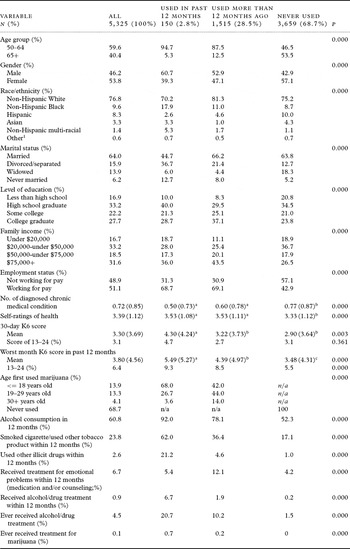
As Table 1 shows, 2.8% of the sample used marijuana in the last 12 months (1.8% in the last 30 days and 1.0% between 31 days and 12 months prior to the interview date), 28.5% of the sample used it more than 12 months prior to the interview date (non-recent users), and 68.7% never used it. Further analysis of non-recent users showed that about 57% reported that they last used marijuana before age 30, 16% reported their last use between age 30 and 39, 12% between age 40 and 49, 6% between age 50 and 59, and only 0.2% reported their last use in their 60s and 70s (data on the time period of last use was missing for 9.7% of non-recent users). Compared to non-recent users and never users, past-year users included a higher proportion of those who were 50–64 years old, male, black, and unmarried. Compared to the never users, the past-year and non-recent users also had somewhat better self-ratings of health (likely reflecting their younger age) but the past-year users reported substantially more psychological distress (i.e. higher 30-day and worst-month K6 scores) than the non-recent and never users.
Sample characteristics by marijuana use status

1Native American, Alaskan native, Native Hawaiian, or Pacific Islander.
(): Standard deviation of the mean.
p: Denotes significant group (past-year users, non-recent users, and/or never users) difference at the specified p level from Pearson χ2 tests or one-way ANONA tests.
a, b, c: Denotes groups (past-year users, non-recent users, and/or never users) that are significantly different from each other by post-hoc tests (Bonferroni) at the specified p level.
As Table 1 also shows, compared to non-recent users, a higher proportion of past-year users initiated marijuana use at an earlier age (≤18 years). Only two past-year users (1.2%) reported that they had initiated marijuana use when they were 60 years or older. Compared to non-recent users and never users, a higher portion of past-year users drank alcoholic beverages, smoked cigarettes or used other tobacco products, and used other illicit drugs in the past 12 months. Further analysis also showed that almost 80% of the past-year users reported that they consumed alcohol in the preceding 30 days, and 44% (compared to 22% of non-recent users and 9% of never users) reported that they had engaged in binge drinking (i.e. 5+ drinks at a time between 1–30 days) in the preceding 30 days. Compared to non-recent users and never users, a higher proportion of past-year users reported that they had ever received alcohol/drug treatment (including the past year), but they were less likely to report having received mental health treatment during the past year.
Patterns of marijuana use among past-year users
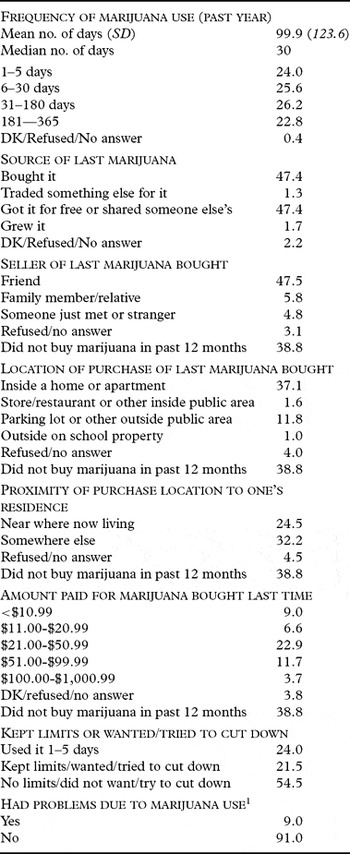
Table 2 shows the use patterns of the 150 past-year marijuana users in the sample. The mean and median number of days of marijuana use in the past year was 100 and 30 days, respectively. Almost a quarter (24%) used marijuana on between 1 and 5 days during the past year, and a similar number (23%) used on more than 180 days. Nearly half of the past-year users reported that they had bought the marijuana they used most recently, mostly from friends, and the same proportion reported that they obtained it for free or shared someone else's. Most who bought it made the purchase at a private home/apartment or at a parking lot or other outside location in their neighborhood. The most frequent purchase price was between $21 and $51 for their most recent purchase. Almost 55% of past-year users had not tried to cut down or did not want to cut down. Nine percent (n = 14) of the past-year users reported emotional and physical problems, low activity, engaging in dangerous activity, serious problems at home/work, and/or conflict with family/friends because of their marijuana use. Of these 14, eight reported they wanted or tried to cut down. No-one reported a problem with the law due to marijuana use.
Characteristics of marijuana use among past-year users (n = 150)

Note: 1Emotional and physical problems, low level of activity or dangerous activities, and problems at home/work, or conflict with family/friend. No-one reported a problem with the law.
Results of logistic regression analysis
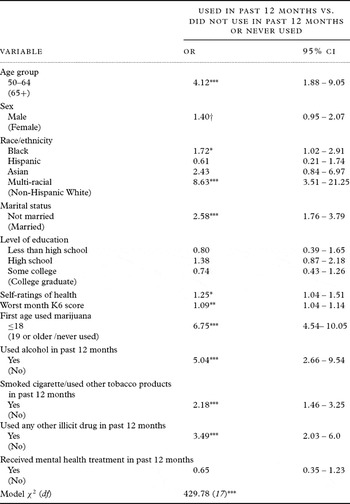
As Table 3 shows, significant correlates of past-year marijuana use were age, race/ethnicity, marital status, self-ratings of health, psychological distress (K6 score), initiation age, use of alcohol, cigarette smoking/use of other tobacco products, and use of other illicit drugs. As hypothesized, younger age and non-married status significantly increased the odds of past-year marijuana use. Male gender was also marginally significantly (p < 0.09) associated with past-year use. Being black or multi-racial, as opposed to non-Hispanic white, also significantly increased such odds. (Caution is required in interpreting the findings related to race/ethnicity, specifically Hispanic, Asian, and multi-racial groups, given the small number of past-year users in these groups.) As also hypothesized, better self-ratings of health (even after controlling for age group), higher psychological distress, younger age of initiation, alcohol use, cigarette smoking/use of other tobacco products, and other illicit drug use during the same time period increased the odds of past-year use. Education and mental health treatment status were not significantly associated with past-year marijuana use among older adults. Odds ratios suggest that younger initiation age and alcohol and other illicit drug use are especially significant correlates of past-year marijuana use.
Correlates of marijuana use among older adults: odds ratios from binary logistic regression results

Note: n = 5,260.
***p < 0.001; **p < 0. 01; *p < 0.05; †p < 0.09.
Discussion
Marijuana use among older adults in the U.S.A. has increased, which is not surprising given that the baby boomers are more likely to have used illicit drugs than prior generations. Data for our study are from 2008, the year in which the oldest baby boomers (those born in 1946) turned age 62. Marijuana use among older adults is concentrated among the “young-old,” with 2008 NSDUH data indicating that almost all past-year users were aged 50–64. This and other findings from our study are largely consistent with two prior studies (Colliver et al., Reference Colliver, Compton, Gfroerer and Condon2006; Blazer and Wu, Reference Blazer and Wu2009) on the demographic correlates of marijuana use among older U.S. adults. Our study also adds to the literature by including additional information on older adults’ marijuana use patterns.
We found that more than two-thirds of past-year marijuana users initiated use before or at age 18 and another 27% between ages 19–29. Their early initiation ages suggest that a significant proportion may have been long-term users rather than those who initiated use in mid- or late-life for medical reasons. Noteworthy is that nearly a quarter of these older past-year users used marijuana on 180 or more days of the year, suggesting that marijuana use was part of their routine lifestyle choices. An ethnographic study of a group of marijuana users aged in their 30s and 40s in London (Pearson, Reference Pearson2001) found marijuana use to be a casual recreational activity integrated into daily routines and a normal aspect of the lives of “mainly otherwise law-abiding and hard-working fellow citizens” (p. 192). We also found that older adult users in the U.S.A. can readily obtain marijuana for free or by buying it from a friend and at a location near their residence, also suggesting that marijuana use may be a social or recreational activity for some older adults.
Other study findings gave us more cause for concern. Given that alcohol and drug use usually remit with age, the high frequency use among a substantial portion of older adult marijuana users suggests their use may be an addictive behavior. Not only were past-year marijuana users more likely to use alcohol, cigarettes, and other illicit substances than non-recent users and never users, they were more likely to have received substance abuse treatment, also indicating that their marijuana use may be part of a long-term pattern of drug abuse or dependence.
On average, past-year users rated their health between “good” and “very good” (the same as non-recent users and somewhat better than those who have never used), perhaps because almost all past-year users were in the younger age group. Past-year marijuana users’ self-ratings of health warrant further investigation given that their use of other substances and high levels of self-reported psychological distress indicate that they are a group at increased (not decreased) risk for health and mental health problems. In fact, past-year users reported substantially greater psychological distress than non-recent users and never users though they were less likely than non-recent users and only as likely as never users to receive mental health treatment. These findings suggest marijuana may be used to cope with psychological distress or as self-medication in lieu of mental health treatment. Pearson (Reference Pearson2001) found that the adult marijuana users he studied perceived the drug as having largely beneficial and calming effects. Findings from our study seem to support this contention since few past-year users reported problems, including emotional problems, associated with their marijuana use, and few had any desire to reduce or stop using marijuana.
Our study also raises a question as to whether marijuana use may pose a barrier to seeking mental health treatment or using other healthier coping strategies to reduce psychological distress. Though marijuana may be used to reduce psychological distress, it may increase it by producing adverse reactions such as panic and anxiety attacks and exacerbating existing mood disorders or psychosis, especially among older adults (Williamson and Evans, Reference Williamson and Evans2000; Coggans et al., Reference Coggans, Dalgarno, Johnson and Shewan2004). The higher prevalence of alcohol and illicit drug use among past-year marijuana users may also cause or heighten emotional, physical, and other problems and add to users’ psychological distress. Further research should examine the possible causal relationship between marijuana use and psychological distress among older adults, older adults’ motivations to use and perceived and actual benefits of use, and barriers to reducing or stopping use when health and mental health problems are involved.
In addition to being unable to establish causal relationships because of the cross-sectional nature of the NSDUH dataset, other limitations of this study are that the NSDUH was not specifically designed to focus on older adults, and self-report data may have resulted in under-reporting of illicit substance use or treatment received for alcohol, drug, or mental health problems. Older adults who have abused substances may experience more shame than younger cohorts in reporting such use, as well as in reporting that they have received treatment for alcohol, drug or mental health problems. Accurate recall of substance use over long periods of time may also be a problem. Although we analyzed the relationship of marijuana use to alcohol, cigarette and all other illicit drug use combined, and although the NSDUH does assess abuse and dependence for a number of substances, only a small percentage of older adults reported illicit drug use. We were therefore unable to provide detailed analyses of the relationship between marijuana and other substance use, abuse and dependence. Future studies might attempt to focus on these relationships among large samples of older adults, including the use of prospective studies that incorporate corroboration through use of collaterals’ reports or toxicology testing.
This study adds to the scant literature on older-adult marijuana users. More definitive information about marijuana use among older adults is needed to strengthen clinical recommendations, but the current findings allow a number of suggestions to be made in improving interventions.
(1) Health and social service providers who encounter older adults in psychological distress may wish to screen them for marijuana and other substance use or abuse, and those who encounter older adult marijuana users may wish to screen them for psychological distress.
(2) Health and social service providers may need to educate older marijuana users about potentially negative physical and mental health problems and encourage them to seek treatment to reduce or stop their marijuana use and to learn and utilize other coping skills. Encouraging older marijuana users to utilize mental health or other services may help alleviate or prevent psychological distress and other negative effects caused by smoking marijuana in older age.
(3) Older adults who indicate they smoke marijuana as a social activity may need to be redirected to activities such as volunteering and other group activities that may provide more physical, social, and emotional benefits.
(4) Public awareness campaigns may help marijuana users identify potential associations of use with psychological distress and health problems and to alert family members and health, mental health, and social service providers of these possibilities as well.
(5) Health, mental health and social service providers may benefit from specific continuing education on marijuana use among older adults as this is unlikely to have been addressed in their degree programs.
(6) The capacity to screen, diagnose and provide treatment for marijuana misuse, abuse and dependence among older adults (as well as younger age groups) should be expanded.
Conflict of interest
None.
Description of authors' roles
D. DiNitto and N. Choi shared responsibility for designing the study, conducting the literature review, and writing the paper. N. Choi conducted the data analysis.